• Donate
  • Our Purpose
  • Contact Us
Executive Magazine
  • ISSUES
    • Current Issue
    • Past issues
  • BUSINESS
  • ECONOMICS & POLICY
  • OPINION
  • SPECIAL REPORTS
  • EXECUTIVE TALKS
  • MOVEMENTS
    • Change the image
    • Cannes lions
    • Transparency & accountability
    • ECONOMIC ROADMAP
    • Say No to Corruption
    • The Lebanon media development initiative
    • LPSN Policy Asks
    • Advocating the preservation of deposits
  • JOIN US
    • Join our movement
    • Attend our events
    • Receive updates
    • Connect with us
  • DONATE
Economics & Policy

Q&A – Vrej Sabounjian

by Zak Brophy August 3, 2011
written by Zak Brophy

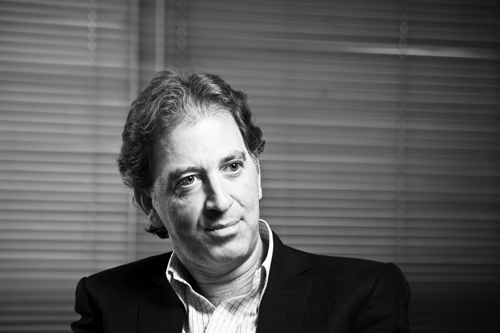
The new Minister of Industry, Vrej Sabounjian, has made his mark in Lebanese business as the president and owner of the food service and laundry manufacturing firm, Vresso. Having just gotten his seat warm at the ministry following his appointment, Executive met with him to discuss his vision for the sector. 

E:  Do you have any intention of pursuing a policy of tax exemption on income from exports? 

I am pro that decision 100 percent with some little modifications.  I think she [former Minister of Finance, Rayya Hassan] wanted to limit it for only five years. Industry doesn’t return its capital within five years, so I suggest somewhere between 50 and 100 percent tax credit on exports without a time limit.

E:  How much continuity can we expect from this government with regards to previous policies in the industrial sector? 

The minister who was here was doing a great job, taking into consideration the situation of the previous government. I am very optimistic that whatever plans we bring to the new government, with a very pro-business prime minister, we will find quick acceptance. 

E:  What does it mean when it is written in the ministerial statement that the government ‘will also create a committee to administer industrial centers and look for industrial zones’ and how will these zones be funded?

We are going to create a committee which is going to oversee a number of regional committees. The regional committees will make their own recommendations and then the main committee will adapt or make any modifications. If we have a good credible project in hand I’m sure there’s going to be a lot of help from the private sector. 

E:  Lebanese industry is very heavily concentrated around Mount Lebanon and Beirut. Do you have any policies to revive industry in the outlying areas?

That is the whole purpose. We can create a zone, for example, in the north and it will probably not be very active and we can do another zone in Mount Lebanon and it will probably be very active. It depends where the industrialists and the manufacturers are from and where they want to do their business.

E:  But will the ministry try and encourage industrial activity in areas where industry has declined over the past years? 

Well there must be a reason for a decline. All I can tell you is the ministry will be fair for all the areas. 

E:  Are there certain sectors that would benefit from giving small firms incentives to merge and consolidate?

Merging in my personal opinion is a matter of culture. Now that we are in a global economy and the Lebanese are known to adapt good ideas immediately I don’t see why they should not try to merge. I don’t think a company should merge with another company because of government incentives though.


E:  A lot of the policies you are going to want to enact will require the support of other ministries. Will you get it?

For the first time in a long time this government is pro-industry. I think the policies previous governments adopted were not pro-industry. In this government there is a shift to giving industry its fair space to grow and have good policies for all the industries in Lebanon.

E:  How much power do you have as a ministry to alleviate that burden of expensive and unreliable electricity and energy on industrialists?

You know unfortunately Lebanon is one of the countries in the Middle East that has no resources, until now, for energy. This is a big concern for all of us. I don’t think it’s just going to be a case of drawing a line and having a final solution but it is in the government’s intention to work on this issue and to try to come up with solutions.  How long it is going to take, I don’t know.

E:  In the interim period, could industrialists get subsidized fuel for their generators or a more preferential tariff on their energy from the government?     

I don’t know if Lebanon can subsidize or give more preferential tariffs. As you know we are buying our energy. But the Ministry of Industry is working on a program to try to make the cost of energy less. This is a priority for us.

E:  You have a comparatively small budget. Do you have the resources to enact the policies and reforms needed to develop the industrial sector?

We asked to have our budget increased 25 percent, and I am confident we are going to get it. For us to be successful we need to listen, be transparent and be honest about what we can realistically achieve. 

E:  What are your intentions with regards to World Trade Organization accession?

It is still in the cards.

E:  What niches of Lebanese industry will be most competitive in the international arena as barriers to trade come down?

If we are talking about appliances I don’t think Lebanon is going to have lots of factories making TVs or cameras for example. But there are a lot of things which we are doing tastefully and at good prices. Clothes, food, jewelry, fashion, wine…

E:  Is the agro-food sector too fragmented?

No.  I’m not always a believer in a big firm and the big size. Why don’t we look at the profitability? We should be concentrating more on the profitability and the possibility of adapting and changing quickly. If you have a huge-sized company you cannot change as easily. So if you have a smaller size but a profitable business you can change and see what the market requirement is and make the necessary changes.

E:  Is the ‘law for the protection of national production’ fit for the purpose and can you assure industrialists it will be applied to protect them from over-subsidized imports?

I don’t like protection in business. I like competition. Competition is good for the consumers, and it’s good also for the manufacturers. However, from the point of protection we should be aware of our size. If we have a contractual agreement with any other country we should take into consideration the size and capabilities of both parties.

E:  Lebanon has a big problem with regards to infringement of intellectual property rights, which is particularly damaging to the knowledge-based industries. How do you intend to address this problem?

It is our priority to try and enforce the laws that exist. We all have to live under the law…

E: …but now they are not being properly enforced. 

This is very important to us.  I can assure you.

E:  How adversely affected do you think Lebanon has been by the unrest and political uncertainty in Lebanon and the wider region?

In Lebanon I don’t see any situation that is not pro business. The laws are pro business and I think there are good opportunities here. I also encourage Lebanese businesses to see this as an opportunity to search for new markets if their markets in the Middle East have been affected.  It presents new challenges and new opportunities. 


August 3, 2011 0 comments
0 FacebookTwitterPinterestEmail
Economics & Policy

A homegrown shortfall

by Sami Halabi August 3, 2011
written by Sami Halabi


The need for security is a constant refrain among Lebanese politicians and journalists, who tend to intone that it has something to do with ministers meeting their maker on a Sunday drive to the mountains, or with the ongoing drama with the country’s southern neighbor. But there is another danger that goes beyond bombs and blasts which policy makers have both ignored and neglected: food security.

Without going into elements of nutritional content and purchasing power dynamics in depth, food security is commonly accepted to require both availability and access to food. Food sovereignty, on the other hand, focuses on the “right” of people in their respective countries to define the systems that feed them rather than having them subject to international market pressures.

The surging price of wheat, and the government’s costly measures to dull the effects provide the most recent reminder of Lebanon’s vulnerability. Last year, Russia imposed an export ban on wheat, the Ukraine limited exports and erratic weather saw other major world producers’ harvests fall; hoarding ensued, and the global price of wheat skyrocketed. Such shocks had an immediate effect on a country as import-dependent as Lebanon and policy action had to be taken. Wheat — which has always been subsidized to support farm production, and at the mill level when necessary to maintain the price of bread — was purchased and stored, and mills began to receive wheat from the local grain board at subsidized rates for the baking of bread. And again, during the first quarter of this year, the government spent $18.5 million to purchase 48,532 metric tons (MT) of imported wheat, which was resold to mills at a subsidized price in order to maintain the price of Arabic bread at $1 per kilogram.

The drastic measures following global fluctuations in wheat prices is indicative of Lebanon’s larger problem: The country’s precariously lopsided agricultural import to export ratio. For example, Lebanon produces around 100,000 MT of wheat a year and imports 700,000 MT, according to Abdolreza Abbassian, senior economist at the United Nations Food and Agriculture Organization (FAO).

“We are already food insecure because we don’t have any more farmers,” says Ali Darwiche, secretary general of Green Line, a Lebanese association that promotes sustainable development. Over the years, he says, Lebanese farmers have been forced to abandon their plots due mainly to the fact that their products have to compete with imports that are cheaper to produce elsewhere and enter Lebanon without import tariffs.

In any given year, more than 80 percent of Lebanon’s food supply is made up of imports, according to the agriculture ministry. This puts the country at the mercy of international commodity prices and frames the issue of food security as one predicated on a lack of food sovereignty.  

The global financial firm Nomura classified Lebanon as the fifth most vulnerable country in the world to a crisis due to rising food prices, on the basis of gross domestic product (GDP) per capita, food as a percentage of household consumption and net food exports as a percentage of GDP.

According to the latest official government figures, the rise in the consumer price index of food and non-alcoholic beverages was 7.6percent year-on-year in June 2011, reflecting a continuous upward climb since the statistics were first recorded in December 2007.

Making matters worse in Lebanon is the fact that when prices go up there is no guarantee that they will come down again, even when global prices drop, due to the asymmetric price transmission within Lebanese markets —meaning, prices stay high because the few who control the market are happier with high margins and have little incentive for competitive pricing.

According to a UN study on economic competition commissioned by the Ministry of Economy and Trade in 2003, which the ministry now says it “does not endorse or validate,” half the products sold in the Lebanese market come from sectors where there is an oligopoly in place, where over 40 percent of the market is owned by four companies or less. According to the document, 72percent of farms in the country are controlled by 6 percent of farmers. The same goes for other products related to food production, like mineral water, pesticides, fuel and so on.

“In something like the tomato market, it is not an oligopoly; the farmers are diverse, but the wholesalers are concentrated and fermented. You’re kind of creating sub economies,” says Jad Chaaban, acting president of the Lebanese Economics Association and a specialist in the economics of food. “It’s a cartel that is spread up across interest groups and professions. We need a more integrated, better-regulated market, and a tackling of oligopolies, because it will increase local sales and decrease imports.”

An unbalanced hunger

Further contributing to Lebanon’s food insecurity are its drastic disparities in wealth. The UN estimates that 28 percent of the Lebanese population lives under the upper poverty line of $4 per person per day, and there is a “wild gap between rich and poor,” says the FAO’s Abbassian.

“From the data we’ve been collecting it seems that… there are pockets of poverty and food insecurity in certain areas in the country,” says Hala Ghattas, assistant professor of community nutrition at the American University of Beirut.

The level of inequality is so wide that the poorest 20percent of the population accounts for 7 percent of all consumption, while the top 20 percent accounts for over 43 percent. “No matter what food prices are, some people will always be able to access food and some will keep falling below a certain threshold; these are the more food insecure,” says Ghattas.

Already consumption patterns have been affected. “We’ve already seen that people were unable to buy meat,” says Chaaban, who explained that the price increase on meats is a reflection of other increases in the components of animal feed. Globally, meat has shot up by 19.9 percent in the first five months of this year, according to the latest FAO figures.

“When the prices are so high, some people reduce substantially their consumption so that it creates health problems,” says Chaaban, who claims that research is beginning to show that the poorest people in Lebanon are starting to show signs of micronutrient deficiencies.

Overall, however, Lebanon does better on nutritional food security indicators than it does on economic ones. The International Food Policy Research Institute, an international food research organization, puts undernourishment at just 2 percent (between 2003 and 2005), well below the global average of 21.3 percent. And another major indicator used to measure food security, the Global Hunger Index (the average of the percentage of general undernourishment, children under five who are underweight, and mortality rates under five years old) fell from 5 percent just after the civil war to 3.5 percent in 2005 and now remains under 5 percent.

Regardless, Lebanon’s lack of agricultural production and large wealth inequities make food security a critical issue in need of governmental attention. However, many of the reforms needed will take time, a continuity of policy and a good deal of money. Essentially, to increase food security, local production will have to increase.

Potential for production

In theory at least, Lebanon has a good deal of potential compared to others in the region.

For starters, if Lebanon actually wanted to employ much of the arable land it has available it could do so rather easily. According to the“ optimistic view” of the UN, the amount of potential arable land in the country is 269,000 hectares, on top of the 306,000 already being used, or 88 percent more potential agricultural land, as compared to a country like Egypt with just3 percent of usable farmland yet to be cultivated. 

However, even if there was the will to employ this land for agriculture, arable land does not necessarily translate into useful and productive crops. “The main factor for food security is the land use planning and you need to make sure that not every piece of land is a piece of real estate,” says Green Line’s Darwiche. “For us the value of a piece of land is in its real estate, not in what it can produce. Prices should go up; it is not fair when real estate goes up by this much, while fruit prices stay low.”

Up until today there is no master plan for land use in the country, with much of the profitable area along the coast already built up, both legally and illegally. Of course any master plan would need political consensus, which would not be an easy thing to navigate in the morass of Lebanese land politics, where each sect has its enclave, and the notion of a national project as one state has been fleeting.

And beyond the issue of land allocation, farmers need incentives to produce in Lebanon. “The government should protect the farmer; the ministries should make sure they get irrigation, electricity and labor,[but] the main problem is the open market economy that doesn’t protect food security. In Lebanon, we don’t have the qualifications to be food secure,”Darwiche says. Accession to the World Trade Organization (WTO), which has been pushed for since 1999 by the Ministry of Economy and Trade, certainly would not help producers who are already facing prohibitive competition from importers cashing in on Lebanon’s lax customs duties. “Where the level of domestic protection is high, as in the Syrian Arab Republic, trade liberalization is likely to reduce domestic agricultural prices, unlike in countries where domestic protection is lower, such as in Egypt, Jordan or Lebanon,” reads a recent UN report on food security in the Middle East.

Along with incentivizing and allocating new agricultural land, there should be a push to make existing food production more effective. At present, Lebanon’s cereal yield stands at 2,619 kilograms per hectare(kg/ha), which is just above the regional, but below the global, average. Countries with more sophisticated irrigation systems like Egypt register 7,589kg/ha.

“To improve yields you need to have bigger lots to justify mechanization and irrigation and use of pesticides within reasonable limits,” says President of Dora Flour Mills and Chair of the Agrifood Traders Syndicate, Arslan Sinno. “You have limited land resources so how can you seek to be self-sufficient when there are alternatives [such as imports]?” According to Sinno, an increase in productivity would take at least 20 years, during which Lebanon should expect price volatility. “Our lots are small and the production is small… and there are no silos or central collection centers. There is no room to separate the types of wheat and clean them, and if you don’t clean them you cannot export them,” he says.

At the current rate, Lebanon is heading into a period of increased food insecurity. Indeed, according to global food charity Oxfam, food prices are set to double by 2030. Right now only the Ministry of Agriculture has put forward a strategy, based on eight axes that include updating laws, reforming the ministry, improving infrastructure and developing microcredit, though as yet nothing concrete in terms of time or costs has been decided. But Lebanon cannot bide its time on such an important and increasingly relevant issue. The land is there; the policy must follow. “We need a real government,” says Darwiche. “Then when we have net balance in food imports and exports equal to zero, we can consider that we have food security.”


August 3, 2011 0 comments
0 FacebookTwitterPinterestEmail
Economics & Policy

The Survival Industry

by James Reddick August 3, 2011
written by James Reddick

It is five years to the month since the 2006 war with Israel ended. The aftermath saw more than 1,100 Lebanese dead, infrastructure in disrepair and entire villages and urban neighborhoods flattened. Since, economists and the media have marveled at the miraculous resurgence of the economy, driven primarily by the reconstruction boom and an influx of foreign cash. But while the economy recovered (for a time at least), the owners of industrial enterprises bombed during the war were for the most part left with their livelihoods in doubt, massive debt and little to no assistance from the central government to get their businesses back on track. In this Special Report, Executive examines the story of Lebanese industrialists and their struggle since 2006 to build back the businesses that support both them and their communities. 

A devastating toll

The scope of the destruction was devastating; in all, 192manufacturing facilities were damaged, with 114 experiencing what the Association of Lebanese Industrialists (ALI) classified as “total damage”. Owners estimated in November 2006 the value of damage to industrial production at $245 million, a number excluding any loss of stock, contract losses and work stoppages. The size of the firms hit ran the gamut, from the Bekaa’s dairy heavyweight Liban Lait, to the more modest Tricot Starlet clothing factory in Beirut’s southern suburbs. Along with these two firms, whose factories were completely leveled, Executive spoke with affected industrialists from around the country, and while a good portion received aid of some kind, all expressed disillusionment with the often misleading response of the government, whose initial pledges never materialized. Many were back in business and upbeat about their commercial prospects, but others, five years later, were emotional about their hardships and the uphill struggle still before them.

The immediate aftermath

Immediately following the end of the 2006 war, the Ministry of Industry and ALI began to collect information on the scope of the damage to factory owners. At the time, hopes were high that direct assistance would flow into the sector.

In late August, the Stockholm Conference brought together donors from around the world, resulting in approximately $900 million in pledges to assist the country, and then at the beginning of 2007, the Paris III conference followed with more than $7 billion in additional contributions. Much of this went towards rebuilding basic infrastructure and damaged hospitals, schools and residential areas. Within this package, two soft loans, one from the Arab Fund for Economic and Social Development (AFESD) and the other from the European Investment Bank (EIB), were pledged to directly assist enterprises damaged in the war, totaling $86 million and $140 million, respectively, but these required ratification by parliament.

According to an unnamed representative of the Council for Development and Reconstruction (CDR) responding to questions by fax: “After three years of signature and due to political constraints, the parliament did not ratify those loans. By the end of 2010, the EIB decided to cancel this facility, the AFESD loan [is] still at the parliament awaiting ratification. Therefore the damaged industrial plants did not get the chance to benefit from these credits.”

In a phone interview, another CDR representative who also requested anonymity said, “at the time when SMEs [small-to-medium enterprises] were in need of this assistance, parliament wasn’t functioning and no decisions were being made.”

One chunk of funding did make it out of the Stockholm Conference and was applied as originally intended — a $4.5 million grant for the United Nations Industrial Development Organization (UNIDO), in partnership with the Ministry of Industry. According to UNIDO National Project Coordinator Nada Barakat, 85 damaged industries have received assistance. But the modest budget is reflective of the endemic lack of support for industry in Lebanon. Out of a total of $45 million from European donors funneled into the United Nations Development Program-managed Lebanon Recovery Fund, just 10 percent was allocated for industrial recovery. Because of this, only small to medium-sized factories with modest needs were targeted, as each allocation had a total limit of approximately $50,000. Nonetheless, UNIDO’s contributions have been critical for the recovery of many business owners.

One such owner, Jihad Sadaka, whose pastry and sweets factory was damaged in the war when the buildings on each side of his shop in Beirut’s southern suburbs were leveled, received a UNIDO equipment donation of a generator and water sanitation system. Sadaka also took part in the organization’s “capacity building” exercises, thereby improving his workplace standards and food safety. With the framed ISO (International Organization for Standardization) certification prominently displayed on his new desk, Sadaka said, “if someone wants to come into the factory now, I’m really proud to show them. Believe me, this was the best thing of my life.”

But most of the stories from recovering industrialists have not been so bright. For companies with losses too substantial for UNIDO assistance, their only potential recourse has been through loan assistance from Banque du Liban (BDL), Lebanon’s central bank. In the midst of political paralysis, the BDL issued two circulars, in May and September of 2007,establishing mechanisms to channel loan assistance through local private banks. According to Mazen Halawi, head of division in BDL’s financing unit, to qualify “clients were required to be unable to continue work without a loan and unable to service their debts from before July 31, 2006.” Both the client’s bank and the BDL would audit the level of damage. Once a value was agreed on the BDL would effectively cover 60 percent (funneled through private banks) via a loan that was forgiven once conditions were met; company owners would have to provide at least 20 percent through their private equity and the BDL also stipulated conditions for a soft loan arrangement to meet the remaining 20percent.

However, in extensive interviews with industrialists, the loan scheme was repeatedly described as unfavorable. Ali Ismael, co-owner of Tricot Starlet, and Sadaka each said it would have required them to mortgage their homes. Furthermore, according to Recovery Lebanon’s August 2008 “Progress and Challenges” report: “The impact of this compensation mechanism has been insignificant. Banks have not shown any interest in supporting enterprises… mainly because of the pay-back period of the granted money.” The central bank could not provide details as to the number of recipients, but Abbas Safieddine of plastics company PlastiMed (who did acquire a loan) speculated that it was “only four or five large companies”.

Political payments

Then there was reconstruction funding from Hezbollah, for which the party is well known. While their donations appear to have been fairly widespread throughout their geographic heartlands, the sums hardly softened the blows to industrialists. Sadaka received a $15,000 sum and Tricot Starlet’s Ismael $100,000 — nothing to scoff at but not nearly enough to rebuild a business.

“My understanding is that they directly assisted in rebuilding or at least compensating for small merchants and supermarkets who were ‘their people’. The losses for the [biggest] companies were too big for them to compensate,” Safieddine said. “At the end it’s politics. Most of the big industries that got hit were in no way affiliated or even close politically to Hezbollah. So there was no push from this side, no push from that side; we are in limbo.”

Despite operating in an economic climate that, in the best of times, is riddled with infrastructural deficiencies and a lack of protection from imports, and in the worst of times threatens to leave family businesses in piles of rubble with little hope of help from the government, industrialists have proved resilient in their efforts to rebuild. When asked if they were concerned about the possibility of a future war, the standard response was to leave it in God’s hands. But some of the responsibility lies with the government, not with The Maker. Despite the best efforts of organizations like UNIDO, what little funding was procured for the industrial sector was squandered by political squabbling in the post-2006 years.

Oussama Halbawi, president of the Association of Industrialists for the Southern Suburbs and the owner of a mattress, fabric and textiles factory that was completely destroyed, expressed his indignation. “In case of war, it’s the government’s responsibility to help out the victims. I was paying taxes so I expect something in return.”

For a micro-economic assessment of the impact of the 2006 war on Lebanese manufacturing, Executive presents the case studies of four factories that were completely destroyed, and documents the unique challenges faced by each as they rebuilt their business from out of the rubble.

August 3, 2011 0 comments
0 FacebookTwitterPinterestEmail
Comment

Jordan’s assault on journalism

by Christoph Wilcke August 3, 2011
written by Christoph Wilcke

Character assassination is a hot topic in Jordan these days as thousands of demonstrators, riding the winds of the ‘Arab Spring’, call for reform and accuse government officials and business leaders of abuse of power and corruption. Asking judges to put critical journalists behind bars is also popular among a ruling class that feels threatened by the sudden surge in revelations pouring out on the street and from the media.

The government of Prime Minister Marouf al-Bikhit is doing its bit to stifle free speech in the name of fighting corruption. A draft amendment to a law setting up an anti-corruption agency would punish people who spread “unjustified” rumors about corruption that “lead to insulting the reputation or infringing upon the dignity” of another person, with at least six months in prison. Taher Odwan, the government spokesperson, resigned over the proposed amendment on June 21.

Rather than add new provisions criminalizing defamation, Jordan should cancel those already in its penal code that send peaceful critics to jail for “insulting” the king or government institutions. In May, Secretary General of the Political Development Ministry Malek Twal promised that a new media strategy would reform those provisions. The government adopted the strategy in June, but it strangely remains unpublished. Instead, Bikhit said he would refer alleged character assassins to the courts.

Bikhit made good on his promise in late May by yanking a criminal defamation case against a journalist, Alaa al-Fazza, from a civilian court and referring it to the military-dominated State Security Court (SSC). The SSC prosecutor promptly detained Fazza for “working to change the constitution by unlawful means,” an offense punishable by death, based on an article he published about a Facebook group that supports the reinstatement of former Crown Prince Hamza, King Abdullah’s half-brother, whom Abdullah replaced with his own son Hussein. Allegedly among its members were 10 members of parliament and two former ministers, including Nabil al-Sharif, the former information minister who had brought the complaint against Fazza. Unlike Fazza, Sharif was not detained or investigated for suspected unconstitutional activities. Fazza is out on bail, but the case continues.

Fazza also incurred the wrath of police chief Huseinal-Majali over an article that blamed him and the interior minister for allowing Khalid Shahin, a business tycoon convicted on corruption charges, to leave prison and the country for medical treatment abroad, never to return. The scandal cost the health and justice ministers their positions, and Majali filed a criminal complaint against Fazza for “spreading false rumors”. Fazza was spared in a general amnesty, but Majali in July filed a civil suit seeking10,000 dinars [$14,100] in damages for harming the police department’s reputation.

Yahya Sa’ud, a member of parliament with roots in the town of Tafileh, was so upset over a June 13 Agence France-Presse (AFP) report that Tafileh residents attacked the king’s convoy on a visit there that he led protests seeking to have AFP Amman bureau chief, Randa Habib, referred to the SSC; two days later, a mob ransacked the AFP offices, and witnesses put Sa’ud at the scene. A police car stationed nearby to protect Al Jazeera’s offices did not intervene.

Al Jazeera correspondents have also been the victims of physical and verbal attacks. Two correspondents’ cars were smashed in March, and a policeman assaulted the bureau chief, Yasir Abu Hilala, while he was covering a demonstration in Amman on July 15. An internal police report on the incident, in which police beat 10 journalists and some protesters, stated that policemen “did not differentiate between protester and journalist” in their beatings “because of the angry commotion that took hold” of them following previous protests on March 25 in Amman and April 15 in Zarqa’, in which numerous policemen were injured.

The police report recommended referring the heavyhanded policemen to court, but Jordan has a dismal record in holding officials to account for violence. When police stood by while a pro-government gang attacked demonstrators in February, there was no investigation, a police spokesperson told Human Rights Watch. And police who failed to stop similar attacks on March 25 and then attacked protesters themselves also faced no charges. Sa’ud faces no charges and is free to launch new attacks on AFP.

Jordan is attacking free speech, both by pursuing journalists under draconian laws and by failing to hold police accountable when they stand by doing nothing — or even join in — when journalists are attacked.

CHRISTOPH WILCKE is a senior Middle East researcher for Human Rights Watch


August 3, 2011 0 comments
0 FacebookTwitterPinterestEmail
Economics & Policy

Beirut’s luxury kitchens

by Executive Staff July 26, 2011
written by Executive Staff

For an inside view of Lebanon’s top restaurants, check out the the luxury special report in the July edition of Executive Magazine, in stores now.

July 26, 2011 0 comments
0 FacebookTwitterPinterestEmail
Special Report

The coveted steps to perfection

by Executive Editors July 17, 2011
written by Executive Editors

Underground, down a dark driveway and below a nondescript building in the back streets of the Beirut neighborhood, Tabaris, is a small, unmarked door. Behind this secret portal a bounty of diamonds, sapphires, rubies, gold, platinum, pearls and other precious gems lies in wait. Here, a treasure trove of wishes is carefully and painstakingly molded, filed and polished by the finest expert craftsmen into symbols of luxury and cherished personal items that will eventually adorn fingers, ears, necklines and wrists.

Before it ends up on the velvet pillows of the Mouzannar showroom to be gawked at and drooled over, the giant aquamarine and diamond-encrusted platinum ring passes through many hands. Under the watchful eyes of more than 20 security cameras [1], the jewellers use age-old techniques, with the help of some modern technology, to perform their transformation of raw materials into glorious ostentation.

When the order for the ring comes in to the jeweller, the first step is selecting the stone. Then, using architectural software [2], the cast setting is digitally drawn in three dimensions. At this stage, the ring is moulded in wax [3], before the pure platinum is melted and poured into the setting. Emerging rough and unfinished [4,5], the ring is cleaned and weighed for value before being polished and filed; each tiny precious filing is collected on stainless steel trays for a later date. The giant piece of aquamarine, meanwhile, is weighed and examined in detail for quality, clarity and shape. The same treatment is given to the diamonds that will form the stone’s bed. Dozens of white diamonds pour from plastic zip-lock freezer bags [6] stored in rows in filing cabinets according to size and gem.

[2]
[3]
[4]
[5]
[6]

Once the gems are selected and prepared, they are ready to be set in the cast. The diamonds are laid out in tiny magnificent rows along the diameter, the aquamarine carefully fitted in its platinum jaw. Now, close to ready, the polishing [7,8] begins again — a process the jeweller explains will file away at least 10 percent of the original weight of the metal. At cleaning stage, the ring is plunged into a bucket of warm soapy water [9] using ordinary dishwashing liquid, then blasted with steam to remove any invisible scratches.

[7]
[8]
[9]

Finally the ring is submerged in salted water and exposed to an electric current to remove any lasting grease before getting a last bath and puff of steam. Still exhibiting golden tones, the ring is lastly dipped in rhodium [10], from which the metal emerges gleaming white. Dried with a hairdryer [11], the ring is ready to leave its humble home [12]. After a process that has taken three days, the ring is taken to the showroom for pricing and exhibition [13].

[10]
[11]
[12]
[13]
July 17, 2011 0 comments
0 FacebookTwitterPinterestEmail
Real estate

For your information

by Executive Editors July 17, 2011
written by Executive Editors

Dubai’s cedar shoreline

By the fourth quarter of this year, the island of “Lebanon” will be home to the first commercially operating project within The World, the 300-island man-made archipelago off the coast of Dubai developed by Nakheel. The island is fully owned by Indian entrepreneur Wakil Admed Azmi, who has spent approximately $16.3 million [AED 60 million] on the construction of a beach club and facilities, in addition to the initial cost of the island. Reza Sinnen, operations manager at the World Island Beach Club (which is being developed on the island), told the United Arab Emirates (UAE) daily Arabian Business in a June 15 article that another $2.17 million [AED 8 million] would have to be invested to complete the commercial resort, which includes a restaurant, lounge, entertainment venue and cabanas, with facilities that allow yachts of up to 80 feet to be docked. The resort aims to sell club memberships that cost up to AED 40,000 [$10,889] per year. Sinnen said problems with the delivery of water, electricity and on-island services mounted as Nakheel’s credit burdens grew, but that the owner cut construction costs by nearly 70 percent and managed the project himself in order to complete it on time. “We are about four months away. We are tying up with partners, yacht operators, travel agents, the Road and Transport Authority, Sealink…there is a lot to do,” Sinnen said. While 70 percent of the 300 islands are sold, according to Nakheel, none of the other owners have begun construction, except Kleindienst Group, which is developing resorts on the six islands it owns, which together are known as the Heart of Europe Project.

A greener prospect

A new environmental initiative that rates the green credentials of buildings in Lebanon was launched in June. The scheme was announced on the closing day of the 16th Project Lebanon, the international trade exhibition for construction and environmental technology that saw around 500 contractors and construction companies from 26 countries set up shop at Beirut International Exhibition and Leisure Center (BIEL) for the week. The ARZ Building Rating System is the first of its kind in the Middle East to classify the environmental performance of existing commercial buildings. The system takes into account Lebanon’s water and electricity shortages, and includes renovation conditions to reduce greenhouse gases. Building owners can invest between $100,000 and $4.9 million, based on building size and condition, to save between $35,000 and $890,000 in costs per year, according to Lebanese Council for Green Buildings President Samir Traboulsi.

From Damascus to Mayfair

A June 20 article in British daily The Telegraph reported that former Syrian Vice President Rifaat al-Assad bought a 10.3 million pound [$16 million] Mayfair townhouse in 2007 by signing a 110-year lease from the Grosvenor Estate, with funds paid by an offshore company based in the British Virgin Islands. Given the current unrest in Syria and the possibility of several Syrian officials facing international investigation, the properties could be confiscated in the event of a criminal investigation against Rifaat al-Assad for “crimes against humanity,” as he is blamed for ordering the massacre in the Syrian town of Hama in 1982 that killed tens of thousands. The article added that the 73-year-old uncle of current Syrian President Bashar al-Assad did not live in the residence until more than a year ago, but has been residing mostly in France and Spain. In 2008, Hafez al-Assad also bought a lease on the adjacent property, but Land Registry documents did not reveal the amount of the contract. In related news, Rami Makhlouf, the maternal cousin of the president, appeared in a rare televised appearance on state television on June 17 and pledged to relinquish all his real estate in Syria to the state and give up any business ventures that bring him personal gain, such as his stake in Syria’s monopolistic telecommunications company Syriatel.

Tourism takes the cake

Of the 35 business developments launched with the help of the Investment Development Authority of Lebanon (IDAL) between 2003 and 2010, tourism projects accounted for 79 percent ($860 million) of the $1.1 billion total mobilized investment. IDAL indicated that the bulk of tourism projects were the construction of luxury hotels and resorts, generating nearly 3,300 jobs over the same time period. The industrial sector was the second largest recipient of IDAL-supported investment between 2003 and 2010, receiving $131 million. IDAL mobilized investments accounted for some 4,760 new jobs over the seven-year period.

Solidere trumps 2010

Due to a surge in operating profits, Lebanese real estate firm Solidere was able to increase net profits by 7.8 percent in 2010 to reach $196.5 million, according to a June 15 statement by the firm. Sales of land plots and increasing revenues from rental units expanded Solidere’s operating profits to $272.2 million last year, a yearly increase of 16.5 percent. Based on its market capitalization of $3.1 billion at the end of 2010, the company was ranked 61st in Al Iktissad Wal Aamal magazine’s annual survey of the Top 100 publicly-traded Arab firms in the region, down from 45th place in the previous survey. As the largest property developer in Lebanon, its total assets are estimated to be worth around $10 billion today, while unsold property is valued at $7.5 billion.

Noor International’s dodgy dealings exposed

Beirut-based developer Noor International, founded by Mohammed Saleh, has not completed more than 5 percent of its residential projects sold off-plan, according to a June 1 article in Lebanese daily Al Akhbar.  It further claims that Saleh fled to Saudi Arabia in May after scamming investors of around $10 million. Noor International first gained notoriety (or infamy, depending on one’s perspective) in 2006 when Saleh sought to raise $1 billion from investors to build “Cedar Island”, a dredging and construction development that would have seen the creation of a 3.3-square-kilometer island off the Lebanese coast in the shape of a cedar tree. To the relief of many, this project was among the 95 percent of Noor’s development ideas never to see the light of day.

Gloom and dividends

Property transactions contracted 21.3 percent year-on-year by the end of April, while the value of the sales dipped 16 percent over the year, according to BLOM Bank. Further indicating a slow-down in construction activity this year, the major supply indicator, cement deliveries, fell 3.5 percent as of the end of April in comparison to the same time last year, according to the Order of Engineers of Beirut and Tripoli, and Byblos Bank. Holcim Liban, one of the major cement producers in Lebanon, will pay $30.25 million in dividends to shareholders starting June 27, at a dividend ratio (dividend payout as a ratio of 2010 net income) of 80.8 percent. Société Libanaise des Ciments Blancs, another major local producer, will also distribute dividends based on last year’s profits on the same day.

July 17, 2011 0 comments
0 FacebookTwitterPinterestEmail
Banking & Finance

Regional equity markets

by Executive Editors July 17, 2011
written by Executive Editors

Beirut SE  

Current year high: 1,073.93    Current year low: 890.83

>  Review period:  Closed June 23 at 892.64 points       Period Change: -0.25%

Slumping Beirut stocks were not buoyed by the long-awaited emergence of a new, Mikati-led government. Instead, the market seesawed ahead of an anticipated political showdown during the upcoming parliamentary session and on uncertainty about unrest in Syria, leaving stocks down 8.2% in 2011 through June 23. Shares of Solidere hardly budged despite positive news of an 8% increase in 2010 net profits. Political bickering has driven the stock down 4.5% so far in 2011, though it is outperforming Bank Audi and BLOM Bank, which shed 15.6% and 10% respectively.

Amman SE  

Current year high: 2,477.99                Current year low: 2,113.46

> Review period: Closed June 23 at 2,122.97 points     Period Change: -1.7%

For Amman stock prices in June there seemed no end in sight for the slide that started at the onset of 2011. The market index has already given away 10.6% in 2011 through June 23 and stocks are yet to recover from the ‘Arab Spring’- driven declines earlier in the year. Continued political uncertainty, as well as unrest in neighboring Syria pose additional risks for all stocks.  However, the banking sector has generally shown considerable resilience with only a 4.7% decline year-to-date, including 1.4% in June.

Abu Dhabi Exchange  

Current year high: 2,833.09                Current year low: 2,471.70

>  Review period: Closed June 23 at 2,716.72 points     Period Change: +2.94%

Stocks on the ADX roared in June to a new 2011 high of 2,775 points on investors’ high expectations ahead of a decision by global index provider MSCI to advance the UAE from “Frontier Markets” to “Emerging Markets” status. However, stocks weakened at the end of the review period when MSCI postponed the decision for six months. The ADX benchmark retained a flat record for the year through June 23 and posted solid gains for the month, as Etisalat leapt 7.8%. Year-to-date gains of 6.8% for banking stocks have been the market’s saving grace.

Dubai FM  

Current year high: 1,781.92                Current year low: 1,352.24

>  Review period: Closed June 23 at 1537.48 points     Period Change: -1.44%

Although the DFM index stumbled on MSCI’s decision to delay a possible upgrade to UAE’s bourses, stocks had little to lose. By June 23 the market was already down 5.7% in 2011 on expectations of further losses at real estate and construction companies and despite a year-to-date gain of 5.7% in banking stocks, with a nice top up of 2.4% in June. Market cap leader Emirates NBD booked a handsome gain of 48.6% during the first half of the year, while real estate behemoth Emaar Properties was down 13.2%, including 2.2% in June.

Kuwait SE  

Current year high: 7,129.30                Current year low: 6,134.60

>  Review period: Closed June 23 at 6,263.9 points     Period Change: -1.8%

Missing positive cues and dropping to thin volumes, Kuwaiti stocks slid further down the May slope at the onset of the summer low trading season. Kuwaitis go on vacation this year with almost 10% of their equity investments scrapped during the first six months. More ominously, the banking sector continued its steady decline, reinforced by Moody’s downgrade of National Bank of Kuwait’s credit ratings on Egypt exposure and real estate risks; the sector is 8% in the red for the year through June 23.

Saudi Arabia SE  

Current year high: 6,788.42                Current year low: 5,323.27

>  Review period: Closed June 22 at 6,449.49 points     Period Change: -4.26%

Tadawul’s stock activity was vibrant in June, backed by plentiful government loans and corporate Sukuks, including a massive 25-year $13.6 billion soft loan approved by the government for Saudi Electricity Company. However, real estate and banking stocks appeared to be off for an early stint of Red Sea vacationing, diving 8% and 4.9% respectively during our June review period. As a result, Tadawul’s year-to-date performance sank to -2.6% by June, ending Saudi’s earlier MENA exchange leadership.

Muscat SM  

Current year high: 7,027.32                Current year low: 5,952.60

>  Review period: Closed June 23 at 6,003.82 points     Period Change: -0.07%

June’s mood swings are not unusual on the GCC’s smallest exchange. Following an optimistic Bank of America Merrill Lynch report, foreign investors flooded blue chip stocks hit by significant May declines. However, it appeared domestic investors were either not swayed or had defected to summer activities as the market gave back earlier gains and volumes thinned out. Investors may be saving up for the three IPOs scheduled for the fourth quarter, or are not hurrying into a market down 11.1% for the year and with few positive catalysts on the horizon.

Bahrain Bourse  

Current year high: 1,475.10                Current year low: 1,330.03

>  Review period: Closed June 23 at 1,338.61 points     Period Change: -0.6%

As Bahraini courts were inking new life sentences for opposition members in June, the market index was inking a seven-year low, followed by a short-lived uptick. Despite continuing protests and the uncertain outlook for the upcoming national dialogue, the market has held up relatively well given the circumstances, falling 6.5% in 2011 through June 23. The key banking sector only gave up 3.7% during the first six months, with the market’s largest traded stock Ahli United Bank actually adding 1.4% year-to-date, compared to a 12.5% dive at Batelco.

Qatar SE  

Current year high: 9,242.63                Current year low: 6,766.80

>  Review period: Closed June 23 at 8,214.35 points     Period Change: -1.92%

It is telling when Qatar’s central bank’s announcement that real GDP may grow 19% in 2011 does not move markets while MSCI’s decision to delay the decision on Qatar’s upgrade sparks a downturn. But this internationally focused exchange can still cheer foreign activities by Qatari companies, including Diar’s recently-approved multi-billion dollar Chelsea Barracks project in London. The market index on June 23 closed down 5.4% year-to-date, ironically one of the better showings among MENA exchanges.

Tunis SE  

Current year high: 5,681.39                Current year low: 4,058.53

>  Review period: Closed June 23 at 4,254.12 points     Period Change: +3.23%

With Ben Ali sentenced in absentia for 35 years, the pre-crisis appeal of Tunisian stocks has returned. Business delegations from across the globe flocked into the country as political parties agreed to postpone elections until October. The market still has a long way to go before it recovers the 16.7% losses in 2011 through June 23, but the upward trend appears to be accelerating; the Tunindex registered the highest June return in the MENA region reviewed here. Meanwhile, Banque de Tunisie remained anchored, declining a relatively modest 5.3% during the first six months.

Casablanca SE  

Current year high: 13,397.47              Current year low: 11,499.64

Casablanca stocks witnessed a precipitous decline in June after the youth movement called for a boycott of the king’s July 1 reform referendum. The MENA region’s June laggard has compiled an 8% loss in 2011 through June 23, with market-cap billionaire Maroc Télécom hitting a multi-year low during the month. Banking stocks have tracked the market so far in 2011, with an 8.1% decline, while the largest bank by market cap, Attijariwafa Bank, shed 9.7% during the first six months.

Egypt SE  

Current year high: 7,210.00                Current year low: 4,878.00

>  Review period:  Closed June 23 at 5,479.74 points     Period Change: -0.79%

Since touching the year’s low in early May, EGX stocks have gained 12.3% through June 23, reflecting optimism for a recovery in tourism and real estate. Although the market is down 23.3% in 2011 to date, heavyweight Orascom Construction is only 4.5% in the red after post-Mubarak gains of 20%. Commercial International Bank and Telecom Egypt investors have not been as fortunate, with the two stocks losing 17.7% and 5% respectively since trading resumed in March.

July 17, 2011 0 comments
0 FacebookTwitterPinterestEmail
Special Report

Fady Chams

by Executive Editors July 11, 2011
written by Executive Editors

After starting out on the Cannes interior design circuit, Prospect Design International’s Managing Director, Fady Chams set up the second branch of the boutique design firm in Dubai in 2005. The firm’s work has been ogled by the eyes of the jet set, with a portfolio that includes the VIP Room in Saint Tropez, to world-famous Movida and Maddox in London, to the iconic art deco Sass Café in Monaco. Closer to home, Prospect left their mark on Beirut’s La Plage beach and Palais nightclub. Though the firm has worked on high-end projects from Casa Blanca to Kazakhstan, the Middle East’s highly hospitable climate remains the focus for their well-secured niche within the interior furnishings market.

  • How did you become a high-profile interior design company so quickly, designing interiors of exclusive high-end clubs and restaurants in Monaco, London, France, and the like?

My brother Sami, after having worked with Ralph Lauren Interiors and many other brands in the south of France, set up Prospect Design in Cannes in 1996. Several friends asked him to design restaurant interiors, which became very successful, and we became specialists in that domain of hospitality design. We were thinking to open Prospect Design in Beirut but security and investment-related factors didn’t allow us to do that.

  • Do you position yourself as designers in the luxury segment?

Not necessarily. We do high-end and we can provide a mid-end French classical Provence house, which is rich in natural materials, [such as] French antique wood, without having necessarily the highest technology and the expensive marble and so on.

  • Wasn’t Palais the biggest budget project in hospitality at the time?

No, not at all. To tell you, it was approximately half a million dollars, which is acceptable when you consider they already had the services, electrical, mechanical, air conditioning and so on. There is big competition in Beirut, especially for [design in] hospitality. Now, we have a lot of private clients for residences… and hope to design a boutique hotel but that is all related to the political and security situation.

  • When you compare the market for luxury hospitality design in Beirut with the regional market, do you see major differences?

In Beirut there are no limits compared to the rest of the Middle East. You can open a restaurant and club wherever you want and you are allowed to sell alcohol and open from very early until very late. In Dubai, [if you are a restaurant that sells alcohol] you have to be in a hotel, which affects our design.

  • What makes it so demanding to work on a luxury restaurant?

You cannot just design a very nice restaurant [based purely on aesthetics]. When it comes to operations you have a lot of problems with the lighting, the seating or the circulation around the tables. Also, going for a contemporary style or a classical style will definitely last much longer than something futuristic with a lot of LED lighting and changing colors.

  • Did the economic downturn impact your business?

Yes and no. Back in 2008, some clients started to freeze their spending. But we do not have a lot of overhead… Before the crisis in Dubai, we were approached by maybe 20 people a week; 90 percent of them were…wasting our time. Now, if we get approached by four clients, three of them are very serious and have the funds.

  • What was the most expensive project you ever worked on?

There were some private residences… that included an indoor swimming pool, a nightclub, a basement tennis court, you name it. In hospitality, it is a business with projections and a feasibility study and goals to meet. They don’t care if I put a gold-plated part in the ceiling or something that looks like a gold-plated part. But the private client would want gold-plated.

  • How did your strategy develop to combine luxury items with mid-range items in your designs of hospitality spaces?

It comes naturally since in most projects no one has an open budget; we are therefore quite skilled in mixing-and-matching a very expensive sofa with a less expensive table and a chandelier that is not a Swarovski one… to create a unique design. If you want a wall covering, I can find you five similar coverings at very different prices.

July 11, 2011 0 comments
0 FacebookTwitterPinterestEmail
Special Report

The end of Excuses

by Executive Editors July 11, 2011
written by Executive Editors

Exactly five months to the day that Lebanon’s last cabinet fell, a new one was formed last month on June 12. The abrupt formation after months of impasse took many onlookers by surprise and the reasons for the long-awaited but little-expected conclusion will no doubt continue to be debated for some time to come. Was it the insistence of Hezbollah to come to terms on how to split the pie, Prime Minister Mikati’s realization that he could not wait for the outcome of the Syrian uprising to see which side he would take, or merely that the daily loss of credibility that came with being unable to form a cabinet of supposedly ‘one color’ was no longer acceptable?

In any case, the Lebanese will have to play the cards they dealt themselves the last time they went to the ballot boxes. Let us not forget that we choose the MPs who voted in the last cabinet, and who chose Mikati to form this one; talking about coups is little more than crying over spilt and rotten milk. But, to see this government and its organs for what they are, and what they can realistically achieve, some deep reflection need occur.

The first order of business is a revision of our political definitions.

In 2005, between the assassination of former Prime Minister Rafik Hariri and our Syrian neighbors kindly withdrawing their army from our lands, we divided ourselves into two seemingly equal and persistently fractious parts. What may have been an apt way to represent the diverging points of view that March should not continue to be the basis by which we see this new government; to do so is to fall into the same duplicitous trap appealing to one or the other of two opposing monolithic ideological constructions. 

Thanks largely to the ever-capricious Druze leader Walid Joumblatt, political movements March 14 and March 8 are now irrelevant semantic exercises. When you actually study the proposed public policies (where they exist) of the new cabinet’s de facto technical policymaking body, the Free Patriotic Movement, they do not differ greatly from the previous government’s policies.

Both advocate private sector participation in electricity and water; neither have real solutions for, or objections to the cartels they control in almost every sector of the economy — evident in the lack of interest in policies that would encourage entrepreneurship and erode the oligopolistic nepotism that sustains inflated pricing.

We should also be realistic about how much can be achieved when we continue to appoint ministers to our cabinets who have kept our economy at the mercy of cabals, affluent family networks and companies. It is not about how monochromatic your political palate may be, but that the same structure will produce the same results.

However, for the first time in a long time in Lebanon, today we have the semblance of a normal political landscape — a government and an opposition — and that is something we should seek to maintain. What the post-Syrian occupation period has taught us is that national unity governments do not work for two very simple reasons: ties to foreign actors trump nationalism and unity of purpose does not exist.

This time, the cabinet cannot point across the table as easily as it has in the past and say things are not getting done because “they don’t let us.” Even if there is sedition in the ranks — and we should expect some given the amount of bickering we have already seen from those supposedly on the same side — this should not delay the key policy decisions that need to be made from now until the 2013 elections.

The measure of this cabinet will be whether it can make decisions, for good or for ill, rather than crumbling from within. The cabinet’s first achievement — the drafting of a policy statement — should be viewed as little more than a publicity stunt; in practice, policy statements fail to represent anything the population can hold a government accountable for (just look at the last one for a case in point).

The next step will likely be to purge the ministries of opposition supporters in “Grade 1” posts and below. Such action is normal in any democratic society — not a “confrontation” as the opposition paints it — and allows the opposition to criticize and appeal to the population while washing their hands of any blame for stalling the implementation of policies from within. It seems clear at this point that the government will not use the courts to go after members of the opposition, most likely in order to keep their own skeletons safely out of sight. Therefore, the only thing that a true opposition would have to fear is if something were to be accomplished and the government received credit.

This will not be easy to come by. Lebanon’s problems are so deeply engrained in the sectarian and administrative system that resolving them will need to confront the very core of the status quo. We should not kid ourselves into thinking that in the span of roughly two and a half years that will happen. But what we can hope for is that a policy framework is implemented so that reform can begin to take place. Beyond geopolitics and the Special Tribunal for Lebanon, the country’s domestic problems need addressing, regardless of which camp takes them on. The onus is on the new cabinet. In anticipation of the direction this government’s policies may take, Executive lays out the framework for what needs to be done.

Lebanon’s problems are so deeply engrained that resolving them will need to confront the very core of the status quo

The Economy

The first order of business will be to make sure that purchasing power remains intact. The Lebanese lira cannot be allowed to devaluate, and that means confidence must be maintained. Executive does not agree with all the policies of the central bank, nor does it support in principle the idea that government officials should hold their positions for close to two decades. However, Riad Salameh, the current central bank governor, has maintained a stable currency, managed several major crises — including the financial crisis and the Lebanese Canadian Bank debacle — enjoys widespread political support and, whether it is based on reality or perception, symbolizes confidence in the market.

His term needs to be renewed, but it should be done so in accordance with legal norms and not ‘moving decrees’ or other so-called legal instruments that skew the already very blurry lines between the executive and the legislative bodies of government.

If the new government is not sworn in by the time the governor’s term is up, there is a mechanism whereby power can pass to his vice governors until the cabinet gets its act together, drafts its trivial policy statement, receives a vote of confidence and votes him back into office. At that point, and only at that point, should he be reinstated.

Once this occurs, the central bank needs to be clear about its policies and how much of the debt it is holding, and willing to hold. The debt cannot be monetized further, nor can the central bank continue to step in to be a market-maker whenever the commercial banks do not feel like pitching in. The logic of debt markets maintains that there is a price to pay for inefficiency and bad policies. Eventually, the government has to be forced to make tough decisions, like those occurring in Greece. The longer we wait, the worse it will eventually become in the end.

It is time for a New Deal à la Libanaise between the state and the commercial banks. We accept that if not for them we would have no stability in our money markets, and this would have a disastrous effect on our economy. But at this point, the interest the government pays to the banks is just keeping the debt cycle running, making the government even more ineffective, and increasing the risk for everyone further down the line.

A real renegotiation, not a ‘Paris IV’, between the banks and their largest obligator is in order now that there is a government in place that should be able to make decisions and follow on through, and there is no better person to negotiate this deal than Salameh himself. As fewer loans go to the government, more should go to the private sector in order to drive the engine that generates fair tax revenues to fund this debt restructuring.

We are not advocating that our industries be privatized, as is being suggested to our Mediterranean cousins by the International Monetary Fund and the European Union. Doing so would require a clear and transparent strategy and a government elected with a mandate — not one that emerged from political collapse. It would require an adequate amount of competition. The scope of service coverage would also need to be ascertained, and that cannot happen when we do not know how many people need to be served, much less what their consumption is. Any privatization would require faith in the institutions that would oversee it, and this is still far off at best.

In the meantime, liberalizing industries such as electricity, water, air transport and telecommunications without selling the state’s assets needs to occur in order to build the platform needed to grow out of the present slump, and to create enough jobs to keep the population from emigrating.

It is unacceptable that we do not have accurate or timely readings of basic economic and social indicators

Concensus on the census

In order to plan for these reforms we will need to know exactly where we stand. It is no longer acceptable that we do not have accurate or timely readings of basic economic and social indicators such as gross domestic product, inflation, poverty, diseases or even the country’s population. The taboo subject of conducting a simple census must be broached and resolved by this government, with questions of sect removed. An accurate reading of residents’ ages, incomes and other essential population statistics are needed before any government can claim it has a public policy. Once this government knows how many people it will need to serve, it can start planning to do so in a realistic and targeted manner. The starting point will be to use what already exists in terms of public policy plans, then improve and implement them.

Public services, taxes and revenue

The electricity plan passed by the last cabinet should be used as the basis for progress in the sector, which must be unbundled into production, transmission and distribution as planned but without its nepotistic elements. Under the current judiciary and regulatory frameworks, private sector participation in the production and distribution of energy will only result in sectarian overlords exercising more control over local populations through distribution contracts and control over production. That is why the electricity law — which establishes an independent regulator —  and others, such as the public private partnership law, need to be enacted and implemented by this government.

The only good thing about the energy shortfall is that there is room to grow in the right direction. Alternative energies such as solar, wind and waste recycling need to be transformed from marketing buzzwords to tangible and transparent industries run by innovators, not sects. If the banks are so keen on ‘going green’, than this is the first energy segment they should fund.

There is no room for waste: all our natural resources must be employed if we are to progress. Our rivers and our seas cannot continue to be dumping grounds for our sewage in a region where water is fast becoming the scarcest resource around. The complications and costs associated with building dams on our perforated geology can only be overcome if we integrate power and water as two industries that are, by force of nature, inextricably linked. Doing so will also allow us to power the plants we need to treat our water so that we do not continue to irrigate our crops with sewage that is creating untold health consequences for the population.

Of course, to build those plants and dams we will need a constant flow of cash and that can only come from one place: the people. Continuing to rely on the debt markets may be an easier and more politically prudent option, but a fair and efficient tax regime is the only way we will ever achieve a just and sustainable solution to our cash flow problem. It is time to wake up to the reality that taxes and fees for public services will need to rise or we will never be able to reform them. This will have to happen gradually for political, technical and social reasons but this government will have to be honest with itself and the people that the days of paying and receiving next to nothing in regards to essential public services are over.

It is simply unfair and unproductive to tax the rich and the poor indirectly through value added tax and excise taxes, while making excuses about a lack of infrastructure to impose or collect progressive and direct income taxes. People need to feel like they are paying for government in order to get angry enough to hold it accountable when it squanders their money. The culture of indirect taxes that has taken hold of this country has separated the people from their government while putting holes in their pockets.

As such, this government cannot continue to view telecommunications as a cash cow for the country. An indirect tax rate of 58 percent on phone bills is not a proper way to fund a government. Instead, the current telecommunications law needs to be applied, in full, and the private sector needs to be allowed to participate on an equal footing with the public sector. If there are parts of the law that need to be amended it can be done through a legal process. The need for such amendments should not be used as an excuse to skirt the obligation of implementing a law that comes from the elected representatives of the people.

With such reform, taxes in the sector could be shifted from being a burden on the consumer to a cost of doing business for private companies that compete against each other, and in so doing lower prices and provide more far-reaching services. The people, not the politicians and their companies, should get something out of privatization if it occurs. There is nothing wrong with a public share of the telecom industry — the same way there is nothing wrong with a private share — so long as the sector works for the people and their businesses and not for the interests of the zaims.

Once these basic elements of a modern economy are in place, the jobs needed to stem the brain drain will appear. But that will not be enough. The most elemental economic responsibility of any government is to create decent work for all citizens. This cannot be done without a national strategy for job creation from school to the workplace. That strategy must be as realistic as our expectations are for this government. Not everyone can be an employee in a high-value knowledge based industry. Some will need to be employed in vocational and industrial jobs, which are no less meaningful or important to the progress of the country.

The first element of that national strategy will need to involve a break with old habits. The government cannot keep funneling the poor into the army and the security services. It must create viable alternatives.

Similarly, qualified people should no longer be discouraged from working in the public sector. Our ministries and administrations are not tools for this government to practice patronage and a sectarian division of favors for votes. This government must formulate a strategy for civil service reform that is fair to those who have dedicated their lives to serve the nation and those who suffer from the lack of services.

The unqualified need to be trained and the incompetent need to go to make room for those who can do the job and deserve their position. Only then may we rightfully be able to expect a decent level of service from our public institutions.

People need to feel like they are paying for government in order to get angry enough to hold it accountable

The courts and corruption

Without question, these national strategies will mean nothing if they are not implemented and if the government is not held accountable. Despite suggestions to the contrary, it is not up to ministers whether or not they apply the laws.

The vote of confidence they receive from the Parliament obliges them to abide by the will of the people. The reason they have not done so, or have done so selectively, is the judiciary is so inefficient and politicized that we must rely on international tribunals to take up Lebanese affairs.

In order to address the problems of a judiciary that is anything but just, combating corruption must be a priority. The basic institutions for combating corruption have consistently been ignored by every post-civil war government to date, barring the implementation of one now-defunct presidential complaints office and a committee no longer in place.

Basic institutions, such as a national anti-corruption body and an ombudsman office, are essential, but so too is the reform of the current oversight bodies such as the Court of Accounts, the Civil Service Board and the Central Inspection Board. As long as these institutions and their budgets are assigned and overseen by the Prime Minister’s office they remain vulnerable to coercion and manipulation.

Learning to stand

It is naïve to think that all these basic elements of responsible government will be established by a cabinet that is manned and controlled by ex-warlords and businessmen with vested interests. But we should at least expect be moving in the right direction.

What many do not realize is that the larger issues — Hezbollah’s weapons, the Special Tribunal for Lebanon and sectarianism as a whole — are linked to a dysfunctional economy and government. A small country constantly subjected to barrages of local and international interests will struggle to protecting its national interests. But some geographically susceptible countries — like Singapore and Switzerland — have protected themselves by creating a strong and sustainable economy, which they use to shield against outside political manipulation.

Whether we can achieve such a reality will depend on how much the Lebanese are willing to accept the excuses that will, in all likelihood, arise when the tough decisions need to be made. As with the last government, it is entirely possible that this new government will attempt to hide behind concocted alibis and scapegoats to justify the continued ineptitude of the Lebanese state.

But before jumping to criticism, the new government is entitled to an opportunity to prove itself — give them a chance to do their job. And if they do not, at least we now know, without doubt, who to hold accountable, because there are no excuses left.

The larger issues – Hezbollah’s weapons, the STL and sectarianism as a whole – are linked to a dysfunctional economy and government

July 11, 2011 0 comments
0 FacebookTwitterPinterestEmail
  • 1
  • …
  • 369
  • 370
  • 371
  • 372
  • 373
  • …
  • 696

Latest Cover

About us

Since its first edition emerged on the newsstands in 1999, Executive Magazine has been dedicated to providing its readers with the most up-to-date local and regional business news. Executive is a monthly business magazine that offers readers in-depth analyses on the Lebanese world of commerce, covering all the major sectors – from banking, finance, and insurance to technology, tourism, hospitality, media, and retail.

  • Donate
  • Our Purpose
  • Contact Us

Sign up for our newsletter

    • Facebook
    • Twitter
    • Instagram
    • Linkedin
    • Youtube
    Executive Magazine
    • ISSUES
      • Current Issue
      • Past issues
    • BUSINESS
    • ECONOMICS & POLICY
    • OPINION
    • SPECIAL REPORTS
    • EXECUTIVE TALKS
    • MOVEMENTS
      • Change the image
      • Cannes lions
      • Transparency & accountability
      • ECONOMIC ROADMAP
      • Say No to Corruption
      • The Lebanon media development initiative
      • LPSN Policy Asks
      • Advocating the preservation of deposits
    • JOIN US
      • Join our movement
      • Attend our events
      • Receive updates
      • Connect with us
    • DONATE