• Donate
  • Our Purpose
  • Contact Us
Executive Magazine
  • ISSUES
    • Current Issue
    • Past issues
  • BUSINESS
  • ECONOMICS & POLICY
  • OPINION
  • SPECIAL REPORTS
  • EXECUTIVE TALKS
  • MOVEMENTS
    • Change the image
    • Cannes lions
    • Transparency & accountability
    • ECONOMIC ROADMAP
    • Say No to Corruption
    • The Lebanon media development initiative
    • LPSN Policy Asks
    • Advocating the preservation of deposits
  • JOIN US
    • Join our movement
    • Attend our events
    • Receive updates
    • Connect with us
  • DONATE
Real Estate

Boardwalk Empire

by Rayya Salem July 3, 2011
written by Rayya Salem

“The world over, everyone is talking about Beirut today, especially in creativity and entertainment,” boasted Samer Bsatt at the June 9 launching of Zaitunay Bay. Beirut Waterfront Development (BWD) held the launching of this residential and retail mega-project — inviting their 22 restaurant and retail tenants, the contractors, investors, shareholders and members of the media — to announce the “first and only [commercial] boardwalk in Lebanon” according to Bsatt, the group’s general manager.

The 20,000-square-meter waterfront project along Beirut’s hotel district coastline aims to cater both to Beirut’s tourists and ‘fun in the sun’ seekers and strategically position the bay as the meeting point for yacht-coasters who sail the Mediterranean during the summer months, perhaps as new members of the upcoming exclusive yacht club.

Farouk Kamal, chairman at BWD, a joint venture that began in 2004 between Solidere and the London-based Stow Development, said that throughout Lebanon’s political upheavals and project delays, the budget has grown to $200 million, which reflects in part the constant upgrades made over the years. Overlooking the construction site from a nearby hotel restaurant, he offered Executive his take on the movers and shakers who are revamping the bay, as well as who stands to reap the rewards.

The first of two phases will see the promenade (starting near St. George Yacht Club to just in front of Marina Towers) and its 17 local and international restaurants open to the public by September of this year, where the space will also host concerts and exhibitions to attract maximum foot traffic.

The main contractors are Mouawad-Edde, on the restaurant side, with MAN Enterprise and Hourieh Enterprise also working on phase two, while project manager Interior Design, Engineering and Architecture (IDEA) oversees work on the site.

The second and final phase will see the yacht club and 53 ‘club residences’ delivered in the spring of 2012. “We have a list of 120 who will be founding members of the yacht club, but not confirmed memberships, ”Kamal said. “We need a harmonious mix, including expatriates living in Europe.”

The club will feature a ‘seven-star’ level of service for the 53 units, part of the reason for the significant price, which can easily be described as the most exorbitant Beirut has ever seen. For the smallest size unit, at 85 square meters, the asking price runs at around $2 million, which translates into $23,500 per square meter, but it can only be bought after one becomes a member of the yacht club.

“For a family of three or four, [membership will be roughly] $50,000 initially and then $4,000 to $5,000 annually,” Kamal said. Of course, since the residences are expected to be used for just a few months a year by their owners, one of the included services available is to rent out the clubhouses throughout the year. All in all, the owners of the project stressed the Lebanese character of the journey to create what they hope will become the region’s glitziest boardwalk. “The [man power] on this project is mainly Lebanese, except for the [architectural] concept, which was done by New York’s Steven Holl [the executive architect supervising the design is Lebanon’s Nabil Gholam]. All are Lebanese who have succeeded in their own fields. Lebanese can deliver beautiful things when they work together,” said Kamal, who originally approached Solidere with his vision for creating an entertainment and lifestyle venue on the boardwalk that would reincarnate Beirut’s dolce vita lifestyle of the 1960s.

Just enough cooks

“We had 150 applications from [commercial] tenants, mostly from Lebanon, and we had to pick carefully so that the mix would create a range— not all high-end — and so as not to create too much competition,” said Kamal. MyWaterfront, the big brother of Beirut sushi joint, Mybar, will occupy the largest space among the 17 restaurants, and will feature an outdoor terrace overlooking the bay. A possible competitor, Hakkasan, a world-famous Chinese restaurant with its main outlet in London, was denied a request for a 900-square-meter outlet at BWD due to size limitations.

Mybar Manager Haytham Nasr didn’t hesitate to sign the nine-year rent contract with BWD. “Once I saw the actual development, it was a no-brainer… It’s prime real estate,” he said. “[And] we are looking at events at the waterfront to make sure there is a lot of foot traffic, especially in dead periods of the year.”

Mybar’s crowd funding concept is structured a little higher the second time around, with buying options at $10,000, $20,000 and $50,000,with the payback period guaranteeing money back within two years, and doubling it after four. “[The funding cycle] was nothing short of remarkable,” said Nasr. “A lot of people have trust in this development. We launched our website a month and a half ago and it took us less than five weeks to raise $1.5 million, all from Lebanese investors.”

Lebanese furniture designer Nada Debs, one of the five non-food and beverage outlets, signed for the lease on the June 9 launch day. Her store, which will sell home items and gifts, will be situated amid the 17 restaurants. The designer seems to be betting that a destination within the hotel district, with the added traffic from sea visitors will pay off, even if she is paying more in rent there than at her Saifi village boutique.

Not so crazy

“When [Stow Development] did Marina Towers [a development overlooking Zaitunay Bay], people thought we were crazy, but it pulled all these projects after us,” said Stow’s Kamal.

Though the yacht club’s sales are dependent upon high-net-worth clients, it is projected the expansiveness of the entire real estate development, once complete, will benefit all levels of the tourism industry.

With the global flare of the many expatriate yacht club members, and the mix of international food and beverage brands such as the Indian restaurant Moti Mahal, the Italian tastes of Signor Sassi and America’s glamour steakhouse Cro Magnon, among others, the new waterfront will surely add spice to Beirut’s reputation for sophisticated cuisine, nightlife, and marine activities. Perhaps the ‘la dolce vita’ is soon to return after all.


July 3, 2011 0 comments
0 FacebookTwitterPinterestEmail
Society

Hospitality: Where everything is possible

by Zak Brophy July 3, 2011
written by Zak Brophy


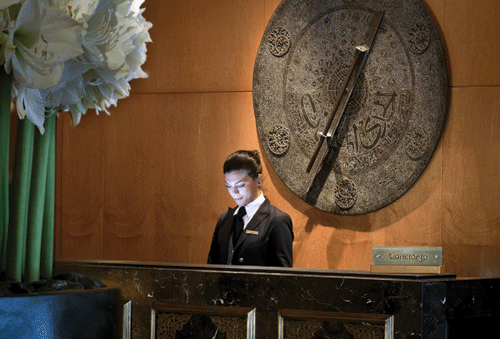
The job of a concierge in a five-star hotel is a portal into the stratospheric world of the super rich, a front-row view of how the ultra well-heeled live. Sometimes it is amusing, sometimes shocking and sometimes downright weird.

When paying top buck for service, guests can, and often do, expect everything on a platter. “I cannot say no to any request. Everything is possible, as long as it is legal,” said Reda Chaiban, senior head concierge at the Habtoor Metropolitan.

Chaiban exudes a genuine passion for his job. Having spent his working life striving to be at the top of his game, he sees himself as someone who can organize just about anything. “A concierge’s contacts are his toolbox. He needs to know everyone in town so he can fix any request,” he explained. 

Organizing a spot at the top table in town or a day out on a mega yacht is routine business for Chaiban, but sometimes he really has to go the extra mile to keep the guests happy. On five separate occasions a returning female guest has had him fly over from France one of the most desired hairdressers in the world. “Like I said, nothing is impossible,” he joked. But what about requests from guests with more illicit designs in mind for their stay in Beirut?

Walking on the wild side

 Chaiban was adamant that none of the staff at the five star hotels would get involved with organizing drugs or prostitutes for visitors.  However, the lines of distinction can become a little blurred.   A concierge from another five-star hotel told Executive, on condition of anonymity, that “there is normally someone in the hotel that knows someone outside who can arrange these things, but it is true we don’t fix it ourselves.” It’s a simple case of passing on a phone number.

The same concierge spoke about a party of men who booked the penthouse at a cost of more than $20,000 per night to throw private parties. “Every night they would bring between 30 to 40 prostitutes, and even if they didn’t sleep with them they would pay them several hundred dollars just for coming,” he said. “People pay up to $5,000 a night for a prostitute; some will pay more for a virgin,” he added.

Official policy is to inform the police if staff members are aware of illegal activity going on in the hotel. But the anonymous concierge smirked at this suggestion. “Even if we suspect illegal things are going on in people’s rooms, we don’t get involved. Quite simply it’s none of our business,” he said.

There is a prince from Saudi Arabia who is infamous amongst Beirut’s hotel staff for his outlandish requests, which have earned him the soubriquet “The Golden Boy”. A receptionist, again speaking anonymously, explained how the prince always books the same penthouse at one of Beirut’s most prestigious hotels. “He has all the windows blacked out, the whole floor carpeted in sheep’s fur and he will only wash in Perrier water or laban,” he said.

Tips are what makes the often-demanding job worth it and are an integral part of the hotel staff’s income. “If I told you how much I earn you would cry,” lamented a senior concierge at a high-end boutique hotel. “But in a good month in high season I can take $12,000 in tips,” he added with a wry smile. Tips don’t always come as notes greasing palms either. “The tips can come as gifts such as perfume, an iPad or an iPhone. Sometimes the guests come to see you as a friend so they want to give you a gift,” said Roxanne, a concierge at the Four Seasons.


July 3, 2011 0 comments
0 FacebookTwitterPinterestEmail
Society

Homes: A full house of assets

by Rayya Salem July 3, 2011
written by Rayya Salem


With a few Lebanese names solidified on the regional stage of furniture design, Lebanon is becoming more aware of furniture as an art form and investment. Executive spoke with some of the country’s biggest players in the field to discover where Lebanese designers are in the maturing world of Arab furniture design.

Art that you sit on

American University of Beirut graduate and London-based designer, Zaha Hadid, made a series of 24 chairs for international architecture and design firm Sawaya & Moroni, the prices for which start at $150,000. This price tag may come as a shock, but Gregory Gatserelia, founder of Beirut-based Gatserelia Design, urges customers to look at the pieces as assets.

“It’s not money paid, it’s money invested,” he says. “So I tell my clients that art is money well invested if you have a good consultant.” Gatserelia just opened SMO Gallery in Beirut to showcase his favorite collections, which include a couch and table of his own design.

Gatserelia says that the creative Lebanese crowd is becoming more and more interested in attending art galleries and shows and they are more aware of certain “collector pieces” or newly available pieces at galleries and showrooms. He works on behalf of clients to acquire those items. Gatserelia’s main business remains interior and architecture design, mostly of Middle East and North African residential and commercial projects, and he is now commissioned to work on the architecture and interiors of the 200 villas in the upcoming Nikki Resorts in Croatia.

“We just commissioned Ross Lovegrove to design a set of suspension lights and a dining room table that is molded into one unique piece, to be installed in a client’s Sursock residence. It’s molded in fiber-carbon through a technology we can’t master here in Lebanon,” he says.

The exclusivity of the piece (only two were made alongside the original) will allow the owner to ask “three or four times” the piece’s original cost, if and when he sells it. 

Despite investment considerations, Gatserelia is careful to keep ‘passion’ as a main ingredient in the art collection process, even though anything that’s properly marketed can be made into an investment item.

“If I see that [someone] is not interested [in the quality of the art], [I will] never get rid of a piece to a person who doesn’t appreciate it, just because [they] have the money.”

A particular soft spot shows for his favorite pieces: “I have pieces [a set of stools] designed by Bernard Khoury that I consider more valuable than all my pieces combined.”


It’s all about the name

With few competitors in the field of Lebanese furniture design, Nada Debs, chief executive officer of design company East & East, has carved out a profitable niche for herself after originally starting out as an interior designer.

Debs’s uniquely Middle Eastern outlook makes her pieces instantly recognizable — a plus that has helped her build her brand since she returned to Lebanon from London. Debs is most known for the “arabesque modern Arabic style” throughout her hand-made furniture lines.

Her company’s name represents the combination of Far Eastern sensibility and Middle Eastern details. The popular mix allows for shipments all over the world, with 40 percent of her products sold abroad, mostly in the Gulf.

“Our customers from the West see our pieces as exotic and authentic, whereas our Middle Eastern customers like the craftsmanship element and handmade detail, which reflect our culture and emotional belonging to the region. Even in the [Gulf Cooperation Council], people who originally liked the whole contemporary Italian look now prefer more subtle furniture and warm colors,” said Debs.

Her limited edition series, ‘Middle East Bling Bling’, included pieces, such as an arabesque chair and a chrome pebble table, infused with mother of pearl. Price-tags for tables in this line begin at $60,000.

Though she admits that many people think her work is overpriced, rising costs of labor and materials leave her with little room to maneuver.

“In the Arab world, labor isn’t cheap like in China. Import taxes make the price 30 percent more, as pieces are made with imported wood, brass and chrome,” she says.

But customers still save on local brands when compared to importing European-made products, which are more expensive, even if they are machine-made. But that won’t be the case for long, it seems. “Definitely, people are more interested in local craftsmanship, not commercial pieces,” says Debs. The proof is in the numbers, as revenues for Debs have grown about 10 times since she started a decade ago, she says.

But it is the corporate deals and special orders that keep her name rapidly circulating in a region that has a sweet tooth for known, often foreign, brands.

As an example of her growing regional prominence, 700 small pieces, such as vases and candleholders, were shipped off to a Middle Eastern royal family last year, and similar bulk orders are popular among Middle Eastern companies who distribute the items among employees as end-of-year gifts.

Recently the Museum of Modern Art in Qatar purchased a “concrete carpet,” which will be exhibited as an art installation and will be part of their permanent collection.

Entrepreneurship organization Endeavor Lebanon, whose London International Selection panel of six judges chose Nada Debs (and another Lebanese business) out of companies from 8 countries, sees potential in Debs and plans to make her company a globally recognizable brand.


July 3, 2011 0 comments
0 FacebookTwitterPinterestEmail
Society

Q&A – Fady Chams

by Rayya Salem July 3, 2011
written by Rayya Salem

After starting out on the Cannes interior design circuit, Prospect Design International’s Managing Director, Fady Chams set up the second branch of the boutique design firm in Dubai in 2005. The firm’s work has been ogled by the eyes of the jet set, with a portfolio that includes the VIP Room in Saint Tropez, to world-famous Movida and Maddox in London, to the iconic art deco Sass Café in Monaco. Closer to home, Prospect left their mark on Beirut’s La Plage beach and Palais nightclub. Though the firm has worked on high-end projects from Casa Blanca to Kazakhstan, the Middle East’s highly hospitable climate remains the focus for their well-secured niche within the interior furnishings market.

How did you become a high-profile interior design company so quickly, designing interiors of exclusive high-end clubs and restaurants in Monaco, London, France, and the like?

My brother Sami, after having worked with Ralph Lauren Interiors and many other brands in the south of France, set up Prospect Design in Cannes in 1996. Several friends asked him to design restaurant interiors, which became very successful, and we became specialists in that domain of hospitality design. We were thinking to open Prospect Design in Beirut but security and investment-related factors didn’t allow us to do that.

Do you position yourself as designers in the luxury segment?

Not necessarily. We do high-end and we can provide a mid-end French classical Provence house, which is rich in natural materials, [such as] French antique wood, without having necessarily the highest technology and the expensive marble and so on.

Wasn’t Palais the biggest budget project in hospitality at the time?

No, not at all. To tell you, it was approximately half a million dollars, which is acceptable when you consider they already had the services, electrical, mechanical, air conditioning and so on. There is big competition in Beirut, especially for [design in] hospitality. Now, we have a lot of private clients for residences… and hope to design a boutique hotel but that is all related to the political and security situation.

When you compare the market for luxury hospitality design in Beirut with the regional market, do you see major differences?

In Beirut there are no limits compared to the rest of the Middle East. You can open a restaurant and club wherever you want and you are allowed to sell alcohol and open from very early until very late. In Dubai, [if you are a restaurant that sells alcohol] you have to be in a hotel, which affects our design.

What makes it so demanding to work on a luxury restaurant?

You cannot just design a very nice restaurant [based purely on aesthetics]. When it comes to operations you have a lot of problems with the lighting, the seating or the circulation around the tables. Also, going for a contemporary style or a classical style will definitely last much longer than something futuristic with a lot of LED lighting and changing colors.

Did the economic downturn impact your business?

Yes and no. Back in 2008, some clients started to freeze their spending. But we do not have a lot of overhead… Before the crisis in Dubai, we were approached by maybe 20 people a week; 90 percent of them were…wasting our time. Now, if we get approached by four clients, three of them are very serious and have the funds.

What was the most expensive project you ever worked on?

There were some private residences… that included an indoor swimming pool, a nightclub, a basement tennis court, you name it. In hospitality, it is a business with projections and a feasibility study and goals to meet. They don’t care if I put a gold-plated part in the ceiling or something that looks like a gold-plated part. But the private client would want gold-plated.

How did your strategy develop to combine luxury items with mid-range items in your designs of hospitality spaces?

It comes naturally since in most projects no one has an open budget; we are therefore quite skilled in mixing-and-matching a very expensive sofa with a less expensive table and a chandelier that is not a Swarovski one…to create a unique design. If you want a wall covering, I can find you five similar coverings at very different prices.


July 3, 2011 0 comments
0 FacebookTwitterPinterestEmail
Economics & Policy

Redialing discord?

by Sami Halabi July 3, 2011
written by Sami Halabi

To describe Lebanon’s telecommunications sector as politicized would be an understatement on par with saying the summer of 2006 was eventful, or that Hezbollah and Israel enjoy a good game of tag from time to time. Since its heyday atop the pyramid of Arab telecommunication industries in the early to mid-1990s, the sector has become little more than a wounded lamb at the mercy of the packs of hyenas roaming Lebanon’s political plains. Today the sector has the dubious distinction of having the slowest average Internet speed in the world and the highest prices for those same services in the Middle East.

“We are lacking so many basic things and the entire root cause of our despair is the governance of the sector,” said Riad Bahsoun, telecom expert at the International Telecommunications Union (ITU) –– the arm of the United Nations that deals with information communications technology. “It’s the domination of politics over performance. It’s the subjection of intelligence to force and collective interests to individual will. This is called tyranny and despotic governance.”

This high-handedness was on full display in May, when the lack of reform and the hyper-politicized decision-making in the sector culminated in an embarrassing encounter between Charbel Nahas, then the telecom minister allied with the March 8 coalition, and hundreds of members of the security forces, who prevented the minister’s team from entering one of the ministry’s buildings in the Adlieh district to dismantle a non-commercial cellular network that had been operating in parallel to the country’s two commercial operators.

Submarine cables coming to and from Lebanon

The confrontation apparently came about when Abdulmenaim Youssef, who is allied with the opposition March 14 coalition and heads Lebanon’s incumbent fixed-line public operator OGERO, requested that the head of the Internal Security Forces (ISF), Ashraf Rifi, who is also allied with the opposition, guard OGERO’s property from the ministry’s prying eyes.

OGERO was created in 1972 and controls the country’s fixed-line services as well as its current Internet infrastructure. It acts under the “supervision of the telecom ministry”. However, it is also financially and administratively independent, in accordance with the law that created it, and answers to the directorate general of operations and maintenance at the ministry, which has also been headed by Youssef since 2007.

Immediately after the Adlieh incident, the political mudslinging began. The convoluted arrangement over who had authority to see, dismantle, own and operate the network descended into quarrelsome disputes over the constitutionality of the move, the civilian rule of the security forces, wiretapping, illegal phone lines and so on, until the issue finally faded into the background. Lebanon emerged from the fracas minus one favorably regarded and technocratic interior minister (Ziad Baroud, who resigned following the incident) and no further along the path to reform.

Legal arguments aside, the cellular phone network Nahas was attempting to confiscate from OGERO was given to the Lebanese government as a gift in 2007 by the Chinese government, through the multinational telecommunications company Huawei. At the time, Lebanon was preparing to liberalize the telecommunications market and introduce Liban Telecom, a legally mandated government-owned body with a corporate framework that would eventually replace OGERO and take on most of its assets. The gift provided the Chinese with an opportunity to enter the market as it was opening up and to prove that its companies were capable of running a high quality network. At the time, the technicalities of the donation were negotiated by OGERO under Youssef’s purview was director general of the company.

According to ITU’s Bahsoun, when questions were raised about whether the network should be monitored by the Telecom Regulatory Authority(TRA), Youssef said that it would be used solely for testing purposes and hence, as a non-commercial network, it would be overseen by himself and not the TRA. Youssef did not respond to repeated requests for comment.

The gift, however, did not arrive until 2009, when the current Energy Minister Gebran Bassil was heading up the telecommunications ministry and plans to set up Liban Telecom had effectively been scrapped due to political wrangling. By this time a row had erupted regarding a new wiretapping law that would take authority over such issues away from the Information Branch of the ISF and split it between the ministries of justice, telecommunications and the interior. In 2007, after the network had been pledged, the interior minster put in a request to the Council of Ministers, Lebanon’s cabinet, to allow the Information Branch to use the network for intelligence purposes. The permission was denied.

“In my opinion this was rejected in turn by the Information Branch,” said Bahsoun, though he stressed that he could not confirm such information. “The Information Branch probably decided to [use it] anyway without formal legal coverage,” he added.

Whether or not the network was used for intelligence purposes will likely be an ongoing source of bickering among Lebanon’s politicians, but the capabilities for such an operation were certainly there. The network was widely reported to have a capacity of 50,000 lines that could have been employed outside the two existing cellular networks. Speaking to the Lebanese Broadcasting Corporation last month, opposition Future Movement Member of Parliament Ghazi Youssef said the network contains a total of only 15operational lines.


“They say that the OGERO equipment is made up of 62 base stations [part of the cell phone network which handles communications between phones and the network] in addition to the core; the intelligence system that manages all of this is there,” said Imad Tarabay, secretary general of the Lebanese Telecom Association (LTA), which represents Lebanon’s private-sector data and Internet providers.

According to Bahsoun, a staunch opponent of Minister Nahas, this equipment was consolidated at some point at building in Adliyeh and this allowed for a more powerful network which he suspects played a part in uncovering some of the Israeli spy networks in the country over the past several years.

“If this network is operating 15 lines, why does it need 400 people to protect it?” he asked rhetorically, referring to the reported number of security forces present at the building when Minister Nahas tried to enter. “The truth is that the Information Branch could not accept in any way the minister of telecommunications or a team apart from theirs to inspect the equipment.”

3G connection

What ultimately emerged from the fiasco is that even if the minister was attempting to lift the lid on any alleged wrongdoing, he was also trying to speed up the implementation of the contentious 3G mobile Internet projects that he launched last January after the cabinet had collapsed, in conjunction with mobile operators Alfa and mtc.

As Executive reported in March, there have been numerous unanswered questions over the legality of the 3G project, due to the fact that it was launched while a caretaker government was in place, and neither the legally required licenses nor frequencies from the TRA and the cabinet have been granted to the companies that will conduct it. Moreover, the prospect of a faster, better service being provided by the public sector, without private sector access to the market, has fueled a campaign against the plan, spearheaded by Tarabay, chief executive of the private sector company Cedar comand distributor of the Mobi wireless Internet service. Tarabay co-owns the company with the son of opposition MP and former Telecommunications Minister Marwan Hamade, and contends that Nahas is attempting to nationalize the telecommunications sector.

He says he has prepared legal files against the telecommunications ministry and is prepared to submit them to the Shura council, Lebanon’s highest court. This comes after an unsuccessful attempt at arbitration through the TRA that, perhaps predictably, did not take action against the ministry it depends on for financing; the TRA spent several months this year without the money to pay its employees.  The TRA also did not respond to repeated requests for an interview.

Most of the controversy surrounding the legality of 3G stems from two contentious issues. The first is telecom Law 431, which states that licenses and frequencies must come from the cabinet and the TRA respectively. Second is unfair competition as a result of exorbitant tax discrepancies between public and private service providers, which would likely come about if the project moves forward.

With regards to Law 431, former Telecommunications Minister Nahas’s response has always been the law is not applicable, ostensibly because it has not yet been implemented in its entirety. His position got a boost last month when he announced that he had seen a Shura council decision stating that the law had been “suspended” because of Article 51, which states that “all applicable[previous] legal or regulatory provisions remain effective until the enforcement” of the law itself. Translation: the law and all the institutions created under its jurisdiction, such as the TRA and Liban Telecom, would also be technically suspended. As Executive went to print the ruling had not yet been made public.

“Law 431 is applicable and being implemented,” insisted Imad Hoballah, acting chairman of the TRA, at a press conference intended to respond to the minister’s statements last month. Hoballah went on to describe the licenses and frequencies that the TRA had given out over its four-year term, though he admitted that these had been handed out before the Shura council decision. Previously, the Shura council has ruled against the ministry and in favor of the TRA but there is speculation this ruling could be particularly pernicious for the TRA.

“We respect the decisions of the Shura council and we will follow them,” Hoballah said, insisting that the decision does not negate the entire law. Asked what the TRA would do if the telecommunications ministry issued 3G frequencies that the regulatory agency is legally mandated to allocate, he declined to comment, saying only that if the telecommunications ministry decides to go ahead without allowing the private sector to participate, “no one can stand in its way.”

“Fundamentally, the TRA has eight months left,” contended Antoine Boustani, an advisor to Minister Nahas, speaking to Executive last month. Boustani’s position, like that of Nahas, is that because the law that created the TRA is not fully implemented, “it’s already obsolete”.

“We don’t decide to implement the law; the Council of Ministers decides. We are moving forward on the basis of the authority of the ministry. When they say they want to implement the law [in full] we are ready,” he said, denying that the ministry officially seeks to shut down the TRA.

“I’m not stopping until I get my rights,” Tarabay snapped back defiantly, adding that he will file court cases against the ministry but is waiting to see the Shura council decision to “fine tune” his lawsuit in line with the status of Law 431. 

But according to Boustani, Tarabay will soon have little to complain about. Last month he told Executive that the ministry plans on leveling the playing field between the private sector and public sector by decreasing the taxes on the former by “50 to 55 percent.” Asked whether the private sector will be allowed to enter the market, he said “byiswa” — an Arabic word suggesting that something on this front could happen and would be a positive — though he couldn’t confirm or deny it. “We will ask for it [in thecabinet]; we don’t have a problem,” he said, adding that such a request “isliberalization, not privatization.” 

He also said that a long-awaited policy statement that waspromised by the minister one year after he took office would soon be issued.The issue has become a major talking point for opponents of Nahas, includingthe TRA, who say that he has no policy and works according to his own whims.Nahas’s response has always been that the ministry’s policy is a matter of“practice not paper.”

Of course, Boustani is not an advisor to the newly appointedTelecommunications Minister Nicholas Sehnaoui, but the latter is widely seen asNahas’s protégé and has already stated that he will follow the same course asthe previous minister. If he adopts Nahas’s purported policy — which Boustaniconfirms is “almost done” — and makes it public, it would mean that the sectorwill have a general set of rules mandated by the ministry under Law 431 for thefirst time since former Minister Gebran Bassil was in office from 2008-09. Thiswould be significant, as it would provide an indication of the minister’sintentions vis-à-vis the many contentious issues in the sector.

Money to make

Bickering aside, the ministry has been pressing on with the3G project, as have both Alfa and mtc. The attempted takeover of the telecomequipment by Charbel Nahas in May can be seen as part of this aggressive pushby the ministry to make the 3G project a fact on the ground as quickly aspossible, before legal issues potentially complicate such plans.

According to Bahsoun and Tarabay, the equipment at Adlieh can technically be upgraded and used as part of the 3G rollout currently being undertaken by Huawei and mtc. Huawei won the contract to build the new network for Mobile Interim Company 2, the state-owned cellular telecom company managed by mtc. The Chinese company’s winning bid was valued at $25.6 million (not including a $2.7 million control center that will be built by Nokia), $10.6 million less than their counterpart Ericsson, who won the 3G contract at Mobile Interim Company 1, the state-owned cellular telecom company managed by Alfa. Both Bahsoun and Tarabay estimate the value of the third network’s equipment, once upgraded, to be around $10 million, (thus making up the difference between the two bids).

Both Alfa and mtc stand to benefit greatly from the 3G project, on top of the revenues they already garner from the talkative Lebanese who pay 58 percent in taxes on all telephone services. Zain’s mtc, for instance, has increased their net earnings from $22.1 million in 2008 to $46.1million under their current management contracts. In January, under the caretaker government, Minister Nahas renewed their contracts for a year.

“We extended 12 months when the minister thought that if these two companies are going to go into the 3G project they need security. They said they need more than two to three months to do such things,” said Boustani.

India-Middle East-Western Europe III

So with the two companies locked in a yearly contract, the Shura council ostensibly on the ministry’s side with respect to Law 431, the TRA hobbled and toothless and Tarabay’s cases needing some time to come to fruition, there seems to be little stopping the 3G project from materializing sometime around the end of the summer. Except for one hitch.

In 2007 Lebanon entered an international consortium to construct a submarine fiber-optic cable from Europe to India —

called the India-Middle East-Western Europe 3 (IMEWE3). Lebanon has already invested some $53 million into the construction of the underwater sea cable to carry traffic and unclog the international bottleneck Lebanon has long suffered.

“Capacity has to be met at all levels,” said Ghassan Hasbani, chief executive of the International Operations group of Saudi Telecom Company (STC), which is part of the consortium and is using the cable. “If you have a high speed local connection network and clogged capacity on your international gateway, then access to international content becomes very slow. These have to come together and the more connectivity there is in the country the better the prospects of lower pricing, of routing for traffic, and the better accessibility you have to the rest of the Internet globally.”

According to a source from the consortium, who asked for anonymity because he was not authorized to speak to the press, the contract between Lebanon and the consortium was signed by “OGERO Telecom”, which is not the official name of OGERO. At the time, the creation of Liban Telecom seemed imminent due to political consensus under the Saniora government and then Telecommunications Minister Marwan Hamade. Director General Youssef and the minister were ensconced on the same side of the political fence, enabling them to lay the groundwork for their political camp’s control of the sector. By December of last year the cable was ready to go and all other member countries of the consortium had started to use it. But by then the political stars of the telecommunications ministry were anything but aligned.

Engineers at Alfa have already confirmed that the 3G project will need IMEWE3 to function. Currently Lebanon’s international connection is through the Cadmos cable connecting the country to Cyprus, through which Boustani admitted a bottleneck would occur if there was a large amount of traffic as would be the case if 3G were introduced. The Cadmos cable also leaves Lebanon at the mercy of Cyprus for international bandwidth.  This is ominous as trouble has been brewing between the two countries over a maritime economic zone agreement between Cyprus and Israel.

Official data is not available, but most estimates are that Lebanon is currently using 2.5 gigabits (Gb) of legal bandwidth. However, Boustani says that the Cadmos cable has 40 Gb available for use after its recent upgrade. IMEWE3 has an initial 30 Gb and can be updated to 1.4 terabits. Thus, according to Hoballah, Lebanon is currently blocking 97 percent of its international bandwidth.

In order to activate the IMEWE3 cable it is necessary to log onto the consortium’s system with a secret code, which according to a consortium source is something only Youssef has the details of.  Again Youssef did not respond to repeated requests for comment.

“We paid a total of some $53 million and we are not using[it] because one person [Youssef] says ‘I don’t want to’ and the collective interest becomes subject to one person,” said the ITU’s Bahsoun.

According to Boustani, the ministry sent a commencement order to OGERO to oversee the project and has since asked for the ownership of the IMEWE3 to be transferred back to the ministry; this is what Youssef has refused to do. “There were some people who were supporting him politically. It used to be former Prime Minister Fouad Saniora but I don’t think today that Saniora will cover him. We hope that this government will lift this political cover so we can work,” he said.

What will also need to occur is the negotiation of an agreement with a European operator to purchase capacity in order to transfer information from Marseille, France (where the cable ends), so that traffic to and from the rest of the world via Europe can come into the cable. The going price for such traffic is about $2 per megabit per second (Mbps) per month, which means that 10Gb of capacity would cost some $20,000 per month. Given that the cellular network alone generates some $3 million each day in Lebanon, this is a relatively trifling sum.

If Lebanon wants full redundancy, in case the European side is cut, they can also negotiate the same contract in India, at the cable’s other pole. Such negotiations take about a month to complete but again this would need to go through Youssef’s office at the ministry as long as he maintains control of the post of director general. Nonetheless, Boustani says the ministry is in direct contact with France Telecom discussing such an agreement.  

Since it was Youssef who negotiated and carried out theIMEWE3 project with the consortium, when the telecommunications minister contacted its management committee to try and wrest control of the cable, the consortium became predictably confused. In the end they decided to take a “hands off” approach, according to the source. Of course the fog of Lebanese laws, their seemingly inconsistent application, and the autonomy of public institutions, especially OGERO, has not helped.

“Youssef sent a letter to the consortium telling them not to hand [it] over to the minister, and he does not have the right to do so,” said Boustani.  He would not comment on whether the ministry would take legal action as a result.

Even if the consortium is convinced to transfer control, the procedure stipulates that when OGERO hands control of the cable over to the ministry it initially does so through the Directorate of Operations and Maintenance, whose head stamps the handover and transfers the asset to the minister’s office. As Youssef himself holds that post, there seems to be scant chance of that happening.

According to Boustani, at the meeting of Arab telecommunications ministers held in Beirut last month the ministry received important political backing that he thinks will see the IMEWE3 handover soon, although this could not be independently verified.  This would not solve Lebanon’s Internet woes outright, however. “Even if IMEWE3 is activated, what use will it have if the ministry of telecommunications sells the international E1 line [2 Mbps] to [private sector] service providers for $3,000, while costs on them is less than $30?” asked Tarabay.

“The Internet cost to the consumer will remain high,” he said, unless the price of E1 falls and Internet Service Providers (ISPs) have access to the bandwidth. Lowering prices requires a decree to be issued by the cabinet because the sector is still not liberalized as per Law 431. Bandwidth will then need to be handed out by the ministry under the directorate general of operations and maintenance — again Youssef’s office.

But while Youssef may be a major roadblock to better Internet, other projects will also need to be completed to see the sector reach an acceptable global standard. According to Jean Gebran, projects director at Consolidated Engineering and Trading Company (CET), the Court of Accounts, the government’s public sector auditor, gave final approval in May to a project to construct the telecommunications ministry’s $40 million fiber-optic backbone throughout the country. CET and Alcatel will carry out the project, which has already begun in the South and the Bekaa valley. It is expected to take 16 to 24 months to complete, according to Gebran.

Furthermore, the ‘last mile’ connection from the fiber to homes will also need to be completed. But in the short-term, even without these projects, 3G service can technically run and allow speeds in the range of 21Mbps, compared to the current average of 0.1, even if this may kill private sector participation in the sector.

Time for action

With a new cabinet and a new minster that are both technically on the same side, there is some renewed hope amongst those in the sector that the coming period will be less fraught with conflict. A government of a single color may be more willing to see off some of the old opposition guard (starting with Youssef), but who they choose as a replacement is entirely another matter, and what the market will look like after any reshuffle of institutions, laws and people may just end up resulting in the same stagnation that has plagued the industry for over 15 years.

“It is very difficult if you ride a donkey to reach a high summit, even if you choose the direction,” said Bahsoun, referring to Lebanon’s telecom policy decision makers. “It’s impossible to reach it if you let the donkey choose the way. However, if you carry the donkey you will die. We are still carrying donkeys and paying for their food.”

But today one side of the political divide can no longer blame the other for obstructing policy implementation. “You don’t have two sides anymore so you don’t have anyone to delay,” said Boustani. Thus, there are no more excuses.


July 3, 2011 0 comments
0 FacebookTwitterPinterestEmail
Society

Is that a no. 9?

by Paul Cochrane July 3, 2011
written by Paul Cochrane

Demand for cigars is so strong that the sector is inundated with counterfeits. An estimated two thirds of cigars smoked in Lebanon are “fake”, with a Honduran, Dominican or Nicaraguan stogie attempting to pass itself off as the crème de la crème of smokes, the Cuban cigar.  It is not easy to notice the difference until one sparks up, as the counterfeiters are pros, switching the paper ring around the cigar for a Cuban brand and using real or counterfeit boxes.

The situation has become such a concern to the legitimate sector that leading distributor, La Casa del Habano, owned by Phoenicia Trading, spent $50,000 this year on a billboard and media awareness campaign to inform consumers about fake cigars, particularly the Cohiba brand.

“The Cohiba Behike is the most expensive and the most popular right now,” said Wael Zeidan, executive manager at Phoenicia Trading. “We classify consumers of fakes into two segments — one, a consumer that knows it is a fake Cuban but smokes it to show off and doesn’t care. The second is a beginner that is easily bluffed, so we focus on him.”

To ensure that fake Cubans are not being put in boxes as the container empties — a classic scam to bump the price of a $2 cigar up to, say, $30 — Phoenicia has undercover employees that go in to check for fakes at its 300 wholesale customers. They are also opening a new outlet to better distribute Cubans from its current five stores.

While Honduras and the Dominican Republic do produce high quality cigars, primarily for the American market due to the trade embargo with Cuba since 1962, such brands are more expensive in Lebanon than Cuban cigars. Hence the fake Cubans are lower quality and normally machine made. One to watch out for is the Cohiba Siglo no.9, as real Cohibas only go up to size six. “It’s so big, it’s crazy,” said Zeidan.

Cohiba is the number one brand around the world, and in Lebanon this is no exception. Top sellers are the Robusto size (50-54 ring gauge), which is ideal for a half hour to one-hour smoke. Cigarillos — the small, lean cigar just a centimeter longer than a cigarette — are also becoming more popular, with Phoenicia Trading bringing out its own brand, Phoenicio.

“Demand for cigarillos is starting to grow, and women are increasingly smoking cigarillos,” said Zeidan. As cigars have a somewhat “old man” reputation, every month Phoenicia holds a breakfast cigar event for women in Ashrafieh, and has introduced cigarettes into Casa del Habano “to get youngsters into the shop and to find out about cigars,” said Zeidan. Pushing sales further are the cigar lounges at some of the capital’s leading hotels. At Le Gray, cigar nights are coupled with tastings of single malt whiskeys. And awareness of cigars is rising, said Paul Atallah, wine and bar manager at Le Gray.

“Some 80 percent of people know what they’re smoking. The rest, it’s just to show off that they are cigar smokers while swallowing the smoke,” he said. “But the culture has changed, and we’re seeing more people go for [brands] Partagas and Hoyo instead of Cohiba; this shows a change in awareness.” Most of the hotel’s cigar aficionados are guests from out of town but it is increasingly attracting non-guests to come to enjoy a cigar, sip an Armagnac and relax.

The economic downturn in the country has affected sales but the 400 percent rise in people smoking cigars since 1980 has provided a loyal customer base. “People get used to smoking cigars, and they continue to buy them,” said Zeidan. Indeed, big spenders are still out there. On a recent Saturday at La Casa del Habano in downtown, a customer bought a whopping five boxes of Cohibas as well as several packs of cigarillos.


July 3, 2011 0 comments
0 FacebookTwitterPinterestEmail
Economics & Policy

Executive Insight – Booz & Co

by Bahjat el-Darwiche July 3, 2011
written by Bahjat el-Darwiche

Developing a vibrant and innovative information and communication technology (ICT) sector would provide the Middle East and North Africa (MENA) region with a propitious opportunity to increase productivity and boost its national economies. However, the region’s innovation sector does not yet offer sufficient support to unlock entrepreneurs’ ideas and investors’ capital. It will take a concerted, collaborative effort from governments and the private sector to stimulate digital innovation and ensure that it is engrained in MENA countries’ future growth.

Why is ICT innovation important to the MENA region? Around the world, the ICT sector has transformed societies and economies over the past decade via a steady stream of innovative new products and technologies. These innovations have changed the way we interact with each other. They have helped entire sectors — such as transportation and utilities — to operate more efficiently and at lower costs. ICT has also spurred widespread modernization across national economies. The impact ICT has had in a relatively short period has been remarkable; the European Union, for example, credits the ICT’s multiplier effect with contributing 40 percent to Europe’s productivity gains over the last 10 years. 

Governments — both in developed and emerging markets — have recognized the potential of ICT and prioritized ICT innovation on their national agendas. Recent examples include the European Union’s Digital Agenda, Malaysia’s ICT Strategic Roadmap, Germany’s ICT 2020 Research for Innovation and the United States’ Strategy for American Innovation. These programs all strive to establish national environments conducive to the promotion of ICT innovation at all levels, through a comprehensive and well-coordinated agenda of government policies.

Poor performance

To date, the MENA region as a whole has shied away from promoting innovation. In 2007, the Arab world spent an average of 0.3 percent of its total gross domestic product (GDP) on overall research and development(R&D), compared to an average of 2.3 percent by countries within the Organization for Economic Cooperation and Development (OECD). In the last 13 years the MENA region filed a total of 3,224 patents, compared to some 1.7 million patents for Japan alone.

In terms of entrepreneurship, the MENA region also lags behind its global peers. According to recent World Bank data that measures the number of new firms created per 1,000 people, the five MENA countries included in the survey (Algeria, Jordan, Oman, Morocco and Egypt) averaged just 0.9startups. That figure trails by a significant margin countries such as France (3.08), Finland (3.37), Singapore (7.4) and the United Kingdom (8.05).

Software piracy has also had a deleterious effect on innovation in the MENA region; in 2009, software piracy accounted for more than $1.4 billion in losses, further reducing the attractiveness of the ICT sector for entrepreneurs. As a result, ICT generates approximately 2 percent of GDP in the MENA region. That number is far higher in truly innovative countries.  In Korea, for example, ICT accounts for around 8 percent of GDP.

If the MENA region were to address these issues, it would have an opportunity to become a significant global contributor to ICT innovation. Jordan, for example, has emerged over a relatively short period of time as a regional powerhouse in ICT innovation, mainly because of sound government policies and strong partnerships between the public and private sectors.

The country’s ICT sector now includes hardware, software, consulting, programming and installation, employs more than 11,000 people and can tap into a steady flow of more than 6,000 information technology graduates per year. Jordan’s King Abdullah II Fund for Development (KAFD) has established Oasis 500, an ICT seed capital fund for innovative startups.

This growth has attracted the attention of major international ICT companies. Intel Capital has invested in two Jordan-based ICT startups — Jeeran, a web-community platform, and ShooFee TV, which aggregates Arab satellite television listings and entertainment content.

To build an innovation environment geared to support the development of a local ICT sector, governments must play a leading role. They have an array of options at their disposal to help stimulate digital innovation, including the implementation of policies and regulations to support and protect entrepreneurs, the creation of and support for funding incentives, the development of an advanced, competitive and high-speed ICT infrastructure and finally, the promotion and development of young talent.

Working together

Governments, however, cannot alone provide the solution to creating a digitally innovative society. The private sector has a pivotal role to play, especially with regards to providing capital to entrepreneurs. To date, the MENA region has largely shied away from investing in innovation or entrepreneurship ventures in favor of lower-risk opportunities such as real estate or the stock market, where exit strategies are easier.

Without funding, neither innovators nor entrepreneurs in ICT can develop new products or commercialize their ideas. According to the Global Entrepreneurship Monitor 2009 MENA report, family members provided the funding for nearly 80 percent of all projects launched by entrepreneurs in seven MENA countries.

That same study revealed that approximately only 10 percent of entrepreneurs tapped into government programs for their funding. While government-subsidized programs are picking up across the MENA region, these funds are not enough to foster a globally competitive platform for innovation.

The private sector needs to step in and bridge the gap and provide funding to entrepreneurs. This will require accelerating the development of the region’s network of venture capital (VC) firms and angel investors. VC firms and angel investors are a critical component of any innovative economy because they provide entrepreneurs with access to “smart capital” — funding along with access to a pool of experts who can direct the growth of promising young companies. The VCs that set up shop early on will gain access to the most attractive investments at the lowest prices. An example of a successful investment is Jordan’s Maktoob, which was acquired by Yahoo in 2009 for an unofficial amount of $85 million.

The worldwide growth of ICT — and its impact on economies and societies — is showing little sign of slowing down. In recent months, the multi-billion-dollar valuations of ICT firms such as Facebook, Skype and Groupon send a strong signal that this sector will continue to generate value, even in the face of a potential bubble. Developing markets, such as China, Russia and Latin American countries, have also witnessed similar growth and high valuations for ICT companies, indicating that the industry is not constrained by geography.

We forecast that the MENA region’s ICT market will grow to reach approximately $120 billion within just four years; a sharp gain from its$90 billion level today. That 33 percent surge in business by 2015 presents entrepreneurs and investors with a significant opportunity.

The path to ICT innovation in the MENA region might take some time and it will  be smoother in some countries than in others — especially when it comes to finding the right balance between government and private sector involvement.

However, governments and the private sector can work together to clear major hurdles like funding, infrastructure, policy and talent development. That in turn would allow the MENA region to realize its potential as an incubator for digital innovation for years to come.

BAHJAT EL-DARWICHE and RAMEZ SHEHADI are partners at Booz & Company


July 3, 2011 0 comments
0 FacebookTwitterPinterestEmail
Society

Whisky: A popular cheer in down times

by Paul Cochrane July 3, 2011
written by Paul Cochrane

Amid the current economic recession, there has been a general downward shift from luxury spirits to medium-priced bottles, while most distributors have put the launch of new brands on hold. With competition getting tougher, brands are working on revamping their image to appeal to the high-end drinker, while distributors are still paying eye-watering sums to get exclusive rights at the capital’s premier nightspots.

“The market always strives to go upwards, but it has been a difficult year globally and in the Middle East, and it is maybe not the right time to introduce new brands,” said Wadih Riachi, cellar manager at Vintage in downtown Beirut. “Yet the drinks sector has not reached a critical mass in Lebanon, by far, in terms of new products, spirits and packaging.”

The spirits segment has developed over the past few years, evident in the rise in premium vodkas, gins, brandies, rums and tequilas on offer. Vodka sales grew by up to 4 percent over the past year, above the120, 000 cases benchmark, but Lebanon is still very much a whisky market, with more than 450,000 cases imported every year.

It is in whiskies that there has been a maturing of the segment, with tipplers increasingly opting for single malts instead of reaching for the ubiquitous Johnny Walker Black Label. “Knowledge about single malts really started last year; we’re on the right track,” said Paul Atallah, wine and bar manager at Le Gray Hotel. “I think single malts will boom, and it is a great match with cigars,” he added.

Currently, imported fine and single malt whiskies average more than 8,000 cases per year, far more than cognac, at around 1,000 cases. Of those 8,000 cases, an estimated 70 percent are the 12 and 15-year-old single malts.

To differentiate the malts from the mass whisky market, companies are working on packaging. For instance, Glenfiddich, the biggest selling single malt label in the world, realized that the packaging for its 21and 30-year-old malts being the same as the significantly cheaper 12 and 15-year-old malts was detrimental to sales.

To make these older and super premium malts stand out,  Glenfiddich got rid of the cardboard tubes in favor of wooden boxes, first for the 30-year malt and later this year for the 21-year. There has been a corresponding 15 to 20 percent rise in the price, but the brand is banking on the improved aesthetic appeal.

The bottle has also changed, along with specific numbering on the labels, which has an appeal to collectors. “Some people want special numbers, such as one customer asking for the ‘600’, for example,” said Vintage’s Riachi.

Glenfiddich’s re-packaging seems to have worked. Vintage typically sold one to two bottles of the 30-year malt a month, but after the makeover they sold two cases in three days. “They got it right,” said Riachi.

Outlets are also emphasizing the range of whiskies a distillery offers. “People like collecting whisky in the same way as wine; instead of a 2001 or 2003 vintage it is a 12, 15, 17, 21 or 30-year-old malt. You drink less but better. And that is the magic of spirits; wine is drunk immediately [after opening], but spirits keep for ages,” added Riachi. 

Rising from the snow

Rare malts and varieties from specific years are also proving attractive.

“Scarcity is the best salesman of wine or spirits,” said Riachi. The Camus 1971 Armagnac, for instance, is likely to sell well this year as a lot of people will be turning 40. And in terms of a unique drinking experience, one of the most sought after this year by whisky connoisseurs is Glenfiddich’s Snow Phoenix.

The Snow Phoenix is a one-off combination of single malts that came about following  heavy snowfall at Glenfiddich’s distillery in the  Scottish Highlands in January 2010 that caused some warehouse roofs to collapse. With casks exposed to sub-zero conditions, the master distiller decided to bring together the whiskies from ex-bourbon and Oloroso casks that had aged for 13 to 30 years into a non-aged single malt. It is now being hailed as a cult malt; some websites selling the Snow Phoenix have already sold out, while in Lebanon only 250 bottles are to be available for sale and half have already been pre-ordered ahead of the July launch. 

The region’s window display

With the summer season not expected to be as dynamic as in years past due to a dearth of tourists, and Ramadan falling in August, drinks sales are expected to be down. But Lebanon still remains a top venue for marketing spirits, from the low to the premium level.

“Lebanon has become a Club Med destination, with two seasons, and the rest of the year having to survive on the Lebanese,” said Carlo Vincenti of Vincenti & Sons, distributor of St. James, Label 5, Glen Moray and Pitu Cachaca. “Lebanon is a window display for the whole region, as a big percentage of the profits from spirits sales in the United Arab Emirates and Saudi Arabia is spent on marketing in Lebanon.” Surprising though it may seem, Saudi Arabia is unofficially the fifth largest whisky market in the world.

Marketing is evident at Beirut’s infamous Sky Bar, where distributors have been spending ever-increasing sums over the past three years to target trendsetters. This year, according to distributors, some $630,000 was spent by Diageo for exclusive rights to sell its brands and by distributor Etablissements Antoine Massoud to plug its Russian Standard vodka at the rooftop bar.

“It is ridiculous, but more outlets are asking for money in advance to exclusively sell alcohol brands, despite the downturn,” said Nagi Hmouda, business manager at Fattal, distributor of Dewar’s, Grey Goose and Patron. “We are skeptical about the season as a lot of losses will be incurred.”

Fattal will not be introducing any new brands this year. Vincenti has launched the premium cognac Bisquit, but is focusing on faster moving spirits such as cachaca — the fastest growing spirits category in the world — rum and vodka.

Yet Vincenti also expects the upward swing in vodka to tail off. “Vodka was a discovery drink and many new brands were introduced to the market, but I think people will shift back to something less neutral in terms of taste, to whisky, rum and tequila, which are taking off.”

With sales down in on-trade — at bars, restaurants and hotels — the less glamorous supermarket has become an important point of sale. Indeed, supermarkets are now charging higher listing fees and investments to display brands.

“High-end brands are on supermarket shelves, but in terms of shelf off-take it is very weak,” said Vincenti. “Such brands shouldn’t be there as the consumers are not the type of people that go to supermarkets. There is a question mark on prestige if a bottle is on a supermarket shelf for months.” The supermarket as a high-end spirit venue may constrain the launching of new products and curb rise in consumption of single malts.

“Demand for single malts has risen over the last two years but I’m not sure it can go on. If on-trade doesn’t evolve, launching luxury spirits will not succeed. You can’t launch a 16-year old whisky in a supermarket, and you can’t sell more than one case per month,” said Vincenti.“But the downturn is not necessarily a bad thing. Lebanon was living in an imaginary world, as you never saw anyone in Europe paying $400 for a bottle in a club. It wasn’t healthy.”


July 3, 2011 0 comments
0 FacebookTwitterPinterestEmail
Economics & Policy

Executive Insight – Paul Naimeh

by Paul Naimeh July 3, 2011
written by Paul Naimeh

When the tourism minister starts talking about how we should change the country’s strategy from attracting “land” tourists to “air” tourists you know that the industry, which props up around one-third of our economy, is anything but buoyant. 

Obviously, those who travel over land (as many coming from Jordan, Kuwait and Saudi Arabia do) will be put off by the prospect of driving by a Syrian rebellion on their way to a relaxing vacation on a Lebanese beach or mountain resort.

And because we don’t know how long the Syrian uprising will last, this year may just be the best time to stop resting on one’s laurels and chart a new course for investment in the industry, just like all those tourists who will be leaving their cars at home this year.

The alternative is to indirectly put over half a million jobs at risk as the sector also plays the role of a catalyst for construction and manufacturing and economic growth as a whole.

Last year, capital investment in the sector was estimated at $455 million, accounting for 12 percent of overall investments. According to ANIMA Investment Network, capital investment for travel and tourism is expected to reach $714.8 million, or 11.8 percent of estimated overall investments in 2016.

Golden days are gone

But gone are the days when Lebanon posted the highest growth rate in tourists arrivals in the world (39 percent in 2009). The current social, economic and political circumstances provide an entirely different reality.

This year tourism numbers have already fallen 18.6 percent. Hotel occupancy in Beirut fell by 20 percent in the first five months of the year, putting it near the top of the loser’s club among capital cities that have been rocked by revolutions, such as Cairo (-42 percent) and Manama (-44percent).

As bleak as all the above looks, the Lebanese investors, notorious for their resiliency and entrepreneurship, still move forward, spending millions this year in an industry that could come to a grinding halt.

From the perspective of the foreign investment experts, investing in Lebanon today would equal lunacy. However, as Lebanese, we think we know how the tides of change sweep across an economy and that those who hesitate and sit on the sidelines miss out on the profits reaped by the brave.

War, lack of government, assassinations, economic stagnation and fear have not been able to blow out the light of our determination to play by the rules that we create and only we understand.

This is the underlying truth of our culture and the promise every Lebanese citizen makes to the investor that chooses to launch a new touristic project in Lebanon.

Unfortunately, the speed at which investments must be made, and profits collected in this sector, have left us counting the change. 

Business in this industry has an average lifespan of two to three years and the effect of rising inflation, not the underlying fundamentals that would have any investor heading for the hills, are what we have to fear most at this point. A government without an inflation policy, coupled with an economy controlled by oligopolies, means prices go up and quality goes down.

Hence an industry which used to be showered with praises for its memorable service in the past has now begun to lose its shine and is sending heavy spending visitors to other areas of the world where they receive more ‘bang’ for their buck.

At this point, as investors in this sector, the question is not what to invest in and when to do it that plagues our minds, but rather “why” and “how effectively”.

Attracting scores of visitors is great; getting them to spend happily is another story. It is time for business managers and investors alike in this sector to choose the right “why” and capitalize on the “how effectively”; otherwise we will again fall in the trap of being held back by alack of government policy. We have learned to live with that in the past, but this time it may just be the difference between the black and the red.

PAUL NAIMEH is founder of Enologia, Route 69 and El Rancho


July 3, 2011 0 comments
0 FacebookTwitterPinterestEmail
Society

A prime selection from Lebanon’s vineyards

by Michael Karam July 3, 2011
written by Michael Karam

Michael Karam, award winning author of Wines of Lebanon and Michael Karam’s Lebanese Wines 2011: A Comprehensive Guide, and associate editor-in-chief for executive, selects his favorite full-bodied Lebanese wines.

Note: These wines are not for what people like to call easy drinking. They can be drunk now but most won’t have reached their best for at least seven to 10 years after vintage if allowed to age properly. Aging allows the tannins to soften and give a silky structure to ‘carry’ the fruit and spices which the wines have in abundance. They should also be decanted at least three hours before serving. This gives them time to settle and breathe.

Château Belle-Vue 2006

A blend of Cabernet Franc, Syrah, Cabernet Sauvignon and Merlot. The wine has a reddish purple hue with notes of bell peppers, leather and stewed fruit, with a whiff of pork sausage. In the mouth, there is a lovely velvet texture with notes of plums and hints of cloves, leading to an outstanding finish. The winery makes only 18,000 bottles so these are not that easy to find.


Château Kefraya

Comte de M 2007

This behemoth of a wine is made from Cabernet Sauvignon and Syrah. It has a deep cherry hue with aromas of black pepper and thyme on the nose. In the mouth it has a wonderfully elegant structure and a smooth finish. One of Lebanon’s most famous reds, and deservedly so. 

Château Ksara

Le Souverain 2006

Made from Cabernet Sauvignon and the little-known Arinarnoa, it has a deep cherry hue with bell pepper and hints of figs on the nose. The Arinarnoa gives wonderful flavors of cassis and cured meats. Texture is silky, while the finish is dry and powerful.


Château Marsyas 2007

A blend of Cabernet Sauvignon, Syrah, Merlot and Petit Verdot. The color is a deep cherry hue. The nose is fruity if slightly toasted, but in the mouth this sumptuous wine is balanced with a superb tannic spine dressed in a cornucopia of ripe forest fruits. A newcomer to watch.


Château Musar 2003

A world famous wine made from Cinsault, Carignan and Cabernet Sauvignon. All vintages are aged for seven years before release. The 2003 tends have a deep garnet hue and aromas of oranges and cinnamon with hints of berry fruits. In the mouth, there is a heady combination of peppers and fruits with hints of chocolate. 


Château St Thomas 2006

A gentle giant made with Cabernet Sauvignon, Syrah and Merlot. It has an intense dark cherry hue. It is redolent of strawberries and cinnamon. The texture is soft and warm and the tannins are integrated to give a wonderfully balanced drinking experience. Older vintages age wonderfully.


Domaine de Baal 2007

Wine from a micro-winery (only 12,000 bottles are produced each year) in Zahle made from Cabernet Sauvignon, Merlot and Syrah. The color is dark purple and the aromas give off notes of black fruits with hints of soft peppers and licorice. In the mouth there are further flavors of black currants, cloves and cured meats. The finish is powerful.

Domaine des Tourelles

Syrah du Liban 2006

With a deep cherry hue it has pepper, eucalyptus and roast coffee beans in the nose. Possessing a robust texture with nicely integrated tannins, there is a lot of fruit on the middle palate and the finish is powerful and sustained. Good aging potential but ready to drink now. It won many plaudits at the recent London wine fair.


Domaine Wardy

Private Selection 2004

This elegant and suave wine is made with Syrah, Merlot and Cabernet Sauvignon. It has a dark ruby hue and an intensely smoky nose. Balanced in the mouth with a fruity finish. Good aging potential with well-integrated soft and velvety tannins.


Ixsir

Grande Reserve 2008

Ixsir is based in Batroun but has vineyards across Lebanon. Its top red is made with Syrah and Cabernet Sauvignon. It has a deep purple hue and a menthol nose with hints of black pepper. Forest fruits on the mouth herald a sustained finish that brings out the spices.


Karam Winery

Saint John 2004

South Lebanon’s only producer (and no relation to the author). This gloriously playful red is made with Cabernet Sauvignon, Merlot and Syrah. It has a black cherry hue with a nose of chocolate, peppers and other spices. In the mouth, the tannins have developed well and in no way obscure the abundance of fruits that dance around the mouth. The finish is sustained and memorable.


Massaya

Reserve 2006

Massaya’s senior red is made from Cabernet Sauvignon, Mourvedre and Syrah. It has an intense cherry hue and a complex nose of green peppers, cloves and cedar. On the palate the texture is velvety and elegant.The tannins appear gradually and the finish is smooth and underpinned with fruit.

July 3, 2011 0 comments
0 FacebookTwitterPinterestEmail
  • 1
  • …
  • 371
  • 372
  • 373
  • 374
  • 375
  • …
  • 686

Latest Cover

About us

Since its first edition emerged on the newsstands in 1999, Executive Magazine has been dedicated to providing its readers with the most up-to-date local and regional business news. Executive is a monthly business magazine that offers readers in-depth analyses on the Lebanese world of commerce, covering all the major sectors – from banking, finance, and insurance to technology, tourism, hospitality, media, and retail.

  • Donate
  • Our Purpose
  • Contact Us

Sign up for our newsletter

[contact-form-7 id=”27812″ title=”FooterSubscription”]

  • Facebook
  • Twitter
  • Instagram
  • Linkedin
  • Youtube
Executive Magazine
  • ISSUES
    • Current Issue
    • Past issues
  • BUSINESS
  • ECONOMICS & POLICY
  • OPINION
  • SPECIAL REPORTS
  • EXECUTIVE TALKS
  • MOVEMENTS
    • Change the image
    • Cannes lions
    • Transparency & accountability
    • ECONOMIC ROADMAP
    • Say No to Corruption
    • The Lebanon media development initiative
    • LPSN Policy Asks
    • Advocating the preservation of deposits
  • JOIN US
    • Join our movement
    • Attend our events
    • Receive updates
    • Connect with us
  • DONATE