• Donate
  • Our Purpose
  • Contact Us
Executive Magazine
  • ISSUES
    • Current Issue
    • Past issues
  • BUSINESS
  • ECONOMICS & POLICY
  • OPINION
  • SPECIAL REPORTS
  • EXECUTIVE TALKS
  • MOVEMENTS
    • Change the image
    • Cannes lions
    • Transparency & accountability
    • ECONOMIC ROADMAP
    • Say No to Corruption
    • The Lebanon media development initiative
    • LPSN Policy Asks
    • Advocating the preservation of deposits
  • JOIN US
    • Join our movement
    • Attend our events
    • Receive updates
    • Connect with us
  • DONATE
Finance

Harvesting higher prices

by Vanessa Khalil April 3, 2011
written by Vanessa Khalil

If anything can be reliably forecast amid the growing upheaval in the Middle East and North Africa, it is the direction of global food prices. They have currently settled at record highs and are certain to increase in the future.

According to the United Nations Food and Agriculture Organization (FAO), an index of 55 food commodities rose 2.2 percent in February, the eighth consecutive month that food prices have increased and a record high since 1990. FAO’s cereal price index, which includes main food staples such as wheat, rice and maize rose 3.7 percent in the same month, the highest increase in one month since July 2008. Meanwhile, the International Monetary Fund’s statement that “the world may need to get used to higher food prices” did little to downplay concerns about further price increases. Soaring food prices were among the factors playing into the uprisings in Egypt and Tunisia,  further unrest elsewhere in the Middle East and North Africa is only helping to push these prices upward. Sifting through the wider implications of the unrest, among other factors, is crucial in understanding the current world food situation and to get a sense of what is to come.

What goes up…

Food is not the only commodity that’s getting more expensive; one side effect of the “Arab Spring” has been the recent crude oil price-jump to more than $100 per barrel, which will likely serve only to drive up food prices even higher.  

Crops were among the commodities that beat stocks, bonds and the dollar in gains for a third straight month. “Probably the most important implication of this oil shock is on financial markets,” said Abdolreza Abbassian, senior economist at FAO.

If oil supply disruption concerns persist, food prices will continue to set records. Uprisings in Libya have already led the African nation to halt its production of 1.6 million barrels per day. Saudi officials’ statements that the country would compensate for Libya’s oil shortfalls calmed markets to some extent but the price impact was limited on fears that Saudi Arabia might exhaust its spare capacity.

“The problem is that transportation costs are up, which trickles down to food prices”, said Simon Neaime, section chief of economic analysis at the Economic and Social Commission for Western Asia (ESCWA).

For grain producers, the oil shock automatically implies higher costs of production. According to a recent report by the Organization for Economic Cooperation and Development, energy accounts for over one-third of grain production cost.

On the macro-economic level, however, it is tightened supply and unforeseen demand that moves food prices upward. The first three months of 2011 saw MENA governments hoarding staple crops in bulk in anticipation of the trouble ahead. In February 2011, the Egyptian government bought 175,000 tons of wheat from the United States and Australia, while Saudi Arabia stockpiled a year’s worth of wheat.

Yet the MENA’s frantic purchases to boost stockpiles had a one-time impact on the market. “All that these countries did was stay on the safe side rather than wait a month or two when food prices would be much higher, or when they [might not] have governments,” FAO’s Abbassian said.  

Currency exchange rates are also contributing to high food prices, specifically for imports in the MENA region. “Another factor we are talking about here is the euro,” said ESCWA’s Neaime, who adds that the euro won’t be going down anytime soon. “Many North African countries trade mostly with the [Eurozone]. Whenever the euro is appreciating, they are importing inflation.”

Fickle weather also remains a long-term driving force behind high food prices. Russia’s ban on grain exports that had started in summer 2010might be extended until year-end 2011. Climate threats are also a factor for 2011; at a March conference on Near East, FAO raised concerns of drought, floods and soil degradation in the region. Meanwhile, the La Nina weather pattern is forecasted to lead to heavier rainfall in the northern United States and Canada, possibly washing out harvests and tightening supplies on corn andwheat.

Weather aside, Japan’s triple disaster is also curbing food supply. The 8.9 magnitude earthquake and the tsunami that followed destroyed close to 20 percent of the agricultural and food industry in Northeast Japan. Meanwhile, the nuclear crisis that resulted from Japan’s Fukushima reactor meltdowns led to food restrictions on Japanese exports. The US, Australia, Singapore and Hong Kong banned food imports from some regions of the country after high levels of radioactive iodine were detected in some samples.  

…Must come down?

Among the downward price pressures on food are the expectations that spring wheat crops will boost supply. “Wheat is one crop that is easier to predict right now because plantings have just taken place this spring. We do see a strong expansion,” Abbassian said. Likewise, the US Department of Agriculture’s “Supply/Demand” March report forecasts world wheat crop to reach 668 million tons for 2011-2012, up 21 million tons on the yearearlier.

Cereal production

As supply increases, the stockpile in the MENA region could damper demand, namely in Egypt and Saudi Arabia. “That could take away some of the spring and summer purchases and correct prices,” said Abbassian.

 Meanwhile, some experts in the foodstuffs industry exporting to Gulf Cooperation Council countries expect lower demand through the rest of the spring, as a wait-and-see mood prevails among consumers and government buyers.  

Preemptive government subsidies in the MENA may also hold down prices consumers pay on the shelf. As an example, the United Arab Emirates recently agreed with the Union Cooperative Society supermarket chain to reduce prices, mainly on rice and bread, back to their 2004 figures starting this April and running until year’s end.

“Higher prices now pressure macroeconomics rather than consumers who are poor and still receiving subsidies. OPEC [Organization of Petroleum Exporting Countries] can afford to help consumers,” Abbassian said. But Neaime has his doubts about less wealthy Middle Eastern countries following the trend. “Countries like Lebanon and Egypt don’t have enough fiscal space to deal with price shocks and subsidies. They have their debts and deficits to worry about,” he said.

Growing pains

But, natural disasters and political turmoil are pieces of a much bigger mosaic. The world’s population is growing at an alarming rate, and resources are getting scarcer. “It’ll take a lot to feed nine billion people in the future,” said Neaime. The IMF asserted that record food prices would persist in line with economic growth and rising living standards.

The pain will be felt especially by the poor, particularly in Africa’s most impoverished countries. According to Neaime, despite economic progress in the developing world, the benefits have not been distributed throughout.

“Economies are growing and so is GDP [gross domestic product] but nothing is happening on a social level,” said Neaime. This means severe repercussions for those who can’t afford food at the current price levels, let alone at future ones. “If you are poor, then that 50 or 60 percent of your income will suddenly not be enough,” added Abbassian.

The repercussions of rising food rises are that they tend to foster greater general social inequity and instability, given that the poor are less able to afford their daily bread while the wealthy cash in on rising food prices through investing in commodities. This often leads to further price hikes and the perpetuation of a cycle that becomes more unpleasant and unsustainable the longer it persists; in the absence of a global calamity to stunt future growth prospects in emerging economies, food price increases seem all but foretold.

So, while the unrest sweeping the MENA region came unexpectedly to many, the unrest down the road, both here and beyond, should not.

April 3, 2011 0 comments
0 FacebookTwitterPinterestEmail
Finance

Executive Insight – Only real demand counts

by Bertrand Carlier April 3, 2011
written by Bertrand Carlier

Behind the current short-term fluctuations linked to shifting growth prospects lies a powerful uptrend in commodity prices. A deep-seated change in lifestyles in emerging countries is creating new needs in a self-sustaining process that generates ever more demand.

At its latest plenary session at the beginning of March, China’s National Assembly confirmed the direction in which markets are moving: industrial metal prices are likely to continue a rally that started a decade ago.

Nobody can or should invest in commodities unless they are convinced of the potential demand for capital goods and infrastructure needed to underpin endogenous economic growth, as opposed to export-driven expansion alone.

According to the Appliance Manufacturers and China Building Association, copper consumption already amounts to 41 kilograms per home. Looking at China’s 12th five-year plan, the proportion of the country’s population living in urban areas will expand from 47.5 percent today to 51.5 percent in 2015; this urbanization will require tens of thousands of kilometers of railways, roads and piping. It will also require new power stations to meet energy demand, and copper and copper derivatives will be needed here as well. 

Whatever the sector, requirements are staggering and the figures speak for themselves. According to the International Copper Study Group, China accounted for 7.87 million tons of the 22 million tons of copper used worldwide in 2009. By comparison, Western Europe, the planet’s second-largest consumer, accounted for “only” 3.13 million tonnes. A few figures from the production side put this trend in perspective: Escondida, the biggest copper mine in Chile, can produce a maximum 1.3 million tonnes per year, and 1.09 million tonnes were actually extracted in 2010. Chile’s total output increased 0.5 percent last year.

Urbanization & income, country comparisons

The 8 percent increase seen in world demand in 2010 should be compared with a 4 percent increase in output. “Shortfall” is a euphemism, and prices are bound to rise further even without consideration of strategic stocking. Having surged to almost $10,200 per ton, copper prices are now fluctuating just above the $9,000 mark. This level looks attractive in the long term.

The emerging-country demand argument may be a cliché, but it represents the stark reality of the situation, especially given China’s latest development plans. Identifying demand factors is the best means of evaluating changes in prices.

Cashing in on calamity

Since February 15, 2011, issues relating to world growth have weighed on all commodity prices. The Japanese disaster has followed instability in the Middle East and North Africa (MENA), clouding the prospects for activity and fuelling price volatility. Yet while instability effectively creates a tax on consumption via crowding-out effects, Japan’s predicament actually strengthens the upswing in commodity prices. After all, reconstruction efforts will require purchases of copper over and above the country’s 1.22-million-ton consumption in 2010. Short-term volatility should not mask a long-term trend bolstered by rising demand for a product of limited supply.

Copper use by region in 2009 (millions of tons)

Copper use by country 2009

In terms of the upheaval currently rocking the MENA region, the outcome is uncertain due to the social factors that are contributing to these crises. The movement of revolt, which derived its power from the ever-widening gaps within these societies, has taken a turn that could threaten stability across the region. None of the main producers has been affected for the time being. The action taken by the Gulf Cooperation Council and conciliatory gestures in the form of handouts are sure signs that the regimes in place are feeling the pressure and acknowledging the risk of social unrest.

Copper use by business sector and region in 2009

The increase in real demand masks a political dimension, too. Just imagine the social unrest if, for  want of basic materials, China fails to deliver the 38 million new homes it has promised under the current five-year plan. Access to such resources is vital and readily explains Chinese and Indian commodity-related acquisitions and equity stakes.

That said, premia for high-probability events are rising, as the case of the insurance market shows. Soaring oil prices against a backdrop of instability in the Middle East and North Africa are a salutary reminder of that fact. In an inversion of the usual relationship on the commodity markets, volatility recently rose in line with a sharp increase in crude oil prices. This insurance premium is apparently $10-$15 per barrel, a stark pointer toward geopolitical uncertainty.

The synchronization of growth cycles is reflected in a combined surge in energy demand. As with copper, the factors driving up energy prices depend above all on growth. Commodity prices are often set by marginal demand, with the disappearance of a few hundred barrels of oil per day out of a total of around 87.5 million barrels consumed per day triggering immediate price adjustments to the upside, with the size of the move depending on the quality of the oil concerned. 

The 2008 crisis probably boosted awareness among major consumers such as India and China that they have to invest if their populations are to benefit from endemic growth. In the present recovery phase, demand for commodities is now increasing among the major developed countries. This amounts to a long-term demand shock in the context of insufficient pre-crisis investment, compounded recently by geopolitical risk.

This is an explosive mixture that is likely to drive commodity prices higher still, amid heightened volatility that reflects wavering growth expectations.


Bertrand Carlier is the manager of Bel Air Fixed Income & Commodity Funds at Credit Agricole Suisse

April 3, 2011 0 comments
0 FacebookTwitterPinterestEmail
Comment

No queen for the tribes

by Peter Speetjens April 3, 2011
written by Peter Speetjens


These are not the easiest of days for Jordan‘s King Abdullah II. The “Arab Spring” has reached Amman and is putting his throne under pressure from two sides. Every Friday, which has been dubbed the national “day of rage,” thousands of leftists and Islamists of mainly Palestinian descent take to the streets to demand political reform. On the other side of the spectrum, the Jordanian tribes have grown ever more vocal in their demands to curb the growing Palestinian influence in the country.

The focal point of their criticism has been none other than Queen Rania, herself of Palestinian descent. In February, 36 tribal representatives sent an open letter to the king in which they accused his wife of “building power centers for her interests that go against what Jordanians and Hashemites have agreed on in governing, and [she] is a danger to the nation, the structure of the state and the political structure of the throne.”

The letter furthermore criticized her frequent presence in the international media, and even accused her of having registered former tribal land in the name of her family. The letter hit the country like a bomb. After all, it is by law forbidden to criticize any member of the royal family. Yet the royal court could do little against the signatories, as they represented some of the country’s largest tribes, including the Bani Sakhr, which in early March blocked the airport road in protest against the state’s ongoing confiscation of tribal lands.

The royal court did act, however, when Agence France Presse Bureau Chief Randa Habib dared share fragments of the letter with an international audience. Habib had to bear the brunt of the royal anger. The court threatened to sue both her and the press agency for “slander,” as she had referred to “tribal leaders,” when in fact they were only representatives. Habib was also fired as columnist for the state-owned daily The Jordan Times.

Among the signatories was the well-known right-wing dissident and former Member of Parliament Ahmad Ouweidi Abbadi, the chairman of the Jordan National Movement, who in 2007 was sentenced to two years in jail for accusing former Interior Minister Eid el-Fayez of corruption. According to him, the “true” Jordanians are today second-class citizens within their own country.

While some of letter’s accusations seem exaggerated, the fundamental sentiment behind the criticism is shared by a considerable part of the population and touches upon the very essence and split nature of Jordan. The country’s original inhabitants mainly consist of tribal Bedouins. It was only after the establishment of Israel in 1948 and the 1967 Six-Day war that hundreds of thousands of Palestinian refugees entered the kingdom.

Many received passports and, on paper at least, are today full-fledged Jordanians. Some 1.2 million among them, however, only have a residency permit. The tribes are extremely worried that the royal court aims to offer them the Jordanian nationality. “King Abdullah must choose: Rania or the throne,” Abbadi told me bluntly. “If she will not disappear we will sooner or later have a civil war.” Harsh words from a bitter man, yet Abbadi is not alone. Some analysts have described the current tense situation as “a Black September without arms,” referring to the 1970 fighting between the PLO and King Hussein’s troops.

Former general Ali Habashneh, the widely respected chairman of the National Committee for Retired Servicemen (NCRS), did not sign the petition. Nor did he accuse Queen Rania of improper behavior or transaction. However, he too believes she has too much of a say at the Royal Court. As early as May 1, 2009, Habashneh offered the King, on behalf of the NCRS, a petition expressing the organization’s concerns. On March 15 this year NCRS again made headlines by publicly claiming that the royal court over the past decade has issued some 130,000 passports to Palestinian refugees.

Habashneh furthermore accused the government of being “weak” in the face of “United States and Israeli pressures to settle Palestinian refugees in Jordan.” According to him, Israel’s right-wing government has killed the idea of an independent Palestinian state, with the (financial) help of Washington, by turning Jordan into Palestine.  In this scenario, he warned, the Black September without arms would likely begin to gather weapons.

Peter Speetjens is a Beirut-based journalist


April 3, 2011 0 comments
0 FacebookTwitterPinterestEmail
Comment

Resistance on the high seas

by Nicholas Blanford April 3, 2011
written by Nicholas Blanford

The stakes are growing in the looming confrontation between Lebanon and Israel over the suspected existence of massive fossil fuel deposits in the eastern Mediterranean. The delight in Israel at the recent discovery of two large gas fields off its northern coastline has given way to concerns that it could provide the pretext for a new war with Hezbollah.

That anxiety has hardened with the uncertainties regarding Israel’s arrangement to purchase Egyptian gas following the collapse of Hosni Mubarak’s regime and calls in Cairo to annul the agreement. The upshot is that the potential oil and gas wealth in the eastern Mediterranean could provide an economic windfall for the countries in the area — Lebanon, Israel, Syria and Cyprus — but it also represents a colossal security headache.

The two gas fields off the northern Israel coast — Tamar and Leviathan — contain an estimated 237.8 billion cubic meters and 453 billion cubic meters, respectively, sufficient to satisfy Israel’s energy needs for the next half century. Last year, the United States Geological Survey estimated that the Levantine Basin Province, which encompasses parts of Israel, Lebanon, Syria and Cyprus, could contain as much as 122 trillion cubic feet of gas and 1.7 billion barrels of recoverable oil.

Key to the tensions between Lebanon and Israel over the gas deposits is that their joint maritime border has never been delineated. Beirut has asked the United Nations to help mark a temporary sea boundary between Lebanon and Israel, a maritime equivalent of the “Blue Line” established by the UN in 2000, which corresponds to Lebanon’s southern land border. The UN has agreed to assist and the Israelis are studying the proposal. But the UN faces a potentially thankless task. The demarcation of the Blue Line 11 years ago was mired in mutual distrust and wrangling with neither the Lebanese nor the Israelis willing to concede an inch of territory to the other. Without goodwill from both sides, the maritime boundary could be even more difficult to define given the complicated geography of the coastline. Some have described the dispute over the gas fields along the Lebanon-Israel border as another “Shebaa Farms” — a source of manufactured tension with Israel.

But one European diplomat in Beirut said that parallels between the Shebaa Farms and the off-shore gas fields are misplaced. “Forget the Shebaa Farms,” the diplomat said, “the Lebanese are not being difficult [over the maritime boundary], because they have real economic interests here. Unless there is a pragmatic arrangement you could have a confrontation.” It is perhaps no surprise then that the sudden interest in the potential fossil fuel wealth off the Israeli and Lebanese coastline has turned the Mediterranean into a potential new theater of conflict between the Israelis and Hezbollah.

Hezbollah’s ability to target shipping — and possibly offshore oil and gas platforms — was demonstrated in the month-long war with Israel in 2006 when the militants came close to sinking an Israeli naval vessel with an Iranian version of the Chinese C-802 missile. Hezbollah fighters have since hinted that they have acquired larger anti-ship missiles, double the 72-mile range of the C-802 variant. Last year, Hezbollah Secretary General Sayyed Hassan Nasrallah warned that his organization now possesses the ability to target shipping along the entire length of Israel’s coastline. In January, Israeli Prime Minister Benjamin Netanyahu described the offshore gas fields as a “strategic objective that Israel’s enemies will try to undermine,” and vowed that “Israel will defend its resources.”

In February, the Israeli navy reportedly presented to the government a maritime security plan costing up to $70 million to defend the gas fields. Upping the ante even further, Nasrallah promised in March that if Israel threatens future Lebanese plans to tap its oil and gas reserves, “only the Resistance would force Israel and the world to respect Lebanon’s right.”

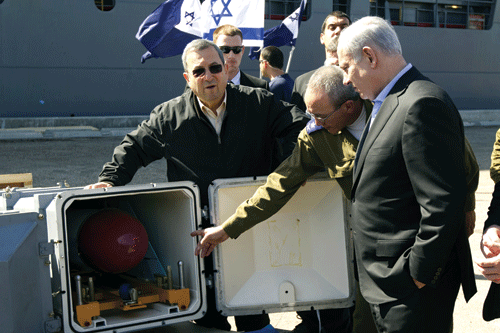
Then there is the recent passage of two Iranian navy vessels through the Suez Canal into the Mediterranean and the Israeli navy’s subsequent discovery in March of a smuggled consignment of arms and ammunition, including six C-704 anti-ship missiles believed destined for Hamas in the Gaza Strip. The missiles, though smaller than the C-802, could target Israeli shipping off Gaza as well as Israel’s Yam Tethys oil rig off the coast of Ashkelon. The oil and gas fields off the Lebanese and Israeli coasts look set not only to become a potential long-term source of wealth — but also a source of conflict in the years ahead.

Nicholas Blanford is the Beirut-based correspondent for The Christian Science Monitor and The Times of London


April 3, 2011 0 comments
0 FacebookTwitterPinterestEmail
Banking & Finance

Money matters bulletin

by Executive Editors March 28, 2011
written by Executive Editors

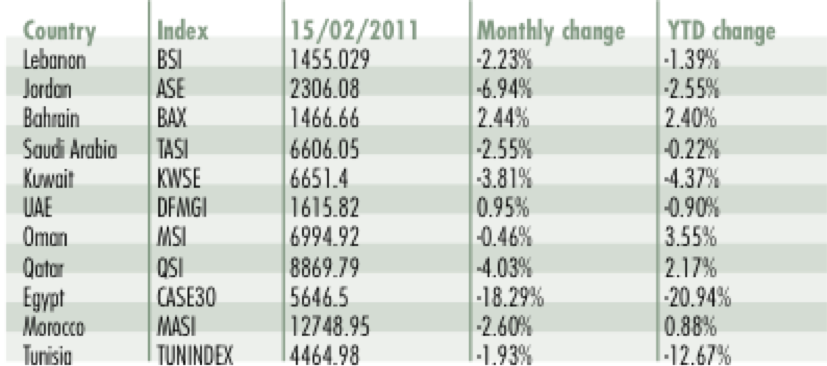
Regional stock market indices

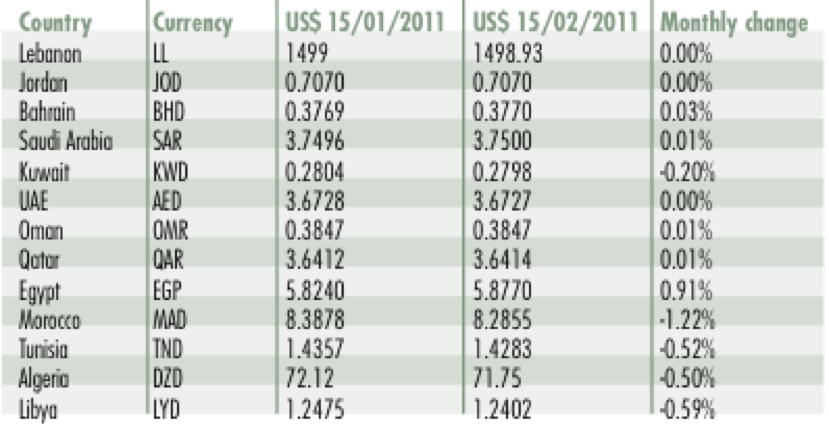
Regional currency rates

UAE developers down at end 2010

Real estate firms in the United Arab Emirates suffered from poor earnings results in the fourth quarter of 2010. Abu Dhabi-based Aldar Properties reported a net loss of $3 billion in the quarter, accounting for its overall $3.07 billion loss for the year. Sorouh Real Estate, Abu Dhabi’s second largest developer by market value, also posted a net loss of $54.18 million compared to a net profit of $7.65 million a year earlier, as its revenues for the last quarter of 2010 fell 51 percent to $58.26 million. Moving to Dubai, Emaar Properties, UAE’s biggest developer by market value, registered a 62 percent decline in net income during the fourth quarter of 2010 to $74.6 million, down from $196.03 million a year earlier. Union Properties’ fourth quarter net loss increased as well, climbing fivefold to $211.8 million compared to a loss of $40.29 million registered in the same period last year, due to losses on property valuations.

Saudi oil production to rise 15.4 percent by 2020

Saudi Arabia’s government stated that local oil production increased significantly during December 2010 to a two–year high of 8.365 million barrels-per-day (bpd), recording a 1.3 percent increase since November. Separately, Business Monitor International (BMI) forecasted a 15.4 percent rise in Saudi oil production between 2010 and 2020, with output reaching 11.4 million bpd by 2020. BMI also expects oil consumption in the Kingdom to increase 40.1 percent during the same period, to 3.91 million bpd. In the near term, BMI believes local oil demand will climb from an estimated 2.79 million bpd in 2010 to 3.38 million per day in 2015, accounting for 38.8 percent of the Middle East’s regional oil demand.

The region’s idiosyncratic unemployment enigma

The number of unemployed in the Arab world is forecasted to reach 19 million by 2020, according to Kuwait-based think tank, Arab Planning Institute (API). The Middle East and North Africa region has been suffering from sluggish labor markets for some time, despite the fact that the workforce is generally young and shows 3.5 percent growth per year, relative to an average 3.1 percent population growth since the 1980s. This favorable employment dynamic has, however, not been used to benefit the region’s development and most MENA countries still lag behind in female employment rates, with less than 40 percent of women eligible for work employed in the labor force. North African countries, however, generally score better in this category, as up to 65 percent of the female population is in the labor force. Another factor contributing to high unemployment in the Arab world is the few job opportunities available for the educated. For instance, up to 50 percent of the unemployed in Tunisia and 44 percent in Morocco have secondary and tertiary degrees, according to API. Under these conditions, a large percentage of people eligible for work become discouraged, excluding themselves from the labor force. Unemployment rates in MENA countries are thus somewhat skewed and expected to remain in the range of 11 to 15 percent over the next decade.      

March 28, 2011 0 comments
0 FacebookTwitterPinterestEmail
Banking & Finance

Regional equity markets

by Executive Editors March 28, 2011
written by Executive Editors

Beirut SE  

Current year high: 1,180.99    Current year low: 935.56

>  Review period: Closed Feb 28 at 936.99 Points                Period Change: -5.3%

More turmoil in the region, no cabinet and a real surprise in the United States going after a (non-listed) Lebanese bank for money laundering in a manner reminiscent of a B-movie: February was a month of few positives for Lebanese stock market investors. However, the BSE’s year-to-date performance of minus 3.6% is not too depressing, given the circumstances. Of the three largest stocks, developer Solidere closed the month in the mid $18s, Bank Audi came in at $7.11 and BLOM Bank at $9.14.

Amman SE 

 Current year high: 2,648.36                Current year low: 2,223.30

> Review period: Closed Feb 28 at 2251.73 Points               Period Change: -5.1%

With Libya and Yemen attracting the caravans of revolution-watching media, Jordan in February was not in the front row of international speculations over its future. The Amman Stock Exchange did not have an easy month, however. In the February review period, all sector indices pushed lower in tandem with the ASE general index, which is down 6% for 2011 so far. According to local media, a handful of investors took their cue from the popular protest handbook and staged a sit-in demanding dismissal of the head of the Jordan Securities Commission.

Abu Dhabi Exchange  

Current year high: 2,931.67                Current year low: 2,471.70

> Review period: Closed Feb 28 at 2,588.90 Points              Period Change: 0.1%

The richer emirate in the UAE was the only market in the GCC that did not drop in February. When seen across sectors, performance on the ADX was mixed; telecommunications ended the review period 4.3% higher while banking weakened 2.9%. But the real estate index suffered badly, dropping 19.9% and construction fell 12.2%. RAK Properties, Aldar Properties and Sorouh Real Estate all suffered double-digit share price losses, as did three financial stocks and Abu Dhabi Ship Building Co. Market cap leader Etisalat gained 3.9% but showed no progress on buying Zain.  

Dubai FM  

Current year high: 1,880.62                Current year low: 1,470.70

> Review period: Closed Feb 28 at 1410.70 Points               Period Change: -8.1%

Even directly after the Dubai World debt trauma, the DFM index did not slump as low as it did at the end of February 2011. With rampant talk of contagions from regional crisis spots, all DFM sector indices tended negative, with transport dropping 12% and real estate 13.3%. Utilities was the worst underperforming sector on the DFM for the review period, down 19.6%. Banking was a brighter spot, weakening only 1.8%. Market volatility in February reached 26.7%. On the year, the DFM index had given up 13.5% by Feb 28 close.

Kuwait SE  

Current year high: 7,575.00                Current year low: 6,319.70

> Review period: Closed Feb 24 at 6,481.10 Points  Period Change: -5.5%

The KSE benchmark index turned totally south in February. The regular market’s sector indices dropped on all fronts, led down by the investment index (-7.9%) and the industrial index (-7.7%). Bahrain’s Arab Insurance Group, which is cross-listed on the KSE, was also here a top gainer, up 21.1%. Shares in Mena Holding, a real estate firm with subsidiaries and projects in Egypt, lost more than 53%. The trading month in Kuwait was truncated Feb 24 as the country celebrated its 50th Independence Day.

Saudi Arabia SE  

Current year high: 6,929.40                Current year low: 5,538.72

> Review period: Closed Feb 28 at 5,941.63 Points              Period Change: -6.5%

Until Feb 14, the SASE Index stood firm but then the TASI fell nearly 700 points to the end of the month. For the year to date, this translated into a fall of 10.3%, the second worst year-to-date Gulf market performance after Dubai. Telecommunications and banking indices showed the weakest sector performances, falling 9.9% and 9% respectively. King Abdullah’s return from hospitalization abroad and his announcement of economic measures toward the end of the month had no visible positive impact.

Muscat SM  

Current year high: 7,027.32                Current year low: 6,058.11

> Review period: Closed Feb 28 at 6,142.42 Points                  Period Change: -10.2%

The MSM fell victim to political unrest and showed the worst drop of all GCC markets in February, wiping out the modest gains from January. Notably, the bourse’s average daily turnover was slightly higher than last month but losing stocks vastly outnumbered gainers. Volatility was substantial, at 21.5%. Within the MSM’s shock-induced downturn the banking sector fared worst, closing the month 18.6% lower. While there were no surprise gainers, investors in poultry specialist A’Saffa Food showed the biggest scare as the scrip fell 28.5%.

Bahrain Bourse  

Current year high: 1,605.98                Current year low: 1,361.19

> Review period: Closed Feb 28 at 1,430.77 Points              Period Change: -1.2%

It is an irony that will not escape careful observers: while Bahrain is being viewed as the GCC member with the greatest exposure to political protests and internal dissonance in Feb 2011, the BB remains the GCC exchange to drop the least in the year to date, at -0.1%. Even in February, market losses remained modest. However, turnover for the month fell about two thirds from January. Arab Insurance Group was the period’s best gainer, up 17.1%. Inovest, a real estate investment firm, slipped 39.6%.

Qatar SE  

Current year high: 9,242.63                Current year low: 6,647.18

> Review period: Closed Feb 28 at 7932.84 Points               Period Change: -9.3%

Like Saudi Arabia, Qatar was not a scene of unrest in February but like the TASI, the QSE Index took a steep downturn in the middle of the month, save for a brief respite on Feb 24. Owing to a share-price surge in early February, Masraf Al Rayan closed the month 8.5% up but the month’s unsuspected best gainer was Qatar Oman Investment Company. The bilateral company, with stake holdings by the two governments, gained 9%. Barwa Real Estate and National Leasing Holding Co underperformed the market with respective losses of 20.8% and 25.6%.

Tunis SE  

Current year high: 5,681.39                Current year low: 4,058.53

> Review period: Closed Sept 23 at 4,058.53 Points                            Period Change: -10.86%

The price of real freedom is never too high and even if the benchmark Tunindex of the TSE closed February 28 down 22.2% since the start of 2011 and 29.6% down from its year high in October 2010, it is far too early to open a cost-benefit calculation on the changes Tunisians initiated in January. The TSE, which had been closed for half a month until Jan 31, could easily have tumbled worse in Feb and there seems to be no historic benchmark for an average post-revolutionary stock market performance.    

Casablanca SE  

Current year high: 13,397.47              Current year low: 10,938.64

> Review period: Closed Feb 28 at 12,805.81 Points                              Period Change: 1.72%

Isn’t Casablanca in revolutionary North Africa? Political prospects on the region notwithstanding, Morocco’s benchmark MASI ended the review period with an upswing that made February into a typical V-month for its investors. The index lost 500 points in the third week of the month and regained them in the fourth. No trouble on the real estate front, it seemed, where Groupe Addoha climbed 5.9%.

Egypt SE  

Current year high: 7,603.04                Current year low: 5,647.00

> Review period: Closed at 5,467.00 Points (Jan 27)                        Period Change: N/A

The only events of record in the EGX during the month of February were postponements; there were several announcements that the bourse would reopen shortly, only to be rescinded before their implementation. The market, which recorded its last session close to date on January 27, has been shuttered for more than 20 regular sessions. The central bank kept pressure on the Egyptian Pound in check throughout Feb and banks returned to serving customers, but with increased controls on transfers.

March 28, 2011 0 comments
0 FacebookTwitterPinterestEmail
AdvertisingSpecial Report

Cooperate to elevate

by Executive Editors March 28, 2011
written by Executive Editors

Over the years I’ve come to the conclusion that the ad industry has endured a lot of finger-pointing but not enough autopsy; a tendency for mudslinging instead of progress through cooperation.

Our region lags behind on so many practices prevalent in more mature and sophisticated markets, the per capita ad spending remains to be among the lowest across the globe and the level of confidence among marketers that advertising relates to growth remains timid.

However, the interesting aspect of this region is in its opportunities: it sits conveniently at the cross-roads of the rising East and the experienced West, with strong economic capabilities and young dynamic populations. Furthermore, the longer term positive effects of the current political change sweeping key Arab states will bring with it better governance, healthier business environments and hopefully a fairer distribution of wealth.

This begs the question of whether the advertising industry, with all its disciplines, will be able to lead and contribute to the process of change or will this industry remain hostage to the transactional cage built by lingering practices of the 1980s and the rising power of procurement, thereby leading to another “lost decade”?

Crafting the answer is the equal responsibility of all stakeholders.

The recent developments in data mining technology, as well as the transfer of frameworks from the science of operations research, has proven beyond a doubt that advertising can and will affect growth — and not just in consumer packaged-goods industries.

Concurrently, agency networks for the past few years have been showing solid commitment to the region by increasing equity holding in the local entities that carried their trademarks. That can only be good news, because if anything it means a “system upgrade” in various ways:

• Upgrade of agency services by transferring learning and experiences from mature markets while offering multinational corporations the ability to sync local activities with global.

• Upgrade of the financial practices and corporate governance, ushering-in higher levels of accountability with the implementation of global best-practice and tools.

• Upgrade of the terms that govern a client-agency relationship, ensuring a fine balance between trading strength and ideas that deliver business solutions.

As the agency reform takes shape it is acting as a catalyst for change. In order for it to take full swing, it requires an embrace from the other side of the spectrum: the marketing community. For advertising to contribute to growth it has to be measured; the good news is that agencies have developed the know-how to do that. Now it’s up to the marketers to increase investment in measuring every aspect of their activities and develop a much greater confidence in entrusting their agencies with access to such gems.

Eventually as we move toward an environment of “advertising that works,” marketers will want to measure value and not just efficiencies. The practice of advertising will become more focused on business results and less focused on the mundane marketing and advertising key performance indicators.

More importantly, when selecting their agency partners, marketers would want to differentiate between those that only offer a transactional solution and those that are capable of contributing to growth — this is key to the success of the partnership, as agencies that understand and contribute to growth cannot survive or operate on remuneration schemes prevalent in a trading/procurement environment that is focused on driving efficiencies in paid media.

Against all odds, and despite the fact that the industry still suffers from underdevelopment on a number of fronts, this region has always been credited for being entrepreneurial. In fact we’ve seen over the years many a high-profile marketer willing to experiment in unchartered territories.

In avoiding the fate of the “lost decade,” the advertising industry, with the participation of all its stakeholders, has the golden opportunity of experimenting with a reformed relationship that focuses on growth as the basis for all conversations.

If this proves to be successful — and it will — it carries the potential of being a global best practice exported out of this region.

SHADI KANDIL is managing director of OMD UAE

March 28, 2011 0 comments
0 FacebookTwitterPinterestEmail
Economics & Policy

Finance ministries must rise to the challenge

by Executive Editors March 27, 2011
written by Executive Editors

Nabih Maroun is a partner, Jihad Azour a senior executive advisor and Mazen Ramsay Najjar a principal at Booz & Company

The global financial crisis may be in the rearview mirror but it’s not yet out of sight. This is particularly true for emerging markets. The BRIC economies (Brazil, Russia, India and China) have returned to warp-speed growth, yet they remain susceptible to external shocks that could threaten their economic expansion and erode their fiscal foundations.

Russia is vulnerable to swings in the price of oil, Brazil to commodity prices and India and China to global demand. China faces additional challenges from potential changes in exchange policy, which could have ramifications for its trade position. All four countries are facing massive capital inflows and overheating, with monetary policies not effectively aligned with fiscal policies. Also, they lack standardized, consistent public statistical data, which renders their economies largely opaque to outsiders.

The emerging economies of the Arab Gulf are in a similar situation; they are strong but with key vulnerabilities. Wealth from natural resources has sheltered these countries from the worst of the financial crisis and, unlike most developed economies, they have maintained fiscal surpluses.

However, the Gulf countries have made significant overseas investments in recent years through government related entities or sovereign wealth funds, which have exposed them to contingent risks arising from the crisis, and have yet to figure out an approach for managing those assets.

These countries also suffer from a lack of transparent economic statistics that would allow an independent evaluation of their economic and fiscal situations, particularly those related to state-owned enterprises, which represent in many cases the bulk of their economies. They also have public sectors that are top-heavy and less productive than they could be.

Good governance

Finance ministries have a key role to play in addressing the challenges emerging in the post-crisis period. Yet, as in other parts of the world, the finance ministries in these emerging markets now have a vastly expanded slate of responsibilities. They still retain their traditional role of public finance management, by controlling taxes and spending at the national level, but finance ministries now must also oversee the sizable assets that many countries had to buy in order to stabilize their economies, such as banks, securities and manufacturers. They are increasingly responsible for economic management — ensuring that the national economy is enjoying healthy growth in the face of a weak global recovery — while preserving the stability of their financial sectors.

In conjunction, they must enhance accountability and transparency measures in order to boost confidence in their countries’ economic stewardship and to strengthen their fiscal credibility. In short, finance ministries must do more, and address more complex issues, than at any time in recent economic history.

Finance ministries in emerging markets have taken some noteworthy steps to address their fiscal and economic vulnerabilities head-on.

India centralized its public debt in 2009 in a newly created debt office.  Brazil consolidated its debt and liquidity management functions, amended its fiscal law and opened its budget to public scrutiny. China updated its budget management law (though questions remain about the quality of its economic data). In the Gulf, the United Arab Emirates, Saudi Arabia and Kuwait have all taken steps to streamline their public sectors, by outsourcing certain non-core government functions, restructuring some municipal agencies and privatizing others.

The UAE has strengthened its debt management and risk-management functions and established stabilization funds and facilities. Qatar is reviewing its regulation and supervision framework for the financial sector and Kuwait recently introduced risk assessment and early-warning capabilities to safeguard the stability of its banking sector.

Although these are laudable measures, their degree of success has been marginal because they represent isolated steps taken by ministries that continue to operate within the same setup they employed before the crisis.

Instead, finance ministries need to make more sweeping, fundamental reforms in their institutional setup and operational capabilities. There is no one-size-fits-all approach to reform of this scope and magnitude. Instead, priorities will vary widely, depending on the fiscal and economic situation in each country.

In that light, the finance ministries in BRIC countries have three clear imperatives. First, they must quantify and mitigate contingent risks within their economies, such as swings in commodity prices, currency fluctuations, private demand and financial exposure, among others. Second, these countries must make their economic systems more transparent. This requires accepting independent opinions — such as those of parliament, specialized agencies, or markets — on economic targets and fiscal and expenditure projections. Third, BRIC finance ministries must better coordinate fiscal and monetary policies. Without such coordination, they will continue to experience volatile economic swings, often requiring corrective measures with high costs.

Gulf priorities

The imperatives for finance ministries in the emerging countries of the Arab Gulf are significantly different. Their greatest priority is to develop institutional capabilities in the management of modern budgets, public debt and state-owned assets — in some cases by using talent and techniques borrowed from the corporate world.

In addition, these ministries should implement more rigorous and transparent economic statistics, which will significantly improve the quality of policymaking and encourage accountability. They must also continue to improve the productivity of government operations. 

These reforms will not be easy to implement, but finance ministries have few alternatives. More important than any single policy measure, they must rethink their overall operating and institutional models and develop new capabilities that are more in line with their expanded slate of responsibilities. Only by developing the right set of instruments for fiscal, debt, and asset management, along with risk prevention tools, will they be able to navigate the post-crisis economy, signal a clear commitment to economic stability and allow their countries to truly thrive.

Finance ministries need to make more,sweeping, fundamental reforms in their institutional setup

March 27, 2011 0 comments
0 FacebookTwitterPinterestEmail
AutomotiveSpecial Report

Samir Homsi

by Executive Editors March 27, 2011
written by Executive Editors

Samir Homsi, president of the Automobile Importers Association, the industry representative of car dealerships in Lebanon, recently sat down with Executive to discuss possible alternatives to conventional gas-fueled vehicles.

  • What do you think of the Ministry of Energy and Water’s proposal for compressed natural gas (CNG) vehicles?

There has been a lot of talk to make new rules, which we need badly. The subject of what to use as fuel has been discussed by the association and also in the parliament with [head of the Parliamentary Energy and Public Works Committee, Mohammad] Qabbani there was a lengthy discussion of what kind of fuel should be used. Our opinion is that while the use of [CNG] cars may be economically beneficial to the user it will be a dangerous alternative, especially in Lebanon. In France — the pioneers — they were using [CNG] fuel in cars but today we see the French getting out of that by using Euro 4 and Euro 5 standard gasoline instead. At any rate, our opinion is to use cleaner gasoline. Obviously our gasoline should be better quality and [we] should import better gasoline with less sulfur for modern vehicles with high Euro-grade standards.

  • Iran, India, Pakistan and Egypt have all adopted CNG. Why not here?

We need to check with what Europe is using. We do not need to copy Egypt or anyone else. For CNG there have to be re-filling stations, but what about being stationed in the middle of Beirut? In Europe they are outside of the cities, far from houses and living places. Can you imagine this in Ashrafieh?

  • What is your stance on the proposed law to allow for the importation of hybrid vehicles?

Hybrids are definitely the future; we expect within two years to have at least half of the members of the association importing hybrids. They are very expensive now and should be less expensive in two years because battery costs will go down slightly. This is where the Ministry of Finance had a good idea for the environment to reduce taxes on four-cylinder hybrid cars.

  • Do you think the government should financially assist consumers to trade in old pollutive vehicles for newer, more fuel-efficient cars?

Part of the plan is to do what Europe is doing but it is not in the government’s budget to pay for cars to be scrapped, as the United States has also done during a certain period. This could be done here with aid from Europe and was proposed directly by us and they were ready to participate in the program. We had a meeting a long time ago with the finance minister and together said, ‘Why don’t we do this with the European Commission?’ It also could be done by asking for aid from USAID [United States Agency for International Development].

  • Do you think the proposed law to allow for the import of environmentally friendly diesel should be expanded to include private vehicles?

I am for the import of clean diesel but not for passenger cars or taxis. The new law is conditional on the proper distribution of diesel, as otherwise, in one year, cancer rates would be up, you will have hell and not see Beirut from any point due to the smog.

  • What more can be done to rein in pollutive vehicles?

I have recommended to [now caretaker] Interior Minister Ziad Baroud, as he took a very positive step to limit accidents and speeding with radars, to also have the same system applied to photograph polluting cars and give them fines. Implementation of force on roads is practically nil so maybe an alternative is to have cameras.

  • Catalytic converters removed from used cars before importation to Lebanon is one cause of unnecessary fuel emissions. What do you think of this legal requirement?

The law that a catalytic converter should be removed before import should end. I’m not sure how this stupid law came into effect.

March 27, 2011 0 comments
0 FacebookTwitterPinterestEmail
Finance

Banking Special Report, 2011

by Executive Staff March 26, 2011
written by Executive Staff

A word with leading Lebanese banking luminaries: Bank Audi’s Chief Financial Officer Freddie Baz, Byblos Bank’s General Manager François Bassil and Saad Azhari, chairman of BLOM Bank discuss the state of the country’s banking sector amid a gloomy economic outlook

March 26, 2011 0 comments
0 FacebookTwitterPinterestEmail
  • 1
  • …
  • 385
  • 386
  • 387
  • 388
  • 389
  • …
  • 696

Latest Cover

About us

Since its first edition emerged on the newsstands in 1999, Executive Magazine has been dedicated to providing its readers with the most up-to-date local and regional business news. Executive is a monthly business magazine that offers readers in-depth analyses on the Lebanese world of commerce, covering all the major sectors – from banking, finance, and insurance to technology, tourism, hospitality, media, and retail.

  • Donate
  • Our Purpose
  • Contact Us

Sign up for our newsletter

    • Facebook
    • Twitter
    • Instagram
    • Linkedin
    • Youtube
    Executive Magazine
    • ISSUES
      • Current Issue
      • Past issues
    • BUSINESS
    • ECONOMICS & POLICY
    • OPINION
    • SPECIAL REPORTS
    • EXECUTIVE TALKS
    • MOVEMENTS
      • Change the image
      • Cannes lions
      • Transparency & accountability
      • ECONOMIC ROADMAP
      • Say No to Corruption
      • The Lebanon media development initiative
      • LPSN Policy Asks
      • Advocating the preservation of deposits
    • JOIN US
      • Join our movement
      • Attend our events
      • Receive updates
      • Connect with us
    • DONATE