• Donate
  • Our Purpose
  • Contact Us
Executive Magazine
  • ISSUES
    • Current Issue
    • Past issues
  • BUSINESS
  • ECONOMICS & POLICY
  • OPINION
  • SPECIAL REPORTS
  • EXECUTIVE TALKS
  • MOVEMENTS
    • Change the image
    • Cannes lions
    • Transparency & accountability
    • ECONOMIC ROADMAP
    • Say No to Corruption
    • The Lebanon media development initiative
    • LPSN Policy Asks
    • Advocating the preservation of deposits
  • JOIN US
    • Join our movement
    • Attend our events
    • Receive updates
    • Connect with us
  • DONATE
Comment

In search of Syrian solidarity

by Anant Damir April 3, 2011
written by Anant Damir

In the initial days of protests in Daraa, on March 13 and 14, several friends and I began to discuss a strategy for how we could contribute to the cause. An organic uprising had been spawned after the secret police’s arrest weeks earlier of schoolchildren accused of scrawling a wall with anti-regime graffiti.

As a journalist, I had the resources to inform members of the press as to what was occurring on the ground. For one week, we facilitated the spread of information, providing news outlets small and large with video and first-hand accounts of both the demonstrations and the violence used to suppress them. We also created a Facebook group with information and links detailing what was happening and where.

On March 22, however, the abuses of Bashar al-Assad’s regime against which thousands were demonstrating in Daraa and elsewhere in Syria touched home. Simultaneously, a friend’s house and our office was broken into and ransacked. My friend was arrested; when he called, asking us to meet with him, we suspected correctly that it was a trap.

The experience puts into sharp relief the dangers of civic mobilization in Syria and the stunted growth of political expression in the country. Whereas in Tunisia and Egypt — though they were a far cry from free societies before the revolutions — a degree of discourse was possible, Syria is in its infancy when it comes to its citizens engaging one another in debates on national identity. Though some were already circumventing Internet censorship laws, access to social media websites such as Facebook was only granted in February [for more, see comment page 12 and story page 30]. Because of this muzzle, the only formal opposition to the Baath party line has come from the old guard of political resistance: the groups who signed the Damascus Declaration for Democratic National Change in 2005.

These are well acquainted with the heavy hand of dictatorship; combined, they have spent many lifetimes in jail. Laudably, they have devoted their lives to their cause, but now that opposition in Syria has adopted a populist dimension they must open themselves up to a dialogue that incorporates Syria’s disparate voices, be they Sunni, Alawite, young, old, pro-or anti-regime. The old guard has entered the “Arab Spring” with the mindset that they have nothing left to lose. But most of those on the streets of Daraa, Latakia, Damascus and elsewhere have everything at stake. They are not lifelong activists but people searching for a voice in their society, with lives to lead outside of politics.

President Bashar al-Assad has attempted to use the sectarian divisions within Syria in his favor. Should his clasp slip, Syria would descend into an ethnically-motivated struggle for power between the Sunni majority and Alawite, Christian and Druze minorities, or so the line goes. Political adviser to the president Bouthaina Shaaban has been playing up these fears, calling the destruction of “peaceful coexistence” the true aim of the protesters. And in Latakia we have seen the real dangers, as the shabiha, notorious Alawite gangsters close to the Assad family (who may or may not be acting on their orders) killed up to 21 people on March 26.

Together with the diverse sectarian makeup of Syria is a multiplicity of desires within the populace. Some chant for the downfall of the regime, but most desire substantial reforms — an end to emergency law and to Article 8, which prohibits alternatives to the Baath Party. And some wish for no political change at all. At its present juncture, nobody has the right to speak for the movement. For the opposition, the true challenge is to respect and heed these myriad voices. One positive indication of the potential for civic engagement and dialogue lies in the example of the proposed “Personal Status Draft Law” in late-2009. A regressive, sharia-based effort to restrict citizens’ rights (particularly for women), it was eventually abandoned due to a widespread outcry against it on the radio, on blogs and from human rights organizations. Though one of the few examples of successful and diverse political participation, it could be a lesson to reformers still stuck in the absolutist terms of the past; despite differences in experience, there is common ground to be shared beyond the overthrow of the regime. 

Without a gathering of opinions, Syrians will be tinder for the sectarian firestorm that Assad is happy to stoke.  

ANANT DAMIR is the pen-name of a Syrian freelance journalist based in Damascus


April 3, 2011 0 comments
0 FacebookTwitterPinterestEmail
Society

Q&A – Vahe Torossian

by Executive Staff April 3, 2011
written by Executive Staff

Vahé Torossian is the corporate vice president of the Worldwide Small and Midmarket Solutions and Partners (SMS&P) group at Microsoft. On a recent visit to the region he sat down for an exclusive one-on-one interview with Executive in Beirut where he talked about how the company is adapting to regional events, and its role supporting small and medium sized businesses in the Middle Eastand North Africa.

You’ve come to the region at an exciting time in history. How has Microsoft reacted to what’s been happening here?

The way that we are looking at the situation today is [to see] what we can do from a business and an IT leadership perspective to help mitigate the [economic] impact and, whenever the economy recovers, help the small and medium enterprises [SMEs] and public sector to recover as fast as possible.

How many staff do you have in Tunisia, Libya and Egypt?

Over all in North Africa it’s about 200 people.

What were some of the projects Microsoft was pursuing in those countries?

Most of the times in these places they are sales marketing and services organizations… there are [a] few that are doing development or engineering types of jobs.

So the customers were mostly the government and government entities?

Yes, that’s right.

A lot of Western and multinational companies have done business with regimes that are known to be human rights abusers and who suppress democratic movements and political opposition. How would Microsoft, one of the largest corporations in the world, reconcile the ethics of working witha regime like that?

I think that Microsoft is very well known in the world in terms of affixing values and of course human rights protection, but we need to be clear that the role of a company like Microsoft is to stay at a level that it should be on, which is to say not engaging in any type of political consideration.

[We] are in countries where there are international rights to do business. Once you are there, if you have an organization in the country which is not respecting intellectual property, what you want to do is to help the government understand that if they establish [anti-piracy legislation] and then enforce it they can bring wealth to the country, increasing taxes and reducing the ‘brain drain.’  Most of the countries you are talking about have had years of talent moving out, especially the younger generation because nobody wants to stay in a country where you can’t protect an invention.

So it’s a business role…

It’s a business but also a citizenship role… We ask two things [of our] general managers anywhere in the world. One thing is, of course, that you run your operation, bring in a profit, develop your people, attract talent and so on, but there’s [another] component which is what you are contributing to the society. We always say 30 percent of your time as a general manager needs to be [spent on] what you are giving back to your country.

[It could be] based on education, giving free some software to a university, for schools, or educating people, helping them be aware of some of the risks found in some countries… or helping parents to be aware of what their kids can do on the Internet and how to protect them. After disasters, for example, we have always given free time [for employees] to be in the street, helping to reconstruct.

Today, I met with the municipality of Beirut and had the chance to share some of my experience of working with municipalities around the world and helping to fix some critical problems. We were talking about, for example, the parking situation, traffic, how to file a complaint on the internet, how to print a visa. All these things are part of a contribution to society but are not necessarily related to the business perspective. It’s about how we are lucky to be educated and how we can bring these things back to the society.

Most small and medium-sized businesses use the Internet. Here in Lebanon we’ve recently been ranked last place in the world out of 185 places in download speed and 184th in upload speed; does that limit the effectiveness of products that Microsoft could bring to the Lebanese market to help SMEs?

For sure, as cloud computing and online Internet services are increasing, the capacity of broadband is going to be critical. In this case [our role] is really to go to the government to explain that there is a huge opportunity to bring back talent and that the bottleneck is going to be inevitable, and what should be done with a telecommunications operator… to accelerate [closing] that gap.

Today people are using multiple devices — it’s not only the PC. You might have phones, tablets, or different types of formats. It is difficult to use these devices to accelerate the development of more opportunities [with poor] broadband, so that’s why in a country like Lebanon the broadband is going to be the bottle neck of expansion.

There are multiple ways to use technology when you observe the behaviors of citizens, and so you fix a problem, and most of these are SME applications. For example, I was mentioning this morning an example in Estonia where you have a concept of e-parking; you use your phone when you want to park your car. You park your car and put in your [license] number and there’s an application that will help you to pay; when the police come they can just check the terminal to see if you have paid to park or not.

How are you adopting your strategy in the MENA to compensate for recent events and the fact that we don’t actually know what is going to happen next with events progressing so rapidly?

We are reinforcing in the places where we are [already], and allocating resources to accelerate the growth and to compensate in the places where we might be behind.

There are still some businesses that are operating [in states hit by unrest] and they [still] have to consume [Microsoft product] licenses because they are still recruiting people, they are still invoicing, and for these ones we try to make sure they are all using genuine operating systems and genuine software, because the piracy rate is quite high in emerging markets; Lebanon is around 72-74 percent, which is quite high.

The technology business was really rocked when the Egyptian government completely shut down the Internet. How do you adapt to the fact that the system on which all your products are based could one day be completely shut down?

Usually we have highly secured lines and we have redundant lines that help us to recover very quickly from this type of [event]. When the tsunami hit Southeast Asia [in 2004], all the cables which were under the sea were destroyed but it took us just 48 hour to find new paths for the employees in Southeast Asia to reconnect to the Internet. Because of that we were able to allow the citizens to find their families and lost friends and so on.

If a country decides to close the Internet and protect its borders there is not much you can do. But experience shows that it’s never a long-term situation; it’s always fixed at some point of time. Today as a country you can’t close off the internet for too long; there will be a revolution!

April 3, 2011 0 comments
0 FacebookTwitterPinterestEmail
Society

Book review: Middle East Patterns

by Executive Staff April 3, 2011
written by Executive Staff

Places, People, and Politics (5th edition)

A book by Colbert Held and John Cumming

People who are not from the region are often puzzled by the Middle East. To outsiders, and to some locals as well, the perennial problems in Cyprus, Palestine, Israel, Iran or Lebanon, and the current events in places such as Bahrain, Egypt, Iraq, Libya or Yemen may seem impenetrable. This, along with the strategic, political and cultural importance of the region, is why a new edition of Middle East Patterns is especially welcome.

The book, which examines the region’s history, geography, international relations and economics, is co-authored by Colbert Held and John Cummings, Americans who are anything but strangers to the area. Held was employed for 15 years as a United States Foreign Service officer, with assignments in Iran, Lebanon and Saudi Arabia, as well as many temporary missions throughout the region; Cummings, who has taught economics at universities in Iraq and the United States, spent nearly three decades in the Middle East working with the US government and the World Bank.

Despite its many incarnations, the basic framework of Middle East Patterns has remained consistent over the last three decades; the examination of the whole region first from a topical perspective and then country-by-country is successfully preserved in the latest version. The region’s ethnographic, economic and geopolitical patterns, with a focus on natural resources, are well covered. On top of this, the book is now enriched by a new economic emphasis: in addition to looking at the “places, peoples and politics” invoked by its subtitle, the fifth edition contains fresh material on socio-economic development and political economy, which in turn complements new sections on topics such as terrorism and piracy.

Syria is the first to be considered — in a chapter tellingly entitled “Middle East Heartland,” ending with a wise summary of the country’s position today: “Despite its own ambiguities, and despite the external efforts to marginalize it, Syria persists as a key historical and geopolitical player in the region.”

While outside perceptions often fail to take into account the region’s true complexities, Middle East Patterns presents a comprehensive and unbiased picture of its nations. The chapter on Iran in particular is a healthy antidote to Western vituperation of countries in the region whose policies are uncongenial, not to mention the oversimplification by foreign media of things Middle Eastern.   

Also including a thorough bibliography, many tables, a copious index and numerous footnotes, the book is no intellectual lightweight. (The current version of Middle East Patterns is weighty in the literal sense as well, having gained more than 40 pages on the 646 pages of the 4th edition, which was published in 2006.)

So whether for a foreign student, a globetrotting manager of a multinational, or just a Western television viewer tired of hearing the region summed up in clichés, Middle East Patterns is a valuable reference. And for a serious non-regional reader who is ready to consume well-written books cover-to-cover but only has time to look at one volume on the Middle East, the work of Held and Cummings could be the best bet. But the best compliment that can be given to Middle East Patterns is that it can also be read, with great interest, by a Middle Easterner.

April 3, 2011 0 comments
0 FacebookTwitterPinterestEmail
Economics & Policy

Executive Insight – Carbon neutral skies in Middle East Aviation

by Alessandro Borgogna April 3, 2011
written by Alessandro Borgogna

Like many other industries, the global aviation sector is preparing for a future in which increasing financial and political pressureswill be brought to bear on the issue of climate change.

Airline operators are putting together plans to cut emissions of carbon dioxide and other greenhouse gases, and these changes may squeeze consumers and businesses in the Middle East, through higher fares, reduced routes and fewer services.  But focusing only on these short-term pain points ignores the tremendous economic opportunities the industry’s transformation could bring to those nations that act first to reposition themselves for competition in a carbon-constrained world. Developing countries have unprecedented access to financial support to help them begin this transition and offset rising costs. The extent to which they take advantage of these funds may determine whether the region can capitalize on the new industries and jobs that will likely result.

The European ETS deadline

The carbon conversation has been slow to reach the aviation sector, due to its relatively small contribution to global emissions (some 2 percent, according to the United Nations), but a near-term deadline has captured the industry’s attention. In January 2012, aviation will be held accountable for its emissions under the European Union Emission Trading Scheme (ETS). The only global effort so far to attempt to include the aviation sector in a carbon-compliance trading system, the ETS mandates that any airline operators flying in and out of the continent — regardless of where they are based — will have to offset their related carbon emissions above a fixed allowed amount.

Air transport emission growth

If extension of the ETS goes on as planned, Middle Eastern airline operators will have to choose between passing on their higher costs to passengers, mitigating them through voluntary offsets purchased by passengers or reducing their profits for the sake of price competitiveness. The global air transport industry has filed a legal challenge to the EU’s plan — but regardless of its outcome, Middle Eastern airlines are still likely to face pressure due to growing global recognition of the sector’s rising importance in the fight against climate change.  In 2009, the International Air Transport Association (IATA) pledged to achieve carbon-neutral growth beginning in 2020; the International Civil Aviation Organization (ICAO) followed last year with a similar goal.

While the 1997 Kyoto Protocol exempted aviation when it affirmed the ETS as the most efficient and effective way to achieve global greenhouse emission reductions, consistent 4 percent to 5 percent annual growth in global air passenger traffic over the last decade has put the sector very much in the spotlight as countries work toward a post-Kyoto agreement.

Opportunities in low-emission

Fortunately, the international accords reached in Copenhagen in 2009 and Cancun in 2010 supported low-carbon investments in developing nations. The platforms for these initiatives are called low-emission development strategies (LEDS), which involve short-term mitigation steps (called ‘nationally appropriate mitigation actions,’ or NAMAs) and more structural mid-to-long-term changes (‘national adaptation programs of action,’ or NAPAs). The LEDS platform represents a tremendous opportunity for the Middle East, and particularly for its aviation industry. Airline operators can now implement emission-reducing projects and receive marketable carbon credits in return, or they can coordinate a larger scale transformation and apply for funding through the NAMA framework.  Thanks to these new efforts, emissions-reducing projects don’t have to break the bank. Projects can either be co-financed or fully financed through a growing pool of internationally available funds. The Copenhagen accord of 2010 established $30 billion in fast-start financing for such projects, and delegates meeting in Cancun last year committed to expanding that amount so that $100 billion in new and additional funds are made available every year by 2020.

Plan of action

Rather than wait to see if they will be forced to comply with the European ETS next year, aviation operators in the Middle East should start laying the groundwork now to get ahead of coming regulations and to investigate the possibilities of breakthrough changes in the fast-growing market for alternative fuels. This can be accomplished through three broadsteps:

Take short-term actions to “clean house”

Fleets operated by Middle East airlines are newer, and hence more efficient, than their European counterparts’, which will help to blunt the impact of the ETS if it is enforced. Still, there is ample room to improve the overall efficiency of the air-traffic system and ensure that all carbon waste is eliminated. Flight delays and aircraft congestion are principal contributors to the aviation sector’s inefficient energy use; these can be dramatically reduced by enhanced cooperation between civil and defense aviation organizations, alongside other regional efforts to optimize aircraft routing. In addition, existing aircraft lease contracts should be reviewed to eliminate the most inefficient parts of the fleet.

Enhance government-industry ties

Operators should engage their governments to ensure that they assume an active role in formalizing a LEDS for the sector that is focused on activities that qualify for NAMA or NAPA support. This will allow the industry to realize carbon credit returns on capital invested and, where applicable, access international carbon finance funds. Ideally, designing a LEDS should be a country’s first step, laying the foundation for future activities, but this may not always be possible. Developing a LEDS is a long and evolving process, and it may make more sense to weave the LEDS approach into existing carbon-reducing activities and use it as the basis for future growth.

Define the business case for bio-fuels

Barring any quantum-leap breakthroughs in aircraft design, the most promising opportunity for emissions reductions in the aviation sector is in bio-fuels, which produce up to 80 percent fewer carbon emissions than fossil fuels over their lifecycle (provided they are grown locally). At least 10 airlines outside of the region have already conducted successful flight tests with feedstocks ranging from sugarcane to jatropha (a type of shrub) to coconuts. Jatropha, in particular, holds immense promise for the region, as it is a non-food crop that can grow in desert climes and does not require much irrigation.  Middle East airline operators are right to be concerned about their profits and competitiveness as the deadline looms next year for compliance with the European ETS. But there are bigger forces in play, and focusing on this factor alone may cost them the chance to seize the opportunities that are emerging with the evolution of carbon finance markets. Middle Eastern airlines have been growing at a much faster pace than global benchmarks, if that growth is to continue then the region’s operators and regulators will need to plot a course for competing —and prevailing — in a carbon-constrained future.

April 3, 2011 0 comments
0 FacebookTwitterPinterestEmail
Banking & Finance

Money matters bulletin

by Executive Editors March 28, 2011
written by Executive Editors

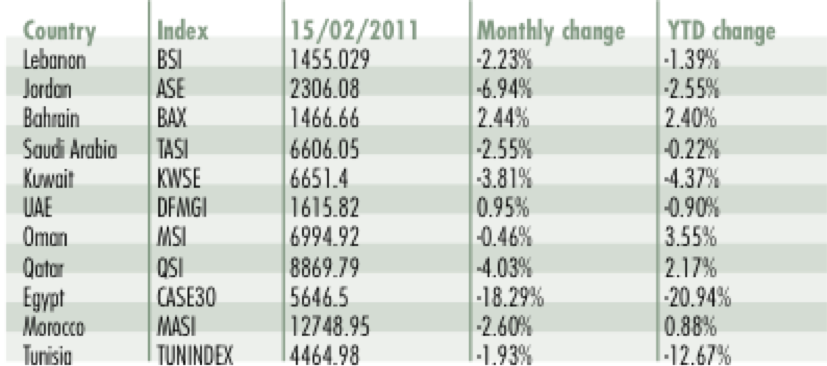
Regional stock market indices

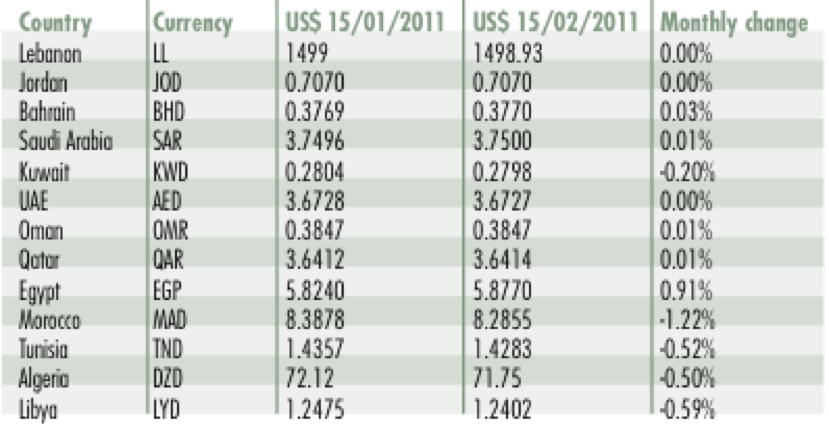
Regional currency rates

UAE developers down at end 2010

Real estate firms in the United Arab Emirates suffered from poor earnings results in the fourth quarter of 2010. Abu Dhabi-based Aldar Properties reported a net loss of $3 billion in the quarter, accounting for its overall $3.07 billion loss for the year. Sorouh Real Estate, Abu Dhabi’s second largest developer by market value, also posted a net loss of $54.18 million compared to a net profit of $7.65 million a year earlier, as its revenues for the last quarter of 2010 fell 51 percent to $58.26 million. Moving to Dubai, Emaar Properties, UAE’s biggest developer by market value, registered a 62 percent decline in net income during the fourth quarter of 2010 to $74.6 million, down from $196.03 million a year earlier. Union Properties’ fourth quarter net loss increased as well, climbing fivefold to $211.8 million compared to a loss of $40.29 million registered in the same period last year, due to losses on property valuations.

Saudi oil production to rise 15.4 percent by 2020

Saudi Arabia’s government stated that local oil production increased significantly during December 2010 to a two–year high of 8.365 million barrels-per-day (bpd), recording a 1.3 percent increase since November. Separately, Business Monitor International (BMI) forecasted a 15.4 percent rise in Saudi oil production between 2010 and 2020, with output reaching 11.4 million bpd by 2020. BMI also expects oil consumption in the Kingdom to increase 40.1 percent during the same period, to 3.91 million bpd. In the near term, BMI believes local oil demand will climb from an estimated 2.79 million bpd in 2010 to 3.38 million per day in 2015, accounting for 38.8 percent of the Middle East’s regional oil demand.

The region’s idiosyncratic unemployment enigma

The number of unemployed in the Arab world is forecasted to reach 19 million by 2020, according to Kuwait-based think tank, Arab Planning Institute (API). The Middle East and North Africa region has been suffering from sluggish labor markets for some time, despite the fact that the workforce is generally young and shows 3.5 percent growth per year, relative to an average 3.1 percent population growth since the 1980s. This favorable employment dynamic has, however, not been used to benefit the region’s development and most MENA countries still lag behind in female employment rates, with less than 40 percent of women eligible for work employed in the labor force. North African countries, however, generally score better in this category, as up to 65 percent of the female population is in the labor force. Another factor contributing to high unemployment in the Arab world is the few job opportunities available for the educated. For instance, up to 50 percent of the unemployed in Tunisia and 44 percent in Morocco have secondary and tertiary degrees, according to API. Under these conditions, a large percentage of people eligible for work become discouraged, excluding themselves from the labor force. Unemployment rates in MENA countries are thus somewhat skewed and expected to remain in the range of 11 to 15 percent over the next decade.      

March 28, 2011 0 comments
0 FacebookTwitterPinterestEmail
Banking & Finance

Regional equity markets

by Executive Editors March 28, 2011
written by Executive Editors

Beirut SE  

Current year high: 1,180.99    Current year low: 935.56

>  Review period: Closed Feb 28 at 936.99 Points                Period Change: -5.3%

More turmoil in the region, no cabinet and a real surprise in the United States going after a (non-listed) Lebanese bank for money laundering in a manner reminiscent of a B-movie: February was a month of few positives for Lebanese stock market investors. However, the BSE’s year-to-date performance of minus 3.6% is not too depressing, given the circumstances. Of the three largest stocks, developer Solidere closed the month in the mid $18s, Bank Audi came in at $7.11 and BLOM Bank at $9.14.

Amman SE 

 Current year high: 2,648.36                Current year low: 2,223.30

> Review period: Closed Feb 28 at 2251.73 Points               Period Change: -5.1%

With Libya and Yemen attracting the caravans of revolution-watching media, Jordan in February was not in the front row of international speculations over its future. The Amman Stock Exchange did not have an easy month, however. In the February review period, all sector indices pushed lower in tandem with the ASE general index, which is down 6% for 2011 so far. According to local media, a handful of investors took their cue from the popular protest handbook and staged a sit-in demanding dismissal of the head of the Jordan Securities Commission.

Abu Dhabi Exchange  

Current year high: 2,931.67                Current year low: 2,471.70

> Review period: Closed Feb 28 at 2,588.90 Points              Period Change: 0.1%

The richer emirate in the UAE was the only market in the GCC that did not drop in February. When seen across sectors, performance on the ADX was mixed; telecommunications ended the review period 4.3% higher while banking weakened 2.9%. But the real estate index suffered badly, dropping 19.9% and construction fell 12.2%. RAK Properties, Aldar Properties and Sorouh Real Estate all suffered double-digit share price losses, as did three financial stocks and Abu Dhabi Ship Building Co. Market cap leader Etisalat gained 3.9% but showed no progress on buying Zain.  

Dubai FM  

Current year high: 1,880.62                Current year low: 1,470.70

> Review period: Closed Feb 28 at 1410.70 Points               Period Change: -8.1%

Even directly after the Dubai World debt trauma, the DFM index did not slump as low as it did at the end of February 2011. With rampant talk of contagions from regional crisis spots, all DFM sector indices tended negative, with transport dropping 12% and real estate 13.3%. Utilities was the worst underperforming sector on the DFM for the review period, down 19.6%. Banking was a brighter spot, weakening only 1.8%. Market volatility in February reached 26.7%. On the year, the DFM index had given up 13.5% by Feb 28 close.

Kuwait SE  

Current year high: 7,575.00                Current year low: 6,319.70

> Review period: Closed Feb 24 at 6,481.10 Points  Period Change: -5.5%

The KSE benchmark index turned totally south in February. The regular market’s sector indices dropped on all fronts, led down by the investment index (-7.9%) and the industrial index (-7.7%). Bahrain’s Arab Insurance Group, which is cross-listed on the KSE, was also here a top gainer, up 21.1%. Shares in Mena Holding, a real estate firm with subsidiaries and projects in Egypt, lost more than 53%. The trading month in Kuwait was truncated Feb 24 as the country celebrated its 50th Independence Day.

Saudi Arabia SE  

Current year high: 6,929.40                Current year low: 5,538.72

> Review period: Closed Feb 28 at 5,941.63 Points              Period Change: -6.5%

Until Feb 14, the SASE Index stood firm but then the TASI fell nearly 700 points to the end of the month. For the year to date, this translated into a fall of 10.3%, the second worst year-to-date Gulf market performance after Dubai. Telecommunications and banking indices showed the weakest sector performances, falling 9.9% and 9% respectively. King Abdullah’s return from hospitalization abroad and his announcement of economic measures toward the end of the month had no visible positive impact.

Muscat SM  

Current year high: 7,027.32                Current year low: 6,058.11

> Review period: Closed Feb 28 at 6,142.42 Points                  Period Change: -10.2%

The MSM fell victim to political unrest and showed the worst drop of all GCC markets in February, wiping out the modest gains from January. Notably, the bourse’s average daily turnover was slightly higher than last month but losing stocks vastly outnumbered gainers. Volatility was substantial, at 21.5%. Within the MSM’s shock-induced downturn the banking sector fared worst, closing the month 18.6% lower. While there were no surprise gainers, investors in poultry specialist A’Saffa Food showed the biggest scare as the scrip fell 28.5%.

Bahrain Bourse  

Current year high: 1,605.98                Current year low: 1,361.19

> Review period: Closed Feb 28 at 1,430.77 Points              Period Change: -1.2%

It is an irony that will not escape careful observers: while Bahrain is being viewed as the GCC member with the greatest exposure to political protests and internal dissonance in Feb 2011, the BB remains the GCC exchange to drop the least in the year to date, at -0.1%. Even in February, market losses remained modest. However, turnover for the month fell about two thirds from January. Arab Insurance Group was the period’s best gainer, up 17.1%. Inovest, a real estate investment firm, slipped 39.6%.

Qatar SE  

Current year high: 9,242.63                Current year low: 6,647.18

> Review period: Closed Feb 28 at 7932.84 Points               Period Change: -9.3%

Like Saudi Arabia, Qatar was not a scene of unrest in February but like the TASI, the QSE Index took a steep downturn in the middle of the month, save for a brief respite on Feb 24. Owing to a share-price surge in early February, Masraf Al Rayan closed the month 8.5% up but the month’s unsuspected best gainer was Qatar Oman Investment Company. The bilateral company, with stake holdings by the two governments, gained 9%. Barwa Real Estate and National Leasing Holding Co underperformed the market with respective losses of 20.8% and 25.6%.

Tunis SE  

Current year high: 5,681.39                Current year low: 4,058.53

> Review period: Closed Sept 23 at 4,058.53 Points                            Period Change: -10.86%

The price of real freedom is never too high and even if the benchmark Tunindex of the TSE closed February 28 down 22.2% since the start of 2011 and 29.6% down from its year high in October 2010, it is far too early to open a cost-benefit calculation on the changes Tunisians initiated in January. The TSE, which had been closed for half a month until Jan 31, could easily have tumbled worse in Feb and there seems to be no historic benchmark for an average post-revolutionary stock market performance.    

Casablanca SE  

Current year high: 13,397.47              Current year low: 10,938.64

> Review period: Closed Feb 28 at 12,805.81 Points                              Period Change: 1.72%

Isn’t Casablanca in revolutionary North Africa? Political prospects on the region notwithstanding, Morocco’s benchmark MASI ended the review period with an upswing that made February into a typical V-month for its investors. The index lost 500 points in the third week of the month and regained them in the fourth. No trouble on the real estate front, it seemed, where Groupe Addoha climbed 5.9%.

Egypt SE  

Current year high: 7,603.04                Current year low: 5,647.00

> Review period: Closed at 5,467.00 Points (Jan 27)                        Period Change: N/A

The only events of record in the EGX during the month of February were postponements; there were several announcements that the bourse would reopen shortly, only to be rescinded before their implementation. The market, which recorded its last session close to date on January 27, has been shuttered for more than 20 regular sessions. The central bank kept pressure on the Egyptian Pound in check throughout Feb and banks returned to serving customers, but with increased controls on transfers.

March 28, 2011 0 comments
0 FacebookTwitterPinterestEmail
AdvertisingSpecial Report

Cooperate to elevate

by Executive Editors March 28, 2011
written by Executive Editors

Over the years I’ve come to the conclusion that the ad industry has endured a lot of finger-pointing but not enough autopsy; a tendency for mudslinging instead of progress through cooperation.

Our region lags behind on so many practices prevalent in more mature and sophisticated markets, the per capita ad spending remains to be among the lowest across the globe and the level of confidence among marketers that advertising relates to growth remains timid.

However, the interesting aspect of this region is in its opportunities: it sits conveniently at the cross-roads of the rising East and the experienced West, with strong economic capabilities and young dynamic populations. Furthermore, the longer term positive effects of the current political change sweeping key Arab states will bring with it better governance, healthier business environments and hopefully a fairer distribution of wealth.

This begs the question of whether the advertising industry, with all its disciplines, will be able to lead and contribute to the process of change or will this industry remain hostage to the transactional cage built by lingering practices of the 1980s and the rising power of procurement, thereby leading to another “lost decade”?

Crafting the answer is the equal responsibility of all stakeholders.

The recent developments in data mining technology, as well as the transfer of frameworks from the science of operations research, has proven beyond a doubt that advertising can and will affect growth — and not just in consumer packaged-goods industries.

Concurrently, agency networks for the past few years have been showing solid commitment to the region by increasing equity holding in the local entities that carried their trademarks. That can only be good news, because if anything it means a “system upgrade” in various ways:

• Upgrade of agency services by transferring learning and experiences from mature markets while offering multinational corporations the ability to sync local activities with global.

• Upgrade of the financial practices and corporate governance, ushering-in higher levels of accountability with the implementation of global best-practice and tools.

• Upgrade of the terms that govern a client-agency relationship, ensuring a fine balance between trading strength and ideas that deliver business solutions.

As the agency reform takes shape it is acting as a catalyst for change. In order for it to take full swing, it requires an embrace from the other side of the spectrum: the marketing community. For advertising to contribute to growth it has to be measured; the good news is that agencies have developed the know-how to do that. Now it’s up to the marketers to increase investment in measuring every aspect of their activities and develop a much greater confidence in entrusting their agencies with access to such gems.

Eventually as we move toward an environment of “advertising that works,” marketers will want to measure value and not just efficiencies. The practice of advertising will become more focused on business results and less focused on the mundane marketing and advertising key performance indicators.

More importantly, when selecting their agency partners, marketers would want to differentiate between those that only offer a transactional solution and those that are capable of contributing to growth — this is key to the success of the partnership, as agencies that understand and contribute to growth cannot survive or operate on remuneration schemes prevalent in a trading/procurement environment that is focused on driving efficiencies in paid media.

Against all odds, and despite the fact that the industry still suffers from underdevelopment on a number of fronts, this region has always been credited for being entrepreneurial. In fact we’ve seen over the years many a high-profile marketer willing to experiment in unchartered territories.

In avoiding the fate of the “lost decade,” the advertising industry, with the participation of all its stakeholders, has the golden opportunity of experimenting with a reformed relationship that focuses on growth as the basis for all conversations.

If this proves to be successful — and it will — it carries the potential of being a global best practice exported out of this region.

SHADI KANDIL is managing director of OMD UAE

March 28, 2011 0 comments
0 FacebookTwitterPinterestEmail
Economics & Policy

Finance ministries must rise to the challenge

by Executive Editors March 27, 2011
written by Executive Editors

Nabih Maroun is a partner, Jihad Azour a senior executive advisor and Mazen Ramsay Najjar a principal at Booz & Company

The global financial crisis may be in the rearview mirror but it’s not yet out of sight. This is particularly true for emerging markets. The BRIC economies (Brazil, Russia, India and China) have returned to warp-speed growth, yet they remain susceptible to external shocks that could threaten their economic expansion and erode their fiscal foundations.

Russia is vulnerable to swings in the price of oil, Brazil to commodity prices and India and China to global demand. China faces additional challenges from potential changes in exchange policy, which could have ramifications for its trade position. All four countries are facing massive capital inflows and overheating, with monetary policies not effectively aligned with fiscal policies. Also, they lack standardized, consistent public statistical data, which renders their economies largely opaque to outsiders.

The emerging economies of the Arab Gulf are in a similar situation; they are strong but with key vulnerabilities. Wealth from natural resources has sheltered these countries from the worst of the financial crisis and, unlike most developed economies, they have maintained fiscal surpluses.

However, the Gulf countries have made significant overseas investments in recent years through government related entities or sovereign wealth funds, which have exposed them to contingent risks arising from the crisis, and have yet to figure out an approach for managing those assets.

These countries also suffer from a lack of transparent economic statistics that would allow an independent evaluation of their economic and fiscal situations, particularly those related to state-owned enterprises, which represent in many cases the bulk of their economies. They also have public sectors that are top-heavy and less productive than they could be.

Good governance

Finance ministries have a key role to play in addressing the challenges emerging in the post-crisis period. Yet, as in other parts of the world, the finance ministries in these emerging markets now have a vastly expanded slate of responsibilities. They still retain their traditional role of public finance management, by controlling taxes and spending at the national level, but finance ministries now must also oversee the sizable assets that many countries had to buy in order to stabilize their economies, such as banks, securities and manufacturers. They are increasingly responsible for economic management — ensuring that the national economy is enjoying healthy growth in the face of a weak global recovery — while preserving the stability of their financial sectors.

In conjunction, they must enhance accountability and transparency measures in order to boost confidence in their countries’ economic stewardship and to strengthen their fiscal credibility. In short, finance ministries must do more, and address more complex issues, than at any time in recent economic history.

Finance ministries in emerging markets have taken some noteworthy steps to address their fiscal and economic vulnerabilities head-on.

India centralized its public debt in 2009 in a newly created debt office.  Brazil consolidated its debt and liquidity management functions, amended its fiscal law and opened its budget to public scrutiny. China updated its budget management law (though questions remain about the quality of its economic data). In the Gulf, the United Arab Emirates, Saudi Arabia and Kuwait have all taken steps to streamline their public sectors, by outsourcing certain non-core government functions, restructuring some municipal agencies and privatizing others.

The UAE has strengthened its debt management and risk-management functions and established stabilization funds and facilities. Qatar is reviewing its regulation and supervision framework for the financial sector and Kuwait recently introduced risk assessment and early-warning capabilities to safeguard the stability of its banking sector.

Although these are laudable measures, their degree of success has been marginal because they represent isolated steps taken by ministries that continue to operate within the same setup they employed before the crisis.

Instead, finance ministries need to make more sweeping, fundamental reforms in their institutional setup and operational capabilities. There is no one-size-fits-all approach to reform of this scope and magnitude. Instead, priorities will vary widely, depending on the fiscal and economic situation in each country.

In that light, the finance ministries in BRIC countries have three clear imperatives. First, they must quantify and mitigate contingent risks within their economies, such as swings in commodity prices, currency fluctuations, private demand and financial exposure, among others. Second, these countries must make their economic systems more transparent. This requires accepting independent opinions — such as those of parliament, specialized agencies, or markets — on economic targets and fiscal and expenditure projections. Third, BRIC finance ministries must better coordinate fiscal and monetary policies. Without such coordination, they will continue to experience volatile economic swings, often requiring corrective measures with high costs.

Gulf priorities

The imperatives for finance ministries in the emerging countries of the Arab Gulf are significantly different. Their greatest priority is to develop institutional capabilities in the management of modern budgets, public debt and state-owned assets — in some cases by using talent and techniques borrowed from the corporate world.

In addition, these ministries should implement more rigorous and transparent economic statistics, which will significantly improve the quality of policymaking and encourage accountability. They must also continue to improve the productivity of government operations. 

These reforms will not be easy to implement, but finance ministries have few alternatives. More important than any single policy measure, they must rethink their overall operating and institutional models and develop new capabilities that are more in line with their expanded slate of responsibilities. Only by developing the right set of instruments for fiscal, debt, and asset management, along with risk prevention tools, will they be able to navigate the post-crisis economy, signal a clear commitment to economic stability and allow their countries to truly thrive.

Finance ministries need to make more,sweeping, fundamental reforms in their institutional setup

March 27, 2011 0 comments
0 FacebookTwitterPinterestEmail
AutomotiveSpecial Report

Samir Homsi

by Executive Editors March 27, 2011
written by Executive Editors

Samir Homsi, president of the Automobile Importers Association, the industry representative of car dealerships in Lebanon, recently sat down with Executive to discuss possible alternatives to conventional gas-fueled vehicles.

  • What do you think of the Ministry of Energy and Water’s proposal for compressed natural gas (CNG) vehicles?

There has been a lot of talk to make new rules, which we need badly. The subject of what to use as fuel has been discussed by the association and also in the parliament with [head of the Parliamentary Energy and Public Works Committee, Mohammad] Qabbani there was a lengthy discussion of what kind of fuel should be used. Our opinion is that while the use of [CNG] cars may be economically beneficial to the user it will be a dangerous alternative, especially in Lebanon. In France — the pioneers — they were using [CNG] fuel in cars but today we see the French getting out of that by using Euro 4 and Euro 5 standard gasoline instead. At any rate, our opinion is to use cleaner gasoline. Obviously our gasoline should be better quality and [we] should import better gasoline with less sulfur for modern vehicles with high Euro-grade standards.

  • Iran, India, Pakistan and Egypt have all adopted CNG. Why not here?

We need to check with what Europe is using. We do not need to copy Egypt or anyone else. For CNG there have to be re-filling stations, but what about being stationed in the middle of Beirut? In Europe they are outside of the cities, far from houses and living places. Can you imagine this in Ashrafieh?

  • What is your stance on the proposed law to allow for the importation of hybrid vehicles?

Hybrids are definitely the future; we expect within two years to have at least half of the members of the association importing hybrids. They are very expensive now and should be less expensive in two years because battery costs will go down slightly. This is where the Ministry of Finance had a good idea for the environment to reduce taxes on four-cylinder hybrid cars.

  • Do you think the government should financially assist consumers to trade in old pollutive vehicles for newer, more fuel-efficient cars?

Part of the plan is to do what Europe is doing but it is not in the government’s budget to pay for cars to be scrapped, as the United States has also done during a certain period. This could be done here with aid from Europe and was proposed directly by us and they were ready to participate in the program. We had a meeting a long time ago with the finance minister and together said, ‘Why don’t we do this with the European Commission?’ It also could be done by asking for aid from USAID [United States Agency for International Development].

  • Do you think the proposed law to allow for the import of environmentally friendly diesel should be expanded to include private vehicles?

I am for the import of clean diesel but not for passenger cars or taxis. The new law is conditional on the proper distribution of diesel, as otherwise, in one year, cancer rates would be up, you will have hell and not see Beirut from any point due to the smog.

  • What more can be done to rein in pollutive vehicles?

I have recommended to [now caretaker] Interior Minister Ziad Baroud, as he took a very positive step to limit accidents and speeding with radars, to also have the same system applied to photograph polluting cars and give them fines. Implementation of force on roads is practically nil so maybe an alternative is to have cameras.

  • Catalytic converters removed from used cars before importation to Lebanon is one cause of unnecessary fuel emissions. What do you think of this legal requirement?

The law that a catalytic converter should be removed before import should end. I’m not sure how this stupid law came into effect.

March 27, 2011 0 comments
0 FacebookTwitterPinterestEmail
Finance

Banking Special Report, 2011

by Executive Staff March 26, 2011
written by Executive Staff

A word with leading Lebanese banking luminaries: Bank Audi’s Chief Financial Officer Freddie Baz, Byblos Bank’s General Manager François Bassil and Saad Azhari, chairman of BLOM Bank discuss the state of the country’s banking sector amid a gloomy economic outlook

March 26, 2011 0 comments
0 FacebookTwitterPinterestEmail
  • 1
  • …
  • 385
  • 386
  • 387
  • 388
  • 389
  • …
  • 696

Latest Cover

About us

Since its first edition emerged on the newsstands in 1999, Executive Magazine has been dedicated to providing its readers with the most up-to-date local and regional business news. Executive is a monthly business magazine that offers readers in-depth analyses on the Lebanese world of commerce, covering all the major sectors – from banking, finance, and insurance to technology, tourism, hospitality, media, and retail.

  • Donate
  • Our Purpose
  • Contact Us

Sign up for our newsletter

    • Facebook
    • Twitter
    • Instagram
    • Linkedin
    • Youtube
    Executive Magazine
    • ISSUES
      • Current Issue
      • Past issues
    • BUSINESS
    • ECONOMICS & POLICY
    • OPINION
    • SPECIAL REPORTS
    • EXECUTIVE TALKS
    • MOVEMENTS
      • Change the image
      • Cannes lions
      • Transparency & accountability
      • ECONOMIC ROADMAP
      • Say No to Corruption
      • The Lebanon media development initiative
      • LPSN Policy Asks
      • Advocating the preservation of deposits
    • JOIN US
      • Join our movement
      • Attend our events
      • Receive updates
      • Connect with us
    • DONATE