• Donate
  • Our Purpose
  • Contact Us
Executive Magazine
  • ISSUES
    • Current Issue
    • Past issues
  • BUSINESS
  • ECONOMICS & POLICY
  • OPINION
  • SPECIAL REPORTS
  • EXECUTIVE TALKS
  • MOVEMENTS
    • Change the image
    • Cannes lions
    • Transparency & accountability
    • ECONOMIC ROADMAP
    • Say No to Corruption
    • The Lebanon media development initiative
    • LPSN Policy Asks
    • Advocating the preservation of deposits
  • JOIN US
    • Join our movement
    • Attend our events
    • Receive updates
    • Connect with us
  • DONATE
Economics & Policy

Broadband’s Roadblock

by Executive Editors January 14, 2011
written by Executive Editors

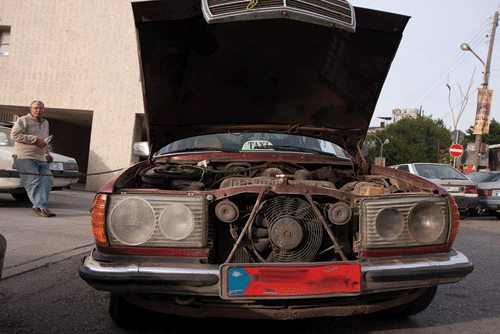
Being stopped at an army checkpoint is a regular feature of Lebanese life, largely endured without complaint as a necessary condition for maintaining the country’s semblance of security. These checkpoints are normally benign: more often than not the officer in charge will give the vehicle a cursory glance before waving the driver through to go about his or her business.

Lebanese Internet, on the other hand, has been pulled over at the same roadblock for more than a decade, leaving the country and its economic development held up behind, while the vast majority of the rest of the developed and developing world passes by Lebanon in the broadband fast lane.

In the past year there have been financial wheels set in motion to move the country past this Internet impasse, but when, or even whether it will be waved through is far from certain.

Political and vested interests have attempted to thwart development at almost every step, and to circumvent the country’s legislative paralysis the “progress” that has been achieved has often been through blatant violations of the same law enacted to liberalize the telecommunication sector. The telecommunications ministry has effectively admitted to having purposely-opaque policies that call into question the integrity of the entire process, while security concerns and espionage charges have piled up like a fast-action thriller.

In the following report, Executive lets you in on what’s still blocking the road to broadband. 

Stalled in a feedback loop

In January 2010, the Minister of Telecommunications, Charbel Nahas, declared that he would release his policy strategy by November — exactly a year after becoming minister — while his ministry announced that it was beginning the process of upgrading Lebanon’s bandwidth from an estimated two gigabits per second (gbps) to 120 gbps. This included connecting Lebanon to an undersea cable called the India-Middle East-Western Europe 3 (IMEWE3) [see box].

Almost a year later, however, as Executive went to print, neither of these pledges have been fulfilled.

“We tried to assist and be an advisory body to the minister in order to help him to develop and write his policy to submit it to the Council of Ministers,” says Mahassen Ajam, commissioner and member of the board of the Telecommunications Regulatory Authority (TRA), the body theoretically mandated to regulate Lebanon’s telecommunications market. “The year is over and there is still no policy for the sector, which is a dilemma for us.”

It’s a dilemma because, according to Law 431, the TRA is supposed to be regulating the as-yet non-existent Liban Telecom that is meant to be the government-owned entity holding all the state’s telecommunications assets. Setting up Liban Telecom has become such a contentious issue, however, that when Executive queried Minister Nahas about it he replied: “I am part of a large governmental block, so don’t talk to me about when to apply the law.”

Indeed, Mahmoud Haidar, principal advisor to the Minister of Telecommunications, says the tenets the minister is willing to stand by are only that pricing should be lower and that the state monopoly over telecommunications should end. 

“When Liban Telecom is established it has the right to have a five year monopoly by the law and the minister doesn’t like that,” he says.

Haidar adds that: “We are all Lebanese and we shouldn’t be hypocrites about our realities. If Liban Telecom is, as the law says, an established company to be owned by the government, its board of directors appointed by the Council of Ministers, I really see that no Lebanese in his true and genuine sense sees that this will be free from politics. The Council of Ministers getting into the appointment of anything is politics. So to those who promote Liban Telecom as the paradise to come, I would simply ask them how they see this happening.”

Indeed, for Liban Telecom to become a reality, the minister would have to propose it and the cabinet would have to assign the board members; since the minister seems disinterested and the cabinet is unable to even meet regularly (if at all), progress appears stalled. 

“You are right in asking about where we are now because we have not come to the public and said everything,” said Haidar, who stressed that the minister never said he would issue an official policy paper because it has no legal mandate.

Thus with the law unimplemented and a policy unissued, Lebanon’s telecommunications regulator finds itself at a loss as to what it should do. Technically, the TRA is in violation of the same Law 431 that created it, given that the law mandates the TRA be financially independent within two years of its creation, which was in 2007.

The TRA cannot yet be financially independent from the government, says Ajam, as the TRA’s independence is “based on the principle that the sector be liberalized… which means giving licenses and making revenues from the market.”

“We were not able to give licenses — it’s as simple as that,” she said, adding that without a national budget approving investments, the TRA had no choice but to take the funds advanced to it by the cabinet. [The TRA does, however, gain some revenue from the annual interim licenses it is permitted to grant to the country’s service providers and has recently received a World Bank grant.]

No straight talk

Considering that it is the government body responsible for upgrading communications in the country, Lebanon’s Ministry of Telecommunications (MOT) has been exceptionally poor at informing the public how it is going about it.

In April 2010 the ministry announced $92 million would be spent on a range of projects, including a national fiber-optic backbone. Following this announcement Mahmoud Haidar, principal advisor to the Minister of Telecommunications, explained to Executive that this figure may or may not represent what the ministry will in fact spend, given that it avoids releasing its actual budget before issuing tenders, as this would influence bidders’ offering price.

Executive later learned the ministry received a $66.3 million treasury advance to begin building the fiber-optic backbone (a treasury advance is a payment made outside of the national budget with the approval of the cabinet). The ministry’s design proposes two large fiber-optic “rings” that span the width and breadth of the country, with most of the cost of the project going to drilling.

The MOT then announced in September that it had contracted out the first phase of the project, namely laying the fiber and drilling, to a consortium consisting of Alcatel-Lucent and its local partner Consolidated Engineering and Trading (CET), for $40 million. Neither Alcatel-Lucent nor CET were willing to comment for this article. The cost of the current project becomes all the more relevant when it is juxtaposed against alternatives.

As previously reported in Executive, the International Telecommunications Union (ITU) proposed a Internet blueprint for Lebanon in 2002 that would have cost $40 million in total — in other words, equal to what is now being paid for the first phase of implementation alone. Riad Bahsoun, a telecoms expert with the ITU, described the current project design as “obsolete” and overpriced due to excessive drilling and said that the costs associated with drilling will only benefit the companies that drill. “They will do it this way and in 50 years we will cry about why they did it this way,” he said. However, Habib Torbey, head of the Lebanese Telecommunications Association (LTA) and president of GlobalCom Data Services, owner of Internet provider IDM, called the design adequate for Lebanon. 

“When you talk about security and redundancy you cannot always look at cost; it’s not a question of cost,” he said.

Securing the lines

Security has been big news over the last two years, with headlines littered with intrigue and espionage involving Lebanese telecommunications. These included the arrest of workers at Alfa (one of Lebanon’s two mobile operators) and Ogero (the state-owned fixed-line monopoly,) for allegedly carrying out clandestine intelligence operations for Israel, as well as calls by Hezbollah members of Parliament for telecommunications evidence in the United Nations Special Tribunal for Lebanon to be thrown out because of Israeli infiltration of the Lebanese network.  Last month, Hezbollah announced, “As part of its persistent efforts to counter Israeli espionage, the Islamic Resistance has made a new major achievement by foiling an Israeli attempt at infiltrating its telecommunications network.”

“Telecommunications technicians of the Resistance managed to discover a spying device the enemy had planted on its telecom network in the Al Qaysiyya valley, near the southern town of Majdel Selem,” said a statement released by the Hezbollah media relations department. “The enemy [Israel] remotely detonated its device as a result of the discovery.”  With all these security concerns regarding telecommunications, one might think the MOT would attempt to address the security of Lebanon’s network when undertaking a project to upgrade the country’s infrastructure — especially when the minister is from the political bloc allied to Hezbollah. 

However, “There is not even the slightest mention of security issues in the tender book,” says the ITU’s Bahsoun, adding that the current plans do not meet ITU standards.

“No expert can understand what motivated the cutting of this project into two different parts: one called ‘civil works’ and the other ‘active equipment’; there is absolutely no technology rationale behind such sectioning,” says Bahsoun, noting that this sort of segmentation can be used to “fool the budget,” and lead to money being siphoned off of the telecommunications upgrading project to different interested parties.

Haidar, the advisor to the Minister of Telecommunications, claims the opposite and says that the first phase of the project is “absolutely” ITU compliant. “How do they know? These documents are confidential,” he remarked to Executive. “I am surprised that they are commenting on documents that they are not supposed to be aware of.”

Also threatening Lebanon’s communications security is the existence of illegal operators, which came to the fore in August 2009 when an Israeli telecommunications network site was discovered on the Barouk Mountain in the Chouf region of Lebanon selling bandwidth to Lebanese operators.

“The Barouk issue is not a penetration of the Lebanese network. It was an Israeli network in Lebanon, installed by Israelis, managed from Israel with Israeli equipment reaching well inside Lebanon under a disguised commercial cover,” said Habib Torbey, head of the Lebanese Telecommunications Association (LTA) and president of GlobalCom Data Services, owner of Internet provider IDM. “How do they expect us to take seriously the security effort [the government] is doing to secure the GSM [Global System for Mobile communications] networks when such big issues are kept under the rug? It’s just not serious and it calls their credibility into question.”

A source with knowledge of the Barouk proceedings told Executive that a colonel in the Lebanese Army posted at the MOT during the last cabinet’s term in 2009, had spearheaded the discovery of the Barouk station along with 80 to 100 other illegal operators. Haidar confirmed this officer was Colonel Dany Fares.

According to the same source, after the telecommunications equipment, built by the Israeli firm Ceragon, was confiscated by the authorities, a man named Fadi Qassem infiltrated the location where the equipment was being held and was later re-apprehended by military intelligence with the equipment in his possession. The source added that Qassem was let go “immediately” because of political pressure. Several other sources, which also asked to remain anonymous, confirmed to Executive that Qassem was behind the operation, though he was described as “small fry” by one.

In February 2009, in the midst of a political debate over wiretapping during the term of the last cabinet, MP Walid Joumblatt — who exercises far-reaching influence over the Chouf Area — called for Colonel Fares to be removed from his post in the telecoms ministry in an interview with Ad Diyar newspaper. It was later during this government’s term that Defense Minister Michel Murr ordered the colonel to be removed from the telecoms ministry, according to Haidar.

Murr also came under attack last month in the Lebanese press after Wikileaks, a global whistleblower site, released United States diplomatic documents from March 2008 to Al Akbar newspaper stating that Murr advised the US on where any future attack may hit and that he would instruct the army to move in only after any Israeli attack had wiped out the resistance movement. The Ministry of Defense did not respond to a request for clarification and an interview.

In December a Hezbollah tip-off led to two more discoveries of Israeli espionage devices on Mount Sannine and, once again, the Barouk Mountain east of the capital. At present there is a committee tasked with uncovering illegal operators within the telecommunications ministry but Haidar refused to disclose details of how many illegal operators have been apprehended so far.

The road ahead

So while the country has been waiting for years for a way forward, and there does seems to be some momentum building to end the roadblock to move us onto the broadband highway, politics still seems to be leaving our tires flat. 

“We are losing our voices telling [the politicians] to remove the telecom sector from politics because this is an economic and strategic sector for the rest of the country, not a stand alone sector,” says the LTA’s Torbey. “God willing, they will hear us one day.”

January 14, 2011 0 comments
0 FacebookTwitterPinterestEmail
Economics & Policy

For your information

by Executive Editors January 14, 2011
written by Executive Editors

More corrupt or just more apparent?

Lebanon is either becoming more corrupt or just appears so, according to the latest survey from the global corruption watchdog Transparency International (TI). The results of TI’s Global Corruption Barometer released last month showed that 82 percent of respondents think levels of corruption across 11 sectors and institutions have increased over the past three years. Over half the Lebanese surveyed (56 percent) believe that the government’s response to this perceived trend is also ineffective, which is more than the global and regional average. In fact, 34 percent of survey respondents stated that they paid a bribe in the past year to facilitate the provisioning of public services. The survey also revealed that the Lebanese think that political parties are the most corrupt entity in the country, followed by public officials and civil servants, MPs, the police, the judiciary and the media.

Gas-inducing deals

Israel has signed a host of agreements with a jointly owned Israeli-Egyptian firm to increase imports of natural gas from Egypt. The move is seen as a major step in the evolving natural gas trade-off between the two states, as Egypt has supplied Israel with a steady flow of natural gas for decades in order to allow the Jewish state to run its power plants and industries. Last month Israel Chemicals, Dead Sea Works, Oil Refineries ltd and OPC Rotem signed agreements to supply 1.4 billion cubic meters of gas over two decades, with an option to more than double that volume to 2.9 billion cubic meters. The counterparty to the agreement was the Israeli-Egyptian firm East Mediterranean Gas (EMG), in which Ampal-American Israel Corporation has a 12.5 percent stake. The gas will be used to fuel three Israeli power plants and is due for delivery sometime in the first half of next year. The move has been described by the Israeli press as a blow to companies exploring and extracting gas off the coast of Haifa, as well as close to the border with Lebanon, which has repeatedly voiced concerns that the drilling could constitute a threat to its sovereignty because of the possibility that reserves may extend into Lebanese waters.

Lebanon’s statistical leprechauns

The dearth of timely and accurate statistics in Lebanon could be on the mend thanks to the European Union and the Northern Ireland Statistics and Research Agency (NISRA). The EU has granted $1.19 million to a joint project with NISRA aiming to bring the Central Administration for Statistics (CAS), Lebanon’ s official body for statistics, up to scratch with international standards. The CAS is theoretically responsible for all national statistics in the country but, as of this writing, national accounts were being compiled by the office of the prime minister; under the program these would be transferred to the CAS. As executive went to print, national accounts had only been published for 2008.

A new way to estimate

A new estimation model to track gross domestic product may remedy Lebanon’s lack of accurate and timely data regarding its economy. The econometric model developed by BLOMinvest Bank claims to provide “a high level of accuracy and precision in estimation” — when it compared its estimations with actual data the margin of error ranged from -0.59 percent to +0.40 percent. As such, BLOMinvest estimated that GDP growth in 2009 stood at 8.6 percent. The variables used in the estimates are: previous year’s GDP, petroleum imports, claims on the private sector, cement production, number of tourist arrivals, government spending, exports, the consumer price index, non-resident spending through credit cards, money supply, construction permits and total imports (excluding petroleum). “The research provided in the paper could be extended further and the margin of error in estimation could be reduced if GDP growth for Lebanon is made available on quarterly basis,” the bank said. “It is of utmost importance for the government to invest more effort in improving its statistical capabilities in order for decision makers in both the public and private sector to be able to make their decisions based on a reliable and updated set of economic information.”

More estimations

The global investment bank Barclays Capital has thrown its hat into the ring of those estimating how much Lebanon’s economy expanded in 2010. The bank calculated that the country grew at a rate of 7.5 percent last year and cautioned against rising uncertainty related to the United Nations Special Investigation for Lebanon (STL). The sectors that drove the growth estimate — namely construction, tourism, trade and financial services — were seen to be solid during the first nine months of the year. On the fiscal side, Lebanon’s decreasing deficit over the course of 2010 in conjunction with a rising primary surplus prompted the bank to estimate that the debt-to-GDP ratio had fallen from 148 percent to 141 by the year’s end. Barclays also put the deficit-to-GDP ratio at 8.5 percent — a figure that it said constituted a structural imbalance, given that it may become even larger if Lebanon passes a national budget and begins to spend accordingly. The bank anticipated that the worst-case scenario would arise if the STL issues its indictment before a political settlement can be reached, leading to the withdrawal of several ministers and the halting of the cabinet and its related institutions. As a result, the bank expects that the Banque du Liban, Lebanon’s central bank, will have to draw on its vast reserves to ward off the devaluation of the Lebanese lira as money is converted into other currencies.  

Be warned ye copyright pirates!

The Ministry of Economy and Trade has stated that in recent months it has used its authority to step up action against violations of Intellectual Property Rights (IPR), which is seen as a prerequisite to joining the World Trade Organization. The ministry said it was increasing surveillance and urging owners of copyrights to refer their complaints to special courts to seek compensation for violations. The current form of IPR legislation dates back to 1999 and is not compliant with the WTO’s treaty on Trade-Related Aspects of Intellectual Property Rights, despite the fact that a parliamentary committee approved Lebanon’s accession to the United Nations World Intellectual Property Organization. Piracy-related losses to copyrighted industries totaled some $29 million in 2009, according to the Office of the United States Trade Representative.

The good and the bad

The Banque du Liban (BDL), Lebanon’s central bank, released both positive and negative news last month about the state of Lebanon’s economy. The BDL’s coincident indicator (CI), an average of eight weighted economic indicators published on a monthly basis, rocketed upwards some 8 percent after remaining stagnant since August. The CI reached 248 points compared to 229 points in September, constituting the largest month-on-month increase of the year. Year-on-year, the indicator has risen by 11.6 percent. On the other hand, the BDL’s quarterly business survey of opinions indicated that commercial sales volumes decreased during the third quarter of 2010.

Debt charts a flat line

Lebanon managed to maintain the level of its gross public debt (GPD) during the first 10 months of 2010 due to both improved borrowing rates and the new borrowing forecast in the budget falling through because it has yet to be enacted. At the end of October, the country’s debt rested at $51.1 billion, which is the same figure as at the start of the year and 2.5 percent higher year-on-year. The level of local debt increased 4.9 percent to hit $30.1 billion while foreign debt fell by a menial 0.7 percent to stay around $21 billion over the covered period. Commercial banks held 59.1 percent of the local public debt during the period while Eurobond holders, foreign private sector loans and special T-bills in foreign currencies accounted for 86.7 percent of the foreign portion of the debt in the first 10 months of 2010. Net public debt, defined as GPD minus the public sector deposits at the Central Bank and commercial banks, increased 2.7 percent to reach $44.9 billion. 

January 14, 2011 0 comments
0 FacebookTwitterPinterestEmail
Real estate

A short reprieve

by Executive Editors January 14, 2011
written by Executive Editors

Beirut real estate witnessed never-before-seen levels of building activity in 2010. The average value per property sale shot up a staggering 22 percent in the first nine months of last year compared to the same period in 2009, according to Bank Audi, pricing much of the middle class out of the market.

But calm came after the storm and property sales started to slow in August and dropped 9.3 percent year-on-year in October 2010. Experts agree that the market has reached a plateau, and prices will remain steady for at least a year, specifically in Beirut. For the long term, it’s a different story; the scarce supply of prime land, increasing demand from locals and expats and underlying legal issues threaten to bump builders’ costs. The result is another storm brewing in the distance, as developers will likley pass their higher costs on to the consumer, pumping up prices yet again. The only question is when.

Elie Sawma, who says he represents nearly 1,400 developers as president of the Building Promoters Federation of Lebanon (BPFL), said the group is “making efforts to keep construction at a steady level to keep a window of opportunity for citizens to buy, because the price will experience another wave [upwards] after this period of calm, at the end of 2011.” Sawma says the rising prices seen since 2008 were a fully expected “natural market correction.”

Problems on the horizon

Land costs have shot up in the past two years, estimated by some developers to have risen from 30 to 50 percent of their project costs. Thus, despite surging overall home sales and prices since 2008, the proportion of developers’ profit margin per project has generally decreased.

In addition, the BPFL say the 2011 budget proposal crafted by the Ministry of Finance could mar their bottom line. Developers may face a tax increase from zero to 1 percent on the total revenue amount of a transaction, a proposal that is expected to bring Lebanon’s cash-strapped government between $133 million and $200 million in revenue, according Minister of Finance Raya Hassan. The BPFL says taxes like this proposed by the finance ministry are weighing heavily on the minds of industry players.

“In every other country, the government imposes a tax on the seller’s profit, but not on the total sales amount,” says Sawma, who is working with the ministry and cabinet to block this clause.

There is also a proposed new tax on unoccupied apartments developers own (as, commonly, when a developer’s asking price is not met for a new unit, rather than lower the price to market value, he will hold on to the flat and wait until the market value increases). Though details are murky, Sawma says, “[the tax] could reach as high as $10,000 a year on some of the larger apartments downtown.” Developers are unlikely to absorb these charges out of their own profits, and will instead charge the end-user the extra costs.

Nader Obeid, partner at Lebanese law firm Alem and Associates, believes the initiatives will help the “real users” of residences. Though the proposals may hinder some types of real estate investment, the authorities should control investment, via taxes, when it burdens the citizens. “[Lebanon] is barely big enough for housing its people; accordingly the community’s need to provide accommodation for… citizens is greater than its benefit from investment in real estate,” said Obeid. “The solution to this dilemma is to give priority to housing and to force the real estate owners to use it for this purpose, not for speculation.”

Whether the proposals break through or not, many experts agree that prices can only shoot up in Beirut. When they do, it’s likely they will rise at a faster rate than we have witnessed this year due to the scarcity of land supply.

January 14, 2011 0 comments
0 FacebookTwitterPinterestEmail
Real estate

For your information

by Executive Editors January 14, 2011
written by Executive Editors

Lebanon on fire

A forest fire re-erupted one week after it had first started in Fitri, 45 kilometers north of Beirut, affecting a total of 150,000 square meters of forest area near homes. The Dec 5 fire was the largest of as many as 120 smaller ones that erupted during the first weekend of December, due to dry air, hot soil and a lack of rain after an unusually long summer period. Interior Minister Ziad Baroud confirmed that 57 fires had started that day across the country. Simultaneously, another fire in Baabda forced hundreds of families to flee their homes. The municipality president Imad Daou told Agence France Presse that firefighters were not able to effectively put out the flames because of the rough terrain and lack of roads and city planning, making it difficult to reach the affected area.  President Michel Sleiman remarked at the scene that the town’s unsatisfactory urban planning meant the fires spread much more than they would have otherwise.  The increase in forest fires is a serious problem for Lebanon as much of its verdant land has been compromised in recent years. With global warming seen as the culprit, this is the first time Lebanon has experienced so many forest fires in such a concentrated period of time.

Doha takes the cup

Fifa’s announcement that Qatar will host the 2022 World Cup games — a month-long event that will require a whole new construction topography for the already booming nation — has construction firms eyeing the $57 billion to be doled out to prepare hotels, roads, stadiums, a metro system and other infrastructure projects, according to Arabian Business (AB). Some $4 billion is needed to build 12 air-conditioned stadiums. The $11 billion New Doha International Airport should be complete within the next two years. The $5 billion to repair existing roads is a small fix compared to the $35.6 billion required for the most ambitious of the infrastructure projects: the new metro rail system, to be fully complete by 2019, which plans to link Qatar internally as well as with the rest of the GCC countries. To deflect some of the cost, the Ministry of Business and Trade is currently researching public-private initiatives. Booz & Co partner Ulrich Koegler told AB, “While they will be actively looking — and discussions with our clients show that this is happening — they will also be diligent in trying not to produce failures that would hurt their reputations ahead of the World Cup.” Drake & Scull International DSI, based in Dubai, and Arabtec Construction, the largest construction firm in the GCC, are already established in Qatar and expected to be the frontrunners for contract awards. Thomas Barry, Arabtec’s CEO, told the daily, “We would expect to be in a position to win a higher share of such a market as we have the correct experience both in stadiums, hotels, residential and retail projects and the like — we are optimistic about our chances.” Industry experts agree that most of the contracts will be awarded to regional firms as Qatar doesn’t have the local expertise for such  infrastructure implementation.  On December 6, Arabtec shares jumped 9.1 percent and Drake & Scull (DSI) shares jumped 6.5 percent to a 12-month high amid expectations for both firms to win contracts in Qatar.

Industrial real estate creeping up the ranks

In contrast to the residential and commercial sectors of real estate, light industrial and logistics will carry a higher rate of return, on average, for investors looking to place their money in real estate in the MENA region, according to a December 12 report by Jones Lang LaSalle. Light industrial real estate is often overlooked and has the most growth potential, with demand rising. Usually controlled by government entities in the GCC, opportunities for the private sector are opening up. There are about 65 million square meters of industrial space in Dubai, making it the most promising industrial market in the region, followed by Abu Dhabi, Riyadh, Cairo and Jeddah. Citing an increase in demand from logistics specialists in Europe and Asia over the last two years, the report predicts the sector “will provide significant potential to generate increased sales activity in this market over the next few years.”

And the award goes to…

Middle Eastern firms are gaining global recognition, with several winning top prizes at the 17th annual International Property Awards gala in late November. Qatar was in the spotlight, as Barwa Financial District won the “International Office Development” top award. Chairman and managing director of Barwa, Ghanem bin Saad al-Saad, said in the firm’s December 6 press release, “Barwa Financial District stands out as a key development for Doha and demonstrates the diversity of our approach to real estate development, from high-end projects to those which meet the needs of all sectors of society and the Qatari economy.” Damac Properties, the region’s largest luxury developer, won in the category of ‘Best High Rise Architecture’ for their upcoming Damac Tower in downtown Beirut. Bahrain’s Pegasus Real Estate was voted the best property development marketer. Turkey’s first LEED-registered project, the $1 billion Varyap Meridian, won in the ‘Best International Architecture – Multiple Units’ category. The mixed-use project, which is under development by Varya, includes a 5-star hotel, residences and office buildings. Located in the Atasehir district of Istanbul, it will comprise 107,000 square meters, 90 percent of which will be green space.

Sales keep rising

The number of sales transactions for properties in Lebanon reached 77,360 during the first 10 months of the year, a 20.6 percent increase compared to the first 10 months of 2009, and a record high for that time period, according to figures from the Directorate of Real Estate, as reported by Bank Audi. Total revenues from the sales reached $7.7 billion in this period, a 51.4 percent increase from the first 10 months of 2009. The average value per sale in this 10-month period grew 25.5 percent to reach LL149.5 million ($99,666). The growth in the number of transactions started to level off in July of 2010, in parallel with declining levels of capital inflows.

Architecture party

On December 11, Beirut-based Loft Investments, founded by Mark Doumet and Ayad Nasser, launched, in partnership with BLOM Bank, their first award show for young Lebanese architects. More than 500 people attended the event in Ashrafieh, where the top prize for contemporary loft design went to Joanne Hayek and Zeina Koreitem. The purpose of the awards, Nasser said, is to encourage young designers to stay in the country, adding, “We have plenty of opportunity here.”

January 14, 2011 0 comments
0 FacebookTwitterPinterestEmail
Banking & Finance

For your information

by Executive Editors January 14, 2011
written by Executive Editors

Lower rates for green hot water

Lebanon’s banks began offering lowered rates on loans to finance the purchase of solar water heaters on December 15, as announced by Banque du Liban, Lebanon’s central bank, earlier in December. Lebanon’s Energy and Water Minister Gibran Bassil, President of the Association of Banks in Lebanon Joseph Torbey and committees from both organizations met on November 29 to discuss potential collaborations between the government and the banks regarding renewable energy initiatives. Torbey said after the meeting that the banks would be looking into financing other products in an effort to decrease electricity consumption, as current energy production does not meet demand. 

Ja, das ist eine libanesische Bank…

Deutsche Bank began coverage of both Bank Audi and BLOM Bank this month, offering an in-depth report on the health of the Lebanese banking sector. The German bank gave both Audi and BLOM “buy” recommendations, suggesting a target price of $9.75 per share for Bank Audi and $13.75 for BLOM Bank. The report predicted that the Lebanese banking sector could maintain 8 to 10 percent asset growth for the next few years, but challenges remain. Deutsche Bank said that rigorous restrictions from Banque du Liban, Lebanon’s central bank, have limited the ability of Lebanese banks to turn ample deposits into profitable lending, as 15 to 25 percent of deposits must be kept at the central bank. This has left the loan-to-deposit ratio in the country at a very low (yet low-risk) 32 percent. The report acknowledged that profits have grown in recent years but said that further improvement of cost-to-income ratios and increased international expansion would help the sector’s profitability ratios. The report also concluded that Lebanon’s banks’ income is earned mainly from interest. Commission income represents only 20 percent, and other non-interest income (such as trading fees) represents only 10 percent, of total income. Deutsche Bank suggested that this be corrected through diversification, in line with larger banks.  Ratings agency Standard & Poor’s (S&P) upgraded the ratings on both BLOM and Audi last month, raising the rating of both banks from “B” to “B/positive.” S&P credited the upgrade to Lebanon’s perceived intention to reduce the public debt through structural reforms. The ratings of Lebanon’s banks continue to be hindered by the below-investment grade rating of the Lebanese sovereign, as Lebanese banks hold a significant part of the country’s enormous public debt. The exposure of Bank Audi to government debt stood at 4.3 times common shareholders’ equity at the end of June 2010, which has recently been lowered by the sale of some Lebanese Eurobonds in favor of international bonds, according to BLOMInvest Bank research. BLOM Bank’s exposure to the sovereign represented 5.4 times common shareholder equity at end-June.

Head start on Basel III

Lebanese banks are slowly working to apply recommendations of the most recent Basel Accords, or Basel III, according to Joseph Torbey, President of the Association of Banks in Lebanon (ABL).  “We have applied most of the recommendations of Basel I and II over the past few years and we intend to do the same in Basel III with the help of the regulatory and monetary authorities,” said Torbey on December 3, at a lunch hosted by the ABL to honor a visiting Turkish delegation.  “Our economy is small but it is wide open to the international markets. We fully abide by the international rules and this will be our firm vision,” he said. Basel III recommendations involve higher standards for tier-one capital adequacy and common liquidity requirements, among other suggestions.  Speaking about Lebanon’s preparedness to meet the Basel III guidelines, Riad Salameh, governor of Banque du Liban, Lebanon’s central bank, said in a September 27 speech at the Standard Chartered Thought Leadership Bankers’ Conference: “Our banks have an average [tier-one capital] ratio of over 6 percent, therefore meeting the 7 percent [requirement] in the coming four to seven years as scheduled by Basel III… is not going to be a problem for our banking sector.”

Angels invest in sausages

The Lebanese Business Angels (LBA) announced this week that it would be investing $100,000 in a startup agro-food business called OVIS. The company makes casings for foods such as sausage and expects to create 100 jobs in the medium term. LBA will take a 15 percent stake in OVIS for their investment. LBA was started by the Bader Young Entrepreneurs Program and consists of individuals and companies willing to invest in local startup efforts. Saad Azhari, chairman and general manager of BLOM Bank leads the group.

Chinese accounts for MENA banks

Both of Lebanon’s biggest international banks are working on forming closer ties between Lebanon and China through business and trade opportunities.  HSBC held an event on December 6 bringing together business leaders from both China and Lebanon in an effort to spur business between the two countries. Speakers mentioned the Shanghai Electric Power Generation Group projects in Saudi Arabia and Iraq as an example of the potential business to be done between the Middle East and North Africa (MENA) and Chinese players. “Companies such as Shanghai Electric… generate a huge amount of subsidiary business when they establish a presence in a country,” said Francois-Pascal de Maricourt, chief executive officer of HSBC Lebanon. “We see a direct impact on FDI [foreign direct investment], employment and trade rise, as well as bringing their expertise to the contracted project.” Standard Chartered has also been looking for ways to ease business between China and its regional clients. On September 29, the bank announced that it had signed in Beirut renminbi (RMB) cross-border trade-settlement account agreements with five MENA banks. Alnima Bank Saudi Arabia, Bank Al Falah Pakistan, BankMed Lebanon, Habib Metropolitan Bank Pakistan and Union Bank Jordan can now settle customer invoices in RMB.  Farooq Siddiqi, regional head of transaction banking for the MENA region at Standard Chartered said this option would present “many opportunities” to the banks’ corporate clients, adding: “As the trade volume between China and the MENA region continues to grow significantly year-on-year, we feel that banks in the region should be prepared to meet the increasing RMB requirements of their corporate clients.”

Syria’s first bond

The Syrian government sold local currency bonds and treasury bills for the first time ever on December 13, worth a relatively modest $21 million. Just a few days before the sale, Adib Mayaleh, governor of Syria’s central bank, told Bloomberg that he expected to have “no problem” selling the bonds to willing buyers. The bonds were conventional in nature rather than Islamic and were only available to registered banks. The sale is meant to add to the funds Syria is spending to develop its energy production and tourism, including the construction of a 5,000-megawatt power facility and a new terminal at Damascus Airport. Also toward these ends, Abdallah Dardari, deputy prime minister for economic affairs, said in September that the country would receive $55 billion in foreign direct investment over the next five years.  According to a recent report from ratings agency Capital Intelligence, Syria has “comparatively strong solvency and liquidity indicators and a demonstrable commitment to gradual economic reform,” but its “economic structure and institutional frameworks are relatively weak and the financial system underdeveloped.” The country’s public debt is held largely (90 percent) by Syria’s central bank and other state-owned banks, with 63 percent of the debt held in local currency.

January 14, 2011 0 comments
0 FacebookTwitterPinterestEmail
Editorial

The price of purgatory

by Yasser Akkaoui January 14, 2011
written by Yasser Akkaoui

To sign the Taef accord in 1989, which helped bring to an end the civil war, every Lebanese member of Parliament and warlord was paid between $2 million and $8 million, depending on the size of their party representation and, of course, fire power. More recently in Qatar, in May 2008, the scenario was repeated but took much more cash — given conflict-adjusted inflation — to convince our warlords-disguised-as-politicians to call off their thugs from fighting in our streets. 

The ability of our political class to manipulate fear in the population using sectarianism and segregation seems to be what determines their price tag for either inflaming or restraining the Lebanese propensity to hate. This is parasitic leadership.

As a governance equation, the Lebanese have got the algorithm all wrong. In the world as it should be, politicians are rewarded according to their ability to create a prosperous environment where society can thrive, and inspire that other great Lebanese propensity — that of living the good life.

Since spring 2010 we have been kept in anticipation for the next confrontation. Each month the threats increase in frequency, as politicians from each side get more creative in articulating what they are ready to do if things don’t go their way. Conflict predictions are high for January. International observers have joined the regional and local chorus of concern regarding our security should indictments in the United Nations’ Special Tribunal for Lebanon be announced.

By now, however, much of the public has become inured. Many live in denial, others have lost interest, while others have simply decided to look on the brighter side of life and to avoid concerning themselves with things that seem beyond their control.

And it’s just this sort of learned helplessness and disenfranchisement that makes pawns of the populous in the politicians’ game of chess.

In the absence of a sober, disimpassioned voice to call us to our senses and lead us from this valley of threats, we can only hope someone, somewhere, is stuffing Samsonite cases with cash to courier to Lebanon’s many mansions at a moment’s notice.

January 14, 2011 0 comments
0 FacebookTwitterPinterestEmail
Finance

The only way is up

by Thomas Schellen January 12, 2011
written by Thomas Schellen

The term ‘stock market’ has quite a ring to it, particularly in the mouths of emotionally-invested stock market officials. Listening to them explaining the appeal and importance of securities trading is more like reading poetry: “the stock exchange has made our hearts beat faster” and the securities market is “the main mirror of the economy.”

Others have recognized the thrill factor in bourse trading, but have been reluctant to chase big profits based on the tenuous idea of ‘reading the market right’.

The skepticism long predates 2008’s financial crash and even the Great Depression and the Wall Street stock market crash of 1929. Don’t gamble on share movements in October, the once-bankrupt American novelist Mark Twain warned famously a century and a half ago. “This is one of the peculiarly dangerous months to speculate in stocks. The others are July, January, September, April, November, May, March, June, December, August and February.”

Investors willing to take a risk or, heaven forbid, gamble in United Arab Emirates stock markets, however, have one clear advantage heading into 2011. There is little downside risk when buying stocks, as markets have already been “punished too much.” Analysts have confirmed that equity investors can expect to face at the very least not a negative and, more probably, a positive year.

“I think it is going to be a positive year in terms of overall index performance and that is primarily because of the significantly low base that we are in right now,” said Walid Shihabi, head of equities at UAE-based investment firm Shuaa Capital. A realistic approach is called for, he added, but whereas the market “can go lower, it is certainly unlikely to go any lower simply because of the deep, deep discounts we are getting right now.”

Bullishness in abundance

“My opinion on the region on the equity side is quite bullish,” said Tareck Farah, chief executive officer of FFA Dubai, a financial services unit of Lebanon’s FFA Private Bank. The ground has been prepared for positive movement in UAE equity markets in 2011, he added, by a cleanup that has taken place in a number of sectors, especially banking and, to some extent, among development and construction companies.

“A lot of provisions have been taken,” he said. “Restructuring has happened in many companies, and any good news and new contracts that any company or bank [can announce] will automatically have positive impact.”

Entering 2011, the bedrock supporting UAE equity markets are the company valuations in terms of asset and book multiples, Shihabi said. “The other positive element I anticipate to happen in 2011 is that the international pool of money might be enticed to become more active in UAE markets.”

Foreign institutional investors have had a great impact on the Emirati stock markets for the past four years, acting as the markets’ “determinant of direction,” Shihabi said. “Local investors have, over the past few years, taken their cues from international investors in the local market. If in 2011 international money arrives as anticipated, it might cause a broader activity cycle and as the liquidity of the market improves, the performance of the underlying stocks will also improve.”

Foreign banks and fund managers are also high on Farah’s watch list for positive market stimulants. “Institutional investors are watching us and bankers are coming to the region on a weekly basis, meeting companies and studying their balance sheets. Perhaps one big [local] bank needs more time to be clean but, overall, things are improving and we notice this on the ground,” Farah said, citing renowned fund manager Mark Mobius’ positive views about the UAE.

Mobius, director of Singapore-based Templeton Asset Management and aficionado of emerging markets, voiced his optimism on UAE stock markets when visiting the country and in recent media interviews.

He is bullish on the BRIC (Brazil, Russia, India and China) markets and keen on frontier markets such as Abu Dhabi and Dubai, along with Nigeria, Vietnam, Kazakhstan and Ukraine, according to an article in Singapore’s Business Times in December.

Another international nod of encouragement came in December from HSBC asset managers at the bank’s New Frontiers Fund; they were quoted by Reuters as saying that they saw investment opportunities in Abu Dhabi banks for 2011 but were still cautious about Dubai banks.

Beyond the stimulus role of international investors, positive transformations of behavior by participants in UAE markets may also produce some impetus to support growth. According to Shihabi, retail investors have become more alert to the impact of significant research findings on the market behavior of institutional money.

The economic environment has also matured in other ways, he said. The system, having developed a thicker skin, is less likely to over-react to any sudden event, and stakeholders in the UAE economy have demonstrated their resourcefulness in working around shortages in liquidity and funding sources.

Traders working in Wall Street, in New York at the beginning of the 1929 Stock Market Crash. Within the first few hours the stock market was open, prices fell so far as to wipe out all the gains that had been made in the previous year

A key expectation for the future of UAE stock markets is consolidation. For FFA’s Farah, a merger of the UAE exchanges could be announced at any moment. “We cannot predict a date, but logically this will happen and it will boost liquidity in the market,” he said.

Shuaa Capital’s Shihabi agrees that a merger is a good idea, which indeed appears to be a widespread sentiment in the financial industry, both locally and regionally. The consolidation of securities exchanges, he said, “seems to have become a priority with the powers-that-be and there is a rational driver in that the UAE needs one exchange and the unification of the exchange.”

He cautioned, however, that the process could prove more difficult than some people anticipate, adding: “I would be somewhat surprised though, if the actual final product arrives in 2011.”

Consolidation is more likely to occur in the realm of financial intermediaries in 2011, Shihabi told Executive. For brokers, 2010 was a “horrible year,” mainly because of the effect very low trade volumes had on their earnings, “but the flip side is that the market has cleaned up — the year will drive a lot of consolidation,” he said. “The cleaning up is actually positive for the companies that have the staying power and can survive the lean period. I think you will see more consolidation in 2011 as a lot of [exit or merger] decisions have been made and you will see the implementation of those decisions and a reduction in the number of brokerages,” he said.

It can’t be worse…

Trading in new classes of financial instruments, such as Exchange Traded Funds, is expected to contribute to expansion of trading activity in the UAE, particularly in the longer term. Also, the activity of primary markets should increase in 2011. There is zero probability that initial public offerings on the Abu Dhabi or Dubai stock exchanges will be less in value or number in 2011 versus 2010: you can’t go below nil with IPOs. To the contrary, there is almost an optimism dawning with the new year that a resurgence of the region’s primary market activity will follow from fundamental economics.

Salim Chahine, professor of finance at the American University of Beirut, told Executive that the downturn in primary markets after the equity boom-years has been within economic cyclicality, pointing out that, “The bubble in IPO markets has taught investors the price of risk. IPOs will come back as economies are cyclical by definition.” 

There is a positive outlook for IPOs in the UAE in 2011 in the view of Shuaa Capital, which has a strong interest in the growth of primary markets. “I am optimistic and we have expectations of IPOs coming in,” said Shuaa’s Shihabi, adding, however, that current regulations such as a requirement to list a minimum of 55 percent in an IPO in the UAE are slowing the prospects for faster growth.

How many IPOs does he expect to see realized in 2011? “Realistically? – Two.” For investors who would like a stock pick at the start of 2011, FFA’s Farah recommended Emaar as his top favorite, saying that the developer “completed most of their projects and delivered them. They are getting rent and fees; their convertible bond issue [in Q4, 2010] was oversubscribed within a few hours; Emaar is a very good buy.”

“I am also bullish on logistics,” he added. 

Saying he viewed Emaar as a good name but did not feel particularly enthused about them at the moment, Shihabi still offered a positive view on the battered real estate and construction sector. “The market overall has been punished a little too much, including the names in the real estate space and in the construction space. From my perspective, names such as Arabtec and Drake & Skull are actually quite attractive. At the current time, these are among my favorite stocks in the market,” he said. Other interesting themes for 2011 could include telecoms, with a slant to the domestic UAE market, and insurance, he added.

However, investors may do well to temper their enthusiasm and remember the risks associated with greeting the new year with a phalanx of predictions and positive assumptions. While limited like all forecasts, research-driven predictions by experienced and knowledgeable market participants that do not promise omniscience are as good as it gets in anticipating the future.

January 12, 2011 0 comments
0 FacebookTwitterPinterestEmail
Finance

Q&A – Christos Papadopoulos

by Emma Cosgrove January 3, 2011
written by Emma Cosgrove

Christos Papadopoulos has been six months on the job as regional chief executive officer for the Middle East and North Africa at Standard Chartered. He recently sat down with Executive to discuss what we can expect from both Lebanese and regional banks in the new year.

E  What will be the drivers of regional asset growth in 2011?

The picture in the region is going to be somewhat diverse. There are some markets where on the wholesale banking side, especially in those markets where there are significant infrastructure investment plans, the wholesale banking assets will significantly grow. And then there are other markets where, just by virtue of large populations and ongoing healthy [gross domestic product] growth, we are going to have consumer assets growing —markets like Egypt — but it is not going to be uniform.

E  Why is wholesale banking part of your Lebanon strategy for 2011?

Standard Chartered is extremely good at connecting trade corridors and FDI [foreign direct investment] flows, so we have a significant role that we can play in Lebanon in providing those kinds of solutions, especially for those corporates that have regional or even [outside]businesses. And that means that we are bringing to the market something that the local banks cannot provide, or at least cannot provide to the extent that we can. What we are very successful at doing is bringing Asian investors and Asian money into this part of the world. So what we’ve done in the Gulf is we have had as much as up to 40 percent of new money coming out of Asia.

Historically Europe used to be a significant supplier of finance to this part of the world, but now Europe is going through its challenges so in many respects when it comes to refinancing, they are not looking to participate, they are looking to get their money back. The extent to which Asia steps in and fills that gap means that you have a successful fundraising effort. Increasingly the Middle East is looking into Asia — whether it is to raise funding or to engage and do business.

When you look at the big trade corridors, whether it’s companies importing from China, whether it’s Korean contractors coming and doing business here, or whether it’s Chinese contractors coming in and working in the region, there is a significant engagement.

You have FDI flows going from the region to Asia, for example when the Qatar Investment Authority bought a significant stake in Agricultural Bank of China, so the world has changed in terms of the shift of economic growth and the emergence of Asia — a shift from West to East. And to a certain extent there has been a shift from North to South — whether it’s moving to the Brazils of this world or moving into Africa because of their commodities story. So you’re building corridors between Asia, Africa, the Middle East and Latin America.

E  What are your expectations for mergers and acquisition (M&A) activities in the region?

We have seen some big deals. We have seen very recently the deal with Zain and Etisalat, which was a significant transaction. Here in Lebanon you have the deals with Bank Audi and EFG-Hermes, so I think good deals that are available will be happening. I don’t think you will see a frenzy of activity, but there will be opportunistic deals as people seek to take advantage of those economies that increasingly provide more attractive returns.

If you want to be in a market that is otherwise unavailable to you, Libya for example, you might consider an M&A type entry into the financial sector. In the nonfinancial sectors, you will increasingly see[activity in] the telecoms sector.


January 3, 2011 0 comments
0 FacebookTwitterPinterestEmail
Comment

Vanquish visas and they will come

by Paul Cochrane January 3, 2011
written by Paul Cochrane

Over the past decade the Middle East has shaken off its ‘danger zone’ reputation of being a place where only the foolhardy or “conflicted tourists” would plan a holiday. Since 2000, the number of tourists visiting the region (excluding Turkey and Israel) has more than doubled, from 24.9 million to more than 53 million. And while 2009 saw a 5 percent slump in international tourist arrivals, the region was only behind Northeast Asia globally in the rise in tourists in 2010, up 16.1 percent, according to the United Nations World Tourism Organization.

Perceived heightened stability, investment, infrastructure development and marketing campaigns have all contributed to tourism in places other than long-term favorites Egypt, Turkey and the Holy Land.

The rise has partly been fuelled by wary Westerners warming to the Middle East as an attractive vacation destination, after being swayed by the flurry of advertising campaigns and travel articles extolling old Damascus’s charms, Dubai’s palatial hotels and Beirut’s infamous ‘phoenix rising from the ashes’ reputation. However, inter-regional tourism has been a key driver for the sector and has corresponded with the emergence of low cost air carriers and the aggressive expansion of Middle Eastern airlines in general.

The rise in tourism has also dove-tailed with a resurgent middle class with the desire and funds to take a trip within the region but not quite enough cash to splurge on a family holiday to Europe or America. Syria has become a regional poster child in this regard, with its tourism sector exploding since the economy was opened up at the beginning of this century; visitor numbers have surged from two million in 2004 to nearly six million in2010. What is notable is that the majority of tourists are from the Gulf, with2.9 million Arabs visiting in 2010, compared to 1.35 million tourists from other, primarily European, countries.

It has been the increased openness of countries that has really encouraged the inter-regional tourism boom, with Damascus scrapping visas for Iranians and Turks and Turkey abolishing visas in 2010 for Syrians and Lebanese. Once the regulations changed, there was a 117 percent rise in Iranian visitors to Syria, while the Turkish-Syrian agreement encouraged482,000 Syrian holidaymakers to stream into Turkey, an 113 percent increase, and an 170 percent rise in Turks heading to their southern neighbor. This sensible bi-lateral move resulted in the largest jump worldwide in visitors between two countries in 2010.

Meanwhile, Ankara’s decision led to 73 percent more Lebanese visiting Turkey than in 2009, and easier visas and marketing campaigns led to74 percent more tourists from the United Arab Emirates, a 60 percent rise from Iran and a 47 percent increase from Saudi Arabia. While Arab and Iranian tourist numbers surged, Ankara’s strained relations with Tel Aviv resulted in a41 percent drop in Israeli tourists, to 80,000 visitors.

That’s not much of a surprise though, as politics and outbreaks of violence frequently cause the region’s tourism figures to yo-yo from one year to the next. But with all the development and infrastructure investment underway — from airport expansion in the Levant and the colossal aviation hubs in the UAE and Qatar, to the new resorts and hotels being built —the region is on track to becoming a top global travel and tourism destination. Indeed, according to the World Travel and Tourism Council, the Middle East’s tourist and travel economy is forecast to rise 149 percent by 2020 from the current $173 billion to $430 billion.

What should be addressed is the scale and feasibility of tourism projects. Mass tourism — as compared to more sustainable tourism that is not primarily seasonal — can have negative social and environmental ramifications. Now is the time for the public and private sectors to plan ahead.

The easing of border and visa restrictions should also expand further to bolster regional travel for Middle Eastern citizens and foreigners; as Turkey and Syria have clearly demonstrated, scrapping visas makes visitor figures jump. In Syria’s case, the country received $2 billion more in tourism revenues in 2010 than the year before.


PAUL COCHRANE is the Middle East correspondent for International News Services


January 3, 2011 0 comments
0 FacebookTwitterPinterestEmail
Comment

Erdogan lumps the leaks

by Peter Grimsditch January 3, 2011
written by Peter Grimsditch


Turkey’s fiery, if thin-skinned, Prime Minister Recep Tayyip Erdogan has a love-hate relationship with the press. He loves the organizations that show appreciation of his policies and seems to hate those that don’t. Heis prone to threaten the offending publications with lawsuits, while urging their boycott by advertisers and readers alike.

Little surprise then that Erdogan should bristle at many of the stories emanating from the Wikileaks disclosure of diplomatic cables over the past few weeks. The notoriously hard-working premier wanted to sue a former United States ambassador to Turkey, Eric Edelman, for claiming, according to some of the press reports, that he had secret bank accounts in Switzerland.

If any such accounts could be found, he proclaimed to the media, he would donate the total deposits to the main political opposition, the Republican People’s Party (CHP). In addition to Edelman, he also wanted to sue the US State Department for uttering such a calumny. The excitable Turkish press debated for days the practicalities of putting such a threat into practice, seeking opinions from senior members of the legal establishment.

While the threat of legal action made for lurid headlines, it somewhat misses the point. The content of the cable was not that he had Swiss bank accounts but that the ambassador had been told by two sources that they existed. The cable did not include an opinion about the likely truth of the claims. It was also a confidential document — essentially a private conversation — between the envoy and his bosses in Washington. Edelman also described Erdogan as having “unbridled ambition stemming from the belief God had anointed him to lead Turkey” and an “overweening desire to stay in power.”The latter comment, of course, is less an insightful piece of news for the home base than a glimpse of the blindingly obvious regarding any political leader.

In any case, a more likely target for lawsuits than the State Department would have been either Julian Assange, the founder of Wikileaks, or the myriad media outlets that published the cables.  In a political environment as beset with gossip, rumour and mendacity as Turkey’s, the prime minister’s tetchiness understandable, even if the tendency to use some of his boundless energies in pursuing the authors of published criticism is perhaps as wasteful as it is unrewarding.

More significant than the tittle-tattle tales of tabloid headlines is the general picture that the US diplomatic service, overall, rejects the notion that the ruling Justice and Development Party (AKP) is hell-bent on turning Turkey into an Islamic state similar to Iran or Sudan, or even that it is unreasonably turning its back on the West and switching its allegiance eastwards.  What the cables do suggest is that Turkey has been redefining its place in the world ever since it realised that its importance as the eastern flank of NATO diminished after the collapse of the Soviet Union.

Especially since 2002, when the AKP came to power, the country’s security policy has been integrated with its economic transition and growth. Turkey’s strength is better illustrated by the size of its economy than the number of soldiers in its army. The cables may be tiresome and embarrassing but are not even news for the most part.

If Erdogan wants an example of real toughness in the face of adversity, maybe his aides could show him one leaked cable that doesn’t even mention him or the AKP. In January of last year, a 75-year-old American, Hossein Ghanbarzadeh Vahedi, walked into the consular section of the US Embassy in Ankara after a dramatic escape from Iran, where he had been held for seven months. Vahedi, according to the cable, had travelled to the country to visit the grave of his parents when, for reasons he never discovered, the authorities confiscated his passport. Vahedi rejected the offer of handing over $150,000for its return and opted instead to pay people to smuggle him out of Iran. After three days of furtive flight, including a nightmare 14 hours on horseback over a freezing mountainous trail, Vahedi reached Turkish soil where he took a bus for Ankara. That’s real fortitude in the face of adversity.


Peter Grimsditch is Executive’s Istanbul correspondent


January 3, 2011 0 comments
0 FacebookTwitterPinterestEmail
  • 1
  • …
  • 393
  • 394
  • 395
  • 396
  • 397
  • …
  • 685

Latest Cover

About us

Since its first edition emerged on the newsstands in 1999, Executive Magazine has been dedicated to providing its readers with the most up-to-date local and regional business news. Executive is a monthly business magazine that offers readers in-depth analyses on the Lebanese world of commerce, covering all the major sectors – from banking, finance, and insurance to technology, tourism, hospitality, media, and retail.

  • Donate
  • Our Purpose
  • Contact Us

Sign up for our newsletter

[contact-form-7 id=”27812″ title=”FooterSubscription”]

  • Facebook
  • Twitter
  • Instagram
  • Linkedin
  • Youtube
Executive Magazine
  • ISSUES
    • Current Issue
    • Past issues
  • BUSINESS
  • ECONOMICS & POLICY
  • OPINION
  • SPECIAL REPORTS
  • EXECUTIVE TALKS
  • MOVEMENTS
    • Change the image
    • Cannes lions
    • Transparency & accountability
    • ECONOMIC ROADMAP
    • Say No to Corruption
    • The Lebanon media development initiative
    • LPSN Policy Asks
    • Advocating the preservation of deposits
  • JOIN US
    • Join our movement
    • Attend our events
    • Receive updates
    • Connect with us
  • DONATE