• Donate
  • Our Purpose
  • Contact Us
Executive Magazine
  • ISSUES
    • Current Issue
    • Past issues
  • BUSINESS
  • ECONOMICS & POLICY
  • OPINION
  • SPECIAL REPORTS
  • EXECUTIVE TALKS
  • MOVEMENTS
    • Change the image
    • Cannes lions
    • Transparency & accountability
    • ECONOMIC ROADMAP
    • Say No to Corruption
    • The Lebanon media development initiative
    • LPSN Policy Asks
    • Advocating the preservation of deposits
  • JOIN US
    • Join our movement
    • Attend our events
    • Receive updates
    • Connect with us
  • DONATE
Q&A

The linchpin of leapfrogging:

by Thomas Schellen October 31, 2025
written by Thomas Schellen

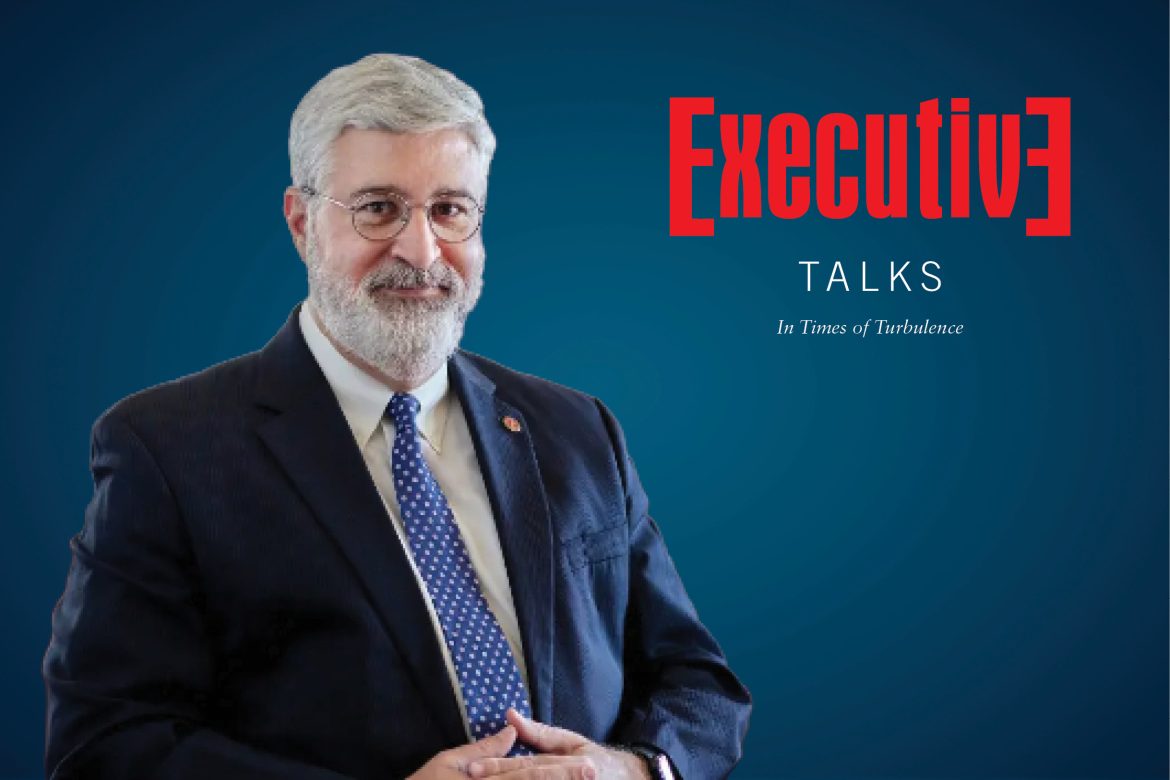
The human being by conventional wisdom and scientific study is to a very large part a creature of habit. Discovering and applying the principles that allow individuals and businesses to change entrenched behaviors to become more productive, is what makes or breaks social adaptation and economic reason. In a democracy’s institutional behavior, the quest for greater productivity and societal relevance is like the search for the philosopher’s stone of governmental sustainability, or a transformative magic potion that facilitates institutional behavior change and speed of progress by a state and its institutions in service to its sovereign. For an insider perspective on Lebanon’s current challenges towards this end, Executive sat down with Fadi Makki, the minister of state for administrative reform. 

When the office of the Minister of State for Administrative Reform (OMSAR) was established back in 1995, its very name stood for an important element in putting Lebanon’s post-conflict public sector on the right development track. As such, OMSAR soon became associated in people’s mind with the activities of UNDP in supporting the Lebanese public sector. Compared to the ministry’s role back then, what is different about the “new” OMSAR today?

As you are aware, OMSAR has been a project-driven ministry. If you have funding, [OMSAR] can work. If you don’t have funding, it has nothing. My predecessors never thought of institutionalizing OMSAR. It had great features in good days, being agile, quick and a magnet for funding. It worked beautifully in times of abundance. But when dire times occurred, the whole thing literally collapsed. 2020 was when OMSAR collapsed and that is when we realized that we should have created capacity, talked about sustainability, and have institutionalized. There were so many learnings. I have inherited what is like a collapsed temple. It has legacy, it has history. It also has some kind of mandate but [this mandate] is not promulgated in law that was adopted in parliament. [The mandate} is not an actual law but was created by the Council of Ministers.

My first task when I came here four months ago, was to reassemble the team. I looked who is still there, who left that I could bring back, and where I could acquire new human resources. How could I be creative in obtaining support. There is so much innovation because “nécessité fait loi”, necessity is the mother of invention. I was eager to open different ways to find resources. I discovered that there is much that you can source from volunteering. You can achieve much with a sort of advanced internships from graduate students from top universities. One could attempt reskilling of whoever was left, the few dozens of people that I still have at the ministry. Re-skilling is something that was never thought about before. You can re-skill, which we did. At the same time, you need funding. We are now using the likes of grants from the EU, UNDP, the Germans and others too, to support what we have, not fully replace. What is different from the old times is that we are not running only on grant money but that we are re-skilling, and using sources such as volunteering and pro-bono support form universities and we are also oiling the wheels for additional funding. Finally, for projects without owner, we are trying to obtain some loans, which speaks for the World Bank loan on digital transformation.

So there are now three main channels of budgeting for OMSAR, one avenue through volunteering and pro bono contributions, one avenue would be through grant money, and one avenue would be debt finance? So there would be no revenue from the usual fiscal sources and taxation?

I have a small budget – the smallest in all the cabinet at about $600,000 – which I use for advisors. OMSAR is not a burden on taxpayers. And getting a loan for IT and technology would be an investment, not an [operating loan], because it has a high return on investment and would trigger and boost [development].

How much of your operational calculation is based on volunteering for the public good? It is a fascinating concept that we witnessed for example through civil society initiatives to light up streets in Beirut in the darkest days of 2021. How much of your mission as a project ministry are you able to fulfill with volunteer contributions?

   Quite a lot. My ministry is 37 people. That is what I inherited. Of those, the professionals, meaning people with degrees, number one third. I have effectively 10 to 12 people that we have to re-skill. I have 20 more who are volunteers or sourced through grants and minimal contracting. So essentially I managed to triple our capacity in creative ways. This said, I am suffering [from human capital depletion] because with more people, I can unlock additional funding. [We need] people who can write concept notes, who can write proposals. We see a lot of good will in the donor community, but we cannot just tell them what we want. That kind of give and take requires advanced [human] resources, someone who has done some project management.

What are currently your most important projects?

Senior recruitment absorbs most of my capacity. I have three pillars; one is admin reform which comprises senior recruitment and the actual reform agenda of restructuring the public administration, the second pillar is digital transformation, and the third, anti-corruption. They go together. You cannot do anti-corruption without digital transformation, and we cannot do that without restructuring the administration. You cannot restructure without recruiting senior experts to oversee administrative reform. It is really a very nice framework that I oversee.

As I said, senior recruitment absorbs most of my capacity, simply because the sheer volume of demand on recruitment is incredible. In the first few months, we had openings for about 24 [senior] positions, between CDR, Ogero, and three regulatory authorities – telecom, civil aviation, and electricity –the privatization [council], Rachid Karami Fair, and a cannabis regulatory authority. These have all been open. We completed two sets of positions, filling eight positions at CDR, and one at Ogero. And [very shortly], we will have four sets of appointments to announce, which will be a very high load. As I speak today, we are looking at the imminent filling of positions at the Electricity Regulatory Authority, the Telecommunications Regulatory Authority, the [Higher Council of Privatization and PPP], and Tele Liban. These are almost 20 positions in senior capacity, and the recruitment process has been very demanding.

We meet every morning on this topic of senior recruitment where we discuss our targets and issues such as scoring [of candidates], interviewing, discrepancies, arbitration needs, coordination of experts, etc. It is really a big operation and I have been trying to have less personal involvement but there is fire fighting to be done all the time.

Is there still a component of sectarian allocation in the process of appointing ranking civil servants?

Unfortunately, yes. For example, we were told that the president of CDR is Sunni so we had to look at Sunni candidates only. We had a bit more than 30 percent of candidates that were non-Sunni but only looked at Sunnis.

In terms of willingness and desire of qualified candidates by their professional background, is there a supply overhang or a demand overhang, meaning an overabundance of top candidates for each position or a desperate deficit in finding enough technically and personality-wise qualified candidates who want to work as premier civil servants for the Lebanese people?  

There is a very interesting metric, which is the number of people who are applying for a position that has not “normally” been associated with their sect. I have that number, and I want to see more of that. If I am catholic and thus don’t apply for a position, such as president of CDR which has historically been held by a Sunni person, my not applying is a sign that I do not trust the system even though I heard the President and cabinet promising reform and talking about the reshuffling of positions. We have been looking at this figure as an important metric of trust.

Are you a builder of meritocracy?

Within constraints. There are certain rules that we are operating within. When we grade candidates, the information for name, sect, and gender is masked, so the people who are evaluating, don’t know who they are evaluating. But to be realistic, on another level, we can look at the sect filter. It is meritocracy in the sense that those who we are naming in the short list, are the best. But it is not always the case that we are able to attract the very best from outside [of electronic recruitment channels on the platform of OMSAR]. That is why we are wondering if we need some room for head hunting.

Do you use any AI tool in the process?

We got an offer recently. Suppose we have about 640 candidates for CDR positions. What we currently do is evaluate against minimum requirements – if a candidate meets them or not – and then a second filter, get the score, get the civil service score, and then a third score. It is really scientific. One interviewing company came to me and said, they could do that in one hour, providing a ranking and recommendation without even needing to short list, based on the competency framework that we give them. However, I do not think that this is ready yet. It could be deployed with some validation but I don’t think it is perfectly legal. In a bid to be entrepreneurial, I am going to ask people to give us the permission to experiment with this, just to evaluate if the AI is reaching similar results as the official process. But principally, the limitations of AI would have to be disclosed and the perception of using an AI tool would need to be managed carefully.

As you were saying, there was no real institution building at OMSAR during the project-driven 25 years of activity before the collapse of 2020. Why?

Not at OMSAR, and not at other institutions. I will tell you why. I was a beneficiary. I was director general at the Ministry of Economy from 2003 to 2005 and I at that time benefited from the technical assistance that OMSAR provided to the MoE, helping us in creating the planning and performance monitoring function. OMSAR wanted us to create a unit but we could not recruit at that time [due to a public sector hiring stop], so we could not populate that unit with staff. So we were enacting focal points, which means asking someone who is doing other things to also be responsible for performance planning, which is not ideal. I do not like focal point as a concept. Almost 25 years later, we still do not have planning functions at every ministry. It is still one of my top priorities to create such planning functions. But I want it through creation of units. It might sound strange to say that we want to hire in staffing new units in the administration, but I do not see any other way to build a public administration.

The administration is no longer as bloated as it once was. We are running with 30 percent of needed capacity and sometimes there are even more vacancies. Therefore, we can no longer speak about implementing reform without adding staff while reskilling existing manpower and letting some go who can no longer fit.

In the mission statement on the OMSAR website, the three pillars are good governance, capacity building, and digital transformation. Anti-corruption is of course intrinsic to good governance, but the original mission focus on building capacity makes it sound somehow like OMSAR in the past was tasked with capacity building – but without building OMSAR’s own institutional capacity. Isn’t this a bit of a logical incoherence?

Yes, OMSAR was tasked with building capacity without building its own capacity first. This was a major shortcoming and that is why we are trying to avoid this by becoming institutionalized and perhaps create it as proper ministry, not as office of a minister of state. Right now it is a state minister’s office that is tasked with admin reform. In order for the donors to say that it is the most important ministry, it has to be a ministry for admin reform. It is on everybody’s mind that we need to do financial reform but at the same time we need to do admin reform. Without it, you can no longer do proper implementation of governance. Therefore, the time is right to properly institutionalize from inside of the ministry so that it becomes on-par with the big ministries.

Admin reform has been done on contractual basis with funding coming from here and there, but senior administrative appointments are here to stay and we need to think of something, a mechanism to contract people into senior positions, constantly upskill them, shift them and move them around. That human resource funding and strategy is what we need to play more and more fully. 

You mentioned several times the concept of skill building, reskilling, or upskilling. This brings to my mind that you developed a paper and whole study on e-readiness back in 2003, one in which OMSAR found this e-readiness to be low or wanting in the administration and elsewhere. Today the e-readiness seems still to be wanting but at the same time, we usually mean a totally different concept when one talks about e-readiness in context of a digital society, not just such things like landline penetration rates and basic ICT infrastructures. What does the high intensity and speed of digital development mean for your quest of reskilling people at OMSAR? How difficult is it to re-skill people?

It is difficult but it equally is an opportunity. Because you could leapfrog. We lost so many [of our administrative human] resources. Therefore, and I am talking here about the core administrative functions, the fiscal burden is no longer [as high as] it used to be. Pensioners are a separate consideration and I do not want to talk about the situation in the military. The hard-core administration is nothing [in terms of cost] compared to what it was before. This is a golden opportunity to invest in those [civil servants] who are remaining. We want to give those who stayed skills in planning, digital transformation, performance monitoring, and some technical skills.

At the same time, you want to bring in a very limited number [of new people]. You no longer need a full cache. This cache is now two thirds vacant. Yet, we don’t want to refill every position. We want to transform the administration and make it more agile, more compact, and create a modern ministry. At the same time, we want [to hire people] to fill new administrative units of HR functions, planning and performance monitoring, and digital transformation functions. We need to map the administration and reskill some to fill the new functions, hire for the new functions and let some [people] go from the old functions. At the same time, we want to reengineer the [government] services. Technology and AI gives us the opportunity to do that. Its leapfrogging because you do not need anymore to automate the administration as it is. You could simply short-circuit many processes and cut down on red tape. From user perspective, there could be many cuts in the services value chain. So the sequence is restructuring, reengineering the services, and then filling positions to support these services.

Leapfrogging is something that has been called for by OMSAR but that Lebanon somehow has not been good at over the past 30 years. Another hot term in corporate advisory is nudging, and it is a term that you have promoted previously in your career. Will nudging – gently pushing people into policy and behavior compliance – be part of your strategy?

You probably noticed from the ministerial declaration at the start of this government that I managed to have the term behavioral science included as one of the principles in forming the administration. I am proud to have injected this. If you want, “piece of me” into this declaration. There is a lot of room for nudging and behavioral science in senior recruitment. By creating a shortlist with some kind of implicit ranking of candidates. Even though it is a shortlist and the ministers are free to choose the number four name, it will be slightly more difficult for them because they then have to prove why they choose the number four and not the number one candidate. This is behaviorally informing a shortlist. There is room for behavioral science.

There even is a lot of room for nudging even in anti-corruption and we will integrate those aspects into our new strategy for 2026 to 2030, which we are currently working on. We are trying to change perceptions and social norms. There are perceptions that there is so much corruption, making [the administration] a basket case. But in the moment when you are starting to change that perception with facts and numbers, of how many are applying [for civil service positions] and how much trust there is, perceptions change. We have to work with scientific tools where we are changing perceptions – and when you change perceptions, you start changing behaviors.

As far as collaborations, there are your collaborations with other Lebanese ministries as well as collaborations with the international community or external partners. Half of the news items on your website highlight meetings with this or that ambassador or this or that international representative.  It is obvious that outreach is important for OMSAR. Within this network building and outreach, both internally and externally, what are your priorities?

In Lebanon, priorities are horizontal. I need to regain trust of three groups of stakeholders. My first group is citizens. I need to regain their trust. They kind of gave up on us, and I need to [build trust] inch by inch, using everything available to me: metrics, numbers, scientific methods, nudging, to change perceptions and change behavior. I also need to regain trust of the donor community because they gave up trusting us about five years ago. So many things happened during that time, we had the financial collapse, the corruption saga, the garbage saga, the thawra, the corona crisis, the port explosion. We had the total disintegration of government services. We saw [donor] support going straight into other NGOs or humanitarian relief but not into public administration. We are trying to regain this trust. And thirdly, we need to regain the trust of other ministries. And this is extremely important. OMSAR has been a kind of incubator and innovator that was carrying the torch of digital transformation in the government and was restructuring – and all of this collapsed five or six years ago. So ministries went it alone. Whoever managed to get a bit of funding, started a fragmented process, and this is extremely dangerous. But before I can tell them to stop doing this and to come and speak to us, I need my capacity. I am building my capacity and making sure that I am running ahead of them and do not slow them down, but I need to start putting some regulatory framework and standards in place so that they join this and that the different entities and ministries start speaking to one another and install systems that are interoperable. It is now my duty to regain the trust of the ministries. Otherwise, we are going to have a massive, chaotic, and fragmented projectization in services and in digital transformation in particular. This keeps me form sleeping because it would be an irreversible damage.

Your ministry by default has a mission that relates to issues of public entities and ministries, from gender equality in the administration to computerization and automation, skill development, and so your fingers should be in every ministry as far as those issues. Is that right?

Absolutely. But what we are doing now, is central planning and decentralized implementation. OMSAR will never be a big team and huge ministry, but I have to have a central planning function and team that does standard setting, that issues guidelines, and creates model ministries. There needs to be some handholding but not implementation. Implementation has to be decentralized, but in an orderly and organized fashion.

In the years of the pre-crisis phase, in 2018-19, there were ministries such as the Ministry of Investment and Technology or the Ministry of Women’s Affairs, both led by ministers of state. In 2025, we see roles in digital transformation being held by the new Ministry of Investment and Technology Affairs, as well as by the Ministry of Telecommunications. How does OMSAR collaborate with the latter? Will it be necessary to establish a ministry of AI and digital transformation?

The creation of a ministry for technology and AI is a fact. The question is how we can minimize overlap and create more synergies between both of us. The basic idea is that we need a regulator. Will this ministry be the regulator? Or will this ministry be creating another regulator? I have a conceptual problem if there is a ministry to create a regulator. We should be very thrifty or efficient in how many organizations we create. It looks like it is good for them to play a role as far as standard setting and technology advisory. But it should stop here. Any service reengineering and redesign should be closely linked to admin reform and stay under OMSAR. This makes sense and we have seen different examples for this.

You have different models and responsibilities with regard to digital transformation in the UAE and in Saudi Arabia, for example. There are different models so we have best to imagine the value chain. The value chain is thus: policy making, regulatory oversight, standard setting, and implementation and operations. And we are trying to make sure that this is clear. Implementation should stay within ministries, as for regulation, we should look at data regulation, cybersecurity, and many aspects of technology, the APIs and the interoperability. There is room for a technology regulator and there is room for the middle ware, the infrastructure that links all ministries through a seamless platform. However, the reengineering of services, is clearly an OMSAR mandate, the capacity building on digital services is clearly an OMSAR mandate, and so is the communication with citizens on the update of services,

And you are also in the driver’s seat as far as appointing the regulatory authorities that should ideally be independent from ministries?

And here I have now a suggestion. The Ministry of Telecommunications is involved in digital transformation where they look after data centers and have the connectivity. There is the Ministry of AI and Technology, there is OMSAR, and there is the Ministry of Industry that oversees Colibat for e-signatures, plus there is the Ministry of Justice that oversees some issues of signatures, and the Ministry of Finance that looks at payment gateways, and the central bank also is involved. What we need is some kind of a supreme council or higher institution, just like we have the higher privatization council. It is high time that in addition to the Ministry of Technology, the regulator, and OMSAR, we bring everybody together under the umbrella of one council headed by the prime minister. Something like this will be essential for coordination.

In the Saudi framework that you alluded to, it seems that the pivotal role of the crown prince is something that could not be easily replicated in Lebanon.

But we do have the executive function, so the prime minister should be playing the role.

From an ex officio perspective, definitely, but the permanence of leadership positions seems different between the Lebanese system and other regional government systems, with many questions about the best method. This brings us back to behavioral science and the question why humans behave as they do. Thinking about another behavioral case seen in the governance system of a global power, one that has lately been occupying the minds of people in most countries, is your ministry playing the role of a department of government efficiency? Are you Beirut Elon?

Am I DOGE? Not yet. But eventually we have to think of administrative efficiency and the fact that we have three pools [of people] at ministries and government: those who want to go, for whom we need to create a graceful exit; then there is the hard-working administration group of people who are re-skillable and we need to invest in them, and not only reskill them but also think of higher salaries. This becomes actually easy since we are no longer a bloated administration. And then there is the third pool that will come from outside and need an appropriate salary scale. This is something that has a DOGE element. So not yet but eventually we will be needing to fulfill a government efficiency role.

In closing, talking about meritocracy and sectarian limitations, I want to add that there are a few cases where we have recently presented shortlists for senior recruitment candidates to the Council of Ministers. These shortlists contain names of people from different sects – and this will be a premiere. Even if the candidate is chosen who is member of sect that also previously was grandfathering this role, it is a breakthrough that we had the courage of taking the shortlist to the Council of Ministers with names where not only the Catholic candidate for the Tele Liban chairmanship is included but also the Maronite. This is already taking things halfway to a meritocratic system. I am extremely happy that at least on a few positions, we have made recommendations [which diverged from the historic pattern].

October 31, 2025 0 comments
0 FacebookTwitterPinterestEmail
Editorial

Sending a clear message:

by Yasser Akkaoui October 31, 2025
written by Yasser Akkaoui

Asymmetry of information is a corrupt politician’s best friend. Now, at the halfway point of the Aoun-Salam administration, trust in what was once heralded as an era of hope and change keeps eroding.

We would like to believe that the government is guided by a well-articulated strategy – one born of high-level coordination across ministries and anchored in a master plan that meets public expectations. Such a plan would address structural reforms, reconstruction, infrastructure development and, crucially, the recognition of government liability to depositors.

Yet the tone captured in this issue—weary, disappointed and skeptical—increasingly mirrors the criticisms we have voiced over past aministrations.

On June 19, the World Bank projected a 4.7 percent inflation-adjusted growth rate for Lebanon in 2025, signaling cautious optimism. But that outlook hinges largely on tourism and consumption, with limited capital inflows.

We are still waiting to hear of plans to enable investment in dysfunctional state-owned enterprises or to unlock the potential of promising companies through access to capital and markets. Isn’t investment the precursor to economic growth and prosperity?

We recognize the impact of ongoing military violations against our country and the need for asserting state authority. We are also convinced that the government can – and must – do better on other priorities: sovereignty also means defending our healthcare, pensions, food security, industries, energy, education and environment.

In all these regards, Lebanon’s private sector has once again demonstrated its capacity to lead. It is emerging as a key driver of economic recovery, offering a proactive alternative to stalled government reforms. While the government remains central to policy execution, it has grown increasingly oblivious to its role. Advocacy groups within the private sector are pushing for reforms in fiscal policy, administrative efficiency and social equity – efforts that complement international calls for structural change and align with World Bank recommendations. Meanwhile, the government continues to rely on an extractive model, taxing a weakened formal sector to balance its books, often at the expense of corporate sustainability, job creation and value generation.

Let us be clear: economies are not managed by ministries of finance and economy alone. They are collectively coordinated economic strategies and visions that optimize the productivity of national resources. Until that day arrives, the distance between government and society will continue to grow – and our fight for the Lebanon we want will go on.

Our commitment at Executive is to a Lebanon with a transparent and unified vision, a country that is unconditionally resolved to thrive.

To play a small part in working towards transparency and coordinated action, Executive Magazine will now be available in two additional languages – Arabic and French – allowing us to reach a broader audience and collaborate with a wider pool of journalistic talent.

October 31, 2025 0 comments
0 FacebookTwitterPinterestEmail
Outlook

To rise from rubble

by Thomas Schellen October 29, 2025
written by Thomas Schellen

The critical acceleration of Lebanon’s deeply entrenched housing crisis can be easily attributed to the degradation of the country’s building stock due to the Hezbollah – Israel war and Israeli invasion of 2024. One year after the escalation of Israel’s war against national territory and nine months on from the aggressive neighbor’s violent assertion of continual military dominance over the southern Lebanese lands in their self-defined interest zone, occupation has not ended, notwithstanding the highly touted October 2025 ceasefire agreement in occupied Gaza. From the perspective of national housing and livelihoods, enemy presence in Lebanon reigns on in continued destruction and hidden displacement.

What is documented from last year’s mayhem is that building stock was victimized in this conflict more than any other aspect of the Lebanese economy and livelihoods.  Some $14 billion worth of economic losses and damages were recorded in the aftermath of this latest confrontation. This aggregate devastation was the outcome of a period of three-month intense war that occurred last fall in the envelope of a 15-month conflict between October 8, 2023 and December 20 of 2024. Further damages and economic losses—not yet captured in detail—have since dragged on, occurring in the nine months of the year to date.

Of these 15 months of Lebanese losses and destruction, 51.5 percent were counted by the World Bank in the category of economic losses. On top of these $7.2 billion, the World Bank’s Rapid Damage and Needs Assessment for Lebanon (RDNA) estimates that, housing “is the most affected sector with damage costs amounting to US$4.6 billion, or 67 percent” of $6.8 billion in damages suffered by the Lebanese until the end of last year.

Moreover, reconstruction needs in the housing sector – representing $6.3 billion, or 57 percent of total conflict recovery costs of an estimated $11 billion that are required between 2025 and 2030 – are estimated to substantially exceed the $4.6 billion of damages and destruction inflicted on building stock.

Clarifying the reconstruction outlook

In assessing the heavy socioeconomic impact on the housing sector as well as the resulting needs, it is necessary to avoid a common misperception that property is wealth. Concentration of wealth in luxury properties and large real estate holdings certainly exists in Lebanon and is highly inequitable. But associating high levels of ownership of first residences in Lebanon with wealth, is incorrect. Thus, the property landscape attribute of distributed property ownership, which is actually comparatively widespread in society, cannot be equated with social resilience.

The gap between people’s home ownership and their perception of own economic wellbeing has widened since 2020. In a 2023 survey conducted by pollsters IPSOS on behalf of German Konrad Adenauer Stiftung, 70 percent of respondents in a representative sample indicated that they own their home (residential unit). Yet according to the survey, a majority – 58 percent of respondents (albeit with substantial regional differences) – describe their living conditions as “poor or very poor”, versus 35 percent considering them “average” and 7 percent who say their living conditions are “good or very good”.

Conducted shortly before the country was exposed to the shock of the October 7, 2023 events in neighboring Israel and without inquiring about expectations of new conflict shocks, the survey sought to map the impact of the then-ongoing economic and financial crisis on the socioeconomic and political landscape of Lebanon. Already months before escalating shocks of conflict started to shake the region, Lebanon’s socioeconomic situation was under such pressure that home ownership, even free of housing loan obligations, could not be regarded as viable store of value that is readily accessible via well-functioning property and mortgage markets. 

In the larger setting of the post-economic-meltdown, the post-war situation of fiscal insolvency and lingering political bankruptcy, of peak multidimensional poverty and galloping inequality, the socioeconomic situation of 2025-35 is not stable, even if the overall economy has started to be on a recovery track. The shouldering of reconstruction costs of devastated housing by private households – despite some governmental easing of duties for owners of affected properties and despite a few new lending schemes in real estate finance – will be prohibitive for many years.

An immobile status quo gets violently disrupted 

A second notable attribute of the Lebanese housing sector is a mixture of speculative pockets with overall stagnation. This dichotomy can be observed over the three decades since the end of the country’s internal war in 1992. The 70 percent rate of home ownership reported from the 2023 survey respondents, is actually congruent with the rate of owner-occupied housing units reported years earlier by researchers for the Central Administration for Statistics (CAS).

CAS surveys in 2007 and 2009 estimated the number of primary residences at 930,500, with a 2 to 1 split between apartments and single-family houses. According to the 2004 CAS census of buildings, 71 percent of units were owned by the people living in them. Moreover, a 2012 CAS paper on Population and Housing in Lebanon says, the country had slightly over 408,500 buildings, including single homes and multi-unit ones. In an indication of value-restricting factors, the age of the building stock was reported as high, with only 21 percent of units younger than 15 years at time of the research.

The 2025 RDNA estimates on the national housing stock of 1,650,000 units in 2024 is not easy to reconcile with CAS surveys or the correlated assumptions of national population and number of persons per household. One thing this could mean is that there is incongruity between damage estimates and reality: the destruction/damage count of 162,900 units is likely in the double-digit percent, not the 10 percent approximation of the World Bank.

The World Bank, echoing widespread lack of trust in state capacity to fund recovery, opines that more than two thirds of the rebuilding burden is expected to fall on private citizens (or, as others speculate, non-state actors and Arab donors), not on the state. In the RDNA lingo, “Given Lebanon’s predominantly private housing sector … it is estimated that around 70 percent of the infrastructure reconstruction needs (around US$ 4 billion) are expected to be privately financed. The remaining 30 percent (around US $2 billion) … are expected to be financed by the public sector to support the poorest and most vulnerable homeowners.”

How the most vulnerable home-owners will be defined and if they will enjoy the necessary political currency and unbiased administrative support for their plights, is probably a mere practical detail in the perspective of a macro-report. Given its repeated and always overburdening post-conflict reconstruction needs over almost four decades – in 1992, 97/8, 2006, and 2024/25 – the country has previously ventured into experiments from private sector investments into downtown Beirut to reliance on Arab and Western donors and acceptance of militia-controlled construction companies. What the Lebanese polity found out through these reconstruction and development ventures is that they unfailingly come with chains of expectations and obligations. They limit the polity from exercising true sovereignty and tie it to market logic and political logic of external powers.

Scenarios for escaping a perma-crisis of housing

The country faces simultaneous new challenges of rebuilding damaged or destroyed homes in half the governorates while also having to develop climate resilience in the highly urbanized nation. Failing to meet these challenges risks further exacerbation of the acute state of emergency and danger of the under-acknowledged housing perma-crisis.

DCIM\100MEDIA\DJI_0047.JPG

In an upside risk, however, developing climate resilience is seen by some as the last best chance for national action to improve urban habitats and find social living solutions. This historic opportunity is spurred on by the housing crisis’ intensity and the urgency of climate action in a country that, according to the Ministry of Environment, is much more a victim of climate problems than a proliferator.

When acknowledging that the Lebanese polity’s old “chaos-as-usual” approach to housing is not viable for anything, three development vectors vie for priority in housing the Lebanese population in dignity and with improved sustainability.

The first vector is civic initiatives, efforts of recovery and rebirth of heritage, including 20th century urban heritage. It is a consistent vector of post-conflict support as previously evidenced by determined responses to the reconstruction needs of neighborhoods hit by the 2020 Beirut Port Blast.

The vector has been noticeably active in 2025. In a pointillist impression from this summer, new projects for revitalizing Beirut’s Grand Theater and Mar Mikhael Station have been launched with civil society enthusiasm and international support by UNESCO and the Emirate of Sharjah in the former, and UNESCO and Italy in the latter project. Mediterranean neighbor country Italy moreover sponsored a September/October exhibition and series of discussions on urban renaissance projects, an initiative that Italian ambassador Fabrizio Marcelli claims was conceptualized last December, just after the end of large-scale hostilities in the 2024 war. 

Civil, non-profit, private, and municipal projects are currently in the process of offering positive impulses of living urbanity in Lebanon. But expecting their scope to change cityscapes beyond investments a few thousand to single-digit million dollars – small change when compared to investment amounts that large commercial developers and political developers like to throw around – is high-risk. It is a niche development vector that attracts young innovators and altruists.

The second development vector demanding national attention is the foreign investments and externally funded reconstruction and development vector. This ethically and politically ambiguous vector has been hotly debated in the post-war environment. Experiences with this model and concerns over vague new concepts that were proposed and rumors that were pushed in recent months, have caused immediate and multi-faceted backlash. Still, the possibility of new hare-brained investment schemes and political dependencies stands in the room.

Climate response as hope for urban rescue

 The third development vector is national ownership of the development process under integration into a global effort of tackling climate risk. This vector is a high minded sustainability scenario affiliated with the Nationally-Determined-Contributions (NDC) process devised under the Paris climate agreements of 2015. It serves two purposes: Lebanon can pursue sustainable and resilient urbanity by way of the country’s newest climate action policy package.    

The official launch of the climate action policy package for Lebanon was held, coincidentally, on the first anniversary of Israel’s escalation of attacks on Lebanon in the morning of September 23, in the regally chandeliered hall of the Grand Serail. Short, easily quotable bullet point lists and fact sheets were handed out before short official speeches in a Lebanese political gathering. The circulated handouts, printed promises for post-conflict recovery through climate action, trumpeted the country’s revised nationally determined contributions (NDC 3.0) as “practical tool for national recovery and hope”.

Climate crisis as hidden chance?
The multi-pronged challenge of making their building stock future proof for towering climate risk and the digital era is universal for nations with comparatively long histories of habitation and urban growth in the industrial age. This is demonstrated by the difficulties of meeting climate risk mitigation needs in prosperous EU countries.

In Lebanon, rehabilitation of urban water networks is mentioned in the Climate package prepared for the next Conference of Parties (COP) meeting that will convene this November in Belem, Brazil. It is in the package under the header of “building resilient cities,” prepared in conjunction with an updated set of Nationally Developed Contributions (NDC 3.0).  

NDC 3.0 stipulate the desire to achieve 22 percent reduction in Green House Gas (GHG) emissions by 2035 in an unconditional (nationally self-funded) scenario and 33 percent in a conditional one (meaning if climate action is supported by international aid). It further declares a target of reaching 20 to 35 percent of renewable energy by 2035.

The previous 2020 iteration of the same goals, which saw Lebanon submit its NDC 2.0 set admirably early, stipulated targets of 20 percent (unconditional) and 31 percent (conditional) for GHG reduction and 18 percent (unconditional) or 30 percent (conditional) in electricity generation from renewable sources by 2030.

According to the climate watch NDC tracker by US-based non-profit World Resources Institute, Lebanon’s NDC 3.0 are improved in terms of clarity and transparency as well as adaptation but do not represent a strengthening of 2030 targets.

The fact sheet of short-term targets includes upgrading drainage networks, restoring degraded ecosystems, and integrating climate risk assessment in the management of cities.

The willful intensity of its meeting’s opening presentations had proponents from involved agencies explaining the policy package by way of an 3.5 minute animation—catering to the attention span of local politicos, jaded journalists, and mundane stakeholders.

The fact sheets declared that prospective economic benefits of determined climate action would be positive for the economy and result in GDP growth by 2050 that could be 40 or 50 percent higher than in a business-as-usual (BAU) scenario. The printed declaration and fact sheet for Lebanon’s NDC3.0 and its short and long-term low emissions development strategy explicitly mentioned the imperative of developing climate-resilient cities.

A paltry $12.8 billion needs to be invested into climate resilience by 2035, according to the projections of the Ministry of Environment and UNDP. The provided information on finance sketched out well-known theoretical funding pathways and mentioned the Luxembourg-domiciled Lebanon Green Investment Facility (LGIF) that was announced in 2024 in collaboration with the Cedar Oxygen Fund.

The brief outline was, however, short on how and when the urgent transition to urban climate resilience would be legislated, financed, incentivized and implemented. The national plan included the short-term targeting of 2030 and long-term targeting of 2050 for aspirations such as reducing losses in the water system to the point of sustainable supply, 100 percent wastewater treatment and reuse by 2050, and 100 percent electrification of urban and rural public transport. 

Still, pushing for climate action points laudably to the needed aspiration of national sustainability. It is a conceptually viable alternative to a chaos-as-usual future of perma- and poly-crises in the crucial urbanity of Lebanon.

Whatever the cost that is not yet reconciled, whatever the political obstacles, whatever the external threats to Lebanese peace, the consequence of inaction today will be impossibly grim for the grandchildren of the current political leadership generation.

October 29, 2025 0 comments
0 FacebookTwitterPinterestEmail
Leaders

Houses of cards

by Thomas Schellen October 29, 2025
written by Thomas Schellen

No one could deny that the Lebanese inhabit a land after which many would-be military conquerors but also political expansionists and economic investors lust. There is ample evidence that this stretch of land on the Mediterranean coast must have been as highly attractive to the proverbial Roman legionnaires that have trodden here as to the deluded crusaders traversing it en route to what they saw as sacrificial conquest for the greater glory of Christendom.

Pioneering geneticists have found it fascinating to map the assemblage of the ancestries and identities of people who live today on this roughly 400 kilometers long stretch of Mediterranean lands spanning ancient Phoenician, Canaanite, and Philistine settlement areas.

Genetic logic would posit this historically hotly contested stretch of coast adorned by early urban cultures and city kingdoms as a habitat of coexistence, a collective model project of united nationalities and interactive economies. Instead, the Eastern Mediterranean coast has recently been once again brutally fragmented and claimed by multiple competing powers. In consequence, this densely populated, highly urbanized, war ravaged land with urban settlements whose living roots are among the deepest in the world, could become a route of tombs of urbanity.

Since two years, increasing numbers of scholars, media reports, activists and legal advocates have been describing the actions committed by Israel in the Gaza territory as “domicide” (domus: Latin for house), which is the deliberate and systemic destruction of homes. But I find myself having to wonder if another neo-Latin scholarly term from the late 20th century will become a byword for what is happening in Beirut: that term is urbicide (urbs: Latin for city).

A redefinition of urbicide – widened from a deliberate destruction of cities in conflicts – in light of Lebanese urban governance—could be adapted to describe a process of creeping dysfunctionality of the city as social and economic sphere.

The functional death of the city could arise from the congestive failure of urban productivity, or be caused by collapse of vital infrastructure such as water supply and drainage networks, or by organizational breakdown of informal and formal human social contracts on health, housing, education, etcetera.

 Unrestrained Anthropocene is the term I resort to for describing the insane period mankind brought upon itself since the mid-20th century that is currently shaping up into arenas of overlapping existential threats of “poly crises and perma crises” (see comment piece here).

Post-blast Beirut as a case study

This month, early in year five ABB (after the Beirut Blast), it is instructive (see story here and photo reportage here) to explore neighborhoods in port districts from Karantina to Gemmaizeh, Achrafieh, and the downtown (Beirut Central District or BCD). Karantina, as fated by old urban highway planning sins, exists in spatial isolation from the city and is the most insular and downtrodden quarter in the path of the Beirut Port Explosion.

While a much poorer quarter than others, the neighborhood also is a habitat of multi-communal diversity. Aside of street art, eye-catching murals installed post-blast on desolate walls, one of the things to see in the streets of Karantina are plaques in recognition of foreign donors that funded specific small urban rebuilding projects in the district. They adorn lamp poles, redesigned playgrounds, a new community center, and even a restored police station.

At the same time, however, Karantina shows next to no signs of vibrant economic activity of a sustainable nature (if one doesn’t count warehouses, parked trucks and speeding delivery scooters as sustainable). There is definitely no visible trace of a national strategy for urban recovery and no indication of state initiatives in terms of social housing or provision of spatial livelihood development incentives.

In the first-impression, the neighborhood looks incomparably better than in 2021 and also better that it did in the mid 2010s, with many improvements of public spaces owed to local initiatives with foreign funding. Yet one cannot overlook the dirt and garbage thrown carelessly into vacant lots, on curbs and around buildings. Accentuated by roadside presence of broken or abandoned cars, the economic fabric is one of narrow streets with interrupted sidewalks and broken pavement, where people tend to be sitting idle in front of sad looking stores of mostly marginal and informal economic activity.

Essential concerns derived from a small quarter

Well-intended micro-improvements of previously broken and dysfunctional spaces in Karantina cannot conceal that larger economic and social barriers – such as the lack of pedestrian access to adjacent parts of Beirut – are still the same as a decade ago. The five-years-ABB impression of a very sad district in this macro-social and neighborhood-business regard is just as limited, stressed and unexciting as five years BBB (before Beirut Blast).

Beirut’s fate lies in two paradigms of globalized capitalist civilization: the paradigm of urban productivity and the paradigm of the right to dignified housing. The paradigm of urban productivity affirms that economic growth happens in human agglomerations and collective productivity environments more organically than anywhere else. The right to dignified housing leaves no doubt that adequate dwelling is key to securing livelihoods in sustainable habitats under conditions of agglomeration. 

Satisfying both needs for a Lebanese community requires public intervention in the property sector as well as a well-funded housing strategy implemented by the state. Care of urban development cannot be allocated solely to civil society actors that are financially and ideologically supported by foreign development initiatives.

In an uncomfortable lesson from humble Karantina, self-inflicted urbicide is a danger that no nice ideas and donor-funded micro-projects will avert if Beirut continues down its current path. That is, if it continues to be a city where the powerful can achieve their interests without equitably contributing to the city’s productivity while the bulk of its economic body, the labor force and their families, gradually suffocates.

Why it matters

The United Nations’ Sustainable Development Goal #11 (SDG11) is to “make cities and human settlements inclusive, safe, resilient and sustainable.” It affirms housing and sustainable urbanity not only as a human right but also as a goal on which the community of nations has agreed.

However, the non-achievement of SDG11 by the target line of 2030 is 99.9 percent certain, judging by the latest SDG “progress” report of June 2025. This, and the protracted failure (seemingly over 80 percent probability) of realizing the sustainable development goals and the ever-more pressing climate goals by 2050, are humongous moral failures. With the non-achievement of SDGs also comes an economic debt to the future, a debt whose severity is further exacerbated by climate debt.

In these past fifty years, the urban value-added has driven the global development story, solidifying in formation of more and more megacities on all populated continents. In the long history of the city, there can be no doubt of the construction of social walls that accompanied the societal wins of urban safety and freedom. The formation of slums for the precariat and of privileged ghettos for the very rich are part and parcel of the human experience of urban agglomeration.

Skills clustering, creation of new urban productivity, and belonging to a city of whose output, identity, and inclusiveness its people can be justifiably proud, is the upside of urban freedom. Smart belonging and urban freedom can even provide an antidote to the city’s anonymity and alienation – if there is prudent urban governance. This means today that a transparent process and communal consensus on housing strategies are socioeconomic imperatives in engineering the spatial aspects of the globally emerging digital society. 

The size of the urban pie

Demographic transitioning means the flattening of population curves, with impossible-to-predict nuances. Capitalism, with its essence of relentless mutation, is sure to change under the influence of human behaviors. What seems safe to anticipate for the remainder of this century is that more people than in any previous century will live on this planet and that urbanization is not going to radically reverse.

Enhanced urban productivity requires departure from exclusionary models of behavior and, hopefully, thinking. Practical regression of language barriers and geographic distance barriers to remote work will persist and become prominent, which means that more people have to work with more people who are not kin, not clan, and not national peers. Such a world cannot afford to remain steeped in racial phobias of the other.

When compared with the insane evil of deliberate domicide of the feared other, self-inflicted functional urbicide will never be as brutal, dehumanizing, and total. But even in a city with such deep, living heritage roots as Beirut, regression into a state of an economic backwater and zombie enterprise is a risk if no common-good orientation, mutuality of rights and obligations, or respect and sense of belonging show themselves. And practically, if no consensual taxation and submission of partisan financial interests to the common good is achieved, never mind the writing of another fanciful but not organically funded national housing strategy.         

October 29, 2025 0 comments
0 FacebookTwitterPinterestEmail
Real estate

Urban productivity in the digital era

by Thomas Schellen October 29, 2025
written by Thomas Schellen

Walking the warrens of old Beirut neighborhoods, driving along rural roads where one illogical turn follows the other, or traipsing past private and public white elephant real estate projects that testify to nothing but unproductive and vain ambitions, the discordant chaos of the country can make even a lifetime optimist doubt their beliefs. It appears inconceivable that this deep, dysfunctional by design, fiefdom system of Lebanon will make way for administrative structures that are not corruption prone, or a fiscal system that, by taxing profits and rentier incomes, prioritizes capturing an economically non-regressive share of economic gains. 

And yet, under an ethical and efficient Lebanese fiscal system that is restructured for a digital-era economy with high profits from automation (including AI) and urban productivity (including exports of services), one cannot but daringly envision a tax regime that captures and redistributes part of the economic gains that professionals and landlords obtain as windfalls – free rentier benefits – from their economic activities in the Beirut metropolitan area. If one wants to talk seriously about the national economic recovery.

The real estate ingredient in economic productivity 

Against the background of Lebanon’s economic strengths and weaknesses as documented over the long term, real estate – and especially productive urban real estate – can either be a key enabler or a devastating barrier in the economic recovery process. Producing competitive, exportable services of high quality is thought to require the population’s broad adherence to the rule of law as core public good in an economically complex society. For stakeholder groups invested in their society, clustering of the most creative and smartest workforce in productive urban Lebanese settings is therefore another precondition for competitive, exportable services to thrive. 

Combining the three stakeholder groups – (1) all economically active people upholding the rule of law, (2) creative and smart professionals, (3) proactive landlords that abide by principles of smart and sustainable property development and maintenance – makes a compelling ethical case for redistributive tax justice. In such a system, part of the economic gains harvested by urban landlords and professionals would be reallocated to all economic actors who sustain the “rule of law” core public good. 

Redesigning property taxes from the viewpoint of urban productivity also makes a strong case in manner of efficient taxation. Some economic gains accrued by landlords and professionals have to be siphoned off and invested into connectivity, hard infrastructures, etcetera, or redistributed by the state—but  under preservation of fair and attractive economic deserts for each of the two groups. In theory, such tax measures, which reallocate a slice of their economic gains, will not be detrimental to but rather supportive of landlords’ and professionals’ long-term economic interests.

However, today there are more urgent concerns in the real estate sector. These are two-pronged: the entrenchment of what the recent Bank Audi Real Estate sector report mentions as “challenging fundamentals” and the destruction that has been wrought on the country’s building stock in 2024. Due to those two prongs of dysfunctionality, the war being the more severe one, the property landscape across much if not most of the territory is scarred and unclear. 

The structural problems of the Lebanese property market include the current absence of housing loans by commercial banks, but also the high demand for affordable housing alongside significant urban building stock that is either vacant because of speculation or so dilapidated that it is unfit for habitation. Outdated regulations and old rent laws are factors in the conundrum. 

Demagogically supercharged misconceptions about social and economic realities in Lebanon, are not rare. Offering one interpretation of the structural problems in the economy and their repercussions on the national real estate landscape, Bank Audi points to weakness of rural job creation and a “continuous” increase in the urbanization rate. 

However, according to UN Habitat and the popular internet source World Population Review, Lebanon’s urbanization has been above global averages already since the 1950s or 60s. The urbanization rate, which has been noticeably flattening in the 20 years since 2005, stood at estimated 89.4 percent in 2023 (21st in the world) but its trajectory has been curtailed around the 90 percent urbanization rate bound, mirrored in an estimated slight contraction (-1.23 percent) in the 2020-25 time period. 

Box 

Urbanization – neither panacea nor symptom of doom

Whereas the urbanization rate, which on a global scale has increased from 34 percent in 1960 to 58 percent in 2024, can be a productivity-enhancing factor as well as a social and environmental detriment, it is a factor that cannot be avoided. Movement of people from rural to urban areas and population growth in Lebanon have made steady conversion of land to settled realms inevitable but, the trend has been poorly regulated and has not been steered into social and economic sustainability to date. 

There is uncertainty over the real building stock in Lebanon. Due to the many upheavals in the country in the past five decades, social factors driving urbanization and internal migrations within Lebanon as well as regional human cross-border movements actually seem to have been increasingly complex and difficult to assess. 

As a 2011 UN Habitat paper states, urbanization has been relentless from the 1960s onward and “urban expansion in Lebanon has been occurring without any guiding strategies or plans, merging the cities into single large agglomerations, threatening arable lands and biodiversity, creating transportation and traffic problems and increasing the challenge of infrastructure and services provision.” 

The crisis years of the 2020s have worsened this situation to the point that rural-urban development gaps are threatening Lebanon along with other consequences of the crisis and war-induced, growing inequality burden. 

End BOX

Another nuance to contemplate in the recent uptick on real estate trends on the supply side is changes in the geographic distribution of building permits issued in the first six months (H1) of 2025. Comparing the regional distribution of building permits in this period with the one of ten years ago, in H1 2015, there are several surprising drops and increases in the geographic distribution of these permits. The sharpest contraction in permit issuance was in North Lebanon, which includes the nation’s second metropolis, Tripoli. North Lebanon in ten-year comparison fell from the second to the last spot in percentage share of total (18.8 percent to 1.1 percent) building permits. The percentage share of building permits this year was a fraction of the North’s 20 percent share in habitation. On the other hand, increases in issuance shares were visible in the very three districts that last year bore the brunt of warfare: Nabatieh issuance increased from 8.7 to 11.4 percent, the Bekaa shot up from 8.4 to 12.1 percent, and South Lebanon more than doubled from 11.7 to 25.4 percent. 

Between the three latter regions (which most people will associate with a mix of rural and urban environments), plus North Lebanon, 50 percent of building permits in the first six months of this year are accounted for. The other 50 percent of building permits in the first six months of this year were reported from the least war-torn governorates, Beirut and Mount Lebanon. However, when comparing the 2015 and 2025 numbers, there was much less variation in parentage shares of permits. Mount Lebanon was unchanged in the position of region with most issued permits and Beirut, arguably the most urban governorate in Lebanon, saw a minor contraction of 0.3 percentage points. For these two regions, 2025 H1 issuance hovered, almost unchanged from 2015, at about 45 and 5 percent, respectively.

This begs the question, absent of more granular data of whether the 16.1 percent jump in issuance reflects a future net increase in housing stock. The ten-year variation in the value of property sales transactions between the first six months of 2015 and 2025 in Bank Audi’s real estate report showed that percentage-wise, variations between provinces were in the three to four percent range, or below. 

Moreover, the H1 2025 and H1 2024 numbers of 2,500 to 3,000 construction permits are pro rata still significantly below the 7,500 permits issued in full year 2022, a year which in itself was part of a multi-year trough for builders and developers. According to a Bank Byblos press statement from October 2020, future real estate demand recorded in the second quarter of that year reflected significant contractions not only in quarter-on-quarter and year-on-year home buying intent, but even represented a record low for all 13 years in which the lender produced a real estate demand index. In the last three-month period before the index was discontinued in summer of 2020, a mere 1.1 percent of Lebanese residents responded affirmatively if they planned to either buy or build a residential property in the coming six months. 

Shortly before the huge shock of the Beirut Port explosion, the demand signals already stood at less than 20 percent of the multi-year average measured starting in 2007, and was about 90 percent down from the peak expression of house acquisition plans over the period. According to a press statement, “6.4 percent of residents in Lebanon, on average, had plans to buy or build a residential unit in the country between July 2007 and June 2020, with this share peaking at nearly 15 percent in the second quarter of 2010”. 

Irrespective of the factors that drove upside blips in building permit issuance the first half of this year, property market vigor and sustainability in 2025 do not look convincing when compared to the heydays of post-conflict (i.e. during the decades from 1992 to 2012) housing construction in Lebanon, with peaks of over 12,000 annual permits early in the 2010s. 

Until they disappeared at the end of Banque du Liban’s calamitous attempt to steer the economy through years of government policy inaction, financing deals and housing loans propped up by central bank stimulus packages may have improved nominal GDP growth figures. However, in post-crisis analysis that can only underscore the importance of getting real estate policy right. Getting it right must start with adequate laws, corruption-resistant land registrations, and fair taxation up to the provision of incentives and securing of both property rights and obligations under an ethical and efficient framework. 

Judging from the poor state of the building stock and from the situation of property regulations and markets, the signals for future real estate supply may be up from last year, but the overall real estate landscape still leaves an abysmal impression.

October 29, 2025 0 comments
0 FacebookTwitterPinterestEmail
Real Estate

Once upon a time in real estate:

by Thomas Schellen October 29, 2025
written by Thomas Schellen

Once upon a time, in a tiny, almost mythical land tugged away from the rest of the world on the far eastern shore of the Middle Ocean, people were gifted a narrative of a resilient society where they are the sovereign. Many were happy as they heard their leaders promise that wishes would work with surety for all in the land. And the people were content because almost all had their little homes. Water could be scarce in the summer, and electricity even scarcer, but their homes were cozy and the weather was fine. A few had palaces. 

Those fairy tale times lasted for many cycles but one day a big explosion devastated parts of their capital city, not to mention many minds. The little country’s economy—already tanking–sunk badly and the people’s cherished money lost its value. Soon after, the country was overpowered by an especially vicious war that revealed the true depravity and depth of the people’s hostile neighbors’ anachronistic aggressiveness. Thus abruptly ended the time when citizens of the small land lived out their dream of owning homes, however humble, while aspiring investors could freely fulfill their desires for storing wealth in hospitable mansions and building lavish residential towers that made them richer although they added no real value to the country. The property market vanished. 

Or did real estate speculation not really end in the small land? In September of 2025, a new Lebanon Real Estate Sector report by the once-prominent local lender Bank Audi, offers a depiction of a gradually recovering property market. The report opens with saying that “demand for real estate [in the first six months of 2025] has recorded a noticeable improvement, returning to levels seen in 2022, albeit weighed down by challenging fundamentals.”

From a conventional economic advisory angle, it bears investigating if and why this statement – ant the entire report – comes with confusing undertones and hidden contradictions. But under a wider discourse on Lebanon’s economic recovery, property angles deserve to be discussed not only as store of value and space for speculation. The prudent approach to property from a macro-social perspective that considers both the Sustainable Development Goals of the United Nations and decades of e economic insights into urbanization, is that sustainable real estate developments are under-discussed, potential levers for uplifting social unity and economic productivity in a needed urban development framework. 

The flat market approach 

Bank Audi’s new report largely adheres to the pre-crisis property narrative that has been the focus of banks, sell-side real estate advisors, and business periodicals for 25 years or more. Replicating this well-known narrative, the report selectively covers demand trends from the angles of transaction numbers and transaction values, and then shifts to discussing current and future supply trends based on data on cement deliveries and building permit issuance. 

The paper concludes with a section that highlights property prices with traditional investor appeal in the downtown of Beirut and nearby districts. It adds an economic-political outlook that in its weighing – between an optimistic, a mid-range middling, and a disadvantageous scenario – favors the optimistic scenario. Under its benign assumptions – stable security with a lasting ceasefire and state “supremacy” over weapons for at least the next 12 months, comprehensive reconstruction efforts, an IMF agreement, and a financial gap resolution law – Lebanon would see GDP growth leap up across the 8 percent threshold. This growth would pull property prices up “by no less than 20 percent”, with a recovery of the housing loan sector acting as “considerable catalyst to the market”.

But is gradual market recovery the core story of real estate in 2025? Property cradles an ambiguous spot in the economic landscape of Lebanon. It is deeply rooted in the nation’s mentality as a store of value and as an investment proposition. Smart urbanity and productive real estate development, on the other hand, are needed for a return to economic vibrancy. Yet, these aspects of the real estate theme are underdeveloped. They have almost never featured in forefront of minds and market reports or led to sincere considerations of social equity and economic productivity. The latest lender report on the real estate market is an illustration of this incongruence. 

Admittedly, all three economic scenarios presented in the market outlook assessment of Bank Audi carry both upside and downside risks. By the bank’s perception, however, the property sector, under all possible scenarios, harbors value in the medium to long term. Moreover, while the report concedes that at time of its publication property prices in Lebanon were still subdued in comparison with the pre-crisis status quo, the analysts interpret this to imply a potential for “substantial capital gains” if and when “politico-economic conditions become fully supportive” of the traditional property value proposition and also cause “a potential noticeable price surge” in real estate. 

A score of open questions

What seems not to be covered under any of the bank’s three scenarios cited above, is actual economic modeling of the impact of sector-specific policies or measures. Such could, for example, be real estate development regulations and social housing development incentives by the Lebanese state. The current, imbalanced regulations on property and urban development, or absence of property tax reforms, are not assessed as impact factors in the middling or negative scenarios. Nor is there any projection on property market developments under the positive scenario if, in addition to national stability and macro-financial efforts, a public national housing strategy were devised and implemented, and urban planning improved. 

It is conceded in the Bank Audi report that the attractive, albeit risky, value proposition of local real estate over recent years has lately been reduced or, for upmarket real estate, already been eroded. But while explicitly acknowledging the need for a new property market approach that emphasizes diversification, improved quality, and increased affordability, the paper does not offer a strategic suggestion on how investment in Lebanese real estate could practically address these three worthy objectives. 

This leaves a bounty of questions. A perspective of two urban development advocates, published late last year by consultancy Badil on the housing crisis after three months of the recent war on Lebanon, argued vehemently for “immediate and sustained action to address short-term humanitarian needs and long-term structural deficiencies.” Does this imply that a new national strategy for housing and real estate by the Lebanese government is needed as cornerstone in the recovery? Or would the opposite be better: should developing a new, smart, and sustainable approach to our dysfunctional property management and development be left to entirely to commercial actors, with society de-facto betting on the learning ability of the private sector players and their agency?

It is obvious that the vulnerability of the Lebanese society to corruption, inefficiency, local and regional crises, and war has also grown to acute danger for its housing market and urban productivity. Shouldn’t the state thus be held to the duty of providing much more than, for example, unspecified incentives for creation of rural jobs? In more positive terms, might the 2025 inflection opportunity provide the golden chance for the government to consult with the business community and local academia to actually design a national strategy for social housing, urban productivity enhancement, and balanced development in this country? 

In the background of this question looms the lamentable fact that even since before independence, reiterative administrative and governmental plans on urban development and real estate organization have gone unimplemented or failed. Flaws in housing policies over the post-1992 decades according to the Badil comment include lack of public housing programs and failure of allocating vacant properties and state-owned urban plots to socially productive use. Additionally, the simultaneous oversupply and artificially high prices of housing units in the conurbation of Beirut point to a distorted market. 

Faced with the post-2024 environment of excessive social inequality and housing supply gaps as well as the country’s huge backlog in economic productivity, Lebanon call ill afford any continuation of the broken housing system. Shouldn’t therefore, a national real estate and environment strategy for protection and best practice be among the urgent priorities of 2025 for the current government? Shouldn’t best use of the country’s one proven natural asset – land – and the associated, man-made assets of urban heritage, be raised as grand themes of awareness building? If so, the society at large and powerful investors in particular can embrace the imperative of a regulatory and fiscal clean up of the property sector.

October 29, 2025 0 comments
0 FacebookTwitterPinterestEmail
Economics & PolicyEducationLast Word

No time to lose

by Atif Rafique October 22, 2025
written by Atif Rafique

Investing in Lebanon’s education system is more urgent than ever, following years of compounding crises that caused a major deterioration in access to learning and forced many families to prioritize basic needs over education.

One in three children is out of school and out of learning; the most marginalized children lag behind their peers; and many teachers are not receiving the support they need.

Strengthening the education sector takes political will, courage and vision, but it will bring significant dividends, helping build a generation that is equipped to contribute to the country’s prosperity and stability.

Education and learning are central to Lebanon’s future. Every child, regardless of nationality, gender or legal status, must have access to a quality, inclusive education.

To achieve this, we need to put children and youth at the centre of reform efforts to improve the public school system, particularly for children who are currently out of school.

We need to ensure schools are building the foundational literacy, numeracy, and life and vocational skills needed for learning, for work and for life.

The Transition and Resilience Education Fund (TREF), an initiative of the Ministry of Education and Higher Education with multination sponsorship and implemented in coordination with UNICEF, is a tool for achieving these goals. Since 2022, TREF has aims to enhance the governance and efficiency of the education system, ultimately ensuring that more children are in school for longer and learning more.

Even during the darkest of times, during economic crisis and the deadly intensification of cross-border conflict in 2024, TREF’s achievements demonstrated that Lebanon has the capacity to deepen reforms on equity and inclusion, teaching and learning, governance and cost-efficiency.

Despite the progress achieved, there is still a severe, but not insurmountable, education and learning crisis. Addressing it will require:

  • Getting all children in school and learning.

We need to reach the estimated half a million children who are out of school and not learning. This involves helping children acquire the literacy and numeracy skills they need for learning, and easing their transition into formal education. It also means ensuring every school is inclusive, especially for children with special needs.

  • Setting a learning target and implementing evidence-based teaching and learning programmes.

We need to measure progress towards improving the education system’s performance. Setting a learning target that all of Lebanon’s children, teachers, schools and partners can support will help ensure success.

  • Defining a vision for Lebanon’s teachers.

Numerous teachers have sought better-paying jobs abroad as the economic crisis drastically reduced their salaries and worsened their living conditions. Teachers who have remained in Lebanon are a cornerstone of society; we must support and motivate them.  

  • Making the case for investment in Lebanon’s public school system.

By increasing its funding for schools and allocating support based on school needs, Lebanon can showcase its commitment to education for children, teachers and schools. Helping schools develop School Improvement Plans, annual budgets, and collect data on attendance and learning outcomes will motivate domestic and international partners to champion the benefits of Lebanon’s public schools for children and for the country’s future.

Failure to properly address Lebanon’s education crisis would have dire consequences, turning today’s children into a ‘lost generation’ with weak earning potential, increasing poverty and inequality, and reducing human capital – which could, in turn, lead to more instability.

In order to succeed, the government must continue to place education at the top of the political agenda and commit the public financing required, so that all children in Lebanon, no matter their circumstances, benefit from quality teaching and learning, imparted by motivated teachers.

UNICEF is determined to continue working with the government to promote quality, inclusive education, and urges all stakeholders to join efforts to bolster the education system.

The future of Lebanon’s children, and of the country itself, is at stake. Failure is not an option.

October 22, 2025 0 comments
0 FacebookTwitterPinterestEmail
Brand Voice

There Are Better Ways Than Burning Leaves

by Philip Morris Management Services October 9, 2025
written by Philip Morris Management Services

Whether yours is a generously sized garden or a petite patio, tending to our outdoor spaces can provide us with some much-needed calm and tranquillity while balancing our busy schedules.

As any keen gardener knows, a verdant space that’s full of life starts from the ground up: good soil is the key to nurture your seedlings into a lush display of flowers and healthy leaves. Good soil contains a wealth of life, in fact, one gram (approximately a quarter of a tablespoon) of soil can contain up to 10 billion organisms.

In a truly beautiful cycle, decomposing matter from past plant life is what fuels the next season of growth. In a bid to be more sustainable, green-fingered folk swear by composting their organic kitchen and garden waste that helps them supercharge their gardens.

Composting is a conscious choice for a multitude of reasons. It’s beneficial for plants, but also for the wider environment. It helps reduce communal waste and in turn, contributes to reducing methane and carbon dioxide emissions from waste treatment. Additionally, soil that has been treated with compost needs less irrigation and no synthetic fertilizer.

Composting is also a far better option than burning leaves and garden waste. When we burn garden waste, we not only sacrifice the nutrient value but also create smoke. The smell is unpleasant for us and for our neighbours besides that burning any organic material produces many harmful and potentially harmful chemicals, whether it’s in the garden or elsewhere.

The best choice is always never to start or to quit cigarettes and nicotine altogether, but the reality is that many don’t. For those who would otherwise continue to smoke, smoke-free alternatives that don’t burn tobacco can significantly reduce harm by eliminating the burning process. These products are not risk-free and deliver nicotine, which is addictive, but they are a better choice than continued smoking.

Gardening is many things to many people. For some it’s about finding a sense of calm

in nature, for others it’s a chance to admire something they’ve grown on their own.

For any gardener who smokes, however, there are always better alternatives to burning.

You may not be aware, but this also applies to the burning of tobacco in cigarettes.

When a cigarette is lit, over 6000 chemicals are released, many of them considered by experts to be harmful. Inhaling these high levels of harmful chemicals with cigarette smoke is the primary cause of smoking-related diseases.

Avoiding burning is a better choice

· Burning garden waste is a missed opportunity to make use of the nutrients in compost, and creates harmful smoke.

· Composting is a good alternative to utilise organic garden and kitchen waste.

· Compost provides nutrients for plants in the coming seasons.

· Compost helps reduce communal waste that ends up in landfills.

Burning organic materials produces smoke

· A burning cigarette releases 1000s of chemicals, many are harmful.

· Never starting or quitting tobacco and nicotine products entirely is the best choice.

· The best choice for adult smokers is to quit entirely.

· For those who don’t quit, smoke-free alternatives that do not burn tobacco, whilst not risk free and addictive, represent a much better choice than continuing to smoke cigarettes.

For more information about smoke-free alternatives, please visit our website.

October 9, 2025 0 comments
0 FacebookTwitterPinterestEmail
CommentEconomics & Policy

Research in crisis:

by Paul Salem October 6, 2025
written by Paul Salem

This is an adapted version of Keynote remarks delivered by Paul Salem on September 24 at the opening of a conference entitled Research in Conflict Settings, hosted by the American University of Beirut, and co-organized with Birzeit University and the Canadian international Development and Research Council.


There is little doubt that the contemporary Middle East is beset by multiple deep and cross-cutting crises.  And indeed, this conference is convened to examine how engaged researchers can forge a path out of this crisis-laden reality. But before delving into our region’s crises, and possible ways out, it is worth pausing to reflect on what we mean when we invoke the concept of ‘crisis’.

Some see crisis as rupture — the sudden interruption of normal life. But as Michel Foucault asked, what exactly is “normal,” and what injustices or exclusions might be hidden beneath it? For Antonio Gramsci, crisis was a time when “the old is dying and the new cannot yet be born” — an interregnum that is dangerous but also one that is full of potential. The Chinese word for crisis combines the characters for danger and opportunity — a reminder that crisis can be a turning point.

More recently, scholars and observers have described our global moment as one of polycrisis or even permacrisis — a convergence of political, economic, security, climatic, and digital shocks that feel less like temporary ruptures and more like a new normal. The danger of this framing is that it encourages resignation — the normalization of conflict and suffering. The challenge is to resist that temptation, to acknowledge the weight of crisis but also to search for a way forward.

The Middle East Today

Nowhere does the sense of polycrisis and permacrisis resonate more acutely than in the Middle East. The region is caught in overlapping geopolitical conflicts, fragile politics, uneven economies, contested social structures, unfinished cultural debates, and severe environmental stress.

Geopolitically, wars have become the new normal, displacing millions, toppling governments, and reshaping alliances between states and armed groups.  The most horrendous and heart rending is the killing and starvation of the Palestinian population of Gaza.

Politically, more than a century after the end of the Ottoman Empire, Arab states are still struggling to establish inclusive and accountable systems of governance. Monarchies remain relatively stable, but most of the revolutionary republics hardened into authoritarian rule. The few democracies have either backslid — as in Tunisia — or remain haunted by sectarianism and corruption, as in Iraq and Lebanon.  Other states have collapsed into state failure and civil war, like Yemen and Libya, and most recently and terribly, Sudan.

Economically, the inequalities are staggering. Gulf economies have harnessed energy wealth to diversify, invest, and increasingly innovate. By contrast, energy-poor states with large populations — Egypt, Jordan, Tunisia — have failed to deliver growth and jobs commensurate with their demographic and educational potential. The promise of the “youth bulge” has too often turned into a source of frustration and unrest. Despite favorable fundamentals, the Arab region has fallen far short of the economic performance of East Asia, where similar challenges were turned into engines of growth.

Socially, questions of public space, women’s rights, youth participation, and minority inclusion remain unresolved and contested. In some societies, space has opened for women and young people; in others, retrenchment and exclusion dominate.

Culturally, the Arab world is still wrestling with issues that have been on the table since the 19th-century Nahda: the relationship between religion and secularism, communal identity and individual rights, faith and reason. These debates remain unfinished, and their outcomes continue to shape politics and society.

Environmentally and technologically, the pressures are profound. Climate change and water scarcity are hitting the region earlier and harder than elsewhere, intensifying competition over resources and fueling migration. At the same time, digital transformation and artificial intelligence are reshaping economies and public spheres. These offer new opportunities for innovation and empowerment, but also new risks — disinformation, cyberwarfare, and technological exclusion.

Yet, despite the darkness, the region is not without sources of hope. Some economies are embracing transformation and finding paths toward diversification and modernity. Countries like Lebanon and Syria are presented with new openings to rebuild sovereignty, governance, and economic vitality. Across the region, brave actors in civil society, the private sector, and some public institutions are working to improve social and political conditions.

History offers perspective. Europe lay in ruins 80 years ago, East Asia 60 years ago. Today both are largely prosperous and peaceful. The only constant in history is change; the challenge is to bend it in a positive direction.

Engaged Research

One might ask, what can engaged researchers do in the face of such daunting realities? But we, like other active and engaged groups within our world, have an important role to play:      in engaging communities to identify agendas and priorities; in undertaking research that not only describes challenges but points to solutions and a way forward; in bringing the force of ideas to impact change in the real world.

For much of the twentieth century, research on crisis settings was largely extractive. Researchers would arrive, collect data, write reports, publish in journals, and move on. Communities under study often saw little benefit from this process. Today, that model is no longer acceptable. Communities in crisis need research that is not just about them, but also for them.

This means moving from passive observation to engaged scholarship. Researchers must become not just chroniclers of tragedy but contributors to recovery and transformation.

But this shift is not easy. It requires balancing scientific rigor with the urgency of action. We must still care about methodology, validity, peer review — but we must also be able to provide insights quickly enough to inform decision-making in real time.

It also requires breaking down silos. A crisis is rarely just a public health problem, or just an economic problem, or just a security problem. It is often all of these at once.  That means researchers must collaborate across disciplines — political scientists with public health experts, economists with sociologists, computer scientists with artists and anthropologists.

And crucially, we must work with communities, not just on them.  Participatory research approaches — co-creating knowledge with affected populations, sharing findings in ways that are accessible, and allowing communities to shape research priorities — are not just ethically sound, they are practically effective.  Research designed with communities in mind is more likely to produce insights that are actionable and relevant.

In the prism of action, we must also take seriously the challenge of moving research findings forward along the path of policy impact and policy making.  Engaged research without impact is of little worth to the communities it seeks to assist.

Looking Ahead

As we look ahead, we know that the polycrises the region is witnessing will not just cease, but will likely evolve and metastasize.   Climate change will reshape agriculture, migration, and conflict patterns. Digital transformation will bring new research tools — real-time data, predictive analytics — but also new risks: surveillance, disinformation, cyberwarfare. Automation will disrupt labor markets, creating new social challenges. Furthermore, regional and global geopolitics will continue to evolve.  Truly, while the old regional and global orders are dead, new ones have not yet emerged.  

While it is not possible, in this complex reality, to predict the future, the methods of strategic foresight can help us describe alternative scenarios for the future, that can serve as a macro guide to the engaged research community, and to all those committed to turning the wheel of history in a more positive direction.

One can imagine three broad scenarios. First, a positive scenario in which the region turns from war to peace, with a two-state solution in Palestine, an Iran that has pulled back from regional ambitions, and a region that has negotiated peace, security, and economic integration on a solid footing.   Within this positive scenario we can’t realistically imagine democracy and good governance breaking out throughout the region but can imagine steady progress in consolidating democracy where it exists; increasing representation and accountability in both monarchies and republics and seeing improvements in political and economic governance that bring wider and more inclusive prosperity.

A second scenario could be a very dark one, where conflict spreads, states collapse, and decades of fragile progress are undone. A middle scenario would be one resembling the pre-2023 status quo — semi-stability with festering crises alongside islands of prosperity.

These thumbnail sketches of possible futures are not presented to indicate any predictive capacity, but rather to indicate that the art and science of strategic foresight is a tool that we can all beneficially use, and to indicate that we have to imagine the outlines of a better future if we want to set our sights on trying to bring it about. 

A resolute determination

The Middle East today is defined not only by polycrisis and permacrisis, but also by resilience and potential. Its challenges are profound, but its future is not foreordained.

Citizens, policymakers, civil society, and researchers alike have roles to play. The more shoulders push against the wheel of history, the more likely it is to turn in a positive direction. The region has known many false dawns, but history teaches us that even prolonged periods of turmoil eventually give way to renewal and transformation. Europe rose from the devastation of two world wars; East Asia emerged from colonial subjugation and conflict to become a hub of prosperity. The Arab world is no less capable of such recovery.

What is required is both vision and persistence: the vision to imagine alternatives to endless conflict, and the persistence to pursue them despite setbacks. We must refuse the temptation of despair and the paralysis of resignation. If we can sketch out futures of just peace, inclusion, and prosperity — even in outline — we can orient policies, social movements, and scholarship toward those ends.

The Middle East’s story is still being written. The question is whether it will be a story of perpetual breakdown, or one of eventual breakthrough. That depends not only on states and leaders, but also on the countless individuals, communities, and institutions that continue to strive, resist, and rebuild. It is to their resilience, and to the possibility of a more peaceful, prosperous, and just region, that we must commit our efforts and our hope.

October 6, 2025 0 comments
0 FacebookTwitterPinterestEmail
Brand Voice

THE DIFFERENCE BETWEEN SMOKE AND AEROSOL

by Philip Morris Management Services October 2, 2025
written by Philip Morris Management Services

IT IS WIDELY KNOWN THAT CIGARETTE SMOKING IS HARMFUL, YET THERE ARE OVER ONE BILLION SMOKERS IN THE WORLD TODAY – A FIGURE THE WORLD HEALTH ORGANIZATION PREDICTS WILL REMAIN CONSTANT COME 2025!

If you hear the word aerosol, you might think of a can of deodorant, but it’s actually much more than that. Aerosol is the scientific, umbrella term for solid and liquid particles suspended in gas – such as a cloud.

Smoke is actually a type of aerosol that is generated during combustion, the scientific name for ‘burning.’ And while smoke is an aerosol, not all aerosols are smoke.

Smoke-free products, while not risk-free—are a better choice for adults who already smoke.

Science and technology have allowed the production of alternative products that don’t burn tobacco, therefore don’t produce smoke—they are in fact, smoke-free.

When scientifically substantiated and subject to appropriate quality and safety requirements, smoke-free products do not create smoke and therefore should not be a source of second-hand smoke or ash. The absence of smoke can significantly reduce the average levels of harmful chemicals compared to cigarettes. Whilst not risk-free and delivering nicotine which is addictive, this makes them a better alternative for adults to continued smoking.

THESE ARE THE FACTS BROUGHT TO YOU BY PHILIP MORRIS LEBANON.

THE DIFFERENCE BETWEEN SMOKE AND AEROSOL

What is Smoke?

Smoke is described as the result of combustion or burning.

 When a cigarette is lit, tobacco burns at temperatures up to 900∘C. This creates smoke which contains approximately 6,000 chemicals, with about 100 of them classified by public health authorities as harmful or potentially harmful.

If the temperature is reduced to a level where tobacco or nicotine-containing liquid is heated instead of being burned, the smoke is removed.

What is Aerosol?

 Aerosol is not associated with combustion. Smoke-free products, while not risk-free, have the potential to significantly reduce the average levels of harmful chemicals compared to cigarette smoke.

 Consumers typically use the term “vapor” to refer to the aerosol generated from heated tobacco products or other nicotine-containing products.

Quitting tobacco and nicotine altogether is the best choice for health. Existing tobacco control measures designed to discourage initiation and encourage cessation should continue.

However, despite these efforts, millions of people continue to smoke. Science-backed, smoke-free products can play a role in moving adults who would otherwise continue to smoke away from cigarettes. With the right regulatory encouragement and support from civil society, together we can deliver a smoke-free future more quickly than relying on traditional measures alone.

  1. https://www.who.int/tobacco/publications/surveillance/trends-tobacco-smoking-second-edition/en/
  2. This should be scientifically substantiated on a product-by-product basis.

THESE ARE THE FACTS. BROUGHT TO YOU BY PHILIP MORRIS LEBANON.

October 2, 2025 0 comments
0 FacebookTwitterPinterestEmail
  • 1
  • 2
  • 3
  • 4
  • 5
  • …
  • 682

Latest Cover

About us

Since its first edition emerged on the newsstands in 1999, Executive Magazine has been dedicated to providing its readers with the most up-to-date local and regional business news. Executive is a monthly business magazine that offers readers in-depth analyses on the Lebanese world of commerce, covering all the major sectors – from banking, finance, and insurance to technology, tourism, hospitality, media, and retail.

  • Donate
  • Our Purpose
  • Contact Us

Sign up for our newsletter

    • Facebook
    • Twitter
    • Instagram
    • Linkedin
    • Youtube
    Executive Magazine
    • ISSUES
      • Current Issue
      • Past issues
    • BUSINESS
    • ECONOMICS & POLICY
    • OPINION
    • SPECIAL REPORTS
    • EXECUTIVE TALKS
    • MOVEMENTS
      • Change the image
      • Cannes lions
      • Transparency & accountability
      • ECONOMIC ROADMAP
      • Say No to Corruption
      • The Lebanon media development initiative
      • LPSN Policy Asks
      • Advocating the preservation of deposits
    • JOIN US
      • Join our movement
      • Attend our events
      • Receive updates
      • Connect with us
    • DONATE