• Donate
  • Our Purpose
  • Contact Us
Executive Magazine
  • ISSUES
    • Current Issue
    • Past issues
  • BUSINESS
  • ECONOMICS & POLICY
  • OPINION
  • SPECIAL REPORTS
  • EXECUTIVE TALKS
  • MOVEMENTS
    • Change the image
    • Cannes lions
    • Transparency & accountability
    • ECONOMIC ROADMAP
    • Say No to Corruption
    • The Lebanon media development initiative
    • LPSN Policy Asks
    • Advocating the preservation of deposits
  • JOIN US
    • Join our movement
    • Attend our events
    • Receive updates
    • Connect with us
  • DONATE
CommentEconomics & Policy

The Gap Law

by Jean Tawile February 11, 2026
written by Jean Tawile

Today, the Proposed Gap Law sits before Parliament. It is the only legislative vehicle available to end the vacuum that is currently our greatest enemy. We cannot afford to reject the law, but we must advocate for its refinement. The law deserves credit for imposing a necessary formal framework. It aims to introduce accountability (though this must be strengthened) and to penalize those who exploited the crisis. Much like previous aborted plans, it seeks to protect small depositors and respect the hierarchy of claims, even if these principles should be more explicitly stated. However, if we allow it to pass as a simple mechanism for distributing losses over two decades, we are not solving the crisis; we are simply institutionalizing it.

For more than five years, Lebanon has remained in a state of self-induced paralysis. Since the 2019 collapse, our economy has been characterized by a “deliberate depression”, a term used by the World Bank’s Lebanon Economic Monitor in fall of 2020 to describe Lebanon’s economic crisis as a result of “intentional policy paralysis” where a lack of effective policy action has become the default. In simpler terms, this means that the political class are letting the country’s wealth slowly disappear instead of making tough decisions and taking responsibility right now. By avoiding real reforms and only focusing on short-term fixes, they’re missing the chance to create a stronger and more competitive economy for Lebanon’s future. This must be a model that is rooted in fair competition and market-driven growth rather than political patronage.

In this vacuum, people have lost their savings, and many talented workers have left the country. Meanwhile, our resilient legal private sector, which continues to fight for survival against all odds, faces an unsustainable battle. Without a structured framework anchored in realism, clarity, and political courage, we are not just losing wealth; we are exhausting the very engine capable of driving our national recovery.

The Architecture of Failure: Beyond the Accounting Gap

The debate surrounding the Gap Law has been held captive by a disputed figure: the USD 72 billion to USD 100 billion “financial Gap” (the shortfall between what Lebanese banks owe in foreign currency deposits and the actual cash they have left at the Central Bank (BDL) and in the banks themselves. It remains fiercely disputed on how much of the State’s debt to the Central Bank is recognized as ‘recoverable’ versus ‘lost’). While officials and policymakers argue over the exact size of the deficit, the real economy is being suffocated. We have spent years treating the crisis as an accounting problem when it is, in fact, a liquidity problem.

No banking system in history has fully repaid deposits immediately after a systemic collapse of this magnitude. To promise otherwise is populist fiction, especially as the liability sits not just with commercial banks, but largely with a Central Bank and a State that have yet to acknowledge their role as the primary debtors. This lack of clarity on the ‘who’ and ‘how’ of repayment directly threatens the real economy.

Consequently, the current draft fails to recognize that the legal private sector is a key stakeholder. Companies in Lebanon are not just “big depositors”; they are the primary economic engine and the source of tax revenues and employment. While our lawful businesses have fought to survive, let us be clear: they are barely keeping their heads above water. This is a hopeless struggle against illiquidity that has forced the legal private sector to either shrink into the informal economy (according to the World Bank’s Spring 2023 Economic Monitor, Lebanon’s cash economy has ballooned to an estimated $9.9 billion – nearly 46 percent of GDP ) or relocate abroad. By freezing their working capital for 10 to 20 years as the present draft implies, the State is effectively handing a death sentence to the very actors it needs to fund its own survival.

Pivoting to a Liquidity-First Blueprint

The core objective of any financial recovery framework must be redefined: it cannot be a “Gap Law” focused on the static accounting of loss distribution. The realistic objective must shift toward restoring liquidity to the economy and restarting monetary circulation. A law that distributes losses over 10 to 20 years without immediate liquidity injection risks suffocating productive activity and prolonging the crisis.

To transition from insolvency toward a healthy, functioning economy, the following recommendations should be integrated into the Gap Law:

  • Mandate an Annual Liquidity Test: The law should introduce a mechanism to measure the combined cash-flow capacity of the State, BDL, and banks annually. This provides a transparent snapshot of public finances and ensures that repayment schedules are not set in stone
  • Create Performance-Linked Adjustments: If GDP growth, IMF support, or increased reserves outperform projections, the law must mandate the acceleration of payments to depositors
  • Structural Differentiation of Depositors: We must clearly differentiate between individual, corporate, and institutional depositors to prioritize the working capital needs of the legal private sector and restart the real economy
  • Incentivize Deposit Retention: To move away from an informal cash economy, the framework should offer incentives to keep funds in the banking system, such as digitalization measures and specific fiscal incentives

Restoring the “Social Contract” Through Targeted Accountability

While the proposed law deserves credit for attempting to introduce a formal framework for accountability, it currently lacks the specific mechanisms required to make that accountability operational. As it stands, the draft could end up being more of a symbolic gesture than a practical solution for achieving justice. To truly move past this period of “deliberate depression,” the law should do more than just recognize the need to hold those responsible for the crisis accountable. It must include clear, actionable measures that ensure those who took advantage of the situation are fairly and firmly brought to justice.

Trust isn’t rebuilt by promises alone; it takes real action. People need to see that everyone is treated fairly, and that those with special connections aren’t getting a better deal while ordinary depositors are left with all the losses.

To strengthen the law and rebuild trust in our society, clear and practical steps are required:

  • Operationalize the Investigation: The law must establish an Independent Investigation and Recovery Mechanism. To be operational, this mechanism should be designed as a specialized commission, potentially supported by international forensic auditors and legal experts. Its mandate would be to trace and claw back illicitly transferred funds and ‘extraordinary’ returns that must be clearly defined, alongside a legal mandate to direct all restituted capital toward depositor compensation.
  • Codify the Hierarchy of Loss: The framework must explicitly reaffirm the fundamental principle of financial justice: bank shareholders and owners must absorb losses before a single cent is taken from depositors. Accountability doesn’t mean much if the people who created the problem aren’t the ones held responsible for its consequences.

Institutionalize Moral Hazard Prevention Reform: Moral hazard occurs when an entity takes on excessive risk because it is insulated from the negative consequences of that risk, with costs borne by another party. Accountability must be forward-looking. Governance arrangements must be fixed to ensure this crisis does not set a precedent for future mismanagement. By reinforcing responsibility across the financial system, we can ensure that the “penalties” mentioned in the draft are not just reactive, but serve as a deterrent for the future.

Conclusion: A Path to Resurrection

Lebanon stands at a crossroads between two distinct futures. We can choose to remain in the current legislative and economic vacuum, which effectively institutionalizes the slow destruction of the businesses and industries that keep our economy running. Or, we can adopt a Gap Law transformed into a clear, courageous economic blueprint; one that prioritizes the real economy, protects the legal private sector, and restores the foundations of trust.

The legal private sector needs the breathing room to stay alive and help the economy recover. These businesses are not the source of our crisis, but they are the only viable engine of our resurrection. Parliament must recognize that we do not need a simple accounting record of our losses; we need an operational contract for recovery. Only through a balanced approach that combines immediate liquidity restoration with institutional fairness can Lebanon finally break the cycle of this “deliberate depression” and lay the foundations for a durable economic future.

Jean Tawile is a board member at RDCL, the Lebanese Business Leaders Association

February 11, 2026 0 comments
0 FacebookTwitterPinterestEmail
Leaders

The Charade goes on and on

by Thomas Schellen January 28, 2026
written by Thomas Schellen

What defines a war in the modern age is in principle simple – exchange of violence in a state of declared conflict – and yet highly complicated in its applications and contemporary interpretations. Is a preemptive war a justified, defensive war? Can an asymmetric and undeclared armed conflict ever be justified?

Can violence by non-state groups that tolerates civilian casualties or targets non-combatants, including off-duty combatants, ever be justified as a fight for self-determination, or is it always terrorism? Is declaring “wars” on terror, on crime (organized or otherwise), on drugs, or a war on guns and hate a justified usage of the term “war” or deceptive marketing of some state’s, group’s or powerful leader’s ideological or even utilitarian agenda?

These are tremendously vexing questions that demand honest answers. They cannot be helped by deflection, denial, and declarations of propaganda. Armed conflict and propaganda are two sides of the same coin: struggle for systemic dominance and aggressive assertion of one’s own social constructs over all others. In the 19th and 20th centuries, this was visible in the prevalence of propaganda wars on ideologies and identities (be it communism, capitalism, nationalism, colonialism, imperialism, Zionism, National-socialism, totalitarianism, Aryan racism, male chauvinism, or any other -ism).

As the anti-art of one-sided high-tech wars has entered the information age and taken steps into digital reality, however, propaganda has an increasing impact to the point of having universal and instantaneous effects. But little is yet understood about the cost-benefit ratio of propaganda on the macro-social scale. How enormous is the price tag of producing such propaganda and spinning global opinion into a “tail wags dog” perception? How immense are the long-term and short-term costs to the social fabric of human restraint? What is the infinite cost of mental destruction of war and propaganda to individuals and families that are either perpetrators or victims of warfare, or even both at the same time? 

In the current era, the distance between propaganda, militant activism and armed conflict appears to be shrinking precipitously. Wars in the first half of the 20th century were waged on battlegrounds of large-scale destruction with addition of rather primitive propaganda machines churning out pamphlets that targeted the lowest common denominators in their own and the opponent citizenry or were engaging in subversive influencing of opinion leaders and public opinion in enemy countries. Additionally, wannabe ideological conqueror states from the Third Reich to the USSR were making strong use of secret police apparatuses and their terror methods in oppressing dissidents.

The second half of the last century saw the battlefields of propaganda move from the public stages and cinema to the private living room, and the frequency accelerate from weekly news reels. Mere years later, in the American-led war on Saddam Hussein, the internet and embedded journalism were added to the information warfare matrix.

Today, with cyber warfare and machine learning pushing into the fray, words are weaponized in an unprecedented way and redefined from their historic meaning or newly defined. Violence in doses from micro to mega is delivered as news to our pockets and harms our minds. Spin doctoring and propaganda are heading towards new peaks. Hate speech and fake images are being streamed; propaganda wars are fought on our personal devices.

All of this natural – or unnatural – evolution of human violence has played out in the Middle East more and with more immediacy of impact than in many other, less conflicted geostrategic zones of planet earth. The seven Arab Israeli conflicts between 1948 and 2025 were the most notorious but by far not all of the components that made the region into the global conflagration hotspot and byword for conflict: proxy warfare during the Cold War, internal unrest and civil wars, interstate wars broken off by autocrats like Saddam Hussein, Iranian aggressions and oppression of unrest on one end and the West Sahara conflict on the other end of the MENA region, ISIL and quasi-state organizations with more weaponry than some states in the region, quarrels between and within Arab dynasties, have all been woven into an overpowering tapestry of skirmishes, assaults, unrest, intrusions, battles, economic conflicts, and open war. 

Most recently, after a one or two decade-long global buildup of self-righteous mindsets on all sides of popular divides along civilizational fault lines, a century-old mentality has erupted internationally in the course of this year. Spectators of global affairs are confronted with unholy mixtures of grandstanding and down-talking; of MAGA-ism and other populism; of fears to the point of paranoia. We witness the demise of win-win or win-win-win non-zero thinking and the rise of win-lose mindsets amidst resurgences of determinism and Spenglerian thought. 

The latter term refers to the impression that this geo-historical moment at the late 2025 inflection point is rife with vibes reminiscent of German writer Oswald Spengler. Owing to whatever forces of pure coincidence, the anglophone intellectual world was confronted exactly one century ago with what Spengler, last century’s German philosopher-dilletante of world history, cast as inevitable rise and demise of cultures.

His book on “the decline of the West” (titled more dramatically in the German original) attributed existential fatigue to the Western hemispheric culture and called the impending terminal stage of this culture out as “Faustian civilization” that would be marked by emergence of Caesarism, meaning a supreme authoritarian figure at the top of the state.

A near perfect specimen of Spenglerian thought was delivered in early December of 2025 in a White House declaration of the Trump administration’s National Security Strategy (NSS). While perhaps less of a strategy document than an anthology of impulsive policy making, the NSS argues with economic, albeit rather weak, economic reasoning that Europe saw a decline in its percentage share of global GDP over the last 35 years because of, among other unnamed factors, regulations that “undermine creativity and industriousness”. What reminds of Spengler is that the next sentence in the NSS preaches even more ominously that Europe’s “economic decline is eclipsed by the real and starker prospect of civilizational erasure”.

The twist in the perspective is a claim to pseudo-enlightened infinity for the American side of the same Faustian civilization. America is cast as “the world’s strongest, richest, most powerful, and most successful country” with total Hemispheric primacy and, indeed, point-by-point superiority.

This is reinforced by exclusionary ideas that frame it as natural and just for nations to prioritize their own interests, suggesting that zero-sum competition is superior to cooperation, reciprocal altruism, and win-win outcomes. Thus, these notions deny a shared planetary fate, dismissing the need for global economic equilibrium and Pareto improvements that are essential to the survival of our planetary ecosystem and civilization.

This picture of the American administration’s mindset is important to comprehend when drawing up response strategies, and thus crucial for the Middle East, although the region makes only a smallish appearance in the NSS – with a blatantly incomplete economic reasoning that is centered on the receding importance of fossil fuels production.

While the main novelty approach (reminiscent of the oft cited our sons of bitches myth as American presidential bon mot) vis-à-vis the region is an assurance that this US administration wants to “work with Middle East partners” on common economic interests and does in no way want to meddle in the exercise of power in Gulf monarchies or nudge them to abandon “traditions and historic forms of government”, it is to be noted that the NSS uses the term “investment” twice in its short Middle East chapter – but without any specificity, nor by giving any hint that this glorious investment might be American.

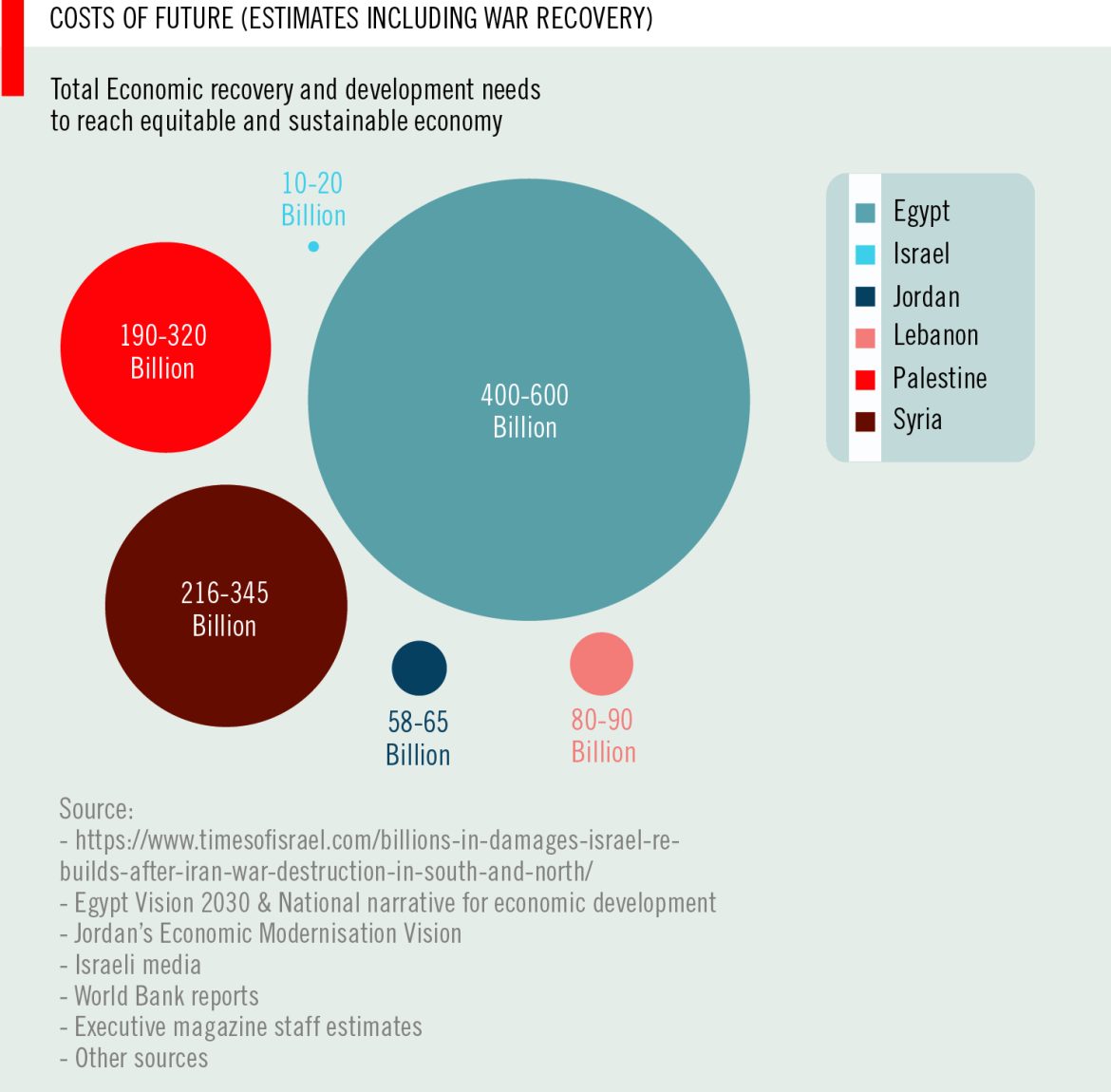
When viewed against unresolved questions surrounding UN Resolution 2803, the immense and arguably utopian capital and social investment requirements—running into the trillions—for achieving economic, social, and environmental sustainability in Egypt, Palestine, Jordan, Syria, and Lebanon, the triumphalist win-lose rhetoric of the American president and the Israeli prime minister in October 2025, together with the implications of the new National Security Strategy, point to a sobering conclusion. The Middle Eastern charade—where dominant global powers and their regional proxies profess commitment to peace and development while perpetuating structural imbalance—continues unabated. As the adapted lyrics of a Queen song might suggest: the show must go on.

Empty spaces—what are we living for?

Abandoned places—we know the score.

 Does anybody know what the Middle East is really looking for?

January 28, 2026 0 comments
0 FacebookTwitterPinterestEmail
Editorial

A scary, sticky, and deceiving mindset

by Yasser Akkaoui January 28, 2026
written by Yasser Akkaoui

The Lebanese government is no longer presiding over a financial collapse; it is attempting to codify a permanent state of decline. The proposed “Gap Law”, short for Financial Gap Resolution Law, testifies to a governmental masterclass in legislative dissembling. By adopting a rhetoric of “protecting small depositors,” the political class is quietly insulating itself from accountability while stripping citizens of their wealth and their future.

For decades, the Lebanese economy siphoned private capital to finance an inept state that prioritized the enrichment of dishonest politicians over the building of a productive nation. Today, the government’s response to the wreckage is an “ad hoc” remedy that betrays a backward, defensive mindset and de-facto powers the survival of the corrupt at the expense of strategy.

We must look to the regional vanguard for achievable alternatives. In 2024, the UAE’s non-oil economy generated approximately $365 billion. For its population of roughly 10 million, this translates to a non-oil GDP per capita of $36,500. Applied to Lebanon’s population of nearly 5.8 million, this benchmark translates to a $211 billion economy.

Such transformation is achievable with $100 billion in investment over the next decade. These investments could even produce much larger fruits by being leveraged into Arab economic integration at the historic inflection point witnessed by the region’s development-minded countries. However, only a trustworthy sovereign state – one  that respects property rights – can domestically attract and regionally leverage such capital on the foundation of revitalizing state-owned enterprises, modernizing infrastructure, and funding reconstruction.

Instead, the country is being strangled by a proposed law that aims for nothing more than the managed evaporation of the people’s assets. This strategy is a blatant violation of Article 113 of the Code of Money and Credit, which explicitly mandates that the state is liable for the losses of the central bank. By attempting to legislatively disappear the burden of long-squandered billions, the government is executing a sovereign default against its own citizens. A political class that did not spare the lives of more than 100,000 citizens during Civil War years of militia rule will not blink before squandering their money. Accountability is a moral imperative.

The solution remains a matter of political will. By using Lebanon’s gold reserves as a strategic shield and its state-owned assets – from failed utilities to prime real estate – as an engine for growth, the government could recapitalize banking sector and begin making the people whole.

Starting with the Gap Law, the state must decide whether it serves the people and the law of the land or is simply the legal department for the warlords who broke the nation?

January 28, 2026 0 comments
0 FacebookTwitterPinterestEmail
Comment

The Digital Generation

by May El Hachem December 2, 2025
written by May El Hachem

Step into almost any café or shared workspace in Beirut and a particular scene repeats itself: young professionals working for economies they may never see. Screens glow with design drafts, code repositories, and contract negotiations with clients in Berlin, Dubai, Toronto—anywhere but here. They are not chasing slogans about resilience; they are trying to stay one invoice ahead of a currency that erases value overnight. These are the Lebanese youth refusing to wait for a state that has abdicated its role in their future.

Lebanon’s youth unemployment rate (ages 15-24) surged from 23 percent in 2018 to 47.8 percent by 2022, according to estimates from the International Labor Organization (ILO) and Lebanon’s Central Administration of Statistics (CAS), a rate that nearly doubled in just four years. It is not a shortage of will that holds them back, but the absence of an economy capable of supporting them. A generation more globally connected than any before it has been reduced to refreshing buffering pages—an everyday reminder of a state that cannot deliver even the most basic infrastructure.

A demographic advantage turned economic strain

Sometimes described as Lebanon’s greatest asset, its youth have become the country’s unkept promise. According to the ILO’s 2024 report, youth aged 15-24 comprise one of Lebanon’s largest and most affected demographic cohorts. Every departure chips away at what remains of that promise. The airports are crowded with one-way ambition: engineers, designers, doctors, all in search of opportunities elsewhere.

But the costs cut deeper. Today Lebanon’s overall employment-to-population ratio has collapsed alongside youth unemployment and now sits at just 30.6 percent down from 43.3 percent only a few years prior according to a 2022 survey conducted by the ILO and CAS. Informality, meanwhile, has become the new rule: the share of informal workers grew from 55 percent in 2018 to more than 62 percent in 2022, according to The Policy Initiative’s 2024 report on Lebanon’s changing workforce.

When degrees don’t translate into jobs

On the surface, Lebanon boasts a stream of university graduates. Yet when these young people enter the job market, they find themselves adrift in a widening skills gap. According to a 2023 survey conducted by World Bank and Forward MENA, the educational arm of Beirut Digital District, on 82 digital and tech companies, 88 percent are actively recruiting full-time staff but cannot find the right talent, while 64 percent are specifically seeking software developers and falling short. The challenge isn’t limited to technical know-how: high demand also exists in digital marketing, UI/UX design—or the process of creating user-friendly and appealing

products—and social media skills, with employers now equally prioritizing ‘soft’ abilities such as teamwork, adaptability, and emotional intelligence.

Worryingly, 76 percent of surveyed companies identify a persistent mismatch between what students learn and what jobs actually require. This disconnect means that businesses face extra costs re-training new hires to fill basic manpower needs, while fresh graduates often find themselves underprepared for the evolving demands of the market.

The roots of this problem run deep. As confirmed by a 2023 World Bank report and additional research by Al Safa News, over 31 percent of Lebanese companies are unable to find suitable talent at all, while three-quarters of employers believe the skills gap is growing. The collapse of thousands of businesses since 2019, combined with an accelerating exodus of young skilled workers, has further depleted local expertise, especially in high-demand sectors like tech, healthcare, and engineering.

Meanwhile, Lebanon’s educational system still privileges rote academics over practical training. As a result, too many graduates leave university without the coding, critical thinking, or digital skills needed to thrive. Sector initiatives such as the World Bank and Forward MENA’s Skilling Up Lebanon program, which has delivered digital and gig economy training to thousands offer hope by directly linking youth to in-demand work and employer-valued certification. But without systemic reform, ambitious young people may remain locked out of the job market, or forced abroad to find roles that match their abilities.

Outdated laws in a freelance economy

Lebanon’s labor framework still belongs to a world before Wi-Fi: written for office hours, not remote contracts; for employers, not platforms. Yet today, thousands of young professionals work across borders, billing in dollars, earning in instability, living without protection.

A 2022 policy brief by The Policy Initiative titled “Lebanon’s ‘Missing Middle’: Online Delivery Workers Under Precarious Conditions,” finds that platform-based workers, from delivery drivers to freelancers, occupy a legal grey zone, excluded from both labor protections and social insurance. The report highlights how the country’s 1946 Labor Code makes no mention of independent or digital workers, forcing them into precarious “consultancy” contracts that deny them basic rights or benefits.

The ILO’s 2025 rapid assessment echoes this picture, warning that Lebanon’s private-sector labor market remains “severely disrupted,” with widespread business closures, income losses, and surging informality, particularly among youth. Together, these findings expose the legal vacuum expanding beneath the country’s most dynamic workforce; one that the state still pretends not to see.

Reform, meanwhile, drags on. Ministries overlap, committees meet, drafts circulate: and nothing changes. Another year of potential quietly dissolves into paperwork.

Education, law, and trust

If Lebanon truly wants to turn its youth bulge into an asset, reform must begin where hope hasn’t yet expired: in classrooms, in contracts, and in trust.

As per the report of the Ministry of Education and UNESCO, Lebanon recently launched the “Digital Transformation Strategy 2025: Reimagining Learning in Lebanon,” an ambitious initiative to infuse artificial intelligence (AI) and modern technology into learning and promote data-driven governance in schools. However, as noted by the Asfari Institute, a UK-based grant making charity, and World Bank, the public-school curriculum, still based on a 1997 framework, remains outdated and inadequate for 21st-century job markets.

Efforts by international agencies, including “Skilling Up Lebanon” by Forward MENA, the World Bank and UNICEF, seek to bridge the gap between academic learning and real digital skills. Nevertheless, challenges such as poor internet infrastructure, persistent digital divides, and insufficient teacher training continue to impede systemic change.

Beyond education reform, Lebanon has also taken long-overdue steps to update its labor market framework. As per a 2025 Asfari Institute policy note, Lebanon adopted landmark amendments to its Labor Law (Articles 1, 2, and 12) in May 2025, recognizing remote and part-time work by expanding the definition of “worker” and modernizing employment contracts to protect a broader range of flexible arrangements. The labor code now formally extends protection to freelance and platform-based work, with recent increases in social security coverage and an official minimum wage of LBP 18,000,000 per month (approximately $200 USD) as of August 2025.

Despite these encouraging legal updates, Lebanon’s reform landscape remains deeply uneven. Yet as per the assessment in the 3RF Reform and Recovery Framework, the deficit of true alignment persists: private sector dynamism is stymied by political instability and inadequate coordination among state, civil society, and business actors. Ongoing crises, from economic collapse to regional conflict, routinely derail even the best-designed reform programs and fuel a crisis of trust in public institutions.

Lebanon’s ability to sustain reform depends on continued international support from the likes of the World Bank, UNICEF, and UNESCO, who increasingly step in to fill funding and governance gaps, but meaningful progress ultimately hinges on the government’s capacity for implementation.

A question Lebanon can no longer postpone

Lebanon suffers from is not a deficit of youth or ambition, but a deficit of alignment. The private sector is ready, the talent is waiting, and the bridge between them is still missing.

Lebanon’s youth are already integrated into the global digital economy; they did not wait for domestic institutions to enable their participation. From cafés, co-working spaces, and family homes, they produce software, media, and services that circulate far beyond the country’s

borders, generating value in ecosystems that hardly acknowledge the states that failed to support them.

The issue is not simply one of departure or “brain drain,” but of structural compulsion. Their exit—physical or economic—was not a matter of preference but of necessity. Lebanon does not suffer from a shortage of skilled or ambitious people; it suffers from political and economic systems unable or unwilling to absorb their capabilities. The result is a persistent mismatch between human capital and national capacity, with long-term consequences for the country’s competitiveness, institutional legitimacy, and social cohesion.

December 2, 2025 0 comments
0 FacebookTwitterPinterestEmail
AnalysisBanking & Finance

Liability and legitimacy

by Executive Editors November 25, 2025
written by Executive Editors

A government’s highest duty is the dignified sustenance of its polity. Governments empowered by their people are accountable to them, and the Lebanese state has a profound reckoning ahead. The reformist government—elected under the banner of rescuing a country gutted by external aggression and catastrophic internal mismanagement—has yet to take the first essential step toward restoration: acknowledging the scale of its responsibility. On the contrary, during a November 2025 conference, Prime Minister Nawaf Salam told a crowd of over 700 participants that the money owed to depositors would not be repaid but written off.

Every delay in accepting liability for the losses imposed on depositors deepens not only material deprivation but also a crisis of democratic legitimacy. In the absence of a coherent resolution framework, Lebanon is drifting further into a fragmented, cash-based economy that echoes the dysfunction of state-owned sectors such as electricity and water: systems in which public failure creates private hardship while well-connected actors benefit from opacity and scarcity.

Just as state assets belong to the Lebanese people, so too do the state’s liabilities. And yet, decades of fiscal mismanagement, coupled with a refusal to assign responsibility within the establishment, have left the private sector—long the country’s sole engine of productive growth—exposed to paralysis and collapse. The choice now is simple: either Lebanon undertakes a credible restructuring process that protects households and restores confidence, or it continues along a path where economic life is conducted outside institutions altogether.

With both the stakes and the costs rising, Lebanon must approach its upcoming meetings with the International Monetary Fund (IMF) not as an agent of international institutions and foreign powers, but as a governing body in need of its own vision that serves the national common good. The credibility of that vision will be measured by whether the state finally confronts the truth it has avoided.

The problem of the IMF

The International Monetary Fund (IMF), devised for a global trade system informed by the economic theories at time of its establishment, has changed in many respects over the past 80 years. But the fund and entire World Bank system of today is still not the entity that the Lebanese government is accountable to. 

The IMF has its governing principles and operational mandates, however controversial, including the mandate of lending money to member countries exclusively on grounds of feasible prospects for repayment of funds injected into an economy and a state’s emergency funding needs. It has its formulas and models for determining a state’s ability to service debts owed to the IMF.

These rules include disbursement ceilings when entering funding agreements and the requirement that the borrowing country’s debt to the IMF does not remain unpaid. A big part of the repayment capacity matrix is the imperative that debt to income ratios are within margins accepted by the IMF or that debts are reduced from excessive levels by any means necessary. IMF agreements are also conditional upon adherence to the fund’s demands, such as implementation of fiscal discipline or/and structural and administrative reforms. 

Unsustainable write-offs

As has been pointed out by Lebanese economists during IMF negotiations in 2021/22 and again this year, the fund’s presumed debt-to-income ratio of Lebanon, with public obligations estimated at 140 billion USD, acts as a wall prohibiting a feasible IMF agreement that also preserves large deposits that exist in the banking system. IMF demands for fiscal reform and discipline add to the tally of conditions which have no more been met by the current government than by its even more hapless predecessors and caretaker predecessors.

Cognizant of the IMF’s institutional behavior, several of the country’s top independent economists and institutional finance experts – many of which with experience working in international financial institutions, including the IMF – have collaborated with Executive Magazine in the production of a position paper that aimed at strengthening the government’s approach to negotiations with the IMF in 2025. The experts’ motivation was to help the new, reformist government in the face of external pressures and degraded institutional capacities, factors that led the experts and this magazine to undertake substantial analysis and draft 11 comprehensive recommendations. The fruits of this collaboration were published on the magazine’s web platform in May. 

The recommendations in this position paper included compliance with self-explanatory economic imperatives such as unification of the exchange rate, gradual implementation of a free-float system, and fulfillment of reform obligations on all stakeholder levels. The recommendations were anchored in the philosophies of holding all actors accountable, and rebuilding trust between the state, its citizens, and the financial system. Their foundational demand, however, was depositor rights; “deposits must be preserved as bank liabilities”.  

With regard to IMF demands for lowering the debt-to-income ratio to more customary or accepted levels, two things have to be understood.

The first notion is that extensive income and extraordinary wealth come with the moral and legal obligations to contribute proportionally to public goods and their provision. This truth does not need IMF curation. It is actually a core truth of functioning and sustainable capitalist orders. A common counter-argument, however, claims that private wealth is inherently more effective at generating jobs than state intervention or redistributive taxation. That claim is not a settled truth in advanced economies, nor is it reflected in the governance models of successful modern states.

The second principle concerns legality and constitutional order. In any jurisdiction that seeks durable and resilient growth, high profits—whether corporate, investment, or rent-derived—are not entitled to special protection merely because they may contribute to employment. A transparent and efficient political economy must protect public assets and ensure that the benefits of growth are shared. The inverse argument, now openly espoused by Lebanon’s Prime Minister—that depositors should be stripped of their assets to cancel or offset irresponsible public debt—is both unlawful and unconstitutional. It converts a crisis of governance into a justification for the destruction of private property and undermines the very basis of a legitimate economic system.

A not so new but pernicious IMF push

Under a new analysis by economist Mounir Rached, the president of the Lebanese Economic Association, the IMF is pushing for a 90 percent write-off of bank deposits, leaving, however, deposits of less than $100,000 relatively unscathed. The erasure of bank liabilities would allow Lebanon’s remaining debt to be stated at $30–32 billion and thus fall into the 1 to 1.5 times GDP range that the IMF seems as manageable. According to Rached, this would amount to a “financial crime” that violates depositors’ rights protected by the Lebanese Constitution.

This jibes with information – rumors and whispered revelations on plans for illicit haircuts that actually deserve to be called economic beheadings – relayed to me by sources close to concerned ministries and the central bank. According to these sources, the assets in the vaults of the central bank stand by current valuation at around $50 billion but do not cover the $80 billion of central bank liabilities to commercial banks.

The new joint plan by Banque du Liban (BDL), Lebanon’s central bank, and the ministries of finance and economy aims to restore BDL balance sheet solvency by closing a $30 billion FX gap. The gap is based on the fact that BDL currently owes banks $80 billion (which are private sector deposits at banks) but holds only $50 billion comprised of required reserves and gold.

To cover the shortfall, the plan proposes a $30 billion haircut on deposits. This reduction follows a previous auto-haircut imposed by banks and BDL on deposits which has already dropped from $123 billion in 2018 down to $80 billion in 2024. If this new haircut is applied, total deposits would fall further to about $50 billion.

This haircut has three components: cutting overpaid interest before the crisis, cut/reduce LBP-to-USD conversions post-Oct 2019, and exit illegal foreign funds. A very brief review of these components makes clear that:
-The “overpaid interest” cut is in contradiction to global banking standards and a breach of banks contract agreements with depositors.
-The cut on “LBP-to-USD conversions” punishes depositors for banks’ responsibilities who agreed to conduct their treasury transactions through the BDL to convert the LBP to USD.
-The elimination of illegal funds (under $5 billion) can be considered as system-cleansing and as such is acceptable.

Along with these measures, depositors will be subjected to illegal stratification by the size of the deposits.
-Depositors under $100k will be reimbursed over 4 years, only if the State and banks participate in the process.
-Depositors holding between $100,000 and $500,000 would receive zero-coupon bonds that are illiquid and practically have no value.
-Depositors with holdings above $500,000 face uncertain recovery prospects. Their effective assets recovery will be contingent on banks’ equity bail-in results and/or potential future Deposit Recovery Fund (DRF) returns.

In a nutshell, the new plan shows that, instead of preparing to pay back the state obligations to the central bank that underlie this $30 billion gap in hard-currency assets, our clever public servants want to newly impose a $30 billion “haircut” of large deposits as secondary erasure of deposits after depositors already suffered a $43 billion contraction in banked assets by 2024 when compared with their $123 billion deposit holdings at EOY 2018.

The problems with this plan include contract-law violations when reclaiming “overpaid” interest that was agreed upon between commercial banks and their corporate and private banking clients. The write-offs of effectively $30 billion in bank liabilities will also not translate into the strengthening of liquidity in the banking system nor will it guarantee actual full repayment of the remaining $50bn deposits. But the retroactive erasure of interest gains is counter to international contract law and violates numerous Lebanese laws and Article 15 of the constitution.

Moreover, economic analysis shows that even after return to nominal solvency, BDL’s assets remain mostly illiquid: Gold sales are legally prohibited under Law 42/86, unless this law is amended. The enterprises under BDL direct or indirect ownership (MEA, Casino, Intra) are practically not sellable unless and until their management is privatized and their profitability restored. Only mandatory reserves are liquid assets and can partially cover a portion of monies owed to depositors with holdings under $100,000. Thus, BDL solvency plan through a consequent haircut will neither translate into liquidity nor into a foreseeable actual full repayment of the remaining $50bn due to depositors.

In his critique of the scheme, LEA’s Rached further points out that the plan lacks any concrete framework for bank restructuring or recapitalization and will be unsuited for building confidence in the financial system. Neither does the scheme offer any exit path from Lebanon’s dominant cash economy. In terms of its rationale, BDL and the State justify this “exceptional” haircut to be driven by an assumed “systemic” nature of the crisis. But legally, as noted above, the haircut on retroactive gains and actions violates Lebanese laws, contractual agreements with banks and Article 15 of the Constitution (property rights). Economically, it undermines trust, liquidity, and investor confidence.

Rached emphasizes in a message to Executive that a genuine alternative plan has to be implemented in order to resolve the banking crisis. One such plan has already been developed by LEA and would feasibly and functionally resolve the crisis within less than one year.

Disregard for Lebanese legal tenets by the IMF is a more serious flagration of Lebanon’s constitutional principles and historic practices than the IMF seems to comprehend. Far worse from constitutional perspective is, however, the contemplation of such measures as demanded by the IMF on part of the Lebanese government. This is immolation, a ritual burnt offering of the constitution by its guardians. Immolation on the altar of hegemonic financial dictates. Our politicians might as well try to burn the whole country into the stone age.  

Changed realities

Other factors scream for new consideration. Recent upside gaps in local estimations of national GDP reached double-digit billions of dollars. The estimates of the Central Administration for Statistics (CAS) for 2023 show a nominal $10.2 billion rise from $21 billion in 2022. By such reassessments of recent GDP trends, the local numbers reveal upward divergence of Lebanon’s GDP from IMF numbers comes to whopping 30 percent.

Moreover, projections for 2025 that by local evidence are much more aligned with economic realities from traffic to retail shopping behaviors by consumers, put the nominal GDP back above the $40 billion mark. All in all, it cannot be denied that the economy of 2025, even if still uneven, in urgent further need of rebuilding, and deeply lacking in equality, looks incomparably better than the memories from each of the three preceding years.   

Lastly, apart from the perniciousness of IMF negotiations that seem to treat laws as nuisances and the far better than predicted trajectory of the economy due to private sector agency, better solutions have been put on the table by competent economists with passion for Lebanese recovery.

A recovery path proposed by economist Farid Boustany categorically rejects all cancellations or forced cuts of any-size deposits and suggests as legal path to recovery under which the government of Lebanon is obligated repay its debt to the central bank and recapitalize the latter, banks are mandated by law to strengthen their liquidity and capital. In this version of an exit from the financial doldrums, the central bank would tap into its reserves, which today stand at about $40 billion in gold and $11 billion in foreign-currency holdings, to inject liquidity and gradually return depositor funds. Boustany also sees merit in instituting a tax on past currency transactions as it would help reduce the financial gap.

For economist Saleh Nsouli, another expert with experience working in international financial institutions, negotiations with the IMF have been hampered by the fund’s disregard for large private and corporate depositors whose financial capabilities sustain employment and drive economic growth. In place of a sole focus on the protection of small depositors, Nsouli advocates for an alternative domestic program to IMF dictates.

His proposal priorities protecting of all depositor rights and injecting liquidity into the financial system. Parts of the central bank’s reserves, including gold, should be mobilized and deployed in providing depositors with cash tranche of 25 percent. The remaining 75 percent of their holdings owed to depositors should be released to them as time deposits with maturities of one to four years. These liquidity injections, which would invigorate the economy, should be coupled with forensic audits, accountability measures and reforms of the banking system. In this regard, the IMF should not be sought out as lender but relied on for technical assistance, helping Lebanon with expertise in tax, fiscal, and regulatory design questions.

These experts, using media platforms including Executive, have invested themselves into the search for a constructive outcome of Lebanon’s appeals to the IMF. This magazine alone has covered economy and policy and banking and finance topics in hundreds of expert comments and analytical articles. Given the latest corrections it would be irresponsible for the current administration to now, as it is nearing the end of its term but has yet to achieve crucial administrative and security reform obligations, rush in making concessions to the IMF. Our national priorities have shifted in the past 12 months since the fake ceasefire. It is unconscionable that the government of Lebanon should not discuss the continued rebuilding of the economy and the resolution of the financial system to greater depth in public consultations with economists and the many qualified stakeholders in the country.

From the eruption of the economic crisis, an agreement with the IMF has incessantly been framed as required for returning international confidence – and investments – to the Lebanese system. But while much has changed in the intervening years, the IMF’s fundamental positions have not moved. The recent Lebanese successes in seeing private sector investments and accessing international finance, such as the awarding of World Bank reconstruction and energy sector loans, shows that the phalanx of international financial institutions’ distrust in the Lebanese government has been disrupted positively. New financing realities are in the process of being created.    

Yet the current administration’s transparency and track record has been far from universal. Rebuilding mutual trust is the deepest need for all actors in the Lebanese polity. This cannot be done in any other way than through a dual process of delivering results and building consensus. Honest communication is part of the deal. Some Lebanese ministries have made great strides towards improving their performance, some even having ministers invest 12-and-more hour workdays and accepting the human capital contributions of highly qualified volunteers and academic institutions. Others seem stuck in the old patterns of glowing speeches that do not match actions in the tradition of clientelism and backroom dealings.

Must this weary public be left to wonder whether the prime minister, appointed because of his globally acknowledged commitment to justice, will skirt the very constitution he took an oath to uphold?

November 25, 2025 0 comments
0 FacebookTwitterPinterestEmail
Analysis

A war on reconstruction and return

by Maryam Alaouie November 21, 2025
written by Maryam Alaouie

The recent Israeli airstrikes on the south of Lebanon have revealed a calculated shift in Israel’s military strategy. The deliberate targeting of civilian infrastructure and attempts at reconstruction, from excavators and asphalt factories to olive trees and beehives, sends one clear message: there is no return to the south of Lebanon.

Since the ceasefire deal was announced on the 26th of November of last year, the Lebanese government has shown limited involvement in any post-war reconstruction efforts in the South. Today, almost a year later, according to Lebanese authorities, Israel has breached the deal over 2,500 times, yet the government has taken no action ­– a reality that has pushed many in the south to take matters into their own hands.

Machinery yards and cement factories targeted in Msayleh

Israel’s escalating airstrikes in October 2025 reveal a clear aim at disrupting infrastructure and reconstruction in the south of Lebanon. On the 11th, in the village of Msayleh, six heavy machinery yards that included 300 reconstruction vehicles such as bulldozers, excavators, trucks, and rollers, were targeted and destroyed by Israeli airstrikes.

Following the attack, Ahmad Tabaja, the owner of one of the warehouses affected, Tabaja Equipment Inc., issued a statement denouncing the attack and stating that Israel’s goal is to “prevent the reconstruction of towns and villages in the south of Lebanon,” adding that he does not belong to or work with any political party, as Israel claims to only target members of Hezbollah.

Furthermore, in another attempt to cripple reconstruction on the south of Lebanon, on the 17th of October, the Israeli army committed one of its heaviest airstrikes since the ceasefire deal, destroying an asphalt and cement manufacturing site near Ansar, in the district of Nabatiyeh. This attack, carried out by 12 Israeli air raids, as reported by the Lebanese National News Agency, destroyed concrete mixers, pumps, fuel tanks, and cranes. The site workers report that they lost the work of a lifetime.

“This is a war on construction, this is a war on the people of the south…they’re going to hit everything related to reconstruction, this is just the beginning, the worst is yet to come,” another factory worker in Ansar told local media.

Hitting the heart of the water supply

On the same day, Israel targeted one of the main sources of livelihood for every southerner: water.  A fuel depot that belongs to the South Lebanon Water Establishment (SLWE), the official public utility responsible for water distribution across all of southern Lebanon, was struck by Israeli airstrikes and lost more than 500,000 liters of fuel.

The Israeli attacks on essential water sources left 25 border towns without water after their networks were completely destroyed. According to SLWE, the estimated cost of repair is around 100,000,000 USD.

“It did not stop there,” Dr. Wassim Daher, President and General Director of SLWE, tells Executive. “Around 25 local pumping stations and 45 solar power systems used to operate these stations in the south were affected, in addition to major pumping stations that supply water to multiple towns, some serving more than 40 towns, such as the Taybeh, Wazzani, and Nabaa Al-Tasseh stations” he added.

Despite the continuous efforts of SLWE to provide water to the citizens in the south and carry out its daily tasks, the war has also impacted the mobility of its employees particularly maintenance workers.

“There has been an increased demand for water in certain areas north of the Litani River due to the displacement of residents from areas south of the river,” says Daher. “This situation has required extended pumping hours and higher water production, as well as the establishment of temporary water points in shelter centers, in coordination with governmental and non-governmental organizations and associations.”

The shortage of water supply in the south has made it harder for the people to return to their houses after the war, according to Daher. “Because,” he explains, “this directly affects the lives of citizens and, consequently, influences their decision to return to their towns and resume their activities, especially since many residents of border villages rely on agriculture.”

“The government is as good as nothing”

The crippling of the water infrastructure has contributed to the high displacement numbers reported. According to the United Nations Office for the Coordination of Humanitarian Affairs, as of December 2024, roughly 178,817 civilians remain displaced and are unable to return to their homes in the south of Lebanon.

The scale of destruction and widespread displacement urgently necessitates the support of the government and its institutions, yet the near total absence of it has been all the more frustrating for southerners.

 “Assistance from the government?” laughs Abbas Hmadi – a young chef from the South whose family is trying to rebuild their home in Shabriha – when asked if they had received any help for the reconstruction process. “We did not receive assistance from anyone, the government is as good as nothing. The house my dad worked all his life to build in our village, Maroun Al -Ras, and cost him about 500,000 USD, is gone. We had another house in Shabriha, a village near Tyre, also gone. Our apartment in Dahye, in the area of Jamous is also gone.”

The family is now waiting for a government permit to excavate their land in order to rebuild. “We don’t know when – or if – we will get it, the government always seems to make things harder for the people instead of easier,” Hmadi says.

When asked why the family did not build in their own border village Maroun Al Ras, he explains, “The Israelis do not want us to rebuild — they are not even allowing us to excavate the land and remove the rubbles.”

The ecological backbone of the South

Houses, water, and roads are not the only forms of infrastructure Israel has been targeting; the ecological and agricultural infrastructure of the South—olive trees and beehives—have also been among the focuses. In June 2025, Israeli troops bulldozed olive groves in Meis El Jabal. The municipal leader in the village told local media, “they don’t want any signs of life…including olive harvest operations.”

Israel’s frequent use of white phosphorous has led to the destruction of thousands of olive trees. According to a report conducted by the Lebanese Ministry of Agriculture and UN-ESCWA, between 6 October and 24 November 2023, over 53,000 olive trees were destroyed in 53 villages. What the olive trees represent to the southerners is not only a source of income, but a part of their environmental culture and heritage.

“My father has been growing olive trees with his bare hands for 40 years now, he lost more than 400 olive trees by Israeli strikes” Hmadi tells Executive.

The bees have not been spared either. The Lebanese Ministry of Agriculture reports that around 3,500 beehives were completely or partially damaged, putting the regions apiculture at risk. It does not stop at the bees themselves – those who care for them have also become targets. In June 2025, Israel killed a beekeeper in the village of Houla.

“From the people to the people”

Since the beginning of the war, residents of the south have lost all confidence in the government and its institutions to help them get back on their feet. This factor contributes to the existing solidarity between the people, making them rely even more on each other, help each other, and pull each other up through community-driven initiatives.

These initiatives come in different forms. In Ramyeh, Hussein Saleh, an activist and municipal council member in the Ramyeh Municipality, fled to the north during the war and started a grassroots campaign that helped more than 4000 southerners, through what he calls “The One Dollar Campaign.”

The name of the campaign was inspired by the monthly funding project ‘One Lebanese Pound’ launched by Sayed Mousa Sadr in the early 1960s as a part of his work on social welfare in the south of Lebanon.

The One Dollar campaign is made to help the people that are living in southern border villages. “It is for the people that stayed in their land, that are living with broken windows, collapsed walls and roofs ruptured by Israeli missiles. Being a one-dollar campaign encouraged people to collectively participate and pay even more than a dollar” explains Saleh. It helps with providing basic utilities like solar power panels, glass restoration, walls, roofs, and doors, before the winter arrives. The campaign includes other initiatives like collecting unwanted furniture and distributing them to those in need, through Saleh’s own means.

 “Just imagine, some of them are living across from the Israelis without even having electricity. I am not claiming to have ‘saved the south,’” adds Saleh. “The south needs billions of dollars to be rebuilt, but I refuse to sit and do nothing. I care about the people and these small acts have had a huge positive impact on their lives and spirits.”

It was work done from the people to the people, according to Saleh.

But how many One-dollar Campaigns would it take to rebuild the South? In the March 2025 Rapid Damage and Needs Assessment report released by the World Bank, South Lebanon’s recovery and reconstruction costs are estimated at 11 billion USD, with 4.6 billion USD needed for the housing sector alone – much of this concentrated in the border villages and Nabatiyeh district.

The Strategy of Attrition

Beyond the physical losses of houses and loved ones, the war has taken a psychological toll on the people of the South. The evidence presented above suggest that the pattern of relentless flows of attacks, are not only for military control but have been designed to undermine the morale of the people and their power to resist. By systematically targeting different forms of infrastructure, the livelihood of southerners has deteriorated drastically.

Ramyeh, the village Saleh comes from, is among the five points where the IDF maintains illegal military presence. He explains that it is not fear that stops people from rebuilding, but common sense. “How can you rebuild under occupation? The Israelis are destroying every wall we try to build, but despite that, people in the south remain resilient and are fueled by the power of resistance.”

As the attacks continue on a daily basis and reconstruction is at a halt, the question remains: until when will the people in the south remain resilient and patient? And when will the government take action and prioritize the return and safety of the southerners from Israel’s clear intentions of occupation?

November 21, 2025 0 comments
0 FacebookTwitterPinterestEmail
Comment

Woman against local odds

by Rawan El Sayed November 14, 2025
written by Rawan El Sayed

When I launched Becoming Social in the summer of 2024 in Tripoli, the economic hub of North Lebanon, I knew the odds weren’t in my favor. Tripoli wasn’t exactly known for being a marketing hub — and definitely not one led by a woman. But I also knew that change had to start somewhere, and I wanted to be part of that shift.

A year later, what began as a leap of faith has turned into a growing agency that’s helping redefine what modern marketing can look like in northern Lebanon. We’ve grown from a one-woman operation to a small but dynamic team handling over 15 clients across different sectors from hospitality and retail to beauty and tech, and that’s just the beginning.

From Global Experience to Local Purpose

After my graduation from The American University of Beirut in 2017, I joined large multinational agencies like M&C Saatchi and Omnicom Media Group working as a full-time employee and learning the ins and outs of the business. Later in 2021, I left for Paris, France where I earned my MBA from Université Paris-Saclay and worked with marketing teams handling European luxury and tech giants such as LVMH & SAP. Those years taught me discipline, structure, and the power of data-driven storytelling. I learned how to read markets through insights, how to translate numbers into creative impact, and how brands can build emotion even in hyper-competitive environments.

But while my career was growing, I felt a persistent pull toward home. Every visit back to Tripoli made me realize how much potential the city had — creative entrepreneurs, ambitious youth, and family-run businesses ready to grow — yet how little access they had to strategic marketing support. I didn’t want to keep contributing my expertise to already-established global brands when I could use it to build something new and impactful back home.

So, I made the decision to return and to exchange skyscrapers for seaside streets and international clients for local potential.

A Leap of Faith — and a Reality Check

Transitioning back wasn’t easy. Tripoli’s market operates very differently from the structured, fast-paced corporate world I came from. Here, marketing budgets are modest, word-of-mouth still drives many decisions, and clients often expect immediate results without understanding the long-term value of brand building.

In the first few months, I found myself explaining concepts that had become second nature abroad, from why a consistent content strategy matters to how paid advertising works. It wasn’t frustration that kept me going; it was curiosity. I wanted to understand why the market functioned this way and how I could adapt to it instead of trying to force it into a model that didn’t fit.

Measurable Growth — One Relationship at a Time

Our first clients came through referrals, mostly small businesses testing the waters of digital marketing. But by the end of our first year, Becoming Social had grown to handle a client portfolio of over 15 brands, we tripled our initial monthly revenue, and expanded services to include branding, paid advertising, influencer collaborations, and outdoor marketing.

Today, about 70 percent of our clients are based in Tripoli, while the rest were projects that came from Beirut, Dubai, and even Paris — a sign that the quality of work coming from Tripoli is starting to attract attention beyond the city.

This growth didn’t happen overnight. It came from listening — really listening — to what business owners were struggling with. Whether it was a family-owned mattress manufacturing company trying to modernize and globalize its image without losing authenticity, or a new coffee shop unsure how to position itself, we approached each project as a partnership, not a transaction.

Facing Challenges Head-On

Of course, running a female-led agency in a conservative, male-dominated environment comes with its own set of challenges. Early on, I often found myself being second-guessed in meetings or having to “prove” my credibility to male clients.

There were also logistical challenges in the form of delayed payments, fluctuating exchange rates, and clients hesitant to commit to long-term retainers because of Lebanon’s economic uncertainty.

To navigate this, I built flexibility into our business model. We started offering phased strategies that allowed clients to test results before scaling. We also relied heavily on measurable KPIs showing clear before-and-after metrics on engagement, reach, and conversion.

That data became my armor. Once clients saw the numbers, the skepticism faded.

Balancing Empathy and Data

One of the biggest lessons I’ve learned is that marketing isn’t just about algorithms or aesthetics; it’s about empathy. Understanding what people need, fear, and aspire to is what turns a strategy into a story.

At Becoming Social, we combine analytics with intuition. For instance, when we worked with a local café that had been struggling post-pandemic, we didn’t just focus on boosting followers. We told their story of resilience, community, and the simple joy of sharing a cup of coffee with friends. The result? Their customer visits doubled within three months, and their brand became part of the city’s cultural fabric.

Those are the wins that matter to me most.

If there’s one thing entrepreneurship has taught me, it’s that growth is rarely linear. You’ll face setbacks, self-doubt, and sleepless nights. There were times I wondered if I’d made the right choice — if I should’ve stayed abroad where things were “easier.”

But every time a local business tells me, “You helped us see our value,” I’m reminded why I came back.

I’ve learned to celebrate progress, not perfection. To embrace mentorship — both giving and receiving. And to surround myself with people who share the same vision: that Tripoli’s story is worth telling.

Why Tripoli, Why Now?

Tripoli is often underestimated — but it’s a city brimming with ideas and creativity. The youth here are digitally savvy and hungry to learn, yet they lack platforms to showcase their talent. That’s why I’ve started collaborating with local universities and creative hubs to mentor students in digital strategy and branding.

The goal isn’t just to grow my agency; it’s to build an ecosystem where marketing talent can thrive locally instead of seeking every opportunity abroad.

As a woman leading an agency in Tripoli, I often get asked if it’s difficult. My answer? Yes, but it’s worth it. Because every challenge is also a chance to redefine what leadership looks like.

I’m no longer just building a business. I’m building a belief that women can lead agencies, shape narratives, and create economic value in their own cities.

The journey of Becoming Social has only just begun. But if this first year has proven anything, it’s that Tripoli is ready for transformation — and so are we.

Our mission remains simple yet ambitious: to break barriers, elevate marketing, and help Tripoli’s businesses shine as brightly as they deserve.

November 14, 2025 0 comments
0 FacebookTwitterPinterestEmail
Job posting

Part-Time Proposal Writer

by Executive Editors November 10, 2025
written by Executive Editors

Position Overview:
Executive is seeking a part-time proposal writer to assist in executing funding strategies that align with the magazine’s editorial calendar and strategic objectives. The ideal candidate will identify and pursue funding opportunities, draft compelling grant proposals, and manage partner relationships to ensure transparency and accountability.

Key Responsibilities:

  • Identify and assess potential grants, sponsorships, and institutional partnerships
  • Write and edit concept notes, proposals, and reports tailored to donor priorities and Executive’s mission
  • Coordinate with the editorial team to align funding with ongoing and upcoming coverage

Qualifications:

  • Proven experience in proposal writing, and fundraising or partnership management, and NGO sectors.
  • Strong understanding of donor landscapes (local, regional and international).
  • Excellent written and verbal communication skills in English (Arabic and/or French are a plus).
  • Strong organizational and project management skills with the ability to work independently.

Commitment:

  • Part-time position (approx. 15–20 hours per week).
  • Flexible schedule with regular coordination meetings.

To Apply:
Please send your CV, a brief cover letter outlining relevant experience, and one sample of a grant proposal or partnership pitch (if available) to [email protected] with the subject line: Proposal Writer Application – [Your Name].

November 10, 2025 0 comments
0 FacebookTwitterPinterestEmail
Brand Voice

THE MANY MYTHS AROUND SMOKE-FREE ALTERNATIVES

by Philip Morris Management Services November 3, 2025
written by Philip Morris Management Services

In a world of misinformation, separating fact from fiction can be challenging at best. Information overload is everywhere, causing confusion and doubt in many areas of life. One such area is smoke-free technology.

Giving up nicotine and tobacco altogether is the best choice a smoker can make, but many don’t. Where smoking was once the only option, smoke-free alternatives now exist to give smokers who don’t quit, a better choice too.

Busting the myths around smoke-free products can prevent informational roadblocks and help more smokers leave cigarettes behind for good. That’s why it’s always important to stop, think, and check whether things are true or just popular belief.

So, what are the most common myths about smoke-free products?

MYTH

“Nicotine is the most harmful thing about smoking.”

FACT

Burning is the most harmful thing about smoking. Nicotine is addictive, but smoke produced by burning is the primary cause of smoking-related diseases.

MYTH

“Smoke-free alternatives are the same as smoking cigarettes.”

FACT

Quitting is best, but smoke-free alternatives are a much better choice than continuing to smoke because they don’t produce harmful smoke. When there’s no smoke, the levels of harmful chemicals can be considerably reduced.

MYTH

“Tar is present in smoke-free products.”

FACT

Smoking-related tar is a weight measurement of leftover particles in smoke when nicotine and water are removed. Smoke-free products don’t produce smoke, so tar is not a relevant unit of measurement.

MYTH

“Tobacco and nicotine products are all the same as each other.”

FACT

That’s not true. Products that burn tobacco and create smoke can be much more harmful than alternatives that deliver nicotine without smoke.

MYTH

“Better alternatives to smoking don’t exist.”

FACT

Better alternatives DO exist. As the name suggests, smoke-free alternatives can emit significantly fewer and lower levels of harmful chemicals compared to cigarettes. This makes them a better choice for adults than continuing to smoke.

Smoke-free products deliver nicotine without burning, which means they don’t produce smoke and can contain far lower average levels of harmful chemicals than cigarettes. This makes them a far better choice for those that don’t quit. As with any product, it’s important to choose an alternative that’s been backed by science, tested thoroughly, and comes from a reputable retailer.

When it comes to advances in science, technology, and tobacco, the right information can really make a difference. By clearing up confusion, adult smokers could be encouraged to make better decisions for their health.

TO LEARN MORE ABOUT SMOKE-FREE PRODUCTS, VISIT OUT WEBSITE

November 3, 2025 0 comments
0 FacebookTwitterPinterestEmail
Economics & PolicyEntrepreneurship

Institutional heft in tumultuous times:

by Thomas Schellen October 31, 2025
written by Thomas Schellen

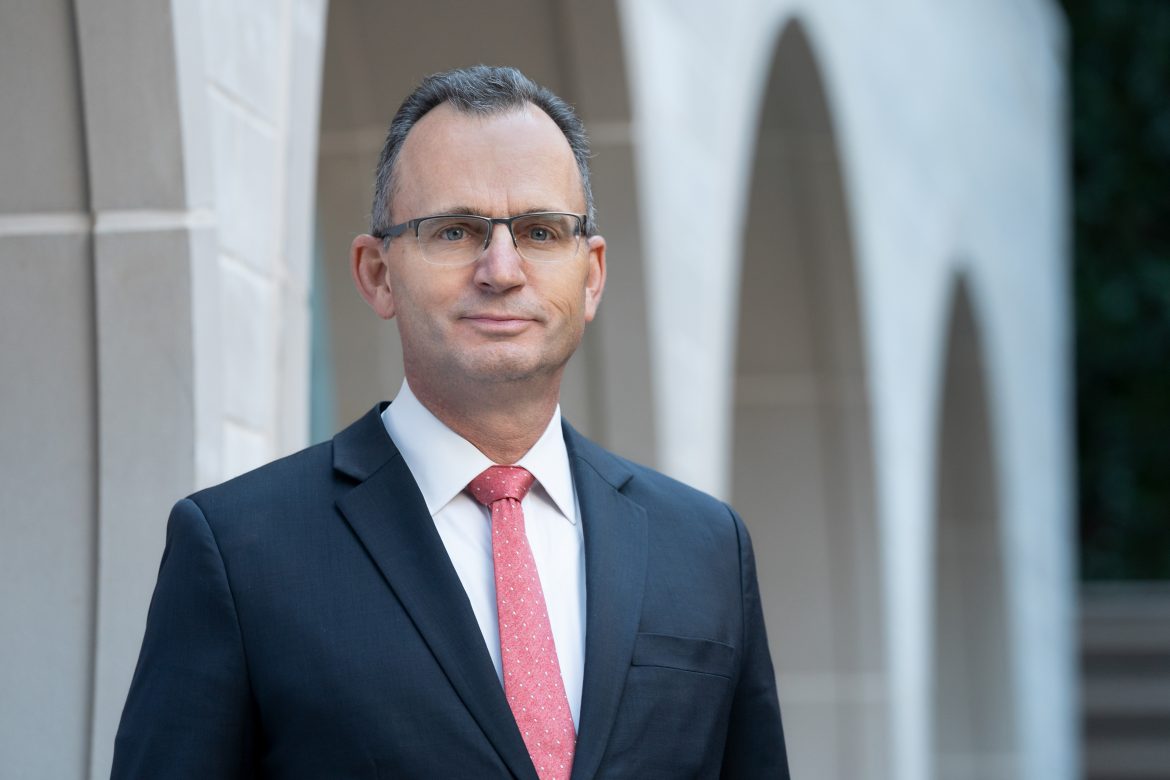
Just having celebrated its centennial, the Lebanese American University is starting its second century as an institution that is deeply invested in Lebanon’s socioeconomic transformation. A glancing view at the past and ongoing pivots of the institution – from “girls’ school” to women’s college to liberal arts college and internationally active university – and the various external shocks that LAU had to overcome in the past 60 years and up to the latest war on Lebanon, gives the impression that the institution itself is a somewhat under researched case study in social and academic transformations. It is also a case study for organizational leadership that is inseparable from the American and the Lebanese heritages in both scholarly and personality profiles. Executive discussed the institution’s constructive but meandering path with Chaouki Abdallah, the university’s 10th president.  

It has been one year at the end of June since the news of your appointment. You have assumed your position officially in October of 2024, a very conflicted moment in Lebanon. But before you agreed to leave your position at a large US university, how long did it take for LAU to find you and convince you to assume the role of the president at the Lebanese American University?

I have no idea how long the whole process took them. They started talking to me two or three months before we reached the agreement for me to come. I was at Georgia Tech as head of research when I got an email from the search firm, asking if I am interested [in the position at LAU]. I had a standard answer of saying ‘thank you so much but I am happy where I am’. They responded by calling me and suggesting that I might want to speak to the chair of the board [of LAU]. Given that it was a Lebanese university, I accepted a call from the chair of the board and we talked for a long time, like 30 minutes. He told me some things that intrigued me. They made me say ‘ha, I am interested’.

One thing that he said was that universities in Lebanon are consequential, almost the last line of defense, or the last institutions that are still delivering all their missions, so that people who graduate go on to do great things. He talked about LAU but also all other universities. And then he told me that during the economic collapse LAU took money out of their endowment in order to make sure that students were able to pay and attend classes. This led me to coming to see the board of LAU in NYC. My wife, who is American, is from Atlanta, and we always thought it would be my last post [to be at Georgia Tech] but she said, “why don’t you go and talk to them. You thought about what you can give back to the country at one point, so let us.”

On the macro scale of things, your arrival at LAU coincided with the university’s centennial, the hundredth anniversary year. Entering the second century is a hard inflection point or an incremental transition for LAU, as well as a psychological marker of importance indicating that you have something else to do now. What is this “something else” that you see as important for LAU’s second century?

To me, universities, and especially universities that are not for profit, are anchor institutions. They are not a business or bank. They are institutions that anchor society. The mission of the university on the highest level is to generate and propagate knowledge, and then become more than that. It becomes a mission to create the environment. It used to be that a university was only concerned about the student when they came to us and would then forget about them after they leave us [as graduates]. That is no longer the case. Before they come to us, we work with schools and we work with alumni. In addition to that, we now are a healthcare system provider.

After the first hundred years, LAU is part of the fabric of society, especially in higher education. The next hundred years, or the next chapter of the story entails the mission that we do a lot more to keep some of the talent that we produce, in the country. Lebanon is a brain factory. We export talents. We import everything else, but we export people who want to do great things for other places. It is not a question of wanting to keep everybody in here because the market and the society cannot absorb all the talent. However, I saw a recent study saying that 65 percent of college graduates aim to leave the country but only 16 percent actually want to leave. The others see no other choice but leaving.

Most people would like to stay if they have the opportunity. The role of the universities now is to create that [environment allowing people to stay and find careers] above and beyond what they already do, which is provide education. How will we do that? One of the areas that I worked with when I was with Georgia Tech, an area that really mashes with the Lebanese spirit, is entrepreneurship. How do you got people to start their own companies instead of just waiting to get hired by a bank or a company? Well, there is an art to that and we have a lot of entrepreneurship. The other area that is extremely important is for universities to be connected to their society, specifically in the research of solving problems.

There is a role for longer-term research and a role for research in basic sciences but there is an increasing need, and especially in a place like Lebanon, to solve problems, such as the problems that EDL has or that municipalities have in treating water, or that the government has in other areas. So I am promoting applied research. Academia has to be a part of society; it cannot be an ivory tower.

LAU in the last century was perceived for a while as “that girls’ school” or a second rate institution for those who could not get to the top university in Lebanon. That was something that people mentioned when discussing LAU even in the early 2000s. But at the current juncture, when Lebanon is still in a societal state of fragmentation, how do you see the role of LAU? Are you a potential unifier of society? Are you still strictly associated with the liberal American Arts tradition in education, or even the earlier missionary tradition that LAU was once founded under?

Let me start with the premise of the question. At one time, there were no universities, or places that educated women. LAU filled that very important role. It was [Beirut College for Women] and before that, since 1835, the American School for Girls. Many people I meet today from the Gulf, or from Lebanon, often their mothers went to LAU, because there were at the time no universities educating women. We had a super-critical role and we are proud of that heritage and our origin. Having said that, how do we see ourselves today? We are a global university. We do believe in the American liberal arts education and its ideals because, if you do it right, it is the best model anywhere. In the US they have applied it rightfully for a long time. Now, there is a lot of pressure on this modal, for one reason or another, but it is very important to have the general education. It is important to have taken history and philosophy before you become a physician or an engineer.

Are we a unifier? I think the role of universities by definition is to make students safe to have ideas, not to make ideas safe for the students. We are not here to tell people what they like to hear. We are a unifier in the sense that we people get educated, and if you do it right, they learn how to question and to ask why. The important part of college education is not the material that you take a course on or the skills that you learn. You can do that by taking a short course. The important part is learning that you don’t know everything.

You mentioned that you see education as something that best is not done with a strong profit motive or focus on making money. On the other hand, the economic impact of a university on society is a measurable quantity and important in assessing the value of a provider. In 2016, the office of institutional research at LAU endeavored to gauge the economic impact of LAU on Lebanon and put the number at around $900 million, or 1.4 trillion LBP at the time, which was relative to a GDP of around 40 or 45 billion dollars. How do you assess the economic impact of LAU at this point in time, as the economy is emerging from the crisis years and still has a long climb ahead in order to climb back?

When I mentioned that the university should not aim for profit I meant it should make enough money to break even and fulfill the mission. But the impact of universities is huge, economically. Just by the fact that we exist here, we buy [many things]. We have an impact, and our graduates have an impact. The ones who stay here will hopefully not only make good money but also pay taxes. According to studies, college educated persons stay married longer, are healthier, live longer, and contribute more to society. The benefits of education transcend the immediate benefits to the person who gets the education and extend to everybody else. I am aware of that study [on the economic impact of LAU], and I think we need to do this on a yearly basis. I think we should do it for all the universities. In fact, one of the things that I see right now as lacking severely, is a center or place where studies on the impact of X on everything – X in this case being higher education – are being done. We are thinking about how to do that. If you ask me how I would assess the total economic impact [of LAU] at this point, I couldn’t even guess. Our budget today is in the neighborhood of $300 million including the hospital. That is the immediate economic impact.

So is the indirect impact impossible to measure at the moment?

Studies I have seen speak of three to almost four dollars in indirect economic impact for each dollar in direct impact.

And with the benefits to every soft drink vendor, brewer, pizza baker and taxi driver, there will be another multiplier for calculating the induced impact and ancillary economic activity around a university.

That is the type of things that needs to be researched, vetted, and eventually communicated. The way I would frame it is to ask: if you do not have this university or this campus, what would be the loss? You would not have the $300 million [of our budget]. Above and beyond that, it is about formulas and studies by economists. I think it should be done throughout [the country] and under normal circumstances, all the universities would submit data to an entity that is under the state, and the state will collate all information and have economists do the calculations and publish them. I am familiar with people who do this in every state in the US. I did it when I was in New Mexico, and we had people doing it in Georgia, and so on. To put it in perspective, at the last university that I was at, the budget was $2.5 billion and the impact to the state was $10 billion. I also saw a study on another state where they did a deep analysis and estimated that the impact is 3-4 dollars to the state for every dollar that is spent on higher education. This does not yet consider the long-time value creation. It is on a yearly basis where the impact for every dollar spent, is for three to four dollars. I myself do not calculate the economic impact of educated people in this way. As I mentioned, educated people will be much more involved and the impact of the university is not just economic. But today’s economic reality [in Lebanon] is such that, if I don’t have the [LAU] university and assume a four to one economic multiplier, I will immediately lose $1.2 billion in the economic activity of the country.

Continuing the discussion on value creation by the university in terms of entrepreneurial and industrial activity, I want to inquire about the situation of your affiliated hubs. Is there an operating entrepreneurship hub and an industry hub? How much value do these create?

 We have an entity that focuses on the interaction with the business world, with companies. We also have the Makhzoumi entrepreneurial innovation center. Our assets by numbers at the university are the students, not the president and faculty. There is one president and 300 faculty, and there are 9,000 students. That is what we build on and that is what the innovation hub does. Our hub at LAU is hosting 15 companies per year and we need to reach an output that is much bigger. By the way, AUB and USJ have something similar. Everybody has something of this type but it really needs to be scaled up to the size of Lebanon. I do not have the latest numbers, but Lebanon has about 200,000 college students. 80,000 of them are at the Lebanese University. I think USJ is 12,000, I am 9,000 and AUB is 8,000. Then there are for-profit universities, the largest is LIU but I don’t know what they do. But the bottom line is that we need to get to [national] scale. We need to really connect these hubs and innovation centers together.

Turning to another topic of the time, in several recent speeches, such as a presentation at a conference at Phoenicia Hotel, you have talked about Artificial Intelligence, AI, and have a tech background. Are you planning a center for AI at LAU?

I think AI is something that is not to be isolated at one place. I know that my colleagues at AUB are creating a college focused on computing and so forth. My belief is that AI belongs everywhere. However, since everyone is [moving into AI], you cannot have everyone doing their own thing. You need to create an AI hub, which was the model I used at Georgia Tech. We are using AI in our operations, we are using AI in medicine, we are using AI in teaching when we are creating courses for every student but also we are creating and delivering courses for executives outside. My point is that there will not be a college [for AI] or something separated. There will be an AI hub to coordinate all of these activities and we are probably launching this in the fall. What I am right now trying to figure out is ‘what does LAU do in AI?’ and I am discovering every day people either working in AI, wanting to work in AI, or doing research on AI. AI is going to be the substrate on which a lot of the business is going to be done, internally and externally. We are delivering courses, doing designs based on this, operationally we are [using it], we are evaluating people based on some AI tools, and so on. I probably spend 30 percent of my time interacting with an AI agent.

I will not have anything to complain about this, as long as you are still occasionally interacting with a real life journalist…

I think you are safe for several reasons. Number one, you are asking questions that no AI agent would come up with. Your questions take our conversation into new directions. Number two, even under the most optimistic scenarios, creativity will always come from humans, not from a machine. The one test for me is humor. AI agents can now pass the Turing test but ask AI to tell you a joke and see if it is funny.

In a final non-AI induced shift of my questioning, I want to ask you about the social angle of LAU activities. This is specifically about the fact that you had very important, and well publicized programs funded by the United States Agency for International Development, which up until this year has been funding activities around the world, including education. How did you experience this cessation of USAID funding as institution, and how did you cope?

We had about 20 million dollars impact on our budget. It was the second largest source of funding for us, and the impact was huge. We are still dealing with it. We said we are going to finish the students that we have and took this upon ourselves to take care of the students we have. We are not going to be able to do the same thing that we used to do, or as much as we used to do. We had a couple of programs [with US public funding], one was the USAID and another one was with MEPI, the Middle East Peace Initiative. That one is still ongoing. It is smaller but it has funding for the students.

In dealing with this issue, we are looking at the whole revenue mix of the university. We are a private university and after USAID going away, we get 90-some percent of our revenue from tuition. This is not sustainable, because we in turn give more than 50 percent in financial aid. We cannot [keep raising tuition payments] and maintain the quality as well as the financial support and so on. We are looking at other ways of doing things, such as diversifying our tuition base. We have a campus in New York now where we hopefully will generate some revenues. We have a successful online program which needs to be scaled. But we also are looking at areas beyond tuition. One thing [in revenue diversification] that I am focusing a lot on, is fundraising and philanthropy. We are trying to raise more funds for our endowment. Our endowment has been okay over the years, but we had to dip into it, as I mentioned, during the economic crisis and had to do the same thing during the summer war [of 2024]. The plan is now to raise some funds, leverage our international connections, our alumni, and others, and frankly try to take advantage of opportunities that we perhaps did not have before, namely the opportunity that Lebanon hopefully stays on this path and reaches a state where it becomes again an attractive place for international students.

Would you like to have a campus in Aleppo, Homs, or Hama?

Syria is an interesting place, for a lot of reasons. We are ultimately looking at a global LAU strategy. There are many places in the world where there is potential, including places where there is a lot of Lebanese diaspora who want an American education. It could be in Africa, in Latin America, and many places but [the strategy] has to fit together. My criteria are twofold: one is if it is part of our mission and we therefore have to do it and figure out how to pay for it. The other criterion is if something is not part of our mission but will generate money and resources that feed into the mission. Syria, under these criteria, is not immediate but it certainly is on the horizon.

Do you have a fundraising target for filling up your endowment?

Yes we do. We are now at 650 [million USD] and have a campaign to go up by about 200 to 250 million. But at four percent [interest returns] per year, we need to get to about a billion [dollars in the endowment] in order to have $40 million per year in interest. If we can get there, I can operate the financial aid more comfortably, and so on. Ultimately, by my back of the envelope calculation, we need about $1 billion and will probably get to $850 or 900 [million].

Is the current scholarship and financial support model still viable or will it have to change over the long term?

No university can do [without this model]. Otherwise we can only admit people who can afford to pay. You will always have to have financial aid based on need and on academic [merit]. You need to provide that to be a university in the full sense of the word. Otherwise you are either depending on one source of funding where that source can dictate your decisions, or you only accept only people who can pay, regardless of their ability. This is a model that for profit universities apply: you pay, you get in. That is not something that I think is the mission of a true university. But financial aid cannot be 50 percent, that is too much. My goal would be to reach 30 to 40 percent.

To return to the beginning of this conversation, you followed the call to LAU one year ago and came here during a very conflicted time. The past academic year was a period of several shocks, not only in the region and aggression on Lebanon, but also of shocks in the realm of academia that forced out people such as the president of Columbia University or confronted Harvard University with radical cuts in their funding by the federal government in the US. You also said in this interview that you do not see the ivory tower model as the future of education. So after this one year with commitment to LAU, would you say that you escaped the American academic ghetto to the freedom of the academic province of Lebanon or would you rather still be in Atlanta in sunny Georgia?

I want to answer this from a few angles. First of all, my friends in the US thought that I knew something at the time. Of course, I did not. But it is a very challenging time for higher education everywhere. The many reasons for this have to do with culture, with politics, and with finance. In Lebanon, higher education has always been the road to the next level. My family is a great example. My father is a stone mason, with eight children, had them college educated, and today every single one of us is three levels higher in the socioeconomic or the financial order than my father was. It is very important to keep that in mind that one role or aspect of higher education is to continue to help individuals to have a good career and good income.

At the same time, there is an opportunity for us in Lebanon right now, because there are a lot of people, young professors or young graduates, who perhaps did not consider coming back last year and were planning to stay not only in the US but other places. But either because of the positive trajectory that Lebanon is on, or because of restrictions on immigration in other places, people could be attracted back to Lebanon and one of the things we need to ask is how can we attract those people? How to make joining this [country] enough of an enticing opportunity that is not having people say we can come and visit for a while but will leave as soon as possible.

Is your identity then split between being a permanent contingency planner and a strategist for permanent development?

Yeah, but a I think a good strategist is someone who thinks in terms of scenarios. The plan will always change. As the saying goes, a plan does not survive its first encounter with reality. But if you do not have a plan, you are always reacting and switching. We have a lot of this in the country and at LAU. We have always been reacting and existing in this constant crisis mode. When you put a plan together, you adapt. You may have to switch but you stick with the plan. My plan is to make LAU sustainable not just financially but also produce the economic impact, do the research on the economic impact, and the entrepreneurship aspect, and so on. I may not be able to do something when people, for example, say they will not support the entrepreneurship event. But that does not mean that I do not stay focused—and I think that people have to work towards this mind shift. And all of that relies on information, on data that you can extract and draw real insight from, versus saying ‘so and so said this’ or ‘this is how we did it before’. That is the other cultural shift: to try to be data informed in our decision making.

How many years do you give yourself to work toward this goal or achieve this goal?

My term is four years and so it is three more years. It is a work in progress and I am currently assembling a team and we are getting some things done. By the time I finish my term, we will see. Either my wife will tell me ‘you come back’ or she will say “I” ’ll come and join you’.   

October 31, 2025 0 comments
0 FacebookTwitterPinterestEmail
  • 1
  • 2
  • 3
  • 4
  • …
  • 682

Latest Cover

About us

Since its first edition emerged on the newsstands in 1999, Executive Magazine has been dedicated to providing its readers with the most up-to-date local and regional business news. Executive is a monthly business magazine that offers readers in-depth analyses on the Lebanese world of commerce, covering all the major sectors – from banking, finance, and insurance to technology, tourism, hospitality, media, and retail.

  • Donate
  • Our Purpose
  • Contact Us

Sign up for our newsletter

    • Facebook
    • Twitter
    • Instagram
    • Linkedin
    • Youtube
    Executive Magazine
    • ISSUES
      • Current Issue
      • Past issues
    • BUSINESS
    • ECONOMICS & POLICY
    • OPINION
    • SPECIAL REPORTS
    • EXECUTIVE TALKS
    • MOVEMENTS
      • Change the image
      • Cannes lions
      • Transparency & accountability
      • ECONOMIC ROADMAP
      • Say No to Corruption
      • The Lebanon media development initiative
      • LPSN Policy Asks
      • Advocating the preservation of deposits
    • JOIN US
      • Join our movement
      • Attend our events
      • Receive updates
      • Connect with us
    • DONATE