• Donate
  • Our Purpose
  • Contact Us
Executive Magazine
  • ISSUES
    • Current Issue
    • Past issues
  • BUSINESS
  • ECONOMICS & POLICY
  • OPINION
  • SPECIAL REPORTS
  • EXECUTIVE TALKS
  • MOVEMENTS
    • Change the image
    • Cannes lions
    • Transparency & accountability
    • ECONOMIC ROADMAP
    • Say No to Corruption
    • The Lebanon media development initiative
    • LPSN Policy Asks
    • Advocating the preservation of deposits
  • JOIN US
    • Join our movement
    • Attend our events
    • Receive updates
    • Connect with us
  • DONATE
Feature

In the shadows of power

by Sami Halabi August 17, 2010
written by Sami Halabi

Promoting one’s own vested interests has always been the mantra of Lebanese policy makers, and we’ve become accustomed to seeing them endlessly tie up progress in legislative knots to protect their turf. So alarm bells ring when our leaders finally agree on something.

On the surface the announcement that our cabinet agreed to Energy Minister Gebran Bassil’s 5-year electricity plan looks like a step toward reform. Ostensibly, the plan aims to end the country’s chronic blackouts and relieve the sector’s deficit burden from the government, which amounted to $1.5 billion last year.

But it is likely intended to preserve the minsters’ own interests — such as reinforcing the pillars of the sectarian system through which they secure their influence — before it serves the needs of their constituents.

What needs to be done is obvious. In production, transmission and generation the sector needs a complete overhaul, and there needs to be a purging of the political patronage systems endemic at Électricité du Liban, Lebanon’s state-owned electricity provider. To his credit, Bassil’s plan addresses these elements in detail and proposes fixes that, according to most experts, could alleviate our short-circuited sector. But before we start to borrow and spend $4.8 billion, we should ask ourselves if this time we do it by the book, or ‘a la Libanaise’.

The convoluted and dysfunctional process by which decisions in the electricity sector are currently made — or more accurately, not made — between the cabinet, the ministry and parliament, is not going to produce decisions that are free from political and sectarian influence.

For all the positive elements of Bassil’s plan, he is advocating against setting up a regulatory body to oversee the overhaul of the system until many of the changes have been implemented. Without the proper checks and balances we risk repeating the same type of ‘sector suicide’ we experienced with telecommunications, which now plagues our economic competitiveness and makes us the laughing stock of the regional telecom industry.

Allowing government to regulate the sector cannot  continue, and yet the cabinet has approved the plan in question, provided that it also has the authority to oversee it.

Aside from the opaque manner in which public borrowing and spending of $2.5 billion to reform electricity is being carried out, if the cabinet is allowed to chaperone implementation, the other $2.3 billion being requested from the private sector will also likely be farmed out to sectarian interests, effectively slicing up our electrical pie. Without conflict of interest legislation and a truly independent regulatory body (not one that is also appointed through sectarian patronage,) the provisioning of electrical production and distribution will be subject to the same nepotistic tendering and distribution of power that typifies our existing institutions.

What’s more, if the practice of local distribution is adopted without ensuring that regional leaders do not monopolize the provisioning of electricity to local populations, there will be nothing to stop them from subjugating the people through greater dependency on them for basic services.

Some have suggested that sectarian loyalties are the only way to guarantee customers actually pay their power bill, but if the cost of tariff collection is strengthening an institution that tore this country to shreds and continues to stunt its potential, then I would personally prefer to live in the dark.  

With new legislation covering public-private partnerships (PPP) now making the rounds to include the private sector in electrical reform, we have the opportunity to start protecting our economy from conflicts of interest, not just the “principles of transparency and equality among participants,” as the new PPP draft is proposing. 

If we are to take the long strides we need to in order to solve our structural problems, such as electricity, once and for all, we cannot do so while ignoring what produced our predicament in the first place — unless of course we want to protect the candle-makers. 

Sami Halabi is deputy editor of Executive Magazine

August 17, 2010 0 comments
0 FacebookTwitterPinterestEmail
Feature

Can Lebanon leave the dark ages?

by Executive Editors August 17, 2010
written by Executive Editors

Today the Lebanese pay for electricity four times: when the bill collector comes knocking, when the government has to use money collected from the citizens or borrowed in their name to cover losses in the sector, when they pay for private generation, and when the television fizzles out due to power surges.

The situation has persisted since the end of the civil war, with plans to reform the sector coming and going as quickly as Lebanon’s post-war governments.

As such, it would be easy to dismiss the most recent plan issued by Energy Minster Gebran Bassil and approved by the Council of Ministers, Lebanon’s cabinet, as just another chapter in the long running saga that is Lebanese electricity. But given the relative stability of Lebanon’s political scene of late and the broad nature of the new plan, at least comparatively speaking, this time could be different.

The five-year plan, which was intended to start at the beginning of this year, allocates some $4.87 billion to reforms aimed at halting power rationing by 2014 and bringing the sector into the black by 2015, plus a further $1.68 billion investment for the “long term.” 

At present, between generation and imports Lebanon effectively has 1,500 megawatts (MW) of electrical capacity, while average demand ranges between 2,000 and 2,100 MW, peaking in the summer at 2,450 MW. To accommodate for expected growth in demand, the new plan proposes to increase generation capacity —  which is technically at 1,875 MW but cannot be fully utilized due to technical inefficiencies — by 47 percent to 4,000MW. Demand for electricity between 2008 and 2009 grew by 7 percent, up from 6 percent growth the previous year.

To fund the new plan, the private sector will be asked to put up $2.32 billion to take part in the production and distribution of electricity, while the public sector will retain its infrastructure and control the transmission of electricity from plants to local districts. The rest of the money sought to implement the reforms is to come from the government ($1.55 billion) and international donors ($1 billion). The initial figure does not include the longer-term plans, which are contingent on the private sector shelling out a further $1.2 billion and international donors putting up another $450 million.

“The plan is beautiful, the minister knows where he wants to get,” says Albert Khoury, deputy general manager of E-Aley, an electricity concession that distributes electricity to the district of Aley. “But the devil is in the details.”

Part of Khoury’s reservations stem from the long-standing debate between the energy ministry, the concessionary companies, and Electricite du Liban (EDL), Lebanon’s state-owned electricity provider. The conflict centers on the rate at which the state sells to the concessions and how much the government spends producing electricity, epitomizing just how fiendishly difficult of a task it is to unravel and reshape Lebanon’s medieval electricity sector.

According to Bassil, electricity costs the government $0.17 per kilowatt hour (KWh) to produce and is sold to the concessions — which serve the districts of Bhamdoun, Aley, Zahle and Byblos — at a loss-making rate of $0.05 per KWh. It is then sold onto consumers at around $0.08 per KWh.

Khoury disagrees with the latter figure, protesting that “the government forces us to sell [to consumers]” at between $0.02 per KWh and $0.05 per KWh, which corresponds to the existing tariff structure at EDL, for power consumption of up to 300 KWh monthly.

A World Bank paper that addressed the situation in 2008 stated that “it is unclear how this agreement is regulated and by whom.” What is clear, however, is that the government is losing money to the tune of $20 million per year based on estimated average sales of between 900 to 1000 gigawatt-hours annually, according to the World Bank. This figure is estimated to rise to $40 million per year by 2015 if the situation persists.

“Gebran Bassil is attacking us and he’s misunderstanding the situation,” says Elie Bassil, chairman and managing director of Electricite du Jbeil, the concession in the Byblos district. “They say we’re buying electricity for low prices. Meanwhile, our overhead is increasing. If the cost of energy increases, we’ll be forced to shut down.”

With the government and the World Bank saying one thing, the concessions saying another and no one seeming to know exactly how the whole thing works, the concessionary issue alone would be enough to stymie reform. But it’s just the tip of the iceberg when you consider that last year alone, the government had to pay out $1.5 billion, or around $375 per person, to cover the deficit of the sector.

“Gebran Bassil is attacking us and he’s misunderstanding the situation… If the cost of energy increases, we’ll be forced to shut down.”

Paying the real price

For the electricity sector to even become economically feasible, let alone become an attractive investment to the private sector, supply and demand curves will need to reach equilibrium.

At present the price floor set by the existing tariff structure — which was set when a barrel of oil cost $21 dollars in 1996 and has remained unchanged since — has prevented this from happening. The power to change the tariffs lies with the cabinet, which has been unable to address issue because of political squabbling and the sensitive social implications.

The pre-tax tariff structure for low voltage consumption, the type used by most residential consumers, is divided into six price categories for every 100 KWh consumed per month. The lowest amount charged is $0.02 per KWh and the highest is $13.3 per KWh for consumers who used more than 500KWh a month. Public administrations and “handicraft and agriculture” industries pay $9.33 and $7.67 per KWh, respectively. 

Under both the scenarios envisaged in the current plan, tariffs will start to rise in the third year. Under the first scenario, tariffs will be increased on average by 43 percent to break even in 2015; the second will increase the price of electricity by 54 percent to start making money in 2015. However, both of these scenarios face potential hurdles.

“The amount that is being asked from the private sector will not come, for the simple reason that tariffs will not change for three or four years,” says Hassan Jaber, energy consultant and vice president of The Lebanese Association for Energy Saving and for Environment (ALMEE).

Asking the private sector to enter into an unprofitable industry is in itself a tall order, let alone one whose eventual profitability is contingent on factors such as a sustained period of peace and political stability, donor willingness, streamlined political decision making and a steady supply of hydrocarbons.

However, Minister Bassil believes that as the private sector is only being asked to provide about a third of new power generation, the impact on retail costs will be limited. Within a few years of the plants being built, the government will be able to make up the difference through the planned tariff increases, he claims.

Ziad Hayek, secretary general of the Higher Council for Privatization (HCP), the government body in charge of planning, initiation and implementation of privatization programs says that these agreements should not be thought of as all debt or all equity but rather a combination of the two. This, he believes, might make private sector involvement attractive to a certain degree. 

One electricity expert described EDL’s situation “as if you cut off a man’s legs and then tell him to run”

The specter of EDL

Supposing all the pieces related to additional generation fall into place, the existing electrical framework will still have to be managed by the EDL, which employs “2000 contractual and daily workers, many of whom are political appointees and unqualified workers,” according to the plan. As to which political parties are impeding progress, “you can never be sure,” says the energy minister.

EDL is supposed to have 5,027 full time employees, but today 3,125 of those posts (63 percent) are vacant, and with an average staff age of 52, the organization suffers from an attrition rate of around 8 percent every year due to retirement. One electricity expert who spoke on condition of anonymity described EDL’s situation “as if you cut off a man’s legs and then tell him to run.”

According to ALMEE’s Jaber, EDL is in such disarray that it “has 200,000 [electricity] meters missing and they don’t have the money to buy them, which means you have 200,000 users that are paying a standard price.” This and other instances where people steal or underpay for electricity are classified as “non-technical losses” and are estimated to constitute half of the $300 million in EDL’s operational losses each year, according the energy ministry.

Uncollected bills, a much heralded and politicized argument for the decrepit nature of Lebanese electrical infrastructure, account for only 12.5 percent of revenue loss; technical losses constitute around 37.5 percent.

Getting the private sector involved in these areas looks like it will be a tough sell for the government. “In some places we cannot reach more than a 5 percent rate of collection, so how will the private sector come in?” asks Bassil.

What adds insult to injury is that if existing electricity legislation passed in 2002 was applicable, EDL as we know it today would not exist. Law 462 mandates that the company be turned into a corporate entity, which would result in the management having control over day-to-day business functions such as hiring and firing of staff, and eventually be partially sold to the private sector in a period of less than two years. Eight years later, not one part of the law has seen the light.

“If someone wants to hinder the process of corporatization, politically they can because it is mostly related to the employees,” says Bassil, whose plan allocates $15 million to reforming human resources at EDL.

“In some places we cannot reach more than a 5 percent rate of collection, so how will the private sector come in?”

Legal issues

Rather than amending law 462, the new plan calls for setting it aside and creating a new structure for the private sector to participate in during the interim period of the plan’s application.

The new arrangement will adopt the principle of Independent Power Producers (IPP), which, in Lebanon’s case, allows private sector players to bid for contracts to enter into Public Private Partnership (PPP) arrangements with the government.

However, a PPP law will have to be passed before any private production of electricity can take place.

Moreover, legislation covering a law for new power plants, effectively breaking the monopoly of EDL, will also have to be passed either as a law on its own or as a part of the PPP law. A draft PPP law has already been submitted to parliament by Amal MP Ali Hassan Khalil and is currently making the rounds in the halls of government.

Applying Law 462 would mandate the unbundling of the sector into production, transmission and distribution segments, which must be up to 40 percent privatized within two years through an international auction. Notably, the plan does include the corporatization of EDL, which should be completed by the end of the third year of implementation at a cost of $165 million.

Having committed to apply the corporatization part of Law 462, Bassil’s position, and ostensibly that of the cabinet who ratified the minister’s new plan, is that Law 462 will be ignored until after the new electrical regime is in place.

“It is fair to say that the minister is not interested in implementing Law 462 as it is because his concerns center on the creation of a regulator [Electricity Regulatory Authority],” says the HCP’s Hayek, whose permanent members are the ministers of finance, economy and trade, justice and labor — all of whom are part of the same political camp opposed to Bassil’s.

Having a regulator would necessarily take away many of the powers of the minister, who states in the last words of the plan: “Exceptional powers should be  given to the Minister of Energy and Water and the Council of Ministers.” In his previous post as telecom minister, Bassil was constantly at loggerheads with the Telecom Regulatory Authority over prerogatives in the sector, something he says he wants to avoid while the energy plan is being implemented.

“We would be mixed up with two sets of prerogatives and have EDL still working and fixing the price. We need to prepare the ground for the ERA to come in later on and see what it will need in terms of regulation, then we will decide when to launch it,” he says.

Many fear that if sectarian leaders are allowed to enter the distribution market they would increase their influence over their constituents

Regulation or sectarianization

Without a regulatory body to uphold the general rules and regulations of the sector, the country and the private sector risk having any plan annulled or changed when a new minister comes in. The constant shuffling of ministers has long been blamed for the discontinuity of policy and reform in the sector; since the beginning of 2008, Lebanon has had three energy ministers.

“Regulatory authorities allow us to transcend the individualization of power, especially in sectors that involve the provision of services because they should not be politicized,” says Hayek. 

Another area where a regulator could prevent undue influence is in the distribution sector. Many fear that if local and sectarian leaders are allowed to enter the distribution market, as is being proposed under service provision arrangements, then they would have control over power to local populations, in effect increasing their constituents’ dependence on them.

Under the current plan, three scenarios have been proposed for the break up of Lebanon’s energy distribution into 15 zones. Scenarios one and three have non-contiguous parts, which could make any assessment of individual service providers’ performance difficult, according to Hayek.

The break up of the country in the second scenario seems loosely based on the geographical distribution of Lebanon’s major sects. According to a source involved with the negotiations with foreign funders, European Union representatives working in Lebanon on infrastructural reform are “not happy at all” with this scenario and will have reservations when asked for funding if this sort of distribution is adopted.

“The fewer regions there are the better because these regions should not become local fiefdoms,” adds Hayek. “Once you have vested interests in companies managing these regions, and if money comes to the hands of influential people, we will never be able to reform further.”

Bassil rejects the idea that he formed the areas on the basis of a sectarian break-up and says that the only consideration was the current structure at EDL.

He also added that he has 12 other scenarios that could be employed, giving the feeling that the plan is more of a “roadmap,” as Jaber calls it, than a detailed plan.

Some, however, believe that Lebanon’s fractious sectarian nature makes this kind of arrangement a more viable option than global best practice.

Although Chafic Abi Said, an energy consultant and former director of planning and studies at EDL, also disagrees that the plan was to break up distribution along sectarian lines, he says “it ought to be [this way] because people will stop stealing if they know, for instance, that Hezbollah in a certain area is responsible for the electricity.”

“In the Chouf during the war they were paying [the] Jumblatts’ civil ministry and it was running because Jumblatt was taking care of it,” he adds.

“Success requires continuity of policy and working together, and the second one is more important. We will all, the minister included, succeed or fail by the measure of how well we work together”

Need to regulate

Another concern is political interests vying for pieces of the generation portfolio that will be up for grabs. Currently there is little to stop influential politicians and their acolytes from using their favorable positions and economies of scale to offer bids that undercut regular market players.

For instance, Prime Minister Saad Hariri and his allies already control the Sidon dump and garbage collection in the greater Beirut area, making them prime candidates to bid for the waste-to-energy project on offer.

Amal and Hezbollah’s influence in the south and the former’s history with the Litani River Project also put them in a good position for the plan’s private-sector hydropower offering. In fact, the former head of the Litani River Authority, Nasser Nasrallah, became an Amal MP in 2005 shortly after leaving the post, according to a source who spoke to Executive off the record.

“I don’t see a problem once we do a transparent tender for a company to win,” says Minister Bassil. “If it is politically backed or not, it is not my problem. My problem is to get the best price, and if we don’t get the best price I won’t accept to proceed with the IPP.”

Better than nothing

For all its potential faults, the plan to reform Lebanon’s most outdated sector can be seen as progress of some sort, considering that this is the first time since the Paris III reform initiatives that a real overhaul of the sector has received the official stamp.

The promise of that earlier reform plan has today faded away, with some $3.8 billion in pledges tied up because Lebanon’s policy makers are not on the same page.

The current electricity reform plan will also need the cabinet, parliament, the HCP and the energy ministry to work hand in hand to rid the Lebanese of what is perhaps the greatest impediment to becoming a modern state — the stalled national budget.

Before any investments can be made this year the national budget, which has eluded the government for the past 5 years, will have to be passed by parliament and continue to be passed for the next five years. In what may be a telling sign of things to come, the finance ministry has announced that they will be proposing the 2011 budget this month, even before the last budget has been passed.

“Success requires continuity of policy and working together, and the second one is more important,” says Hayek. “We will all, the minister included, succeed or fail by the measure of how well we work together.”

If they can’t find a way to do that, Lebanon’s electricity deficit will only increase, meaning in the years to come it will be ever more common for the Lebanese to be applying their make up by flashlight and cooking by candlelight. At least they will know who to blame, that is, of course, if they can find them in the dark.

August 17, 2010 0 comments
0 FacebookTwitterPinterestEmail
Editorial

Power over the people

by Yasser Akkaoui August 17, 2010
written by Yasser Akkaoui

When Energy Minister Gebran Bassil announced his blueprint for electricity reform, he started his presentation with the phrase “itafaqna,” or “we agreed.” Whenever our so-called leaders use this, something is not quite right. More often than not it hints at conspiracy rather than cooperation. And so, the worrying absence of a mechanism of private sector involvement in the draft proposal and only a hint of the creation of a regulatory body to see that the plan outlives the minister’s term came as no surprise. What was present, however, were clues that Lebanon’s future electricity had been ‘allocated’ along troublingly familiar lines, with proposed regional networks following the county’s traditional power bases.

We were told of plans to implement wind power (presumably in the north), waste power (presumably close to urban areas) and hydroelectric power (presumably in the south). A student of Lebanese politics 101 will tell you how that particular pie will be carved up. There was no mention of solar power, despite Lebanon being blessed with nearly 300 days of sunlight every year, but then again there was probably no political incentive.

 Where does one begin? The obvious conclusion drawn by a reader unfamiliar with the way things work in Lebanon would be that this is a shocking conflict of interest. How can those who determine policy and represent our best interests be allowed to exploit national assets for personal gain at the expense of those they serve? In truth, the notion of separating political and economic interests is too sophisticated for a nation that, despite its outward worldliness, is still a feudal backwater.

Executive may be a voice in the wilderness but we will use it anyway. If the government wants to behave like a government, it must ensure that any PPP, or Public Private Partnership, be conducted with utmost transparency and be listed on the Beirut Stock Exchange, allowing the public the right to a share in a national utility.

The electricity sector must not be allowed to turn into an opaque entity that sells power to the state, which in turn levies crippling taxes and pockets the proceeds, which in turn get mismanaged… in the dark.

August 17, 2010 0 comments
0 FacebookTwitterPinterestEmail
Society

Crisis-proof style

by Emma Cosgrove August 3, 2010
written by Emma Cosgrove

What does luxury powerhouse Louis Vuitton do as designers step away from haute couture and multi-national brands file for bankruptcy? They throw a party – several in fact.

Still basking in the golden glow of their World Cup triumph – providing the trunk from which the cup itself traveled from Paris to Johannesburg  – the legendry fashion house finally opened its long-awaited Beirut store with a string of soirees and press events. The ostentatious branded trunk facade that covered the Beirut Souqs store whilst it was being prepared came off with a fanfare, perfectly illustrating the statements of brazen confidence from Vuitton’s chief executive officer Yves Carcelle.

“We were the only brand which published double digit growth 2009 worldwide, so yes there was a crisis but we didn’t feel it. We rather have the feeling that each time there is a crisis, that reinforces our market share because people in these periods tend to turn to objects of real value,” said Carcelle at the July 15 opening of the Allenby Street boutique. The Beirut store marks Vuitton’s 453rd store worldwide with regional outlets in Bahrain, Qatar, Abu Dhabi, Riyadh and Jeddah. In addition to the traditional Louis Vuitton luggage, bags and shoes, the brand will also produce a city guide for Beirut, as they do for all of their stores, with restaurants, hotels and activities fitting the brand, which should be available in October. Joseph Ghosn, editor in chief of several Conde Nast Paris websites and a native of Lebanon will be heading the effort.

Vuitton is one of the headlining brands of luxury conglomerate Louis Vuitton Moet Hennessy (LVMH). In 2009 LVMH profits dropped 13 percent, causing group Chairman Bernard Renault to announce that “bling went out of fashion with the crisis.” But Vuitton seems to be one of the few brands not affected by the bling backlash.

Though Louis Vuitton has been growing strongly, the brand’s behavior is congruent with current trends in the luxury fashion world, which is squarely looking east.

In October 2009, Vuitton became one of the first luxury brands to open a store in Ulaanbaatar, Mongolia. The brand is also choosing to upgrade its flagship stores in London and Paris, even in these lean times.

August 3, 2010 0 comments
0 FacebookTwitterPinterestEmail
Society

Carving a slice

by Executive Staff August 3, 2010
written by Executive Staff

There are few markets more obstinate to penetration than the automotive industry. To compete with the giants of East and West — Korea and Japan on one side, Europe and the United States on the other — you need either a massive resource base to fund your start-up operations or a full nelson on regional sales, and preferably both, as is the case for government-run manufacturers such as China’s Zhongxing.

So when a new, independent automaker of limited size crops up in a region already thick with competition, take-off is going to be a measured and gradual process.

This has been the story for Britain-based McLaren Automotive, which has worked for two decades to extricate itself from the larger milieu and gain traction as a truly independent manufacturer. From its debut in 1989 to the release of its last road car, the Mercedes-Benz SLR McLaren, the high-performance automaker has always preferred to partner with better-entrenched, more fully equipped brands in the production of its vehicles. Its first car — the McLaren F1, celebrated for almost a decade and a half as the world’s fastest road vehicle — flowed naturally from the McLaren Group’s experience in Formula 1 racing in terms of design and dynamics, but was powered by an engine designed and built by BMW. Later models were built with and distributed by Mercedes-Benz.

The McLaren MP4-12C, set for launch in early summer 2011, breaks this trend. At last the world has access — albeit extremely limited access, as only 1,000 cars are to be released in the first year of production — to a road vehicle that is solely and completely the work of the company that brought the world the F1. Enthusiasts seem unanimous in their predictions that the MP4 will compete with the best in its segment, including the Lamborghini Gallardo, Audi R8, Mercedes-Benz SLS, and most notably, the Ferrari 458 Italia.

At first, this fact seems antithetical. The massive overhead costs of design, testing and development that go into producing a supercar mean that, as often as not, sales of the finished product barely compensate for the resources poured into its manufacture. On some occasions, a supercar costs a company more than it reaps in benefits. So how is it that a micro-manufacturer like McLaren can hope to build its own supercar from scratch, relying exclusively on their own facilities and team, and still profit enough to carry out their stated aim of expanding operations in the future?

The answer: they’re not building it from scratch. The MP4 draws not only inspiration, but much of its technology from its F1 predecessor, including brake steer — a technology which applies the brake to the inside rear wheel during sharp turns, tightening the radius — and a seven speed ‘seamless shift’ dual clutch gearbox. It is a highly scientific car, with every ounce of weight accounted for, in accordance with the company’s oft-repeated motto “everything for a purpose,” and uses a chassis molded from a single piece of carbon fiber, reducing weight without sacrificing strength.

Even the new developments in the vehicle were designed, tested and retested before McLaren fastened a single rivet: a virtual vehicle was built and tested in McLaren’s F1 simulator, which was readjusted for the MP4’s own parameters.

“By the time we began production of our first prototypes, the car was already 60 percent complete,” Ian Gorsuch, regional director for the Middle East, Africa and Asia Pacific, told Executive at a recent media roundtable in Beirut: “We cut our costs down dramatically by simulating the car before we ever physically built it.”

From its earliest beginnings, McLaren has been a piecemeal innovator. It has been a producer of parts, some of which ended up in road cars, others in racecars, and some which found their way into the late Mars Orbiter (after the Orbiter’s unfortunate crash, those pieces now dot the surface of the red planet, while McLaren insists that their technology had nothing to do with the crash). Finally it has come up with enough parts to assemble a complete vehicle.

It’s still a modest step — in the Middle East, the company will limit its distribution to dealers in Saudi Arabia and the United Arab Emirates, restricting its operations in Lebanon to a single service station — but for a maker just stepping out in its own shoes, even modest steps are important ones.

August 3, 2010 0 comments
0 FacebookTwitterPinterestEmail
Society

Q&A – Stefano Macaluso

by Executive Staff August 3, 2010
written by Executive Staff

Girard-Perregaux is one of the first of a number of high-end watchmakers to open monobrand outlets in the Beirut Souks. Executive sat down with Girard-Perregaux Vice President Stefano Macaluso recently to talk shop, the economy and the Lebanese market.

E  Monobrand outlets are a new phenomenon in Beirut’s high-end luxury market, and yet we’ve see a number of them cropping up already in the Beirut Souks. Any thoughts on what could be causing this trend?

The idea of monobrand outlets is, as you say, relatively new here in Beirut, and I think it reflects an increased interest by big-name brands in Lebanon and in the Middle East in general. At a time when luxury watchmakers were tallying losses in Europe and the United States, sales soared in this region. Even in Dubai, which suffered its own imploding economic bubble, we had our best year ever for top-end, extremely complicated pieces in 2009.

I think the Middle East continues to hold a lot of potential. Middle Eastern countries will not be affected like European countries, which resorted to big cuts in social investment.

The situation is still complicated in the United States and in Europe, but we are also reacting there, though a little behind our developments in this region, and will shortly be opening a monobrand boutique on Madison Avenue in New York. So the next stage for the brand, even if the market has slowed, is expansion.

E  How long have you had a foothold in Beirut?

Our first contact was [just over] a year ago, after I was invited by Ziad Annan [of A&S Chronora] to discover the location. I fell in love with the city immediately and saw great potential for growth, because as I’ve said, Lebanon was booming even in the face of global recession. With a strong regional partner and a good business climate, it seemed an opportune moment to open our own boutique.

We consider the location [in the Souks] to be very good, even if it is currently under construction. Compared with other sites in the Middle East in particular, I appreciate the architectural approach, as opposed to say that of Dubai, Abu Dhabi or Kuwait, which tend to opt for a more aggressive supermall approach. The Souk is a good compromise between the traditional market, with visibility for every brand, and the sophistication of modern architecture. In all, it feels like a more human approach to commercial development.

August 3, 2010 0 comments
0 FacebookTwitterPinterestEmail
Economics & Policy

Frozen in the past

by Caroline Anning August 3, 2010
written by Caroline Anning

There are so many things we need here,” says Seera Hablas, surveying the small, run-down village of Zouq Al Habalssa from the vantage point of the overgrown hillside, on which she keeps the hives of her beekeeping business. “We need the government to acknowledge that this part of Lebanon exists and needs attention — it’s as if the state only sees it as a place for martyrs and terrorists.”

Akkar, Lebanon’s northernmost province, with a population close to 300,000 people, has the air of a land forgotten. Covering nearly 800 square kilometers, it provides a large portion of the Lebanese Armed Forces’ recruits and militant Salafist networks are known to be active in the area, but for the most part this primarily agricultural governorate simply doesn’t feature on the mental maps of most Lebanese. Tourists don’t visit, investors don’t invest, and the government is conspicuously absent. As former Member of Parliament for Akkar Karim Rassi tells Executive: “Akkar is only around 100 kilometers from Beirut, but it’s like going back a few centuries.”

Zouq Al Habalssa is typical: infrastructure is crumbling, jobs are in short supply and education and healthcare provision is weak. Women are expected to stay at home, and the men — when they can find work — are mostly employed in the army; if not, says Hablas, they usually have to leave for Tripoli, Beirut, or further afield. Akkar, with its dated and uncompetitive agricultural economy, has little to offer them.

Out of sight, out of mind

“It’s difficult to work out exactly what Akkar’s problems are, because there is a real lack of accurate, up-to-date data on the region,” says Fawaz Hamidi, director of the Business Incubation Association in Tripoli (BIAT), a local non-profit business support organization, particularly because the province only became a governorate in 2004 after previously being subsumed under the North Lebanon governorate.

However, some things are broadly known: According to data from the United Nations and local non-governmental organization Mada, Akkar has the largest share of individuals living below the poverty line in Lebanon at 64 percent, with 23 percent living in extreme poverty.

It also has the lowest average individual income, with 16.6 percent of households earning less than $40 a month, compared to a national average of 4.5 percent. With approximately 80 percent of residents living in rural areas, Akkar has the lowest rate of urbanization in Lebanon, and it also has the largest average family size, with families averaging 6.1 members compared to a national average of 4.8.

Human capital is weak due to one of the country’s worst school systems, resulting in a poorly trained workforce and Lebanon’s highest levels of illiteracy.

In addition, despite being rich in water resources, a 2008 report by Mada noted that mismanagement in Akkar has led to a situation in which only 53.8 percent of houses in the governorate are connected to the public water supply — compared to a national average of 85.5 percent — and 20.9 percent have no running water whatsoever. 


Currently, 98 percent of the economy is comprised of microenterprises, primarily family-run agricultural businesses. All of this — coupled with Akkar’s limited infrastructure — has put off the private sector from investing in the region, exacerbating the already-major problem of access to capital, says Hamidi.

“There is no culture of equity funding, and micro loans are still expensive in Lebanon,” he says. “The banks don’t like to give small loans.”

According to a report conducted in 2008 by the International Finance Corporation, the advisory arm of the World Bank, only 11.5 percent of potential micro loan demand in Lebanon is being met.

The roots of Akkar’s troubles lie in its geography and history. With its relatively homogenous sectarian makeup (primarily Sunni, with a small Christian minority) and location well out of Israel’s line of fire, Akkar was not directly affected by the civil war, but the district’s remoteness, proximity to Syria and the long-term presence of the Syrian army led to it being economically and socially cut off from the rest of Lebanon.

While it escaped the war, it also missed out on the benefits of reconstruction, and concerted economic development has been virtually nonexistent in Akkar until recently. Residents have traditionally relied on Syrian markets for cheaper goods and services and, until its destruction in 2007, the Nahr al-Bared Palestinian refugee camp also served as an economic hub for the region, acting as a tax-free zone where local people could procure smuggled goods at knockdown prices.

“North Lebanon has always been poor, but the South was also poor and it suffered so much from security threats, so it got the most attention,” says Sateh Arnaout, an advisor to the Council of Ministers on regional development, on leave from the World Bank. “That was reasonable, because if you’re in a country with limited resources you have to make difficult decisions about where to channel those resources, and clearly the South needed it most.”

Wake up call

However, several factors have coincided in recent years to bring Akkar to the attention of policymakers, non-governmental organizations and international donors. The Syrian army’s 2005 withdrawal from Lebanon drew the region back into the government’s sphere of influence to some extent, and after the 2006 war, says Arnaout, “attention started shifting to the other neglected regions, which is really all the ones that border Syria.” 


A 2008 report by the United Nation’s International Poverty Center highlighted that Akkar is now the poorest region in the country, quashing the previous assumption that the South was the sick man of Lebanon and redirecting the government’s attention northwards.

“Economic development in North Lebanon is now one of the government’s main priorities, as it realizes that prosperity in this area will contribute towards peace and stability in all of Lebanon,” Arnaout adds. Peace and stability in Akkar became a prime concern for both Lebanon and the Islamist-fearing West after the 2007 Nahr al-Bared conflict; an international Salafist group battled the Lebanese army for three months at the camp, located 16 kilometers to the north of Tripoli on the Akkar coastline, leaving some 450 soldiers, civilians and militants dead and hundreds more wounded.

The crisis resulted in the complete destruction of the camp, forcing some 30,000 refugees to flee their homes and damaging the economy and infrastructure of the surrounding area. The general consensus is that, to some extent, the poverty and isolation of the region contributed to the outbreak of the conflict, driving home the problems that can arise from leaving a large, remote region to fester.

As a result, the last few years have seen tens of millions of donor dollars and the usual footmen of economic development — engineers, development experts, sociologists and the like — file in to Akkar. The United Nations has a number of programs in the region, as does Relief International and several other major non-governmental organizations (NGOs) such as Oxfam, as well as well-established local organizations such as the Safadi Foundation.

Failing farms

Akkar’s economy is mostly agricultural, so this sector has been the focus of much of the development work. The existing system of small, family-run farms doesn’t work, says BIAT’s Hamidi, because “by the third generation the farmers have lost the know-how, they’re out of touch with international developments.”

Elias Wehbe, an agricultural engineer working with the Safadi Foundation, agrees: “Akkar has more potential than any other region, especially in agriculture, but [the farmers] don’t have any scientific knowledge,” he says, adding that until now the Bekaa has been seen as Lebanon’s breadbasket. European countries won’t take much of Lebanon’s produce because it doesn’t meet international standards, and the local press is full of scares about the toxicity levels of locally-produced goods, from strawberries to parsley.

“Farmers don’t understand about the fertilizers they’re using, and nothing is industrialized. There’s still so much still to be done in agriculture,” concludes Vanessa Campos Yakan, a spokesperson for the Safadi Foundation.

The work on improving the agricultural sector covers all areas, from identifying potential new products — with mushrooms and kiwis among the appetizing foodstuffs of the future — to conducting soil testing and vaccinating livestock. Unlike other aspects of development work in Akkar, this is one area where organizations tend to coordinate their projects.

Safadi, for example, has partnered with the United Nations Development Program (UNDP) on agricultural projects in Akkar: the UNDP provides the equipment and the Safadi Foundation contributes two engineers.

According to Abdallah Muhieddine, the UNDP’s area manager for North Lebanon, one of the most successful programs has been to offer farmers weather station data every two weeks to help them optimize their production methods. “One farmer reduced the cost of his fertilizers from $1,500 to $250 because of this weather prediction project,” he reveals. 

The UNDP also works with Lebanese Agricultural Research Institute (LARI), a government body, to test soil and water in Akkar in order to improve the quality of the produce and bring it up to international standards.

After years of absence, “the Ministry of Agriculture is much more active now through LARI,” says Wehbe. In addition to these broad-based programs, a number of NGOs fund individual agricultural ventures with small grants. Relief International, which is funded by the United States Agency for International Development (USAID), provided part of the finances for Seera Hablas to revive her father’s beekeeping businesses in Zouq Al Habalssa, which had languished after all her brothers left to join the army. The venture has provided a vital source of income in a village where unemployment, especially among women, is very high, says Hablas.

Time for variety

Although agriculture is at the heart of Akkar’s spluttering economy, BIAT’S Hamidi believes that it can be only part of the solution to the region’s problems. “The key issue for Akkar is to diversify its economy… we can’t rely on agriculture alone, there needs to be two or three sectors to spread the risk,” he says.

With tourists pouring into Lebanon at rates not seen since before the Civil War, Hamidi suggests that Akkar should be looking to take advantage of the annual international influx, setting up eco-tourism lodges and nature trails to show off the region’s unspoiled natural beauty.

Some local residents are already getting in on the act. Tony Antoun used to own a dairy production business in Akkar, and expanded his successful enterprise to Baghdad. But in 2004, after the US-led invasion, Antoun was kidnapped on suspicion of being an American spy. He had to pay $500,000, everything he had, to secure his release.

“When I came back to Lebanon, I had nothing,” he says. “I was really in debt and had to sell my business. I thought the best thing to do would be to open a small business with low costs.”

He came up with the idea of opening a tannour, a traditional Lebanese bakery, calling it Hadbe w Nar (grain and fire) — “because when you have nothing, that’s all you need to get something started again.”

Inside the bakery, women knead the dough and press it against the baking hot walls of the oven pit with a practiced flourish, creating warm, deliciously crispy bread in a matter of moments. Over endless glasses of hot sage tea, Antoun talks about his plans to open a restaurant in the style of a traditional Lebanese house, as well as a number of reasonably priced holiday chalets in his picturesque location in the hills of Qobayat. 

“Relief International gave me a $6,000 grant, and arranged for access to a $65,000 loan from Kafalat [a Lebanese organization providing loan guarantees to small and medium-size enterprises], which will pay for the restaurant,” he says. “The money for the chalets will have to come from elsewhere, but there’s amazing potential for tourism here: the hospitality of people [here] is the closest to the traditional Lebanese hospitality. But there’s no interest from the government or others; no one thinks to go to Akkar when they come to Lebanon. We need to promote our region.”

With outsiders staying away, the low-income levels in Akkar mean that the local market is limited: “The only problem here is customers,” explains Antoun. “There’s no lifeblood in the region. I only make around $1,000 a month here; in Beirut I would make that in a day.”

Essential investments

Creating a viable, diverse local market needs more than soil testing and bakery funding; serious work is needed to upgrade infrastructure and stem the tide of the fleeing workforce.

“We need major investments in railways, roads, telecommunications, electricity; none of this is happening,” says Hamidi. Some moves are being made to improve infrastructure — the UNDP, for example, has installed solar panels on the roofs of schools and hospitals in Akkar — but so far the work has been largely tokenistic. And, Hamidi argues, the famous “Lebanese entrepreneurship” that people speak of just isn’t a reality on the ground, especially in places like Akkar. The poor quality of education in the area, particularly in the government-run schools, means that many people are not qualified for jobs even when they are available.

“I go to the villages in Akkar, and all I see is guys smoking arguileh [water pipe] by the side of the road all day,” sighs former MP Rassi.

“One guy in my village is 37, jobless, retired from the army. Because he gets his retainer from the army he doesn’t feel the need to do anything. He just keeps his minimal salary, doesn’t work and waits to die.”

Some NGO workers also complain of a growing culture of entitlement in Akkar. Both the UNDP and Relief International have programs that try to strengthen municipal councils, with the aim of creating bodies that can actually spur economic development in their areas and respond to the needs of the local population. Unlike the organizations associated with local heavyweights — such as the Safadi, Mouwad, Fares and Hariri foundations, who are around for the long term and whose operations are both philanthropically and politically motivated — groups such as Relief International have a greater interest in building up sustainable local institutions that can take over their development work.

Akkar exists under the yoke of the client-patron political system, which is found across Lebanon but is particularly prevalent in rural, disenfranchised areas. A few major families dominate politics in the area, including the Fares and Frangieh clans.

“The linkage between the local and national level is individual,” says the UNDP’s Muhieddine. “It comes from the local leaders in society who have a personal relationship with the MP,” he explains. “The local leaders’ power is boosted by the services provided by their patron in the national government, while the national MP benefits because of all of the local guy’s village votes for him. This is not a situation conducive to economic development — it leads to stagnation and maintaining the status quo.”

As such, both the UNDP and Relief International are working to strengthen the municipalities, which are currently, for the most part, not fit for purpose.

“We aim to strengthen the social networking between local people and the municipal authorities by building knowledge and skills regarding local economic development, better engagement and participatory approaches,” explains Vrinda Dar, chief of party for Relief International. “Economic development can neither happen nor be sustained just by injecting money.” 

However, an injection of money seems to be exactly what people are looking for. Dar says she found “most municipalities” initially negative to the scheme, which only offers limited USAID funding and focuses on capacity building and facilitating public-private partnerships.

“Some people, when they don’t see the money, they don’t want any part of it. So I don’t bother with them,” says the UNDP’s Muhieddine. “I’m not here to solve all the villages’ problems. I provide ideas, experience, tools, access and a road map to development. What’s the point of coming in, building something, cutting the ribbon in a nice ceremony and then what? They just wait for the next donor.”

Achieving independence

Eventually, Akkar will need to be weaned off its donor dependency if it is to develop fully, and the state and private sector will have to take over. After its long absence, the renewed interest of the central government (see box on p.67) in the governorate is promising, but with its huge debt burden it does not have the funds to act on its own.

And after years of neglect, the problems facing Akkar are great; both human capital and basic infrastructure, the building blocks of economic development, are lacking. It will take a prolonged, concerted effort and investment from the government, donors and the people themselves to pull Akkar out of the past and into a prosperous future.


August 3, 2010 0 comments
0 FacebookTwitterPinterestEmail
Economics & Policy

Chasing the dragon

by Thomas Schellen August 3, 2010
written by Thomas Schellen

With monster-sized bank offerings and strong growth in primary markets activity,  the global landscape of initial public offerings made a strong showing in the first seven months of 2010. However, in Arab markets, the picture included pea-sized volumes, vastly overestimated listing numbers and IPOs that went into hiding.  

Keeping count of initial public offerings in the Middle East and North Africa during the first half of 2010 was a simple task, with the total raising of funds in the $1.2 billion range from 16 IPOs with completed subscription by June 30. The tally for standard entries into the sphere of public trading across the MENA is mouse-like next to the 800-pound gorilla in the 2010 global IPO market, China.

Saudi Arabia was the stage for seven offerings across the MENA, followed by four in Tunisia (which included one with a double listing in Morocco), two in Syria, and one each in Egypt and Qatar. Four of these stocks, including Mazaya Qatar Real Estate, which closed its subscription at the end of January, have yet to start trading.  

No starker contrast could be imagined to the Far East. Roaring with new issues to the tunes of $22.6 billion and $8.9 billion, the Shenzhen and Shanghai stock exchanges in the Middle Kingdom led the world IPO action in the first half of 2010, according to a report by the World Federation of Exchanges. That was before the IPO of Agricultural Bank of China (AgBank) raised $19.23 billion in July in a dual offering on the Shanghai and Hong Kong bourses.

The biggest offering in an Arab stock market so far was the 1.02 billion riyal ($272 million) measure by Saudi Arabia’s Knowledge Economic City Co. in May. It attracted almost 2 million investors and subscription demand reached $469 million, said lead manager NCB Capital. At the time of writing, the stock has yet to commence trading on the Saudi Stock Exchange.

The average offering size for MENA IPOs in the first half of 2010 was in the vicinity of $75 million. Regional investors did not limit themselves to the region’s primary market opportunities; China’s AgBank IPO, for example, was rather attractive to GCC money. With subscription to 6.8 billion shares or a stake of over 22 percent, the Qatar Investment Authority is being cited as the largest single holder of AgBank shares issued in Hong Kong. The Kuwait Investment Authority also was a massive subscriber, picking up 1.95 billion shares. The AgBank price per share on July 22 closed near $0.42, confirming that alone the Qatari investment in this Chinese IPO is worth over two times all initial public offerings on MENA exchanges for the year to date.

Including one Middle Eastern IPO in July, of the Saudi Al Jouf Cement Co., the cumulative value of 17 MENA IPOs in the first seven months of this year is $1.38 billion, more than $500 million short when compared with the region’s 11 IPOs in the same period last year, according to Zawya.com data.

The value disparity is mainly on account of the April 2009 Vodafone Qatar issue, which pushed the average offering size in the first six months of 2009 from about $94 million up to over $170 million.  

However, the demand for IPOs in the region has otherwise shown definite upsides in year-on-year comparison. For the offerings in 2010 to date, average subscription demand has exceeded more than nine times the capital offered, which indicates a resurging investor interest when compared with the paltry appetite of four times demand in the first half of 2009.

Investors also saw improved returns on primary market subscriptions when reviewing the performance of IPO stocks in relation to market indices across the Gulf Cooperation Council. While stock market indices provide depressed numbers for the first half in general and individually for the time since floatation of the 2010 IPO stocks, the performance of the new stocks was solid, and overwhelmingly positive for the parameters of first-day, first-month and total time since trading debuts.   

August 3, 2010 0 comments
0 FacebookTwitterPinterestEmail
Economics & Policy

Executive Insight Booz and Co

by George Atalla August 3, 2010
written by George Atalla

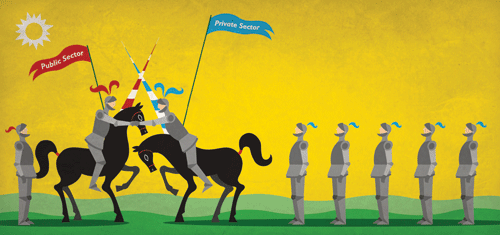
Public–private partnerships (PPPs) have helped many countries in the Middle East modernize their highways, upgrade their communications infrastructure and build new power plants. But such partnership models have proven less effective for governments seeking to outsource certain services, such as health care.

Handing over such services to the private sector requires a greater level of collaboration and trust between governments and their partners than straightforward infrastructural works. Creating an electronic payments system, for instance, goes to the heart of what government does and affects its everyday transactions in a way that the construction of a sewage plant does not.

To better manage such services, the Egyptian government is developing a new approach to partnership called ‘joint ownership’, which could be broadly applicable throughout the region. This approach transforms the way in which public services projects are structured and offers opportunities for private sector entities around the world to capitalize on the region’s rapid growth.

In the joint ownership model, both the government and the private entity get a stake in a newly formed private company. The government awards a contract to the jointly owned company, giving it the right to be the sole provider of the service in question. It also contributes regulatory support, clearing a path for the company to operate without interference. The private sector contributes the technical and management know-how, as well as a portion of the financing for the project.

Successful system

The Egyptian government conducted its first experiment with the joint ownership model to launch a nationwide e-payment system in 2007. The newly formed company, e-finance, was created with an initial investment of 60 percent from the government and 40 percent from its private-sector partner, and was granted concession rights that made it the sole entity allowed to operate an electronic payments platform for the Ministry of Finance.

The Egyptian government was also able to ensure the buy-in of the banks, pension fund managers and others that needed to be part of the system. The private partners, meanwhile, provided know-how in the areas of software development, banking, automation, and e-services, as well as designing, installing, managing and maintaining the e-payment system. The new system allows civil servants, who used to line up at cashiers’ windows every week for cash payments, to receive their salaries automatically via an ATM card.

Hundreds of thousands of pensioners now receive their income from the government in the same way. The company is expected to become profitable over the next several years, once the infrastructure is in place and the system reaches its projected number of processed transactions.

The experiment proved so successful that the Egyptian government is now considering other areas in which joint ownership might be effective. For instance, there are opportunities to replicate this model for services as diverse as carrying out customer handling and data processing at customs, providing state-of-the-art training to Egyptian and regional civil servants, and even for conducting government-wide procurement services.

 There is a caveat to these partnerships: They are short-term commitments. Governments, after all, should not be the owners of companies. Their economic role should be to set and enforce the regulations that enable competitive markets. But as long as both parties understand this condition, they can reap several immediate benefits from joint ownership.

Complimentary pairing

Most importantly, the partnership offers access to resources that neither side would independently have access to. The public partner gets the technical, financial and management resources of its private-sector partners: the private sector’s often higher salaries mean it enjoys better-trained workers and deeper expertise than exists in government.

In turn, the public partner can offer concession rights and support regulatory changes that may be vital for the new company’s success.

Second, the venture’s risks are shared in a way that can increase the initiative’s prospects of success. For instance, political, legal and environmental risks are borne by the public partner; after all, the public partner can directly influence outcomes in those areas. Risks relating to the design of the service or financing fall to the private partner, which presumably has more expertise in those areas.

Finally, jointly owned companies offer straightforward exit strategies in the form of initial public offerings or strategic sales that are not available in most other types of PPPs. In particular, if the company is prospering, the public partner can push for an initial public offering, giving it a way to cash out of its position. Or the public partner can sell all or part of its stake to a strategic investor.

The same structure that bestows benefits also creates some risks. If the government has granted concession rights, the new company may be a monopoly player in the market. To address this issue, contracts need to clarify what services must be provided and what is reasonable for consumers to pay.

The joint ownership model also creates a conflict of interest for the public partner. The government would normally push to maintain low prices for its services, but as a stakeholder in the company, it should be maximizing profits. This risk can be diminished by creating a separate entity within the government to monitor the performance of the company.

In the long term, the real priority for any Middle Eastern government must be to figure out what fixes are required in its legal, regulatory and institutional frameworks, so that its private sector can launch public-services projects without such intensive government involvement.

This is the true sign of success — when the government doesn’t need to offer itself up as an owner in order to spur private sector participation. Until that happens, joint ownership will remain a potential short-term strategy.

August 3, 2010 0 comments
0 FacebookTwitterPinterestEmail
Finance

Life saver Lang

by Emma Cosgrove August 3, 2010
written by Emma Cosgrove

Before 2006, Near East Commercial Bank (NECB) was going nowhere. “There was no increase in revenues, no increase in assets — no increase at all,” said Dominique Lang, the Swiss banker who has acquired the task of reviving it. “It was, in our opinion, a dormant company, but it had a good name and good staff.”

Where the Central Bank saw a stain on Lebanon’s thriving banking scene, Lang saw an opportunity.

Playing the long game

Lang, a Swiss banker for nearly 30 years and chairman of Nomina Finance in Zurich, and his business partner Alfred Wiederkehr finalized the acquisition of the bank in April of this year — a deal nearly 10 years in the making.

NECB has been located at the Place de Beyrouth since 1978 when SNA insurance group owned it, before the Caland family took control.

Since 1993, Lang had been aware of Lebanon’s banking potential through a business relationship with the Caland family, and he became a shareholder at NECB when he and Wiederkehr wholly subscribed to a $9 million capital increase at the bank in 2006, gaining a 43 percent stake. Lang remained a shareholder until 2007, when the Central Bank began putting pressure on NECB to shape up its neglected balance sheets. He then became chief executive and soon enough, the sleeping bank began to show signs of life.

And indeed, the Central Bank’s concerns were not unwarranted. At end-2007 NECB had $142 million in assets and just $17.6 million in loans, with 40 percent of these considered “doubtful” and 10 percent classified as “bad debt.” The bank posted $3 million in losses that year.

But soon after Lang took over the management of the bank, he began to clean house.

“The bank had a big portfolio in real estate which was bringing in no money so we sold the biggest part of this portfolio. The operational result was then in the black,” he said.

Lang dropped most of this underperforming portfolio in favor of much higher-yielding treasury bills. This move significantly improved the bank’s interest margin and sped up the transition from red to black. The recovery was helped as well by the fact that NECB managed to spend significant time in red figures without losing a single depositor — a feat Lang attributes to the relationships between bank staff and clients.

In 2008 the bank made $283,000 in profits; 2009 saw more growth to almost $2 million. And according to Lang, the bank has already generated $2.6 million in profits for the first half of 2010 “The bank is now back to a normal situation,” he said.

It was this success in bringing NECB back from the brink, combined with the owning family’s dwindling interest in the bank that led Lang and Wiederkehr to buy the remaining 57 percent of the bank. The decision was made in January of 2010 and the deal, the value of which both parties have agreed not to release, was approved by the Central Bank in April.

According to Lang, the central bank was very receptive to the acquisition. He says that the close involvement of the Central Bank and Banking Control Commission (BCC) with regards to strategic planning has helped, and was not a hindrance as some of the bigger banks often complain.

Selling secrecy

Now Lang has the job of improving the bank past mere profitability.  A feasibility study is currently being conducted regarding the opening of two new branches in Beirut and Lang plans to continue the bank’s niche profile, focusing mainly on retail and private banking. He plans to focus on small and medium loans (ranging from $50,000 to $500,000) as smaller loans have a better profit margin and entail much lower risk.

Further, Lang says that the banking secrecy law and the know-how within the sector are good selling points to international clients.

“We see a slight demand from people in Europe, in Switzerland, to have an alternative to banks in Europe for the secrecy,” he said. “Lebanon is one of the remaining countries that has a law for banking secrecy. Until now we have brought [international] private clients for an approximate amount of $250 million.”

August 3, 2010 0 comments
0 FacebookTwitterPinterestEmail
  • 1
  • …
  • 410
  • 411
  • 412
  • 413
  • 414
  • …
  • 686

Latest Cover

About us

Since its first edition emerged on the newsstands in 1999, Executive Magazine has been dedicated to providing its readers with the most up-to-date local and regional business news. Executive is a monthly business magazine that offers readers in-depth analyses on the Lebanese world of commerce, covering all the major sectors – from banking, finance, and insurance to technology, tourism, hospitality, media, and retail.

  • Donate
  • Our Purpose
  • Contact Us

Sign up for our newsletter

    • Facebook
    • Twitter
    • Instagram
    • Linkedin
    • Youtube
    Executive Magazine
    • ISSUES
      • Current Issue
      • Past issues
    • BUSINESS
    • ECONOMICS & POLICY
    • OPINION
    • SPECIAL REPORTS
    • EXECUTIVE TALKS
    • MOVEMENTS
      • Change the image
      • Cannes lions
      • Transparency & accountability
      • ECONOMIC ROADMAP
      • Say No to Corruption
      • The Lebanon media development initiative
      • LPSN Policy Asks
      • Advocating the preservation of deposits
    • JOIN US
      • Join our movement
      • Attend our events
      • Receive updates
      • Connect with us
    • DONATE