• Donate
  • Our Purpose
  • Contact Us
Executive Magazine
  • ISSUES
    • Current Issue
    • Past issues
  • BUSINESS
  • ECONOMICS & POLICY
  • OPINION
  • SPECIAL REPORTS
  • EXECUTIVE TALKS
  • MOVEMENTS
    • Change the image
    • Cannes lions
    • Transparency & accountability
    • ECONOMIC ROADMAP
    • Say No to Corruption
    • The Lebanon media development initiative
    • LPSN Policy Asks
    • Advocating the preservation of deposits
  • JOIN US
    • Join our movement
    • Attend our events
    • Receive updates
    • Connect with us
  • DONATE
Comment

Bill’s American dream

by Riad Al-Khouri July 3, 2010
written by Riad Al-Khouri

What do former American President Bill Clinton and the new Miss USA Rima Fakih have in common? Jokes about Clinton’s notorious womanizing aside, rather a lot, actually: Rima is a perfect example of Bill’s answer to America’s economic woes. 

Speaking in April about fiscal responsibility, Clinton said immigration was a key to United States central government budget deficit reduction, which in turn was vital for America’s future. He was quoted on the website of The Atlantic magazine as saying, “We [the US] need more immigrants. We need to reverse the age ratio. I see that as part of fiscal responsibility.”

Coming from the US president who will perhaps best be remembered for putting a long deficitary American federal budget into surplus, this is serious stuff. Expounding on his theme, he added that “the great virtue of this country, the thing we have over China and India, is that we have somebody from everywhere here, and they do well. This country still works for immigrants.”

He should have added that immigrants also work for their new country. Typically fleeing trouble spots or poverty pockets, of which there are more than a few in the modern Arab world, migrants from the Middle East tend to be hard working and — on the whole — economically successful. Only a short hop from my vantage point of Ann Arbor, Michigan, places like Rima Fakih’s hometown of Dearborn show the inspiring impacts of Arab immigration to the US.

The bustle of places like Dearborn allows Clinton to conclude that: “The changes we make will be less draconian if we get more people into the system. I don’t think there’s any alternative than to increase immigration. I don’t see any kind of way out of this [deficit] unless that’s part of the strategy.”

This brings us back to Ms Fakih. With his eye for the ladies, one wonders what Bill makes of Rima personally, but there is no doubt that he approves of what she represents: a young and successful migrant to America. Born in Lebanon but raised in the US, Rima Fakih is fairly typical of newly arrived Arab-Americans: from a modest background and flourishing in their new homeland in ways difficult to imagine had they never come to the US. These emigrants have been arriving in force from the Arab world for over a century, and they and their descendants are to be found in most communities around the US.

Rima Fakih - Miss USA

The contribution of these Arab-Americans to the US economy has traditionally not been easily quantified in dollar terms or labor market participation. That is partly because so many of them change their names and turn their backs on their roots. Not so Rima Fakih: though she will represent the US in this summer’s Miss Universe competition, she has shown pride in her Arab heritage. Yet even if she doesn’t win the world crown, her camera-friendly credentials are assured and she will doubtless go on to parlay the Miss USA title into serious money. That way, Clinton’s beneficent fiscal loop happily closes, with migrants such as Fakih working their way up and enriching the American system. Young and successful, they pay more in taxes and don’t rely on state benefits.

On another level, Fakih underlines the positive moral and cultural importance of Arab Americans living in US society. OK, she’s easy on the eyes, and she and her successful immigrant community cheer up the American economy, but this sort of prominence is also playing another crucial role. Fakih has come as an antidote to the “Islamist terrorist” xenophobia that is unfortunately commonplace in the US press, both before and after 9/11. Long prior to the destruction of the Twin Towers in September 2001, this kind of sentiment was — and remains — widespread in America. And though Fakih has not been immune to the conspiratorial accusations of the right-wing media, the general praise of the mainstream — despite the minor pole-dancing distracter — has done well to marginalize her critics and better the image of Arab Americans.

Hopefully, the new Miss America’s rise will help a little to clear the air in that respect, even as Bill Clinton’s thinking on the economic role of immigrants reminds us of their strong positive contribution. 

RIAD AL-KHOURI is a senior economist at the William Davidson Institute of the University of Michigan in Ann Arbor 


July 3, 2010 0 comments
0 FacebookTwitterPinterestEmail
Comment

Wanton democracy

by Peter Speetjens July 3, 2010
written by Peter Speetjens

Words are like colors. They come and go with the seasons. Not so very long ago, words like “democratization” and “a new Middle East” were all the fashion in Washington and many a journalist, the trendy type, jumped on the bandwagon arguing that the Iraq war was about just that: democracy.

But the tune changed even under George Bush and today the “D-word” has largely fallen out of fashion. While it can still be used in criticizing such countries as Iran or Syria, it is generally avoided in reference to the rest of the region. Hence, we heard next to nothing about the democratic turns for the worse in Egypt and Jordan, which with Saudi Arabia, form America’s triangle of “moderate” Arab allies.

Despite a flood of promises not to, the Egyptian parliament on May 11 routinely and for the zillionth time extended the state of emergency that has continuously been in place since 1981, the year when Egypt’s former President Anwar Sadat was killed and his successor Hosni Mubarak took over.

While emergency rule per definition is a temporary solution to an extraordinary situation, a whole generation of Egyptians has come to accept as normal the suspension of their universal human rights. Members of Mubarak’s National Democratic Party (NDP), which has dominated Egypt’s political landscape since 1952, argue that the extra powers are needed to counter terrorism and drug trafficking. This hardly seems the ruling party’s only goal however. What’s more, the goal hardly justifies the means.  According to human rights advocates, many thousands of Egyptians spend their lives behind bars without charges and without a fair trial. Torture is widespread. Meanwhile, basic human rights such as the freedom of association and expression have been severely reduced. Censorship is everywhere.  It is no secret that the state’s extraordinary mandate has come in handy in the run-up to elections, when the NDP’s political opponents, especially members of the Muslim Brotherhood are arrested and locked up. Most of them are released once the elections are over, yet not everyone is that lucky.

When a civilian court in 2006 dismissed all charges against Khairat al-Shatir, the Brotherhood’s deputy supreme guide, and 15 other party members, Mubarak transferred their cases to a military tribunal, which in 2008 sentenced them to up to 10 years in jail. Naturally, the military court is no public affair, while the current emergency laws do not include the right to appeal.

Meanwhile, the ailing 82-year-old Mubarak continues to pave the way for his son Gamal to take over the presidential crown, while his second son, Alaa, keeps an eye on the family’s growing business empire.

The democratic barometer of Jordan does not peak much higher. Egypt’s eastern neighbor in May finally presented the long awaited new election law. King Abdullah II dissolved parliament late last year and parliamentary elections are set to take place by the end of this year.

While Jordan’s king publicly called for fair and free elections, he appointed Rajai Muasher, openly an opponent of political liberalization and reform, to take charge of formulating the new election law.

The end result is flawed, to say the least, and has been severely criticized by international human rights organizations. The main criticism concerns the fact that, while about half of Jordan’s population lives in Greater Amman, the new law has downsized constituencies and increased the number of seats in the lower house of Parliament to 120, which are spread all across the country. The obvious aim is to keep the “power of the people” firmly in the hands of the “true” Jordanian tribes, while Jordan’s capital remains underrepresented and with it the majority of Jordanians of Palestinian descent, as well as urban-based Islamic parties.

The color of the day is, therefore, not the “D-word” but “status quo,” and how to keep it no matter what. Having just returned from a trip to Egypt, the image that sticks in my mind as an epitome of the country’s politics is that of 40 elderly men protesting at the Ministry of Health against a cut in their benefits. They were faced by at least twice as many policemen in black, while around the corner two trucks filled with more uniforms awaited.

No image comes to mind regarding Jordan. The Hashemite Kingdom generally forbids demonstrations.

PETER SPEETJENS is a Beirut-based journalist

July 3, 2010 0 comments
0 FacebookTwitterPinterestEmail
Comment

Beware the black swan

by Natacha Tannous July 3, 2010
written by Natacha Tannous

Forecast to reach an altitude of $55.4 billion by year’s end, the precarious flight of Lebanon’s arrears is ruffling far too few feathers among our policy makers. Instead, they’re counting on economic growth to dilute the debt by reducing the debt-to-GDP ratio, which differing sources currently place around 150 percent. In the words of Finance Minister Raya el-Hassan: “Don’t use economic textbooks to understand the Lebanese model.”

Is Lebanon somehow serendipitously always right on the money? Is the country some sort of economic maverick with a secret recipe for success?

True, Lebanon has never defaulted on its debt, but staking so much on our economic exceptionality to see us through can only help hasten the arrival of our ‘black swan’ — that unpredictable and improbable high-impact event left unaccounted for in the economic models, which could sink us into a debt deathtrap.

Prudence therefore calls for effectively managing the surging debt burden; we need to reduce the debt inventory and avoid renewing bonds at maturity while containing inflation amid excessive liquidity.  Our archaic infrastructure cannot maintain current growth rates indefinitely and only the gullible would believe the cyclical reduction in Lebanese bond yields are sustainable.

Financing long-term growth requires structural reforms. We must improve infrastructure and promptly implement, among other things, an energy policy to tackle the national power company’s $1.4 billion yearly losses; we must realize the potential of our natural resources and human capital, and create new initiatives in education. The government must quit beating around the cedar tree and properly address these issues to build a healthy economy.

In a modern country it is unacceptable that the 2010 budget, if endorsed by Parliament, will be the first budget passed in five years. And as it stands, this budget projects a $4 billion deficit, meaning debt issuance is unlikely to slow anytime soon. Central Bank Governor Riad Salameh admits he is “concerned about the growing deficit and we are incessantly calling for reforms to decrease [it].”

How though, is not clear-cut; in terms of expenditure, the quality and transparency of public spending must improve and the chronic leakages that plague the system need to be stemmed. On the revenue side, wages in Lebanon total approximately $20 billion; with direct income tax rate of 10 percent, government should be collecting some $2 billion annually, not the current $780 million. Closing the loopholes on tax dodgers will take time to implement; in the meantime, additional revenues could be mobilized through a 2 percent increase in value added tax, though this would likely spur social upheaval. Government officials have sung about privatization, public-private partnership (PPP) and securitization answering our debt woes, but none of these options can fully fix the problem.

In regard to privatization, between the telecom operators and the low value of the national airline, utilities companies, ports and airports, the government would be lucky to collect $10 billion and not sell at distressed prices, while it would also lose the revenue of telecom tariffs – currently a de facto form of taxation that earned government $1.36 billion last year. Privatization could help pay down the volatile part of the Lebanese debt — Eurobonds held by non-Lebanese — but it is no long-term solution. PPPs could help improve infrastructure without increasing the public debt, but require an autonomous capacity for the private sector to finance itself, and this is not self-evident. Such partnerships are complex, and potentially unsustainable. Ultimately, PPPs will not solve Lebanon’s debt bind.

Securitization is not the answer either, as future revenue streams from such a scheme must be proven viable before implementation. The fact is, the Lebanese market isn’t mature enough for it and the International Monetary Fund does not consider securitization proceeds as debt reduction, but rather an alternative type of debt. So as the government toys with wishful thinking on ways to balance the books and stalls on progress in substantive structural reform, our debt continues to take flight.

As long as the economic forecast stays bright and shiny, the country should be able to glide through debt refinancing by issuing more sovereign paper. The problem is the improbable — that black-winged bird which swoops down on us from above while we were gazing at how high we’d climbed. When our economic model begins its plummet toward reality, we will only have ourselves to blame.

NATACHA TANNOUS is EXECUTIVE’s financial correspondent

July 3, 2010 0 comments
0 FacebookTwitterPinterestEmail
Economics & Policy

Traditional airlines are caught in no man’s land

by Dward Clayton July 3, 2010
written by Dward Clayton

Two trends in the Middle East airline industry have dominated headlines in the last decade. The first is the launch of premium carriers — such as Emirates Airlines, Qatar Airways, and Etihad Airways — which have taken luxury to new levels to appeal to an international jet set. The second is the rise of low-cost carriers (LCCs) — such as Fly Dubai, NAS, SAMA, Air Arabia, Bahrain Air and Al Jazeera — which have used a no-frills approach to make flying affordable to a larger group of people.


As carriers at each end of the spectrum gain more and more market share, they are putting pressure on the players left in the middle: traditional, full-service airlines that are caught up in the impossible task of trying to be all things to all people. They rely on a single product to serve both premium business passengers and budget travelers: The same seats, meals, flight attendants, reservations staff, check-in processes, and loyalty programs are expected to do double duty for those seeking a top-level experience as well as those on a $10-a-day vacation.

In the Middle East, the traditional airlines at risk are often national flag carriers. For instance, Wataniya and Al Jazeera are fighting to capture share from Kuwait Air; NAS and SAMA have begun competing with Saudia; and Egypt Air will come under pressure this year as Air Arabia Egypt launches its operations.

The weakening and even failure of a national airline has an impact far beyond its own operations. The citizens of a country that loses its national airline often lose many of their options for air travel, unless other carriers can profitably provide connectivity. National airlines act as global ambassadors to the customers they carry and a struggling national carrier can damage a nation’s reputation.

If traditional carriers are to succeed in the future, they will need to understand how to compete in an evolving industry.

Sizing up the competition

Premium carriers are the first threat to traditional carriers: In an effort to become global players, government-backed Gulf Cooperation Council luxury carriers are investing in new planes, expanding their networks, and intensifying their operations at a dizzying rate.

Gulf carriers Emirates Airlines, Qatar Airways and Etihad Airways are ranked among global leaders for high quality of service and expansive global networks: Qatar Airways is one of six airlines in the world with a five-star Skytrax rating; Emirates was nominated “Airline of the Year” twice; and Etihad has consistently ranked at par with Emirates and is considered a leading premier airline.

These three carriers have penetrated every major market in the world and grabbed market share from incumbents.

Government support has allowed these airlines to rapidly expand their fleets, forecasting their anticipated growth: The three combined have about 535 planned aircraft deliveries by 2015, and Dubai’s ruler Sheikh Mohammed bin Rashid Al Maktoum said in a recent interview with CNN that Emirates would order further aircraft at Britain’s Farnborough Airshow later this month.

Filling these planes will require Gulf carriers to gain market share from competitors. In the short term, they will primarily target Europe-to-Asia routes, which will set the stage for fierce global competition. Airlines that can offer outstanding service, efficient operations, and superb reliability — rather than sheer market presence — will enjoy the upper hand.

At the other end of the market, LCCs are making inroads with low prices and high efficiency. Nine LCCs launched in the Middle East between 2003 and 2010, with their market share increasing rapidly from 1.6 percent in 2005 to 7.1 percent in 2009. These airlines generally offer short flights, averaging 1,100 kilometers and 1.5 hours, with a turnaround time of about 25 minutes. LCCs’ low prices have led to increases in demand, but have also eroded airlines’ yields. 

Not everyone wants to travel on a no-frills low-cost carrier, and so it is doubtful that they could survive simply by providing a cheap alternative for existing passengers. The beauty of the low-cost carrier model is that it has attracted new passengers, creating its own market.

Meanwhile, traditional carriers cannot make up the loss of passengers to low-cost carriers by creating new markets for travel. Rather, they rely on filling their aircraft with more connecting passengers, who are less profitable and ensure traditional carriers remain shackled to their costly connecting hubs and all the associated costs, such as baggage sorting and transfer lounges.

Getting out of no man’s land

The expense of maintaining the illusion of limitless service for full-price ticket holders makes it nearly impossible for traditional carriers to compete with LCCs’ low costs. And because there is a real limit to the service they can afford to offer, they also can’t extract the same price premium that high-end carriers enjoy.


Worse still, as traditional carriers’ profits evaporate, so does their ability to invest in the next generation of aircraft and systems, which might go some way to helping them out of their misery by providing lower running costs as well as a better experience for passengers.

Operating profit margins of network carriers have plummeted. Most large Middle Eastern airlines are simply not in a position to transform themselves into low-cost carriers or premium hub carriers.

National flag carriers, in particular, have a responsibility to act in the best interests of their countries, rather than merely considering what is best for their balance sheets.

But there are five steps that can help flag carriers to develop a new operating model that integrates some of the best elements of premium airlines, low-cost carriers, multiple-brand airlines, and multiple hub airlines.

1. Unmask the real network: point-to-point flying. Traditional carriers typically carry both connecting and point-to-point traffic. Although point-to-point traffic generally has better yields, traditional carriers configure their business for connecting passengers — for example, by building their schedule around their connections. More emphasis on larger point-to-point routes — such as intercity trunk routes, holiday destinations, and small regional services — would improve their competitive positioning.

2. Take pressure off the hub. A traditional hub-and-spoke network allows an airline to connect the largest number of cities with fewest flights, but suffers from two limitations: People generally end up going out of their way to travel via the hub, and arrivals and departures at the hub are arranged to maximize the number of connections, which leads to costly peaks in demand for ground services and severe congestion.

The solution is to use multiple hubs, which often reduces both problems by putting connections through the most convenient hub and reducing the distance of journeys.  Also, by better allocating the main connections between two hubs, peaks at each can be reduced, easing pressure on both of them.

3. Give customers only what they want. Premium airlines are masters at understanding what services their customers are willing to pay more for. Often national carriers can tailor their services to exploit cultural or behavioral idiosyncrasies in their passenger base that will increase loyalty.

4. Remember that less is more. LCCs’ ruthless cost-cutting highlights just how much excess costs most airlines carry.

Traditional airlines can mimic LCCs’ use of as few aircraft types as possible, reduced turnaround times and higher utilization, their simplified and automated ground services and their flexible labor arrangements.

5. Share the pain. Many small or mid-sized airlines cannot generate the scale or cost benefits of large airlines; such carriers can save as much as 5 to 10 percent of their total costs by merging with a similar-sized airline.

There is no question that traditional carriers are squeezed by new competitive circumstances, as well as industry changes that have been difficult for everyone. But with the right strategy, they can find their way out of no man’s land.

July 3, 2010 0 comments
0 FacebookTwitterPinterestEmail
Economics & Policy

Bold reform – the gordian knot of prudent public finance

by Fabio Scacciavillani July 3, 2010
written by Fabio Scacciavillani

On the whole, the Middle East seems to have been quite resilient to the global financial crisis thus far. Both the energy commodities exporters and the countries that do not enjoy large oil reserves have mostly been able to maintain healthy annual growth rates, even though they suffered the inevitable setbacks, especially during the most acute phase of the credit market meltdown.

For the Gulf Cooperation Council countries, the performance was driven mainly by the public spending capacity accumulated during the years of climbing energy commodity prices, which has allowed governments to maintain an unabated flow of funds into infrastructure investments. But for the Middle Eastern countries that do not enjoy substantial commodity resources, the resilience came from a structural shift in economic policy.

In particular in the Levant (Egypt, Jordan, Syria and Lebanon), the economy was able to withstand the impact of the global crisis thanks to the long lasting effects of the structural reforms enacted during the past decade (and in some cases even earlier), plus the improvement of the security situation, notably in Lebanon.

Economic liberalization spurs enormous gains in efficiency and productivity when the dynamics of free markets spring powerfully back to life. Sectors dominated by inefficient public management or widespread red tape are swiped by performance gains and innovation. The results are often stunning: double digit growth, stronger exports, strong capital inflows, creation of small companies, improved services and so on.

This notable feat, however, cannot hide the fact that the effect of the reforms have been considerable for certain segments of the general population, but have rarely translated into a broad based improvement in living standards, especially for the lowest income brackets. The pattern we often observe in the Middle East has a familiar tinge, as it tracks the experience of many places where economic freedom sprouted after decades of repression, including Eastern Europe, China, India and parts of South-East Asia. The most blatant example was the so-called Russian oligarchs, who made exorbitant fortunes acquiring the crown jewels of the Soviet Union’s state-owned enterprises during the dismantling of the Soviet’s control and command system, benefiting from opaque procedures brought in by hasty privatization. 

The failure of the ‘trickle down’

But even where the excesses that characterized Boris Yeltsin’s time as the Russian premier were largely avoided, the process of liberalization tended to favor those with better connections to decision makers, family ties, the right professional skills (finance or engineering above all) and plenty of money, or simply those who happened to be in the right place at the right time.

The consequence is often that income disparities fuel resentment from those excluded or left at the margins. A middle class fails to emerge and actually, when buoyant growth leads to price increases, notably in real estate, the living standards of the salaried might even decline. Adding to the plight, with faster growth infrastructure becomes obsolete and overwhelmed, environmental problems are exacerbated, chaotic urbanization creates congestion and, at times, social tensions, while social services struggle to adjust.

The reaction to these woes is often a political backlash against the reforms and the reformists – in Eastern Europe and India, for example, governments that had pushed for liberalization ended up losing elections – but even where elections are not held resentment and cynicism can mount.

Hard to handle

Obviously, the authorities are not completely blind to these dynamics and effectively redistribute in some form the larger revenues resulting from additional tax collection and privatization receipts. Egypt doubled civil servant wages between 2005 and 2009, while Jordan and Syria also doubled public sector wages and pension outlays over the same period. Sometimes the tax windfall is channeled into less laudable areas; the doubling of defense expenditure in Jordan over the last five years, for example, is hardly justified by intensified security threats.

The redistribution of economic benefits through public expenditures, whether justified or not, carries two risks. On the one hand, expenditures and entitlements are politically difficult to undo, especially if exceptional economic growth is taken for granted – when it inevitably slows, governments are suddenly saddled by unsustainable deficits. Also, public expenditure tends to favor certain groups, resulting in patronage, dependency and complacency toward mismanagement of funds.

More generally, redistributive public policies represent a quick fix that might work in the short run but fail to address the key issue: why doesn’t the economic liberalization extend to the lower segments of the population through private sector mechanisms?

The reason, in my view, lies in the fact that liberalizing economic reforms are relatively easier to engineer, if only because extensive literature and widespread international experience outlines the practical steps to take. But liberalization is just the first step to extend opportunities and welfare.

The second, most critical and difficult task is to create a level playing field for all, not just for the privileged or canny few. A level playing field requires independent institutions that prevent special interests exerting an undue influence on the decision making process, assuming a dominant position in key sectors or hijacking resources for their own use. In short, it requires the establishment of an adequate system of economic governance hinging on three planks.

Foremost is a judicial system that carries justice without particular regard for the powerful and enforces property rights without being prone to external influences. Second are public bodies which are impartial and do not shy away from tough decisions, even when they upset the government or anyone in a prominent position. Third, since institutions are not abstract entities but result from the actions of men, it must be assured that those who perform public duties are shielded from political pressure and must not be penalized when they disappoint the rulers. Other policy actions ought to complement the governance framework, such as sound regulation, appropriate labor market laws, credible monetary and financial supervisory authorities, consumer protection and a business environment open to foreign investments.

In essence, the journey toward full economic freedom requires impartial institutions whose decisions cannot be subjected to the interests of individual or groups, however prominent they might happen to be. In the absence of these basic rules, reforms risk a dire destiny. They will end up substituting an old oligarchy with a new one, though not necessarily a better one.
 

July 3, 2010 0 comments
0 FacebookTwitterPinterestEmail
Economics & Policy

Savvy is the MENA private equity investor

by Executive Staff July 3, 2010
written by Executive Staff

Using the world’s de-facto barometer of investment danger, credit default swaps (CDS), many fast growing Middle Eastern and North African economies including Saudi Arabia, Egypt, Abu Dhabi, Bahrain and Qatar are perceived as less risky investment destinations than heavily indebted, slower growing European states.

For much of the month of May — even after the announcement of a 750 billion euro debt stabilization package for the European Union — the cost of a five-year Saudi CDS was lower than a French or British CDS of similar maturity, while Egyptian CDS prices remained below those of Greece, Portugal, Spain and Italy. Even the Middle East’s most indebted state, Dubai, was cheaper to insure against non-payment than Europe’s most indebted state, Greece. If May’s CDS prices are a guide, it’s better to be locked into a currency union with Abu Dhabi than with Germany, the traditional model of financial probity, transparency and geo-political safety.

It goes against stereotypes, but the MENA region’s relatively low and improving risk profile is real, and its appeal as an underpenetrated market for private equity is immense. Regional opportunity is largely the product of more than a decade of legal and financial reform, particularly in the Gulf States. Since 1998 all six members of the Gulf Cooperation Council have passed capital markets laws, deregulated and privatized industry and opened up domestic investment to foreigners.

Today, the GCC economic engine is transforming both the Gulf and its MENA neighbors through rising levels of private equity investment. Private equity has accelerated regional consolidation in fertilizers, logistics, banks, travel, the internet and high-end retail.  As MENA private equity expands, it is improving balance sheet discipline and corporate governance, strengthening financial markets, sowing seeds for new industries and diversifying economies that remain overly dependent on hydrocarbons.

A youthful market

Less than a decade old, with years of expansion ahead of it, the local private equity industry has no reliable performance indexes. But the returns of the region’s best private equity teams have been stellar — with internal rates of return of 30 percent or more, frequently achieved after only two or three years of investment and largely unleveraged by debt. Unlike Asia, a region that cannot accommodate the huge numbers of private equity investors looking to invest there, access to top teams — once identified — remains relatively easy in MENA markets.

Growth, at least at the moment, also comes cheaper in the MENA region. The MSCI Arabian Markets Index, for example, has a price-earnings to growth (PEG) ratio of 0.9. That is lower than the PEG ratio for China’s CSI 300 Index and India’s BSE Sensex 30 Index by 18 percent and 44 percent respectively. GCC corporate earnings growth is better than in Latin America, another emerging market where increased popularity has made access to top teams difficult.

This is a particularly propitious time for regional private equity investors for other reasons. The financial crisis of 2008-2009, and the spectacular regional failures and scandals it provoked at MENA’s most overleveraged and least transparent companies, has led to a transformation of attitudes at the family groups that dominate MENA’s still fragmented and overwhelmingly local businesses. Traditionally reluctant to sell equity to outsiders, many owners now welcome deals when they are packaged with private equity expertise that can focus and streamline diverse local business lines into disciplined platforms for regional expansion.

A safe bet

Stagnant regional bank loan growth after the collapse of Lehman Brothers has also increased the appeal of private equity financing, while decreasing its competition. Long-term private equity financing for expansion is all the more coveted, given that the overwhelming majority of regional bank loans mature in three years or less, meeting working capital needs but little else.

Although this stands in contrast to more developed economies, the most successful investments in the MENA region tend to be minority investments. With significant amounts of debt leverage largely absent from Middle East private equity deals, taking a large minority stake often allows entry at a bargain price, since it shifts the incumbent owner’s focus from current valuation to future value creation. The best local private equity teams have often paid less than 10 times historic earnings, versus listed rivals selling for twice that. In this way, well-negotiated minority stakes provide effective leverage when the investment is finally exited.

United by common language and tradition, the MENA region is a young and increasingly dynamic block with a population of more than 210 million, an economy that is already worth $1.6 trillion, and an annual growth rate that should clock in at 5 percent this year and continue for the foreseeable future. Buoyed by the budget and trade surpluses of conservatively managed Gulf States, this is one emerging market that smart money should not ignore.


July 3, 2010 0 comments
0 FacebookTwitterPinterestEmail
Economics & Policy

Credit Suisse – Adel Afiouni

by Natacha Tannous July 3, 2010
written by Natacha Tannous

Credit Suisse held its first Middle East and North Africa Equities Conference in Beirut this month, bringing together more than 40 corporates from around the region. Executive sat with Adel Afiouni, managing director of the bank’s investment division, to discuss debt, Dubai and the financial future of the MENA region.

E  This is the first time you’ve held a conference in Lebanon: why now?

Firstly, Lebanon is doing very well. We took this as an opportunity to bring our clients to Beirut and allow them to see Lebanon’s success story firsthand. Secondly, Credit Suisse is actively present in Lebanon; we have always been committed to the country. Our presence in Lebanon goes back to the 1960s.

On the investment banking side, we have been one of the most committed international banks in Lebanon. Over the past 10 years, we have advised the Lebanese government on international bond issues and liability management transactions and managed many of the Lebanese Eurobonds. Most recently, Credit Suisse was lead manager for Lebanon’s debt exchange in 2009, the largest-ever debt exchange by a non-Latin American emerging market sovereign.

E  It seems that debt capital markets (DCM) have been growing as a result of the financial turmoil. What’s your take on this?

In 2009, we’ve seen bonds issuance out of the Middle East and North Africa increase substantially, leading to a strong growth in the regional DCM. The reason for this was that the market for syndicated banks loans, which is traditionally the main source of funding for local borrowers, was almost shut down, as banks’ liquidity and appetite for lending decreased at the time.

In a way, this was a very positive development because it opened the access to international capital markets to Middle Eastern borrowers, thus diversifying their sources of funding. For example in the first quarter of 2009, Credit Suisse was involved in two landmark transactions: The State of Qatar international debt issue and the Commercial Bank of Qatar debt issue. Both transactions were massively oversubscribed with very high demand from international clients in the United States and Europe. This was a clear indication of strong appetite from the international capital markets for high quality issuers out of the Middle East.

Over the long term, we believe the international debt capital markets will continue to be an important source of funding for MENA issuers. We think we will progressively witness more active markets because more regional corporates are becoming familiar with the need to use the international markets and are preparing themselves for such access. However, as market conditions evidently remain volatile, timing is key for those issuers who are planning to tap the markets.

E  What competitive advantages does the MENA region have over the rest of the world in terms of investment horizons?

Following a tumultuous 2009, the MENA markets are looking attractive in a global context with a strong macroeconomic backdrop facilitating return to growth.

Even if the stock markets are not yet liquid enough, there has been tremendous progress over the last seven years. Further liberalization and opening markets to foreign investors will continue to enhance interest in the region.

As a firm, we have a strong presence in the Middle East, in Abu Dhabi, Beirut, Cairo, Doha, Dubai, Jeddah, Manama and Riyadh, and we are bullish on the Middle East.

We have also continued to expand our range of regional products to support the development of local equity markets and attract further interest from investors.

For example, we have been one of the pioneers in structuring regional investment opportunities with principal protection, and in offering our clients derivatives products on regional equity to assist them in hedging their downside risk or customize their risk return objectives.

E  There’s been a lot of talk about the Middle East deploying significant amounts of capital this year – do you anticipate this happening?

Yes, there is excess cash in the Middle East, especially from Sovereign Wealth Funds, and some large privately owned conglomerates. Those important investors have developed their investment strategies and aim to diversify their asset allocation and build long term sources of revenue. Therefore, as part of those objectives they will continue to deploy capital abroad.

Middle Eastern investors and, to a larger extent, emerging market investors like China, will remain an important source of capital for Western companies.

Credit Suisse can play an important role in this due to its broad network of client relationships globally, by bringing together our MENA clients and our Western clients.

E  Will the region continue to grow and become more established and reputable as a global financial hub?

Certainly. Saudi Arabia is the most obvious example, as it has the largest market capitalization in the region. Regulators in Saudi Arabia have an excellent reputation and have been taking measures to further develop their markets. The potential is huge. Credit Suisse has been developing products (swaps and other derivatives) for our clients to provide exposure to the Saudi market.

International investors are able to purchase such products through our entity and there is very good interest in the Saudi market from those investors. Having said that, Middle Eastern regulators, rightly so, want to avoid excesses and hot money.

Saudi Arabia is cash rich. Even if the stock market will benefit from international investors the authorities are approaching this matter with caution because they want to open their markets to long-term international investors, not to speculators.

E  How do you see an increase in interest rates impacting MENA countries which have significant debt levels?

For one, the significant debt level is not necessarily true for the region in entirety. Those raising capital now are undoubtedly benefiting from lower interest rates. As for rate hikes, I think most borrowers do manage their interest rates risk dynamically and banks such as ours are offering a number of solutions to corporates to allow them to hedge their risk to an increase in interest rates and to optimize their cost of funding.

E  Will Dubai regain its strength?

Dubai is a fantastic story; they’ve done a tremendous job in building the infrastructure and attracting talents and workforce. Dubai will remain a major center in the region. It’s a great hub; you just need to look at Dubai International Financial Center, Dubai Media City, Dubai Internet City, Emirates Airlines and many other success stories.  So people shouldn’t focus on a temporary paradigm shift but look at the long term big picture as well.

E  Exotic products are usually taken up by banks rather than corporates in the MENA; do you see that changing now with new buyers for your products?

Our objective is to provide our clients with customized solutions that meet their risk and return profile. We are using solutions and product ideas that have proved popular with our global clients and adapting those ideas to MENA markets.

Clients, whether banks or corporate, are going back to basics today and prefer simple ideas to more exotic and highly structured products, so we have adapted our offering to take this into account.

For example, as mentioned earlier, we have been one of the pioneers in offering derivatives on regional markets, equity and debt. This has allowed us to create principal protected investment products in local equity.

Those products cater to investors who are seeking regional exposure while limiting their risk on the downside. Those ideas allow broadening the type of investors interested in the regional markets and reach out to risk averse conservative investors as well.

July 3, 2010 0 comments
0 FacebookTwitterPinterestEmail
Economics & Policy

Public finances – Slave to a ravenous debt

by Natacha Tannous July 3, 2010
written by Natacha Tannous


Lebanon’s outstanding debt reached $51.5 billion at the end of the first quarter, while this year’s budget — if endorsed by Parliament — has slated $4.3 billion for debt servicing, accounting for as much as one third of overall spending. The stock of debt, currently estimated at 147 percent of gross domestic product, towers over the economy and only looks set to grow, while the biggest holders of the debt, Lebanese commercial banks, appear to be largely unfazed as they eye their mounting credits.

Lebanese commercial banks — the tycoons

Commercial banks represent the biggest demand for sovereign paper. They are the main subscribers of the $30 billion outstanding debt denominated in Lebanese lira. Their share of total subscriptions to treasury bills (T-bills) and notes in lira in the first quarter of 2010 stands at 65 percent, according to the Ministry of Finance’s quarterly bulletin, followed by public institutions (with 13 percent of subscriptions), then Banque du Liban (BDL), Lebanon’s central bank, and the public banks with 10 percent each.


Commercial banks also own an estimated 60 to 80 percent of the $18 billion outstanding Eurobonds denominated in foreign currency, a substantial chunk of the total $21 billion in foreign currency debt (see charts above). The two largest creditors among Lebanese banks are BLOM Bank and Byblos Bank, with total holdings of more than $4 billion each.

On the bright side, “commercial banks [acting as a stable investor base] spared the country from the tumultuous effects of the global financial crisis, as they continued to buy the debt and prevented the country from facing refinancing risk,” says Walid Raphael, general manager of Banque Libano-Française (BLF).

This high ownership share has been an advantage to the country “in the sense that it represents an internal debt, which might not be subject to international market behavior and risks,” explains Nabil Khairallah, general manager of Banque de l’Industrie et du Travail.

While this may be true to an extent, the largest Lebanese banks’ mixed ownership structure means they are not strictly Lebanese. Moreover, Khairallah adds that local ownership has also been “negative in the sense that the banks are financing the budget deficit rather than financing the economy in productive investment opportunities.”

With the United States Federal Reserve funds rate likely to rise from its current near-zero level by 2011, the problem of refinancing risk will surge in Lebanon as the country’s Eurobonds, T-bills and certificates of deposit will need to show higher interest payments to maintain the appetite for Lebanese papers, competing with subscriptions to less risky debt abroad.

Consequently, not only will the debt servicing burden grow for the government, but commercial banks will also face problems on their balance sheets because assets (such as sovereign bonds) receive fixed rates, whereas liabilities (such as customers’ deposits) pay variable rates according to market trends.

This would then be particularly challenging for banks holding Eurobonds. The Eurobonds’ lengthy maturity dates and fixed rates mean that their subscribers could suffer prolonged exposure to coupons paying lower percentages than the market-rate, while having to pay out higher rates to customers on their deposits.

However, “it is only a conceptual mismatch because deposits are sticky [, or stable],” claims Freddie Baz, chief financial officer of Bank Audi. “Interest rates have nothing to do with insolvency, but rather profitability. This incurs risks of losing money for a transitory period until the banks address and manage their mismatch, which they have always succeeded in doing, given that 50 percent of assets are short-term and can therefore be adjusted quickly.”

Additionally, “one should not overestimate the banks’ direct exposure to the sovereign debt since it only concerns a quarter of their balance sheets,” says Raphael. “At BLF our exposure to Lebanese Eurobonds is only 4.4 percent of our total assets.”

Despite reassurances, some banks have already started working to reduce risk and diversify their balance sheets to minimize sovereign debt exposure. For instance, Bank Audi’s investments in foreign currencies “were channeled toward placements in highly rated sovereign bonds or sovereign-related corporates (essentially from Qatar and Abu Dhabi), at the detriment of foreign currency denominated Lebanese sovereign bonds,” according to the Audi’s 2009 annual report.

The banks’ exposure to sovereign bonds in lira also declined in 2009. Nevertheless, such a process must be done gradually, as banks cannot make large adjustments in their portfolios without increasing sovereign risk and triggering a large sell-off.

BDL, Lebanon’s ‘last resort’ card?

The BDL holds 23 percent of the total local currency debt, according to the Economic Letter published by the Association of Banks in Lebanon in April 2010. In the first quarter alone, the BDL subscribed to 10 percent of Lebanon’s T-bills and notes, according to the Ministry of Finance’s first quarter bulletin. But “most of the share owned by BDL corresponds to debt that is being rolled over,” said Nabil Yamout, an advisor to Finance Minister Raya el-Hassan.

The Central Bank bought that debt a decade ago, when there was pressure on the local currency and it wanted to bridge the gap in the deficit in auctions. A wane in commercial banks’ appetites for Lebanese T-bills in the first six months of 2001 prompted the BDL to increase its holdings by $1.7 billion to reach $3.3 billion, in order to provide the government with sufficient liquidity in local currency.

Today it is a different story. “The main role of a central bank is to monitor interest rates but once you get to a level of zero, it is difficult to take initiatives, so we focus on managing the liquidity,” says Central Bank Governor Riad Salameh. Most of its current actions relate to monetary policy, explaining why BDL sold certificates of deposit in March to absorb excess liquidity in the market at the same time that the Ministry of Finance suspended issuance of T-bills for the month.

Indirectly, the reason behind such policies seems to be the nominal currency peg in Lebanon. Over the last 15 years, the country’s money supply has sustained year-on-year growth higher than financing in both the private and public sectors, with the monetary supply increasing 38 percent more than the increase in loans to both sectors.

If the Central Bank did not absorb this excess liquidity, banks would incur decreased returns resulting from increased interest payments to depositors, and would be reluctant to attract more deposits. In turn, if the money supply slowed or even decreased, there would be less funding available for the government’s ever-larger refinancing needs. The local currency would then come under pressure, causing problems for BDL’s dollar peg policy. In short, part of the policy of the Central Bank and the Ministry of Finance is to issue debt instruments — even to the point where they exceed Lebanon’s financing requirements — to absorb the high level of liquidity flowing into the banking sector.

International creditors: a volatile creditor base?

A rough estimate by leading bankers puts the level of international subscription to Lebanese Eurobonds between 20 percent and 40 percent of total subscriptions. In 2009, non-residents subscribed to $100 million (or a 40 percent share) of the $250 million Eurobond issuance, which will mature in 2014 and yield a 7 percent coupon.

“We want to diversify our investor base and we need to involve more institutional investors,” Minister Hassan tells Executive.

“As we successfully reached 30 percent subscription from international investors in the latest Eurobond issue,” she says, referring to the March 2010, $1.2 billion 10-year Eurobond with a coupon of 6.375 percent, “we want to expand that trend because we understand the implications of a ‘crowding out’ effect.”

However, international creditors should have little reason to be interested in the paper. The Lebanese yield is similar to Egypt’s (5.75 percent on a 10-year maturity), but far more risky, being that Lebanon has a lower credit-quality rating of B1/B compared to Egypt’s BB+. Moroccan Eurobonds should be sapping even more demand from Lebanon’s, with yields at 6.375 percent but carrying a BB+ rating.

One could also look at Lebanon’s credit default swap (CDS) spread — effectively the market’s perception of a county’s default risk — versus countries with similar credit ratings (see table below); Lebanese Eurobonds have a significantly lower interest rate yield than peers’, meaning subscribers are rewarded less for taking equivalent risk.

For example, Venezuela’s credit quality is comparable to Lebanon’s, given that Moody’s rates Venezuela one notch lower than Lebanon (B2 versus B1), while Standard & Poor’s rates the South American’s credit worthiness higher (BB- versus B). With such a straddle, one would think that the CDS spreads of the two countries would be close to one another, but Lebanon trades much lower at 305 basis points (bps) while Venezuela is at 1,325 bps (as of June 18).

Nevertheless, “comparing Lebanon to countries with similar ratings is a delicate endeavor,” said Georges Saghbini, chief financial officer of Société Générale de Banque au Liban (SGBL). “One major point to be considered is that investors rarely carry Lebanese paper for speculative purposes; the market has proven it several times in a row. Thus, you cannot speculate against Lebanon’s debt.”

He adds that a major difference between Argentina and Lebanon is that the later has never defaulted on its external debt, “nor has the International Monetary Fund been intrinsically involved in the country’s economic and social policies… Not to mention that the country’s foreign currency reserves — maintained at comforting levels — have been a good confidence driver.”

The international interest in Lebanese Eurobonds stems from the fact that the country turned out to be a safe-haven during the recent credit crisis, insulated from systemic market risk, explained Melhem Samaha, director Global Markets at Credit Suisse for the Middle East and North Africa region.

“This environment would provide a natural bidder in times of crisis, should an international creditor decide to sell its paper,” he says.


However, “there has always been some 20 to 30 percent of international holders in Lebanese Eurobonds,” noted founder and chief executive officer of Arabia Monitor research and advisory firm, Florence Eid. “But the question is whether the percentage corresponds to Lebanese accounts abroad or non-Lebanese foreign holders. I would not be surprised if foreign investors, and particularly emerging market (EM) fund managers, placed more interest in the paper on the back of two years of macroeconomic growth along with healthy foreign direct investment and bank reserve figures.”

Indeed, EM-based accounts, such as pension funds, benchmark themselves to indices such as the JP Morgan Emerging Market Bond Index (EMBI), and thus are forced to buy Lebanon’s paper to keep tracking the index, all the more since Lebanon’s weighting has increased to 2.99 percent (see graph to the left), up from 2.24 percent at the beginning of 2009.

And for that matter, non-Lebanese international holdings — considered the ‘volatile’ part of Lebanon’s outstanding debt — will remain stable only as long as the country’s current economic performance is maintained.

The shift toward an increase in lira denominated debt has been apparent since 2008 and the share now represents 59 percent of the total debt. In fact, where total outstanding debt has increased by 32.8 percent since 2005, local currency debt increased by an astounding 54.3 percent, whereas foreign currency debt increased by just 11.1 percent. Issuing more in Lebanese lira is a positive by-product for the country: Lebanon can borrow in lira at decreasing costs because the dollar denomination usually drives the rates up, given that Eurobonds have longer maturities.

Domestic dependence

“Reliance on domestic finance is definitely a strength,” says Andreas Bauer, the IMF mission chief for Lebanon. Firstly, “you need to issue debt in the currencies of your liability and decrease potential foreign exchange risks; therefore, if de-dollarization is the trend, then issuing in Lebanese lira makes more sense,” he said.


Secondly, “commercial banks cannot do much with their inflows in lira [so] their liquidity needs to be absorbed by T-bills and credit deposits,” explains Marwan Salem, head of research and advisory at FFA Private Bank. “Thus, issuing in Lebanese pounds is the logical choice and helps the banks.”

Thirdly, because the foreign currency debt is mostly held locally, it is a burden for Lebanese commercial banks — directly or indirectly on behalf of their clients — since they are lending in a currency for which the BDL is not the lender of last resort. As a result, banks need to sustain deposit increases in the specific foreign currencies of the Lebanese debt they subscribe to, otherwise if there is pressure on these foreign resources, it can put that debt at risk. The more Lebanon can convert its debt to lira, the stronger the country stands, as it will prevent an unhealthy dependence on a foreign currency.

Lastly, if international creditors had held the majority of Lebanon’s foreign currency denominated debt in recent times of crisis — say when former Prime Minister Rafiq Hariri was assassinated in 2005, or the July 2006 War — there might have been a collapse in the financial system. But, “this scenario would not happen in Lebanon because whatever the currency, our creditor base is mostly stable; our debt is not so volatile, contrary to many emerging markets and developing economies that have a large international institutional investor base,” said Nassib Ghobril, head of economic research and analysis at Byblos Bank.

Banking on growth

Worryingly, there is no plan to pay back the principal of the debt. Decision-makers are counting on our debt-to-GDP ratio to sail downstream with the winds of favorable economic conditions. On the one hand, the IMF forecasts 8 percent real GDP growth for 2010, which will help the debt denominator increase, while simultaneously the numerator should grow at a slower pace because the cost of debt is decreasing. Indeed, although the weighted interests on outstanding T-bills and Eurobonds are 8.3 percent and 7.3 percent respectively, current interest rates on new issues are far less. Furthermore, Lebanese Eurobonds are trading far above issue prices, therefore the overall effective yield is only 5.2 percent.

“This is bound to reduce the debt burden, especially given the expected decline in future interest rates and the fact that a 1 percent decrease reduces interest payments by $400 million,” said Saad Azhari, chairman and general manager of BLOM Bank. With such numbers, Central Bank Governor Salameh expects our debt-to-GDP ratio to drop to 138 percent. But this macroeconomic outlook is far from foretold and growth in Lebanon is not ensured. Years of neglect have left the country lacking the infrastructure to sustain high productivity and healthy growth across a variety of sectors to support the economy. Instead, Lebanon’s economic growth is dangerously undiversified into three sectors — banking, real estate and, to a lesser extent, tourism.

The country is neither implementing far reaching solutions in the sectors facing challenges, nor actively addressing potential bubbles in areas of the economy that are currently working — and yet it is sustained economic growth that policy makers are counting on to avoid the debt becoming unmanageable.

Of the 40 bankers, government officials and corporate leaders Executive interviewed for this article, not one presented a feasible plan to reduce the escalating stock of debt, estimated to reach $55.4 billion by the end of the year; the ‘solutions’ they provided — such as public-private partnerships, privatization and securitization — were solely intended to decrease debt accumulation or pay down the volatile part of the country’s debt held by non-Lebanese institutions.

The finance ministry, along with the BDL, is coordinating efforts with the World Bank and the IMF to elaborate on such debt management policies. Needless to say, the Lebanese should have the prerogative to have their debt monster slain.

July 3, 2010 0 comments
0 FacebookTwitterPinterestEmail
Finance

Who owns the banks

by Paul Cochrane July 3, 2010
written by Paul Cochrane

Lebanon’s banking sector has been called many things: the unofficial government, the country’s financial savior, a nepotistic mafia, and that ‘other economy,’ which continuously shines while the ‘real economy’ limps behind.

 That the banks have extraordinary influence here is a given, having funded the country’s post-war reconstruction through loans to the government and ridden out every kind of systematic risk imaginable, bar a nuclear bomb or natural disaster. The banks and the bankers are Lebanon’s economic superstars.

The ‘real’ power brokers

The owners of the banks are clearly powerful men, with the ear of the government and the Central Bank. Indeed, BankMed is owned by the Hariri family’s Group Med, with Prime Minister Saad Hariri having a 24 percent stake. Central Bank Governor Riad Salameh was appointed during the late former Prime Minister Rafiq Hariri’s first term in office in 1993, while many of the senior administration are affiliated with the Hariri political camp. More than one private sector figure has told Executive over the years off the record: “We are the government.”

“Definitely bankers are more powerful than the political system,” said Badri el-Meouchi, executive director of the Lebanese Transparency Association (LTA). “The Association of Banks in Lebanon has more weight with politicians than any other organization in the country, and banking regulations were drawn up by the banks decades ago and have been protected since then.”

With Lebanon’s 62 banks predominantly managed by founding families — although they are not always the major shareholders — the sector is controlled by a small cabal. It is also largely dominated by the country’s 12 alpha banks — those with deposits over $2 billion.

At the end of 2008 alpha banks held $95 billion in consolidated assets, or 88.3 percent of all banks’ consolidated assets, and $77.3 billion in customer deposits (83.7 percent of total deposits), according to Bilanbanque, the annual report issued by the financial services firm BankData in collaboration with the Association of Banks in Lebanon, which had yet to publish 2009 figures as Executive went to print.

Governments and financial sectors are intertwined across the planet, but in Lebanon, where the banks control the lion’s share of the country’s debt and are such major contributors to gross domestic product (see story on page 86), how they are owned and managed is an issue of paramount concern.

“There is clear political influence,” said Ali Awdeh, head of the research department at the Union of Arab Banks. “They are the country, but not in a ‘negative’ way; they are the economy. But the government wouldn’t want to make them angry… so maybe the bankers are more powerful than politicians.”

But the connections between the government and the banking sector are opaque, in terms of financing of political parties and bankers’ influence over economic decision making on the national level.

Politics aside, there is also not full disclosure of banks’ financial practices and agreements with shareholders.

“The major problem we face is transparency, which is not as it should be. That’s why there is not 100 percent disclosure and no one knows what bonuses are,” said Awdeh.


“Transparency on banks’ investments is needed to access risk exposure of banks. For instance, ‘marketable securities’ could be anything, from biscuits to tobacco,” he added.

The importance of being open

The Alpha banks are, in general, more transparent than the Beta banks due to listing on the Beirut Stock Exchange (BSE), wanting to list on bourses abroad and needing to attract capital through financial institutions acquiring shares. This has lead to a gradual implementation of corporate governance at the Alpha banks as institutions demand greater disclosure.

“To be listed on stock markets outside Lebanon the criteria is stronger than on the BSE, which is not strong on corporate governance,” said Meouchi. Currently just six banks have listed shares on the BSE. This is not enough, according to Awdeh, “because if shares are listed we know who owns the banks, as they have to disclose information. But maybe [most] banks are avoiding being listed to not have to declare more information.”

While banks do list major shareholders, the connection between companies, particularly holding companies, and the management is not always clear. Many of these holding companies have little or no publicly available information, and in certain cases, holding companies are wholly or part-owned by banks’ founding families and other shareholders.

“The moment you start looking in an objective way at the books of the banks, you are opening Pandora’s box. And auditors are named by banks not by the government, so there is a problem in Lebanese commercial law,” said Yahya Hakim, managing director of the LTA.

Government oversight of the legally mandated external audits at commercial banks is through “Lebanese Certified Public Accountants.” Often, however, the partner at the auditing firm and the “public accountant” signing off on the audit are the same person.


“The key is corporate governance and governing structures that are in place. This is a global phenomenon, not just in Lebanon, but also in Europe and the United States. What we want to see is accountability, transparency, committee structure and lines of responsibility,” said Thomas Jacobs, senior country officer Lebanon at the International Finance Corporation (IFC), the private arm of the World Bank Group.

Earlier this year, the IFC acquired an 8 percent stake in Byblos Bank for $100 million.


“If banks really want to grow and be major players, they need other investors. Look at Byblos, it wanted IFC, and Bank Audi had [Egyptian investment bank] EFG-Hermes,” he added.

Opening the Alphas

Among the Alpha banks, the major shareholders are no longer Lebanese banking families. They are institutional investors, private investors, holding companies and Gulf royalty.

The banking families still make up the management and sit on their boards of directors, but as a percentage few have controlling stakes.

“If you compare the ownership structure of the top three or four banks with the beta banks, it is institutional shareholders versus families,” said Jacobs.

Take BLOM Bank, for instance, established by Syria’s Azhari family. The family has a 2.86 percent direct stake, plus an 11.87 percent stake through the Azhari’s Banorabe Holding in Luxembourg, while AZA Holding — of which the family controls 50 percent — has a 9.33 percent stake in BLOM. Cumulatively it is not enough for the Azharis to have control. 

As Saad Azhari, managing director of BLOM, told Executive: “If we didn’t perform as management, the shareholders could make us go.”

BLOM Bank’s largest shareholder is the Bank of New York Mellon, with 34.37 percent.


Bank Audi-Saradar and Byblos are similar. The Audi family has an 8.07 percent stake and the Saradars hold 6.84 percent. Prominent investors include the Kuwaiti royal family, al-Sabbah, with 4.90 percent and Sheikha Suad al-Homaizi with 8.08 percent, the UAE’s Sheikh Diab bin Zayed al-Nahyan with a 6.72 percent stake, and prominent Saudi family al-Hobayb with 5.25 percent. The Gulf connection is not surprising, given that Raymond Audi established the bank in 1962 with his brothers and prominent Kuwaiti businessmen. Kuwaiti Sheikha Suad al-Homaizi has been on the board of directors ever since.


Byblos Bank’s founding family, the Bassils, have a 3.57 percent stake, but like the other Alpha banks the family manages Lebanon’s third largest banking institution. Byblos and BLOM have common shareholders, with the Bank of New York Mellon having a 12.12 percent in Byblos, while BLOMINVEST Bank, BLOM Bank’s investment arm, also has a 1.56 percent stake in the bank.

There is a great deal of this cross-linkage in the sector. Major French financial player Group Credit Agricole has a 9 percent stake in Banque Libano-Francais and a 6 percent stake in Fransabank. The latter is dominated by the Kassar family, with Adnan Wafic Kassar, chairman and general manager (and minister of state in the cabinet), and General Manager Adel Kassar holding 36.15 percent each. Fransabank also has a 74.04 percent stake in BLC Bank and 40 percent of BBAC through recent acquisitions, making the Fransabank Group one of the biggest players in the sector.

A family affair

While the diversification of the shareholder structure has had a positive impact on the industry in terms of growth and accessing capital, concerns still need to be addressed.


“The issue of conflict of interest is not very strong [in corporate governance here] as shareholders are a closely linked group,” said Meouchi. “Then there are minority shareholders rights, which are not a focus. If banks want to attract more shareholders they have to give them protection, which is something new.”


Major shareholders invariably have seats on banks’ board of directors while, as mentioned, the founding families dominate management.

“The shareholder base is a little wider now but family control is still there, and you can’t tell what agreements exist between shareholders, who most of the time are silent shareholders,” said Hakim.

On the other hand, the bankers justify the family-owned structure, pointing to the sector’s weathering of the global financial crisis and the spike in deposits that followed, particularly from the Gulf, that have made the banks record profits and heavily liquid.

Best to keep it close

“There is a study which showed that over the long-term, family businesses do better than public companies and the reason is that today when you are on the financial markets, managers tend to look at short term profits because every three months you have to show your figures and make them better than expectations,” said Walid Raphael, GM of Banque Libano-Francaise.


“When a bank is controlled by a family usually they look at the long-term and they try to put a strategy to achieve long-term goals. I think it has played a certain role in our resilience over the last international financial crisis because bankers were more conservative in their approach to risky assets and in their policy of managing the bank,” he added.

Investment’s double-edged sword

Shareholders have been both a boon and a risk to banks that have opened up to external investors. For instance, in 2006 EFG-Hermes acquired a 20 percent stake in Bank Audi, later increasing this to 28 percent. When the Egyptian investment bank went in, it sunk more than half its equity to effectively be a passive investor.

“It didn’t make any sense, but to make it convincing they came up with a stock option plan to give six million shares to the staff of Bank Audi, but only three or four of the staff got the bulk of it… equivalent to some $200 million,” said a bank’s general manager, requesting anonymity.


“It was a very short term management thing, then EFG started buying extra shares, speaking with other shareholders and wanted control of the bank. At the end they were buying shares without really declaring them and there was a big fight among the board, as the largest shareholder in the bank was not in agreement with the management.”

Audi’s Chief Financial Officer Freddie Baz disagreed, saying EFG-Hermes left as “happy investors.” The Egyptian investment bank sold its stake in January for $913 million after giving up the possibility of acquiring a bigger stake and rumors of a merger were quashed. Half of the stake was sold to a group of existing shareholders and other individuals, while $450 million in shares was acquired by M1 Group, the Lebanese holding company headed by former prime minister and billionaire Najib Mikati.

Confidence injection

A more positive development has been the IFC’s investment in Byblos Bank, as well as its extension of $482 million in guarantees to four Lebanese banks since 2006 as part of its Global Trade Finance Program.

“The IFC has added a lot of confidence to these banks and it is not hot money, this is stable money,” said Awdeh. The IFC’s Jacobs said that while they are fairly exposed due to their involvement in the Lebanese banking sector, the corporation might invest in “one or two more banks.”


Meanwhile, in late May, American emerging market fund Franklin Templeton Asset Management indicated an interest in investing in Lebanon’s banking sector, after its executive chairman came to Lebanon on invitation of BLOMINVEST.


“Banks are well run, Lebanon is doing well, and banks are growing regionally. To me, that points to good investment opportunities,” said Jacobs.

How further foreign institutional shareholders investing in the banks will impact the sector remains to be seen. This could lead to heightened demand for transparency, minority shareholders rights and corporate governance — or investors will accept the current modus operandi of the banks’ management.

But for now, it is very much business as usual in Lebanon’s centers of economic power.

As Awdeh said, “the banks have started to escape the mentality of being a family business, but it will take a lot of time.”

July 3, 2010 0 comments
0 FacebookTwitterPinterestEmail
Real Estate

Lebanon – No time for the past

by Nada Nohra July 3, 2010
written by Nada Nohra

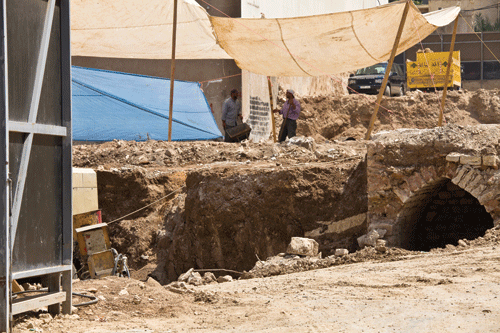
Passing through the bustling Gouraud or Pasteur Street in the Gemmayze neighborhood of East Beirut, one cannot help but notice the hive of activity in what was formerly one of the area’s biggest car parks. The site is walled off from the public but, peeking through the gate as a dump truck leaves full of dirt, the curious onlooker can see bulldozers and construction workers in early stages of excavation of what is slated to be one of the largest residential developments in the area.

Dubbed “Gemmayze Village,” work on the 7,000 square meter gated residential community was started last October by Conseil et Gestion Immobiliere (CGI), the real estate arm of Audi Saradar Group. Scheduled for completion by 2014 or 2015, the 37-floor tower will be surrounded by gardens and five housing blocks ranging from three to 10 floors each.

Real estate developments in Beirut proclaiming to set a new standard in luxurious living have become commonplace cliché in recent years, but two aspects of the Gemmayze Village make for less-than-ideal development. First is the discovery of archeological ruins at the site, which the Directorate General of Antiquities (DGA) is studying to determine their significance and how they can best be preserved.

Second — an issue that has increasingly loomed over Gemmayze in recent years — is the fact that the construction of another towering edifice will further erode the historical nature of the neighborhood, which contains clusters of traditional, low-rise buildings.

As architect and heritage activist Habib Debs asked: “Aren’t there other neighborhoods in Beirut where they can build towers?” 

He and fellow campaigners have fought against the construction of new high-rises in old neighborhoods for a number of years, but it has been a losing battle in the absence of adequate laws to control such developments. CGI declined Executive’s request to comment on the issue.

Archeology on site

According to Assaad Seif, coordinator of archeological research and excavations at the DGA, both archeological and construction excavation are happening simultaneously in different areas of the Gemmayze Village site, with the former working where artifacts have been found and the latter where they have not. The ruins unearthed so far date to the Roman period and include irrigation channels and water basins. Seif explained that the findings are being cleaned and assessed, and a report is being prepared to find an adequate method to preserve them. The directorate also found two tombs at the site’s entrance on Pasteur Street, which will be excavated later.

Officially, there are several approaches the DGA could take to preserve the ruins. If the remains are significant and need to be kept on site, the state could expropriate the land. If not, the artifacts could be integrated within the development, dismantled and reinstated within the site, or removed to be studied in archeological labs and scientifically recorded. The minister of culture has the final decision, which mainly depends on the department’s assessment and recommendations.

“Nothing is thrown away into the sea or done in a subjective manner,” said Seif.

As Executive went to print, the DGA had not officially announced its intentions.

Seif explained that on any land plot in the Gemmayze vicinity there is a high probability of archeological finds, given that the area has been inhabited for thousands of years. He advises prospective investors to consult with the DGA before purchasing land to limit the risk of lost investment opportunities in the case of land being expropriated.

Archeological concerns

Helen Sader, professor of archeology at the American University of Beirut, is worried about how archeological findings are being treated, mainly because rescue excavations – those carried in areas where construction of development or infrastructure projects are taking place – are largely being carried out by students and unqualified staff, while findings are not consistently reported.  Consequently, the public has not been kept well informed of what the directorate is uncovering.

“We never really hear of what is going on; when we do know, it is from the newspapers,” she said, adding that she is unsure whether the DGA is taking the appropriate course of action.

Once or twice per year the DGA issues a scientific journal called Baal, which includes scientific reviews and details of excavations that have taken place around Lebanon.

The information contained in the publication, however, can be more than a year old, as findings are only published when the studies are complete. The DGA’s Seif said that the Ministry of Culture was working to upgrade its website to include more up-to-date information.

Seif denied that workers at the excavation sites were unqualified, but conceded that there was a lack of archeologists in Lebanon and therefore the number of people working at the directorate is insufficient.

“We have 90 percent of all those who are graduating from Lebanese universities” working in the archeology excavations teams, said Seif. Currently those teams comprise some 45 people, or about one third of department requirements, he added.

The lack of staff members, particularly of people specializing in urban archeology, means archeological losses are occurring, said Seif.

“We prefer not to have losses but we are obliged to accept them,” he said. “We are working according to our potential.”

Impacting the past and present

Along with the Gemmayze Village’s impact on ancient ruins from bygone civilizations are the present-day implications of a 135-meter monolithic stone-clad tower dwarfing the quaint, low-rise ottoman and colonial-era structures which characterize one of Beirut’s few remaining heritage areas.

That developers want to build high-rise towers in Gemmayze is not new, however, and neither is residents’ and activists’ struggle to stop them by trying to deny them building permits.

Back in August 2005, the director general of urbanism (DGU) announced that it was putting Gemmayze under study due to the high demand for tower construction in the area, explained Joseph Abdel Ahad, head of the DGU at the time. The directorate has never actually had the funds to hire a private company to carry out a detailed survey, however, and to this day the study has yet to be implemented. A year after placing Gemmayze under study, Abdel Ahad said the DGU issued a circular laying out strict building specifications, which, if applied, would limit building heights.

“These conditions were preliminary until a study was done, but it never happened, and we are still applying the circular,” he said.

The circular includes many specifications, mainly forbidding merging several plots into one – which could lead to an increase in built square meters allowed and the rise of more towers. It also sets the building height limit at two times the width of the street and prohibits the practice of retreating from the street, which would allow developers to build taller buildings.

Despite the circular, however, tower permits are still being issued.

What went wrong?

As with many sectors in Lebanon, conflicts of interest abound in the real estate industry, with the lines blurred between developers and those meant to regulate development.

Take Ziad Akl for instance, who is both a member of the higher council of town planning at the DGU and the architect behind the Sursock Residence tower – the cause of much controversy in 2006 when the permit was issued due to its location between the historical Sursock Museum and Villa Linda Sursock. 


Akl argues that due to Beirut’s high exploitation factor – the maximum percentage footprint of a plot of land that a building can occupy – owners of large land parcels have to build high-rise buildings in order to take full advantage of their investment. He explained that the Gemmayze Village sits on one of the largest plots in the neighborhood.

“Those who have large land parcels and the right to build on them, they have to build high-rises, or else where are they going to put their square meters?” he said, adding that none of the towers currently in Gemmayze breached the DGU circular in any way. Akl said he would like to see the historical cluster of buildings preserved as well, but authorities should first find a way compensate land owners for the loss on investment.  

Debs, the architect and heritage activist, disagrees, saying that full utilization of the exploitation factor is not a given right, and authorities should be able to lower it if needed.

“Authorities have the right to lower the exploitation factor to protect an area,” he said. “The public interest should come before the private one.”

Still, every development in the neighborhood is studied case-by-case and altered according to DGU’s request. As Akl points out, the original design of the Gemmayze Village included just two high-rise towers; the directorate asked the developer to change this to one tower and several low-rise building blocks to better blend with Gemmayze’s aesthetic.

Does history have a future?

Whether towers should be built in Gemmayze or not, or whatever the steps the authorities should take in order to preserve historical clusters of buildings, what is almost certain is that building permits once given will not be taken away, and what is demolished will not be rebuilt in kind.

It also remains to be seen whether the Lebanese authorities will manage to begin the urban study of the Gemmayze area before new development obscures the historical character of the neighborhood forever.

July 3, 2010 0 comments
0 FacebookTwitterPinterestEmail
  • 1
  • …
  • 414
  • 415
  • 416
  • 417
  • 418
  • …
  • 686

Latest Cover

About us

Since its first edition emerged on the newsstands in 1999, Executive Magazine has been dedicated to providing its readers with the most up-to-date local and regional business news. Executive is a monthly business magazine that offers readers in-depth analyses on the Lebanese world of commerce, covering all the major sectors – from banking, finance, and insurance to technology, tourism, hospitality, media, and retail.

  • Donate
  • Our Purpose
  • Contact Us

Sign up for our newsletter

    • Facebook
    • Twitter
    • Instagram
    • Linkedin
    • Youtube
    Executive Magazine
    • ISSUES
      • Current Issue
      • Past issues
    • BUSINESS
    • ECONOMICS & POLICY
    • OPINION
    • SPECIAL REPORTS
    • EXECUTIVE TALKS
    • MOVEMENTS
      • Change the image
      • Cannes lions
      • Transparency & accountability
      • ECONOMIC ROADMAP
      • Say No to Corruption
      • The Lebanon media development initiative
      • LPSN Policy Asks
      • Advocating the preservation of deposits
    • JOIN US
      • Join our movement
      • Attend our events
      • Receive updates
      • Connect with us
    • DONATE