• Donate
  • Our Purpose
  • Contact Us
Executive Magazine
  • ISSUES
    • Current Issue
    • Past issues
  • BUSINESS
  • ECONOMICS & POLICY
  • OPINION
  • SPECIAL REPORTS
  • EXECUTIVE TALKS
  • MOVEMENTS
    • Change the image
    • Cannes lions
    • Transparency & accountability
    • ECONOMIC ROADMAP
    • Say No to Corruption
    • The Lebanon media development initiative
    • LPSN Policy Asks
    • Advocating the preservation of deposits
  • JOIN US
    • Join our movement
    • Attend our events
    • Receive updates
    • Connect with us
  • DONATE
Comment

Derision of democracy

by Sami Halabi June 1, 2010
written by Sami Halabi

When things go wrong, progressive types normally try to fix them. But in Lebanon, this simple logic is rarely followed; more often than not we go along with the situation so as not to stir up tension, in the hopes that somewhere down the line things will fix themselves. But our problems don’t get fixed — they fester.

The Lebanese still adhere to an archaic and dysfunctional municipal system based on the dictates of an Ottoman sultan, with a dash of French colonialism thrown in for good measure. Looking at our current administrative process — in which it takes 67 signatures to fix a truck belonging to a municipality, according to economist Marwan Iskandar — it’s obvious that applying an old system to a new world just doesn’t work.

 Change is painfully slow in this country, where political power is tied to sectarian affiliations and local loyalties, and people’s sense of disenfranchisement is so engrained that it becomes self-fulfilling. Lebanon’s political leaders have a vested interest in maintaining the entrenched patronage systems in their sectarian fiefdoms, which ensure that no major decisions are taken without their consent.

Citizens suffer as a result; around $480 million stuck in the Beirut municipality’s coffers that could be used to develop the city has been tied up for months because the mayor, Abdelmounim Ariss, and the governor, Nassif Kaloosh, are from opposing parties and can’t agree to sign the same piece of paper.

The election process itself is no more democratic than the system of governance. A significant portion of last month’s municipal elections were over before they started, with 15 percent of the seats won uncontested — amounting to 56 council seats and 199 mayoralties. The polls were supposed to be a platform to continue the government’s piecemeal electoral reforms that were introduced in last year’s parliamentary elections. Proposals ranged from the introduction of pre-printed standardized ballots and campaign finance reforms that prevent vote buying, to proportional representation and quotas for women to make for a more balanced outcome.

The much needed reforms would have provided a more democratic and equitable outcome for Lebanon’s voters. However, seeing the status quo that so benefits them threatened, our politicians engaged in the time honored tradition of stalling the matter by reviving age-old excuses that reforms such as lowering the voting age (opposed by all the Maronite-led parties) and allowing non-residents to vote (opposed by non-Christian-led parties) would upset the sectarian “balance” of the country, even though there is scant evidence as to the sectarian impact of either. The constitutional deadline for the elections was duly ignored until it was too late and the reforms had to be abandoned.

With electoral reform dead in the water, lawmakers then went on to neuter the democratic process further with “consensual lists” that allowed the interior minister to announce the “results” of some contests before the actual ballots were cast. And where the Free Patriotic Movement and Hezbollah didn’t get their way with the lists, instead of running a campaign based on policy to defeat their opponents, they packed up and pulled out. The Future Movement and the Nasserites didn’t do much better; after they couldn’t come to agreement over how to divvy up the spoils, their supporters decided to have a punch-up in the polling stations.   

But all the blame cannot be laid squarely at the feet of our politicians. After all, if they can get away with making a mockery of the democratic process and still get people to come out and vote for them, then why wouldn’t they take advantage of the situation?

With every year that passes of politics-as-usual, we complain that things aren’t getting any better. But if we genuinely want to see reform, there is no other option than to do what the politicians always tell us will tear the country apart: end confessionalism and change our political and administrative system.

We need to change our mindset and realize that what we let fester will never fix itself — or we should simply shut up and stop complaining.

SAMI HALABI is deputy editor of Executive Magazine

June 1, 2010 0 comments
0 FacebookTwitterPinterestEmail
Comment

A Nile of denial

by Peter Speetjens June 1, 2010
written by Peter Speetjens

Conflict is looming on the Nile’s southern horizon. Following 13 years of fruitless negotiations with Egypt and Sudan over a new Nile Agreement, four of the river’s upstream countries decided to go it alone on May 14.

Ethiopia, Tanzania, Uganda and Rwanda signed a new treaty that calls for equitable water sharing, while Kenya, Congo and Burundi are to follow suit. Ethiopia, source to some 80 percent of all Nile water, wishes to develop its hydroelectric capacities, while countries such as Kenya and Tanzania aim to increase their agricultural output through irrigation.

“This agreement benefits all of us and harms none of us,” said Ethiopia’s Minister of Water Resources Asfaw Dingamo. “I strongly believe all Nile Basin countries will sign the agreement.”

Minister Dingamo should have known better, as the treaty sent a flood wave of concern further downstream.

Egypt has warned numerous times that any developments anywhere along the Nile will be regarded as a threat to its national interest and a potential cause for war. In fact, right until the moment of signing, high-level Egyptian and Sudanese diplomats attempted to alter the course taken by their southern neighbors.

The new treaty and the failure to reach a last-moment compromise were fiercely debated in Cairo, where Zakaria Azmi, a member of the Egyptian Presidential staff, warned members of Parliament against “talking nervously about the issue.”

Egypt gets understandably nervy where the Nile is concerned as 97 percent of its water resources stem from the world’s longest river, which supplies nearly all of its drinking water, feeds an extensive agricultural sector and generates a substantial part of the country’s electricity.

Meanwhile, 95 percent of Egypt’s ever-increasing population lives in the delta, which is subject to erosion and degradation.

Khartoum is Cairo’s closest ally in this regard. Sudan possesses more water resources than just the Nile, but nearly all of these are located in the politically volatile south of the country. Egypt and Sudan refuse to sign the new treaty, demanding acknowledgement of all existing agreements and a timely notification of future projects — which should be approved unanimously, not by majority vote.

Egypt essentially rejects proposals to water down previous agreements, which are highly in its favor and hinder any upstream developments. A handful of bilateral treaties signed since the late 19th century culminated in the 1929 Nile Agreement, which entitles Egypt to monitor and veto all upstream developments, while it can undertake any project without the consent of upstream countries.

The 1929 treaty formed the basis for the 1959 Nile Agreement. At that time, Egypt was planning to build the Aswan High Dam and needed a reliable flow of water, while a by-then independent Sudan demanded an amendment to the 1929 treaty, which it deemed unfair. The 1959 Nile Agreement stipulates that Egypt is entitled to 55.5 billion cubic meters (BCM) and Sudan 18.5 BCM annually. It also entitled Egypt to build the High Dam and allowed Sudan to construct several smaller dams, as well as irrigation and hydroelectric projects.

The upstream countries led by Ethiopia refuse to have their future dictated by the 1959 Nile Agreement, which not only disregards their interests, but was also based on previous treaties that were all ordained by the then-colonial master of the world, Great Britain.

Downstream and largely devoid of rain, Egypt’s citizens have every right to be concerned, yet should not blindly blame their upstream neighbors for their (potential) future woes. They would do better to look to a political establishment that, for the past 13 years, refused to move even an inch toward recognizing the upstream demands.

Meanwhile, that establishment poured billions of dollars (and gallons of water) into trying to make the desert bloom at Toshka near the Sudanese border — a project that by the day grows into an ever larger white elephant. In addition, the fertile Nile delta is shrinking as urbanization and real estate development march onward, thanks to the inability of the Egyptian authorities to formulate and implement a proper zoning and urban planning system.

At the same time, it is not Egypt, but China and other Arab nations that have become the leading investors in the upper-Nile’s East Africa.

Should the Egyptians one day face water shortages, a large portion of the blame must surely fall on their ostrich-like politicians for a shocking lack of foresight.

PETER SPEETJENS is a Beirut-based journalist

June 1, 2010 0 comments
0 FacebookTwitterPinterestEmail
Society

The New Italian Stallion

by Nadim Mehanna June 1, 2010
written by Nadim Mehanna

Whenever an automaker departs significantly from its own standards and norms, it raises certain questions about the maker, the marque, and the industry as a whole.

Manufacturers — and sport and luxury car manufacturers in particular — invest millions of dollars in creating “attitudes” consistent with their products, and for these attitudes to stick, it is important that any car manufactured under their marque be recognizable down to the smallest detail. Customer loyalty depends on consistency. Radical innovation, even if it means radical improvement, is always something of a gamble.

So what do we make of the Ferrari 458 Italia? The Italia is, in the company’s own words, “a completely new car from every point of view,” and demonstrates both the company’s experience in Formula One (F1) racing and increasing global awareness of acceptable levels of fuel consumption and carbon dioxide emissions.

The F1 influence is apparent from without as well as within the car: the bodywork is compact and aerodynamic, favoring elegant simplicity and light-weight materials, though some may find the Italia’s rounded rump less appealing than its predecessors, the 430, as Ferrari has halved the stoplights from four down to two, while also trimming the tailpipes to three. From the driver’s seat though, the parallels are unmistakable, as the steering wheel and dashboard both hew strongly to racing lines.

Under the hood, a new 4499 cc V8 employs the low piston compression height characteristic of racing engines. Capable of 570 CVs at 9000 rpm, the Italia has the highest power output we’ve seen not only in its range, but in the history of the company as well. However, equipped with a seven-speed dual-clutch transmission, the Italia may leave the fundamentalist Ferraristas longing for the more raw F1 sequential gearbox.

With all that power, you’d expect fuel consumption to be egregious — sports cars have largely ignored the current auto market trend toward increasing fuel efficiency and lowering emissions. Instead, they’ve enjoyed riding high above the storm on the checkbooks of their clients.

The Italia, however, is one of the first to make a serious stab at fuel economy, largely by fine-tuning its component parts to utilize light-weight materials and reduce internal friction. Thus, despite the fact that its engine is significantly more powerful than any other in its class, the Italia produces only 320 grams per kilometer of CO2 – another benchmark for the maker and something of a novelty within its segment. 

This shows that growing environmental awareness has reached even the upper echelons of the auto industry.  More interesting is what the Italia can tell us about Ferrari itself, as a company, a brand and an image.

In many of Ferrari’s recent models — the California being a prime example — the company has added versatility to provide customers practicality as well as performance in a bid to enter new territory for the speed-centric superbrand.

 The Italia, on the other hand, is sporty to the 10th degree, entirely focused on the driving experience. Ferrari is, at its core, Italian. That it would name its new model Italia is, in effect, an affirmation that Ferrari’s finest qualities are encapsulated here. Though a step forward in terms of handling, power and fuel efficiency, the Italia is also a reversion to Ferrari’s core principles. Whatever differences from the past it displays can be taken as signposts to the company’s future — the Italia is Ferrari’s new flag-bearer. 

NADIM MEHANNA is an automotive engineer and the pioneer of motoring on Middle Eastern television since 1992

June 1, 2010 0 comments
0 FacebookTwitterPinterestEmail
Society

Football and politics: fair play?

by Rany Kassab, Zeina Loutfi & Ramsay G. Najjar June 1, 2010
written by Rany Kassab, Zeina Loutfi & Ramsay G. Najjar

June. The grip of football fever will soon engulf the globe as all eyes turn to South Africa, the host nation of one of the biggest events on the planet: FIFA’s World Cup 2010.

Whether one supports the mighty Spanish, the spectacular Brazilians, the creative Dutch or the resilient Germans, emotions always run high; the results can make or break a country’s morale.

The popularity of the game is such that it transcends borders, language barriers and social classes. What was once regarded as the common man’s sport of choice has become a multi-billion dollar business controlled by a few men (it is still largely a man’s world) who yield the power to assign lucrative broadcasting rights and grant countries the privilege to host an event capable of attracting hundreds of thousands of spectators and scores of companies vying for a piece of the pie.

The popularity of football and its mass appeal means that it often draws public figures and politicians, eager to be associated with a game steeped in nationalistic fervor, competitiveness and outright machismo.

Ratings by association

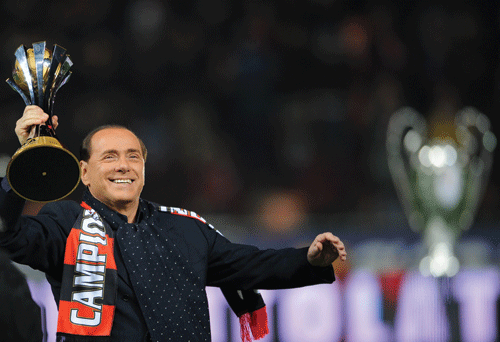
While politicians such as Henry Kissinger and Silvio Berlusconi are known to be genuine fans of the game, most others are often advised by their communication consultants to attend key matches, on the proven premise that the jubilation that accompanies a national team’s win will translate into higher approval ratings for the politician, while turning him into some sort of lucky charm for fans (especially when considering the level of superstition in the game).

The power of football is undeniable. It can lift a nation’s spirit, unite people from diverse backgrounds and even help overcome racism and social prejudice. When the French won the World Cup in 1998, one poll showed that more people would have voted for Zinedine Zidane for the presidency than they would have for any other political candidate, despite his origins and background. While this might have been somewhat influenced by the euphoria that surrounded the win, it nevertheless shows the potential gains that could be achieved by leveraging the cult status of the sport.

The universal language of football, and its ability to surpass differences, was probably best illustrated on Christmas Eve 1915, when German and British soldiers came out of their trenches, after weeks of fierce fighting, for one improvised game of football, which, while it may not have influenced the course of the war, showed how the love of the game can bring down barriers.

Closer to home, the game on April 13th that brought politicians representing both sides of Lebanon’s political divide together for a symbolic football match, illustrated – besides the less than perfect physical fitness of our representatives – the ability of football to serve as a common denominator and a medium to communicate key messages away from rhetorical discourse or political debates, which often fail to reach their intended audience.

Historically, football, and sport in general, has always been used as a means for political showboating and to rally constituents on nationalistic grounds. In 1980, the “Miracle on Ice” victory by the American Hockey team over the Russians became a symbol of American triumph and superiority at the height of the cold war, thanks to a well-crafted communication strategy. The event galvanized Americans and lifted their spirits and feelings of national pride following the debacles of Vietnam and the takeover of the American embassy in Tehran.

The dark side

That said, despite all the good that it can bring, football can sometimes be a source of division and an excuse to fuel sectarian and sometimes racial prejudice for pure political gain.

A few years back, France’s Jean-Marie Le Pen criticized the French national team for fielding an entire squad featuring “non-native” Frenchmen, in an attempt to solidify his role as the protector of “French Identity.” In 2002, Le Pen was a runner-up to elected President Jacques Chirac, with 18 percent of the total popular vote.

Similarly, the much publicized World Cup qualifying game between Egypt and Algeria was a chance for the leadership in both countries to show restraint and call for calm, but instead they took the opportunity to play on the heightened emotions of football fans to bolster their own domestic credibility and nationalist credentials.

Talking the talk

At the end of the day, what seals the sometimes-unnatural bond between football and politics is communication, and politicians’ desire to project a certain image of themselves to voters and opinion leaders.

In that sense, football becomes a communication channel and its lingo part of politicians’ lexicon, adding to the military jargon of speeches and discourse to portray leadership attributes and unflinching confidence.

Incidentally, a close look at the industry terminology reveals the similarities between the worlds of football and communication; target, audience, defensive, offensive, goals, and strategy are terms used regularly in both fields.

Whoever wins the World Cup, we can be sure that the game will continue to grow and expand its reach and popularity, provided that we do not turn it into a sport that is within the reach of only a fortunate few who can afford entrance fees to the stadiums or subscriptions to cable channels.

Football, the most democratic sport in the larger sense of the term, is the game of the masses, which is arguably its forte.

For this reason, the role of professional soccer’s governing bodies and the political establishment should be, first and foremost, to ensure that the sport remains accessible to everyone, and to leverage and channel its popularity in the right direction.

June 1, 2010 0 comments
0 FacebookTwitterPinterestEmail
Economics & Policy

Eastern expansion

by Andrew Horncastle & Georges Haines June 1, 2010
written by Andrew Horncastle & Georges Haines

As their North American and European competitors recover from the economic crisis, Middle Eastern chemical companies are facing new opportunities and new challenges.

They are continuing to build on their cost advantage in basic petrochemicals, which has made them formidable challengers in the global industry. They are also beginning to invest in more specialized chemicals to further strengthen their overall position and create more industrialized, diversified economies in their countries. However, as they expand into new chemicals, their cost advantage diminishes and they will have to be selective about their approaches to growth and develop new capabilities to compete successfully.

Cashing in on the crisis

As the global chemicals industry begins to pick up the pieces and recover, it is finding itself in a post-crisis landscape that looks significantly alien. Middle Eastern companies have capitalized on a cost advantage of 30 percent to 90 percent in natural gas-based feedstock — the raw material necessary for producing basic petrochemicals. As a result, regional companies will nearly double their share of global capacity from 2008 to 2013 (from 11 percent to 19 percent for ethylene and 7 percent to 14 percent for polypropylene). Additionally, Middle East chemical companies are well positioned logistically to serve Asian markets, which are currently growing faster than those in North America and Europe.

With these advantages, chemical companies in the Middle East are expected to emerge from the crisis in good shape, despite the fact that global demand for chemicals has dropped while supply has expanded.

To date, companies in the region have focused on basic commodity chemicals based on natural gas feedstock, such as fertilizers and plastics; these are relatively straightforward to manage and highly profitable. Indeed, Middle East firms have such a strong cost advantage in manufacturing these products that Western companies, including Borealis, ExxonMobil Chemicals and Dow, have partnered with regional forms in order to benefit from these advantages.

But with the gap between demand for gas and available supply widening in the region and pressure from governments to diversify economies and create jobs, chemical companies are investigating the possibility of expanding into a broader product portfolio that encompasses oil-based (e.g., naphtha) feedstock.

However, the cost advantage that Middle East companies enjoy with natural gas reduces significantly when moving to naphtha feedstock.

In addition, these products are more complex to manufacture, require greater interaction with customers to provide the necessary technical and applications support, and demand new capabilities for Middle Eastern companies to manage the diversified portfolios and complicated supply chains. 

To determine their path forward, Middle East chemical companies need to look at two elements: the competition and their own capabilities.

In terms of competition, North American and European companies are likely to be more aggressive in defending their territory in specialty chemicals — where their innovation capacity is a strong source of competitive advantage — than in basic chemicals. However, a lot of specialty segments are commoditizing rapidly and Middle Eastern companies are finding opportunities to put down stakes — particularly as Western companies divest businesses to clean up their balance sheets or adjust to their growth strategies and, in doing so, seek to sell or establish joint ventures for their businesses that could significantly benefit from integration with Middle Eastern players.

Earning and learning

In these cases, it will fall to the Middle Eastern firms to make sure that they truly capture knowledge from these partnerships, thus building their own capacity to develop a high-value and diversified product portfolio, rather than simply acting as the purveyors of inexpensive feedstock. In particular, regional companies should consider where else they might be able to build a competitive advantage, such as using their regional proximity to Asia and Europe to better serve those markets.

Saudi Arabia and the United Arab Emirates have both started to move into new chemical products and are making significant investments in integrated petrochemical and specialty chemical projects.

But the move is not without challenges. They must carefully choose those products that meet their profitability targets, yet at the same time balance government requirements for diversification and job creation in order to receive the feedstock they require. In addition, they need to further develop their technology and management capabilities to handle the diverse array of products. Marketing these products will also be more complex, as companies will need to work much more closely with customers to meet their needs; this requires them to place supporting infrastructure directly in Asia and Europe, where there is a demand for these products.

In order to overcome these challenges, Middle Eastern companies should focus first on just a small number of new products to allow for a learning curve, then build a sustainable, competitive position. They should continue to use acquisitions and joint ventures with Western and Asian companies to make use of existing technology, market access and management experience, as well as capabilities, in order to be competitive. In doing so, it is important for Middle Eastern chemical firms to have a clear strategic intent toward acquisitions or joint ventures and vital that they capture the integration benefits of such arrangements.

Forging the future

As the crisis recedes, companies in the Middle East will continue to shape the chemical industry by further increasing their footprint across products and regions, as they build on their relative advantages. As a result, they will be a main driver in the transformation of the chemicals industry by actively pursuing acquisitions and forging new alliances.

June 1, 2010 0 comments
0 FacebookTwitterPinterestEmail
Economics & Policy

Deals by the dozen

by Executive Staff June 1, 2010
written by Executive Staff

Nine new merger and acquisition (M&A) plans with potential worth of well over $12.4 billion have been announced by companies in the Middle East and North Africa (MENA), according to Regional Press Network (RPN)’s DealFlow Monitor.

The largest imminent M&A transaction is a sale of telecommunications assets by Egypt’s Orascom Telecom Holdings to South African MTN. 

Gulf Cooperation Council countries are expected to return to the pre-crisis boom times in M&As, projected to reach $25 billion this year and up to $100 billion in 2011, according to the GCC M&A Barometer survey conducted by Zawya and M Communications.

The GCC M&A Barometer surveyed 27 investment banks, which highlighted telecommunications and financial services as two industries in the Middle East that will see more consolidations. The majority of M&As are expected to take place within the GCC, with Saudi Arabia leading the United Arab Emirates, followed by Qatar. Some 85 percent of bankers expect mid-market transactions to dominate the M&A market this year.

The new projects announced in the one-month period between mid April and mid May of this year, have pushed the known portfolio of major business partnership deals in the region — acquisitions, mergers, joint ventures, venture capital participations, strategic and financial investments — to more than 940 deals with an aggregate value of $142.6 billion, since January 2009, according to the RPN’s DealFlow Monitor.

Telecommunications transactions represent the largest slice of the pie in this period, at $32.3 billion, followed by deals in financial services, at $25.6 billion.

Oil and gas investments rank third, with a value of $19.9 billion. The three sectors account for 60 percent of deals recorded by RPN Dealflow since January 2009.

A recent report by Ernest & Young found that M&A deals announced in the Middle East and North Africa dropped by 67 percent in value to $34 billion in 2009, down from $102 billion in 2008.

The largest transaction recorded in the past 16 months was concluded with a definite sales agreement in March when India’s Bharti Airtel acquired mobile communications network assets from Kuwait’s Zain Group in a $10.7 billion deal. As a comparatively large deal, the Zain IPO accounted for 48 percent of all telecom M&As recorded between Jan 2009 and end of March 2010.

The biggest deal cancellation over the same period was the $1.7 billion fire sale of Dubai construction leader Arabtec to Abu Dhabi’s Aabar Investments, which was called off in mid April.

The two companies said the cancellation was in mutual agreement, despite the suddenness and dearth of information involved, which was matched only by the suddenness and dearth of information involved in the initial bombshell announcement in January. 

One in every four M&A deals of just over 200 deals tracked by RPN Dealflow between January 1 and April 15 of this year involved a partner outside of the MENA region (inclusive of Turkey) but most of these deals related to assets located within MENA.

Analysts say that outbound M&A activities by cash-heavy Arab Sovereign Wealth Funds and private wealth aggregators will proceed with more scrutiny and inbound flows will witness the increasing appetite of international players for slices of MENA economic activities.

Dynamics of M&A in one sector often get a stimulus from a major deal closing, as demonstrated when Zain’s telecoms sale to Bharti was quickly followed by MTN and Orascom disclosing that they entered discussions for an MTN takeover of Orascom’s Algerian unit, Djezzy.

June 1, 2010 0 comments
0 FacebookTwitterPinterestEmail
Economics & Policy

How peace pays

by Josh Wood June 1, 2010
written by Josh Wood

For the past 32 years, UNIFIL — the United Nations Interim Force in Lebanon — has been a thread in the fabric of life in Lebanon. While most mentions of UNIFIL relate to Lebanon’s numerous conflicts with its southern neighbor and violations of the UN-mandated Blue Line that ostensibly marks the border with Israel, there is another face to the peacekeeping mission: its economic impact.

Over the past year alone, UNIFIL spent $32 million on contracts with local Lebanese firms, according to UNIFIL spokesperson Andrea Tenenti. UNIFIL’s nearly 13,000-strong military force and civilian staff also pump millions of dollars into the local economy through privately purchased goods and services – and the mission says that it is the largest single employer of Lebanese citizens in the south. In addition, in an effort to improve its public image, the mission invests millions of dollars every year in building infrastructure for local communities and offering direct aid to the population of South Lebanon, which is among the poorest areas of the country, having endured the 22-year-long Israeli occupation.

While UNIFIL is by no means an economic savior for the south, it is certainly a crutch. Its continued presence has provided a steady stream of income for the local economy for more than three decades, with the amount of money being spent soaring in recent years as troop numbers have grown. After Israel’s 2006 war on Lebanon UNIFIL rapidly began increasing its personnel numbers, from less than 2,000 before the hostilities to around 11,500 military personnel by the end of 2006.

These new troops were not cheap: UNIFIL’s 2006 to 2007 total budget topped $495 million, a 543 percent rise from the $91 million spent a year earlier.  For 2009 to 2010, the appropriated budget reached nearly $590 million.

The procurement spending spree

Most of UNIFIL’s budget is given to countries that contribute troops to the mission, money sent to cover the salaries of soldiers. While the Lebanese economy sees some of this money later through troops’ private spending, it is UNIFIL’s procurement budget for goods and services which offers the largest cash injection into the Lebanese economy.

Items on UNIFIL’s yearly procurement budget include everything from condoms to laptop computers — estimated to cost UNIFIL $136,763 and $138,500 respectively, in 2009. The most costly this year — and nearly every year — is food rations to feed UNIFIL staff and soldiers, with an estimated tab of $18.2 million.

In filling its procurement needs UNIFIL turns to companies around the world, but has, over time, shown a preference for awarding contracts to Lebanese businesses.

“As a rule, [UNIFIL] generally tries to buy most things from Lebanon — if you can find it here of course,” said Timur Goksel, a longtime UNIFIL spokesman who now teaches at the American University of Beirut.

This year, 160 Lebanese vendors and firms were awarded roughly $33 million (40 percent) of the total anticipated procurement budget of $82 million, according to Executive’s calculations.

While UNIFIL was unable to produce similar statistics for most other years, in 2007 UNIFIL spokeswoman Yasmina Bouziane told the international media that the mission was set to spend $36 million of its $90 million spending budget in Lebanon — again about 40 percent. In October 2006, shortly after the Israel-Hezbollah ceasefire, UNIFIL’s acting Chief Administrative Officer Jean-Pierre Ducharme said UNIFIL had spent $40 million on Lebanese contracts that year and that 60 percent of its total procurement budget over the last three years had been spent locally.

The largest contract with a Lebanese company has been an exclusive deal with Medco to supply fuel for UNIFIL jeeps, armored personnel carriers, helicopters and other vehicles, as well as generators. Since 2006, these contracts have totaled $50.7 million, with contracts signed in 2007 alone running at $22 million.

With UNIFIL’s increased demand for new bases and extra space on existing bases to accommodate its mushrooming numbers, Lebanese construction firms have also benefited.

The largest construction contracts UNIFIL has disclosed have been with Hanna Khoury and Brothers Company ($9.3 million), Dalal Steel Industries (at least $3.2 million), Maroun Assaf ($1.5 million) and Daher Contracting ($1.1 million).

UNIFIL’s Miguel de Cervantes base near Marjayoun — considered “the best UN base in the world” by many UNIFIL personnel — was little more than a campground in 2006. Marwan Dalal from Dalal Steel Industries said that his company provided 90 percent of the steel and prefabricated buildings used on the $16 million base, which was primarily built using prefabricated structures.

Major goods procured by UNIFIL in 2008

Major goods procured by UNIFIL in 2008 - Lebanon

Major services procured by UNIFIL in 2008

Major goods procured by UNIFIL in 2008 - Lebanon

Dalal added that the company had been responsible for similar amounts of work at other UNIFIL bases and positions.

Besides working with UNIFIL, Dalal Steel has also maintained contracts with American forces in Iraq and Afghanistan, the Lebanese Armed Forces, as well as with other UN missions across the world. While not disclosing exactly how much the company makes per year, Dalal said that contracts with UNIFIL could account for up to 20 percent of the company’s yearly business.

While arranging construction and procuring petroleum require fairly large contracts, UNIFIL also maintains smaller contracts — covering everything from gardening to mobile phones — with more than 150 other Lebanese firms.

Local jobs for local people

UNIFIL claims that its 800 or so full-time local staff make it the largest single employer of Lebanese in the area. Many more Lebanese also work with the peacekeepers on a temporary basis.

UNIFIL’s permanent local staff members are attracted by comparatively high salaries, jobs that have room for professional development and the opportunity to eventually take their career outside of Lebanon.

“Most of the Lebanese who started off with UNIFIL in the early years have now become permanent UN staff members all over the world,” said Goksel.

About 140 of UNIFIL’s permanent local staff are translators. Amal Kahawaji, a translator with UNIFIL’s Indonesian battalion, said that translators are paid about $2,000 per month – an attractive sum for young Lebanese university graduates whose average starting salary on entering the workforce is usually much lower.

For contractual workers, the jobs are also welcome but they do not reap the benefits of full-time UNIFIL staff.

Several cleaners from One World (a company working exclusively with UNIFIL providing cleaning, maintenance and landscaping services) on the Miguel de Cervantes Base said that they didn’t feel that their $500 per month salary was fair compensation for the work they were doing. However, the women, all from the surrounding villages, said that they were still lucky to have the jobs as work was scarce in the area.

All in all, former UNIFIL spokesman Goksel estimated that around 2,000 families in South Lebanon rely on UNIFIL for their livelihood.

Yoga and reconstruction

While contracts between UNIFIL and Lebanese firms clearly represent the most significant economic contribution of the peacekeeping mission, direct commitment of UNIFIL money and resources to local communities in the South also has a major impact on the area.

Civil Military Cooperation (CIMIC) projects are aimed at capturing the ‘hearts and minds’ of local residents and improving the public’s perception of UNIFIL.

“Quick Impact Projects” are the most common CIMIC operation. These small-scale projects cost up to $25,000 a piece and are primarily aimed at reconstruction and infrastructure building.  Examples of such projects include building sports facilities in villages and renovating schools.

The UN funds $500,000 worth of these projects a year — enough money for 30 projects in 2009.  Individual troop contributing countries, however, fund the majority of the projects. In 2009, Italy led the field, completing 112 projects worth $2.1 million. The Korean contingent completed 25 projects, totaling $1.3 million.

UNIFIL also provides a host of other activities within the local communities, from clearing unexploded ordnance to hosting free health clinics and even Yoga and Taekwondo classes, organized by the Indian and Korean contingents respectively.

Last year, UNIFIL’s clinics and medical teams treated more than 40,000 local patients, and since the beginning of 2005, a total of 150,000 people have received such treatment.

While Yoga might not have the same tangible benefits as other contributions such as free healthcare, UNIFIL stands by these endeavors, saying that they improve the quality of life for residents. Educational courses, such as language and computer classes, also help build skills to boost residents future job prospects.

A home away from home

On the tree-lined roads leading up to UNIFIL’s Miguel de Cervantes base near Marjayoun, Spanish flags fly outside of shops and locals greet foreigners with a friendly “hola, como estas?” At the Mirage Bar, camouflage-clad men drink $2 Almaza beers while their comrades scope out the prices of Hezbollah souvenir items and electronics next door.

This scene — repeated in permutations across South Lebanon — is a direct result of combining foreign troops with comparatively high disposable incomes and entrepreneurially minded members of the local population.

“If every soldier spends just $1, it will be very good for the economy,” said Jallal Ramal, who runs the PX (military jargon for an on-base store) at UNIFIL position 8-33 on the Lebanese-Israeli frontier.

While it is difficult to calculate exactly how much money UNIFIL soldiers and civilian staff regularly spend in the local economies of southern Lebanon, it is certainly far higher than Ramal’s $1.

Countries that contribute troops are given $1,028 per month per soldier by the UN. Additionally, the UN directly pays soldiers $1.28 per day for serving in Lebanon. As this wage is well below the standard salaries offered in some — especially Western — troop contributing countries, some contingents’ home countries subsidize this pay quite heavily. 

Other, poorer countries pay their soldiers directly out of the UN-provided stipend, though not necessarily always the full $1,028 per month.

Neither the diplomatic missions of most troop contributing countries nor UNIFIL headquarters in Naqoura were willing to comment on troop salaries for the various contingents, making it difficult to ascertain exact troop spending across the board.

However, Lieutenant Colonel Mar Guslin of the Indonesian battalion estimated that each soldier in his unit spent a minimum of $100 per month in the local economy. 

With around 1,000 troops stationed on the battalion’s Adchit Al Qusayr base, this would equate to at least $1.2 million spent on consumer goods and services in the surrounding villages each year.

Salaries for Spanish soldiers are much higher. Including the UNIFIL stipends and subsidized pay from the Spanish government, soldiers’ salaries start at 3,500 euros ($3,954) per month, according to Colonel Rafael Ropero Bolivar, a liaison officer at the Spanish embassy in Beirut. 

Pay grades go all the way up to 8,000 euros ($9,866) per month for Spanish generals serving in Lebanon.

With much more disposable income than other contingents, it is reasonable to assume that troops from European countries spend money more freely in the local economy.

While admitting it is difficult to calculate exactly how much cash a soldier might splash, Lieutenant Colonel Ismael Muro, a public information officer for the Spanish contingent, said that the average soldier might spend between $200 and $330 per month, with some spending up to $670 monthly.

By the lower-end estimates Muro supplied Executive with, annual local spending by the 1,076-strong Spanish contingent would be more than $3 million.

The presence of peacekeepers with money to burn has spurred a growth in shops, restaurants and services that cater exclusively to UNIFIL. 

“I don’t have any local customers,” said Khaled Nahra, the owner of Casa Elias, a large gift shop near Marjayoun that sells everything from blue beret-wearing stuffed animals to hard liquor and ninja throwing-stars to its peacekeeping clients.

In some of the predominantly Shiite Muslim southern towns, such as Naqoura, market demand has outweighed Islamic conservatism, with shops and restaurants selling alcohol for soldiers.

As stores catering to UNIFIL across the south expand their warehouses and the mission’s gargantuan headquarters in Naqoura sprawls even further in a flurry of construction, it is apparent that the word “interim” has lost its meaning.

With troops entrenched in the south for the foreseeable future, companies, communities and families in the area can look forward to continued economic benefit from the restive reputation of the land south of the Litani.

June 1, 2010 0 comments
0 FacebookTwitterPinterestEmail
Economics & Policy

Regional equity markets

by Executive Editors May 27, 2010
written by Executive Editors

Beirut SE  (One month)

Current year high: 1,200.49    Current year low: 737.84

>  Review period: Closed: April 21 – 1,143.23         Period change: 2.74%

A cone-shaped rise and fall on the Beirut Stock Exchange kept the MSCI Lebanon index gains modest in the review period. BLOM Bank was the best gainer in April with 16.1%, followed by Byblos Bank (common shares) with 14.8%. Byblos shareholders approved a 66% rights issue on April 12, boosting interest in the scrip around that time. Other good news for banks came from ratings upgrades by Moody’s, in line with a sovereign upgrade, and by Fitch. Market cap leader and real estate stock Solidere weakened in the review period.  

Amman SE  (One month)

Current year high: 2,968.77                Current year low: 2,396.28

> Review period: Closed: April 21 – 2,561.04          Period change: 1.72%

Rather noticeable volatility reigned on the Amman Stock Exchange, where the ASE benchmark index could not sustain an intra-month rally and closed the review period only 1.72% up from the last close in March. Earlier in April, the index had risen to near 2,650 points, its highest level since last October. Although the Housing Bank for Trade and Finance moved 6.3% lower, other banking stocks showed resilience and their sector index ended the period 4% higher. Market cap leader Arab Bank gained 7.6%. The indices for industrial and insurance stocks dipped into negative territory.

Abu Dhabi SM  (One month)

Current year high: 3,239.74                Current year low: 2,441.28

> Review period: Closed: April 21 – 2,820.45          Period change: -3%

There was no fun and gains for equities in Abu Dhabi this April, but for the year to date the index was still up 2.8%. The general trend was downward across all sectors on the exchange and the best performing stock in the review period was out-of-towner Qtel, which advanced 22.6%. Aldar Properties lost 9.1%. The worst performing sub-indices were consumers, down 9.7%, followed by real estate and telecommunications, which lost 6.7% and 6.3%, respectively. Pundits have it, however, that the investor confidence in Abu Dhabi and across GCC markets is on a positive track. 

Dubai FM  (One month)

Current year high: 2,373.37                Current year low: 1,533.36

> Review period: Closed: April 21 – 1,730.51          Period change: -6.1%

Book and run was the motto of Dubai investors, who apparently hurried to cash in gains achieved in March and reacted nervously to any hint of unfavorable news on the DFM. Investor behavior sent the index tumbling in the review period and pushed it back into negative territory for the year to date – the region’s only index to be in the red by that measure. For the three weeks in April, only six stocks on the DFM could show gains. Losers included well-known names across all sectors, such as Aramex, Oman Insurance, du, Arabtec, Emirates NBD, and Emaar.

Kuwait SE  (One month)

Current year high: 8,371.10                Current year low: 6,650.80

> Review period: Closed: April 21 – 7,244.30          Period change: -3.84%

Being far south of Iceland’s ash cloud didn’t do much for equities in Kuwait in April. The KSE index was the GCC markets’ second worst performer in the review period, dropping below 7,300 points for the first time in two months. The downward push at the end of the review period uniformly affected the major sectors whose indices all entered the red. Banking, down by 0.43%, was the least affected. Market champion Zain Group shed 5.9%.  

Saudi Arabia SE  (One month)

Current year high: 6,894.55                Current year low: 5,407.31

> Review period: Closed:  April 21 – 6,730.12         Period change: 1%

The petrochemicals sub-index had the best performance, up 3.63%, whereas energy and utilities fared worst at minus 11%. Losers outnumbered gainers and included the largest bank by market cap, Al Rajhi, which dropped 6.4%. Market-heavy manufacturers SABIC advanced half a percent. Optimistic voices on the year’s equity performances remained dominant but — except for volcanic emissions in unpronounceable Nordic locales  — April, on the whole, was a steam-less month in GCC equity markets.

Muscat SM  (One month)

Current year high: 6,933.75                Current year low: 5,049.03

> Review period: Closed: April 21 – 6,906.66          Period change: 3.21%

The Muscat Securities Market index close represented the best GCC performance in the review period. Poultry farming company A’Saffa Food doubled its share price as the MSM’s top gainer in April after the company undertook a 10 for one stock split at the end of March. The banking sector index led the market’s upward performance sector-wise and the banking index outperformed the general index by almost 3%. Market cap leader BankMuscat ended the review period 5.1% higher; telecommunications operator Omantel was in the balance with a 0.1% drop.

Bahrain SE  (One month)

Current year high: 1,656.43                Current year low: 1,413.28

> Review period: Closed: April 21 – 1,540.52          Period change: – 0.42%

Significant fluctuations rocked the Bahrain index, which closed down 65 points from its intra-month high but still up 5.64% for the year to date. The banking index, in a rough ride, outperformed the market but the investment sector underperformed. Market cap leader Ahli United Bank was among the top gainers, up 2.94%; the scrip has appreciated 61% in the year to date. At the other end of the scale was Gulf Finance House which could not stem its price slide and closed the April 21

session 19.2% down on the month. 

Doha SM  (One month)

Current year high: 7,801.33                Current year low: 5,426.04

> Review period: Closed: April 21 – 7,617.62          Period change: 2.1%

The Qatar Exchange was the second best GCC performer from April 1 thru 21. The close on April 21 represented a gain of 9.5% for the year to date, almost on par with the Saudi Tadawul’s y-t-d gain of 9.9%. Like several other regional exchanges, the QSE index reached new 18-month highs in April but couldn’t sustain them. There were more gainers than losers on the QSE and Al Khaleej Insurance and Doha Insurance topped the gainers’ list with respective share price increases of 17.3% and 16.8%. Insurance was the best sector index in the review period, followed by banking.

Tunis SE  (One month)

Current year high: 4,772.39                Current year low: 3,337.48

> Review period: Closed: April 21 – 4,738.92          Period change: 1.53%

The Tunindex of the Tunisian Stock Exchange stayed its course with little volatility compared with the last session in March. The index closed a five-point whisper below its year high from February 9. Insurance company Assurances Salim, which debuted on April 1, gained 42% from its issue price but any stock performance in the review period was incomparable to that of telecommunications infrastructure firm Servicom, whose price reportedly rose nine fold on a trade of three shares.

Casablanca SE  (One month)

Current year high: 12,137.95  Current year low: 9,997.56

> Review period: Closed: April 21 – 12,038.45        Period change: 5.4%

The Casablanca Exchange was the number 2 upward outlier among MENA securities markets in April, with a rise of 5.4% during the review period. Dropping in the first week of the month, the MASI benchmark index rose strongly from April 12, scaling a new 17-month high with 12,137.95 on April 20. The majority of stocks showed gains, including the market heavies Maroc Telecom (up 1.26%) and Attijariwafa Bank, which ended the period 4% higher after profit taking on April 21.

Egypt CASE  (One month)

Current year high: 7,591.37                Current year low: 4,953.53

> Review period: Closed: April 21 – 7,581.71          Period change: 11.4%

The Egyptian Stock Exchange raced to the top of the regional charts in the April review period, heaving the EGX 30 index to a 22.1% rally from the start of 2010. Index readings reached in mid-April have been the highest since mid September 2008. Orascom Telecom Holding, the number two by market cap on the EGX, was top dog in share price appreciation during the review period and rallied 33%. Telecom Egypt gained 8.9% and Orascom Construction, 3.3%.

May 27, 2010 0 comments
0 FacebookTwitterPinterestEmail
Economics & Policy

IPO Watch

by Executive Editors May 27, 2010
written by Executive Editors

Insatiable” was not the word to describe the behavior of actors in Middle Eastern primary markets in April 2010. While it appears credible that investors have been hungering after opportunities, the dearth of initial public offerings (IPOs) and secondary offerings in April 2010 was so complete that no actual primary market performance numbers were available from the Gulf or the Levant.

The only market to report any securities market entrant and any new offering in April was Tunisia, where two insurance companies took listing steps. Tunis Re, the reinsurance company, carried out the subscription period for its IPO from April 5 to 16, offering 22 percent equity for $10 million. The results of subscription were not published at the time of this writing.

Assurances SALIM started trading at the beginning of April following its $7 million subscription offer for 25 percent equity in March, which was over-subscribed almost 30 times. The company’s share price, $10.62 at issue, started trading at $15.22 on its first day and closed at $15.20 on April 20.

The underperformance of Middle Eastern IPO activity this year is noteable when compared with international markets. According to Zawya, the count of eight IPOs between January 1 and April 20, 2010, represented a slight increase from seven in the same period a year ago, but the cumulative value of the eight recent IPOs was less than $440 million, down 60 percent from $1.1 billion a year ago. 

By contrast, global IPO activity in the first quarter of 2010 increased fivefold to 267 public  offerings, the aggregate value of which skyrocketed to $53.2 billion from only $1.4 billion in the first quarter of 2009, said a report by financial auditor Ernst & Young.

The value of issues ballooned in part due to venerable Japanese life insurer Dai-ichi’s $11 billion conversion from a mutual company owned by policy holders to a public listing.

Beyond this mega issue — the world’s largest IPO in two years — and two large insurance IPOs in South Korea, the usual emerging markets champs China, India and Brazil were named as the prime grazing grounds for IPO investors so far this year. Proving them right, the state-owned Agricultural Bank of China said in April that it wants to stage the world’s largest IPO ever, to raise $30 billion in the third quarter of 2010.

Reinforcing the image of a pale Middle Eastern IPO ice princess, companies in the region that recently announced planned offerings promised long-term marvels while keeping the veil tight on timing and details. Lebanon’s Middle East Airlines wants to privatize about 25 percent through an IPO in 2011, the airline’s chairman Mohammed Hout said in a replay of listing plans that were shelved due to the upheavals of 2006. In the Gulf, officials of retailer Landmark and building materials firm Danube each hinted at IPO plans, but with time frames ranging from two to four years.

More tangible investment opportunities, albeit with eligibility limits, came from two companies with rights issues on their agenda. Saudi Stock Exchange-listed insurer Saudi Fransi Cooperative in early April obtained shareholder approval to double its number of outstanding shares to 20 million through a $33.3 million rights issue. Shares were issued at $3.33 apiece between April 10 and April 19. The company’s share price, which had risen sharply at the beginning of April, dropped back in the course of the month to close at $11.47 on April 20.

In a new rights issue announcement on April 19, United Arab Emirates telecommunications firm du revealed that it was seeking a billion-dirham capital infusion from shareholders, through a 25 percent rights issue which will increase the company’s total number of outstanding shares to 5 billion.

Officials at du said the new capital will be used for network expansion and new tech capacities. Pending shareholder approval in May, the issue will be carried out in May/June as the second sizeable rights issue in the UAE in nine months.    

As far as full initial public offerings with pizzazz and a powerful Middle Eastern corporate ingredient, regional investors may look to India where Emaar MGF, the property joint venture led by Emaar Group, has announced its intent to raise $770 million through an IPO before the end of the summer. That offering will considerably spice up the Indian IPO market, which boasts so far 20 IPOs with cumulative worth of $1.2 billion from January through March 2010.

May 27, 2010 0 comments
0 FacebookTwitterPinterestEmail
Economics & Policy

For your information

by Executive Editors May 27, 2010
written by Executive Editors

IMF estimates for Lebanon

According to International Monetary Fund estimates, Lebanon registered the second highest growth rate in the Middle East and North Africa behind Qatar last year. The Fund estimated that Lebanon’s economy grew 9 percent in 2009, which placed the country in fourth place globally in terms of real gross domestic product growth. This year the IMF estimated that Lebanon will grow 6 percent, 2.5 percent higher than the MENA region average, and by 4.5 percent in 2011, 0.3 percent below the MENA average. In parallel, the fund estimated that inflation during 2010 would average 5 percent, 1.5 percent below the MENA average. The IMF also forecast Lebanon’s current account deficit at 12.8 percent of GDP, 2.06 percentage points above the finance ministry’s proposed budget deficit for the year. In conclusion, however, the Fund noted that forecast accuracy is mitigated due to Lebanon’s weak statistics regime and stressed that real sector statistics should be provided on a more timely basis.

SME’s lap up loans

Kafalat, the publicly-sponsored financial institution offering loan guarantees for small and medium-sized enterprises in value added sectors, has reported that the value of loans extended to these businesses in the first quarter of 2010 has grown by 57.5 percent year-on-year. The total value of the loans guaranteed by the institution totaled $46.3 million in the first three months of the year. The number of loans also grew by 83 percent, from 214 in the first three months of 2009 to 392 during the same period in 2010. That said, the year-on-year average value per loan decreased 24 percent, to $118,173 per loan. The largest portion of loan guarantees were extended to projects in the agricultural sector, which captured 49.2 percent of total guarantees in the first quarter of the year. The region with the most guarantees was Mount Lebanon, accounting for 39.8 percent of the total number of guarantees over the covered period.

At last – 2008 figures announced

Almost a year and a half after the fact, the government of Lebanon has released official figures for real sector growth in 2008. The figures were compiled by the National Accounts Unit with the aid of the French research firm L’Institut National de la Statistique et des Etudes Economiques (INSEE). The report states that gross domestic product in 2008 reached $29.9 billion, reflecting a real GDP growth of 9.3 percent during the year. The real negative trade balance came in at $8.7 billion in 2008, compared to $6.3 billion in 2007. The figures confirm that commercial services were still the dominant sector in 2008, comprising 33 percent of the economic output, followed by trade (27 percent), construction (13 percent), industry (9 percent), government (9 percent), transport and communications (7 percent), and then agriculture and livestock (6 percent). The only sector that contracted in 2008 was the energy and water sector, with 4 percent sliding down the drain.

Bond boost from ratings firm

The global ratings agency Moody’s has upgraded Lebanon’s government bond ratings from B2 to B1. Last December the agency rated Lebanon as having a positive outlook because of “sustained improvement in external liquidity, the strengthened ability of the country’s resilient banking system to finance fiscal deficits and an amelioration of the domestic political situation following the formation of a consensus government last November.” Moody’s also upgraded the country’s foreign currency bank deposits to B1 from B2 and its country ceiling for foreign currency bonds to Ba3 from B1, while maintaining a stable outlook on sovereign ratings. The agency also stated that increased foreign assets at Banque du Liban, Lebanon’s central bank, “[placed] the country in a more favorable position to absorb financial shocks (including any potential rise in deposit dollarization), while also providing ample cover for the government’s maturing foreign currency debt.” However, Tristan Cooper, vice president and senior credit officer at Moody’s Sovereign Risk Group, cautioned that “despite the recent improving trends, Moody’s notes Lebanon’s significant political and economic vulnerabilities. These include wide twin deficits, a very high public debt overhang, a tense domestic political environment, and the persistent threat of an escalation with Israel.”

Broadband lumbers forward

Telecommunications Minister Charbel Nahas said last month that the project to develop a national fiber-optic network to increase Internet speeds in Lebanon will cost $92.9 million. The announcement was made at a conference on April 12, after the minister had announced in January that the project would cost some $166 million. In March, Executive cited telecommunications experts at the International Telecommunications Union, the United Nations agency for telecommunications, as stating that the project should cost no more than $40 million. Speaking at the conference, Nahas said that $66.3 million had been requested from the Council of Ministers, Lebanon’s cabinet, to start funding the project. The figure is close to the previous minister’s estimate of $64 million to implement the project. Lebanon is still in the process of passing a budget for the year, before which new projects cannot be funded from government coffers. According to Naji Andraos, director general of construction and maintenance, the project requires some 4,000 kilometers of fiber optic cable, most of which will be laid in two “super rings” that will carry the bulk of the data around Lebanon to be transferred to “metro rings” in population areas. The “access layer,” the final crucial link between telecommunications infrastructure and the user, is still being studied by the ministry, which hopes to finish its assessment by mid-2011, according to Abdulmenaim Youssef, the head of Lebanon’s incumbent public operator, Ogero. Youssef also heads the Directorate of Operations and Maintenance at the Ministry of Telecommunications, whose job it is to oversee Ogero’s operations. Without defining the access layer, an accurate financial estimate of how much the project will cost is near impossible. “The tender for the optical backbone and the metro backbone is still in the planning phase,” said Anders Lindblad, president of Ericsson in the Middle East. “Sure there is a budgetary estimate, but the competition [in the vendor market] will determine the price.” He added that the project will likely take 10 to 15 years to complete. In related telecom news, Kamal Shehadi, the chairman of Lebanon’s Telecommunications Regulatory Authority (TRA), has resigned, according to a TRA press release dated April 26.

The LNG alternative

A study by Poten & Partners commissioned by the World Bank has found that liquefied natural gas (LNG) could prove to be an effective solution to Lebanon’s current energy problems. The study stated that Lebanon could relieve itself of its high oil bills by switching the Zahrani combined cycle gas turbine (CCGT) power station to LNG, saving the country between $75 million and $80 million a year. The study also stated that while the Beddawi plant in the north of the country was being supplied by the Gasyle 1 pipeline, it would be too expensive to transport gas to the south of the country from the station. Poten & Partners estimated that Lebanon needs 1.5 million to 2 million tons of LNG per year, which could be procured from the expected 80 million extra tons coming online in the global market between 2009 and 2013. If Lebanon acts fast and takes advantage of current market surplus, the firm believes that the country would not have to pay an additional country-specific risk premium and could acquire gas at a price of $7 per million British Thermal Units.

growth for First quarter tourism

The number of tourists who visited Lebanon in the first quarter of this year has grown by 32.1 percent when compared to the same period in 2009, according to Byblos Bank. The total number of tourists who visited the country between January and March came in at 393,212. The lion’s share of tourists came from Arab countries, which accounted for 43.2 percent of total visitors, followed by Europeans (22.5 percent), Asians (21.6 percent), then travelers from the Americas (8.8 percent), Oceania (2.2 percent) and Africa (1.6 percent). Just over 40 percent of the total number of tourists entering Lebanon in the first quarter came in March, which registered 158,411 tourist visits. According to Global Refund, the VAT refund operator, visitors from Saudi Arabia spent the most in Lebanon during the first quarter of this year, comprising 21 percent of all tourist spending. Spending by visitors from Syria also rose by 57 percent year-on-year during the first quarter. The highest product category for tourist spending was fashion and clothing, at 67 percent of the total.  Speaking to the press last month, Fadi Abboud, Lebanon’s tourism minister, stated that Arab visitors account for 70 percent of tourism revenue. According to Abboud, the total amount granted to the ministry to promote Lebanon abroad in the proposed budget is just $4 million. He added that he hopes to raise an equal amount from the private sector and to establish a promotional board for Lebanon between the private and public sectors to promote tourism.

May 27, 2010 0 comments
0 FacebookTwitterPinterestEmail
  • 1
  • …
  • 419
  • 420
  • 421
  • 422
  • 423
  • …
  • 707

Latest Cover

About us

Since its first edition emerged on the newsstands in 1999, Executive Magazine has been dedicated to providing its readers with the most up-to-date local and regional business news. Executive is a monthly business magazine that offers readers in-depth analyses on the Lebanese world of commerce, covering all the major sectors – from banking, finance, and insurance to technology, tourism, hospitality, media, and retail.

  • Donate
  • Our Purpose
  • Contact Us

Sign up for our newsletter

    • Facebook
    • Twitter
    • Instagram
    • Linkedin
    • Youtube
    Executive Magazine
    • ISSUES
      • Current Issue
      • Past issues
    • BUSINESS
    • ECONOMICS & POLICY
    • OPINION
    • SPECIAL REPORTS
    • EXECUTIVE TALKS
    • MOVEMENTS
      • Change the image
      • Cannes lions
      • Transparency & accountability
      • ECONOMIC ROADMAP
      • Say No to Corruption
      • The Lebanon media development initiative
      • LPSN Policy Asks
      • Advocating the preservation of deposits
    • JOIN US
      • Join our movement
      • Attend our events
      • Receive updates
      • Connect with us
    • DONATE