• Donate
  • Our Purpose
  • Contact Us
Executive Magazine
  • ISSUES
    • Current Issue
    • Past issues
  • BUSINESS
  • ECONOMICS & POLICY
  • OPINION
  • SPECIAL REPORTS
  • EXECUTIVE TALKS
  • MOVEMENTS
    • Change the image
    • Cannes lions
    • Transparency & accountability
    • ECONOMIC ROADMAP
    • Say No to Corruption
    • The Lebanon media development initiative
    • LPSN Policy Asks
    • Advocating the preservation of deposits
  • JOIN US
    • Join our movement
    • Attend our events
    • Receive updates
    • Connect with us
  • DONATE
Comment

A liberty too far?

by Peter Speetjens May 1, 2010
written by Peter Speetjens

If I were to be one country of all the countries in the world, I would be Israel, at least in terms of external relations. After all, what other country has the liberty to invade neighboring territories with impunity, bomb civilian targets, assassinate adversaries using forged Western passports, spy on its most fervent financial and military backer, the United States, and snub its vice president while he is on an official visit to the country.

Perhaps this is what former British Prime Minister Tony Blair had in mind when he told the annual conference of the American Israel Public Affairs Committee (AIPAC) on March 23: “The Middle East should regard Israel not as an enemy but as a model.”

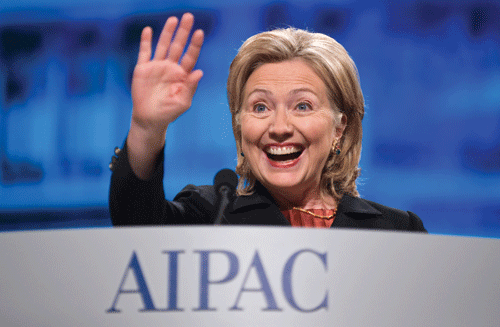
A member of the British lobby group “Labour Friends of Israel,” Blair today is the largely invisible envoy of the “Quartet on the Middle East.”  He was not the only celebrity invited by AIPAC, which advocates pro-Israel policies to the US Congress and executive branch and is widely regarded as one of the most powerful lobby groups circling the White House — a core of American politicians and some 130 evangelical leaders also gave acte de presence. Among them was US Secretary of State Hillary Clinton, who said: “Our commitment to Israel’s security and Israel’s future is rock solid.”

Note that this declaration of “rock solid” love came less than two weeks after Israel’s Interior Ministry announced the construction of 1,600 new illegal settler homes while US Vice President Joe Biden was on a mission to Israel to revive peace talks.

Clinton’s remark came only days after the emergence of 21 declassified documents from the Federal Bureau of Investigation (FBI) that bring the 1984 AIPAC spying scandal back into the limelight. The documents concern an FBI probe into the theft of a confidential report, which compromised the Reagan administration’s position in the 1984 negotiations over a US-Israel Free Trade Agreement (FTA).

The US International Trade Commission (ITC) had solicited data, under strict secrecy provisions, from US industries concerned about reducing tariffs on Israeli goods. They were compiled into a report called "The Probable Economic Effect of Providing Duty-Free Treatment.”

According to the FBI, AIPAC obtained the report and handed it over to a high-ranking Israeli diplomat. In 1985, the US signed a FTA with Israel. Ever since, the cumulative US trade deficit with Israel has soared to some $70 billion. It was not the only spying scandal concerning AIPAC.

In 2004, the FBI arrested Jonathan Pollard, who had handled the Iran dossier while working as a political analyst under Douglas Feith, former under secretary of defense for policy, and Paul Wolfowitz, former deputy secretary of defense. Both are well-known neoconservatives, while Feith is one of Washington’s most hard-line hawks regarding US foreign policy in the Middle East. Pollard handed more than one million classified documents to Steve Rosen and Keith Weissman, AIPAC’s former policy director and Iran analyst, respectively.

In this context, it is worth recalling that AIPAC was established as a spin-off of the American Zionist Council (AZC) in 1962, only six weeks after the US Justice Department ordered the AZC to register as an Israeli foreign agency. Today, AIPAC is the beating heart of a myriad of pro-Israeli organizations, individuals and think tanks, which comprise “The Israel Lobby.”

Political scientists John Mearsheimer and Stephen Walt, who can be credited for igniting the first public debate over the many troubles and travails of the lobby, wrote that AIPAC has an “almost unchallenged hold on US Congress.” It is no secret that political careers get a boost once AIPAC support is secured. Hence, the popular annual conferences and the recent AIPAC letter calling for an end to public criticism of Israel, which was signed by three quarters of the US House of Representatives.

But the Zionists may recently have been caught poking thorns in the side of their most powerful patron: the US Army. American military circles are increasingly aware that their country’s unconditional support for Israel’s regional belligerence is compromising American initiatives in the Muslim world, and endangering the lives of US soldiers in Iraq, Afghanistan and elsewhere. Should this perception spread through the halls of American power, it may be hard indeed for AIPAC’s silver tongue to keep its shine.

PETER SPEETJENS is a Beirut-based journalist

May 1, 2010 0 comments
0 FacebookTwitterPinterestEmail
Society

The new riddle

by Ayman Haddad May 1, 2010
written by Ayman Haddad

In the beginning there were three risks. Or at least that is how the pre-1970s corporate observers and academics saw it. Like many fields of science, the initial elegant simplicity was to prove deeper and more profound than those early pioneers of the field could first imagine.

The historical view of risk 

* Market risk observed that markets could fail without warning.

* Contingency risk revealed that risk lay in not having a robust and thorough enough strategic plan to engage in these markets regardless of their climate.

* Agency risk was, in days gone by, focused on the risk of a company’s management failing in its capability to deliver plans and steer a company to success.

That was the old model. More than 30 years later, it is time for a major rethink.

Leadership risk is now emerging as the most significant future management issue. The quality of a company’s leadership determines how well the company performs and how it is able to differentiate itself from the competition.

Yet, companies all over the world are finding it increasingly difficult to find good leadership talents. The types of challenges business leaders face have multiplied, the complexity of the issues has grown and broad global trends are adding variables to the equation.

In the next decade, three key “storms” are likely to come together to make the job of finding the right leadership talent tougher than ever before.

Storm 1: Population

The population of the planet has tripled in the last century to around 6.5 billion and is still growing. Projections suggest that it could hit 11 billion this century. Over 95 percent of this surge will, from now on, come from the developing world — particularly China and India.

It is expected that by 2050 the population of today’s ‘developed world’ will fall from 1.2 billion to less than a billion. The developing nations’ populations will double in this time, as will the global migration of temporary workers.

Today, China and India together account for a sixth of the global economy. By 2017 this will be a quarter, with India’s growth fuelled by education, languages and technology.

China’s  growth will be spurred by industry, resources and supply of labor. To meet their commercial needs for the next 10 years, they will together require more oil per year than Organization of Petroleum Exporting Countries has currently been able to produce each year-to-date. This level of growth requires vast resources, technical talent and knowledge.

But the real demand concern is executive talent.

China has said that to meet its business industrial needs for the next 10 years in the telecommunications and technology sectors, it must fill a deficit of nearly 70,000 executives, who will be drawn from abroad. Germany is declaring a 48,000 deficit in engineers and will also seek them from outside its borders.

This draw on talent is just one small influence on the next major source of concern: the aging population. In 2006 in the United States, two workers left the workforce for every one that entered. In short, the populations of the western world are becoming both smaller and older.

A recent Harvard Business review survey said that by 2011, 50 percent of the workforce of the western world will be over 50 years of age, rising to 80 percent by 2018.

Japan claims that by 2020, 65 percent of its financial services workers alone will be over 50. China expects that by 2050, 31 percent of workforce will be over 60 years old.

The European Union expects a work-force deficit ranging between 42 and 70 million people. The US estimates range from 32 million to 48 million. The peak will strike as the last of the baby-boomers hit 65 — the current legal retirement age in many countries.

Both regions cite solutions that include the ongoing employment of an otherwise retiring workforce, as well as significant sourcing of talent and leadership from fast developing nations. But developing nations, with their rapidly growing populations, are also in need of executive talent and will therefore have to take measures to retain domestic talent or look to the developed world to fill their requirements, thus compounding the issue.

With populations shrinking in the developed world, the work force of these nations will have to include employees above today’s accepted retirement age if there is to be sufficient support for the senior generations, which will outnumber the young.

Resetting the balance

Labor, talent and leadership will also need to come from more diverse sources. The mix of genders, ages, races, nationalities and languages is about to surge in the workplaces of developed nations.

The male-female balance is also likely to go up, and at older ages than before. A study by the International Labor Organization this year reported that 63 percent of women in the developed world are in employment today; 40 percent of them are in the global frontline workforce, while 34 percent are in management.

It also found that 25 percent of women in their 20s in Britain do not intend to have children until their 40s and 12 percent do not intend to have children at all. In Italy, a third of women in their 30s are in full-time work, but the birth-rate there fell from 2.6 in 1985 to 1.2 in 2005. Indeed, in the last 20 years, birth-rates in developed nations fell from 2.4 to 1.6, a trend that looks likely to continue.

Storm 2: Mobilization

Today, 200 million people live in countries they did not grow up in, as the laws that previously kept talent at home have become more relaxed. Fifty percent of Saudi Arabia’s 13 million citizens are under 18 and 65 percent of Iranians are under 25 — workforces in nations with declining oil reserves and, in Iran’s case, employment droughts. They will likely have to migrate.

It isn’t just international migration but intra-national as well: 120 million people have mobilized from rural to urban areas in China in the last 10 years. China is encouraging talent migration to enable learning and knowledge. In 2007, 50 percent of the planet was living in urban regions.

Storm 3: Multi-generation

So as the veterans hang on and the new generation becomes employed, we could see five generations in the workforce by 2013 of all races, genders, abilities, languages and wealth.

In October 2006, the World at Work consortium surveyed 487 organizations and over 3,000 workers around the world: 88 percent of respondents stated that the ongoing management of the multigenerational workforce was a major factor in a company’s growth and success.

A work force of diverse beliefs, cultures, skills and generations needs to be provided with the conditions in which it can succeed. We need to go back to the basics. We need to again talk to, listen to and engage with our people, like we used to.

The needs of multiple generations must be catered to, to sustain the number of employees required to service the much larger retiring population. We won’t be able to throw cash at this problem. With so few people to fill so many jobs, good wages for talent will be a given.

Thus, today’s system of cash reward will have to be bolstered by intrinsic incentives: in good times and bad, the most powerful means of attracting, engaging, developing and retaining top talent is to provide it with the conditions for it to succeed and feel successful, rewarded, valuable and influential.

It is this mindset we need to now understand again. Employee branding and employee equity is at its peak when well-led. Word of mouth spreads, and through this well-led organizations attract talent and earn loyalty.


May 1, 2010 0 comments
0 FacebookTwitterPinterestEmail
Economics & Policy

Movement for everyone

by Fares Saade May 1, 2010
written by Fares Saade

Fueled by demographic growth, urbanization and economic development, the cities of the Gulf Cooperation Council are growing at a rapid rate that is outpacing their current transport infrastructure and services.

The United Nations forecasts that 88 percent of the GCC will be urbanized by 2025, compared to a world average of 57 percent. What’s more, an increase in income levels will cause demand for mobility to outpace even the region’s rapid population growth.

So far, this surge in demand has been largely met by private vehicles and taxis, with public transportation accounting for less than 10 percent of all motorized trips. This approach has resulted in congestion, pollution and deteriorating road safety. It threatens to slow the growth of the region’s cities and undermine the quality of life for urban residents.

To address these challenges, authorities have been making massive investments in public transportation systems; regional governments have recently announced that they will pour a combined $26 billion into metro systems, trams and monorails. However, these investments alone will not change commuters’ habits and attract them away from cars and onto public transport. Other countries’ experience shows that careful policy formulation and planning are indispensable to the success of public transportation. For the car-dependent cities of the GCC, those lessons are particularly critical.

The path to public transport

Transport authorities must be realistic about how many people will actually use public transportation. With strong car cultures and populations spread over large areas, GCC cities will have to work hard to drag drivers out of their cars.

To reach even modest success, transport authorities must consider five critical steps. Although their implementation will vary by country, each serves a common goal: enhancing the attractiveness of public transport and dissuading individuals’ use of cars.

Focus on convenience: People will not use public transportation if it is not easy to do so, and thus public transport should first aim to be accessible. The recently opened Dubai Metro is a case in point: It is still working to reach a satisfactory and sustainable level of use with plans for “park and ride” facilities and better feeds from high-frequency bus services and taxis.

The cleanliness and comfort of stations and vehicles are also important in attracting riders from all socioeconomic brackets. Finally, fare levels and structures need to balance affordability for users with transport authorities’ goal of maximizing revenues. To offset the reduced convenience of public transportation, the cost of the trip to the customer — in both money and time — must be lower than the cost of the same trip using a car.

Integration: The easier it is for commuters to ride multiple modes — for instance, bus and metro lines — the more convenient public transport becomes.

There are two main levels of integration. The first one is at the station level; major interchange stations provide commuters with access to metro, tram, bus and taxi services. Metro stations in sparsely populated GCC cities would require strong feeders, such as buses and taxis. Fares and ticketing are the second level of integration: Allowing users to pay a single fare and use a single ticket for multiple modes is another element of convenience, particularly when the combined fare is lower than the sum of the fares on the different modes.

Smart card ticketing technology has now become the standard for many metros, as it offers users the added benefit of being able to use it for parking and various small purchases, such as newspapers and drinks.

Discourage car use: Disincentives for car use are probably the best way to encourage riders to use public transportation. Recent studies have shown that urban rail systems mostly attract riders who had previously been using the bus rather than those who had been driving — unless authorities impose severe restraints on the ownership and use of personal cars.

Such measures may include limiting car ownership (via sales taxes, import duties, and annual fees) and restricting car usage (via parking charges, congestion and road tolls, and fuel taxes). For GCC cities, the challenge is substantial. Taxing car ownership and fuel is likely to be contentious in an oil-producing region accustomed to low taxes and import duties.

The dynamic management of parking space and policies that charge for it would likely prove not only easier to implement but also be better targeted to specific congested areas of city centers. A number of cities, most notably in Saudi Arabia and the United Arab Emirates, have been moving in that direction recently.

Overall, in a region where very few people use the existing bus service, restricting car usage is inevitable if public transportation is to really take off. Measures can be gradually introduced over time as public transport becomes available and convenient.

Bring in the private sector: Private- sector involvement can offer a number of benefits to GCC cities in developing or operating modes of public transport.

u The greater efficiency that characterizes private-sector operation leads to reduced government spending on subsidies for urban transportation. Other countries’ experiences show that competition for operating franchises is the primary way to reduce subsidies.

* Public-private partnerships in infrastructure projects, such as rail transport and station development, alleviate the fiscal burden on governments and facilitate the projects’ execution. There is an increasing need for better financial management of these projects as GCC governments attempt to boost their reserves and ensure fiscal discipline, despite the oil boom of the last few years.


* Private operators tend to have the discipline and much-needed customer orientation to ensure high standards of service quality, reflected in service frequency, schedule suitability, maintenance, image and staff friendliness.

Create an enabling institutional and regulatory framework: Few of the above-mentioned policies and measures are possible without a solid and integrated framework for planning and regulation. Public accessibility, intermodal integration and disincentives for car use require well-integrated planning between the relevant government entities. Private-sector participation requires transparent and well-developed licensing, regulations and enforcement mechanisms. This is difficult in the current GCC institutional context, which remains largely fragmented and underdeveloped. Planning, regulation and enforcement responsibilities are often distributed among different uncoordinated entities with overlapping roles and responsibilities.

However, in the past few years, a growing number of countries have been establishing integrated transport authorities with a clear mandate for planning, regulating and enforcing all matters related to surface transport and traffic management. Not all countries may want to have a single entity; nonetheless, the allocation of responsibilities and the coordination mechanisms have to be well-established.

Public transportation may not be the sole remedy for the looming mobility challenges facing GCC cities, which demand a holistic approach that includes strategies for traffic management, non-motorized transport such as walking and cycling, and the integration of transport with land-use planning. But none of these strategies will dispense with the need to develop and promote the use of public transportation. Accordingly, following these vital steps to encourage public transport use will help public transportation reach its ultimate objectives.

FARES SAADE is a principal at Booz & Company

May 1, 2010 0 comments
0 FacebookTwitterPinterestEmail
Economics & Policy

Tallying tobacco

by Karah Byrns May 1, 2010
written by Karah Byrns

The proposed tobacco control law being mulled by the Lebanese Parliamentary Administration and Justice Committee has stirred debate between health-minded civil society activists, lobbyists from the tobacco and advertising industries keen to protect their commercial interests and a public skeptical of how serious the government is about enforcing any real tobacco control policy.

Arguments have covered not only health concerns but also Lebanon’s economy, asking whether or not the country can afford to lose the cash raised by the tobacco industry, specifically in the agricultural, hospitality and advertising sectors.

The controversial legislation would be surprisingly strict compared to the current law, calling for a ban on smoking in indoor public places including bars and restaurants, forbidding advertising of all tobacco-related products and insisting on pictorial warning labels on cigarette packs equivalent to 40 percent of the packaging size.

Proposed as a series of amendments to a draft law from 2006, this version revisits the country’s stance on tobacco following its commitment to the World Health Organization Framework Convention on Tobacco Control (FCTC), an international treaty that Lebanon signed in 2004 and ratified the next year. The FCTC arose as a global response to scientific data, albeit from the 1960s, which revealed the gravity of the health risks associated with tobacco use and is the treaty that prompted tobacco control legislation across the world.

Implementation of the draft tobacco control law would allow Lebanon to catch-up on its FCTC obligations, as the country has already missed the 2008 compliance deadline for implementing larger warning labels, the 2009 deadline to ban advertising and the 2010 target to ban smoking in indoor public places.

According to George Saade, program coordinator at the health ministry’s National Tobacco Control Program (NTCP), the tentative deadline for parliamentary approval of a national tobacco control policy is May 31, coincidentally “World No Tobacco Day.”

Smokey quantification

A study released last month by the American University of Beirut’s (AUB) Tobacco Control Research Group — authored by Jad Chaaban, Nadia Naamani and Nisreen Salti — has quantified a number of previously undocumented tobacco-related figures.

Cost of smoking as a percentage of GDP in Lebanon

For starters, the study reports that 40.3 percent of Lebanese are smokers. With cigarette consumption reaching an estimated rate of 12.4 packs per person per month, Lebanon also has one of the highest overall consumption rates in the world. The figure is three times that of Syria, and 12 times that of Singapore.

Looking at the overall benefits to the economy, the net revenue from tobacco is estimated at $271 million, taking into account tax revenues, subsidies to Lebanon’s 24,000 tobacco farmers, advertising, revenues from licensing and all other net gains for the government, international tobacco companies, distributors and retailers, and the Regie du Tabac et Tombacs — the state-run entity under the Ministry of Finance, which oversees Lebanon’s tobacco industry.

When evaluating overall costs to the economy, the sum includes health care costs, productivity loss, environmental costs due to forest fires and street waste clean-up, totaling $326.7 million, around 1.1 percent of Lebanon’s GDP. This figure is relatively high; in Egypt, where smoking prevalence is also high, the costs represent 0.7 percent of GDP.

The balance of tobacco’s revenue and costs leaves the country with a net loss of some $55.4 million. The real figure could be even higher since the study excluded costs related to regular exposure to second-hand smoke, as well as excluding many smoking related diseases due to a lack of sufficient data.

 “What is obvious is that Lebanon’s economy is losing money on smoking,” said Chaaban.

According to Public Health Researcher Jade Khalife at the Ministry of Health’s NTCP, international data strongly supports the economic assertion that employers will benefit from increased tobacco control in the form of improved employee productivity, reduced hiring costs and lower building maintenance costs. Khalife raised the example of Ireland, where smoke-free environments saved employers the equivalent of 1.1 to 1.7 percent of GDP.

In the hospitality sector, studies conducted in other countries generally show that banning smoking in indoor public places either does not affect, or actually increases, revenue for restaurants and bars. In Ireland, the first European country to ban smoking in enclosed workspaces in 2004, a study in the Irish Journal of Medical Science found that a year after the ban was enacted customer numbers in Dublin pubs had increased by 11 percent.

More recently in Turkey, hospitality sector revenue rose some 5 percent in 2009 following a public indoor ban. And in Lebanon, apart from the fact that the majority of Lebanese are non-smokers, a recent survey done by the NTCP underlined that restaurants could also see increased business from a ban, with 56 percent of Lebanese smokers reporting that they are bothered by smoke in restaurants, and 98 percent recognizing that second-hand smoke is harmful to them.

“In our bars and restaurants 60 to 70 percent of the people are smoking,” estimated Gemmayze Development Committee member Paddy Cochrane, who is coincidentally Irish-Lebanese. “After experiencing the ban in Ireland and being a non-smoker myself, I think it’s a fantastic idea, but as a bar owner, I’m not there to tell people what they can and cannot do. But if the government passes a law, it’s different.”

Although restaurants and bars would lose money made off of the promotion and sale of cigarettes in their venues, the impact is negligible, added Cochrane.

No more Marlboro man

The advertising sector also stands to lose from the proposed legislation. According to AUB’s study, tobacco advertising comprised 4.5 percent of total advertising spending in Lebanon in 2009, a figure roughly coinciding with an estimate of 4 percent provided by the President of the Lebanon Chapter of the International Advertising Association (IAA) George Jabbour. Research company IPSOS reported that tobacco advertising made up 1 percent ($7.2 million) of the total media advertising, excluding ‘below the line’ advertising, such as promotions, handouts and events – which the industry would rather see exempt from any ban.

According to Jabbour, advertisers need time adjust to the change. 

“We need a grace period. We have employees that we cannot just throw away. We need to restructure,” he said.

“No one is saying it should be stopped as a legislation. But we don’t want this legislation to just be propaganda. We don’t want the advertising industry to be the scapegoat,” said Jabour, concerned that ban or no ban, smokers will carry on regardless, leaving advertisers to carry the can.

Skeptics argue that smoking is as much a part of the local culture as general disregard for the law. In focus group studies conducted by the AUB Tobacco Control Research Group, even researchers in favor of the policy had to admit that the most frequent concern about the policy implementation cited by participants was the willingness of the general public to abide by a law, even if it passes. Last month NTCP’s Saade released a statement saying that fines for breaking the law may reach $663 for establishments and $33 for individual smokers. But who would implement this remains undetermined as yet.

More recently, a modification of the draft law regarding the public ban was introduced to provide exemptions for public establishments that make separate smoking and non-smoking areas. This move drew sharp criticism from the AUB Mechanical Engineering Department, which “strongly advises against any such exemption because it has been shown through numerous scientific studies that partitioning indoor spaces into smoking and non-smoking areas does not work, even when advanced ventilation and filtration technologies are used.”

A similar attempt to impose separated areas in Spain failed and the country is now considering a complete ban, after many establishments already invested in redesigning their businesses.

Applying policy… maybe

The AUB Tobacco Control Research Group also strongly warned that “multinational tobacco companies have consciously thwarted previous policy attempts to limit the reach of this harmful product… The industry should not be allowed to weaken tobacco control policy.”

While the NTCP estimates that 3,500 Lebanese die each year due to tobacco use, the public health aspects of the tobacco control law, and even the economic ones, have thus far been trumped by political interests in the halls of government. Lebanon’s three largest tobacco importers, Philip Morris, British American Tobacco and Japan International Tobacco, declined the opportunity to contribute to this article.

May 1, 2010 0 comments
0 FacebookTwitterPinterestEmail
Economics & Policy

Burning a hole

by Sami Halabi May 1, 2010
written by Sami Halabi

The Lebanese government has developed a habitual pattern of behavior in regards to progressive policy: the idea is lit with good intentions, smoked by vested interests and political squabbling, then forgotten like ash flicked away in the wind. When not tossed aside entirely, major policy initiatives are often simply relegated to an indefinite sentence in a bottom drawer somewhere in parliament.

There have been signs recently that government may be trying to curb this damaging addiction, however, in light of the tobacco control legislation currently being mulled by politicians.

The first puff

The draft law on tobacco control was first proposed in 2004 by Member of Parliament Atef Majdalni – who was also the acting chairman of the Public Health Parliamentary Committee at the time — as well as MPs Nasser Kandil, Ghattas Khoury and Ahmad Fatfat, only to find itself promptly shelved.

In March 2004 Lebanon signed, and later ratified, the World Health Organization (WHO) Framework Convention on Tobacco Control (FCTC). The country has since missed every deadline for the staged implementation of the convention, with none of its articles having yet been applied.

In 2006, under a new cabinet and parliament, another draft law was again submitted for consideration, a copy of which was obtained by Executive. This new draft was a diluted version of the first, removing clauses pertaining to testing tobacco before sale and confiscation of materials in contravention of the law, and limiting the authority of inspectors to implement the law.

According to the document, these amendments were made after consulting with the Regie Libanaise du Tabac et Tombacs (Regie) — the Lebanese government entity under the Ministry of Finance in charge of tobacco imports and exports and the licensing of farmers, wholesalers and retailers — as well as the syndicate of advertisers, syndicate of doctors and the Ministry of Public Health (MOPH). Even this watered-down version was shelved, however, as the country spiraled into conflict and political stalemate from 2006 to 2008.

Without the new legislation, Lebanon’s tobacco regulation is based on the six-article long Law 394, issued in 1995, which falls well short of the international obligations mandated in the FCTC. The current law states that health warnings should cover 15 percent of advertising media (print, outdoor, TV and cinema) and read: “The Ministry of Health warns: Smoking leads to serious and fatal diseases.”

Notably, it does not forbid the sale of tobacco to people under the age of 18, but bans handing out free samples to this age group.

Starting again

At the beginning of 2009, the draft law was still gathering dust in a government drawer. Executive’s investigation uncovered that the parliamentary Administration and Justice Committee of the previous government went back to the original 2004 legislation and began the entire amendment process over again – work which has continued under the Administration and Justice Committee of the current government. This amendment process includes “consulting and listening to opinions of stakeholders,” according to a source on the committee, who spoke on condition of anonymity.

Tobacco production by region in 2009 - Lebanon

These stakeholders include international tobacco companies whose lobbyists sit in on committee meetings — a fact confirmed by several sources close to the proceedings.  Lebanon’s three largest tobacco importers, Philip Morris International, British American Tobacco (BAT) and Japan Tobacco International declined the opportunity to contribute to this article.

“The tobacco lobby, like all the lobbies, will try to stop anything that might threaten their business,” says Yassine Jaber, a former minister of economics and trade and current MP in the Amal party.

George Jabbour, president of the International Advertising Agency’s Lebanon chapter, conceded that members of the advertising industry have also lobbied members of the committee, though he disagrees with the ethics of this.

“You cannot change the facts of life, and this is a fact of life,” said Jabbour. “Today, there is a trend and there are proven facts that cigarettes are not a good thing.”

The source on the committee said civil society groups who work on tobacco control issues were not invited to give their opinions.

They went on to explain that a sub-committee, under former minister and MP Samir al-Jisr, has been formed with the purpose of carrying out proceedings without the involvement of industry lobbyists. This sub-committee met twice in April in the presence of members of the Regie and the MOPH.

The absence of an official tobacco lobby at sub-committee meetings is, however, is a matter of switching hats: an international tobacco lobbyist, who asked not to be identified, confirmed that the Regie asked Jihane el-Murr, BAT’s head of corporate and regulatory affairs, to attend sub-committee sessions under the auspices of a “representative” of the tobacco industry, rather than a lobbyist.

The committee source confirmed that subcommittee negotiations are revolving around the details of the advertising ban, the definition of public space, fines on violators, forbidding sales to persons below 18 and the obvious display of cigarettes at retail points.

Tobacco taxation and smuggling

Notably absent from discussions is a hike in tobacco taxation, normally a cornerstone of tobacco control policy.

According to a Turkish international tobacco representative, when tobacco control legislation was introduced in Turkey — which had comparable smoking incidence to Lebanon — consumption dropped some 5 percent. However, when taxes were applied, the market saw a 20 percent fall in consumption.

The government could have, technically, proposed a budget this year including increased taxes on tobacco — it did not. The stated reasoning behind this decision, and the impetus to keep tobacco prices low, is the fear of increased smuggling across Lebanon’s porous borders.

“England, a developed country surrounded by water, has a tobacco market of which 30 percent is supplied through smuggling,” said Mohamad Daher, head of the Regie’s anti-smuggling unit. “What about us, whose sea, land and air borders are completely open? How much smuggling do you think we have?”

In the late 1990s then-Prime Minister Salim el-Hoss spearheaded a raise in the tobacco tax. Smuggling soared and the government lost revenue, forcing Hoss to backtrack on the measure. However, another official present at subcommittee meetings, who also spoke on condition of anonymity, attributed the increase in smuggling to Syrian control over Lebanon’s borders at the time, as well as politicians’ protection of smuggling rackets.

The Regie is the only body in Lebanon authorized to license wholesalers and retailers. Presently, there are around 490 licensed wholesalers in Lebanon, who must pay the Regie $10,000 for a license, prove that they have a place to store merchandise and open their books up for spot inspections, according to Khalil Dugan, legal advisor to Regie Chairman Nasif Siklawi.

But as far as licensing retailers goes, nothing has been done for decades. “Because the amounts are small, [the government] deems them negligible,” says Daher. “If you are going to chase people for one or two cartons then you need 1,000 men, and they don’t exist. If you see cigarettes at smeneihs [stores licensed to sell only food], all those cigarettes are smuggled.” Daher’s unit consists of up to 50 inspectors for all of Lebanon.

Farming fear

The combination of increased smuggling and a decrease in consumption would no doubt have widespread economic, health and social effects on Lebanon. But there is one sector in society that stands to lose out more than anyone else.

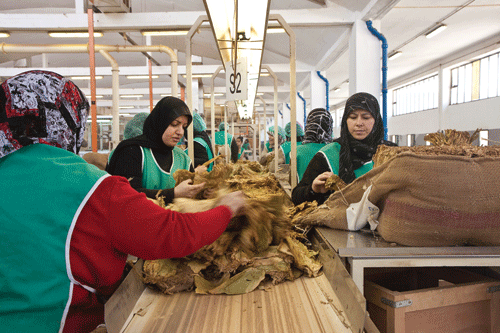
According to the Regie, Lebanon currently has 24,000 licensed tobacco farmers spread throughout the country, some 57 percent of whom are located in the south. Farmers receive a subsidized set rate for their crops through the Regie’s ’Price Support Program,’ depending on the quality and type of tobacco they grow.

The price farmers are paid, however, has not changed for 15 years according to MP Jaber, whose electoral support in the south stems from many of those same farmers. At present, farmers in the south and the Bekaa Valley receive an average of $7.46 and $6.04 per kilogram, respectively, for the same type of tobacco, according to the Regie. Farmers in the north produce another type of tobacco used in the nargile, or water pipe, and are paid an average price $6.04 per kilogram.

The total amount paid out to farmers last year was $52.6 million, according to the Regie, an increase of 3 percent on 2008, with the south counting for 61 percent of production last year. Total production of tobacco in Lebanon last year reached some 7.7 tons.

According to the World Bank, on the international market the average price per metric ton of tobacco is $3,500, meaning that the Regie lost some $3,330 per metric ton of tobacco it sold last year, totaling losses of some $25.6 million.

The tobacco bought by the Regie is sold on to international tobacco companies according to a barter system, whereby international tobacco companies buy a share of Lebanon’s tobacco output equal to that of their present market share.

The arrangement constitutes a net loss for the Regie, which still manages to be a profitable organization through money funneled to it from the finance ministry and other activities, including the sale of the local Cedars brand, which is produced at its headquarters in Haddath using Lebanese tobacco.

Meanwhile, the government raked in around $189 million in tobacco tax revenue in 2008, according to the latest data from the World Bank and Lebanese Customs.

Money ain’t everything

While the arrangement is a monetary loss for Lebanon, it does serve several functions that are socioeconomic and political in nature. Farmers are ensured a fixed and steady income, allowing them to stay on their land. This prevents further migration to Lebanon’s cities, which are already struggling to provide infrastructure for urban living.

To boot, this arrangement helps the main political parties in the south — Amal and Hezbollah — to provide for their key constituents, both keeping the parties in power and maintaining a population base near to the border to stand against Lebanon’s main military threat — Israel.

“In the south our role was more important during the [Israeli] occupation, and even now it is still important,” said a high-ranking member of the Regie, on condition of anonymity.

In a bargain that is renewed annually, international tobacco companies have, for years, enjoyed secure access to the Lebanese market by buying the country’s relatively low-quality tobacco. Marwan Iskandar, economist and managing director of MI Associates, and several other sources who spoke off the record, said that the companies actually discard a portion of this tobacco due to its poor quality.

“In the north we are planting something that does not have a place in the international market,” said the source at the Regie. “We are trying to sell it to the countries that do not know tobacco well.”

The source added that Lebanon used to lose some 500 percent on sales of northern tobacco, though current losses are between 200 and 300 percent. Abdul Mawla el-Mawla, tobacco technology manager at the Regie who is also responsible for buying and selling all of Lebanon’s tobacco, denies that the tobacco is still being discarded, as he claims quality has increased over the years to a level that “has become acceptable” to international companies.

But if tobacco legislation is enacted and consumption decreases, as is expected, a domino effect may occur.

“The international companies will tell me that ‘you are not selling as much for us,’” says Mawla, implying they will change the arrangement. “If my revenues fall, who is going to take Lebanese tobacco? What do I do with the farmers?”

Irrigation irritation

Amal MP Jaber, who holds a parliamentary seat allocated to the Nabatiye district, says he doesn’t see the link between tobacco legislation and his constituents’ livelihoods. He is, however, aware that the situation cannot continue forever. “Nobody in the south of the country is fond of planting tobacco. Tobacco is the most difficult type of crop you can ever dream of; the whole family works 7 days a week to make it,” he says. “Farmers hate the whole system of [growing] tobacco, they hate the way they have to work so hard and how they are humiliated by having to wait in [long] lines when they sell their crops to the Regie.”

According to the World Bank, the average labor days per hectare needed to cultivate tobacco in Lebanon is 610, as opposed to 25 for cereals and 242 for fruits and vegetables.

The bank also estimates that tobacco constitutes a third of household revenue for tobacco farmers, with around 40 percent of them working off-farm and 23 percent rotating tobacco with other crops such as chickpeas and fava beans. “Why do people [in the South] choose tobacco? Because they have no alternative,” says Jaber. Tobacco is a ‘dry plant’, which means it is rain fed and does not require irrigation, an asset currently lacking in much of South Lebanon.

What is vexing about the situation is that there are solutions and the legal infrastructure to facilitate them is already in place. In 1950’s, the government created the Litani River Authority (LRA), mandated to enact projects along the river and around the region. Later, Law 221 — entitled the Water Authority Law — was passed. Its implementation decrees gave the LRA the mandate to irrigate 42 percent of Lebanon, including all of the south and southern Bekaa, not to mention supplying 7 to 10 percent of the country’s electricity through hydropower and providing potable water to 20 percent of the population.

Apparently, the government had other priorities. “If we calculate over the years how much money we have paid to subsidize the planting of tobacco, we could have done the Litani river project five times over,” says Jaber. “Unfortunately, there has not been a sense of responsibility…”

Environmental experts have begun working with the government on proposals to expand the Litani river projects and Jaber added that after receiving $50 million in funding from Kuwait, “we are halfway there.” Whether it will take another 60 years to make it the rest of the way remains to be seen.

In principal, everyone agrees

All the stakeholders Executive interviewed for this article said they were in favor of enacting the proposed tobacco control law, but its actual application will be another issue.

“We are with stopping smoking, and sections for smokers, and all of the elements of the law, and with a complete awareness program; but we have to be realistic. There are people who are addicted,” said Mawla, who advocates having a grace period to implement the law, as do members of the advertising and hospitality sectors.

Rima Nakkash, assistant research professor at the faculty of health sciences and coordinator of AUB’s Tobacco Research Group believes that a grace period will only allow for piecemeal reforms and give stakeholders the chance to dilly dally around the law and maintain the status quo.

With or without the grace period, if the proposed tobacco control legislation is passed without being neutered by amendments, smoking rates and tobacco consumption will undoubtedly decrease in the mid to long term.

“By that time we will have finished the Litani River project,” said Jaber. “God willing, by that time we won’t need to have tobacco plants.”

May 1, 2010 0 comments
0 FacebookTwitterPinterestEmail
Real Estate

Development disorder

by Nada Nohra May 1, 2010
written by Nada Nohra

It has been 20 years since the end of the war, but we still haven’t seriously started reconstructing the country,” said Serge Yazigi, head of the Majal urban observatory, part of the urban planning institute of Académie Libanaise des Beaux-Arts at Balamand University.

Beirut may be in the midst of a construction boom, but the lack of a coherent, concerted vision of how Lebanon’s capital should look,  function and grow leaves urban planners like Yazigi shaking their heads in dismay.

Cities the world over face the challenge of rapidly urbanizing populations, particularly in developing countries, which often lack a strategy or effective policy to direct their growth down a sustainable path. In the case of Beirut, this problem has been compounded by an almost unmatched exposure to devastating conflict.

Low standards of living in the city’s numerous “informal settlements,” rocketing property prices, the absence of public transport, traffic congestion, environmental degradation and rampant construction are all serious challenges facing Beirut.

Yet thus far, no government body has shown the muscle to impose an urban plan to address these issues and ensure the city’s sustainable growth.

Informal settlements

Some of the first informal settlements sprang up in Beirut in the late 1940s as Palestinians fled Israeli aggression, with new ones forming over the years as people sought to escape rural poverty, Israeli invasions and civil war. Over time, areas around the capital that had at first acted as temporary sanctuaries for refugees became their permanent residences.

Today these areas host low-income urbanites who, decades ago, built homes there illegally and therefore do not pay taxes.

A recent study by Mona Fawaz, assistant professor in the graduate programs of urban planning and urban design at the American University of Beirut, said that the Hayy El Selloum area, located in the southern suburbs of Beirut, is the largest informal settlement in the city with a population of 100,000 people. Other informal settlements around Beirut include Zatriyyeh, Rouwaysat, Ouzaai and Al Raml Al Ali. The most recent numbers from the United Nations Human Settlements Program (UN-Habitat) stated that in 2005, 53.1 percent of Lebanon’s urban population lived in slums or informal settlements.

Fawaz said inflation in the real estate market has effectively made it impossible for people living in informal settlements to move to other parts of the city, making these ever more densely populated. The need for people to reside near their workplace has also prevented many from moving to other areas, due to the lack of adequate public transport.

“These people have nowhere else to go so they are adding floors. What you are ending up with is a complete deterioration of these neighborhoods that are so congested they are impossible to live in,” said Fawaz.

Many informal settlements, due to their illegality, do not receive basic services from the government. Nancy Hilal, urban planner at UN-Habitat said that these communities often form their own committees through which they raise money to build local sewage systems and other necessary services. Out of 12 settlements in a UN study, only two officially received electricity from the national power company — others receive it through a variety of means such as private generators and political influence to divert the electrical grid. 

The government has done little or nothing to upgrade living standards in these areas or help residents move to better locations.

The one attempt it did make after the Civil War was the establishment of Elyssar, a public agency for the planning and development of the south western suburbs of Beirut: home to some 500,000 inhabitants living in informal settlements, according to a UN-Habitat.

The project was supposed to include more than 10,000 affordable housing units, 1,000 shops, some 100,000 square meters of light manufacturing, parks, warehousing and workshop centers, as well as basic infrastructure.

“It was the first time the government got involved in urban planning,” said Hilal. “However… planning is very political. This is why it is not being implemented.”

Elie Sawma, president of the Building Promoters Federation of Lebanon, said that his organization was pushing the government to reactivate the Elyssar project, which would decrease pressure in the real estate market by boosting supply. Sawma added that the price per square meter would be between $2,000 and $2,500 — lower than other areas in Beirut but significantly higher than the informal settlements, which would most likely defeat their purpose.

High prices on middle incomes

Middle class Beirutis are feeling the heat of the city’s red-hot real estate market, as local, expat and foreign demand causes prices to balloon. By law, foreigners are allowed to own only 10 percent of any one district in Beirut. A recent Al Iktissad Wal Aamal study showed that foreigners owned 6.52 percent of the capital, including properties purchased by Lebanese on behalf of foreigners, or properties purchased by local companies that are foreign-owned.

Inflation has hit all market segments with prices on lower-end properties in Beirut having risen some 120 percent on average since 2005, and 150 percent on higher-end homes, according to Ramco real estate advisors.

Urban planners Executive spoke with said the Lebanese authorities should help to control prices and encourage affordable housing in a city filled with ever-more high-rise luxury towers.

“We should keep it as a free market but some limitations need to be put in, like forbidding speculation or a jump in prices,” said Majal’s Yazigi, noting that these initiatives should be part of a specific urban plan which governs the construction and expansion of the city.

“Each country deals with the increases in prices in different ways, but all developed countries in Europe have a policy which fights the increase in land prices,” said Mohamed Fawaz, head of the Directorate General of Urbanism (DGU) between 1974 and 1993.

Public transport

Increased urbanization, a lack of public transport and among the highest per capita car-ownership rates in the world, are escalating Beirut’s traffic congestion, parking shortages and pollution from car emissions.

 “We are losing a tremendous amount of time to go from one place to another. [The congestion] is decreasing our attractiveness to tourists and affecting our health,” said Yazigi.

According to a study by advertising agency Pikasso, 65.2 percent of households in Beirut own a car and use it as their most frequent mode of transport. 

Mohamed Fawaz said that since the first meeting of Metropolis (World Association of the Major Metropolises) in 1985 – in which he took part as the head of the DGU – it is a commonly accepted fact that private cars cannot solve transportation and traffic issues in cities.

“However, this ‘conviction’ has not yet reached Lebanon,” he said.

Transportation means currently available include taxis, shared taxis, buses, or private minivans. Beirut needs 700 buses to provide efficient public transportation, said Mohamed Fawaz.

“Our city hasn’t provided a quarter of that number,” he remarked.

The World Bank initiated a $204 million “Urban Transport Development Project” at the start of 2009 to help provide Beirut with traffic management, parking improvement programs and training for police.

Though this program has improved traffic circulation and increased available parking, authorities have yet to set out a comprehensive public transport strategy, which Fawaz said should incorporate rail trams.

Mona Fawaz also related the lack of public transport to the housing situation, as high real estate prices force out lower-income earners, concentrating them in low-rent areas, which curbs the city’s natural growth.

“Public transportation and networks should be created in order to allow for this city to grow, for those who cannot afford municipal Beirut to be able to live somewhere where they can commute using a public network,” she said.

Do we have a plan?

In July 2009, the government approved the “National Physical Master Plan for the Lebanese Territory” —  a study concluded in 2005 by the Council of Development and Reconstruction (CDR), the DGU and L’Institut d’aménagement et d’urbanisme de d’Île-de-France.

Experts laud the plan as a step toward achieving sustainable planning; the problem is that it does not include specific instruments for implementation.

“The planning instruments and the related institutional setup are almost non-existent in Lebanon and the cooperation between the institutions that are involved in planning is absent,” said Dania Rifai, Habitat program manager at UN-Habitat. “[Therefore urban] planning is restricted to construction permits.”

Role of DGU

Lebanon’s urban planning law dates back to 1983 (Law number 69), which gives the public authorities (the DGU) the power to regulate the built environment and infrastructure in Lebanon. The DGU was also given the authority to set population densities in different areas, forbid construction that might negatively affect the surrounding area, protect the environment and order the acquisition of land for public purposes, among other things. 

“However all its decisions have no value unless they are approved by the cabinet, and that is the disaster here in Lebanon,” said former DGU head Mohamed Fawaz. Consequently, the DGU’s powers are have been limited by political impasse.

The DGU was meant to have an active role in post-2006 war reconstruction, with the power to intervene in planning and preserve historic areas in line with social values. “However, financial limitations and political entanglements came in the way of their ability to play an effective role in the process,” said Mona Fawaz in her UN report ‘The Reconstruction of Lebanon after 2006.’

The DGU also offers technical assistance to municipalities that lack urban planning departments. The only municipalities with urban planning departments are Beirut and Tripoli, according to Mohammed Fawaz.

Municipalities are also involved in the urban planning process, since the head of the municipality must sign all construction licenses – except in Beirut, where the governor signs them.

Mohamed Fawaz pointed out, however, that license approval at the municipal level usually focuses exclusively on whether building specifications abide by the law, but do not consider criteria such as how sympathetic the project will be to its surroundings.

Often it is simply beyond the municipalities’ capacity to use anything but strictly legal criteria to assess license applications, as most lack the human, technical and financial resources.

Survival mode

The DGU is not playing the essential role it should be in ensuring sustainable development in Lebanon, and other government agencies lack adequate resources. 

Yazigi pointed out that urban planning in Beirut is still in “survival mode.”

“Instead of trying to anticipate the problems to come, all our energy is lost on solving as much of the current ones as we can — we need to identify a vision and reinforce the state power in order to implement [it],” he said. “If there had been a plan [since the civil war ended], we could have preserved more heritage and more identity. We could have enhanced tourism, investment attractiveness and… inhabitants’ quality of life.”

May 1, 2010 2 comments
0 FacebookTwitterPinterestEmail
Real Estate

Resurrecting the Dahieh

by Nathanael Massey May 1, 2010
written by Nathanael Massey

Over the course of July and August 2006, Israeli air strikes pounded Beirut’s southern suburb of Haret Hreik, pulverizing infrastructure and forcing many of the quarter’s residents to flee.

Four years later the rubble has been cleared, clusters of new structures dot the landscape and life has returned, albeit to a soundtrack of seemingly ceaseless construction.

The architects behind this effort are not shy about asserting that the resurrection of this section of the Dahieh has been swift and efficient.   

“In the beginning, we asked the people of the Dahieh who they wanted to rebuild for them,” said Hassan Jeshi, chief executive officer of the Waad reconstruction project. “At the time 70 percent opted for us. By the time we had completed our preparations and established the project as a viable entity, the 30 percent who abstained had decreased to 3 percent.”

The project’s recipe for success: a massive bankroll, timely delivery and an open channel for public input. Waad — meaning ‘promise’ — was launched in mid-2007 under the authority of Jihad al Binaa, the construction arm of Hezbollah.

Since then, Waad, a non-profit organization, has rebuilt 95 of the 245 buildings destroyed during the Israeli bombardment, with the remainder currently in the later stages of construction. Another 200 completely new buildings are slated for completion by the end of 2010. By Waad’s estimation, the reconstruction is roughly 64 percent complete, and the project aims to finish its work by mid-2011.

To say that Waad restored the Dahieh to its former glory would be overly romantic. The suburb is crowded and chaotic; with 800,000 residents, according to Waad, it is home to just under a quarter of Lebanon’s population and boasts little infrastructure beyond the basic amenities of housing, commercial centers and basic public services.

Yet it has resuscitated the area, and in a country where the urban aesthetics change lot by lot, the project has consciously created a cohesive, overarching identity within the scope of its work.

“When we first started planning, we wanted to make major changes, move buildings, create parks,” said Jeshi. “But the people refused — they wanted to return to their neighborhoods as they were.”

Instead, the project took a subtler approach to urban planning, planting trees, adding subterranean parking lots and standardizing the facades of the reconstructed buildings, which feature double walls for noise reduction and energy conservation, earthquake resistant architecture and safety features such as fire suppressants and electrical grounding.

“These things did not exist in the Dahieh before,” said Jeshi. “In most of the country they still do not exist.”

Waad comprises architects, designers, academics, local authorities and members of the public. Members from these groups work as a consultative body overseeing the reconstruction, and were initially responsible for conceiving a set of guidelines — detailing safety specifications, aesthetic considerations and improvements to the overall area.

Accordingly, contractors submit all plans to the committee for review before they are passed to Waad’s own architects for final approval.

The Dahieh reconstruction project is billed at $400 million. The Lebanese government is responsible for roughly 30 percent of that sum, $180 million, but has so far only delivered 60 percent of its promised compensation, according to Waad. Jihad al Binaa has picked up the rest of the bill.

“The reconstruction is an answer to [the Israeli] challenge,” said Jeshi. “It exists to improve the resisting soul within the people, so that they will be with the Resistance more – without owing favors to anybody, but with their dignity and their heads held high.”

May 1, 2010 0 comments
0 FacebookTwitterPinterestEmail
Economics & Policy

Regional equity markets

by Executive Editors April 9, 2010
written by Executive Editors

Beirut SE  (One month)

Current year high: 1,200.49    Current year low: 715.49

>  Review period: Closed: March 26 – 1,119.09        Period change: 3%

The Lebanese bourse was in the volume shadows, with average daily trade values of $2.3 million in March — significantly below the turnover figures in the first two months of 2010. The MSCI Lebanon Index closed at 1,119.09 points on March 26, reflecting a gain of 3% versus the February 28 close. For the first quarter to date, the index return was a paltry 0.3%. This contrasts unfavorably with the MSCI Arabian Markets Index, whose 11.5% increase in the period from Jan 1 to Mar 26 even exceeded the gains of the Saudi Stock Exchange’s TASI.  

Amman SE  (One month)

Current year high: 2,968.77    Current year low: 2,396.28

> Review period: Closed: March 25 – 2,446.34        Period change: -0.2% 

The Amman Stock Exchange found itself at an uncomfortable distance to the positive trends exuded by regional peer markets. The close at 2,446.34 points on March 25 gave the ASE general index a minute 0.2% drop when compared with the February 28 close, but a slide at the end of the review period also means that the ASE is the only MENA bourse to end the first quarter in the red, down 3.4% year-to-date. Sub-indices for services and insurance provided bright spots on the index charts in March but the more influential industrial and banking sub-indices underperformed.

Abu Dhabi SM  (One month)

Current year high: 3,239.74    Current year low: 2,441.28

> Review period: Closed: March 25 – 2,903.92        Period change: 7.4%

The Abu Dhabi Stock Exchange baked in a balmy light that had its origins as much in the gains of the Dubai Financial Market as, ultimately, in Abu Dhabi’s financial supportiveness for Dubai’s temporary tightness last December. The banking sector did nicely with a gain of 8.6%, but this increase paled against the recovery performance of real estate stocks, where the sector index rallied 19.95% in the course of 20 sessions. The top performing ADX stock, however, was International Fish Farming Holding Co, leaping 38.2%.

Dubai FM  (One month)

Current year high: 2,373.37    Current year low: 1,533.36

> Review period: Closed: March 25 – 1,845.21        Period change: 15.8%

As if it wanted to deliver a message on the advantages of acting contrary to the horde behavior in stock markets, the Dubai Financial Market was full of optimism  in March, after the predictable state and national affirmation of debt commitments related to the Dubai dream’s funding essence. Utilities tanked 21% as real estate rose 28.5%.  bold enough to purchase Emaar shares at the pessimistic bottom on Dec 9, 2009 and selling on Mar 25, would have seen an enjoyable gain of 59%.

Kuwait SE  (One month)

Current year high: 8,371.10    Current year low: 6,391.50

> Review period: Closed: March 25 – 7,489.80        Period change: 1.5%

Banking and food provided the growth impetus on the sector side, while insurance was a negative outlier. Amidst other insurance stocks trading in moderate ranges, First Takaful Insurance Company crashed an extraordinary 45% in only two trades of 120,000 and 30,000 shares in the past 30 days. While still 1,700 points away from its 12-month high, the KSE is now the second-best share price performer in the GCC for the year to date, trending to a first-quarter gain of 6.9%.

Saudi Arabia SE  (One month)

Current year high: 6,801.64    Current year low: 4,632.51

> Review period: Closed: March 24 – 6,756.98        Period change: 5%

Thanks to appreciating 5% in the review period, the SSE could claim the distinction of being the region’s first market that achieved a double-digit gain in 2010 and was up 10.4% for the year to date. Construction, petrochemical and industrial sectors led the rally in March. Sub-indices of sectors that moved lower since the last close in February were insurance, media and multi-investment. The market close on March 24 represented an 18-month high.

Muscat SM  (One month)

Current year high: 6,813.20    Current year low: 4,575.99

> Review period: Closed: March 25 – 6,779.20        Period change: 1.3%

The Muscat Securities Market closed at 6,779.20 points on March 25, representing a 1.3% gain from the last close in February. Banking was the best performing sector index. As the MSM in late March breached the 6,700 points level for the third time in the past 12 months, bourse metaphysicists may have been motivated to test their insights about the psychological import of the 7,000 points barrier. For market participants with an earthly orientation on share price performance, it may have been more inspiring to note that the MSM index has been inching toward the 7% gain for the year to date.

Bahrain SE  (One month)

Current year high: 1,681.28    Current year low: 1,413.28

> Review period: Close: March 25 – 1,528.46          Period change: 0.7%

With the island kingdom’s vigorous PR campaigns focusing on Bahrain’s pole position for doing business in eastern Saudi Arabia, and with the remaining global attention span consumed by the Ferrari F1 desert win spectacle, the Bahrain Stock Exchange was the relative underperformer in the March 2010 GCC stock price race.  Banking and insurance provided the positive highlights. Ahli United Bank was the star performer in March, climbing 10.2%. The BSE first-quarter gain margin, while a respectable 4.8%, was underperformed only by the DFM.

Doha SM  (One month)

Current year high: 7,624.45    Current year low: 4,810.00

> Review period: Closed: March 25 – 7,413.76         Period change: 7.9%

From a perspective that performance stability and equality ought to be a GCC markets good, the Qatar Exchange was very fortunate in March. That gain lifted the year-to-date performance of the QSE to 6.5% – out of the red and into a happy first-quarter performance trinity with the Omani and Kuwaiti exchanges. All QSE sector indices followed the uptrend in March, although banking and services excelled among them. The single scrip to suffer a double-digit weakening in the March review period was the Qatar Cinema and Film Distribution Co. 

Tunis SE  (One month)

Current year high: 4,743.05    Current year low: 3,080.88

> Review period: Closed: March 26 – 4,693.45        Period change: 0.4% 

The leveling of performance by the Tunisian bourse’s Tunindex continued in March and the index close of 4,693.45 points on Mar 26 represented a gain of 0.4% from the last close in February. On a quarterly basis, however, the TSE’s impressive year-to-date gain of 9.4% has been eclipsed only by the SSE. Real estate developers Simpar, which jumped 52%, Attijari Leasing Co (24.6%), and insurer STAR (17.2%), were the other top gainers in March. In April, the initial public offering of insurer Tunis Re can be expected to create a buzz and draw interest to the market.

Casablanca SE  (One month)

Current year high: 11,729.86  Current year low: 9,997.56

> Review period: Closed: March 26 – 11,228.49      Period change: 1.2% 

Real estate firm CGI was top performance dog with a gain of 18.8% in the review period; paper maker Papelera de Tetuan was the underdog with a 14% share price weakening. Against the general assumption that the future of the Moroccan exchange resides in a substantial increase in the number of listed stocks, an unconfirmed media report on March 27 said the Groupe ONA conglomerate and its largest shareholder, SNI, plan to merge into a single holding company and delist.  

Egypt CASE  (One month)

Current year high: 7,249.55    Current year low: 3,193.94

> Review period: Closed: March 28 – 6,765.26        Period change: 2% 

Volatility of 23% in the Feb 28 to Mar 25, 2010 review period and a feeble 2% gain  stained the Egyptian Stock Exchange’s first quarter performance — even as the EGX’s overall first quarter gain of 9% remains nothing to scoff at. Losers outnumbered gainers in March and of the three market cap leaders, only Orascom Construction had a good share price performance, up 11.3% in the review period. Telecoms heavies OTH and TE dropped 5.5% and 11.7%, respectively.

April 9, 2010 0 comments
0 FacebookTwitterPinterestEmail
Economics & Policy

For your information

by Executive Editors April 9, 2010
written by Executive Editors

Public Debt grows though defect slows

The latest figures on Lebanon’s gross public debt as Executive went to print, showed an increase of 1.1 percent in January to $51.6 billion, according to Byblos Bank. The figure is a 9.9 percent increase compared to the same period in 2009. Domestic debt also increased some 16.6 percent this year, compared to January 2009, totaling almost $30.4 billion, with foreign debt increasing just 1.5 percent to $21.3 billion over the same period. Local currency debt accounted for 3.4 percent more of the gross public debt than it did at the end of January 2009, at 58.8 percent, signaling a continuing trend toward denominating debt in local currency, which makes it easier for the government to mitigate currency fluctuation concerns. Other promising fiscal signs emerged in January when the fiscal deficit for the month reached $17.7 million compared to the $300 million posted a year earlier. Debt servicing also decreased 26 percent year-on-year to $212.5 million in January, making up 27.6 percent of total expenditures during the month. Lebanon also scored a primary surplus of $201.2 million in January compared to a deficit of $7 million in the same month last year.

Banks propose NDIC buy-out

The Association of Banks in Lebanon have floated the idea of buying the Lebanese government’s share of the partly state-owned National Deposit Insurance Corporation (NDIC) for around half a billion dollars. The NDIC is half government owned, with the other half belonging to commercial banks. In theory, the government is supposed to inject $50 million a year into the corporation but has not paid its dues since 1996, making it liable for some $700 million dollars. The proposal would exempt the government from its dues and result in the banks paying $550 million to acquire the entity this year. The banks will pay the government a further $150 million in the coming two years, while the banks would continue to manage the operations of the NDIC along with the Banque du Liban, Lebanon’s central bank. The proposal would require the law covering the NDIC to be modified or a new law to be passed. 

Son of Lebanon tops Forbes rich list

Forbes has released its annual list of the world’s billionaires, 12 of whom were Lebanese or of Lebanese origin. Topping the list  with a fortune of $53.5 billion was Mexican Carlos Slim, whose father is Lebanese. Coming in at 64th richest person in the world, worth $10 billion, is Brazilian Joseph Safra, whose family originated from Aleppo, Syria, before moving to Beirut after World War II. The list also showed that Bahaa Hariri, the older brother of Lebanon’s Prime Minister, was $100 million richer than the previous listing with a fortune of $3 billion. Bahaa Hariri was followed by former Prime Minister Najib Mikati and his brother Taha who each had a net worth of $2.5 billion. Lebanon’s Prime Minister Saad Hariri also increased his personal fortune, with an estimated $1.9 billion fortune to his name, up from $1.4 billion in the previous rankings.

Policy quagmire to slow economic potential in 2010

Barclays Capital has indicated that Lebanon’s gross domestic product will likely grow 6 percent in 2010. The investment bank stated that real GDP growth in 2009 was more than 8 percent and attributed the slowdown to a fall in consumption. Barclays also expected a rise in both public and private investment to help spur the economy. The bank expects inflation to hit 4 percent this year on the back of higher oil prices and a possible increase in value added tax. Capital inflows are expected to remain steady while remittances are expected to climb. As such, Barclays expects that the current account deficit will be trimmed from 9.1 percent in 2009 to 8.6 percent in 2010.  The banking sector is also expected to do well but will fall relative to last year, with deposit growth projections coming in at 15 percent over the course of 2010 compared to more than 20 percent growth in 2009, according to the bank. Barclays also indicated that the toughest challenges for Lebanon’s economy would be the ability of its policy makers to enact reforms to begin to deal with fiscal problems, which it reckons will see the deficit widen to 11 percent of GDP from around 9 percent last year. It also predicted that the debt-to-GDP ratio would remain constant at 154 percent, due to the lack of reforms at the state-owned Electricité du Liban maintaining its weight on government finances. 

Up or down, take you pick of inflation statistics

According to the Consultation and Research Institute (CRI), a private consulting firm, February saw real prices in Lebanon deflate. Throughout the month, the consumer price index (CPI), the premier indicator of inflation, fell 0.26 percent relative to January. However, according to the Central Administration for Statistics (CAS), Lebanon’s official body for the collection of economic data, the CPI in February 2010 rose 0.5 percent relative to January, carried by increases in the price of transportation (14.6 percent), housing (6.1 percent) as well as water, electricity, gas and “other fuels” at 5.5 percent. Yearly inflation also differed widely between the two organizations with CRI estimating that year-on-year prices in February showed an increase of 6.08 percent with a 12-month CPI moving average of 3.17 percent, while the CAS recorded a CPI rise of only 2.9 percent. According to Byblos Bank, 70 percent of Lebanon’s inflation is caused by the increased price of imports.

Energy Ministry plans EDL reform

Figures from the finance ministry have stated that in 2009, Lebanon spent $1.5 billion on the state-owned Electricité du Liban (EDL), with 94.4 percent being spent on fuel oil and natural gas to generate electricity.  The total amount of transfers to EDL in 2009 were 7.1 percent lower than in 2008, due to a decrease in both debt servicing (-18.1 percent) and reimbursements (-6.3 percent). Most of the decrease was attributed to a fall in oil prices last year compared to all of 2008. Gas oil expenditure in 2009 increased 26 percent while fuel oil decreased by 1 percent relative to 2008, signaling the beginning of a shift toward cheaper gas-based power generation. EDL expenditures also constituted 20.4 percent of primary government expenditures in 2009, 4.8 percent lower than in 2008. Lebanon’s energy minster has also proposed a 10-point plan to reform the energy sector in Lebanon. The plan proposes providing short-term power solutions to cover for the upcoming summer season when electricity consumption peaks, rehabilitating old power plants in the medium-term, preparing a plan to allow independent producers to generate 5,000 megawatts of power by 2015, diversifying energy resources by shifting to liquid and natural gas plants and employing renewable energy, expanding the energy transport network, improving distribution and collection, installing remote counters and restructuring tariffs. A committee was also formed at the ministry to resolve outstanding issues between EDL and electricity concessionaires.

Tourism sector set for further growth in 2010

The World Travel and Tourism Council (WTTC), a global travel and tourism industry forum, has estimated that tourism in Lebanon will directly contribute 13.3 percent of gross domestic product over the course of this year. The council stated that $4.39 billion in revenue would be generated through tourism, with direct industry employment accounting for some 199,000 jobs and constituting 13.7 percent of total employment in 2010. The WTTC also indicated that indirect contributions to the Lebanese economy coming from tourism would constitute 37.6 percent of economic activity and generate some $12.39 billion. According to the WTTC, Lebanon is currently globally ranked 13th in terms of the share of travel and tourism employment in the country’s job market, but ranks 42nd in terms of expected real employment growth in the sector over the next 10 years. Last month, Lebanon’s tourism minister also stated that the sector would grow by 10 to 20 percent this year, and reassured the public that there would not be a war with Israel.

April 9, 2010 0 comments
0 FacebookTwitterPinterestEmail
Economics & Policy

Running out of steam

by Sami Halabi April 4, 2010
written by Sami Halabi

Of the five pillars of Islam, making the pilgrimage to Mecca was perhaps the most testing for those who lived in the time before planes and cars. Each bodily able Muslim who sought to enter heaven would trek through the sands of the Arabian Peninsula by camel caravan, braving the scorching summer sun or the freezing winter nights; from Damascus, this pilgrimage could take two months.  Then, in 1864, at the height of the Ottoman Empire, the Arab world’s Turkish masters proposed a grand idea. A waqf, or sacred Islamic donation, would be opened to all Muslims of the world to fund the Hejaz Railway, which would extend from Damascus to Mecca and allow travelers to make the trip in four days, and for less than 10 percent of the price.  Fast-forward to today, and the thoughts of current Arab rulers are on the same track as their northern predecessors. The Gulf Cooperation Council has decided that they will build a joint railway to link their countries. While the advantages of such a scheme would be enormous, especially in the commercial sense as the project is envisioned to be a cargo route first and a passenger route second, deciding that something should be done and actually doing it are proving to be very different matters.

Hard to decide

Planning for the railway began to gain steam in 2004, when the GCC Technical Committee’s (GCCTC) transport department, the body overseeing the project at the regional level, commissioned a preliminary study carried out by the American firm Parksons Brinkerhoff and the Kuwait-based Global Investment House. The study eventually proposed two routes for the project. The first would have run from Kuwait through Saudi Arabia to Bahrain, connect to Qatar via a new bridge over the water, then reach the United Arab Emirates and Oman. The second route ran from Kuwait to Oman overland and through Saudi Arabia and the Emirates, with a connecting track to Qatar and Bahrain; the latter plan eventually won out. 

In February 2007, a consortium led by Systra of France, Khatib and Alami of Lebanon and Canrail of Canada was asked to perform a feasibility study covering topographical and statistical data, integration, financing and development options, legal models, as well as passenger and freight configurations.

The study, described as an “economic feasibility study” by a source who is part of the consortium and spoke on condition of anonymity, did not cover the potential problems that could ensue from the fact that every nation, which would be designing, funding, and implementing their own part of the project, also had the right to change specifications in its own territory.

“It was the case that the design would be done under the supervision of the GCC, but now the countries are seeking to design their own respective projects,” says Ibrahim al-Sbeiteh, director of transport at the GCCTC.

This is not the only issue that has led some to question the project’s feasibility.

“The multiple delays that we are seeing right now in the GCC rail network are probably also due to some liquidity problems that are down to the [financial] crisis,” says Philippe Dauba-Pantanacce, senior economist on the Middle East and North Africa at Standard Chartered investment bank.

The freedom to delay

Unlike the Ottomans, who had the luxury of administrative control over the entire area of the Hejaz, the authority of each country over their segment of track and the fractious nature of GCC decision making has made progress less than steady. Since the feasibility study was completed and approved by the GCC in December 2008, little headway has been made and divisions have begun to appear in other areas.

For example, the Gulf countries have still not implemented the common customs union that was agreed in 2003. Meanwhile, the prospect of a GCC monetary union that has been in the works for more than a decade was dealt a severe blow last year when the UAE decided to pull out, ostensibly angered when the council decided to host the Gulf central bank in Riyadh instead of the Emirates. Oman decided not to commit back in 2006.

“As we have seen in the GCC monetary union project, there are a lot of political hurdles within the GCC that constitute barriers to progress in these projects,” says Dauba-Pantanacce.

So, if track record is anything to go by, the planned completion time of 2017 may be little more than a chimera. The source on the consortium said the current completion date in 2017 would be pushed back. Construction was slated to start this year, but the project is still in the engineering design phase and, according to Zawya, companies are only expected to be prequalified for contracts this September, with detailed design contracts to be awarded in December during the GCC summit in Abu Dhabi. 

The devil is in the details

In order for detailed design contracts to be awarded however, each country will still have to decide on the route that the track will take through their respective territories. Except for Saudi Arabia, which has already started its own national railway development, GCC states have yet to define the parameters of their respective railway segments.

A further cause of concern is the status of the world’s longest marine causeway between Bahrain and Qatar, which is jointly funded by both nations. In June, Reuters reported that the 40-kilometer, $3 billion project had been suspended “amid escalating costs and increased political tension,” with a sizable portion of that extra cost due to the decision to fit the causeway with a railway as part of the GCC common rail project.

The report was later denied by the assistant undersecretary for financial affairs at Bahrain’s Ministry of Finance and chairman of the Qatar-Bahrain Causeway Foundation, but such complications do little to inspire confidence.

Diesel or gas: fuelling the divide

Because the railway was envisioned as more of a freight project than a passenger one, the speed and volume at which goods can be moved through countries is of utmost importance to the eventual linkage and completion of the project.

According to the consortium source, the $25 billion estimated cost was based on a diesel powered standard speed across the railway. But the newest proposals by Qatar and Oman to opt for an electric line could throw a spanner in the works and bring the project back to the drawing board.

The shift is significant because of several factors. Despite sitting on some 23 percent of the world’s know gas reserves, the GCC, with the exception of Qatar, is facing a gas shortage due to rising demand primarily associated with power generation. Qatar opting to run an electric train is precisely the kind of wildcard that could see the project’s financial and technical scope become increasingly more complex to implement, not to mention the political tensions such a move would stoke.

“They [GCC nations] will have some difficult tasks to resolve, mainly on the processes, the support, the interoperability, and potentially on investment priorities. Interoperability will be the most important thing to agree on, at the GCC level,” says Ulrich Koegler, partner and member of the leadership team for Booz & Company’s Middle East transport and infrastructure practice.

“If you don’t have interoperability, at the end of the day you have truncated networks,” adds Koegler.

That prospect would also entail some costly fixes in order to accommodate a common network that meshes with individual country needs. Ostensibly, the reason Qatar and Oman need electric trains is because they are more interested than the other countries in the high speed passenger oriented options that such trains offer.

GCC rail map

The economic feasibility study which was approved by the GCC was prepared on the basis of a speed of 200 kilometers per hour, which is around about the maximum speed possible with a diesel-powered train. Anything above that will require electric power. And the faster you go, the more you pay. 

Speed or strength

The hitch is that ‘double stacking’ — the rail industry term for having two containers stacked on top of each other as opposed to one — is not possible on electric trains. Since the project was only deemed viable because of its economic advantages relating to freight, the use of electric trains throws the entire economic feasibility of the project into question.

Possible solutions to this issue include switching trains and containers at stations, or building separate tracks to accommodate for high-speed electric trains that would be used for passenger transport; the former would add significantly to time spent passing between stations on opposite sides of a border, while the latter would entail considerably higher costs. “The most important thing for us at the GCC project is that the specifications are the same and the timing is agreed upon — that’s all,” says Sbeiteh. “The tendency now is that the GCC line will be diesel with the exception of Oman and Qatar. The Qataris are envisioning that they will need another track for diesel.” The increased expense of the double-track plan could cause total costs to mushroom and threaten the overall scheme’s completion.

“Do we want to first put more money in a common railway system instead of, for instance, diversifying our economy?” asks Standard Chartered’s Dauba-Pantanacce.

Paying for it all

Ultimately, without a concrete cost figure, governments in the region will be hard pressed to allocate large amounts of money to projects that are contingent on others doing the same, though if the regional railway is to work at all, they will have to do just that.

“Rail is a massive investment and you will find very few companies willing to fund it, even if there is a subsidy or [service] availability model over many years because the amount of uncertainly… is transferred to the private sector,” says Fares Saade, principal with Booz & Company and member of their transport, engineering, and services practice.

The liquidity situation is also not homogenous across the region. Saudi Arabia is still flush with liquidity and knows that it will have to put up the lion’s share of the cash, according to Koegler.

Foreign funds

Countries with tighter liquidity conditions, such as the UAE, may consider offers such as the one made in June by the International and Commercial Bank of China, in conjunction with Beijing’s railways ministry, to offer financing, export credit and advisory services to the UAE. It now seems likely that they may use this option, as the UAE National Transport Authority and the Chinese government signed a memorandum of understanding to develop technical and regulatory aspects of the country’s railway in May.

Qatar has also signed a joint venture with Deutsche Bahn International to form the Qatar Railways Development Company (QRDC), which boasts initial capital holdings of $25 billion and constitutes the largest offshore commercial deal for the German railway giant. The Qatari government will own 51 percent of the company through Qatari Diar.

Kuwait seems to be the only country in the region that will opt for public-private partnership (PPP) arrangements, after starting an office to begin tending for such projects, says Koegler. “A rail system will have low or negative returns if you don’t take the socioeconomic benefits into account; and of course private players cannot play on socioeconomic benefits,” he concludes.

Then there is always the option of another waqf, but unlike the Ottoman attempt to fund its rail, this one might carry interest.

“If they don’t finance it through a direct injection of money and they go through issuing bonds, I think that would be creatively the most appropriate way to do it,” says Dauba-Pantanacce. “Having longer-term bonds in line with long-term cash generation projects like a railway is the most sound, recognized and applied methodology that we have seen elsewhere.”

Getting people to use it

Even if the technical, financial and political hurdles are overcome, the challenge of getting people out of their cars and onto the train will be a formidable one. Today, the only piece of mass overland transit in the GCC, the Dubai Metro, is still eerily empty for most of the day.

“There will definitely be a cultural reluctance from the local population to heavily use public transportation to make a long distance trip [of] more than two hours, because they have not been used to that,” predicts Dauba-Pantanacce.

Without the religious allure of the Hejaz railway’s final destination (which it never reached, getting only as far as Medina), a passenger element to the GCC railway will be little more than a convenient ‘add-on’ to the cargo element. But like the Hejaz, time and money will be the defining factor of how successful the project is.

It took the Turks and the rest of the Muslim world 44 years to build their most famous railway. The question is: how long will it take the Arabs to agree to do the same?

April 4, 2010 0 comments
0 FacebookTwitterPinterestEmail
  • 1
  • …
  • 420
  • 421
  • 422
  • 423
  • 424
  • …
  • 682

Latest Cover

About us

Since its first edition emerged on the newsstands in 1999, Executive Magazine has been dedicated to providing its readers with the most up-to-date local and regional business news. Executive is a monthly business magazine that offers readers in-depth analyses on the Lebanese world of commerce, covering all the major sectors – from banking, finance, and insurance to technology, tourism, hospitality, media, and retail.

  • Donate
  • Our Purpose
  • Contact Us

Sign up for our newsletter

    • Facebook
    • Twitter
    • Instagram
    • Linkedin
    • Youtube
    Executive Magazine
    • ISSUES
      • Current Issue
      • Past issues
    • BUSINESS
    • ECONOMICS & POLICY
    • OPINION
    • SPECIAL REPORTS
    • EXECUTIVE TALKS
    • MOVEMENTS
      • Change the image
      • Cannes lions
      • Transparency & accountability
      • ECONOMIC ROADMAP
      • Say No to Corruption
      • The Lebanon media development initiative
      • LPSN Policy Asks
      • Advocating the preservation of deposits
    • JOIN US
      • Join our movement
      • Attend our events
      • Receive updates
      • Connect with us
    • DONATE