• Donate
  • Our Purpose
  • Contact Us
Executive Magazine
  • ISSUES
    • Current Issue
    • Past issues
  • BUSINESS
  • ECONOMICS & POLICY
  • OPINION
  • SPECIAL REPORTS
  • EXECUTIVE TALKS
  • MOVEMENTS
    • Change the image
    • Cannes lions
    • Transparency & accountability
    • ECONOMIC ROADMAP
    • Say No to Corruption
    • The Lebanon media development initiative
    • LPSN Policy Asks
    • Advocating the preservation of deposits
  • JOIN US
    • Join our movement
    • Attend our events
    • Receive updates
    • Connect with us
  • DONATE
Consumer Society

Micro machines

by Executive Editors May 3, 2010
written by Executive Editors

The Anthony Bonja Fortress watch has a look to match its name. With a thick steel casing held together by six hefty screws and a weighty leather strap, it’s the kind of timepiece you would want on your wrist when facing down an angry bear or a brutish boss. It exudes an aura of solid self-confidence in a way only $5,000 concentrated in four square centimeters of stainless steel can. But inside, there is an entirely different matter at hand — or in this case, on hand.

As a mechanical watch, the Fortress is powered by a system of gears and springs so delicate and so precise that their dimensions and alignment must be measured to the micrometer. It’s this balance of aesthetic sophistication and technical precision that makes a luxury watch, but Anthony Bonja, like the dozens of Middle Eastern brands offering luxury watch lines, is only responsible for half of the equation.

The company is a jeweler, not a watchmaker. The mechanical aspects of its watches — called the “movements” or “ébauches” — are purchased outside of the region, the fruit of a niche market of specialized producers. 

“To the best of my knowledge, all manufacturing of movements used by Arab luxury watch brands occurs outside of the Middle East,” said Susan Maroua, public relations manager at Tabbah Jewelry. “This structure isn’t unique to the Middle East either — it’s the norm for most of the industry.” Companies that produce their own in-house movements — like Rolex, Zenith and Jaeger LaCoultre — and sell to other private groups “are exceptions,” according to Maroua.

Step by step

The majority of the watch making industry is structured ‘horizontally,’ according to the Fédération de l’Industrie Horlogère Suisse (FH) — the association of Swiss watch makers — meaning that any given watch passes through several companies or technicians, each of whom is responsible for a different step in its development, before it reaches the showroom.

“As a luxury jewelry line, we work in participation with a number of specialists to produce our watches,” explained Stephan de Palmas, regional director for Van Cleef & Arpels in the Middle East. “Our company will develop a concept and send its specifications to one of the manufacturers we work with – Jaeger LaCoultre, for example – which will produce and send us the disassembled movement. The movement is then sent to another specialized technician who adds complications [mechanics that run off the movement] that will, say, cause a couple to meet and kiss on a tiny bridge every twelfth hour, or show the cycles of the moon.”

“Finally, when the watch’s mechanical aspects are fully assembled, it returns to our workshops to be decorated and jeweled, and from there goes to our retailers to be sold,” he said.

Regional markets

On the receiving end, Middle Eastern states are among the top importers of luxury watch movements globally. According to the FH, the United Arab Emirates is the 9th largest importer in the world, with Saudi Arabia, Lebanon and Bahrain not far behind.  Taken on a per-capita basis, the Middle East accounts for nearly as many watch sales as some of the world’s largest markets in Japan, Europe or the United States, and the region’s segment seems to be growing.

Middle Eastern markets, along with heavyweights China and India, played a major role in pulling the luxury watch industry out of its 2009 slump, and international retailers are increasing their regional foothold as a result.

“Dior is up this year 6 percent,” said Jacob Hrayki, regional manager for Dior. “I believe retailers are in a more confident position this year, investing better in their stocks and mainly in their strategic brands.”

FH estimates that Swiss watchmakers exported some 2.1 million watches and 35,000 movements, worth a combined $1 billion, to the Middle East in 2009. That constituted a decrease of 22 percent from 2008 sales, which is a testament to the difficulty the industry faced that year. However, sales have picked up sharply in the first months of 2010, with regional sales of Swiss watches and movements increasing by nearly 40 percent in January and February.

As Swiss as cheese with holes in it

Although Japan, Russia and Germany produce and export a portion of the markets’ movements for use in luxury watches, Switzerland is still the industry’s silverback gorilla.

The alpine state exported $12.3 billion worth of watch related products in 2009, while its closest competitor, Hong Kong, achieved sales of only $5.6 billion.

Much of the country’s own industry is dominated by a single company, ETA SA, a wholly owned subsidiary of The Swatch Group, which supplies the movements used by the majority of mid-range luxury watch brands made in the Middle East.

However, that partnership is slated to end in the very near future. In 2003 ETA announced that it would end all sales of movements to makers not allied with the Swatch group by 2006, prompting a panic among smaller makers and driving sales as makers rushed to build up their reserves in anticipation of the closure.

“There was no innovation, no new development, and when I pushed them to start new production, everybody started shouting,” Nicolas Hayek, the chief executive officer of Swatch, said at the time. “I said I was not going to deliver any more of my movements unless they try to do their own production. Otherwise the Swiss watch industry… will go down.”

Following protests by smaller makers, the company was investigated by the Swiss Competition Commission and found guilty of abusing its dominant market position.

During the settlement period, ETA agreed to push its export closure date back to the end of 2010 while engaging in a slower “phasing out” of its movements from the market. By the end of this year, however, Middle Eastern jewelers along with other makers around the world will need to look for new sources to furnish their machinations.

The alpine state exported $12.3 billion worth of watch related products in 2009, while its closest competition, Hong Kong, achieved sales of only $5.6 billion

May 3, 2010 0 comments
0 FacebookTwitterPinterestEmail
Editorial

Leave us alone

by Yasser Akkaoui May 1, 2010
written by Yasser Akkaoui

Even the piecemeal tax increases contained in the Lebanese Ministry of Finance’s 2010 budget proposal are insulting. The private sector and the expatriate community — the two entities that keep the Lebanese economy alive and the government afloat — can’t help but feel that they’re being forced to give more blood to the leeches of the state and still receive nothing in return.

For example, in some countries taxes on cigarettes help cover healthcare costs. In Lebanon, taxes are what the Ministry of Finance, through the Regie Libanaise du Tabac et Tombacs, uses to pay tobacco farmers for their crop, at times registering up to a 500 percent loss. This is insane.

Such complaints are not just the moaning of the wealthy. This is a reaction to the crude policies of a government that, under pressure from donor nations to get its fiscal house in order, will further burden those who already carry it, instead of attempting to lighten the load through measures that are simple common sense.

Lebanon is neither a classic laissez-faire economy that lets businesses run wild and free — it is too corrupt for that — nor is it a typical welfare state which provides education, healthcare and housing for its citizens. Quite simply, it falls between the two stools and instead of seeking to remedy the failings in its national infrastructure and behave like a mature government, it takes the easy route and taxes those whose economic health is predicated on unfettered economic activity. 

For years now, Lebanon has prided itself on its fiscal wisdom, boasting that it is this prudence that has kept it from ‘pulling’ an Argentina or a Greece. But that our politicians even talk in those comparisons — that yes, we are looking over the cliff, but no, where others have fallen we will keep our balance — is a testament to their fiscal ineptitude.

The private sector cannot be held responsible for this colossal waste. Should government one day become transparent and accountable, and show it has spent the money we already gave wisely and efficiently, then we could talk about, perhaps, paying more into government coffers.    

But that day is a long way off. Until then, quite simply, the private sector should be left well alone. We, the private sector, have kept Lebanon afloat for over 50 years. Let us work; let us employ; let us create; let us spur consumption.

Let us be.

May 1, 2010 0 comments
0 FacebookTwitterPinterestEmail
Finance

Back to the real

by Emma Cosgrove May 1, 2010
written by Emma Cosgrove

Credit Agricole Suisse is the main private banking arm of Credit Agricole Group, with Middle East offices in Abu Dhabi, Bahrain, Beirut, Doha and Dubai. Executive recently sat down with Frederic Lamotte, the bank’s chief investment officer, to discuss how private banking has changed in the last two years.

E  How did you manage to keep your clients during the crisis?

First, the structure of the bank is very solid and the name itself has helped retain some clients. Second, I would say that from more of an investment point of view, we had the insight of not pushing our clients into risky products.

We have always had a, not conservative, but relatively safe approach to investment. We never had any Lehman products; we never thought that Lehman or other United States investment banks were adequate for supporting investment products for our clients. We never proposed structured credit products to our clients.

In general, we never had [to worry about the Lehman crash, the ensuing ‘credit crunch’ or Bernard Madoff’s Ponzi scheme debacle] because someone stood up in the line and said they didn’t understand, or didn’t believe [in them], or that something had not been sufficiently explained, and so we didn’t market [high risk, complex] products to our clients.

This meant we never had any problems of that nature to deal with, which I think kept us from losing some clients.

On the contrary, we have gained many clients who had these bad experiences with other banks in terms of investments.

I think we have basically the same total assets as we had before the crisis: roughly $50 billion if you take the whole Credit Agricole Suisse group.

E  Today’s client really wants assurance. What type of reassurance on the level of corporate governance can be communicated to the client?

First of all, we belong to a large banking group and as such we have several layers of compliance issues locally in Switzerland, but also wherever we are operating. For example: we have a branch in Singapore, which has to follow the local rules in Singapore.

Because we belong to a French bank we have to follow some French rules and since we are incorporated in Switzerland, we also comply with the Swiss law. So we have three layers of rules that we must follow.

It puts a lag on various angles of the asset management process, but it does give reassurance to our clients.

As for the decision making process, we have investment committees every two weeks and we have designed our investment committees a bit differently after the last two years because we recognized that in some instances we wanted to acquire the specific knowledge of a specialist to best exploit some asset classes.

I will take the example of commodities. Two years ago we decided to start investing in commodities. We started with gold and had a very good experience and made a lot of money for our clients. But it was not enough. We wanted to really learn more about the investment process on commodities.

So we partnered with a company called Diapason, which is actually a Swiss company managing around $11 billion in assets in commodities, and we asked them to participate in our investment committee. This has been extremely successful because we recognized that we were not specialists in this market, so we were happy to share with somebody who is a professional in the field. But they are not managing the money for us. We manage together and that allows us to learn about the process and to be able to explain to our client why a decision was taken.

Selling funds to clients in the past was equivalent to taking their money and giving it to a third party to manage without really controlling what it was doing. This model has reached its limit because we could not completely control how the money was managed, which was difficult to explain to our clients.

The second conclusion we drew from the crisis was that we had to show our clients the exact risk [their portfolio was exposed to].  To do that, we designed a special investment fund, which is an umbrella fund where we have 29 different compartments [for different types of assets]. The client is able to see exactly and in real time how the fund is composed.

This is backed by a portfolio guardian who does not report to me, he reports to the risk control division. And the portfolio guardian makes sure that nothing in the portfolio starts to diverge from the [risk] profile [of the client]. I think this is quite an important change that we have put in over the last two years.

E On an investment level, how did the crisis change the conditions you put on the managers of hedge funds?

Hedge funds is an industry where we have been lately investing. It was fortunate. It’s a product for large investors — very large investors. It’s also a product where the approach of institutional investors and private investors is very different. The concept was developed, as diversified, low risk and liquid — exactly what private clients want.

But actually we’ve seen it’s not very low risk, sometimes it’s not very safe and sometimes it’s absolutely not liquid. When you look at the alternative investment space today you can see that institutional investors did not come out of hedge funds. The only ones who came out were private investors because they heard a marching call somewhere else, so the alternative problem came because of liquidity issues with private clients.

A lot of products sold to private customers were funds of funds, where you delegate to a third party and they go and delegate again to somebody else. It’s a double black box when risk is rising globally in the market. We sold 35 percent of our alternative investments in March 2008. I should have said: “Sell 100 percent.”

Now we’ve changed the way we approach alternative investment completely. First of all, we only go back to large investors [those who can invest $10 million into a single product]. Our new scheme on alternative investment is a direct investment in hedge funds exclusively through managed accounts. This approach ensures a high level of liquidity.

E  How did the crisis change the offers that Credit Agricole makes to clients?

On the investment front, the crisis has brought back the idea of going back to more of what I call real assets. Collateralized debt obligations were pure financial mental constructions; you didn’t know what was behind them. You had to dig so much and understand the correlation issues, which is a very complex issue for normal people. So the idea is to go back to real assets, such as commodities. We are very bullish at this point in time on industrial metals and precious metals. They are real assets that have the capacity to store value independently of which currency you use to measure its value. It’s a storage of value.

Second is real estate: we are defining a new offer on real estate. At the moment we are advocating London, because sterling is low and the prices of London real estate on the office side have gone down drastically. So we think there is a niche. And we are proposing to our clients a very concentrated risk. We tell them to invest there. We can show them the buildings. It’s not like we give you global stuff. We concentrate the risk. We show them the exact asset.

Third, I think what is very important about the real asset is to include corporations. And to that extent private equity, I think, is a real asset. When you own a share, not the listed shares, but a private share of a company who has a product or a service, this is a real asset. So for us private equity is part of the real asset panel, which we promote to our clients.

May 1, 2010 0 comments
0 FacebookTwitterPinterestEmail
Comment

Iraq’s recount stew

by Ranj Alaaldin May 1, 2010
written by Ranj Alaaldin

Iraq continues to be embroiled in its messy post-election coalition building process. Domestic rhetoric and behind-the-scenes dealings have been supplemented with visits to regional neighbors, with every man and group naming their price for compromise and cooperation. As expected, this process will likely take longer than the optimistic one to two-month timeline predicted by Iraqi officials, particularly since Iraq’s electoral commission ordered a manual recount of the votes cast in Baghdad province on April 19.

The recount came after complaints from the incumbent Prime Minister Nouri al-Maliki of the Islamic Dawa Party and his State of Law coalition. Ordered by a special elections court, the recount covers 68 seats in the 325-seat parliament and could alter the final result of the poll; especially since Maliki came a close second behind the victor, Ayad Allawi and his Iraqi National Movement (INM), with 89 seats to Allawi’s 91.

Since the March 7 vote, both the INM and State of Law have been courting smaller political blocs and parties in attempts to garner a majority of seats for the purposes of forming a government. Maliki alleges the electronic system of vote counting was unreliable, and any ruling could have a number of implications.

Firstly, many will ask what difference it makes to Maliki since Iraq’s Supreme Court has ruled that it is the largest post-election parliamentary alliance, rather than the largest vote winner in the election, that can form the next government. But a recount that changes the result in Maliki’s favor gives the prime minister a strengthened hand in his push to retain the premiership and have his State of Law coalition lead the next government.

As the largest bloc, State of Law (and indeed Maliki) would redeem the prestige it lost when INM was declared the largest single bloc after the elections, and in such a position State of Law could be more willing to negotiate with INM; that is, Maliki would rather have Allawi and INM play second-fiddle to him (as runners up) than the other way around. Maliki has also recently witnessed internal problems within Dawa itself, with reports suggesting that specific factions within the grouping oppose another Maliki premiership. A recount in Maliki’s favor constitutes a political boost and may temper the tongues of his critics.

The extent to which the recount ruling will adversely impact Iraq’s political process will depend on Allawi’s own reactions to it. The former Iraqi premier has previously contested the jurisdiction and legitimacy of Iraq’s institutions, such as the supreme court, and it will be interesting to see how his coalition will react to any detrimental outcome the recount may bring. What could be dangerous is any subsequent perception on Iraq’s streets that this is yet another attempt to sideline the Sunni voice in politics by Shiite powers, which dominate post-2003 Iraq’s institutions and domestic affairs.

Allawi has indeed warned of pressure that may be brought to bear upon Iraq’s electoral entities, but there is yet to be any significant suggestion that they have succumbed, given that Iraq’s electoral commission, the Independent Higher Electoral Commission (IHEC), refused Maliki’s earlier calls for a manual, nationwide recount.

The United States will be wishing for stability as it prepares to withdraw all combat troops by the end of August, as part of its wider withdrawal plan (recently confirmed as being on schedule by the top US commander in Iraq General Ray Odierno), which should see the US military out of Iraq by the end of 2011. However, uncertainty may already be proving conducive to terrorism, with a series of bombings claiming more than 80 lives in the past month alone.

Of course, a recount may not change anything or even benefit State of Law. Iraqis may welcome the recount if it actually legitimizes the results, even if it does delay the political process, particularly if they trust the voting process driven by IHEC. Many will, however, be concerned about any changes it provides, since Iraq’s political entities are all too capable of just about everything and anything. Both Maliki and Allawi could contest the outcome if it goes against them; Maliki in particular could push for his earlier calls for a recount in other provinces in addition to Baghdad, while Allawi may continue to call into question any potential wavering of Iraq’s electoral entities.

RANJ ALAALDIN is a scholar on Iraq and is published regularly in The Guardian

May 1, 2010 0 comments
0 FacebookTwitterPinterestEmail
Comment

Scudsupmtions

by Nicholas Blanford May 1, 2010
written by Nicholas Blanford

Watching the development of the story concerning Hezbollah and Scud missiles has been an object lesson in how speculation can be spun into established fact. I first heard the rumor from sources in Washington about three weeks before the story was broken in Kuwait’s Al Rai Al Aam. The newspaper essentially claimed that Syria had transferred Scud rockets to Hezbollah. Israel, it continued, had come close to bombing an arms convoy, but deferred at the last moment due to American promises to diplomatically push the issue with the Syrians.

The Al Rai Al Aam piece was followed a day later by a larger story in The Wall Street Journal, which covered much of the same ground but included confirmation on the Scud transfer from an American source.

Yet for all the fuss it has generated, details of the alleged transfer are unclear and have become mired in conflicting intelligence information, and Israeli officials have been uncharacteristically reticent in discussing the allegations. It remains unknown which variety of Scud is alleged to have been transferred, whether the rockets have entered Lebanon, whether they remain in Syria but in Hezbollah’s hands, or whether Hezbollah personnel have been trained on the systems only. Syria’s most advanced Scud is believed to be the Scud D, a Syrian-manufactured copy of a North Korean version of the original Russian rocket.

Even the American State Department hesitated to confirm the allegation in an otherwise strongly-worded statement regarding how the number two at the Syrian embassy in Washington had been summoned for a finger-wagging interview-without-coffee. The next day, the State Department admitted it was unsure that the Scuds had been delivered to Hezbollah in the first place.

Nonetheless, though no evidence has been provided, one can be sure that six months from now it will have become an accepted fact that Hezbollah has Scud rockets.

It is true that since the end of the 34-day war with Israel in 2006, Hezbollah has sought to bolster its arsenal with larger rocket systems with increased range and, crucially, fitted with guidance systems allowing it to strike strategic targets in Israel, such as military bases, airfields and industrial sites in the event of another conflict.

Military analysts believe that Hezbollah has received the M600 rocket, thought to be a Syrian clone of the Iranian Fateh-110, which can carry a 500-kilogram warhead 250 kilometers, far enough for Hezbollah to hit Tel Aviv from its camouflaged bases in the northern Bekaa Valley.

Yet, the acquisition of Scud rockets would present a formidable logistical challenge to Hezbollah, including smuggling the 13.5 meter rocket — almost double the length of the M600 — across the Lebanon-Syria border, which, with numerous countries’ intelligence agencies keeping an eye on who or what passes through, is one of the most closely scrutinized frontiers in the world.

Given the capabilities of the M600, it is unclear why Hezbollah would seek to augment its arsenal with the high-signature Scud. The Syrian Scud D variant has a range almost three times that of the M600 but the size of the warhead is the same and the additional range may not be an important requirement for Hezbollah, given the new emphasis on accuracy and the comparative lack of strategic targets south of Tel Aviv.

An additional drawback for Hezbollah is that the Scud is liquid-fuelled, which complicates handling, storage, deployment and firing compared to the solid-fuel rockets in its arsenal. Solid fuelled rockets require no lengthy preparation process and can be launched quickly, a key requisite for Hezbollah, which is ever wary of Israel’s aerial dominance. The Scud, however, requires fuelling just prior to launching, which can take 45 minutes even in ideal conditions, let alone in a war. The propellants used are highly toxic and have to be stored and handled by trained operators.

Unlike Hezbollah’s other rockets, which can be fired from jerry-rigged launchers, Scuds are launched from specially-designed vehicles called Transporter-Erector-Launchers (TEL). Bringing these into Lebanon undetected would pose no small challenge for Hezbollah. All in all, if I was Hezbollah’s armaments procurement officer and someone offered me Scuds, I think I would be inclined to say, “Thanks, but no thanks.”

NICHOLAS BLANDFORD is the Beirut-based correspondent for The Christian Science Monitor, The Times of London and  Jane’s Defense Weekly


May 1, 2010 0 comments
0 FacebookTwitterPinterestEmail
Comment

Eruption disruption

by Paul Cochrane May 1, 2010
written by Paul Cochrane

Expect the unexpected” is a terrible cliche, but given the wars, natural disasters and financial crises of late, it could be considered standard procedure for our times. While a volcanic eruption was to be expected — at some point or another as volcanologists frequently warn — Icelandic volcano Eyjafjallajökull’s burst of ashy activity on April 15 caught everyone with their pants down. Military powers had developed no secret weapons able to stop it and all the ’enhanced’ airport security measures and full body X-ray scanners could do nothing to screen the threat.

As the ash cloud’s creeping tendrils closed one major Northern European airport after another, it became starkly obvious how easily aviation — the predominant means of international travel — could have its wings clipped. One day of inactivity might have been tolerable, but five was catastrophic.  The impact of the volcanic eruption was staggering: 29 percent of global aviation was grounded, 1.2 million passengers were affected, airlines lost some $1.7 billion in revenue and the International Air Transport Association (IATA) said it may take up to three years for airlines to recover.

The volcanic eruption also exposed supply chain vulnerabilities, such as Gulf supermarket chain Lulu saying they were running out of fresh produce, usually flown in from Europe.  Personally, I was scheduled to be back in Beirut April 16, returning from Tokyo via Paris’ Charles de Gaulle (CDG) airport. Instead, after the 14-hour flight from Japan, I was diverted to Lyons in Southern France, where passengers were herded onto a bus for a further seven hours on the autoroute to Paris to spend the rest of the day lining up for assistance in CDG. After that, we waited in limbo, unsure whether tomorrow the ash cloud would clear to allow for take-off.

Yet, where one pillar of the globalized world fell, another, telecommunications, stood tall to save the day.  On the second day stuck in Paris, Air France became “unwilling” to provide another night’s accommodation. I put out the word, via my Facebook status, that I was stuck in Paris and needed a place to crash until April 20, my re-scheduled departure; within an hour I received an SMS message on my mobile offering me a bed. One clear lesson for individual contingency planning is that access to cash and telecommunications is essential; judging by reports and personal experience, airlines overwhelmingly failed to live up to their legal obligations to comprehensively assist passengers during the “volcano crisis.”

Many passengers, left to fend for themselves with their own funds, took to more old fashioned means of transportation — by land and sea – to complete their connection. In my case I pondered how to get from Paris to Beirut the fastest way possible: 40 hours by bus to Plovdiv, Bulgaria, another seven-hour bus to Istanbul, and from there a flight to Beirut.  As fate would have it though, the ash cloud cleared just enough on the morning of my rescheduled flight to permit takeoff, before closing in again later in the day to silence the runways.  Had the eruption continued — as some predicted it would — adaptation would have set in, with streams of people moving up and down Europe by any means possible.

Still, this would have been far less tragic than the last big Icelandic “volcano crisis” in 1783, when the eruption lasted eight straight months, spread ash as far as Damascus, causing massive crop failure and livestock loss leading to tens of thousands of deaths.

With the spate of natural disasters to hit the world recently — from Hurricane Katrina in the United States, to the Asian tsunamis and the Haitian earthquake — one might have thought airlines and governments would have planned for a volcanic occurrence. Contingency plans, however, were not effectively in place to deal with widespread airport closures, governments dithered and insurance companies pulled the “Act of God” clause to escape claims. Few can predict when natural disasters will occur, but we know for certain that they do occur, and so it is prudent for governments, businesses and individuals to prepare.

Crises, by their nature, arrive unexpected — we should expect that.

PAUL COCHRANE is the Middle East correspondent for International News Services

May 1, 2010 0 comments
0 FacebookTwitterPinterestEmail
Comment

An irrelevant election

by Peter Grimsditch May 1, 2010
written by Peter Grimsditch

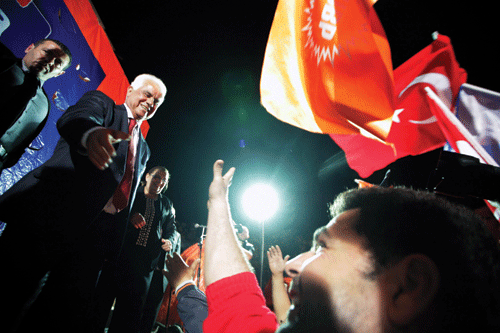
The brilliant classical scholar and poet A. E. Housman had a profound mistrust of opinions that are shared by a large number of people. Even, perhaps especially, when the vast majority of manuscripts contained the same version of a line of Latin poetry, the former Cambridge University professor was dogged in pursuit of what he saw as a more likely — and correct — alternative. His views on last month’s presidential elections in Northern Cyprus would doubtless have been entertaining and scathing in equal measure.

The anonymous commentators and analysts so oft quoted (or invented) by political writers have mostly been trotting out the same, simplistic line of the likely effects of the outcome, no matter who won.

The incumbent president, Mehmet Ali Talat, was credited with holding 71 meetings with his long-time fellow trade unionist, Greek Cypriot leader Demetris Christofias, which led to a series of unofficial and unenforceable agreements between the two sides of the divided Island, which was split in 1974 when Turkey invaded after a Greece-backed coup attempt. All these would be jeopardized, ran conventional wisdom, if the so-called nationalist hardliner, Turkish Cypriot Premier Dervis Eroglu, were to win the April 18 vote. The entire process of unification for an island now in its 36th year of division would be put on hold at best and vanish forever at worst.

Eroglu won an absolute majority in the first vote, eliminating the need for a run-off the following Sunday. And with that victory, the pundits continued, Turkey’s chances of joining the European Union suffered another devastating reverse. All of this somewhat misses the point.

Turkey’s ruling Justice and Development Party (AKP) calls the shots in the Turkish Republic of Northern Cyprus (TRNC) and it made very little difference who actually won last month. Turkish-Cypriots are financially dependent on Turkey. Without the $500 million annual contribution from Ankara, the TRNC would sink into bankruptcy faster than Greece. The rhetoric from both candidates during the election was mainly for domestic consumption.

Christofias said he was ready to negotiate with whomever was elected but insisted he would not resume talks from scratch. Eroglu told supporters: “Talks will continue because I want peace more than those who say that I don’t.”

Much more significant is what Recep Tayyip Erdogan, the Turkish prime minister, had to say. His clear disdain for what he sees as disruptive tactics from the European Union was illustrated by his public description of the union as a Christian club. It may well be true that a solution to the Cyprus issue is a prerequisite for Turkish EU membership. However, rapid accession is unlikely with or without a solution, and Erdogan’s desire for an answer to the divided island’s problems has other motives. Opening the northern side to direct trade would improve its economy and eventually lessen its dependence on Ankara’s money, and a reduction in the 30,000 troops stationed there would cut Turkey’s contribution to maintaining their presence.

Even additional benefits accorded to Turkish Cypriots if they become “official” members of the European Union alongside their fellow Cypriots in the south are less than they might appear. Around 40 percent — or 80,000 — Turkish Cypriots already hold EU passports. Roughly the same number cross into Greek-Cyprus daily to work jobs that pay far more than the equivalent employment in the north.

For all the publicity surrounding the Talat-Christofias talks, nothing of worth was achieved in two crucial areas — a system of governance or a solution to the property problem. In the north, 30,000 villas and apartments have been built since the split, mainly on land owned by Greek Cypriots. Properties subject to claims by their former owners are being sold at discount prices to foreigners, perhaps unaware of the difficulties of ever securing full title to them. The land problem is not one-sided. The land that houses the old Larnaca Airport and part of the terra firma on which the new one stands belongs to Turkish Cypriots. Optimism stemming from the 18 months of meetings between politicians on both sides of the island is based on little, save an excess of shallow public relations, cheerfully and regularly trotted out by the foreign media.

Housman-style followers of useful information would do better to watch for results from Erdogan’s visit to Athens this month.

PETER GRIMSDITCH is Executive’s Istanbul correspondent

May 1, 2010 0 comments
0 FacebookTwitterPinterestEmail
Comment

United by farce

by Sami Halabi May 1, 2010
written by Sami Halabi

Optimists have lauded the sight of Lebanon’s politicians playing a game of football together, under the banner “we are one,” as a sign of good faith to mark the 35th anniversary of the Civil War.  But for those of us less buoyant in nature, the sight was a slap in the face. We would rather see our public figures stop playing games and start getting serious about governing the country.

The players — a mixture of ministers, members of parliament and members of the Lebanese Football Association — managed to muster “unity” for a full 30 minutes, the duration of the match.

However, once the final whistle was blown — much to the relief of Lebanon’s heavier public figures — the youngest player and only goal scorer, Phalange MP Sami Gemayel, did little to contain his contempt for the opposing team’s captain, Hezbollah MP Ali Ammar.

“It seems that Ali Ammar’s defense strategy is a failure,” Gemayel was quoted as saying in the press, ostensibly alluding to the discussions over a national defense strategy currently being mulled at the National Dialogue sessions. 

Playing foul-for-foul, Ammar was quick to boot the ball back into the other end: “Our defense strategy is only directed against the Israeli enemy, and our team did not want to defeat the team of PM Hariri because he is the Prime Minister,” he retorted.

Notably absent from the game were the public, who have been banned from football matches since 2005 due to fears of sectarian violence pouring out into the streets. The irony of this, of course, is that some of the same politicians waddling haplessly across the pitch were the ones to stoke sectarian tensions in the first place.

Thus, with the stands empty, the absence of the public from the political field of play — from parliamentary committees to national dialogue sessions — was extended from the figurative to the literal.

The fact is that many of the player-politicians at last month’s “unity” match have done more to reinforce Lebanon’s sectarian divide through sports than anyone else, given that many own sporting clubs and/or interfere with appointments at the various sports federations.

And while our public figures kick out cash for personal prominence in Lebanon’s sporting arena, when it comes to supporting sports as a national institution — through the Ministry of Youth and Sports, for example — the ball gets deflated, with thread-bare funding for the ministry making it little more than a pawn in the greater struggle for power in Lebanon’s cabinet.

In front of the cameras, of course, the player-politicians told a different story. All agreed that sports needed to be encouraged in Lebanon, though as a former member of Lebanon’s national rugby league squad myself, as well as a development officer for the sport, this doublespeak looked clearly offside.

During a meeting with an adviser to a former sports minster, our team was promised only partial funding for travel expenses if Lebanon made it to the 2008 world cup finals; qualifiers would not be funded at all. When Lebanon hosted an international tournament in 2004 and the lights cut out in the middle of a game, then-President Emile Lahoud had to intervene to get them turned on again; a massive poster of Lahoud was later draped over the grandstand for the final, which Lebanon won against France.

If Lebanon’s politicians truly wanted to encourage sports in the country, they could start by giving the people access to “public” municipal sporting facilities — currently off-limits to those without the right political connections or money to pay.

It was the public who paid some $100 million to reconstruct Camille Chamoun stadium, only to be barred from its first event of the year, as the politicians played their “unity” match. Perhaps the referee should have given them all red cards at the opening whistle and consigned this self-congratulatory sham to an early shower.

SAMI HALABI is deputy editor of Executive Magazine

May 1, 2010 0 comments
0 FacebookTwitterPinterestEmail
Comment

Of politics and profits

by Riad Al-Khouri May 1, 2010
written by Riad Al-Khouri

Iran and Turkey’s respective economic involvement in the Middle East continues to grow, but as is so often the case in our region, business is becoming mixed up with politics. A good example of this is Tehran’s relations with the United Arab Emirates, home to about half a million Iranians and one of Iran’s largest business partners in the region. Iranian exports to the Emirates increased 50 percent from 2005 to 2009, and at the same rate in the previous five years. Last year, trade between the two countries was worth some $15 billion.

Great, you might think — unless you are the United States, which has been pressing the Emirates to limit business dealings with Iran as Washington continues to place sanctions on the Islamic republic and browbeat others into following suit. Over the past few months, a series of high-ranking US officials have been sent to the emirates in an effort to promote an anti-Iranian line and convince the UAE to restrict profitable centuries-old trade across the Gulf, warning of the consequences of strong economic relations with Tehran.

The UAE is aware of the ‘reputational risk’ run in the US over dealings with the Iranians, and accordingly humors Washington — without taking the matter seriously at a practical level. The American position is that normal consumer goods getting into Iran do not undermine sanctions, but that high tech is another story — the Emiratis, however, continue with business as usual, and despite US pressure, trade volumes between Iran and the UAE look set to continue growing.

Esfandiar Rahim-Mashaei, the head of Iran’s Presidential Office, called for Iran-UAE trade ties to be strengthened on a recent visit to the UAE, stressing that “both countries have a lot to offer as key players in the region’s economy.”

Ultimately, Iran and the emirates have a mutual interest in increasing trade, and so will work to promote business co-operation, irrespective of Washington’s bluster.

The other big economy on the northern border of the Arab Mashreq is Turkey, officials of which have for the past few years crisscrossed the region to open doors for the country’s businesses. Thanks in part to these improved trade links, Turkey has seen a strong recovery  after the economic slump of 2009.

Turkey’s youthful profile drives much of its development: over a quarter of the population is under 15 years old, with only 6 percent aged 65 or older. Turkey is notably more youthful than the Eurozone countries, where 18 percent of the population is over 65 and only a sixth younger than 15. With such creaky demographics, Brussels should rush to have Turkey enter the geriatric European Union, yet Turkey’s prospects for admission remain slim.

As the EU snubs Ankara, the Turks have sought friends and business partners elsewhere, including in the Arab world. In the past seven years, while total annual Turkish exports tripled to $102 billion, sales to the Middle East grew twice as fast.

Jordan, for example, saw its imports of Turkish goods jump from $188 million in 2004 to some $386 million last year, a whopping rise, but still way below the rate at which other Middle Eastern states bought Turkey’s products. Another interesting case can be found in Lebanon’s imports from Turkey, which went up 150 percent from 2006 to 2008, though they retreated somewhat in 2009.

Finally, it must be asked if Turkey and Iran are competing economically with each other in the Arab world, especially in places like Iraq — which they both neighbor — or Syria, which shares a long border with Turkey but is politically allied with Tehran. The answer so far seems to be no, with Turkey exporting more manufactured goods while Iran focuses mainly on raw materials. So for the time being at least, Tehran and Ankara’s respective strong economic drives to the south continue, but without mutual competition.

RIAD al-KHOURI is a senior economist at the William Davidson Institute at the University of Michigan in Ann Arbor,  and Dean of the Business school at the Lebanese French University in Erbil, Iraq

May 1, 2010 0 comments
0 FacebookTwitterPinterestEmail
Comment

A liberty too far?

by Peter Speetjens May 1, 2010
written by Peter Speetjens

If I were to be one country of all the countries in the world, I would be Israel, at least in terms of external relations. After all, what other country has the liberty to invade neighboring territories with impunity, bomb civilian targets, assassinate adversaries using forged Western passports, spy on its most fervent financial and military backer, the United States, and snub its vice president while he is on an official visit to the country.

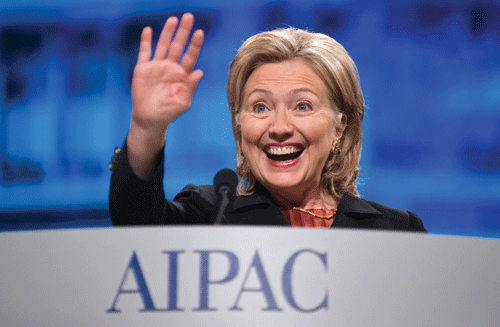
Perhaps this is what former British Prime Minister Tony Blair had in mind when he told the annual conference of the American Israel Public Affairs Committee (AIPAC) on March 23: “The Middle East should regard Israel not as an enemy but as a model.”

A member of the British lobby group “Labour Friends of Israel,” Blair today is the largely invisible envoy of the “Quartet on the Middle East.”  He was not the only celebrity invited by AIPAC, which advocates pro-Israel policies to the US Congress and executive branch and is widely regarded as one of the most powerful lobby groups circling the White House — a core of American politicians and some 130 evangelical leaders also gave acte de presence. Among them was US Secretary of State Hillary Clinton, who said: “Our commitment to Israel’s security and Israel’s future is rock solid.”

Note that this declaration of “rock solid” love came less than two weeks after Israel’s Interior Ministry announced the construction of 1,600 new illegal settler homes while US Vice President Joe Biden was on a mission to Israel to revive peace talks.

Clinton’s remark came only days after the emergence of 21 declassified documents from the Federal Bureau of Investigation (FBI) that bring the 1984 AIPAC spying scandal back into the limelight. The documents concern an FBI probe into the theft of a confidential report, which compromised the Reagan administration’s position in the 1984 negotiations over a US-Israel Free Trade Agreement (FTA).

The US International Trade Commission (ITC) had solicited data, under strict secrecy provisions, from US industries concerned about reducing tariffs on Israeli goods. They were compiled into a report called "The Probable Economic Effect of Providing Duty-Free Treatment.”

According to the FBI, AIPAC obtained the report and handed it over to a high-ranking Israeli diplomat. In 1985, the US signed a FTA with Israel. Ever since, the cumulative US trade deficit with Israel has soared to some $70 billion. It was not the only spying scandal concerning AIPAC.

In 2004, the FBI arrested Jonathan Pollard, who had handled the Iran dossier while working as a political analyst under Douglas Feith, former under secretary of defense for policy, and Paul Wolfowitz, former deputy secretary of defense. Both are well-known neoconservatives, while Feith is one of Washington’s most hard-line hawks regarding US foreign policy in the Middle East. Pollard handed more than one million classified documents to Steve Rosen and Keith Weissman, AIPAC’s former policy director and Iran analyst, respectively.

In this context, it is worth recalling that AIPAC was established as a spin-off of the American Zionist Council (AZC) in 1962, only six weeks after the US Justice Department ordered the AZC to register as an Israeli foreign agency. Today, AIPAC is the beating heart of a myriad of pro-Israeli organizations, individuals and think tanks, which comprise “The Israel Lobby.”

Political scientists John Mearsheimer and Stephen Walt, who can be credited for igniting the first public debate over the many troubles and travails of the lobby, wrote that AIPAC has an “almost unchallenged hold on US Congress.” It is no secret that political careers get a boost once AIPAC support is secured. Hence, the popular annual conferences and the recent AIPAC letter calling for an end to public criticism of Israel, which was signed by three quarters of the US House of Representatives.

But the Zionists may recently have been caught poking thorns in the side of their most powerful patron: the US Army. American military circles are increasingly aware that their country’s unconditional support for Israel’s regional belligerence is compromising American initiatives in the Muslim world, and endangering the lives of US soldiers in Iraq, Afghanistan and elsewhere. Should this perception spread through the halls of American power, it may be hard indeed for AIPAC’s silver tongue to keep its shine.

PETER SPEETJENS is a Beirut-based journalist

May 1, 2010 0 comments
0 FacebookTwitterPinterestEmail
  • 1
  • …
  • 419
  • 420
  • 421
  • 422
  • 423
  • …
  • 682

Latest Cover

About us

Since its first edition emerged on the newsstands in 1999, Executive Magazine has been dedicated to providing its readers with the most up-to-date local and regional business news. Executive is a monthly business magazine that offers readers in-depth analyses on the Lebanese world of commerce, covering all the major sectors – from banking, finance, and insurance to technology, tourism, hospitality, media, and retail.

  • Donate
  • Our Purpose
  • Contact Us

Sign up for our newsletter

    • Facebook
    • Twitter
    • Instagram
    • Linkedin
    • Youtube
    Executive Magazine
    • ISSUES
      • Current Issue
      • Past issues
    • BUSINESS
    • ECONOMICS & POLICY
    • OPINION
    • SPECIAL REPORTS
    • EXECUTIVE TALKS
    • MOVEMENTS
      • Change the image
      • Cannes lions
      • Transparency & accountability
      • ECONOMIC ROADMAP
      • Say No to Corruption
      • The Lebanon media development initiative
      • LPSN Policy Asks
      • Advocating the preservation of deposits
    • JOIN US
      • Join our movement
      • Attend our events
      • Receive updates
      • Connect with us
    • DONATE