• Donate
  • Our Purpose
  • Contact Us
Executive Magazine
  • ISSUES
    • Current Issue
    • Past issues
  • BUSINESS
  • ECONOMICS & POLICY
  • OPINION
  • SPECIAL REPORTS
  • EXECUTIVE TALKS
  • MOVEMENTS
    • Change the image
    • Cannes lions
    • Transparency & accountability
    • ECONOMIC ROADMAP
    • Say No to Corruption
    • The Lebanon media development initiative
    • LPSN Policy Asks
    • Advocating the preservation of deposits
  • JOIN US
    • Join our movement
    • Attend our events
    • Receive updates
    • Connect with us
  • DONATE
Consumer Society

Micro machines

by Executive Editors May 3, 2010
written by Executive Editors

The Anthony Bonja Fortress watch has a look to match its name. With a thick steel casing held together by six hefty screws and a weighty leather strap, it’s the kind of timepiece you would want on your wrist when facing down an angry bear or a brutish boss. It exudes an aura of solid self-confidence in a way only $5,000 concentrated in four square centimeters of stainless steel can. But inside, there is an entirely different matter at hand — or in this case, on hand.

As a mechanical watch, the Fortress is powered by a system of gears and springs so delicate and so precise that their dimensions and alignment must be measured to the micrometer. It’s this balance of aesthetic sophistication and technical precision that makes a luxury watch, but Anthony Bonja, like the dozens of Middle Eastern brands offering luxury watch lines, is only responsible for half of the equation.

The company is a jeweler, not a watchmaker. The mechanical aspects of its watches — called the “movements” or “ébauches” — are purchased outside of the region, the fruit of a niche market of specialized producers. 

“To the best of my knowledge, all manufacturing of movements used by Arab luxury watch brands occurs outside of the Middle East,” said Susan Maroua, public relations manager at Tabbah Jewelry. “This structure isn’t unique to the Middle East either — it’s the norm for most of the industry.” Companies that produce their own in-house movements — like Rolex, Zenith and Jaeger LaCoultre — and sell to other private groups “are exceptions,” according to Maroua.

Step by step

The majority of the watch making industry is structured ‘horizontally,’ according to the Fédération de l’Industrie Horlogère Suisse (FH) — the association of Swiss watch makers — meaning that any given watch passes through several companies or technicians, each of whom is responsible for a different step in its development, before it reaches the showroom.

“As a luxury jewelry line, we work in participation with a number of specialists to produce our watches,” explained Stephan de Palmas, regional director for Van Cleef & Arpels in the Middle East. “Our company will develop a concept and send its specifications to one of the manufacturers we work with – Jaeger LaCoultre, for example – which will produce and send us the disassembled movement. The movement is then sent to another specialized technician who adds complications [mechanics that run off the movement] that will, say, cause a couple to meet and kiss on a tiny bridge every twelfth hour, or show the cycles of the moon.”

“Finally, when the watch’s mechanical aspects are fully assembled, it returns to our workshops to be decorated and jeweled, and from there goes to our retailers to be sold,” he said.

Regional markets

On the receiving end, Middle Eastern states are among the top importers of luxury watch movements globally. According to the FH, the United Arab Emirates is the 9th largest importer in the world, with Saudi Arabia, Lebanon and Bahrain not far behind.  Taken on a per-capita basis, the Middle East accounts for nearly as many watch sales as some of the world’s largest markets in Japan, Europe or the United States, and the region’s segment seems to be growing.

Middle Eastern markets, along with heavyweights China and India, played a major role in pulling the luxury watch industry out of its 2009 slump, and international retailers are increasing their regional foothold as a result.

“Dior is up this year 6 percent,” said Jacob Hrayki, regional manager for Dior. “I believe retailers are in a more confident position this year, investing better in their stocks and mainly in their strategic brands.”

FH estimates that Swiss watchmakers exported some 2.1 million watches and 35,000 movements, worth a combined $1 billion, to the Middle East in 2009. That constituted a decrease of 22 percent from 2008 sales, which is a testament to the difficulty the industry faced that year. However, sales have picked up sharply in the first months of 2010, with regional sales of Swiss watches and movements increasing by nearly 40 percent in January and February.

As Swiss as cheese with holes in it

Although Japan, Russia and Germany produce and export a portion of the markets’ movements for use in luxury watches, Switzerland is still the industry’s silverback gorilla.

The alpine state exported $12.3 billion worth of watch related products in 2009, while its closest competitor, Hong Kong, achieved sales of only $5.6 billion.

Much of the country’s own industry is dominated by a single company, ETA SA, a wholly owned subsidiary of The Swatch Group, which supplies the movements used by the majority of mid-range luxury watch brands made in the Middle East.

However, that partnership is slated to end in the very near future. In 2003 ETA announced that it would end all sales of movements to makers not allied with the Swatch group by 2006, prompting a panic among smaller makers and driving sales as makers rushed to build up their reserves in anticipation of the closure.

“There was no innovation, no new development, and when I pushed them to start new production, everybody started shouting,” Nicolas Hayek, the chief executive officer of Swatch, said at the time. “I said I was not going to deliver any more of my movements unless they try to do their own production. Otherwise the Swiss watch industry… will go down.”

Following protests by smaller makers, the company was investigated by the Swiss Competition Commission and found guilty of abusing its dominant market position.

During the settlement period, ETA agreed to push its export closure date back to the end of 2010 while engaging in a slower “phasing out” of its movements from the market. By the end of this year, however, Middle Eastern jewelers along with other makers around the world will need to look for new sources to furnish their machinations.

The alpine state exported $12.3 billion worth of watch related products in 2009, while its closest competition, Hong Kong, achieved sales of only $5.6 billion

May 3, 2010 0 comments
0 FacebookTwitterPinterestEmail
Editorial

Leave us alone

by Yasser Akkaoui May 1, 2010
written by Yasser Akkaoui

Even the piecemeal tax increases contained in the Lebanese Ministry of Finance’s 2010 budget proposal are insulting. The private sector and the expatriate community — the two entities that keep the Lebanese economy alive and the government afloat — can’t help but feel that they’re being forced to give more blood to the leeches of the state and still receive nothing in return.

For example, in some countries taxes on cigarettes help cover healthcare costs. In Lebanon, taxes are what the Ministry of Finance, through the Regie Libanaise du Tabac et Tombacs, uses to pay tobacco farmers for their crop, at times registering up to a 500 percent loss. This is insane.

Such complaints are not just the moaning of the wealthy. This is a reaction to the crude policies of a government that, under pressure from donor nations to get its fiscal house in order, will further burden those who already carry it, instead of attempting to lighten the load through measures that are simple common sense.

Lebanon is neither a classic laissez-faire economy that lets businesses run wild and free — it is too corrupt for that — nor is it a typical welfare state which provides education, healthcare and housing for its citizens. Quite simply, it falls between the two stools and instead of seeking to remedy the failings in its national infrastructure and behave like a mature government, it takes the easy route and taxes those whose economic health is predicated on unfettered economic activity. 

For years now, Lebanon has prided itself on its fiscal wisdom, boasting that it is this prudence that has kept it from ‘pulling’ an Argentina or a Greece. But that our politicians even talk in those comparisons — that yes, we are looking over the cliff, but no, where others have fallen we will keep our balance — is a testament to their fiscal ineptitude.

The private sector cannot be held responsible for this colossal waste. Should government one day become transparent and accountable, and show it has spent the money we already gave wisely and efficiently, then we could talk about, perhaps, paying more into government coffers.    

But that day is a long way off. Until then, quite simply, the private sector should be left well alone. We, the private sector, have kept Lebanon afloat for over 50 years. Let us work; let us employ; let us create; let us spur consumption.

Let us be.

May 1, 2010 0 comments
0 FacebookTwitterPinterestEmail
Economics & Policy

Movement for everyone

by Fares Saade May 1, 2010
written by Fares Saade

Fueled by demographic growth, urbanization and economic development, the cities of the Gulf Cooperation Council are growing at a rapid rate that is outpacing their current transport infrastructure and services.

The United Nations forecasts that 88 percent of the GCC will be urbanized by 2025, compared to a world average of 57 percent. What’s more, an increase in income levels will cause demand for mobility to outpace even the region’s rapid population growth.

So far, this surge in demand has been largely met by private vehicles and taxis, with public transportation accounting for less than 10 percent of all motorized trips. This approach has resulted in congestion, pollution and deteriorating road safety. It threatens to slow the growth of the region’s cities and undermine the quality of life for urban residents.

To address these challenges, authorities have been making massive investments in public transportation systems; regional governments have recently announced that they will pour a combined $26 billion into metro systems, trams and monorails. However, these investments alone will not change commuters’ habits and attract them away from cars and onto public transport. Other countries’ experience shows that careful policy formulation and planning are indispensable to the success of public transportation. For the car-dependent cities of the GCC, those lessons are particularly critical.

The path to public transport

Transport authorities must be realistic about how many people will actually use public transportation. With strong car cultures and populations spread over large areas, GCC cities will have to work hard to drag drivers out of their cars.

To reach even modest success, transport authorities must consider five critical steps. Although their implementation will vary by country, each serves a common goal: enhancing the attractiveness of public transport and dissuading individuals’ use of cars.

Focus on convenience: People will not use public transportation if it is not easy to do so, and thus public transport should first aim to be accessible. The recently opened Dubai Metro is a case in point: It is still working to reach a satisfactory and sustainable level of use with plans for “park and ride” facilities and better feeds from high-frequency bus services and taxis.

The cleanliness and comfort of stations and vehicles are also important in attracting riders from all socioeconomic brackets. Finally, fare levels and structures need to balance affordability for users with transport authorities’ goal of maximizing revenues. To offset the reduced convenience of public transportation, the cost of the trip to the customer — in both money and time — must be lower than the cost of the same trip using a car.

Integration: The easier it is for commuters to ride multiple modes — for instance, bus and metro lines — the more convenient public transport becomes.

There are two main levels of integration. The first one is at the station level; major interchange stations provide commuters with access to metro, tram, bus and taxi services. Metro stations in sparsely populated GCC cities would require strong feeders, such as buses and taxis. Fares and ticketing are the second level of integration: Allowing users to pay a single fare and use a single ticket for multiple modes is another element of convenience, particularly when the combined fare is lower than the sum of the fares on the different modes.

Smart card ticketing technology has now become the standard for many metros, as it offers users the added benefit of being able to use it for parking and various small purchases, such as newspapers and drinks.

Discourage car use: Disincentives for car use are probably the best way to encourage riders to use public transportation. Recent studies have shown that urban rail systems mostly attract riders who had previously been using the bus rather than those who had been driving — unless authorities impose severe restraints on the ownership and use of personal cars.

Such measures may include limiting car ownership (via sales taxes, import duties, and annual fees) and restricting car usage (via parking charges, congestion and road tolls, and fuel taxes). For GCC cities, the challenge is substantial. Taxing car ownership and fuel is likely to be contentious in an oil-producing region accustomed to low taxes and import duties.

The dynamic management of parking space and policies that charge for it would likely prove not only easier to implement but also be better targeted to specific congested areas of city centers. A number of cities, most notably in Saudi Arabia and the United Arab Emirates, have been moving in that direction recently.

Overall, in a region where very few people use the existing bus service, restricting car usage is inevitable if public transportation is to really take off. Measures can be gradually introduced over time as public transport becomes available and convenient.

Bring in the private sector: Private- sector involvement can offer a number of benefits to GCC cities in developing or operating modes of public transport.

u The greater efficiency that characterizes private-sector operation leads to reduced government spending on subsidies for urban transportation. Other countries’ experiences show that competition for operating franchises is the primary way to reduce subsidies.

* Public-private partnerships in infrastructure projects, such as rail transport and station development, alleviate the fiscal burden on governments and facilitate the projects’ execution. There is an increasing need for better financial management of these projects as GCC governments attempt to boost their reserves and ensure fiscal discipline, despite the oil boom of the last few years.


* Private operators tend to have the discipline and much-needed customer orientation to ensure high standards of service quality, reflected in service frequency, schedule suitability, maintenance, image and staff friendliness.

Create an enabling institutional and regulatory framework: Few of the above-mentioned policies and measures are possible without a solid and integrated framework for planning and regulation. Public accessibility, intermodal integration and disincentives for car use require well-integrated planning between the relevant government entities. Private-sector participation requires transparent and well-developed licensing, regulations and enforcement mechanisms. This is difficult in the current GCC institutional context, which remains largely fragmented and underdeveloped. Planning, regulation and enforcement responsibilities are often distributed among different uncoordinated entities with overlapping roles and responsibilities.

However, in the past few years, a growing number of countries have been establishing integrated transport authorities with a clear mandate for planning, regulating and enforcing all matters related to surface transport and traffic management. Not all countries may want to have a single entity; nonetheless, the allocation of responsibilities and the coordination mechanisms have to be well-established.

Public transportation may not be the sole remedy for the looming mobility challenges facing GCC cities, which demand a holistic approach that includes strategies for traffic management, non-motorized transport such as walking and cycling, and the integration of transport with land-use planning. But none of these strategies will dispense with the need to develop and promote the use of public transportation. Accordingly, following these vital steps to encourage public transport use will help public transportation reach its ultimate objectives.

FARES SAADE is a principal at Booz & Company

May 1, 2010 0 comments
0 FacebookTwitterPinterestEmail
Economics & Policy

Tallying tobacco

by Karah Byrns May 1, 2010
written by Karah Byrns

The proposed tobacco control law being mulled by the Lebanese Parliamentary Administration and Justice Committee has stirred debate between health-minded civil society activists, lobbyists from the tobacco and advertising industries keen to protect their commercial interests and a public skeptical of how serious the government is about enforcing any real tobacco control policy.

Arguments have covered not only health concerns but also Lebanon’s economy, asking whether or not the country can afford to lose the cash raised by the tobacco industry, specifically in the agricultural, hospitality and advertising sectors.

The controversial legislation would be surprisingly strict compared to the current law, calling for a ban on smoking in indoor public places including bars and restaurants, forbidding advertising of all tobacco-related products and insisting on pictorial warning labels on cigarette packs equivalent to 40 percent of the packaging size.

Proposed as a series of amendments to a draft law from 2006, this version revisits the country’s stance on tobacco following its commitment to the World Health Organization Framework Convention on Tobacco Control (FCTC), an international treaty that Lebanon signed in 2004 and ratified the next year. The FCTC arose as a global response to scientific data, albeit from the 1960s, which revealed the gravity of the health risks associated with tobacco use and is the treaty that prompted tobacco control legislation across the world.

Implementation of the draft tobacco control law would allow Lebanon to catch-up on its FCTC obligations, as the country has already missed the 2008 compliance deadline for implementing larger warning labels, the 2009 deadline to ban advertising and the 2010 target to ban smoking in indoor public places.

According to George Saade, program coordinator at the health ministry’s National Tobacco Control Program (NTCP), the tentative deadline for parliamentary approval of a national tobacco control policy is May 31, coincidentally “World No Tobacco Day.”

Smokey quantification

A study released last month by the American University of Beirut’s (AUB) Tobacco Control Research Group — authored by Jad Chaaban, Nadia Naamani and Nisreen Salti — has quantified a number of previously undocumented tobacco-related figures.

Cost of smoking as a percentage of GDP in Lebanon

For starters, the study reports that 40.3 percent of Lebanese are smokers. With cigarette consumption reaching an estimated rate of 12.4 packs per person per month, Lebanon also has one of the highest overall consumption rates in the world. The figure is three times that of Syria, and 12 times that of Singapore.

Looking at the overall benefits to the economy, the net revenue from tobacco is estimated at $271 million, taking into account tax revenues, subsidies to Lebanon’s 24,000 tobacco farmers, advertising, revenues from licensing and all other net gains for the government, international tobacco companies, distributors and retailers, and the Regie du Tabac et Tombacs — the state-run entity under the Ministry of Finance, which oversees Lebanon’s tobacco industry.

When evaluating overall costs to the economy, the sum includes health care costs, productivity loss, environmental costs due to forest fires and street waste clean-up, totaling $326.7 million, around 1.1 percent of Lebanon’s GDP. This figure is relatively high; in Egypt, where smoking prevalence is also high, the costs represent 0.7 percent of GDP.

The balance of tobacco’s revenue and costs leaves the country with a net loss of some $55.4 million. The real figure could be even higher since the study excluded costs related to regular exposure to second-hand smoke, as well as excluding many smoking related diseases due to a lack of sufficient data.

 “What is obvious is that Lebanon’s economy is losing money on smoking,” said Chaaban.

According to Public Health Researcher Jade Khalife at the Ministry of Health’s NTCP, international data strongly supports the economic assertion that employers will benefit from increased tobacco control in the form of improved employee productivity, reduced hiring costs and lower building maintenance costs. Khalife raised the example of Ireland, where smoke-free environments saved employers the equivalent of 1.1 to 1.7 percent of GDP.

In the hospitality sector, studies conducted in other countries generally show that banning smoking in indoor public places either does not affect, or actually increases, revenue for restaurants and bars. In Ireland, the first European country to ban smoking in enclosed workspaces in 2004, a study in the Irish Journal of Medical Science found that a year after the ban was enacted customer numbers in Dublin pubs had increased by 11 percent.

More recently in Turkey, hospitality sector revenue rose some 5 percent in 2009 following a public indoor ban. And in Lebanon, apart from the fact that the majority of Lebanese are non-smokers, a recent survey done by the NTCP underlined that restaurants could also see increased business from a ban, with 56 percent of Lebanese smokers reporting that they are bothered by smoke in restaurants, and 98 percent recognizing that second-hand smoke is harmful to them.

“In our bars and restaurants 60 to 70 percent of the people are smoking,” estimated Gemmayze Development Committee member Paddy Cochrane, who is coincidentally Irish-Lebanese. “After experiencing the ban in Ireland and being a non-smoker myself, I think it’s a fantastic idea, but as a bar owner, I’m not there to tell people what they can and cannot do. But if the government passes a law, it’s different.”

Although restaurants and bars would lose money made off of the promotion and sale of cigarettes in their venues, the impact is negligible, added Cochrane.

No more Marlboro man

The advertising sector also stands to lose from the proposed legislation. According to AUB’s study, tobacco advertising comprised 4.5 percent of total advertising spending in Lebanon in 2009, a figure roughly coinciding with an estimate of 4 percent provided by the President of the Lebanon Chapter of the International Advertising Association (IAA) George Jabbour. Research company IPSOS reported that tobacco advertising made up 1 percent ($7.2 million) of the total media advertising, excluding ‘below the line’ advertising, such as promotions, handouts and events – which the industry would rather see exempt from any ban.

According to Jabbour, advertisers need time adjust to the change. 

“We need a grace period. We have employees that we cannot just throw away. We need to restructure,” he said.

“No one is saying it should be stopped as a legislation. But we don’t want this legislation to just be propaganda. We don’t want the advertising industry to be the scapegoat,” said Jabour, concerned that ban or no ban, smokers will carry on regardless, leaving advertisers to carry the can.

Skeptics argue that smoking is as much a part of the local culture as general disregard for the law. In focus group studies conducted by the AUB Tobacco Control Research Group, even researchers in favor of the policy had to admit that the most frequent concern about the policy implementation cited by participants was the willingness of the general public to abide by a law, even if it passes. Last month NTCP’s Saade released a statement saying that fines for breaking the law may reach $663 for establishments and $33 for individual smokers. But who would implement this remains undetermined as yet.

More recently, a modification of the draft law regarding the public ban was introduced to provide exemptions for public establishments that make separate smoking and non-smoking areas. This move drew sharp criticism from the AUB Mechanical Engineering Department, which “strongly advises against any such exemption because it has been shown through numerous scientific studies that partitioning indoor spaces into smoking and non-smoking areas does not work, even when advanced ventilation and filtration technologies are used.”

A similar attempt to impose separated areas in Spain failed and the country is now considering a complete ban, after many establishments already invested in redesigning their businesses.

Applying policy… maybe

The AUB Tobacco Control Research Group also strongly warned that “multinational tobacco companies have consciously thwarted previous policy attempts to limit the reach of this harmful product… The industry should not be allowed to weaken tobacco control policy.”

While the NTCP estimates that 3,500 Lebanese die each year due to tobacco use, the public health aspects of the tobacco control law, and even the economic ones, have thus far been trumped by political interests in the halls of government. Lebanon’s three largest tobacco importers, Philip Morris, British American Tobacco and Japan International Tobacco, declined the opportunity to contribute to this article.

May 1, 2010 0 comments
0 FacebookTwitterPinterestEmail
Economics & Policy

Burning a hole

by Sami Halabi May 1, 2010
written by Sami Halabi

The Lebanese government has developed a habitual pattern of behavior in regards to progressive policy: the idea is lit with good intentions, smoked by vested interests and political squabbling, then forgotten like ash flicked away in the wind. When not tossed aside entirely, major policy initiatives are often simply relegated to an indefinite sentence in a bottom drawer somewhere in parliament.

There have been signs recently that government may be trying to curb this damaging addiction, however, in light of the tobacco control legislation currently being mulled by politicians.

The first puff

The draft law on tobacco control was first proposed in 2004 by Member of Parliament Atef Majdalni – who was also the acting chairman of the Public Health Parliamentary Committee at the time — as well as MPs Nasser Kandil, Ghattas Khoury and Ahmad Fatfat, only to find itself promptly shelved.

In March 2004 Lebanon signed, and later ratified, the World Health Organization (WHO) Framework Convention on Tobacco Control (FCTC). The country has since missed every deadline for the staged implementation of the convention, with none of its articles having yet been applied.

In 2006, under a new cabinet and parliament, another draft law was again submitted for consideration, a copy of which was obtained by Executive. This new draft was a diluted version of the first, removing clauses pertaining to testing tobacco before sale and confiscation of materials in contravention of the law, and limiting the authority of inspectors to implement the law.

According to the document, these amendments were made after consulting with the Regie Libanaise du Tabac et Tombacs (Regie) — the Lebanese government entity under the Ministry of Finance in charge of tobacco imports and exports and the licensing of farmers, wholesalers and retailers — as well as the syndicate of advertisers, syndicate of doctors and the Ministry of Public Health (MOPH). Even this watered-down version was shelved, however, as the country spiraled into conflict and political stalemate from 2006 to 2008.

Without the new legislation, Lebanon’s tobacco regulation is based on the six-article long Law 394, issued in 1995, which falls well short of the international obligations mandated in the FCTC. The current law states that health warnings should cover 15 percent of advertising media (print, outdoor, TV and cinema) and read: “The Ministry of Health warns: Smoking leads to serious and fatal diseases.”

Notably, it does not forbid the sale of tobacco to people under the age of 18, but bans handing out free samples to this age group.

Starting again

At the beginning of 2009, the draft law was still gathering dust in a government drawer. Executive’s investigation uncovered that the parliamentary Administration and Justice Committee of the previous government went back to the original 2004 legislation and began the entire amendment process over again – work which has continued under the Administration and Justice Committee of the current government. This amendment process includes “consulting and listening to opinions of stakeholders,” according to a source on the committee, who spoke on condition of anonymity.

Tobacco production by region in 2009 - Lebanon

These stakeholders include international tobacco companies whose lobbyists sit in on committee meetings — a fact confirmed by several sources close to the proceedings.  Lebanon’s three largest tobacco importers, Philip Morris International, British American Tobacco (BAT) and Japan Tobacco International declined the opportunity to contribute to this article.

“The tobacco lobby, like all the lobbies, will try to stop anything that might threaten their business,” says Yassine Jaber, a former minister of economics and trade and current MP in the Amal party.

George Jabbour, president of the International Advertising Agency’s Lebanon chapter, conceded that members of the advertising industry have also lobbied members of the committee, though he disagrees with the ethics of this.

“You cannot change the facts of life, and this is a fact of life,” said Jabbour. “Today, there is a trend and there are proven facts that cigarettes are not a good thing.”

The source on the committee said civil society groups who work on tobacco control issues were not invited to give their opinions.

They went on to explain that a sub-committee, under former minister and MP Samir al-Jisr, has been formed with the purpose of carrying out proceedings without the involvement of industry lobbyists. This sub-committee met twice in April in the presence of members of the Regie and the MOPH.

The absence of an official tobacco lobby at sub-committee meetings is, however, is a matter of switching hats: an international tobacco lobbyist, who asked not to be identified, confirmed that the Regie asked Jihane el-Murr, BAT’s head of corporate and regulatory affairs, to attend sub-committee sessions under the auspices of a “representative” of the tobacco industry, rather than a lobbyist.

The committee source confirmed that subcommittee negotiations are revolving around the details of the advertising ban, the definition of public space, fines on violators, forbidding sales to persons below 18 and the obvious display of cigarettes at retail points.

Tobacco taxation and smuggling

Notably absent from discussions is a hike in tobacco taxation, normally a cornerstone of tobacco control policy.

According to a Turkish international tobacco representative, when tobacco control legislation was introduced in Turkey — which had comparable smoking incidence to Lebanon — consumption dropped some 5 percent. However, when taxes were applied, the market saw a 20 percent fall in consumption.

The government could have, technically, proposed a budget this year including increased taxes on tobacco — it did not. The stated reasoning behind this decision, and the impetus to keep tobacco prices low, is the fear of increased smuggling across Lebanon’s porous borders.

“England, a developed country surrounded by water, has a tobacco market of which 30 percent is supplied through smuggling,” said Mohamad Daher, head of the Regie’s anti-smuggling unit. “What about us, whose sea, land and air borders are completely open? How much smuggling do you think we have?”

In the late 1990s then-Prime Minister Salim el-Hoss spearheaded a raise in the tobacco tax. Smuggling soared and the government lost revenue, forcing Hoss to backtrack on the measure. However, another official present at subcommittee meetings, who also spoke on condition of anonymity, attributed the increase in smuggling to Syrian control over Lebanon’s borders at the time, as well as politicians’ protection of smuggling rackets.

The Regie is the only body in Lebanon authorized to license wholesalers and retailers. Presently, there are around 490 licensed wholesalers in Lebanon, who must pay the Regie $10,000 for a license, prove that they have a place to store merchandise and open their books up for spot inspections, according to Khalil Dugan, legal advisor to Regie Chairman Nasif Siklawi.

But as far as licensing retailers goes, nothing has been done for decades. “Because the amounts are small, [the government] deems them negligible,” says Daher. “If you are going to chase people for one or two cartons then you need 1,000 men, and they don’t exist. If you see cigarettes at smeneihs [stores licensed to sell only food], all those cigarettes are smuggled.” Daher’s unit consists of up to 50 inspectors for all of Lebanon.

Farming fear

The combination of increased smuggling and a decrease in consumption would no doubt have widespread economic, health and social effects on Lebanon. But there is one sector in society that stands to lose out more than anyone else.

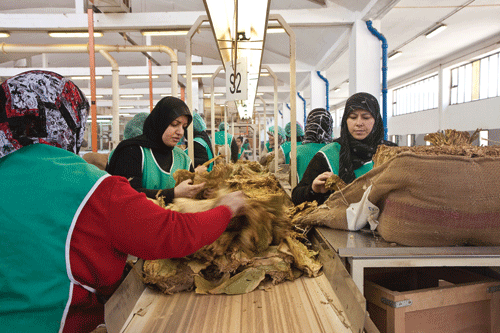
According to the Regie, Lebanon currently has 24,000 licensed tobacco farmers spread throughout the country, some 57 percent of whom are located in the south. Farmers receive a subsidized set rate for their crops through the Regie’s ’Price Support Program,’ depending on the quality and type of tobacco they grow.

The price farmers are paid, however, has not changed for 15 years according to MP Jaber, whose electoral support in the south stems from many of those same farmers. At present, farmers in the south and the Bekaa Valley receive an average of $7.46 and $6.04 per kilogram, respectively, for the same type of tobacco, according to the Regie. Farmers in the north produce another type of tobacco used in the nargile, or water pipe, and are paid an average price $6.04 per kilogram.

The total amount paid out to farmers last year was $52.6 million, according to the Regie, an increase of 3 percent on 2008, with the south counting for 61 percent of production last year. Total production of tobacco in Lebanon last year reached some 7.7 tons.

According to the World Bank, on the international market the average price per metric ton of tobacco is $3,500, meaning that the Regie lost some $3,330 per metric ton of tobacco it sold last year, totaling losses of some $25.6 million.

The tobacco bought by the Regie is sold on to international tobacco companies according to a barter system, whereby international tobacco companies buy a share of Lebanon’s tobacco output equal to that of their present market share.

The arrangement constitutes a net loss for the Regie, which still manages to be a profitable organization through money funneled to it from the finance ministry and other activities, including the sale of the local Cedars brand, which is produced at its headquarters in Haddath using Lebanese tobacco.

Meanwhile, the government raked in around $189 million in tobacco tax revenue in 2008, according to the latest data from the World Bank and Lebanese Customs.

Money ain’t everything

While the arrangement is a monetary loss for Lebanon, it does serve several functions that are socioeconomic and political in nature. Farmers are ensured a fixed and steady income, allowing them to stay on their land. This prevents further migration to Lebanon’s cities, which are already struggling to provide infrastructure for urban living.

To boot, this arrangement helps the main political parties in the south — Amal and Hezbollah — to provide for their key constituents, both keeping the parties in power and maintaining a population base near to the border to stand against Lebanon’s main military threat — Israel.

“In the south our role was more important during the [Israeli] occupation, and even now it is still important,” said a high-ranking member of the Regie, on condition of anonymity.

In a bargain that is renewed annually, international tobacco companies have, for years, enjoyed secure access to the Lebanese market by buying the country’s relatively low-quality tobacco. Marwan Iskandar, economist and managing director of MI Associates, and several other sources who spoke off the record, said that the companies actually discard a portion of this tobacco due to its poor quality.

“In the north we are planting something that does not have a place in the international market,” said the source at the Regie. “We are trying to sell it to the countries that do not know tobacco well.”

The source added that Lebanon used to lose some 500 percent on sales of northern tobacco, though current losses are between 200 and 300 percent. Abdul Mawla el-Mawla, tobacco technology manager at the Regie who is also responsible for buying and selling all of Lebanon’s tobacco, denies that the tobacco is still being discarded, as he claims quality has increased over the years to a level that “has become acceptable” to international companies.

But if tobacco legislation is enacted and consumption decreases, as is expected, a domino effect may occur.

“The international companies will tell me that ‘you are not selling as much for us,’” says Mawla, implying they will change the arrangement. “If my revenues fall, who is going to take Lebanese tobacco? What do I do with the farmers?”

Irrigation irritation

Amal MP Jaber, who holds a parliamentary seat allocated to the Nabatiye district, says he doesn’t see the link between tobacco legislation and his constituents’ livelihoods. He is, however, aware that the situation cannot continue forever. “Nobody in the south of the country is fond of planting tobacco. Tobacco is the most difficult type of crop you can ever dream of; the whole family works 7 days a week to make it,” he says. “Farmers hate the whole system of [growing] tobacco, they hate the way they have to work so hard and how they are humiliated by having to wait in [long] lines when they sell their crops to the Regie.”

According to the World Bank, the average labor days per hectare needed to cultivate tobacco in Lebanon is 610, as opposed to 25 for cereals and 242 for fruits and vegetables.

The bank also estimates that tobacco constitutes a third of household revenue for tobacco farmers, with around 40 percent of them working off-farm and 23 percent rotating tobacco with other crops such as chickpeas and fava beans. “Why do people [in the South] choose tobacco? Because they have no alternative,” says Jaber. Tobacco is a ‘dry plant’, which means it is rain fed and does not require irrigation, an asset currently lacking in much of South Lebanon.

What is vexing about the situation is that there are solutions and the legal infrastructure to facilitate them is already in place. In 1950’s, the government created the Litani River Authority (LRA), mandated to enact projects along the river and around the region. Later, Law 221 — entitled the Water Authority Law — was passed. Its implementation decrees gave the LRA the mandate to irrigate 42 percent of Lebanon, including all of the south and southern Bekaa, not to mention supplying 7 to 10 percent of the country’s electricity through hydropower and providing potable water to 20 percent of the population.

Apparently, the government had other priorities. “If we calculate over the years how much money we have paid to subsidize the planting of tobacco, we could have done the Litani river project five times over,” says Jaber. “Unfortunately, there has not been a sense of responsibility…”

Environmental experts have begun working with the government on proposals to expand the Litani river projects and Jaber added that after receiving $50 million in funding from Kuwait, “we are halfway there.” Whether it will take another 60 years to make it the rest of the way remains to be seen.

In principal, everyone agrees

All the stakeholders Executive interviewed for this article said they were in favor of enacting the proposed tobacco control law, but its actual application will be another issue.

“We are with stopping smoking, and sections for smokers, and all of the elements of the law, and with a complete awareness program; but we have to be realistic. There are people who are addicted,” said Mawla, who advocates having a grace period to implement the law, as do members of the advertising and hospitality sectors.

Rima Nakkash, assistant research professor at the faculty of health sciences and coordinator of AUB’s Tobacco Research Group believes that a grace period will only allow for piecemeal reforms and give stakeholders the chance to dilly dally around the law and maintain the status quo.

With or without the grace period, if the proposed tobacco control legislation is passed without being neutered by amendments, smoking rates and tobacco consumption will undoubtedly decrease in the mid to long term.

“By that time we will have finished the Litani River project,” said Jaber. “God willing, by that time we won’t need to have tobacco plants.”

May 1, 2010 0 comments
0 FacebookTwitterPinterestEmail
Real Estate

Development disorder

by Nada Nohra May 1, 2010
written by Nada Nohra

It has been 20 years since the end of the war, but we still haven’t seriously started reconstructing the country,” said Serge Yazigi, head of the Majal urban observatory, part of the urban planning institute of Académie Libanaise des Beaux-Arts at Balamand University.

Beirut may be in the midst of a construction boom, but the lack of a coherent, concerted vision of how Lebanon’s capital should look,  function and grow leaves urban planners like Yazigi shaking their heads in dismay.

Cities the world over face the challenge of rapidly urbanizing populations, particularly in developing countries, which often lack a strategy or effective policy to direct their growth down a sustainable path. In the case of Beirut, this problem has been compounded by an almost unmatched exposure to devastating conflict.

Low standards of living in the city’s numerous “informal settlements,” rocketing property prices, the absence of public transport, traffic congestion, environmental degradation and rampant construction are all serious challenges facing Beirut.

Yet thus far, no government body has shown the muscle to impose an urban plan to address these issues and ensure the city’s sustainable growth.

Informal settlements

Some of the first informal settlements sprang up in Beirut in the late 1940s as Palestinians fled Israeli aggression, with new ones forming over the years as people sought to escape rural poverty, Israeli invasions and civil war. Over time, areas around the capital that had at first acted as temporary sanctuaries for refugees became their permanent residences.

Today these areas host low-income urbanites who, decades ago, built homes there illegally and therefore do not pay taxes.

A recent study by Mona Fawaz, assistant professor in the graduate programs of urban planning and urban design at the American University of Beirut, said that the Hayy El Selloum area, located in the southern suburbs of Beirut, is the largest informal settlement in the city with a population of 100,000 people. Other informal settlements around Beirut include Zatriyyeh, Rouwaysat, Ouzaai and Al Raml Al Ali. The most recent numbers from the United Nations Human Settlements Program (UN-Habitat) stated that in 2005, 53.1 percent of Lebanon’s urban population lived in slums or informal settlements.

Fawaz said inflation in the real estate market has effectively made it impossible for people living in informal settlements to move to other parts of the city, making these ever more densely populated. The need for people to reside near their workplace has also prevented many from moving to other areas, due to the lack of adequate public transport.

“These people have nowhere else to go so they are adding floors. What you are ending up with is a complete deterioration of these neighborhoods that are so congested they are impossible to live in,” said Fawaz.

Many informal settlements, due to their illegality, do not receive basic services from the government. Nancy Hilal, urban planner at UN-Habitat said that these communities often form their own committees through which they raise money to build local sewage systems and other necessary services. Out of 12 settlements in a UN study, only two officially received electricity from the national power company — others receive it through a variety of means such as private generators and political influence to divert the electrical grid. 

The government has done little or nothing to upgrade living standards in these areas or help residents move to better locations.

The one attempt it did make after the Civil War was the establishment of Elyssar, a public agency for the planning and development of the south western suburbs of Beirut: home to some 500,000 inhabitants living in informal settlements, according to a UN-Habitat.

The project was supposed to include more than 10,000 affordable housing units, 1,000 shops, some 100,000 square meters of light manufacturing, parks, warehousing and workshop centers, as well as basic infrastructure.

“It was the first time the government got involved in urban planning,” said Hilal. “However… planning is very political. This is why it is not being implemented.”

Elie Sawma, president of the Building Promoters Federation of Lebanon, said that his organization was pushing the government to reactivate the Elyssar project, which would decrease pressure in the real estate market by boosting supply. Sawma added that the price per square meter would be between $2,000 and $2,500 — lower than other areas in Beirut but significantly higher than the informal settlements, which would most likely defeat their purpose.

High prices on middle incomes

Middle class Beirutis are feeling the heat of the city’s red-hot real estate market, as local, expat and foreign demand causes prices to balloon. By law, foreigners are allowed to own only 10 percent of any one district in Beirut. A recent Al Iktissad Wal Aamal study showed that foreigners owned 6.52 percent of the capital, including properties purchased by Lebanese on behalf of foreigners, or properties purchased by local companies that are foreign-owned.

Inflation has hit all market segments with prices on lower-end properties in Beirut having risen some 120 percent on average since 2005, and 150 percent on higher-end homes, according to Ramco real estate advisors.

Urban planners Executive spoke with said the Lebanese authorities should help to control prices and encourage affordable housing in a city filled with ever-more high-rise luxury towers.

“We should keep it as a free market but some limitations need to be put in, like forbidding speculation or a jump in prices,” said Majal’s Yazigi, noting that these initiatives should be part of a specific urban plan which governs the construction and expansion of the city.

“Each country deals with the increases in prices in different ways, but all developed countries in Europe have a policy which fights the increase in land prices,” said Mohamed Fawaz, head of the Directorate General of Urbanism (DGU) between 1974 and 1993.

Public transport

Increased urbanization, a lack of public transport and among the highest per capita car-ownership rates in the world, are escalating Beirut’s traffic congestion, parking shortages and pollution from car emissions.

 “We are losing a tremendous amount of time to go from one place to another. [The congestion] is decreasing our attractiveness to tourists and affecting our health,” said Yazigi.

According to a study by advertising agency Pikasso, 65.2 percent of households in Beirut own a car and use it as their most frequent mode of transport. 

Mohamed Fawaz said that since the first meeting of Metropolis (World Association of the Major Metropolises) in 1985 – in which he took part as the head of the DGU – it is a commonly accepted fact that private cars cannot solve transportation and traffic issues in cities.

“However, this ‘conviction’ has not yet reached Lebanon,” he said.

Transportation means currently available include taxis, shared taxis, buses, or private minivans. Beirut needs 700 buses to provide efficient public transportation, said Mohamed Fawaz.

“Our city hasn’t provided a quarter of that number,” he remarked.

The World Bank initiated a $204 million “Urban Transport Development Project” at the start of 2009 to help provide Beirut with traffic management, parking improvement programs and training for police.

Though this program has improved traffic circulation and increased available parking, authorities have yet to set out a comprehensive public transport strategy, which Fawaz said should incorporate rail trams.

Mona Fawaz also related the lack of public transport to the housing situation, as high real estate prices force out lower-income earners, concentrating them in low-rent areas, which curbs the city’s natural growth.

“Public transportation and networks should be created in order to allow for this city to grow, for those who cannot afford municipal Beirut to be able to live somewhere where they can commute using a public network,” she said.

Do we have a plan?

In July 2009, the government approved the “National Physical Master Plan for the Lebanese Territory” —  a study concluded in 2005 by the Council of Development and Reconstruction (CDR), the DGU and L’Institut d’aménagement et d’urbanisme de d’Île-de-France.

Experts laud the plan as a step toward achieving sustainable planning; the problem is that it does not include specific instruments for implementation.

“The planning instruments and the related institutional setup are almost non-existent in Lebanon and the cooperation between the institutions that are involved in planning is absent,” said Dania Rifai, Habitat program manager at UN-Habitat. “[Therefore urban] planning is restricted to construction permits.”

Role of DGU

Lebanon’s urban planning law dates back to 1983 (Law number 69), which gives the public authorities (the DGU) the power to regulate the built environment and infrastructure in Lebanon. The DGU was also given the authority to set population densities in different areas, forbid construction that might negatively affect the surrounding area, protect the environment and order the acquisition of land for public purposes, among other things. 

“However all its decisions have no value unless they are approved by the cabinet, and that is the disaster here in Lebanon,” said former DGU head Mohamed Fawaz. Consequently, the DGU’s powers are have been limited by political impasse.

The DGU was meant to have an active role in post-2006 war reconstruction, with the power to intervene in planning and preserve historic areas in line with social values. “However, financial limitations and political entanglements came in the way of their ability to play an effective role in the process,” said Mona Fawaz in her UN report ‘The Reconstruction of Lebanon after 2006.’

The DGU also offers technical assistance to municipalities that lack urban planning departments. The only municipalities with urban planning departments are Beirut and Tripoli, according to Mohammed Fawaz.

Municipalities are also involved in the urban planning process, since the head of the municipality must sign all construction licenses – except in Beirut, where the governor signs them.

Mohamed Fawaz pointed out, however, that license approval at the municipal level usually focuses exclusively on whether building specifications abide by the law, but do not consider criteria such as how sympathetic the project will be to its surroundings.

Often it is simply beyond the municipalities’ capacity to use anything but strictly legal criteria to assess license applications, as most lack the human, technical and financial resources.

Survival mode

The DGU is not playing the essential role it should be in ensuring sustainable development in Lebanon, and other government agencies lack adequate resources. 

Yazigi pointed out that urban planning in Beirut is still in “survival mode.”

“Instead of trying to anticipate the problems to come, all our energy is lost on solving as much of the current ones as we can — we need to identify a vision and reinforce the state power in order to implement [it],” he said. “If there had been a plan [since the civil war ended], we could have preserved more heritage and more identity. We could have enhanced tourism, investment attractiveness and… inhabitants’ quality of life.”

May 1, 2010 2 comments
0 FacebookTwitterPinterestEmail
Real Estate

Resurrecting the Dahieh

by Nathanael Massey May 1, 2010
written by Nathanael Massey

Over the course of July and August 2006, Israeli air strikes pounded Beirut’s southern suburb of Haret Hreik, pulverizing infrastructure and forcing many of the quarter’s residents to flee.

Four years later the rubble has been cleared, clusters of new structures dot the landscape and life has returned, albeit to a soundtrack of seemingly ceaseless construction.

The architects behind this effort are not shy about asserting that the resurrection of this section of the Dahieh has been swift and efficient.   

“In the beginning, we asked the people of the Dahieh who they wanted to rebuild for them,” said Hassan Jeshi, chief executive officer of the Waad reconstruction project. “At the time 70 percent opted for us. By the time we had completed our preparations and established the project as a viable entity, the 30 percent who abstained had decreased to 3 percent.”

The project’s recipe for success: a massive bankroll, timely delivery and an open channel for public input. Waad — meaning ‘promise’ — was launched in mid-2007 under the authority of Jihad al Binaa, the construction arm of Hezbollah.

Since then, Waad, a non-profit organization, has rebuilt 95 of the 245 buildings destroyed during the Israeli bombardment, with the remainder currently in the later stages of construction. Another 200 completely new buildings are slated for completion by the end of 2010. By Waad’s estimation, the reconstruction is roughly 64 percent complete, and the project aims to finish its work by mid-2011.

To say that Waad restored the Dahieh to its former glory would be overly romantic. The suburb is crowded and chaotic; with 800,000 residents, according to Waad, it is home to just under a quarter of Lebanon’s population and boasts little infrastructure beyond the basic amenities of housing, commercial centers and basic public services.

Yet it has resuscitated the area, and in a country where the urban aesthetics change lot by lot, the project has consciously created a cohesive, overarching identity within the scope of its work.

“When we first started planning, we wanted to make major changes, move buildings, create parks,” said Jeshi. “But the people refused — they wanted to return to their neighborhoods as they were.”

Instead, the project took a subtler approach to urban planning, planting trees, adding subterranean parking lots and standardizing the facades of the reconstructed buildings, which feature double walls for noise reduction and energy conservation, earthquake resistant architecture and safety features such as fire suppressants and electrical grounding.

“These things did not exist in the Dahieh before,” said Jeshi. “In most of the country they still do not exist.”

Waad comprises architects, designers, academics, local authorities and members of the public. Members from these groups work as a consultative body overseeing the reconstruction, and were initially responsible for conceiving a set of guidelines — detailing safety specifications, aesthetic considerations and improvements to the overall area.

Accordingly, contractors submit all plans to the committee for review before they are passed to Waad’s own architects for final approval.

The Dahieh reconstruction project is billed at $400 million. The Lebanese government is responsible for roughly 30 percent of that sum, $180 million, but has so far only delivered 60 percent of its promised compensation, according to Waad. Jihad al Binaa has picked up the rest of the bill.

“The reconstruction is an answer to [the Israeli] challenge,” said Jeshi. “It exists to improve the resisting soul within the people, so that they will be with the Resistance more – without owing favors to anybody, but with their dignity and their heads held high.”

May 1, 2010 0 comments
0 FacebookTwitterPinterestEmail
Finance

Frontier finance

by Emma Cosgrove May 1, 2010
written by Emma Cosgrove

International expansion has been the inclination of many of Lebanon’s banks in recent years, and being no strangers to unpredictable security conditions, frequent electrical outages and the slow crawl of legal modernization, the fledgling Iraqi market may well seem an attractive prospect.

“The local Lebanese market is saturated with banking services, which made [Lebanon’s Central Bank] eager to encourage banks, such as ourselves and others, to expand outside the local market,” said Chawki Badr, head of international expansion at BBAC, which at the beginning of 2010 began operating a branch in Erbil, Iraq’s third largest city and the capital of the autonomous northern region of Kurdistan.

Iraq was a natural location to broaden the reach of Lebanese banks due to the familiar conditions, preexisting trade relationships and the Iraqi government’s incentives to bring international investors in the country — including tax-free status for 10 years and guarantees that no industries will be nationalized.

While many, if not most, of Lebanon’s banks have representative offices in Iraq or partnerships with local banks, BBAC, Byblos Bank and Intercontinental Bank of Lebanon (IBL) are the only Lebanese banks with full branch operations in the country.

Walid Kazan, assistant general manager and head of the international network division at Byblos Bank, said that a representative office was not sufficient to fully service the bank’s clients.

“As a representative office you are limited as to the type of banking operations that you can do,” he said. “You cannot perform many of the banking operations such as taking deposits or actually giving a checkbook to clients or doing transfers. What you have to do is to channel those requests through the network of your bank.”

“Having a branch allows the bank to perform these banking operations instantly, and to better cater to the needs of its clients. There is a big difference,” he added.

Both IBL and BBAC have one branch office in Iraq, both located in Erbil.

Byblos has had a branch in Erbil since May 2007, and opened a second one in Baghdad in February of 2010. The branches offer bank accounts, loan services, letters of credit, fund transfer facilities, credit and debit cards, ATMs, online banking and currency exchange.

Crisis of confidence

With a new and relatively untapped market comes both ideological and regulatory challenges.

Private banks are a relatively new concept in Iraq, where the banking system was nationalized until 1992. The state still owns seven of some 45 banks in the country, though these account for a disproportional 80 percent of total deposits.

Even after privatization, banks in Iraq were not permitted to make international transfers or offer foreign currency letters of credit until October of 2003. Rudimentary service offerings have led to a lack of knowledge and even distrust in modern banking, especially in the northern region of Kurdistan.

“Through my experience I see that they still don’t have great confidence [in banks] and they prefer to keep their savings in cash,” said Ziad Hassan, manager of BBAC’s Erbil branch. “They don’t even use the bank on a daily basis. For example, merchants don’t post their selling amount everyday in the banks.”

Both BBAC and Byblos said that efforts were underway to encourage the use of modern banking services and educate the people about the benefits of moving away from a cash-only existence. But progress is slow.

Hassan said: “It’s a very tough and difficult market, its not easy.”

Baghdad is slightly more modern in its financial thinking. Badr said that writing checks is much more common in the capital and that the banking industry there is modernizing at a faster pace, due to the influx of foreign banks into the market.

“[With] the incorporation of Lebanese banks in the Iraqi market, the level of banking and financial services provided by local Iraqi banks has become noticeably better and more efficient.  This is due to the increased competition in the banking sector,” said Badr. “Also, the injection of the Lebanese banks’ expertise into the market has led to the creation of a more mature banking culture.”

On top of the trust issues that some Iraqis have with commercial banks, archaic legislation restricts private banks from offering services that are commonplace to their operations in Lebanon.

“Law innovation is extremely slow, but it is important to note that every suggestion we’ve presented has landed on good soil and has always been taken into consideration,” said Badr.

The old ways of Iraqi banking have also not been completely shaken off by the country’s government, bringing further challenges for foreign banks entering the market.

One Lebanese banker in the country, who declined to be identified, said that the Iraqi government will often require companies working on government contracts to open letters of credit with certain Iraqi banks, hampering true competition in the market.

Erbil has enjoyed a fairly stable security situation for some time, which is why these banks chose to begin their Iraqi operations there. But, with Byblos Bank’s Baghdad branch in full operation, other Lebanese institutions are expected to follow suit. BBAC has obtained a license to begin operations in Baghdad, but Hassan said that the security situation will dictate when a branch will actually open.

Keeping safe the safe

“We are waiting for security to settle after the elections. After the new government [is installed] we will see how it goes,” said Hassan.

Security is a challenge which Byblos meets with caution.

“The priority for us is the security of our staff,” said Kazan. Byblos employees are restricted in their movements around the city, and Kazan added that security represents a major expenditure for the bank.

Although the branch office is located in what Kazan describes as one of the safer corners of Baghdad, Byblos gave its Baghdad employees the option of coming to Lebanon during the recent elections due to the increased possibility of a physical threat. None of the employees, however, chose to leave.

Along with personnel safety, ensuring security when transporting money, a common occurrence in a cash-inclined market, is also a real concern. For both issues, the banks employ private security companies.

Kazan said that, given the security situation: “We are very happy with the results we are achieving in Iraq. When we first entered the Iraqi market we didn’t have the expectations that a bank would [normally] have while stepping into a new market. The uncertainty of the situation made us very cautious in our business forecasts.”

But even with all of its challenges, Iraq’s redevelopment of its oil resources, massive reconstruction projects and competitive labor costs will likely bring more Lebanese banks to the table.

“It would be extremely wise to ‘book a seat’ right now in this market and take the risk of doing so,” said BBAC’s Badr, “as in time it will be an expensive and costly exercise to enter this market.”

May 1, 2010 0 comments
0 FacebookTwitterPinterestEmail
Finance

Back to the real

by Emma Cosgrove May 1, 2010
written by Emma Cosgrove

Credit Agricole Suisse is the main private banking arm of Credit Agricole Group, with Middle East offices in Abu Dhabi, Bahrain, Beirut, Doha and Dubai. Executive recently sat down with Frederic Lamotte, the bank’s chief investment officer, to discuss how private banking has changed in the last two years.

E  How did you manage to keep your clients during the crisis?

First, the structure of the bank is very solid and the name itself has helped retain some clients. Second, I would say that from more of an investment point of view, we had the insight of not pushing our clients into risky products.

We have always had a, not conservative, but relatively safe approach to investment. We never had any Lehman products; we never thought that Lehman or other United States investment banks were adequate for supporting investment products for our clients. We never proposed structured credit products to our clients.

In general, we never had [to worry about the Lehman crash, the ensuing ‘credit crunch’ or Bernard Madoff’s Ponzi scheme debacle] because someone stood up in the line and said they didn’t understand, or didn’t believe [in them], or that something had not been sufficiently explained, and so we didn’t market [high risk, complex] products to our clients.

This meant we never had any problems of that nature to deal with, which I think kept us from losing some clients.

On the contrary, we have gained many clients who had these bad experiences with other banks in terms of investments.

I think we have basically the same total assets as we had before the crisis: roughly $50 billion if you take the whole Credit Agricole Suisse group.

E  Today’s client really wants assurance. What type of reassurance on the level of corporate governance can be communicated to the client?

First of all, we belong to a large banking group and as such we have several layers of compliance issues locally in Switzerland, but also wherever we are operating. For example: we have a branch in Singapore, which has to follow the local rules in Singapore.

Because we belong to a French bank we have to follow some French rules and since we are incorporated in Switzerland, we also comply with the Swiss law. So we have three layers of rules that we must follow.

It puts a lag on various angles of the asset management process, but it does give reassurance to our clients.

As for the decision making process, we have investment committees every two weeks and we have designed our investment committees a bit differently after the last two years because we recognized that in some instances we wanted to acquire the specific knowledge of a specialist to best exploit some asset classes.

I will take the example of commodities. Two years ago we decided to start investing in commodities. We started with gold and had a very good experience and made a lot of money for our clients. But it was not enough. We wanted to really learn more about the investment process on commodities.

So we partnered with a company called Diapason, which is actually a Swiss company managing around $11 billion in assets in commodities, and we asked them to participate in our investment committee. This has been extremely successful because we recognized that we were not specialists in this market, so we were happy to share with somebody who is a professional in the field. But they are not managing the money for us. We manage together and that allows us to learn about the process and to be able to explain to our client why a decision was taken.

Selling funds to clients in the past was equivalent to taking their money and giving it to a third party to manage without really controlling what it was doing. This model has reached its limit because we could not completely control how the money was managed, which was difficult to explain to our clients.

The second conclusion we drew from the crisis was that we had to show our clients the exact risk [their portfolio was exposed to].  To do that, we designed a special investment fund, which is an umbrella fund where we have 29 different compartments [for different types of assets]. The client is able to see exactly and in real time how the fund is composed.

This is backed by a portfolio guardian who does not report to me, he reports to the risk control division. And the portfolio guardian makes sure that nothing in the portfolio starts to diverge from the [risk] profile [of the client]. I think this is quite an important change that we have put in over the last two years.

E On an investment level, how did the crisis change the conditions you put on the managers of hedge funds?

Hedge funds is an industry where we have been lately investing. It was fortunate. It’s a product for large investors — very large investors. It’s also a product where the approach of institutional investors and private investors is very different. The concept was developed, as diversified, low risk and liquid — exactly what private clients want.

But actually we’ve seen it’s not very low risk, sometimes it’s not very safe and sometimes it’s absolutely not liquid. When you look at the alternative investment space today you can see that institutional investors did not come out of hedge funds. The only ones who came out were private investors because they heard a marching call somewhere else, so the alternative problem came because of liquidity issues with private clients.

A lot of products sold to private customers were funds of funds, where you delegate to a third party and they go and delegate again to somebody else. It’s a double black box when risk is rising globally in the market. We sold 35 percent of our alternative investments in March 2008. I should have said: “Sell 100 percent.”

Now we’ve changed the way we approach alternative investment completely. First of all, we only go back to large investors [those who can invest $10 million into a single product]. Our new scheme on alternative investment is a direct investment in hedge funds exclusively through managed accounts. This approach ensures a high level of liquidity.

E  How did the crisis change the offers that Credit Agricole makes to clients?

On the investment front, the crisis has brought back the idea of going back to more of what I call real assets. Collateralized debt obligations were pure financial mental constructions; you didn’t know what was behind them. You had to dig so much and understand the correlation issues, which is a very complex issue for normal people. So the idea is to go back to real assets, such as commodities. We are very bullish at this point in time on industrial metals and precious metals. They are real assets that have the capacity to store value independently of which currency you use to measure its value. It’s a storage of value.

Second is real estate: we are defining a new offer on real estate. At the moment we are advocating London, because sterling is low and the prices of London real estate on the office side have gone down drastically. So we think there is a niche. And we are proposing to our clients a very concentrated risk. We tell them to invest there. We can show them the buildings. It’s not like we give you global stuff. We concentrate the risk. We show them the exact asset.

Third, I think what is very important about the real asset is to include corporations. And to that extent private equity, I think, is a real asset. When you own a share, not the listed shares, but a private share of a company who has a product or a service, this is a real asset. So for us private equity is part of the real asset panel, which we promote to our clients.

May 1, 2010 0 comments
0 FacebookTwitterPinterestEmail
Comment

Iraq’s recount stew

by Ranj Alaaldin May 1, 2010
written by Ranj Alaaldin

Iraq continues to be embroiled in its messy post-election coalition building process. Domestic rhetoric and behind-the-scenes dealings have been supplemented with visits to regional neighbors, with every man and group naming their price for compromise and cooperation. As expected, this process will likely take longer than the optimistic one to two-month timeline predicted by Iraqi officials, particularly since Iraq’s electoral commission ordered a manual recount of the votes cast in Baghdad province on April 19.

The recount came after complaints from the incumbent Prime Minister Nouri al-Maliki of the Islamic Dawa Party and his State of Law coalition. Ordered by a special elections court, the recount covers 68 seats in the 325-seat parliament and could alter the final result of the poll; especially since Maliki came a close second behind the victor, Ayad Allawi and his Iraqi National Movement (INM), with 89 seats to Allawi’s 91.

Since the March 7 vote, both the INM and State of Law have been courting smaller political blocs and parties in attempts to garner a majority of seats for the purposes of forming a government. Maliki alleges the electronic system of vote counting was unreliable, and any ruling could have a number of implications.

Firstly, many will ask what difference it makes to Maliki since Iraq’s Supreme Court has ruled that it is the largest post-election parliamentary alliance, rather than the largest vote winner in the election, that can form the next government. But a recount that changes the result in Maliki’s favor gives the prime minister a strengthened hand in his push to retain the premiership and have his State of Law coalition lead the next government.

As the largest bloc, State of Law (and indeed Maliki) would redeem the prestige it lost when INM was declared the largest single bloc after the elections, and in such a position State of Law could be more willing to negotiate with INM; that is, Maliki would rather have Allawi and INM play second-fiddle to him (as runners up) than the other way around. Maliki has also recently witnessed internal problems within Dawa itself, with reports suggesting that specific factions within the grouping oppose another Maliki premiership. A recount in Maliki’s favor constitutes a political boost and may temper the tongues of his critics.

The extent to which the recount ruling will adversely impact Iraq’s political process will depend on Allawi’s own reactions to it. The former Iraqi premier has previously contested the jurisdiction and legitimacy of Iraq’s institutions, such as the supreme court, and it will be interesting to see how his coalition will react to any detrimental outcome the recount may bring. What could be dangerous is any subsequent perception on Iraq’s streets that this is yet another attempt to sideline the Sunni voice in politics by Shiite powers, which dominate post-2003 Iraq’s institutions and domestic affairs.

Allawi has indeed warned of pressure that may be brought to bear upon Iraq’s electoral entities, but there is yet to be any significant suggestion that they have succumbed, given that Iraq’s electoral commission, the Independent Higher Electoral Commission (IHEC), refused Maliki’s earlier calls for a manual, nationwide recount.

The United States will be wishing for stability as it prepares to withdraw all combat troops by the end of August, as part of its wider withdrawal plan (recently confirmed as being on schedule by the top US commander in Iraq General Ray Odierno), which should see the US military out of Iraq by the end of 2011. However, uncertainty may already be proving conducive to terrorism, with a series of bombings claiming more than 80 lives in the past month alone.

Of course, a recount may not change anything or even benefit State of Law. Iraqis may welcome the recount if it actually legitimizes the results, even if it does delay the political process, particularly if they trust the voting process driven by IHEC. Many will, however, be concerned about any changes it provides, since Iraq’s political entities are all too capable of just about everything and anything. Both Maliki and Allawi could contest the outcome if it goes against them; Maliki in particular could push for his earlier calls for a recount in other provinces in addition to Baghdad, while Allawi may continue to call into question any potential wavering of Iraq’s electoral entities.

RANJ ALAALDIN is a scholar on Iraq and is published regularly in The Guardian

May 1, 2010 0 comments
0 FacebookTwitterPinterestEmail
  • 1
  • …
  • 420
  • 421
  • 422
  • 423
  • 424
  • …
  • 686

Latest Cover

About us

Since its first edition emerged on the newsstands in 1999, Executive Magazine has been dedicated to providing its readers with the most up-to-date local and regional business news. Executive is a monthly business magazine that offers readers in-depth analyses on the Lebanese world of commerce, covering all the major sectors – from banking, finance, and insurance to technology, tourism, hospitality, media, and retail.

  • Donate
  • Our Purpose
  • Contact Us

Sign up for our newsletter

    • Facebook
    • Twitter
    • Instagram
    • Linkedin
    • Youtube
    Executive Magazine
    • ISSUES
      • Current Issue
      • Past issues
    • BUSINESS
    • ECONOMICS & POLICY
    • OPINION
    • SPECIAL REPORTS
    • EXECUTIVE TALKS
    • MOVEMENTS
      • Change the image
      • Cannes lions
      • Transparency & accountability
      • ECONOMIC ROADMAP
      • Say No to Corruption
      • The Lebanon media development initiative
      • LPSN Policy Asks
      • Advocating the preservation of deposits
    • JOIN US
      • Join our movement
      • Attend our events
      • Receive updates
      • Connect with us
    • DONATE