• Donate
  • Our Purpose
  • Contact Us
Executive Magazine
  • ISSUES
    • Current Issue
    • Past issues
  • BUSINESS
  • ECONOMICS & POLICY
  • OPINION
  • SPECIAL REPORTS
  • EXECUTIVE TALKS
  • MOVEMENTS
    • Change the image
    • Cannes lions
    • Transparency & accountability
    • ECONOMIC ROADMAP
    • Say No to Corruption
    • The Lebanon media development initiative
    • LPSN Policy Asks
    • Advocating the preservation of deposits
  • JOIN US
    • Join our movement
    • Attend our events
    • Receive updates
    • Connect with us
  • DONATE
Economics & Policy

Tele-me-when

by Sami Halabi February 3, 2010
written by Sami Halabi

“If you don’t have it you are losing the game,” said  Gareth Locksley, author of a new study by the World Bank, which found that if broadband penetration had risen by just 10 percent in 2008, Lebanon’s economy would have grown by an additional 1.2 percent to 1.5 percent, with similar growth for every 10 percent increase thereafter.

According to the study, Lebanon could accrue $78 million to $98 million for every 10 percent rise in broadband penetration. The economic growth allowed over just one year by such an increase would easily cover the costs of the required infrastructure upgrades, and even turn a profit.

“In some circumstances, [the cost to benefit ratio could be] substantially less, depending on the technology used,” said the report.

Smoothing internal strife

“The impact on the Lebanese economy if [it does not] embrace broadband now would be equivalent to Lebanon having not embraced learning foreign languages a generation ago,” stated the report presented by Locksley, who spoke at a press conference last month alongside Telecom Minister Charbel Nahas and the chairman of Lebanon’s Telecom Regulatory Authority (TRA) Kamal Shehadi. At the conference, Nahas announced that he would set out his general policies for the government-owned sector over the course of 2010.

With both Nahas and the previous minister hand picked by the parliamentary opposition leader Michel Aoun, it now seems that his party, the Free Patriotic Movement, has chosen to change its telecommunications policy, which was previously highly critical of the TRA that was supported by the parliamentary majority in the run-up to last June’s elections.

“The TRA is bound to fulfill all its duties and responsibilities under the minister’s supervision, following all general rules for the regulation of telecommunications services in Lebanon, as set out by the minister,” the previous policy read. The TRA is meant to regulate Liban Telecom, the corporate entity which would inherit the different areas of Lebanon’s telecom infrastructure from the telecom ministry. However, the realization of Liban Telecom has been delayed since the telecom law was passed in 2002.

Since taking the helm, Nahas  has promised to reorganize internal policies and external relationships with regards to licenses, pricing and prerogatives between the TRA and the Telecom Ministry which were still “not clear.”

Waiting on the government

As Executive went to print, the Shura council, Lebanon’s highest court, had still to rule on several cases regarding prerogatives in the sector which arose during the conflicts between the TRA and the ministry, such as a national numbering plan that would outline how numbers are distributed to the public.

“If we don’t have a real and practical partnership we won’t get anywhere,” said Shehadi.

The telecom minister also laid out a plan to implement broadband Internet in the country at a cost of some $166 million, although the minister conceded that “we cannot know what the projects will [actually] cost.”

According to Nahas, the proposed cost of the overhaul has been approved by the finance ministry and is included in the proposed 2010 budget, which had yet to be ratified by the cabinet or parliament when Executive went to print. The minister would not comment on issues regarding government-controlled pricing, which sets some of the highest rates in the world.

The first tenant of the proposed plan was to begin by connecting Lebanon to the International Middle East Western Europe 3 (IMEWE3) network by May, a major requirement of broadband infrastructure in Lebanon. The expansion plan also includes laying 400 kilometers of land lines, which would accommodate 400,000 new users, in addition to laying 830 km of fiber optic cables.

The upgrade would result in the national throughput capacity increasing from 2 gigabytes to 120 gigabytes and result in a corresponding increase in Internet speeds from 256 kilobits per second to 2 megabits per second, according to Nahas. The ministry also plans to increase the number of leased lines available to the private sector from 800 to 4,000 connections.

When queried by Executive, Nahas refused to comment on the creation of Liban Telecom or the continued gross corporate governance violation within the ministry, whereby the director general of operations and maintenance, who has close ties to the parliamentary majority, heads the incumbent operator, Ogero, and the arm of the ministry that oversees its operations.

February 3, 2010 0 comments
0 FacebookTwitterPinterestEmail
Real Estate

Hiking up mountain prices

by Nada Nohra February 3, 2010
written by Nada Nohra


Northeast of Beirut and far from the coast’s cloud of persistant pollution lays the village of Kfardebian. The village’s 40 square kilometer boundary, of which the most well known areas are Ouyoun Es-Siman and Faqra, extends from 600 meters above sea level to reach 2,800 meters in altitude, in the Kessrwan district of Mount Lebanon. 

A renowned tourist destination, Kfardebian is particularly popular in the winter season, when both locals and tourists partake in winter sports on its snow-covered hills.

The tourism activity in Kfardebian has attracted significant real estate investment over the last few years, in chalets, hotels and restaurants. While the Ouyoun Es-Siman area has become overcrowded with developments, making land less available, developers are now turning their attention to the quieter Faqra.

“If we are talking about Faqra and excluding Faqra Club, it is still empty,” said Nadi Nammar, managing partner at MR Group, architects of soon-to-be-built mountain resort Les Dunes de Fakra.

Bassam Salameh, vice president of the Kfardebian municipality, explained that the real estate activity in Faqra was formerly concentrated within Faqra Club — a gated community, which was created in 1976 — but in the last few years, new investment and developments appeared in areas adjacent to the club such as the Tilal Faqra, Oakridge, Les Dunes de Fakra, Ahlam and others.

“Activity in the [Faqra] area during last year was crazy,” said Salameh.

All of these developments are high-end mountain resorts comprising small and big chalets, with or without gardens, spas, swimming pools and different amenities.

Karim Bassil, chairman of Byblos Real Estate Investment (BREI) — developers of Edelweiss, a small aprés ski village in the heart of Faqra Club — thinks that the spike in demand for Faqra property goes back to the 2006 war.

“The war made people realize that in Lebanon, no matter what, we are in a risky environment and in case something happens, [Faqra] could be a safe second home,” he said. “All of them are Lebanese families.”

Skiing season and demand

Until mid-January, Kfardebian was still waiting for the winter storms that usually cover the area with snow much earlier in the season. Wael Hmaidan, executive director of environmental campaign group IndyAct, told Executive in December that Lebanon’s longer summer season is one of the consequences of global warming and the country is threatened by severe desertification in the future. ?But real estate experts are at odds as to whether the shortening of the winter season, already seen this year, is impeding the area’s growth.

“It has affected us a little bit because if the snow season is delayed, our selling season is delayed, since this is the time when we sell,” said David Mansour, developer of Tilal Faqra, adjacent to Faqra Club. “If [people] don’t see the snow they don’t come up to the area, and if they don’t come they don’t buy.”

Salameh agreed, saying: “People are not motivated to come and stay in their chalets [if] there is no snow.”

But others believe that Faqra, in particular, is more of a summer attraction, since buyers in the area are looking more at investing in gated mountain resorts than the nearby ski slopes in Ouyoun Es-siman.

“I think people prefer summer over winter because in summer, you can spend two whole months but in winter you only go up for a weekend,” said Bassil.

For the same reason, Carlos Chad, sales manager at Faqra Club said, “I think that the strength of Faqra today is in summer rather than winter.” However, he said the changing weather could affect the area.

“In my opinion, in 10 years, it will be a summer place if [the weather] continues like this,” said Chad.

With the change in weather in mind, the club is working on a grass slope to allow for summer skiing.

Prices rising

Chad explained that Faqra Club owns some 80 percent of the land available for sale; the price is currently at $1,300 per square meter, compared to $250 in 2003, and set to rise.

“I’m sure we will reach $2,000 by the start of the summer,” he said.

Several years ago, Bassil bought land in the center of Faqra Club for $400 per square meter, which is now worth around $1,500.

The remaining 20 percent not owned by Faqra Club are also expected to command sky-high prices.

“There was an offer at $1,700 [per square meter] and the owner of the land refused because he thinks it is worth more,” said Chad.

Land scarcity is inflating prices:  of the 900 plots within Faqra Club’s boundaries, only 45 are currently offered for sale. Outside the club, prices have not reached the same level, but are rising due to the increasing attractiveness of the area. “In 2006, the price per square meter of land was $100 or $150,” said Mansour. “Now it is $600 to $700.”

MR Group’s Nammar said, “Where we are building Les Dunes, it was very cheap; but not anymore. Five years ago, you could have bought land for $90 per square meter, now you cannot find [any] below $250,” he said.

Prices of built-up areas follow the same pattern, with the average price per square meter in Faqra between $3,500 and $4,000, compared to $1,500 three years ago, said Salameh. Within the club, prices may rise to $8,000 per square meter for built-up areas, depending on the developer and the design, said Chad.

Challenging construction

Another price inflator is the fact that building in Faqra costs more than in coastal areas. The cost of both labor and material is higher because of its remote location, which increases transportation fees.

“The same chalet in Faqra costs some 15 percent more [than in Beirut],” said Mansour.

Profits are further dented by the increasing prices of land, coupled with rules which forbid developers to build high-rise buildings or construct on more than 25 percent of the plot.

Chad said that the expense factor has made it unfeasible for developers to build in Faqra Club anymore.

“Edelweiss would have not happened if the land wasn’t bought four years ago,” he said.

Another challenge of building in the area is the harsh winter season, during which construction halts.

“You can barely work seven months per year,” said Mansour.

Infrastructure ails

Even though Faqra Club has its own infrastructure, developers who build outside the club have to bring their own power and water supplies, build their own sewage system and repair the roads. The fact that Kfardebian covers 40 square kilometers does not make it easy for the municipality to supply a comprehensive infrastructure for the whole area.

“If a developer wants to build in the area, he [has to] do everything by himself,” said Tilal Faqra’s Mansour.

“The road that leads to our project was only three meters wide, but there was a plan by the municipality to enlarge it to 12 meters and we helped,” said Nammar.

Municipality chief Salameh said that while Faqra’s infrastructure was costly and a significant problem for developers, the municipality has plans, backed by construction permit revenues, to collaborate with developers and enhance the area’s amenities. 

Demand outgrowing supply

Whether the winter season gets shorter or not, investing in Faqra seems to be a promising deal and developers in the area anticipate a further increase in both demand and prices over the next few years.

“I think that the demand in the next two to three years [will be] much more than all the supply combined,” said Mansour.

“According to what is happening now, I expect that the prices in the area will double or triple in the next two to three years,” said Salameh, adding that if the Kfardebian municipality can operate well, it could compete with the most important skiing destinations in the world. 


February 3, 2010 0 comments
0 FacebookTwitterPinterestEmail
Real Estate

Q&A: Mounib Hammoud

by Executive Staff February 3, 2010
written by Executive Staff
 
E: The Souks Project is a quite misleading name. What is exactly meant by the term?

Contrary to what many people think, the Souks Project does not refer to the SOUKS in the traditional sense of the word. It is a high street retail area that is going to blend into the Beirut Central District and complete the retail scene. It is like the last piece of the jigsaw puzzle that had been missing so far.

E: When exactly did Solidere obtain the permits? And when will construction start?

The Souks project consists of a northern and southern part. We obtained permits for the southern part, which is the retail area. Works will start in January. As all underground facilities, including the parking, have already been completed, we only need to build the superstructure. Delivery time is some 16 to 18 months, so we expect the project to be completed in the summer of 2006.

E: How come you did not obtain permits for the project’s northern part?

The northern part consists of a cinema and department store. The design for the cinema stems from 1996 and just needs updating. The trend has changed. Today, a cinema needs to be done like an arena with at least 1.10 meters of leg space, so people can pass without stepping on each other. That’s why the initial plans had to be revised. The updated design for the department store has been handed in and we’re waiting for the final permits.

E: What can we expect in the retail area? 

It will be a self-sustained and complete retail area with underground parking facilities for some 2,500 cars. The complex will be covered, but not like a traditional SOUQ. It will be a pedestrian area with some 250 shops both inside the complex, as well as outside along the streets. The whole structure has a very beautiful architecture and will offer a clean and secure environment for the whole family, both day and night. As the area is constantly guarded, shops do not need any shutters, so people can even visit at night to go window shopping.

E: What will be the main retail features?

The area will have four anchors. First of all, there will be the jewelers’ corner, where most Lebanese and international jewelers have taken an option on both retail and office space. There will be no specialized streets in the area, but for security reasons, all jewelers will be based in one area. Jewelers at the SOUQ are a major magnet. Shoppers from the region who have a personal relationship with jewelers will come to shop and then use the rest of the SOUKS. The second anchor will be a gourmet supermarket, which will be based in what used to be the old French SOUQ. Thirdly, there is the cinema complex and fourthly a department store.

E: Is there demand for such a large development in the downtown area? What would be your immediate catchment area? 

First of all, in residential terms, there is the Saifi Village, which has been a highly successful project with some 240 apartments sold. Then there are the seafront apartments, many of which have already been bought by high-end individuals. Zeitouni Street will become a residential area, geared up for both medium and upper income individuals. The same is true for the Wadi Abu Jamil area, while Zoukak al Blatt is already fully occupied. Secondly, there are some 3,500 hotel rooms on the western end of the project, which will be increased to some 5,000 in the near future. Visitors can walk from their hotel into town to go for a meal or to go shopping. Then, there is the business and public sectors. All government institutions are based in downtown. If you need to be at the finance ministry, at the prime minister’s office or at customs, you have to come to downtown. Most foreign embassies are located in downtown. Most Lebanese and foreign banks have their head office in downtown. The same is true for insurance companies. And there are all the Lebanese and foreign companies which have their offices here.

E: But in terms of office space, the BCD has so far not experienced the success as expected?

That’s a misconception. There is a lot of demand. Starco is full. Azariah is almost full. Atrium is full. In fact, 95% of all smart office space is occupied. This is why [Joseph] Mouawad is building a second Atrium. And, contrary to what people think, some 85% of all old buildings has been booked. The thing is that a lot of clients own office space, but haven’t moved in yet. At the moment, I have only five or six offices for rent. That’s it. And so, the situation for offices is similar to the residential one, where 95% is occupied and 5% is natural recycling.

E: Are you not afraid of competition with malls such as ABC in Ashrafieh and the new Admic mall in Dora? 

Only time can tell what will happen, but I think the Lebanese retail market is becoming more mature. I think each has its market and critical mass.

E: In 2001, Admic was considering taking the department store plot and opening an outlet of the Les Galeries Lafayette? Are they still interested?

We’re currently talking to a number of international players. I can’t say more than that.

E: Can you tell us about the pricing strategy.

That is also too early to tell, as we only got the permits a month ago. As soon as the tenant strategy has been determined, we can decide on prices.

E: A lot of people in the country have been wondering why it took so long to obtain permits. Maybe you can give us the definitive answer. Was it a political issue? 

I’m not the one to ask this question. All I can say is that this is an extremely complicated project, with both private and public spaces. What’s more, we’re not just talking about constructing a building here. We’re regenerating streets and recreating the heart of the city, which not only promotes Beirut but the whole country, and which has to compete on a regional level. That’s why it received a lot of political attention from all sides.

E: Did you lose business because of the delay? 

The SOUKS were always supposed to be the driving force, the engine, of the refurbishing of downtown. Today, Solidere has succeeded without. Already we have some 30,000 to 40,000 visitors a day, and these are people not living within the project. Especially when downtown Beirut will be residentially mature, the SOUKS will only complement what already exists and only push Beirut further into being a regional magnet.

E: Will Beirut be able to compete with for example Dubai? 

It is not about competition. Dubai has its market and we have we ours. However, apart from things like climate, geography and history, Beirut as a retail and entertainment center offers one big difference with Dubai. I was in Dubai recently and ended up eating in the hotel restaurant for three days in a row. Not only was I tired from work, but it would take about 20 minutes to go to the restaurant of my choice. In Beirut you leave the hotel, go for a walk, and you have an overwhelming choice.
 

February 3, 2010 0 comments
0 FacebookTwitterPinterestEmail
Real Estate

Ruins to spring riches

by Nada Nohra February 3, 2010
written by Nada Nohra


Nestled amid pine trees in the Naas area of Bikfaya in Mount Lebanon, sits an old abandoned factory in which Lebanon’s cleanest and healthiest mineral water used to be bottled.

Today, all that is left is a small spring running straight from the mountain through three small taps.

But this is soon to change. FFA Real Estate, the fully owned subsidiary of FFA Private Bank, has a four-year plan to turn the factory into a luxurious wellness resort, surrounded by signature villas, bungalows and a five-star hotel. The estimated development cost is $60 million, and construction is set to begin by the end of this year.

A touch of history

The water source was discovered in 1917 by the landowners, the Majdalani family. In 1933, the family was granted a license to build and operate a bottling plant, and opened their business shortly after.

In 1939, the factory halted operations because of World War II, not to open again until the early 1970s, when the Naas Bikfaya Mineral Water Company was formed by a presidential decree. The business operated as a joint stock company and was traded on the Beirut Stock Exchange.

In 1986, however, production stopped again due to the Lebanese Civil War, when the factory was used as a Lebanese Army base. The factory has not reopened since.

 Healthcare and water

FFA Real Estate wants to capitalize on the rare properties of Naas mineral water, which — after having done comparative studies with local and foreign bottled mineral waters — proved to be the least mineralized in Lebanon and can compete with the well-known water brands across the globe, such as Evian and Vittel. Julien Khabbaz, manager at FFA Real Estate, explained that Naas water helps flush kidney stones because of its low mineral content and is good for bathing because of its high sulfate level.

“We are still conducting research on the water,” he said. “We are going to integrate this spring water into the spa, creating a holistic experience where people can drink the water and bathe in it.”

Acquiring Naas

In October of last year, FFA Private Bank announced the acquisition of 86 percent of the Naas Bikfaya Mineral Water Company through a private placement, at $0.93 per share. Georges Abou Jaoude, general manager of FFA Private Bank, said the bank currently owns 91 percent of the company after acquiring additional shares. Most of the shares had been owned by the Majdalani family, of whom Roy Majdalani still holds the remaining shares and will chair the company.

“He stayed in as chairman and he is helping us on a daily basis to acquire more shares, partner with the neighbors and enhance the whole project,” said Abou Jaoude.

He explained that FFA Private bank met with the Majdalani family in 2008, but did not decide to buy shares and start the project until the bank saw stability in the tourism and real estate markets in 2009.

Abou Jaoude explained that in December 2010 or January 2011, Naas Bikfaya Mineral Water Company will be listed once more on the Beirut Stock Exchange with a new initial public offering (IPO) to raise capital for the project, with shares offered at between $1.25 and $1.30 each.

 The project

The initial plan was designed on a 46,500 square meter plot, but has since seen 5,000 more square meters added from a neighboring property through a joint-development agreement, and is likely to be expanded further.

“We are trying to talk to everyone to see how [our neighbors] can be integrated through joint developments…anything that would help the area overall,” said Khabbaz.

According to the preliminary concept, the Naas resort will include a wellness center (the restored old factory), a 60-room luxury hotel, 25 bungalows and 10 residential villas.

While the blueprints of the project have yet to be finalized, the initial architectural design was created in collaboration with three architects: Guillaume Credoz, director at the French Ateliers U, Ayssar Arida, the founder of the London-based Q-dar, and Guerric Péré, president of the France-based Ilex Paysages.

The resort operators have yet to be chosen; Abou Jaoude added that FFA are looking at some 20 operators in order to choose the best one.


“We think we will have a clear view on operators, architects and financing within the next 3 months,” he said.

Since the factory has not been operational since 1986, its infrastructure is damaged and FFA Real Estate is going to rebuild it entirely, in compliance with Leadership in Energy and Environmental Design (LEED) standards.

“New infrastructure, new sewage systems and a new electricity grid will all be done again,” said Abou Jaoude.

The project will be financed from three sources: new subsidized loans from the central bank for the tourism and environmental sectors, the pre-sale of the signature villas, and the equity that will be raised from the eventual IPO on the stock exchange.

A master plan

Abou Jaoude said that FFA is trying to help develop a master plan for the whole Naas area, beyond this one project, to enhance overall growth.

“It is about changing the identity of Naas, creating a destination, and making it as one of the environmentally friendly areas of Lebanon,” he said. Accordingly, FFA Private Bank, in collaboration with the municipality of Bikfaya, wants to lobby for a ‘green committee’ in the area that will help revamp the old, dormant hotels, protect the green spaces, set planning guidelines and increase the investment value of the land.

“That is our aim at the end of the day — having a profitable project called Naas for our shareholders and investors,” said Abou Jaoude.

February 3, 2010 0 comments
0 FacebookTwitterPinterestEmail
Finance

Reeling in the rich

by Emma Cosgrove February 3, 2010
written by Emma Cosgrove


The region’s rich are staging a comeback. With the timeline for an economic rebound still unknown, personal fortunes may be the first to recover from the global financial meltdown. And as the rich get richer, the region’s banks are poised to catch as many big fish as they can.

“The global financial crisis hit the investment portfolios of the wealthy worldwide and banks, now more than ever, need a compelling wealth management offering,” said Gul Khan, HSBC’s global head of wealth management for the bank’s Islamic entity, Amanah.

HSBC and Standard Chartered, two of the region’s largest international banks, have announced efforts to expand their offerings in the premium banking market, catering to the wealthy and the super wealthy in new ways.

Tough at the top

The upper crust has seen losses the world over with the Forbes list of the world’s billionaires shrinking by 30 percent from 2008 to 2009.

Of the 752 who made it to the list for 2009, 87 percent saw losses last year. The total of the group’s wealth was nearly halved, dropping from $4.4 trillion to $2.4 trillion. Along with personal fortunes, assets in private wealth management decreased significantly from 2008 to 2009. According to wealth management advisory firm Scorpio Partnership Director Stephen Wall, the private banking industry worldwide is valued at $14.5 trillion, down 16.67 percent or $17.4 trillion from 2008.

“It’s a rather strange period in the sense that, although the overall impression is that the banking sector is shrinking and that there are less opportunities, there are still a number of opportunities arising in private banking,” said Panos Manolopoulos, vice president for the Europe, Middle East and Africa region at Stanton Chase International, an expert in the field of executive compensation.

But now that the crisis seems to have bottomed out, banks are expanding their services in premium and private banking for clients with more than $100,000 in capital and  upwards of $1 million, respectively.

HSBC has opened a premier Islamic program in Malaysia, Saudi Arabia, the United Arab Emirates, Indonesia, Qatar and Bahrain, to serve affluent clients who wish to use Sharia compliant banking services. The bank heralds the program as the first of its kind in the world. Though capital requirements vary in some countries, most of the bank’s premier programs require $100,000 in assets and investments to qualify.

HSBC Lebanon Chief Executive Officer Francois Pascal de-Maricourt told Executive in December that the premier market would be a focus of 2010.

Standard Chartered Bank is also targeting affluent clients. The bank announced in November that it will be opening private banking offices, catering mainly to millionaires, in Qatar, Bahrain and Lebanon. For premium customers not eligible for private banking, Standard Chartered will be adding 850 financial advisors to its global “Priority Banking” program by the end of 2010.

The perks

What does $100,000 get you? The programs include free transfers to accounts at any branch of the bank, anywhere in the world. Most other fees are waived as well, including ATM charges. The programs also include a high-limit credit card (at HSBC the limit is $20,000.) Customer service benefits include dedicated call centers, meeting rooms and lounges at bank branches around the world, as well as emergency services such as cash advances.

Of course, both premium and private banking also include dedicated financial advisors to help clients grow their fortunes.

And with private banking  — usually requiring $1 million in capital — the benefits and service increase with special dedicated wealth managers and offshore accounts with a promise of privacy. These services may include special loans for when a client needs cash but doesn’t want to pull out investments, and dedicated trading programs for those who want to take control of their own portfolios.

Back on track

Drops in investment returns, executive salaries and bonuses have affected smaller portfolios likely to be in the market for the $100,000 asset cut-off of most premium banking programs. But thanks to a stronger leaning toward prudence, executives in the Middle East have taken a softer hit than elsewhere in the world.

While ubiquitous in the West, the outrageous bonuses often three or four times higher than the executives’ annual salary were not conventional in the Middle East.

Stanton Chase’s Manolopoulos said he expected executive compensation to be restored to its pre-meltdown levels in the near future.

“There have been some pressures and some bonuses were given up, it’s true,” he said. “But there hasn’t been so much impact in that field.”

“By the end of 2010 we will be back to the original numbers of previous years.”

A run on the banks

Scorpio Partnership and Standard Chartered Private Bank released in September 2009, “The Future Wealth Report,” a survey, conducted in May and June of 2009, of 1,414 individuals with average net worth of $2 million each. The global survey called them “the future rich,” all of whom would be considered premium banking clients, and many would qualify for private banking services.


The survey noted that half the respondents had goals of quadrupling their fortunes within the next 10 years, one quarter of those in the next five.

According to the survey, “34 percent admitted that they have lost money in the crisis, but the vast majority believed that 2009 will not be a write off and 2010 might even be a good year.”

Though the respondents in the Middle East and North Africa were more willing than their European counterparts to hand the reins of their cash over to a financial advisor  — with 34 percent saying that they would use a financial planner in the future, compared to 10 percent in Eastern Europe and 17 percent in Continental Europe — large banks are still fighting the bad reputation built by the financial crisis.

“The common conception in parts of the world where confidence in the financial advisory profession is low, is that the financial industries lack professional standards and are dogged by sharp practice and short term goals,” said the report.

This sentiment is precisely what the financial services industry will be fighting in the coming year.

This distrust of financial planners does not, however, equate to an aversion to risk; 60 percent of the respondents reported being “intrigued” by investments with a high level of risk and a corresponding high level of return. HSBC’s Maricourt said this was one of the key issues in financial advising for wealthy clients.

“Quite often we are trying to get a view of what kind of risk level the client wants to take because clearly the more risk you take, the higher the potential return,” he said.

Getting their groove back

In a time where liquidity is scarce and bad loans are a fact of life, tapping into the wealthy set is a good way for banks to efficiently grow deposits.


“Premier banking is usually intended for a bank to grow their liabilities and to grow their deposits,” said James Gebara, senior manager of personal finance services at HSBC Lebanon.

And after the banks have collected their high profile clients, they must shepherd their portfolios toward growth, a game that has changed in recent years.

“What we have seen is that clients are now trying to really have a better understanding of what they are investing in,” said Maricourt. “We saw, for instance, that for a period of time, our clients were less interested in equity because there was a lot of uncertainty in terms of stock markets and in terms of what would be the potential loss on equity markets.”

“More recently we have seen some people reentering the equity markets, but we try to select the markets that we think are more likely to grow with a lower level of risk.”

According to the Future Wealth Report, today’s premium banking client prefers to be hands-on with his money. For financial advisors and wealth managers, the watch word for the coming year is “diversify.”

“They are trying not to invest all of their eggs in the same basket and I think that nowadays the key is to achieve the right level of diversification,” said Maricourt.

With almost a third of the Future Wealth Report’s respondents under 29-years-old and just under half were between the ages of 30 and 44, the premier and private banking sectors look set for a busy time ahead.
February 3, 2010 0 comments
0 FacebookTwitterPinterestEmail
Real Estate

Tripoli’s Idle arches

by Executive Staff February 3, 2010
written by Executive Staff


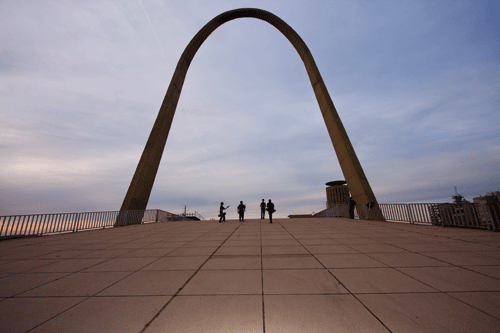
The Rachid Karami International Fair stands tall in the heart of Tripoli, Lebanon, and should be an iconic symbol for this aspiring city. Yet very few people seem to know much about this architectural masterpiece, designed by the world famous Brazilian architect Oscar Niemeyer.

The fair was part of an ambitious plan to modernize Lebanon at large, to focus on the areas outside of Beirut in the 1960s. The master planners nearly achieved their ambition but were foiled by the Lebanese Civil War. Fifty years later, the fair stands as a poignant reminder of what could have been and how stagnant the modernization process of Lebanon remains, with its dilapidated concrete structures holding firm but desperately in need of investment.

Brazilian curves in Tripoli

Oscar Niemeyer, who turned 102 last year, is renowned for his work in his home country Brazil and its capital city, Brasilia. Niemeyer was appointed the master architect for Brasilia — a city built from scratch in the 1950s. The architecture he created was exquisite and won accolades around the world. Dubbed the “King of Curves” for his famous domes, curves and arches, Niemeyer said his distinct style was inspired by “the body of the Brazilian woman.”

President Fouad Chehab commissioned a report from the Institut de Recherche et de Formation en Vue du Developpement (IRFED) in 1961 to appraise Lebanon’s human, economic and social needs. The report highlighted the need to create an economic center away from Beirut, which was sucking up most of Lebanon’s available capital and creating large income disparities with the rest of the country.   

Following the IRFED report, the idea arose for the Rachid Karami International Fair, to turn Tripoli into a more desirable place to live.

“The upgrading project will provide Tripoli with a trendy area filled with housing, commerce, sports, recreation and tourism,” states the profile of the project on Neimeyer’s website. “The International Fair of Lebanon is to be the central attraction in Tripoli: a center of culture, art and recreation; of major importance in its theaters, museums, local sports and entertainment.”

The project was commissioned in 1963 and work gradually commenced, but just shy of its completion in 1975, work halted with the onset of the civil war. A dilapidated structure is largely what remains today but one that still maintains a high potential for renovation.

The buildings of the International Fair are listed on the World Monument Fund Watch List. Although sections of the fair were reopened in 1995 and exhibitions are held in parts of the grounds, the vast majority of the structures have been neglected.

Since 1994 there have been various proposals to redevelop this massive site, many of which have fallen through, overcome by the fair’s expansive 1 million square meter grounds.

“There are a total of 20,000 square meters for exhibitions, of which only half are currently used,” said Antonie Abou Rida, director general of the Rachid Karami International Fair. “Further to this, there is another potential area of 40,000 square meters that could be used as exhibition space if redeveloped.”

Chinese investment

One investor interested in the International Fair is the Chinese government-owned firm Chinamex, which offers Chinese companies a platform to sell goods to retailers and suppliers.

Lebanese industrialist Jacque  Sarraf, chairman of the multifaceted Malia Group, is leading the ambitious joint project with Chinamex to redevelop the International Fair. They have already set up successful hubs around the world in Atlanta, Dubai, Amsterdam and Manchester.

“This is part of a global plan for Chinamex, they need somewhere in the Levant — everywhere else is covered,” said Abou Rida.

Both the Lebanese and the Chinese stress they are keen to protect the architectural heritage of the site. “The design has to be approved by the government and nothing will be changed,” Sarraf said. “No new construction will be added.”


The scale of the project is such that two phases have been laid out. “The first phase plans to bring 1,200 Chinese companies [in] and then the second phase will bring that number up to 3,000,” Sarraf told Executive. The total cost of both phases will be some $29 million. If this project goes through, Tripoli could see dramatic changes as, according to Abou Rida, the project would bring some 3,600 Chinese to Tripoli with their companies, and would provide some 3,000 jobs for locals.

However, trying to convince the Chinese government that the security conditions are good enough in Lebanon is not easy. The government has already given Chinamex an exemption on work visas and import tax. The project, planned to start in 2005, was first delayed by the 2006 war and then indefinitely after the Nahr el-Bared crisis in 2007.

“This situation was made even worse with the financial crisis. The international market is now not the same as it was in 2005,” Sarraf said. It is evident, however, that the Chinese government remains interested.

“Just last week the ambassador of China came to Tripoli to look at the site and see if the project was possible,” said Abou Rida. But Sarraf is cautious as to the prospects, “We just don’t know if it will go ahead or not.”

The IRFED legacy

The Lebanese government is keen not to give up on the project and appears to realize the continued importance of the IRFED report. Tripoli is desperately in need of major investment. There will be many skeptics regarding whether a Chinese company bringing in a significant number of its own labor is the right way to go about this investment. But the government and the Minister for Economy and Trade Mohammed Safadi, in particular, seem convinced and are actively trying to reactivate the project with the Chinese.

“The new government of (Prime Minister Saad) Hariri and (President Michel) Sleiman have a new strategy for foreign investment that should also make it easier for the Chinese to invest, and Safadi will also go to the Shanghai Fair in May,” Sarraf stated.

President Chehab left a lasting legacy that is yet to be completed, with his plans for Lebanon still relevant today. The need to develop an economic center outside Beirut is still as vital in 2010 as it was in 1961, as modernization of the country’s institutions remains as stagnant as ever.

February 3, 2010 0 comments
0 FacebookTwitterPinterestEmail
Finance

Shadows of foreclosure

by Emma Cosgrove February 3, 2010
written by Emma Cosgrove


A Dubai court issued a precedent-setting ruling last month that may be a game changer for the emirate’s real estate market. When the housing bubble burst and Dubai’s properties lost an average of 52 percent of their value, many homeowners fled the country to escape mortgages that had become worth more than the value of their homes.

But British bank Barclays, in the court judgment on January 11, won the right to repossess these properties and auction them off in traditional foreclosure proceedings.

The ruling is the first application of Dubai’s 2008 foreclosure law, which had yet to be put to use. Until 2008, the United Arab Emirates’ legal system made foreclosure and repossession difficult if not impossible, leaving banks with the options of settling loan defaults out of court or simply waiting for the economic climate to improve so that they could begin collecting from their debtors again.

“The court’s decision in Barclays’ favor strengthens our belief that the UAE property market is evolving in line with other mature markets,” said Zeeshan Saleem, Barclays consumer banking director, in a statement. “Customers’ financial wellbeing is our key priority. We understand that the global financial situation may have impacted some of our customers and that they may face challenges in meeting their financial commitments.”

In September, the ratings agency Moody’s predicted that 12 percent of Dubai’s 27,000 mortgages would default within 12 to 18 months. According to UAE central bank statistics, bad or non-performing loans rose by 10 percent from October to November, totaling $8.7 billion.

Price protection

Under the new law, lenders must give 30 days notice before beginning foreclosure proceedings before a judge. If the claim is found to be legitimate, the property is turned over to the Dubai Land Department, which will sell foreclosed properties at auction. If the result of the sale is less than the amount owed by the debtor, the bank may collect the rest from the borrower, in accordance with the mortgage contract.

If, to the contrary, the auction price exceeds the value of the mortgage, the balance is returned to the borrower; with Dubai’s housing market still in the dumps, however, this scenario is unlikely.

According to legal experts, the whole process will take between two and four months.

Though Barclays will be foreclosing on an unnamed number of properties along with the region’s largest mortgage lender, Tamweel, which has several foreclosure proceedings in progress, industry sentiment is that this ruling will not lead to an avalanche of foreclosures before the courts.

“[I’m] not sure if [banks] will be rushing to repossess properties and then have to sell the properties into a still depressed market,” said Robert Thursfield, director of financial institutions at Fitch Ratings.

Christopher Neil, chief executive officer of real estate investment consultancy Landmark Advisory said: “Banks will go to the courts and make use of this law if there is no other way of trying to resolve the default situation, [but] they will try other means before doing so.”

“If, however, the borrower has left the country, then the bank has little choice but to go to court.”

The main worry is that flooding the market with foreclosed properties at auction will bring down prices in an already suffering market.

“The local banks in particular will not want to push prices down further and exacerbate the negative equity in their lending portfolios,” said Neil, adding that this was a common notion across the banking sector.

 “Banks will adopt a number of strategies to avoid foreclosure such as extending payment terms, agreeing to accept interest payments only, deferring interest so that installments become more manageable, or persuading borrowers to downgrade thereby releasing equity for repayment.”

“Eventually when prices rise again, they will then be able to repossess the properties and sell them to cover outstanding debts.”

February 3, 2010 0 comments
0 FacebookTwitterPinterestEmail
Comment

Sectarianism ends at home

by Sami Halabi February 3, 2010
written by Sami Halabi


As Mediterraneans, we Lebanese like to compare ourselves to our Italian counterparts in more ways than one: our food, our way of life, our weather; the list goes on. But one, perhaps less desirable, similarity is just starting to be addressed by our Mediterranean cousins. Last month, an Italian judge ordered a father of a 32-year-old to pay his daughter’s allowance, which came to $490 per month, as well as $16,850 in arrears or risk having his assets confiscated. The ruling was slammed by Italy’s Minister for Public Administration — who described the ruling as “a slap in the face of good sense” — calling for a new law to force Italy’s bamboccionas, roughly translated as ‘big babies’, to leave home by the age of 18.

Generally speaking, laws that dictate to the public how they should conduct their lives are antithetical to free societies; but considering that more than 59 percent of Italians under the age of 34 still live at home, the proposed law could be a welcome exception. 

Looking to our own country, a similar pattern of refusing to fly the nest emerges. The lack of a census makes hard numbers impossible to come by, but the phenomena of the bambocciona in Lebanon is perhaps embodied in a well known Arabic proverb: “Those who live with their parents [can] take it easy.”

Taking it easy, however, has far-reaching economic consequences. Without incentives for progress, societies naturally become inefficient and lose economic footing. Just look at the former Soviet bloc’s economies during the Cold War or that of Cuba’s today. Conversely, societies that push their youth to “find their own path” not only encourage (or force) them to find a job, retain it, and develop their own ideas independently from their family; they also, in effect, encourage integration within society that breaks down cultural stigma and religious discrimination. 

With a little help from the Allies in World War II, the Italians managed to scrap their most deplorable political construct: fascism. Even with the horrors of a 15-year civil war, the Lebanese have still not managed to do away with their primary political ailment, sectarianism, since it reared its ugly head in the mid-1800s.

The conflation between the bambocciona and the protraction of sectarianism in society is significant in the Lebanese context since children are first and foremost susceptible to their parents’ ideologies. In a seemingly endless and vicious cycle, children raised in a sectarian household pick up the bitterness of the previous generation, add their own context to it, and inevitably hand it over to their children. What’s more, young men and women typically leave the nest only when they are married, usually to someone from the same sect and political mindset, thus compounding the problem and making any break of the cycle virtually impossible.

It is almost laughable to observe Lebanon’s political class squabbling over the establishment of a committee to merely study the abolishment of political sectarianism, let alone sectarianism in general. Firstly, those spearheading the initiative — the parliamentary opposition and more specifically the parliamentary speaker — have little political interest in implementing tenants of the Taif accord, which mandated that a non-sectarian senate be formed who’s head would rival the speaker’s for political influence. Hence, it’s quite obvious that the call is little more than a political parry to the parliamentary majority’s thrust over the issue of Hezbollah’s weapons.

For their part, the Christian parties in the parliamentary majority and opposition are up in arms and clinging to the rights accorded to them by the institution of political sectarianism. Those with the most to gain from sectarianism, the country’s religious figures, predictably balked at the mere suggestion of setting up the committee. The last time civil marriage was proposed, the Sunni mufti rejected it outright, as did the Maronite patriarch out of “solidarity” with his Muslim counterpart. To top it off, the prime minister could only muster the sentiment that any agreement should be based on a “consensus,” the Lebanese code word for indefinite delay.  

With all this bickering in the political sphere just to establish a committee, waiting for our “leaders” to resolve the issue is tantamount to “Waiting for Godot.”

While enacting policy in Lebanon to force youths out of their homes and into the real world may be a tad excessive — not least given the economic hardships Lebanon has faced since the end of the civil war — creating the societal structures to produce a healthier and more economically vibrant country has to start somewhere. It’s not going to start in the halls of government, so it might as well start at home. Babies have to stop crying sometime, no matter how big they become.  

SAMI HALABI is the deputy editor of Executive Magazine

February 3, 2010 0 comments
0 FacebookTwitterPinterestEmail
Comment

Tight-lipped Libya’s brazen bluff

by Paul Cochrane February 3, 2010
written by Paul Cochrane

When sanctions against Libya were lifted in 2004, international oil companies (IOCs) viewed the former rogue state as the El Dorado of black gold, and clamored to be the first to exploit the country’s riches after a 30-year hiatus. But five years later, IOCs are reining in their enthusiasm as doubts arise over how much oil Libya really has.

As international relations thawed, Libya’s National Oil Corporation (NOC) embarked on a global campaign to attract IOCs, offering competitive bidding rounds to explore and develop the country’s energy reserves. Part of the enticement was an oft repeated statement that 70 percent of the country was yet to be explored for oil and that Libya had 39 billion barrels in proven reserves.

These ‘facts’ are still doing the rounds, with the “BP Statistical Review of World Energy 2009” and the United States’ International Energy Agency (IEA) stating Libya has 43.7 billion barrels of proven oil reserves. At face value, this would mean Libya has the fourteenth largest reserves in the world and the largest in Africa, ahead of Nigeria’s 36.2 billion barrels.

But Libya, like the majority of oil producing countries, has been playing it thick and fast with their figures. A leading petroleum geologist familiar with Libya, who asked for anonymity so he could still work in the country, told me: “[The reserve] is nothing like that, it is a third to half of that figure.”

That would mean anywhere between 14 to 21 billion barrels, placing Libya second in reserves in Africa, ahead of Algeria’s 12.2 billion barrels. And as for 70 percent of the country being unexplored, that figure is “nonsense; it is very well explored,” said the source.

The geologist added that the amount of reserves that Libya actually has are evident at the NOC’s technical conferences, where diagrams are shown that indicate less than half of the official government figure — if you know what you are looking for. When the presenters are questioned in public, “they squirm,” the source said, but when queried in private on a technical basis they agree that Libya doesn’t have the reserves it claims.

There was further indication that Libya has been inflating the figures when the NOC last year revised their production capacity target of 3 million barrels per day by 2015 down to 2.3 million barrels per day.

The exploration licenses Libya granted to IOCs are also indicative of there being less in the ground than hoped. Out of the 90 wells drilled after the country’s most recent exploration and production sharing arrangements — the EPSA-4 acreage, launched in 2004 — only five discoveries have been made. International oil and gas exploration and production company Occidental has had a zero success rate, drilling 18 dry wells.

IOCs are now banking on the Sirt, Ghadames and Kufra fields to turn up trumps, but even if there are sizable finds they are unlikely to boost the reserve’s figure to 43 billion barrels. The NOC’s current policy is to focus on developing existing fields — there are an estimated 60 to be tapped — rather than offer IOCs expensive tenders to explore territory that may well draw a blank.

So why is Libya cooking the books? One reason is that it attracts more foreign direct investment (FDI) and interest from IOCs, similar to how countries like to boast of huge FDI inflows yet fail to mention that however-many billions of dollars is over 10 years or has been ‘pledged’ in investment — very different from actual annual inflows. Secondly, it puts Libya in a better bargaining position within the Organization of Petroleum Exporting Countries (OPEC) when it comes to oil quotas.

“It isn’t acceptable within the NOC to question [the] numbers because [they are] given for political reasons, for political advantage within OPEC,” said the source.

But why would BP and the IEA back up the Libyan figures? Well, the British oil giant is operating in Libya and presumably doesn’t want to ruffle any feathers. As for the IEA, its credibility came under fire last November when a whistleblower said the agency was deliberately underplaying an impending global shortage over “fears that panic could spread on the financial markets if the figures were brought down further.”

The game that Libya is playing is dangerous and, alas, one that it is not playing alone. Saudi Arabia, the world’s largest oil producer, has never been transparent with its reserve figures, nor are the majority of OPEC producers.

If we can’t take oil reserves at face value and trust them, then how much oil is there? If you subtract 20 odd billion barrels from Libya’s ‘proven’ reserves, and so many billion barrels from, say, Saudi, Algerian and the United Arab Emirates’ reserves, among others, then the total global oil reserves would be substantially less than claimed. It’s time Libya — and everyone else — starts telling it like it really is or the financial markets could be in for yet another turbulent ride.

PAUL COCHRANE is the Middle East correspondent for the International News Services and writes for Petroleum Review

February 3, 2010 0 comments
0 FacebookTwitterPinterestEmail
Comment

Total tiptoes back to Iran

by Gareth Smith February 3, 2010
written by Gareth Smith


President Barack Obama’s Iran policy is complicating the calculations of all parties interested in the country’s vast energy reserves. But along with the resource-hungry Asian tigers, France’s largest oil company is keeping its options open.

Total has long wrestled with the United States’ policy toward Iran, which has obstructed the implementation of its 2004 deal to develop phase 11 of the 26-phase South Pars gas field. For Total, as for energy-hungry nations like China and India, South Pars is a massive prize with 13 trillion cubic meters of gas — around 8 percent of global reserves.

To date, US-led sanctions have slowed down Iran’s exploitation of the world’s second-largest reserves in both oil and natural gas. Measures aimed at US oil companies, enacted in 1996 by President Bill Clinton, have been followed by banking sanctions drawn up under president George W. Bush by Stuart Levey, an official retained by Obama as undersecretary at the Treasury.

New moves in Washington targeting companies linked to Iran’s Islamic Revolutionary Guard Corps (IRGC) are likely to bar from the lucrative US market any company worldwide that does business with companies and individuals on a US hit list, known as Specifically Designated Nationals (SDN). With the IRGC playing a growing role in Iran’s economy, “new intelligence” promised by Levey’s department could extend the SDN well into the energy sector.

Phase 11 of South Pars is slated to produce 2 billion cubic meters per day of gas for a liquefaction plant, South Pars LNG, as well as 70,000 barrels a day of condensate. At present, despite total gas reserves of around 29.6 trillion cubic meters, Iran currently plays only a small role in the global export market, consuming nearly all current domestic production of around 116 billion cubic meters.

For Iran, the production of liquefied natural gas (LNG) is essential for efficient export as it avoids the construction costs and market inflexibility of pipelines. LNG requires a high level of expertise and experience, both of which Total possesses.

Along with Statoil Hydro of Norway, Royal Dutch Shell and Spain’s Repsol, Total long delayed decisions over its involvement in South Pars, partly due to haggling with Tehran over terms but mainly because of sanction fears.

Frustrated at the Western companies’ delay, Iran looked east, agreeing on investment deals of more than $90 billion with Chinese, Indian, Malaysian and Russian companies. Last June, Iran and the Chinese state-owned company China National Petroleum Corp (CNPC), signed a contract for the upstream task of extracting gas from phase 11, apparently replacing Total.

But these investors are relatively untested in LNG, and Iran has no liquefaction plant eight years after work first began on South Pars. Unsurprisingly perhaps, reports continued in the Iranian media throughout last year that Total was working to continue its involvement, although the French company denied it was in talks with Iran.

Then in December Christophe de Margerie, Total’s chief executive, admitted to The Wall Street Journal that the company was keeping its options open over South Pars through wider cooperation with CNPC.

His interview was published shortly after Seifollah Jashnsaz, head of the state-run National Iranian Oil Company (NIOC), told Iran’s Mehr news agency that NIOC had met Total in the second week of that month.

But it seems Total has found a way around the problem. It isn’t talking to NIOC about South Pars, but it is talking to the Chinese.

De Margerie said Total was discussing with CNPC a multibillion-dollar natural gas project in northern China, as well as deals in Iran and Venezuela’s lucrative Carabobo region. Total and CNPC, with Malaysia’s state-owned Petrona, also won the rights to the small Halfaya oil field in Iraq in December. De Margerie portrayed the cooperation as being between Total’s expertise and China’s sheer volume and market presence. And he confirmed that Total was talking to CNPC about cooperation over South Pars — presumably as CNPC benefits from Total’s expertise in liquefaction, the key challenge in the Iranian field.

Exactly what form this work could take without upsetting Washington is unclear. De Margerie insisted Total would still prefer a comprehensive deal including gas extraction, its transformation into LNG and the export of LNG — something that would be incompatible with US sanctions. But short of this, Total is surely signaling it wants to keep open its interest in Iran.

For Tehran, the stakes could barely be higher as it plans to spend $200 billion to double gas production by 2014. While Iran’s oil revenue is recovering along with the recovery of oil prices to around $80 a barrel from $40 in February 2009, developing gas reserves remains a necessity if the country is to meet an ambitious growth target of 8 percent. Improving growth from the current 2.2 percent projected for 2010 by the International Monetary Fund is an urgent necessity if the authorities are to provide employment for young people and ease political unrest. Total may still play an important role in realizing these goals.

Gareth Smyth is the former Tehran correspondent for The Financial Times

February 3, 2010 0 comments
0 FacebookTwitterPinterestEmail
  • 1
  • …
  • 431
  • 432
  • 433
  • 434
  • 435
  • …
  • 685

Latest Cover

About us

Since its first edition emerged on the newsstands in 1999, Executive Magazine has been dedicated to providing its readers with the most up-to-date local and regional business news. Executive is a monthly business magazine that offers readers in-depth analyses on the Lebanese world of commerce, covering all the major sectors – from banking, finance, and insurance to technology, tourism, hospitality, media, and retail.

  • Donate
  • Our Purpose
  • Contact Us

Sign up for our newsletter

[contact-form-7 id=”27812″ title=”FooterSubscription”]

  • Facebook
  • Twitter
  • Instagram
  • Linkedin
  • Youtube
Executive Magazine
  • ISSUES
    • Current Issue
    • Past issues
  • BUSINESS
  • ECONOMICS & POLICY
  • OPINION
  • SPECIAL REPORTS
  • EXECUTIVE TALKS
  • MOVEMENTS
    • Change the image
    • Cannes lions
    • Transparency & accountability
    • ECONOMIC ROADMAP
    • Say No to Corruption
    • The Lebanon media development initiative
    • LPSN Policy Asks
    • Advocating the preservation of deposits
  • JOIN US
    • Join our movement
    • Attend our events
    • Receive updates
    • Connect with us
  • DONATE