• Donate
  • Our Purpose
  • Contact Us
Executive Magazine
  • ISSUES
    • Current Issue
    • Past issues
  • BUSINESS
  • ECONOMICS & POLICY
  • OPINION
  • SPECIAL REPORTS
  • EXECUTIVE TALKS
  • MOVEMENTS
    • Change the image
    • Cannes lions
    • Transparency & accountability
    • ECONOMIC ROADMAP
    • Say No to Corruption
    • The Lebanon media development initiative
    • LPSN Policy Asks
    • Advocating the preservation of deposits
  • JOIN US
    • Join our movement
    • Attend our events
    • Receive updates
    • Connect with us
  • DONATE
GCC

Private equity – Bigger, fewer, more focused

by Executive Staff April 3, 2009
written by Executive Staff


Predicating the future has never been an easy task and it has gotten no easier today. Charlatans with crystal balls are in ample supply however, especially when it comes to the lifeblood of the region. Last year when the price of oil was at around $150 a barrel, Merrill Lynch was predicting that the price would reach anywhere between $180 to $200 a barrel. Last December their figure was around $25 per barrel. According to Business Monitor International (BMI) and OPEC, the 2009 average for oil prices will level out at around $50 a barrel. All of this ‘shooting in the dark’ leaves private equity (PE) firms — and everyone else for that matter — at a loss with regard to how much cash flow will be generated in the region in the near future.

Therefore, ignoring the predictions is probably the best way to go about handling the issue of oil prices. Nevertheless, “Oil will remain the backdrop on which we exist,” said Arif Naqvi, CEO of Abraaj Capital, while speaking on a panel at last month’s PE investment international conference in Dubai. “Everyone is happy with $60 to 80 per barrel,” he went on to say. While the intrepid CEO may be wrong about what everyone’s satisfaction levels are pertaining to the price of oil — even if the budgets of countries around the region are positioned well below the $50 a barrel mark — there can be little doubt that he is right in that without an ample supply of petrodollars, the PE industry’s prospects for growth are not promising.

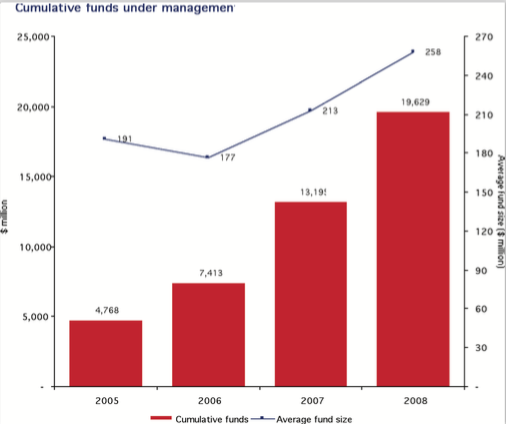
The average fund size in 2008 registered at around $258 million, up from around $177 million in 2006, according to research conducted by Zawya Private Equity Monitor (ZPEM) and the Gulf Venture Capital Association (GVCA).

Coming together

That said, there has been much debate within the industry regarding where future investment will be targeted and how the landscape of the industry will look.

“We expect this trend [of larger funds] to continue, with a smaller number of larger general partners leading the industry through its next phase of evolution,” wrote Vikas Papriwal, partner private equity and sovereign wealth funds at KPMG, in the annual GVCA Private Equity and Venture Capital in the Middle East report.

In support of the argument that larger and more diversified firms will rule the day, many observers point to the prospects of mergers and acquisitions between funds that seem to be in the pipeline.

“There are growing signs that a cooling market, tightening liquidity and rising borrowing costs could prompt a wave of consolidation in the region,” says James Tanner, head of Placement and Relationship Management.

Imad Ghandour, executive director of Gulf Capital, notes that “there has been an increase recently in funds buying from each other.”

On the surface things may look to be stagnant, but things are happening out of sight. “There are quite discrete asset sales and processes going on. Every week someone says, ‘officially we are not really selling, but unofficially here is what’s available,’” says Yahya Jalil, senior executive officer and head of private equity at The National Investor in Dubai. This may not seem surprising given that worldwide the value of companies PE firms are holding has decreased by around 50 percent, according to The Economist. Moreover, only half of the funds announced since 2006 have so far been raised and approximately $11.7 billion of announced funds in 2006 to 2008 have failed to make a close, according to ZPEM and the GVCA. Clearly the number of PE funds in the region will need to be consolidated greatly.

This new makeup of funds, however, does not necessarily predicate the fact that these consolidated funds will be attractive to investors, who are becoming more prudent and concerned with specialization as opposed to reputation.

“When investors begin to deploy money again it is going to be less to general funds that have generic purposes and more to specific opportunity funds. They will begin to ask the PE firms about the specific opportunities present where the firm wants to invest their money,” says Hisham El Khazindar, managing director and co-founder of Citadel Capital.

Ammar Al-Khudairy, managing director and CEO of Amwal Al Khaleej Investment Co., remarks that, “the asset accumulation firms are less in fashion than they were a year ago. The pure dedicated type of firms are more in fashion; this is the new paradigm without a doubt.” He adds that “institutional investors much prefer to deal with people who do nothing but PE. They are being much more selective and a larger size is not one of the selection criteria; they see it as a negative aspect.”

What will the future hold? The argument seems to be far from over, but given the two opposing forces in the market and the eventual equilibrium that will have to be met, in all likelihood “there will be a ‘happy medium’ and funds will not want to go over $10 billion,” concluded one senior PE executive.

April 3, 2009 0 comments
0 FacebookTwitterPinterestEmail
Finance

Qatar – A pearl of prudence

by Executive Staff April 3, 2009
written by Executive Staff

Watching their regional counterparts struggle to stay afloat, banks in Qatar are making very calculated and prudent moves this year. While the global financial turmoil has not hit the Qatari banking sector as hard as other GCC nations, bankers and analysts alike are expecting the ripple effect of the crisis to arrive sooner than later. Fortunately, most banks in the pearl of the Gulf did not invest heavily in structured products or toxic assets — as many other banks in the region did — which has helped Qatar avoid major a fallout in its small, yet robust, banking sector.

With a predicted real GDP growth of around 8.5 percent in 2009, today Qatar is one of the fastest growing economies in the world. As global markets face an indefinite period of recession, many investors are looking for financial safe havens. With its diverse and relatively peppy economy, Qatar hopes bankers and investors will continue to flock to the country and help it achieve financial supremacy over its oil-poor neighbors Bahrain and Dubai. With many multi-billion dollar projects spanning numerous industries in the works, the banking sector would be a major beneficiary of such developments. Unfortunately, due to the global economic slowdown, many of those projects are expected to be delayed or cancelled, leaving banks to feel the blow in their loan portfolios. But thanks to major diversification strategies, banks in Qatar are believed to be well protected against any aftershocks the global meltdown could send their way.

Sovereign serenity
Despite the inevitable slowdown in growth, with the affluent government standing behind its economy all sectors are expected to perform adequately this year. The resilience of the banking sector, according to Mohamed Damak, a rating specialist in financial services at Standard & Poor’s, is “above average,” which is “mainly due to the combination of lower exposure to structured investment products” and the proactive role taken by the Qatari government. For example, in the fourth quarter of 2008, the Qatar Investment Authority (QIA) announced its plans to acquire between 10 and 20 percent ownership in every local bank — of which there are 11 total — helping to increase confidence across the banking sector and to boost liquidity conditions in the market. More recently, at the end of March 2009, the government purchased $1.8 billion worth of local banks’ investment portfolios in order to share the burden of such funds, revive lending, boost liquidity and to support the economy.
While this latest act has been welcomed with open arms by banks across the country, Raj Madha, director of equity research at EFG-Hermes in Dubai, points out “the reality is this is essentially a free gift from the government. It does have the negative impact of encouraging risky behavior on the basis of relying on the government to act as a backstop. However, given the very unusual nature of the current global situation, it may seem reasonable to make an exception on this occasion.”
Still, Madha views this “start of greater intervention from the government” as “positive for valuations, underpinning that the government stands behind the [banking] sector in case of a blow up. Clearly,” he cautions, “this creates some moral hazard, but this is not really the market to be worrying about moral hazard and perverse incentives.”
Abdulbasit A. Al-Shaibei, chief executive officer of Qatar International Islamic Bank (QIIB), believes that this move “is a prudent strategy [by] the government of Qatar,” while calling the sovereign’s decision — unsurprisingly — “generous” toward local banks.
But, Madha highlights, one must not forget that “credit portfolios are still exposed” and the government’s purchase of investment portfolios “has no impact on loan provisioning.” As far as the central bank’s role is concerned, the majority of observers seem to be quite content with how well the institution is managing its banking sector.
Elena Panayiotou, an analyst at Moody’s Investors Service, trusts that Qatar Central Bank (QCB) “aims to exercise sufficient prudential control and supervision of the local banking sector and to harmonize Qatari banking regulations with international standards, as well as to address specific risk areas.”
Damak reiterates this sentiment, saying, “the [QCB] is hands-on with risk issues, meaning they are aware of the different risks and they tend to be proactive when dealing with risks.” In general, Damak — like Madha — sees the “interventionist” attitude of the government as a positive thing. In the event of an emergency, he believes, Qatari banks can expect to “see some kind of extraordinary support.”
Overall, there is no disagreement about the supportive role played by the Qatari government toward its banking sector. Yet, despite the copious sovereign support, “the main issue will be whether the government spending will take up the slack from slower growth in the private sector,” warns Madha.

Home is where the heart is
Before the international financial crisis began, banks around the world — Qatar included — were looking abroad. Whether it was for cross border investments, lending or general expansion, Qatari banks “were a bit aggressive in terms of going abroad,” notes Al-Shaibei. In 2009, he says, “Qatari banks will focus more on the local market [and] concentrate on strengthening their equity base.”
Over the past five years, contends Damak, banks have been “growing tremendously.” Qatar National Bank (QNB), Commercial Bank of Qatar (CBQ) and Doha Bank (DB) alone have witnessed a growth rate of 43.2 percent in 2008, Damak discloses.
Madha agrees, saying that last year “was all about growth and finding new areas to expand the balance sheet into. This year, growth is almost a bad word, with banks focusing primarily on profitability.”
Panayiotou emphasizes “a slowdown in the Qatari banks’ business growth, reflecting the current global economic environment, the tightened funding conditions both domestically and internationally, [as well as] the banks’ more risk-averse behavior.” Strategically, banks will have to “apply more prudent lending policies, particularly in the retail sector as consumer indebtedness in the country rises and as the risk element of the segment increases,” she adds. According to Moody’s data, Panayiotou explains, personal loans have one of the highest delinquency rates in the entire Qatari banking system.
Robert Thursfield, a director in the financial institutions group at Fitch Ratings in Dubai, chimes in saying that “lending growth is likely to be slower” this year in the Qatari banking sector.

Risky business
Due to the declining property market in Qatar, banks will indubitably be adopting a shrewder attitude towards developers and customers alike. Even though the Qatari property market conditions are not nearly as severe as those in Dubai, it is still a crucial concern for the banking sector. Mortgage lending will witness a significantly more conservative approach, insists Damak, as “the expected decline in property prices will have some manageable effects on the Qatari banking system… and the fact that some of the projects will be delayed or cancelled will translate into lower opportunities for growth going forward.”
Al-Shaibei admits, “Of course, we will get hit because of the drop in property prices.”
Panayiotou illustrates the deteriorating real estate situation in the country, saying “a further decrease in demand in the Qatari property market will lead to slower growth in the financing of the construction and the real estate sectors in the country.”
Luckily, Al-Shaibei insists, “everything will be manageable. [The real estate issue] is not going to get out of control.” All local banks are heavily dependent on government projects, so thankfully for them the sovereign’s damage control should be sufficient to deal with any property contractions. Bank growth is also expected to slow due to continued declining liquidity.
Liquidity in the Qatari banking sector is currently adequate, but like in every other economy around the world, it is expected to tighten significantly as the crisis unfolds. Experts unanimously agree that liquidity has been declining in the Qatari banking system lately. The extended and unknown period of global distress is, explains Panayiotou, “expected to lead to a tightening of the banks’ liquidity levels, particularly as funding conditions in Qatar and in international markets continue to be challenging.”
This year, banks in the country will be targeting lower growth than ever before in order to preserve liquidity in the long run and to achieve realistic profitability goals. In terms of balance sheet growth, Madha says, “Qatari banks are now reducing their expectations to low double digits, from the stratospheric levels we saw in 2006 through 2008. This will require some shift in mentality, with banks being much more selective about providing credit.”
Damak asserts that this year, “preserving liquidity and asset quality indicators” will be top priorities on the agendas of local banks.
Seeing as banks are prominently dependent on customer deposits, there is “[f]ierce competition in Qatar in attracting deposits, together with the challenging conditions in the inter-bank and wholesale markets, [which] is likely to put pressure on banks’ funding and liquidity levels going forward,” voices Panayiotou. The good news, she proclaims, is that Moody’s’ concerns “are partly mitigated by the government’s strong financial position and its significant and growing contribution to the Qatari banks’ funding base.”
Another risk, noted by both Panayiotou at Moody’s and Damak from Standard & Poor’s, is the banks exposures to the Doha Stock Market (DSM). Damak warns that Qatari banks will have “some exposure to the stock market and with this decline we will see some one-off effects on profitability if the stock market is not stabilized during the remaining quarters [of 2009].”

What to do
In order to avoid financial catastrophes, Qatari banks will have to act preemptively on a number of fronts. First and foremost, banks must maintain, if not boost, their current liquidity conditions in order to safeguard themselves from future crises in either global or local markets. Secondly, banks should be cautious with provisioning and balance sheet security. Damak stresses the need for calculated risk management, as the international operating environment is clearly not as favorable as it used to be. Also, he says, taking good care of credit and funding is important to banks’ success and protection in the current circumstances. Panayiotou draws attention to the banks’ “need to identify and finance clients that provide good returns with relatively low risk profile, while at the same time ensuring that they take early remedial actions in cases where delinquency rates of existing clients start to rise.”
Prudent moves and preventative measures are the safest best for Qatari banks in 2009. To date, Qatar’s banking sector has been able to avoid any major hits on its domestic front from the global financial crisis, but symptoms of the downturn are likely this year with anticipated slower growth and tightened liquidity conditions.

April 3, 2009 0 comments
0 FacebookTwitterPinterestEmail
GCC

Private equity – Where to scare up the cash

by Executive Staff April 3, 2009
written by Executive Staff


In times of crisis come times of great opportunity, or so we are told. The proverb does seem to bear some truth, however, when applied to the regional private equity (PE) market. Perhaps for too long, PE activity has been focused on a few hotspots in the Middle East and North Africa and has neglected many of untapped or fundamentally solid areas. Now there is little choice when it comes to being picky; firms need to go where the opportunities are rife and many countries in the region are taking advantage of the newfound openness towards expansionism that has taken hold of the industry.

The first country in the cross hairs seems to be Saudi Arabia. The usual criticisms of Saudi being a cumbersome and overly conservative market have turned out to be unfounded. Both Saudi Arabia’s central bank and its sovereign wealth fund (SWF) are coming out of this financial debacle much less scarred than most of their regional counterparts, but that’s not to say they have been unaffected.

“There will be an increased reliance on cash coming out of places such as Saudi… which are unlikely to be so badly affected by current market conditions,” says Robert Hall, head of transaction services Middle East & South Asia at KPMG. Others are more reserved in their analysis.

Ammar Al-Khudairy, managing director and CEO of Amwal Al Khaleej Investment Co, says “I would not point out Saudi Arabia as a bastion or a haven of still available money. It is a haven of less economic turmoil without a doubt. That does not, however, necessarily give investors more comfort than other markets vis-à-vis deployment or fresh commitment of capital.”

Flow like the Nile

Another country that looks to continue its upward trend despite the effects of the global downturn is Egypt. The land of the pharaohs has already attracted $2.8 billion in PE investments (33 percent of total MENA investments) since 2005 according to Zawya Private Equity Monitor and the Gulf Venture Capital Association. Even though this figure is largely attributed to Abraaj’s investments of $1.4 billion in the Egyptian Fertilizer’s Company (EFC) and a $501 million investment in EFG Hermes in 2006, Egypt is expected to continue to attract investment from PE firms desperate for buying opportunities.

“There is a positive outlook on the medium to long-term prospects of Egypt because of the demographics, reforms and the fact that Europe needs the southern Mediterranean basin as a manufacturing base because of environmental and cost of labor issues,” says Al Khudairy.

For the more risk-prone capitalist there is always Iraq which, despite its obvious shortcomings, cannot be written off when considering investment opportunities in the region.

“Obviously Iraq has its challenges, but PE is a local business and you need to be there early,” says Hisham El Khazindar, managing director and co-founder of Citadel Capital. In theory, the promise of post-conflict Iraq is monumental given its oil reserves, demographics and the amount of greenfields on offer for potential investors. However, other industry heavyweights would rather pay more when and if the political risks of Iraq ever do subside.

“Iraq still has significant geopolitical risks and we won’t know the full effect of these risks until the US winds down its occupation,” says a regional PE chief executive who spoke on condition of anonymity. “I would rather pay three times the amount [for a company] without a civil war than with one.”

Preservation is key

The regional PE sector is at a crossroads, or perhaps the more accurate term would be a U-turn. Gone are the days when investors lined up to throw money at PE firms. Today, what separates the wheat from the chaff will be cold hard cash.

“If you have already raised money then you will be OK, if you haven’t then you are in trouble,” says Imad Ghandour, executive director of Gulf Capital. That notion becomes even more reinforced when one considers that leveraging options have all but dried up for the immediate future.

“I do not see previous levels of leveraged investments restored in the foreseeable future, as the market will need to clear excess leverage,” says Rami Bazzi, senior executive officer at Injazat Capital. Al Khudairy adds that, “leveraging is gone for two or three years at least.”

As regional PE firms move forward, the key to surviving will be to take care of ones own and keep limited partners happy whether or not the bottom has been reached.

“The bottom may have been reached but it is important to remain disciplined and stay focused on your existing portfolio a little bit longer, to make sure it is in good form and weathering the storm before starting to get distracted by some of the great opportunities, even if it means you miss the bottom,” says El Khazindar.

The ride has been bumpy and it’s not over yet. What remains to be seen is whether regional PE firms will hold on for the ride or if they will be thrown to the wayside.

“We have had a rising tide that lifted all the boats and the industry never had to really roll up its sleeves and do the dirty work as portfolio companies,” says Yahya Jalil, senior executive officer and head of private equity at The National Investor in Dubai. “That time is now at hand.”

April 3, 2009 0 comments
0 FacebookTwitterPinterestEmail
Capitalist Culture

Ethics – The need for greed

by Michael Young April 3, 2009
written by Michael Young

Ever since the financial crisis hit last October, rarely a day goes by without another article being published suggesting how we must all develop a greater social conscience when it comes to economic affairs.

That word “conscience” is an interesting one, both for its quasi-religious overtones and for the fact that use of the word in the last, let’s say, 25 years, when free- market capitalism was accorded near mystical status, could assure you a life sentence with hard mockery.

Take for example what the sociologist Amitai Etzioni recently had to say about the good life, and how to achieve it in the shadow of the global economic crisis. Lamenting consumer voracity in the capitalist system, he observed: “Only after we come to see that additional goods add precious little to our happiness; that pursuing them is Sisyphean — the more we gain, the more we seek; and that deep contentment and human flourishing rise out of spiritual projects and bonding with and caring for others, shall we be able to come to terms with much that bedevils us.”

These are doubtless noble thoughts, and who can deny that the financial crisis was, in large part, a result of a system that didn’t know when to put order in the increasingly rickety credit edifice, because the rising profits were too alluring. However, what is galling in absolutist pontifications like those of Etizioni is that they seem to imply that everything about capital expansion in the past decade and more, and even the capitalist system in general, has been about greed. Certainly greed played a large part of it — but then again, what is the motor of an expanding economy except a desire to accumulate, therefore a certain kind of greed?

And it was not all about unalloyed greed. The expansion of sub-prime mortgages in the housing market allowed those who, hitherto, could not purchase a home, to do so. The market ultimately collapsed, the regulatory framework was a shambles, but the rationale behind the loosening of credit conditions was in many ways defensible. There was more money circulating in the market, so why not allow more people to benefit from this? In this period of rapid change, economies grew, spurred on for most of this period and until last year by low oil prices, pushing consumption up and allowing countries like China and India, with their large populations, to expand employment and reduce poverty.

Nothing odd here; these are the normal tropes of an expanding economic order. Of course, the critics have more often been loudest in their censure of the poorly understood market for derivatives, whose value in connection with palpable economic benchmarks was always dangerously vague. However, when one calls for “spiritual projects and bonding with and caring for others,” that is an implicit attack on the very foundations of the capitalist economy, sounding warning bells that the backlash against that economy may be even more excessive than its unquestioning defense.

What is disturbing in the sudden onrush of moral sanctimoniousness in the markets is the increasing effort in many societies to go overboard in legislating morality — or more perniciously, in legislating day-to-day behavior on moral grounds. Why is this a problem? Largely because it is often unclear who decides what is virtuous in the marketplace. It need not always be the state, but can be a vocal minority, which, because of its effectiveness, can ultimately impose its will on a majority. This seems to have been the case, for example, with anti-smoking crusaders who over the decades turned the debate over public smoking into largely a moral one, managing to transform smokers into pariahs banished to the sidewalks of most Western cities.

But let’s assume for a moment that it is the state that legislates virtue. How does it effectively do so in the markets? Certainly tighter regulatory frameworks can be introduced to protect investors and prevent destructive market meltdowns; certainly too, more public money can be put into socially meritorious projects, or into, let’s say, more foreign aid to countries in need. However, nothing can or will alter the essential greed at the heart of capitalism, and nothing should. When states take onto themselves the duty of creating more righteous orders, this becomes social engineering, and the dangers to society only multiply.

There are many lessons to be learned from the financial crisis, not least that this may be as close as we will ever get to a bottomless pit of capital loss. That the markets will need deep reform in the coming years is obvious. But we should get a grip. We’re not on the verge of a new ethical metamorphosis when it comes to the nature of capitalism, nor should we welcome such a thing. In difficult times people become extreme. And nothing is more extreme than an overdose of morality in a financial system that, by definition, demands healthy amorality.

April 3, 2009 0 comments
0 FacebookTwitterPinterestEmail
GCC

Abu Dhabi – A sure and steady rise

by Executive Staff April 3, 2009
written by Executive Staff

Abu Dhabi, the capital of the United Arab Emirates and the largest of the seven, has been overlooked for years by investors and entrepreneurs who tended to consider Dubai a more attractive destination. Yet the capital did not stand idle. The fact that Abu Dhabi possesses 10 percent of the world’s oil, five percent of its gas reserves and that it produces 90 percent of oil in the UAE, has enabled it to diversify its economy by investing heavily in infrastructure, real estate, tourism, financial services and other key sectors. In 2007, the Urban Planning Council released the Abu Dhabi 2030 plan, which has been the foundation for the growth of the real estate sector. Dr. Hanni Shammah, CEO of Bloom Properties, believes that Abu Dhabi is trying to become a global city, in line with New York, London and Hong Kong.

“Abu Dhabi is in the midst of a structural change. It is rebranding and repositioning itself with the rulers aspiring to transform the city into a global and cosmopolitan city, while keeping a proud Arab/Emirati identity,” says Shammah.
A major problem for Abu Dhabi since the beginning of its boom has been the lack of real estate supply, whether residential or commercial. Consequently, the capital became more expensive than Dubai. Mohammed Al Haj, CEO of MBI, a venture capital firm that specializes in properties and financial investments, say that since the UAE government aims to attract investors from around the world, it expected the inflow of expatriates would take 10 years.
“What happened is that the region was attractive and the oil prices were dramatically high, which attracted all those people in only three or four years,” he explains. “Therefore, the demand was really high and the infrastructure wasn’t ready.”
Due to the tremendous shortage of supply and Abu Dhabi’s long-term plan, the real estate market grew quickly. Major residential and commercial projects were being launched and developed, while demand escalated. But oil wealth has proven to be insufficient to protect Abu Dhabi from the impact of the current crisis. Although the capital has strong market fundamentals, demand for most real estate segments has gone down, prices and rents of residential properties are decreasing, and bank financing is becoming less available.

Residential prices
Before the financial crisis started to impact residential real estate prices in Abu Dhabi, they were escalating rapidly. Buyers were acquiring property despite the high prices, encouraged by the promising economic growth of the capital in general and the housing market in particular. According to the Landmark Advisory first quarter 2009 report, even though the fourth quarter of last year witnessed a softening in villa and apartment prices, they increased 80 and 55 percent respectively for 2008.

End-user demand is high in Abu Dhabi, but it was not the only reason prices escalated. Speculators saw the capital as the next best thing after Dubai and aimed to make the same returns on real estate investments.

Shammah says, “I know several people who got a bit greedy and instead of investing in a single property they went for whole floors and multiple units, while not necessarily having the means to digest such investments.” He added that prices in restricted areas have been more resilient to the current conditions as opposed to freehold areas. “Most price decreases that I have seen in freehold areas were within the 20 to 30 percent range,” he adds.

Hussain Ali Al Shamkhani, chief investment officer at Escan, agrees with Shammah, but he believes that because Abu Dhabi opened up its market recently, speculators have not had as much time to affect the market. This means end- user demand has been a more significant factor.

“There was not enough time — [the speculators] would have made one flip, two if they were lucky, but I believe that most of them did not have the chance to,” he says.Whether the prime driver of the market was speculators or end-users, one sure thing is that the former are out of the market right now and the latter are more conscious about purchases. The factors behind the decreasing demand are mainly the lack of financing, as well as uncertainty and lack of confidence in the real estate market and the economy in general. Consequently, prices started to decline, going back to their original values in some cases. The Landmark report states that since their peak in the third quarter of 2008, prices of villas have decreased 20 to 25 percent, while prices of apartments declined by 15 to 20 percent. The report adds that Abu Dhabi’s master developments like Al Raha Beach, Al Reef, Al Reem Island and Hydra Village were the most affected. Al Reem witnessed the biggest plunge declining from 20 to 25 percent between the third quarter of 2008 and March of this year. Listings for Al Raha Beach and Reem Island suffered a 10 to 15 percent decline in the same period.
Hesham Ikhwan, branch manager at the newly opened Landmark Properties in Abu Dhabi, believes the fundamentals of Abu Dhabi are still sound, since demand is still higher than supply. He attributes the fall in prices to two things: the financial crisis and the soaring prices featured at last year’s Cityscape.
“At Cityscape last year, developers launched their projects at very high prices, which were around 2,000- 2,500 AED ($540-$680) per square foot, so when investors bought [the properties] they could not sell them right afterwards as usual. So it took the market a while to realize that obviously prices were too high, therefore it leveled off for a while and then [prices] started to decrease.”
It is important to differentiate between off-plan units and those completed or under construction. Off-plan units have been the worst hit since people are currently looking for properties that will give them immediate returns, either by renting or occupying them so they don’t have to pay rent. Loshini Lawrence, operations manager at the Abu Dhabi branch of Better Homes, explains “banks are not offering mortgages on off-plan properties right now. They are more focusing on ready projects in Abu Dhabi.”

Since end-users currently dominate the market, they will certainly find finished properties more suitable. Paying rent for a couple of years until the delivery date of a new apartment is expensive, further completed projects are easier to finance and less vulnerable to volatility.

“If you have an off-plan unit and you are trying to sell, good luck!” says Al-Shamkhani, explaining that while completed projects are best positioned, those under construction have had their share of price declines as well. “People are hearing that developers are going to delay or top construction, citing the lack of funding. For example, if it is now the time to make your fourth or fifth payment, you have to rely on your own money,” he furthers.

Experts agree that the price correction in Abu Dhabi residential real estate is healthy in the long run and essential to bring prices back to more affordable levels.

“If prices can be in a range from 400AED ($108) per square foot to 1,000AED ($270) in residential properties, [it]

Distressed assets ripe for the picking

The ongoing global liquidity crisis has put the completion of many real estate developments in the UAE and the region into question, since developers, who relied heavily on banks or off-plan sales for construction, have found themselves with empty pockets and no equity to cover their costs. Consequently, these projects have decreased in value and some institutional investors and high-net- worth individuals who can still secure financing see these assets as good investment opportunities.

Duncan Pickering, real estate partner at DLA Piper in Abu Dhabi explains, “distressed assets generally come from borrowers who default or who are about to default. Banks would generally be working with the company to negotiate an exit or sell the property, and generally, for companies that are holding on to the distressed assets, time is running out for them so they need to find a resolution quickly.”

Property consultant Jones Lang LaSalle announced mid- March that $1.98 billion worth of equity is waiting to be invested in distressed assets in the GCC region, the most attractive destinations being Abu Dhabi, Qatar and Saudi Arabia. The Dubai real estate developer Cirrus Development revealed in the same month an international fund to buy distressed assets in Dubai, the US and the UK, targeting prime real estate and hospitality assets. Moreover, the US- based property firm Tate Capital also began a two-month study to identify investment opportunities in the UAE. By acquiring distressed assets, Tate Capital is aiming to create a long-term income stream for the company. Morgan Stanley also announced in January its plan to acquire distressed assets around the world, including in the Middle East, by establishing five global funds.
Pickering expects that “there will be funds from all around the world that are looking at the Middle East to see whether they can pickup distressed assets.” However, these assets are associated with some risks. “One of the key risks is failure to carry out adequate due diligence either because the deal has to be done very quickly or because the seller has limited information or inaccurate records. The seller may be under pressure from the lender to sell,” says Pickering. For example, in Abu Dhabi, there is no public register to check if a particular development was partly sold and contracts were exchanged, which would make it harder for the investors to make a decision. The lack of reliable information would make the right price of the asset very hard to determine. “The opportunity to buy distressed assets is really only as good as the investors’ ability to negotiate the right price,” adds Pickering.

“We always recommend a buyer get full disclosure from the selling management team as soon as possible. Unless information is available, the purchaser cannot decide if there is an investment opportunity that is worth exploring — it takes a lot of money and time to carry out such an investigation,” he further explicates.
Investors appear to still be in the exploration and investigation process, since there have been no big announcements about this type of transaction yet. However, it is expected that in the near future investments of this nature will take place.


While the speculative market may be dead, experts say property values will increase in the long run. Oscar Marquez, a real estate trainer at the Leader’s Edge Training says, “real estate will always double in value. I remember when I first got into real estate [and] started to sell houses for $150,000. Now the same house is selling for $600,000. That was 20 years ago. Twenty years from today the house worth $600,000 is going to be $1.2 million.”

Residential rents
As Abu Dhabi attracted resident expatriates, the demand for leased property grew and rental rates increased accordingly, especially for residential apartments. According to the Landmark report, average rental rates for residential villas and apartments in the fourth quarter of 2008 were 35 and 80 percent higher than in the same period of 2007. During the fourth quarter, one-bedroom apartments witnessed the biggest hike as they registered a 125 percent increase in rents, followed by two and three bedroom units at 95 and 100 percent, respectively.

High rents, coupled with low availability in Abu Dhabi, caused some people to commute to work in the capital while living in Dubai.

Lawrence said, “you may pay three times [the rent] in Abu Dhabi for the same accommodation that you would pay in Dubai. People are not ready to pay that much anymore, they are doing their homework and negotiating the price and the number of payments.”

Al Haj of MBI thinks that rents soared even more than the report stated. “It depends on the location, but in some place, rents increased 90 percent and even 100 percent. For example, now if I am renting a house and paying 20,000 AED ($5,400) if I move out, the new tenant would pay 80,000AED ($21,000). Some owners are willing to pay current tenants one year of rent in order to move so that they can bring a new tenant and make him pay more,” Al Haj explained. Hence, tenants who pay affordable rents consider themselves lucky and try to renew their contracts benefitting from the low, five percent rent cap in Abu Dhabi.

Rents are holding stronger than prices since people who are reluctant to buy still need a place to live. Unlike Dubai, people are not leaving the capital due to job losses or the closing of companies. The Landmark report states that apartments witnessed an increase of two to three percent in the last quarter and another one to two percent in the first two months of the year. Villa rental rates decreased three to five percent in the last quarter and recovered by two to three percent during January and February.

The fact that villa rental rates decreased was because more units are coming on stream, which increases availability and “tenants have more [options] for villas, like in Al Raha Garden and Al Khalifa city, but for apartments they are very hard to find, especially the two bedroom apartments,” said Ikhwan from Landmark.
Rents are not expected to slowdown, since demand is still strong and supply is expected to remain short in the next couple of years.

Matthew Green, associate director of CB Richard Ellis in Abu Dhabi, says that rents are expected to hold stronger than in Dubai since “in Abu Dhabi, we can say that on average there will be 8,000 to 10,000 [new units] in the next couple of years, while Dubai has been averaging 30,000 units per year.”

Office space
Soaring demand has also hit offices, since Abu Dhabi was becoming an attractive destination for new businesses, branches and relocations. Consequently, there is an even bigger supply gap than in the residential market and new companies have found it more appropriate to use commercial villas as offices. CB Richard Ellis’ fourth quarter Abu Dhabi report stated that even though rental rates started to soften in the fourth quarter of 2008, there was a 30 percent overall increase during the year. Lawrence from Better Homes, whose office is located in a commercial villa, explains, “when we chose the villa, it wasn’t the cheapest, but we had no choice. There was no tower space available.”

Many companies opening in Abu Dhabi face the same difficulties. Not only is finding office space a problem, but finding a place to park is a major issue as well. According to Al-Shamkhani from Escan,“if you go downtown in Abu Dhabi, good luck finding a parking space. Sometimes you have to drive around 15 minutes or up to an hour to find a spot, so villas are more convenient.”

Companies are currently cautious about expansion plans and are picking more affordable and smaller offices. According to Asteco’s fourth quarter Abu Dhabi real estate report, demand for large offices has decreased slightly, while demand for smaller offices, between 50 and 100 square meters, has increased. Experts predict the market will maintain high prices until new offices come online.

Future outlook
Compared to its neighbor Dubai, Abu Dhabi has not gone as far in terms of growth and development, but that should not be considered a disadvantage in these tumultuous times. What happens in Dubai happens in Abu Dhabi on a smaller, more delayed scale. This gives Abu Dhabi the opportunity to anticipate, either by improving its property laws, trying to secure financing or controlling the market supply. Simply said, as Dubai suffers, Abu Dhabi learns.

April 3, 2009 0 comments
0 FacebookTwitterPinterestEmail
GCC

The dollar’s exposure

by Executive Staff March 22, 2009
written by Executive Staff

“The dollar is our currency, but your problem,” quipped US Secretary of the Treasury, John Connolly, to his European counterparts in 1971. Today, nearly 40 years later, his words couldn’t ring truer. While the value of the US dollar weakened relative to the world’s other major currencies for most of the George W. Bush presidency, the slide became ever more precipitous in the first half of 2008. This helped spur inflation across the Middle East — where the value of many countries’ currencies are pegged to the greenback — as imports priced in euros, yens and anything other than dollars quickly became more expensive.

For states in the Gulf Cooperation Council (GCC), the equation was even more costly as the dipping dollar eroded the value of their trillions in accumulated dollar holdings. New revenues from oil receipts are also priced in dollars, and so even as the dollar price per barrel of oil reached record highs through the first half of 2008, the value of each dollar earned from oil was declining.

What was pushing the dollar down? The factors are numerous, complex and interrelated, but part of the answer is that America has been living well beyond its means and is thereby exposed to significant liabilities. Total US government debt surpassed $10 trillion in September 2008, helped along by the trillion dollar tax cuts early in Bush’s presidency and the hundreds of billions absorbed by military adventures in Iraq and Afghanistan. More generally, however, the American economy simply consumes more than it produces and has been doing so for a long time — in 2008 this imbalance amounted to $677 billion. The US has run an annual balance of payments deficit on current accounts of approximately six percent of GDP for most of the last decade, implying that for every $100 worth of goods and services produced, America consumes $106 worth. Where does the other six dollars come from? In essence, America has been borrowing money from the rest of the world.

If the Americans could have continued forever printing more dollars to send out into the world in exchange for the tangible products the rest of the world makes, they might not have had a problem. However, as total American debt lurched ever higher through the 2000s, moneylenders everywhere began to question America’s ability to pay this money back. These creeping doubts meant that US debt — effectively the dollars sent abroad — became less attractive to hold onto, thus contributing to the dollars declining value.

US dollar against major world currencies

Monthly average values

Welcome to the financial crisis

The grinding slow-down in the US economy through 2008 led the US Federal Reserve Bank to continually lower interest rates to try and encourage growth, with the January 2008 rate of 4.25 percent falling to 0.25 percent — effectively zero — by year’s end. Yet as the global financial crisis began to cascade and investors’ August of angst morphed into September’s sheer panic, capitalists grabbed their money and ran to where they always run when Armageddon seems nigh, the pocket of their champion, Uncle Sam.

“Despite the next to nothing yield offered by dollar denominated investments, a flight to safety into US dollars and government bonds has kept the US dollar from collapsing,” wrote Kathy Lien, director of currency research at FX360.com, in a December 2008 report. “The concern for safety was so high that investors were willing to take negative yields just to park their money with the US government.”

Thus, since August 2008 the dollar’s dive has U-turned — albeit, far from smoothly — riding demand for dollar-shelter and appreciating nearly 20 percent against the euro between July 2008 and February 2009. How can this be happening when there are so many good reasons to sell the dollar? The non-partisan Committee for a Responsible Budget estimated that the different bailouts and stimulus packages the US government has announced will total $2.6 trillion in new spending; Morgan Stanley predicts the 2009 US deficit at $1.5 trillion, or some 10 percent of GDP. While some of this new spending will be paid for through new borrowing, the rest of the money will be created, in essence, out of thin air.

“The Federal Reserve is basically printing money and using that money to flood the market with liquidity, eroding the value of the US dollar in the process,” noted Lien. “The central bank will not be worried about a weaker currency and will in fact welcome one because they know that a weaker currency is like an interest rate cut in many ways because it helps to support and stimulate the economy.”

Foreign exchange traders are a cynical lot. More than one has noticed the long-term benefits to America in driving the dollar down. Effectively, it allows the US to renege on a portion of its foreign debt, as US debt is denominated in dollars. If, for example, an American borrowed $100 worth of euros and used them to purchase goods in July 2007, they would have been able to buy 73 euros worth of stuff. If they repaid the $100 a year later in July 2008, after the US dollar had declined in value, it would only have bought 64 euros worth of stuff, meaning whoever lent America that money is getting short changed.     

As well, American workers need jobs and American politicians lose theirs when unemployment remains high. A high value for the dollar means that foreign imports into the US are continually displacing American producers, while a low dollar produces a surge in exports and creates jobs for middle class Americans, thereby preserving political careers.

“The G.C.C. states are locked into the dollar and the fate of the dollar is their fate as well”

The Chinese checker

While many countries worry about dollar devaluation, few have more to lose than China, by far America’s largest lender with a staggering $1.95 trillion in its foreign exchange reserves. The US has been able to run such a large balance of trade deficit for so long in large part because China has, essentially, been recycling its trade surplus — which was $262 billion in 2008 — back into buying US treasury bonds, supporting the dollar’s value, keeping US interest rates low and lending America back the money to buy more Chinese goods. Daniel Sternoff, director of emerging markets and energy research at Medley Global Advisors (MGA), explains that China’s trade surplus will shrink if China’s exports fall as the world economy weakens, or if China’s own $580 billion economic stimulus package to bolster domestic demand successfully props up its economy, keeping imports “at a relatively decent level.” These possible scenarios make it uncertain whether China will continue to have sufficient trade surpluses in 2009 to recycle back into the US treasury market to prop up the dollar.

“And that’s just a question of what’s the overall supply of dollars they have to be purchasing more,” says Sternoff. “Whether they will begin to sell their reserves outright is more of a political question, and we have received some indications that they are going to be spending at least $300 billion of their foreign exchange reserves.” 

A nightmare scenario for the US and the global economy at large would be if China began dumping its US reserves. This would flood currency markets with dollars, causing their value to drop, in turn evaporating the value of US dollar savings held by countries, companies and people the world over and writing off the US as the globe’s largest export market. Beijing has “serious worries over the potential for much greater dollar weakness and the erosion of the value of their holdings,” and has been looking for ways to try and diversify its reserve holdings, Sternoff points out. Yet he adds that the Chinese also “have a very strong vested interest in the stability of the global financial system and in the stability of the US economy… They’re not about to start currency wars with the US by shooting themselves in the foot by selling their bond holdings.” A second nightmare scenario is that the vast overhang of dollars in portfolios around the world has grown to a magnitude that may be beyond the control of any single group of players — and that when everyone is worrying about currency depreciation, it may only take a small event to spark a stampede for the exits.

GCC’s dollar marriage

The fabric of Gulf economies has been intertwined with the dollar since the 1970s arrangement with the Organization of Petroleum Exporting Countries (OPEC) to have oil sales priced exclusively in dollars. With five out of the six GCC currencies currently pegged to the dollar, Kevin Muehring, a financial journalist specializing in macro economics and monetary policy, remarks that, “for better or for worse, the GCC states are locked into the dollar and the fate of the dollar is their fate as well.” The Gulf’s banking systems are structured around the dollar, the banks, the government and the private sector all hold huge proportions of their assets in dollars and, most importantly, “oil is priced in dollars and therefore most of their revenues, before they are converted into their domestic currencies through government spending, are in dollars,” says Muehring.

However, one need only look to Iran to see that a dollar divorce is, although long and unpleasant, possible. In 2003, the world’s fourth largest oil producer began large-scale movement of its foreign-held assets out of dollars and as American financial sanctions continued to press on the exposed parts of the Persian purse, Tehran announced in April 2008 that it was no longer taking dollars in exchange for its oil.

“We agreed with all the buyers of Iran’s crude to trade oil in currencies other than the dollar,” said Hojjatollah Ghanimifard, international affairs director of the National Iranian Oil Company, to the Fars News Agency. “In Europe, Iran’s crude is being sold in euro, in Asia in euro and yen.”

Kuwait also caused ripples through the Gulf when it became the first GCC country to break ranks and de-peg from the dollar in May 2007, instead locking its dinar into an exchange rate mechanism based on a ‘currency basket’, including the dollar, the euro, the pound and the yen.

“The massive decline in the dollar’s exchange rate against main currencies… has contributed to the increase in local inflation rates and this step is part of the central bank’s efforts to curb inflationary pressure,” said Sheikh Salem Abdul-Aziz al-Sabah at the time.

Inflation due to dollar devaluation had other GCC states openly speculating through the first half of 2008 that they might also de-peg their currencies, “but now, this discussion is not happening,” remarks Sven Behrendt, associate scholar at the Carnegie Middle East Center in Beirut. In recent years Gulf states have funnelled much of their surplus oil revenues into sovereign wealth funds (SWFs) to reinvest, with the Council on Foreign Relations estimating the Gulf SWFs’ 2007 external portfolio at $1.3 trillion. However, the global financial storm has pummeled Gulf SWF holdings, with the Abu Dhabi Investment Authority alone estimated to have lost some $140 billion through 2008.

“They shifted a lot into equity, and with that came a higher risk exposure to their portfolios,” says Behrendt. “Now they’ve burned — quite substantially — their fingers in some of their investments.”

Given the lack of transparency with which the SWFs operate, accurate fiscal assessments are difficult, but what is clear, says Behrendt, is that they have been burned with heavy losses and are now among those sheltering their bundles of cash in US treasury bonds, in turn helping to keep the dollar high.

Should a viable alternative to the dollar reveal itself to investors, support for the dollar will collapse

Forever a dollar world?

Everybody uses US dollars because everybody else accepts them, but this was not always the case. Historically, the pound was the world’s general medium of exchange and the invoice currency of much of international trade. In the 1960s, however, major weaknesses in Britain’s economy forced London to de-value the domestic currency and the sterling lost its international shine, making way for the assent of global dollar hegemony. Today, with the US economy plummeting and the greenback baring an ever-growing debt, is the dollar’s reign near its end?

Muehring, the financial journalist, acknowledges the dollar will experience massive downward pressure in 2009, but “the offsetting pressures will be the lack of currency alternatives as the underlying economies of both the euro and the yen are in worse shape than the US.”

This was highlighted last month when German Finance Minister Peer Steinbrueck stated that a number of the 16 euro zone countries were “getting into trouble” and may need help — read ‘financial bailout’ — from the euro’s two biggest economies, Germany and France. Bloomberg reported European countries have committed more than $1.5 trillion to “save their banking systems from collapse,” and a number of countries are now staggering under the debt-load. The cost of insuring the debt of Ireland, Greece and Spain against default is at an all-time high. As well, Austria’s exposure to banks in eastern Europe has Vienna pleading with the EU for help, as the country “is on the hook for so much money that essentially if they don’t get paid by eastern Europe they’ll go bust,” said Marc Faber, managing director of Marc Faber Ltd., to Bloomberg. 

And so as the global financial crisis pushes counties and economies to the cliff’s edge, investors continue to huddle under the dollar for lack of anywhere else to hide. But the foundations of the dollar’s dominance are cracking and should a viable alternative reveal itself to lure investors away, support for the dollar will collapse.

March 22, 2009 0 comments
0 FacebookTwitterPinterestEmail
Levant

Politics over pragmatism

by Peter Grimsditch March 22, 2009
written by Peter Grimsditch

If the International Monetary Fund (IMF) were putting up candidates in this month’s municipal elections in Turkey, the best advice would be for them to withdraw before being trounced. On one side, the ruling Justice and Development Party, or AKP, is spending lavishly on certain local authorities while holding off on raising tax revenues. Those killjoys from the IMF have been campaigning for months for Prime Minister Recep Tayyip Erdogan to do exactly the opposite. If Turkey wants a new standby loan to see it through the tough times of 2009, say the men with built-in calculators, it needs to be less profligate.

A “deal” has been on the cards allegedly since last November and even in February Erdogan claimed the talks were progressing well despite a “last minute hitch” when the IMF was said to have injected some “unacceptable conditions.” A team from the Fund spent most of January in Turkey seeking to hammer out a deal before suspending the talks. Smart money (and certainly not the IMF’s) is going on a forecast that no agreement will be reached before the elections on March 29. A plummeting currency and rising unemployment are making life difficult for the Turks as it is, without the possibility of cutting public spending and improving tax collection.

The indication of economic performance afforded by early 2009 numbers make for grim reading. Officially the government’s policy is still to aim for four percent growth this year, a number it has been adhering to despite advice from the IMF and others that it was not only unattainable, but ruinous. In January, the budget deficit rose by 466 percent year-on-year to $1.65 billion, overall revenues limped up a mere 0.3 percent, tax revenues fell by 2.4 percent and spending shot up 15.3 percent. In face of the inevitable, some economists are now predicting that a two percent drop in GDP this year is far more likely than growth of any size.

Greasing democracy’s palm

While the IMF is talking of belt-tightening and even said to be suggesting a tax on pensions to help fund the social security system, AKP local authorities are distributing free food, washing up liquid and, reportedly, fridges and cookers, a tactic reminiscent of the Lebanese parliamentary elections of 2000.

In Ankara, the AKP-controlled metropolitan municipality awarded $64 million in local tenders in the first six weeks of 2009. The equivalent 2008 figure for the whole of January and February was $12 million. One tender this year for $26.6 million to buy washing up liquid, soap, detergent, beans, rice, jam, vegetable oil, pasta and cheese was won by Orpas Gida, with a note on the tender saying the products were to be delivered to locations specified by the head of the municipality’s social services department. In 2008 the exercise cost $1.4 million. The voters also know the temporary rules of the election game, with reports from throughout the country of the owners of illegally constructed buildings (of which there are many) using the campaign period to add another floor, reasoning that no local authority of sense would raise objections just ahead of polling day.

Meanwhile, more conventional ways of trying to stimulate the economy, which at any other time would have appeared sound suggestions, look increasingly hollow these days. New measures announced in February allow investors up to a 75 percent reduction in corporate tax for five years if they create at least 100 jobs and move textile plants to the eastern or south-eastern parts of the country before 2010. To help the car industry, the government is urging drivers to scrap their old vehicles to buy new ones. The central bank cut its benchmark interest rate by 1.5 percent to try to encourage business to borrow and grow. In practice, one of few expansion areas is the number of unemployed, with a rise of more than two percentage points in the last quarter of 2008 to 12.3 percent.

All of this depressing statistical news makes the more lurid politics of the mayoral race in Kecioren almost a welcome diversion. The AKP incumbent Turgut Altmok has pulled out of the election after photos were handed to the party leadership of him and a woman with whom it was claimed he was having an affair. The real problem appears to have been less his alleged dalliance than the fact that he refused to accept influence from the mayor of the neighboring Ankara Municipality about who should be on the AKP ticket.

March is going to be an interesting month.

Peter Grimsditch is Executive’s Turkey correspondent

March 22, 2009 0 comments
0 FacebookTwitterPinterestEmail
Levant

Aid work on a shoestring

by Executive Staff March 22, 2009
written by Executive Staff

“Give me the money that has been spent in war and I will clothe every man, woman, and child in an attire of which kings and queens will be proud,” said 19th century US senator and anti-slave leader Charles Sumner in reference to the US Civil War. His words have lost no salience since. The war in Iraq, for instance, has cost US tax payers at least $3 trillion according to research conducted by the former chief economist at the World Bank, Joseph E. Stiglitz. That’s enough money to put a lot of shirts on a lot of backs.

In Lebanon, war has become somewhat of a national sport pitting the interests of regional and global players against each other in a seemingly endless saga of death and destruction. Indeed, the latest episode of Lebanon’s war saga that took place in 2006 between Israel and Hizbullah proved no different, leaving dead around 1,200 Lebanese dead — mostly civilians — and 160 Israelis, mostly soldiers. Human suffering aside, Lebanon’s Council for Development and Reconstruction (CDR) estimated that the total material cost of the war stood at $3.6 billion.

Lebanon’s many needy

What was unique about the 2006 conflict, however, was the speed and magnitude of international humanitarian assistance in the form of funding that poured into Lebanon upon the cessation of hostilities.  A host of non-governmental organizations (NGOs) have since moved in to provide the humanitarian relief and development assistance needed for the country to recover from the conflict. Furthermore, the Nahr el Bared conflict in 2007 between the Lebanese army and the Fatah al-Islam militant organization kept the focus on Lebanon in terms of funding for humanitarian assistance. The Italian Government alone has committed over $217 million towards emergency relief and infrastructure in Lebanon since the 2006 war.

Today, however, Lebanon enjoys relative political stability, with Merril Lynch estimating 2009 growth at 2.7 percent, while most of the countries that have pledged money towards humanitarian efforts in the country are contracting. “The global financial crisis has affected humanitarian work around the globe. Countries worldwide have to make reductions and external elements are an obvious selection,” says Christina Bennike, Lebanon country program manager at the Mines Advisory Group (MAG), a British mine clearance organization.

Additionally, the transient nature of humanitarian work entails a specific work model that comes in three stages: the emergency phase (during and directly after a conflict or natural disaster), the post-war construction and capacity building phase and, finally, the development phase characterized by long, drawn out funding cycles. This natural progression also brings with it funding constraints that complicate the budgets of humanitarian organizations operating in Lebanon.

“Funding for projects during the crisis period could typically be expedited in around three months as opposed to the time it takes today which can be up to a year,” says Wolfgang Hager, EU senior policy adviser to the Lebanese Government. “Projects are now moving into more of a maintenance phase.”

As such, most revenue streams flowing into Lebanon for emergency and construction phases are expected to dry up by the end of this year. “The final phase of financing for our emergency program will [go from] 2009 until 2010 and I don’t think we continue with financing after that,” says Fabio Melloni, director of the Italian development cooperation office, the humanitarian and development arm of the Italian government.

“Usually when you have a crisis situation in any country you have a lot of international NGOs and donors that will come in and give a lot of money to handle emergency relief issues and then all of a sudden they leave,” adds Ghassan Makarem, editor and media coordinator at Lebanon Support, an organization that coordinates humanitarian efforts in Lebanon. “People already got their money for the first part of 2009. The problems will start when they apply for funding for 2010 or late 2009.”

Time to tighten the belt

As the cash flow of large donors becomes increasingly restricted, humanitarian relief organizations and some NGOs are feeling the crunch.

“This year we are getting half the budget we received last year, for projects of a similar nature [sic],” said a senior director of a European NGO, speaking on condition of anonymity.

Sarah Shouman, country director at Search for Common Ground, says “there is definitely going to be an effect on NGO funding and donors will be a lot more stringent on their regulations as to how they give out funding. Everyone is going to feel that and be taken aback.”

On some levels the lack of funding has already begun to materialize through the scaling down of projects essential to the well-being and development of the Lebanese population. Two of the seven international mine clearing organizations in the country have already shut down due to a lack of funding and it seems likely others will follow.

“Last year we had 22 [mine clearing] teams; at the beginning of this year we had 18 and now we are down to 15. We stand to loose more than half of our teams,” says Bennike. “The more we reduce teams the less likely there will be a handover of land, which is going to impede economic recovery, the construction of villages and homes as well as increase civilian casualties.”

As if that wasn’t enough, another natural element of the humanitarian sector is to move with the tide of wars and natural disasters. “Unfortunately, with the NGO game wherever the need is; you have to rush there,” says Shouman. Ergo, the recent Israeli onslaught on Gaza is expected to deplete the already skeletal coffers of large donors like the EU and the US. To some extent this transference of priorities has already begun to materialize. On February 18, the EU announced in a joint statement that it will grant the UN agency for Palestinian refugees (UNRWA) a further $51 million to meet humanitarian needs in the Gaza Strip.

Naturally, the combination of these factors has begun to affect Lebanon’s real economy as many people who were employed in these organizations are either on the verge of being unemployed or have already been handed a pink slip.

“The [number of] jobs will drop with the money,” explains Makarem. “There have been situations where all of a sudden you have all of the men in a village… unemployed.” Also complementary businesses stand to suffer once their cash cows leave Lebanon for greener pastures. “It’s over for the suppliers and some of them know it, but there is nothing they can do about it,” adds Makarem.

All in all, it looks like the party is over for the humanitarian sector in Lebanon. Most of what’s left to do inside the country will either be completed by the end of this year or pan out across several years and funding cycles before eventually being handed over to local partners and the Lebanese government. What remains to be seen is whether Lebanon’s government and civil society can shed their sectarian pretensions, step up to the plate and help themselves instead of having others do it for them.

Israel’s recent gaza onslaught is expected to deplete the coffers of donors like the U.S and E.U.

March 22, 2009 0 comments
0 FacebookTwitterPinterestEmail
Levant

Rockin’ the shop

by Executive Staff March 22, 2009
written by Executive Staff

The global music industry is facing hard times. Over the last five years, sales of legal ‘hard copies’ (CDs, DVDs, cassettes and records) have declined sharply, due to the rise of MP3 and iTune formats, as well as Internet downloading. Some of these losses have been partially replaced by legal online sales — amounting to 15 percent of music sales worldwide by 2007, according to figures from the International Federation of the Phonographic Industry (IFPI), but the industry has been slow to grapple with new technologies and the changing consumer mentality. Add to this volatile mix the global economic crisis and a severe credit crunch, and the emerging picture seems gloomy indeed. Yet artists, retailers and producers are not all that pessimistic.

Tony Sfeir is the founding manager of both the retail shop CD-Thèque and independent label Incognito Records. He sees himself as the classic ‘disquaire,’ offering a near-complete knowledge of his products to customers and making it a point to let them discover new music. Sfeir takes his business extremely seriously. In fact, he even closed down CD-Thèque’s second outlet in Hamra when another professional disquaire could not be found.

“You know you have found a real tradesman when people say they bought their music from Raymond, not from the CD-thèque,” says Sfeir, referring to one of his employees. The closure has cost the company part of its turnover, but Sfier believes it has generated credibility, saying “CD-thèque has loyal customers who returned to the original establishment in Ashrafiyeh.” He quotes the 2008 turnover of CD-thèque as around $700,000 — down from $800,000 in 2007 due to the shop closure — estimating this to be 20 percent of the legal sales market in Beirut. He has yet to see a drop in sales due to the financial crisis.

The franchise guys

Anthony Ziade, CEO of the Virgin Megastore franchise for Lebanon and KSA, is equally optimistic about customer loyalty, feeling that Virgin has no real competition in Lebanon on the level of the overall shopping experience on offer. The concept of Virgin Megastore is a combination of music, books, films, multimedia hardware, musical instruments and a cafe. “Music is the anchor of Virgin, it is the first thing you connect with our Megastores, so we will keep selling hard copies – even if they represent only a fraction of our sales volume now.” Music has dropped from over 50 percent of turnover back in 2001 to a mere 15 percent in 2008. This is a global evolution. At Virgin France, music represents only seven to eight percent of total sales volume today and even that figure continues to drop. Yet Ziade is not considering selling MP3’s in the Megastore or through its website.

“I don’t think the Middle Eastern public is ready for that yet, even in Lebanon,” he says. The crisis is not making itself felt in Virgin’s sales yet, Ziade claims. It has, however, manifested on the supplier side, where the retailer is experiencing some shrinkage in its sourcing, as some producers and distributors have gone out of business or face difficulties obtaining credit. Suppliers are also less eager to give credit, demanding upfront payments instead and following up payments very closely. Despite the difficulties, Virgin Megastore has now branched out to Saudi Arabia, where it has taken the retailer some time to get started. The concept of Virgin Megastore is a controversial one in KSA. “We faced many hurdles from the side of the government, what with censorship and related issues, but we are now proud to present a respectable range of CDs, DVDs and books — albeit more limited than in Beirut of course,” says Ziade.

Hady Hajjar, marketing manager of the recording label Rotana Music, doesn’t see the global crisis as a major threat either. “We are not just selling ordinary products. Music is a universal language and people will always need music in one way or another. We have 120 stars in our portfolio, including all the big names in the Middle East.” Hajjar therefore doesn’t see the financial crisis as a major threat, although he admits Rotana has been affected by the global drop in music sales. To counter these losses, the Rotana empire, as Hajjar likes to call it, has been branching out to include management and event organization, as well as a digital department for the sale of ringtones and digital online formats. In 2008, the company signed contracts with Zain and Mediaphone to cover the region. Additionally, it has started licensing out its music to companies around the world in an effort to reach Arab households worldwide, and acquiring licensing contracts from Sony, Universal, Fox and Disney to distribute their music and films through its own distribution network in the region.

New scenes

Although Rotana is an established authority on the Arabic music scene, the company is always on the lookout for new talent, trying to keep its finger on the pulse of the ever-changing tastes of the young. Amanda Hartford manages Rotana Musiqa, one of Rotana’s multiple satellite channels, which features a show closely tracking hip-hop, techno and alternative music in the region. She is fascinated by what’s brewing now in terms of new developments. “Compared to only three years ago, young musicians — whether rappers, DJ’s or rockers — are becoming very professional. Scenes are rapidly evolving, especially in Lebanon, but also the clubbing scene in Egypt and hip-hop in Saudi Arabia, to name just a few.” Rotana has been sponsoring events like the Sound Bomb hip-hop festival in Beirut last fall and while these artists do not fit into any of the company’s formats at the moment, Hartford sees it eventually reaching the point where sub-labels will be set up for the different genres.

Yet questions are cropping up about how open the industry is to newcomers. Rima Khcheich is an up and coming Lebanese singer, who combines her classical tarab training with jazz influences. She has released three albums with the Dutch Yuri Honing Trio. She claims the situation for Arabic music in general today is bad, complaining that only commercial music has a chance to reach the audience, while artists who are working to develop their own voice do not get a lot of chances to produce their music, let alone to get it distributed.

“I produced my own first CD, so production is possible if you are determined, but distribution is another matter,” says Khcheich.

Sfeir feels the key is to create a separate or alternative scene. “With Incognito, we have started from the bottom up and I think that is the key to our success. We started with releasing budding musicians who gravitated around the CD-thèque,” he adds. The shop started publishing a magazine, organizing events and in that way eventually managed to create an interest in the music it wanted to release. The original Incognito label focused on rock and alternative music, such as Scrambled Eggs and Mazen Kerbaj. In 2006, the sub-label New Oriental Sounds was created, which releases classical Arabic music from across the region with a modern touch, in jazzy or experimental interpretations, or blended with a more Western-oriented sound.

This has proven quite popular, to the point where Incognito is now selling between 7,000 and 8,000 copies of its bestselling products. Together with their distribution of other labels, this has resulted in a turnover of $800,000 for 2008. “We are nowhere near the level of something like the Cuban scene yet, which is known and appreciated throughout the world, but we are trying to build a similar name for Beirut internationally,” he claims.

Piracy

Both independents and established companies agree that distribution is the biggest hurdle. In countries like Syria, Sfeir points out, there is hardly a distribution network for the simple reason that CD’s are downloaded and burned on demand in the retail shops — which brings us to the piracy issue.

The Middle East, as is well known, has a reputation for music and film piracy. Rotana’s Hadi Hajjar estimates illegal copying in Lebanon alone at 80 to 90 percent of the market. Ziade agrees, though he estimates that the effect on Virgin Megastore is not a sales issue, arguing that Virgin customers have a certain buying power and prefer the quality and extra features of the original. The issue, he says, is credibility.

“Customers ask us for season 17 of a series like ‘24,’ but we are still at season 12. We follow the official channels and we honor release schedules, whereas the pirated version is already on the market, of course,” said Ziade.

On the other hand, Ziade says he has seen a real effort from the Lebanese authorities in the last year and a half to crack down on piracy, although he agrees there is still a long way to go. Rotana has recently lowered the price of its CD’s drastically to combat piracy sales. Hajjar explains the concept, saying the price of a legal copy is now only a few dollars above the pirate price, as opposed to the previous 10 dollars-plus difference.

“We have also waged an awareness campaign and are moreover making a real effort to bring our CD’s closer to consumers, working not only with our own retail outlets and dedicated chains like Virgin, but setting up distribution to the small local supermarket-cum-fuel station chains,” he says. For smaller labels like Incognito, though, piracy does not have the same effect. Sfeir has no major problem with piracy, apart from the effect it has of impeding the establishment of a distribution network. On the contrary, he sees piracy as a form of promotion, bringing Incognito’s music to new audiences.

“A part of this public will eventually go looking for the original copy, attend concerts, or in other ways contribute to our scene,” concludes Sfeir. As Khcheich sees it, the main disadvantage is that with all the copying going on in the Arab world, “not only can you not count on the real CD selling in most countries, but there’s no way to know even how many you are selling.”

March 22, 2009 0 comments
0 FacebookTwitterPinterestEmail
Levant

Ever the snow bunnies

by Executive Staff March 22, 2009
written by Executive Staff

The warm weather this year may be celebrated by some but for the many keen skiers the snowy slush and closed slopes in the ski resorts of Lebanon are causing consternation. Despite this, however, people are still taking to the slopes at the ski resorts of Faraya and Kfardebiane in large numbers, allowing the businesses there to breathe a huge collective sigh of relief.

In fact, such is the nature of Lebanon that despite this being the worst ski season in terms of snow in recent history, businesses have seen robust growth year-on-year. Joanne Zarifé, communications manager of the Intercontinental Mzaar, says that, “the occupancy of the resort maintained a high level exceeding the percentage of the last two years by 26 percent and the hotel has occupancy averages of 90 percent until March 2009. Our restaurant outlets have also shown an increasing occupancy of 22 percent compared to 2008.”

Ronald Sayegh, general manager of www.skilebanon.co.uk, also announced that his company had achieved growth of 20 percent last year. So while the warm weather has kept the snow away, the lack of snow has not kept the people away.

However, companies in the mountains are not resting on their laurels and are keen to stress that there is enough snow to enjoy the slopes. As Zarifé claims, “Now since the weather conditions have changed due to global warming, there are periods where skiing conditions are perfect and periods where it could be much better. But since it snowed heavily [in February], it is guaranteed that the month of March will be great in terms of skiing.”

March 22, 2009 0 comments
0 FacebookTwitterPinterestEmail
  • 1
  • …
  • 477
  • 478
  • 479
  • 480
  • 481
  • …
  • 696

Latest Cover

About us

Since its first edition emerged on the newsstands in 1999, Executive Magazine has been dedicated to providing its readers with the most up-to-date local and regional business news. Executive is a monthly business magazine that offers readers in-depth analyses on the Lebanese world of commerce, covering all the major sectors – from banking, finance, and insurance to technology, tourism, hospitality, media, and retail.

  • Donate
  • Our Purpose
  • Contact Us

Sign up for our newsletter

    • Facebook
    • Twitter
    • Instagram
    • Linkedin
    • Youtube
    Executive Magazine
    • ISSUES
      • Current Issue
      • Past issues
    • BUSINESS
    • ECONOMICS & POLICY
    • OPINION
    • SPECIAL REPORTS
    • EXECUTIVE TALKS
    • MOVEMENTS
      • Change the image
      • Cannes lions
      • Transparency & accountability
      • ECONOMIC ROADMAP
      • Say No to Corruption
      • The Lebanon media development initiative
      • LPSN Policy Asks
      • Advocating the preservation of deposits
    • JOIN US
      • Join our movement
      • Attend our events
      • Receive updates
      • Connect with us
    • DONATE