• Donate
  • Our Purpose
  • Contact Us
Executive Magazine
  • ISSUES
    • Current Issue
    • Past issues
  • BUSINESS
  • ECONOMICS & POLICY
  • OPINION
  • SPECIAL REPORTS
  • EXECUTIVE TALKS
  • MOVEMENTS
    • Change the image
    • Cannes lions
    • Transparency & accountability
    • ECONOMIC ROADMAP
    • Say No to Corruption
    • The Lebanon media development initiative
    • LPSN Policy Asks
    • Advocating the preservation of deposits
  • JOIN US
    • Join our movement
    • Attend our events
    • Receive updates
    • Connect with us
  • DONATE
Levant

The baby borrow

by Executive Staff October 3, 2008
written by Executive Staff

In malls around town, couples pushing baby strollers are a common sight. However, for many plagued by infertility, children are a luxury they can’t afford.

According to Dr Joseph Aboud, an oncological and gynecological surgeon, Lebanon’s infertility rate stands at 15%. “This percentage can be further broken down, whereby 85% of cases can be solved with medical treatment while the remaining couples will often require IVF surgeries,” he added. The specialist recommends, however, that the right approach to solving infertility problems should be carefully balanced and progressive in terms of treatment procedure.

In vitro fertilization (IVF) procedures have been done in Lebanon since 1989. IVF involves the female eggs being fertilized by sperm outside the woman’s womb and is used as treatment for infertility when all other methods of assisted reproductive technology fail. The process is based on hormonally controlling the ovulation process and removing the ova (egg) from the woman’s ovaries before allowing sperm to fertilize. The fertilized egg is then transferred to the patient’s uterus.

Currently there are about 14 IVF centers in Lebanon, where each assisted reproduction procedure costs about $2,500, according to Dr Aboud. who underlined that in the United States such a procedure can cost up to $25,000. The specialist estimates that about 25% of patients undergoing IVF will be able to conceive after the first trial, while others will frequently require one to five additional procedures.

One bank has identified the need for reproductive assistance and the inherent costs that are linked to it as an opportunity. First National Bank (FNB) started marketing fertility loans of late in all its branches. Maher Mezher, head of FNB’s marketing department, explained that he became familiar with infertility problems during the course of a study he led at Université Saint Joseph (USJ), where he teaches. “While conducting the study, we discovered that about 18% of newly married people were unable or faced difficulty conceiving. The Fertility Association of Lebanon estimates this rate to about 15%. If applied to the general Lebanese population, this figure would translate into 10,000 couples suffering from infertility,” he pointed out. The study also attributed infertility to couples getting married later, change in lifestyles as well as acute stress, causing loss of sperm motility and other infertility problems.

What’s covered

The FNB fertility loan is divided into four main lines. The first line includes fertility treatments such as diets, injections, vitamins, medication and surgeries. The second type of procedure financed by FNB is stem cell collection and conservation. In a developing embryo, stem cells can differentiate into all of the specialized embryonic tissues. In adult organisms, stem cells act as a repair system for the body thanks to their ability to replenish specialized cells, as well as maintain the normal turnover of regenerative organs, such as blood, skin or intestinal tissues. Medical researchers believe that stem cell therapy has the potential to dramatically change the treatment of human disease as stem cells can now be grown and transformed into specialized cells with consistent characteristics. A number of adult stem cell therapies already exist on the market, the more popular ones being associated with bone marrow transplants and to treat certain types of cancers such as leukemia. “These cells are collected from the child’s umbilical cord during delivery and refrigerated at a temperature of -169 degrees, then sent to stem cell banks located in England, Germany, or the United States. These stems, when available in sufficient number, can be used to treat heart disease, Alzheimer, paralysis or any injuries that are caused during an accident,” Mezher explained.

The importance of stem cell treatment has promoted FNB’s decision to finance such vital procedures and make it available to the public. “Besides fertility treatments and stem cell conservation, FNB also finances delivery expenses,” Mezher said. The manager explained that although much of the population may enjoy social security or medical coverage, such insurances may not fully cover procedures in relation to delivery, allowing the bank to step in and fill the gap.

The fertility loan is also granted to couples who can have a child without medical assistance but are in need of financing their baby’s accessories — strollers, furniture for the baby room, car seat, clothes or any other item required by a newborn.

Anyone with a salary of $600 dollars or more can apply for the loan while self employed individuals such as doctors and merchants should boast a salary exceeding $1,500. The loan will also finance the $2,800 or so needed for stem cell preservation. “Nonetheless, loan amounts should not exceed one third of the client’s salary and ought to be reimbursed over a maximum period of three years,” Mezher said.

Top tier loans

FNB applies an interest of 5% on the fertility loan which, according to Mezher, is quite affordable when compared to other loans that are otherwise backed by tangible assets. The amount limit of the loan is $7,000, however, clients with a salary of over $2,000 can obtain a loan of $10,000. On average, each IVF procedure costs about $2,500 and historical data has shown that more than one procedure is required. “We only cover IVF treatments done in Lebanon as we settle doctors’ fees directly,” Mezher added, noting that the loan is not available to non-residents.

The manager underlined the confidentiality involved in the process of obtaining a fertility loan. “Loan applications are distributed to doctors who help their patients fill them out. They are then processed by one department only at the bank and overseen by two FNB employees. I was, however, really surprised by the number of forms which were filled out directly by clients at the various branches and especially in rural southern and northern areas,” said the manager. Lebanese seem to have overcome the cultural taboo traditionally linked with infertility problems. Dr Aboud reckoned that he has seen some patients resort to selling their property, whether apartments or land, to finance assisted reproductive treatments.

An indicator of couples’ desire for children is the FNB’s call center, which went from receiving 26 calls to up to 256 calls per day after the launch of the fertility loan. “We expect to grant as many as 500 to 1,000 loans within a year and a half,” Mezher said.

FNB has relied on a powerful marketing campaign to promote its new loan product. About 1,300 billboards displaying the fertility loan ad were put up around Lebanon while a press conference was organized at the Phoenicia hotel for the public launch of the loan. An ad campaign including TV, newspapers and magazines was also organized. Finally an SMS campaign was initiated a few weeks earlier, with some 100,000 messages sent to mobile phones around the country.

According to Mezher, “The bank is actually creating awareness. We have abandoned classical marketing campaigns that tout the merits of our institution and replaced them with an effective approach underlined by new products from which our clients ultimately benefit”

As profitable a product as the new fertility loans may be, their impact certainly has an important social dimension. In Mezher’s words, “We are positioning ourselves as a daring bank with a keen interest in humanitarian issues.”

October 3, 2008 0 comments
0 FacebookTwitterPinterestEmail
Levant

Market flux

by Executive Staff October 3, 2008
written by Executive Staff

The days that one would see groups of Syrian workers sitting on every street corner, drinking coffee and smoking cigarettes while waiting for a job, are long gone by. Since the assassination of former Prime Minister Rafic Hariri in 2005, Syrians have generally proven more reluctant to try their luck across the border, as many Lebanese blame Syria for the string of political killings that shook the country in recent years. It is estimated that following the murder of “Mr. Lebanon,” some 30 Syrians were killed in random attacks.

Meanwhile, Lebanon’s construction and real estate market is booming across the board. Nearly everywhere in Beirut, buildings are bought up, emptied and demolished to make way for yet another new apartment block. With less Syrian workers around while demand is soaring, labor cost has witnessed a significant increase in recent years.

According to a Lebanese contractor from eastern Beirut, who preferred not to be named, the salary of a Syrian laborer has risen by an average of some 33%. “Three years ago an unqualified worker was about LP15,000 ($10) a day,” he said. “Today he charges about LP20,000 ($13). A qualified worker, such as a carpenter, electrician or painter, costs some LP45,000 ($30) a day, up from $20 to $25 a day.”

According to him, there are several reasons for the price hike. “It’s more expensive for Syrians to take the bus to Lebanon and food has become more expensive, so it is only normal that they demand a wage increase,” he said, adding that, ”since March 14 there are simply less Syrians around. A few years ago, you could pick up a worker from the street even for $8, as many were desperate just to eat. Now, you are lucky to find anyone at all.” 

Construction inflation

Personally, the contractor is not too affected by the lack in supply, as he has been working with more or less the same group from Aleppo for more than a decade. He warned that the cost of labor is neither the sole nor the main cause for the increase in construction costs. “Fuel, steel, lead, cables, everything has become more expensive,” he said.

Still, that has not stopped the Lebanese from building. According to figures released by the Order of Engineers of Beirut and Tripoli, the Lebanese authorities issued construction permits for a total of nearly 6.1 million square meters during the first seven months of 2008, an increase of 26.5% compared to the same period last year.

Even the clashes in May 2008 did not stop the builders from building, although the increase in construction activity that month was relatively smaller than in other months. Most permits issued (49.8%) concerned the Mount Lebanon region, followed by north Lebanon (16.5%), South Lebanon (15.9%), Beirut (12.1%) and the Bekaa (5.6%).

The increase in construction activities is to a large extent caused by a soaring demand for real estate. According to the Investment Development Authority of Lebanon (IDAL) over $4.3 billion worth of properties were sold in Lebanon in 2007 alone. Most buyers are Lebanese expatriates working in the Gulf, Europe and the US. According to most real estate brokers, the price of properties in Beirut and Mount Lebanon saw an average increase by some 40% over the past year.

Soaring real estate

“The price of medium and high end property in Beirut has increased by some 35% to 40% over the last four months alone,” estimated Raja Makarem of Ramco Real Estate Advisers. According to him, however, the price increase hike is not so much the result of a rise in construction cost, but by a surge in demand, some 90% of which stems from Lebanese expatriates.

Still, he expected a (minor) market correction to take place during the coming months, mainly due to the current instability in the world’s financial markets. “Over the last three years, the market grew by some 25% to 30% a year, while this year by up to 40%,” he said. “I think the market will go back to normal growth figures in the coming months.”

While the Lebanese banking and real estate sectors have so far not been tarred by the American subprime and financial market crises, Lebanese expatriates may adopt a wait-and-see attitude before investing. In addition, some may have been personally affected by the crash in international stock markets, while others may have lost their jobs due to the collapse of banking giants such as Lehman Bros.

“Although there is no crisis whatsoever, the recent craze for Lebanese real estate may be over, at least temporarily,” Makarem concluded. 

October 3, 2008 0 comments
0 FacebookTwitterPinterestEmail
Levant

No party without parking

by Executive Staff October 3, 2008
written by Executive Staff

Dressed in white and blue shirts or in grey or black uniforms emblazoned with their company logos, valets scurry around the streets of Beirut, at the entrances of posh restaurants and fashionable clubs where the Lebanese, from jeunesse dorée to middle-aged businessmen, like to see and be seen. They have become a fixture in our life, an immutable service on which all venue owners heavily rely.

In a city where the nightlife industry prevails, winning over more traditional commercial sectors with time, finding a parking spot has become a tricky task. Fashionable areas such as Gemayzeh, Monot, Downtown, Abdel Wahab Street, as well as venues like Sky Bar, White, Riviera, Centrale and Buddha Bar boast a flurry of valets waiting to park the vehicles of customers going out for dinner, a dance or just to grab a quick drink.

Valet parking companies seem to have sprouted around Beirut. Primitive business models built on one freelancer managing a team of valets, have morphed into full-fledged companies, employing tens if not hundreds of people during the peak season. In most places, shabby young men valeting clients’ cars have been replaced by clean-cut employees, respectfully familiar with clients’ names, cars and social status. Although mom-and-pop-style operations still prevail in some areas, they have increasingly been replaced by large companies with names such as VIP, Private or VPS, the latter being owned by Mohamad Mazyad, a.k.a. “Abu Brahim.”

Abu Brahim got his first job parking cars in the early 1990s at the St. Georges resort. Later, employed by one of the ‘freelancers’, he also handled valet parking of the Trad Hospital, followed by the Caracas Bar. In the mid-nineties he was promoted by his employer to the position of supervisor. He was so good at it that in 1998 he decided to abandon his day job in a gas station to dedicate his time to work in valet parking, after taking over his former employer’s operation. “I signed my first contract with the Hard Rock Café and also started to offer this type of service for the McDonald’s food chain,” Abu Brahim said. In 1999, he got his big break after landing the valet parking of Circus, at the time one of the Lebanese capital’s hippest venues. Business then also expanded to managing valet parking for beaches, including Bamboo Bay resort. “Today I manage the parking facilities of some 45 places, which extend from Beirut to the South, if beaches are included, and in the various streets of Beirut such as Monot, Verdun and downtown areas. I also managed the valet parking services at the presidential palace for the wedding of Emile Emile Lahoud [the son of the former Lebanese president],” he said.

Pulling ahead

Abu Brahim believes that to succeed in this line of business, managers need to be wise, patient and acute to clients needs. In bars and clubs around town, the level of service valet parking provided has become inherent to the venue’s image, an efficient valet parking task force thus contributing to or impeding a location’s popularity. The relationship between venue owners and valet parking services is usually defined by a contract delineating conditions such as insurance or formal attire the valets are required to wear.

When asked about money changing hands between venue managers or owners and valet parking companies in order to be granted the deal, Abu Brahim denied the allegation. “I only pay a rental feel for the venue owner in case I use his parking when one is available,” he said. Nonetheless, Gemayzeh owners have said, without incriminating any company in particular, that they had been approached by valet parking providers who offered a financial compensation against being granted a contract. Some freelancers valet parking in Gemayzeh said that they earn around $2,500 dollars every month, and up to $4,000 dollars during peak season.

Of course, there is the question of accidents. “They happen when cars are involved, although not so frequently if compared to the actual size of the operation. We have had about 11 accidents in an 18 months period and they were covered by the insurance company,” said Abu Brahim, but refused to disclose the amount of the actual coverage.

Although contracts between venue owners and the valet parking services providers are supposed to be binding, they have known to be broken without contestation from the service provider.

“My public relations and marketing approach rests on my name in the market and my credibility as a service provider. I am neither a lord nor the son of a lord,” said Abu Brahim.

Valet parking providers around Beirut run the risks of theft or vandalism perpetrated against their clients’ cars. In order to curb that risk, and avoid complaints or police intervention, valet parking companies have put in place certain security procedures. As Abu Brahim explained, “I have established a system of control, whereby every car picked up from a client is given a number and a card that indicates the name of the person who received the car and parked it as well as the name of the person who dropped it off. This particular system allows a better control on the actual flow of vehicles.”

Besides a team of valets Abu Brahim has one supervisor at every venue and an assistant who controls payments made by clients. A patrol also goes around the different venues and makes sure the operation is running smoothly. “I personally visit all the venues on the weekends starting Thursday during winter, while I am on call all week during summertime,” he added.

According to Abu Brahim, the peak of the season for valet parking services remains the summer, when foreign tourists — mostly from the Gulf — come to Lebanon and Lebanese expatriates flock back to their hometowns. In the various bars and clubs, valet parking rates are about LL5,000 ($3.33) per car. Clients who want to show off their cars at entrance of clubs tend to be generous tippers and among the various nationalities whose cars the valets park, the Lebanese remain the best tippers. “I have one client who pays hundreds of dollars but good tippers tend to pay LL100,000 ($65),” said Abu Brahim.

Location, location, location

The location of venues and bars are indicators of the importance of the valet service. Big clubs such as Sky Bar, White, or Riviera will attract many partygoers and hence generate a handsome return for companies managing their valet parking.

“Managing valet services for a club such as Sky Bar is great, as the venue has all the right elements to be successful: a mix of the right people, the right venue, the proper management and a parking spot that can accommodate enough cars. Verdun is another area that attracts many city dwellers as it is constantly bustling with activity whether during the day or at night, as well as all year round,” Abu Brahim pointed out.

The entrepreneur explained that he has avoided providing valet services in Gemyazeh, one of Beirut’s most popular streets, known for its many bars and old buildings. “There are not enough parking spots in the area and we end up clogging the street and using residents’ parking spots,” he said. He prefers not to provide valet services for a venue that does not have a proper parking lot in the vicinity, which could be used as a last resort when activity is at its peak.

VPS employs a secretary, a human resource manager and accountant, as well as a team of valets, a large number of which are employed permanently. During summer Abu Brahim also employs university students who possess a driving license and have undergone three days training, after which they are hired for $500 a month.

Abu Brahim explains that valet parking is about creating a good atmosphere, saying, “At the end of the day, our company is providing a service and a good one. I make sure that everyone leaving a venue is happy and I do not allow my men to ask clients for payment if they inadvertently forget to tip them. This is not what our company is about.”

October 3, 2008 0 comments
0 FacebookTwitterPinterestEmail
Executive magazine cover
Editorial

Avoiding the storm

by Yasser Akkaoui October 3, 2008
written by Yasser Akkaoui

The Middle East escaped the brunt of the September 15 global meltdown; the subprime securitization lesson is one that should be well heeded. The US and the UK paid big for giving credit where credit wasn’t due and will be picking up the pieces for some time to come.

The Gulf should not face this problem. The banking sector can control local credit, which, unlike the US, is still awarded on a strict merit basis, while outside investment, say from Russia or the Far East should, by and large, not present that much of local problem should a major default occur. The risk, should there be one, lies in the uncovering of any creative financing instruments — the ones that are tied to a financial hair-trigger — that we still don’t know about and which might, like a nasty jack-in-the-box, pop up and surprise us on an idle Tuesday afternoon. For one thing is certain, the relatively young Gulf markets and the Gulf regulatory bodies are untested in dealing with any financial crisis let alone a tsunami such as the one that hit the US and UK banks.

Talking of property, Dubai may soon find itself in a bit of a mini pickle. Quite simply the town has become too expensive to live in for people, who would, quite reasonably, expect to be able to. Rent or mortgage repayments are normally calculated at one third of a person’s income and the sad fact of the matter is that Dubai rents are out of sync with salaries. This is due to an oversupply of one type of property developments and a lack of what we might call “regular” homes.

The astronomical rents have already had an impact on a business community unwilling to move out of the center and face the daily nightmare of commuting. While some companies are consolidating, others are scaling down their back office operations, keeping only vital front of house staff because the town is simply becoming too expensive to keep them there.

We may have escaped one storm; let’s just pray another is not looming on the horizon.

October 3, 2008 0 comments
0 FacebookTwitterPinterestEmail
By Invitation

Potholes and checkpoints along Lebanon‘s knowledge economy path

by May Wazzan October 3, 2008
written by May Wazzan

Those who had previously destined the ‘knowledge economy’ (KE) to buzzword status have probably changed their minds by now. The concept has had immense implications for the behavior of governments, businesses and individuals. It is difficult to make out a single unified and clear definition of the KE. In the simplest terms, a KE is an economy where the generation and utilization of knowledge is the main source of growth.

According to the World Bank, the four central pillars that determine a country’s readiness for a KE are education, innovation, information and communication technology (ICT) and the economic and institutional environment. Based on those, the Bank designed a measurement tool (the KAM) which at present shows Sweden heading the race with a ‘KE readiness’ score of 9.58. Lebanon, scoring 5.00, ranks 69th amongst 140 countries, nine positions lower than it did a decade ago. Regionally, it ranks 8th. A couple of years ago, Fadi Aboud, President of the Lebanese Industrialists Association, wrote an article titled “Lebanon’s Place under the Sun” where he told about his nightmares of Lebanon fatally falling behind. He now says, “The nightmares will naturally persist since the pace of reform and change is still slow. Lebanon is slipping behind other countries in the region and around the world in developing a knowledge-based economy.”

Stifled innovation
Amongst the pillars, Lebanon scores the lowest regarding innovation. In the past four decades only 33 US patents were distributed in Lebanon. As little as 0.5% of GDP was spent on research and development (R&D) in 2003, according to a recent World Bank report. The latest available statistic on the number of internationally published research papers dates back to 1990-1995. It was 500 papers, down from 743 during the 1970-1975 period.
On the brighter side, the country does have a national Science Technology and Innovation Policy (STIP). Peter Tindemans, a UNESCO consultant who worked with the National Center for Scientific Research (CNRS) on devising the policy stated that, “there was great enthusiasm among stakeholders. STIP was prepared by three very active working groups of persons from universities, CNRS institutes and industry.” Dr. Hassan Charif, CNRS advisor, explained that the budget increase promised to CNRS has failed to materialize. Moreover, he said, “what we received in research projects this year amounts to only half of what we usually get.” The new government has endorsed the STIP. Given the necessary commitment, STIP can become a cornerstone of Lebanon’s KE because it aims to mobilize and foster collaboration between the government, the scientific community and the private sector.
Private initiatives that promote technology and innovation, albeit very shy, are not completely missing in Lebanon. Berytech is a business incubator which houses technology related startups and SMEs. “It bridges the gap between research and commercialization,” said Tania Mazraani, business development and communications director at Berytech. She also explained some of the challenges, such as the country’s unstable and risk-adverse environment, costly and underdeveloped ICT infrastructure, high barriers to entry, and limited funding opportunities for entrepreneurs. Since its instigation, Berytech has distributed over $150,000 worth of grants for technology start-ups and has recently launched a new fund that “will be investing from $100,000 to $1,200,000 in any single investment, a range not generally served by formal venture capital funds,” she said. As a side note, it has to be mentioned how disappointing the suspension of the Beirut Emerging Technology Zone (BETZ) in Damour was. This national initiative could have been a noteworthy accomplishment for Lebanon.
Lebanon scores higher on the ICT pillar than it does on the other three. Nevertheless, Gabriel Deek, president of the Professional Computer Association in Lebanon, explained that the country missed out on the late 90s internet hype and has not yet caught up. IT companies are faced with massive “disablers” such as expensive telecommunication, deficiency in R&D activity and interest therein and the limited size of the local market. “The government lacks awareness… there is no centralized decision-making process for the sector,” he said. As a member of the national ministerial ICT committee created in 2000, he said the committee met only once.

E-government
The use of ICT in government falls under the e-government strategy, an imperative element of the National E-Strategy launched by the Office of the Minister of State for Administrative Reform (OMSAR) in 2003. Tania Zaroubi and Najib Korban, Senior ICT Project Managers at OMSAR, explained that despite the existence of an e-government strategy, its action plan misses proper high authority commitment especially with regards to funding. Nevertheless, OMSAR has been active in initiating a number of e-government projects. “The human resource capacity in the public sector creates a serious obstacle,” said Zaroubi. Kabalan explained that the unwillingness and resistance of some long due mindsets and agendas is impeding the government’s e-readiness.
The legal framework is also holding back the development of the ICT sector. This brings us to the country’s low score on the economic and institutional environment pillar. A KE is characterized by a regime which rewards investment in knowledge, encourages competition and portrays overall competent legal standards, along with well functioning labor and financial markets. According to the Heritage Foundation, Lebanon’s business and investment freedom, property rights and the regulatory regime that “deters foreign capital” all need to be improved. For example, although a law protecting intellectual property rights was voted by Parliament in 1999, enforcement is still condemned to be weak. Fadi Abboud explained that “the private sector has been the most innovative player and the major driving force behind development… but we need to create the right environment to help boost its efficiency. The only way to mobilize a private sector is to leave it alone and to stop creating obstacles.” Lebanon ranks 9th regionally and 73rd worldwide with respect to the Index of Economic Freedom.
Surprisingly, Lebanon ranks 6th amongst MENA countries with respect to the Education pillar, whereas it is known to have the highest literacy rates in the region. 48% of university-aged students were enrolled in tertiary education in 2003, the highest rate in the Arab World. Moreover, almost 26% of university students were enrolled in scientific, technical and engineering disciplines known to support KE readiness. AUB has collaborated with two international universities as well as Siemens to design an electrical and computer engineering PhD program and an IT masters program. This scheme, which is funded by the European Commission, is a vivid example of the networks and objectives of KE Higher Education institutions.

How to grow the knowledge economy
Education for the KE involves more than providing access and increasing enrollment — these conditions are necessary, yet not sufficient. For instance, globalization has implied a role for universities in importing and exporting knowledge. Several higher education centers in Lebanon have strong international affiliations. The need to seek quality assurance by importing international standards is recognized. Although Lebanon has been a higher education destination for Arab students, international universities are gradually seizing more opportunities to open campuses in the Arab World. Therefore efforts to continue attracting non-Lebanese students to the country are crucial. Unfortunately, sending qualified Lebanese to settle abroad is not knowledge exportation. A World Bank report shows that in 2000, 38% of highly educated Lebanese nationals lived in OECD countries. That number is probably even higher today.
Finally, an economy’s ability at leadership and vision-making, and its ability to diffuse knowledge through a healthy set of social networks and civil society are also necessary for the move towards a KE. A country’s social capital is hard, if not impossible, to measure. Yet, simply put, the nature of a county’s social capital can either smoothen the road to a KE or create frustrating checkpoints beyond which the road is blocked. In this context, corruption and lack of accountability are examples of facets that can create major setbacks. Analyzing how the nature of Lebanon’s social capital affects the pursuit of a KE is food for thought and an interesting issue for further examination.
It seems that most potholes on Lebanon’s road to a KE have already been acknowledged and quite a few of the required strategies have been devised. However, major checkpoints are delaying their implementation and the state of Lebanon’s KE is deteriorating. Given the country’s unrest, this issue faces the threat of being pushed further and further down the agenda. Meanwhile, the country continues to send off its most valuable asset — its human capital. The KE is a promising pursuit for Lebanon and for the mindsets that have adhered to their eagerness to learn and progress. It may as well be the country’s present chance to get back on a durable development path.

MAY WAZZAN is a Lebanon-based consultant who works on economic development projects

October 3, 2008 0 comments
0 FacebookTwitterPinterestEmail
Capitalist Culture

USA – Presidential posturing

by Michael Young October 3, 2008
written by Michael Young

With the American presidential election coming up next month, it is worth asking what aspects of capitalist culture will a new administration adopt, particularly as regards the Middle East. Will the defense of open markets and open minds be high on the agenda of the new president, and how does John McCain differ from Barack Obama in that regard?

An interesting answer to these questions comes from Fouad Ajami, writing in the Wall Street Journal of September 10. Ajami, a professor of Middle East studies at the Johns Hopkins University School of Advanced International Studies in Washington, was one of the intellectual godfathers of the Iraq invasion, someone close to the neoconservatives in Washington and a firm believer in America as beacon to the world.
In his article, Ajami argues that signs of the public’s misgivings with Obama are the result of its uncertainty about the candidate’s capacities in foreign policy. But Ajami also sees a deeper problem: Obama and those supporting him have abandoned what traditionally have been the two rival views of American power: one view that focuses on America as America, and on defending a more exclusive form of American nationalism; and another view that focuses on America as a country that can shape the world. The first represents a more “isolationist” approach to America in the world, against the second, a more “imperial” one.
For Ajami, Obama and his supporters have broken out of this old duality. “In their view, we can make our way in the world without the encumbrance of ‘hard’ power. We would offer other nations apologies for the way we carried ourselves in the aftermath of 9/11, and the foreign world would be glad for a reprieve from the time of American certitude.” Ajami goes on to explain that “Obama proceeds from the notion of American guilt: We called up the furies, he believes. Our war on terror and our war in Iraq triggered more animus. He proposes to repair for that, and offers himself (again, the biography) as a bridge to the world.”
This is, in its own way, a devastating reading of what lies ahead in the United States. For all the details over specific foreign policy options today being discussed in the election campaigns, there is a more fundamental vacuum in both parties when it comes to defining America’s destiny abroad. Obama seems to accept an America in decline, seems to embrace an America that accepts global moral relativism so that the country will refuse to impose its values on others. McCain, from an older generation, has proven less timid in reaffirming established American values, but in the coming years can his approach endure in a changing global environment? Both men have not yet found, nor greatly concerned themselves with, developing a new foreign policy ethos for the U.S.
That will have important repercussions in the Middle East, where the US continues to be heavily involved. McCain, more than Obama, has referred in his rhetoric to spreading democracy in the region. However, at this point that seems more an empty statement of intention than the outline of a policy the candidate is dying to implement. Indeed, few candidates seemed more committed to democratization than George W. Bush; the ideal was even at the center of the president’s second inaugural address. Despite this, the Bush administration has pretty much returned to the habits of administrations past, back to business as usual with Arab despotisms, most recently that of Libyan leader Muammar al-Gaddafi.
In light of that, it might be a bit much to expect that McCain will push even harder than Bush on democracy when the situation in the Middle East, now characterized by the rise of Iran, imposes ever closer cooperation with Iran’s adversaries, all of whom happen to be autocrats.
And what of Obama? The Democratic candidate has repeatedly said he would open a “dialogue” with Iran — and in all likelihood he might do the same with Syria. The real issue is not dialogue in itself; it is whether Obama is clear about what the conditions of the dialogues need to be, and what he must gain for talking to the other side. If that is not clear, and nothing in Obama’s comments in recent months on the aims of a dialogue suggest it is, then the US could face a problem in the region as it pursues dialogue for dialogue’s sake, its justification being solely the fact that George W. Bush refused to engage in dialogue.
The dearth of foreign policy lucidity on both sides of the electoral divide is worrisome. McCain seems more certain of the America he wants, which is better than Obama; but the country that George W. Bush leaves behind is not one that can afford to remain locked in the same foreign- policy mindset, regardless of Bush’s unsung successes. As for Obama, his inexperience suggests that the America he leads may be one cast adrift in the world, without a compass. We in the Middle East had better beware.


Michael Young

October 3, 2008 0 comments
0 FacebookTwitterPinterestEmail
Comment

Beirut‘s long wait for the WTO

by Riad Al-Khouri October 3, 2008
written by Riad Al-Khouri

The Arab world continues to underperform economically and remains a minor player in the area of international business, despite the oil boom and rise of sovereign wealth funds. That failure is partly because so much of the region still lies outside the globalized economic system, including regional and international treaties and bodies.

In particular, the region remains seriously under- represented in the World Trade Organization (WTO), with ten out of 22 Arab League members not having acceded. Moreover, there is a suspicion that states already part of the organization are not making effective use of their membership while those countries that are in the process of acceding, or otherwise outside the WTO, could enhance significantly their positions.
At the same time, there is a great deal of interest in the WTO in the Arab region, and several countries have completed their accession over the past few years while other states are in the process of acceding or have otherwise expressed an interest in doing so. Yet, along with this momentum, there is a large knowledge gap among Arab officials, the media, civil society organizations and the public as to what the WTO is and how it operates.
Against this background, and in a difficult and complex regional context where political and security policies play a part, six Arab countries are negotiating to join the WTO. Among these, the case of Lebanon is one of the most interesting. Lebanon was one of the founding members of the precursor to the WTO, the old General Agreement on Tariffs and Trade (GATT) in 1947, but pulled out a few years later. Now the Lebanese are edging back to membership, though the path has not been smooth. An application to join the WTO was submitted in January 1999, yet getting on to a decade later Lebanon’s accession is still not a done deal. Most other applicants have acceded in a lot less time.
Progress in negotiating halted due to conflict with Israel in 2006 and the political instability around it; the latter could prove to be a stumbling block, with legislation piled up in parliament. Certain measures the government will have to take to qualify for WTO membership may be unpopular, and enacting these amid political tension could be difficult.
At the last WTO meeting on Lebanon’s accession, in May 2007, among the issues raised was the state of intellectual property rights (IPR) in the country. Current economic reforms include several draft laws on intellectual property, and Lebanon appears to be on the road to better protection of IPR. However, it was not always so: in 2000 the private US Business Software Alliance watchdog group estimated Lebanon’s piracy rate as the highest in the region — today, it is clear that piracy, while still a serious problem, is not as widespread as it was a decade ago. As recently as last year, Lebanon remained on the US IPR official Priority Watch List, the positive initiatives started by the Lebanese government in early 2006 (including the formation of a police High Tech Crime Unit) interrupted by political unrest. The good news is that for 2008 Lebanon is no longer in the ‘Priority’ category, but has been shifted to the less serious ‘Watch List’. (Interestingly, Israel remains on the former, while some of Lebanon’s regional colleagues in the latter category include Algeria, Egypt, Kuwait, Saudi Arabia, and Turkey.)
Respect for IPR is a key condition of WTO accession; not coincidentally, Lebanon acquired observer status at the WTO shortly after passage of the 1999 Copyright Law. Problems exist not only because of deficient legislation. Lebanon’s tarnished reputation as a haven for piracy is partly due to lack of awareness. Experts (mainly from Western countries and companies) come to Beirut to address businesses, the general public, the media, as well as information technology companies on the need to respect IPR. Promoting the benefits of using legal software and other IPR goods focuses on awareness and education more than on enforcement; yet, the going is tough in an atmosphere of economic difficulty and lack of respect for authority.
Lessons of earlier accessions in and out of the region suggest that countries like Lebanon should promote open deliberations in parliament and in the media on the accession process. Another important point for acceding countries to keep in mind is that they should tap the experience of recently acceded WTO members in similar developmental circumstances. For example, some Arab countries that are seeking to join the WTO have consulted Jordan and used its expertise to aid the accession process, an interesting and successful example of South- South cooperation. Hopefully, such practices will spread, easing the transition of countries like Lebanon into the WTO.


Riad al Khouri, co-founder and principal of KryosAdvisors, is senior fellow of the William Davidson Institute at the University of Michigan, Ann Arbor

October 3, 2008 0 comments
0 FacebookTwitterPinterestEmail
Comment

Our cyber susceptibility

by Paul Cochrane October 3, 2008
written by Paul Cochrane

Over the summer the spectre of cyber warfare gained international significance, spurred on by reports of cyber attacks that crippled Georgia’s infrastructure in the wake of Russia’s ‘intervention’ in South Ossetia.

Reportedly carried out by nationalistic Russian hackers rather than by the Kremlin itself, the incident has shown how vulnerable a country’s critical national infrastructure (CNI) is to cyber attacks. Even presidential campaigns are open to attack, with senators John McCain and Barack Obama’s systems allegedly hacked into by the Chinese.
The dark side of technology has also come to the attention of the private sector in the Middle East, with a handful of banks in Dubai hit by ATM card theft and fraud in September. Furthermore, cyber crime continues to rise in the region, with some 50 million incidents of hacking against the public and private sectors in March, up from 15 million in December 2007, according to a study by internet security firm Trend Micro.
How seriously Middle Eastern governments are taking cyber crime is difficult to gauge however, particularly in terms of prevention and awareness. Additionally, businesses and governments are reluctant to announce cyber attack incidents so as to not cause concern to shareholders and the public, while statistics like the one above need to be taken with a pinch of salt as internet security firms have a vested interest in making out that cyber crime is worse than it may actually be.
Nonetheless, last year’s Virtual Criminology Report by NATO, the FBI and other agencies stated that cyber spying is one of the biggest security threats nations face, with 100 countries having experienced some form of cyber warfare. Britain’s secret service, MI5, went as far as saying the country was “four meals away from anarchy” if there was a serious interruption to CNI and the distribution of food.
That countries are starting to take the threat seriously was highlighted at a conference I attended in Crete in September organized by the European Network and Information Security Agency (ENISA), which was set up in 2005 to investigate internet security problems and make recommendations for EU member states on how to protect themselves. What struck me was how long the EU has taken to tackle the issue on a collective basis, and that between three to five years are needed for all EU countries to be at a common level of protection. Furthermore, in a speech given by Jorgo Chatzimarkakis, German Member of the European Parliament (MEP), he said that he “couldn’t understand politicians who doubt the importance of this endeavor” to tackle cyber crime. ENISA itself was at risk of not even getting established at one point, while few MEPs know much about cyber crime. Meanwhile, a speech by Lord Toby Harris stressed how ambivalent Britain’s political establishment is about information security, with less than ten out of the 1,400 members of the House of Commons and the House of Lords taking a serious interest in the subject. In a country where six government departments have reported system compromises over the past year, many multiple times and identity theft is estimated at $3.4 billion a year, this almost beggars belief. But while the EU is starting to take on the challenge of improving cyber protection for governments, businesses and consumers, the fact that ENISA’s budget is only $11.5 million a year indicates that more needs to be done and for regulations to be enacted.
Naturally, I started to think about how the Middle East is prepared for this phenomenon when so many EU countries are just setting up Computer Emergency Response Teams (CERTs) and Disaster Recovery Plans (DRP). The picture is not overly rosy, with the International Data Corporation estimating that total internet security spending in the region will only touch $9.3 million by 2009, with the UAE, Saudi Arabia, Kuwait, Qatar and Bahrain the top five investors. When you consider that security systems for small networks of 100 computers cost roughly $15,000, and those involving 1,000 computers $30,000, the region’s spending is woefully inadequate to protect CNI and businesses. What is being done on the legal front also needs to be addressed.
For instance, how protected are governments and businesses from cyber attacks when European countries do not have a Data Breach Notification Law? Are there units of law enforcement adequately trained to take on e-crime? And are there DRPs and CERTs in place for when the seemingly inevitable happens?
Such questions need to be asked as the region gets more connected, and will gain further importance if many Arab countries go ahead with plans to build nuclear power plants (NPPs). After all, a NPP in Baxley, Georgia, was shut down for 48 hours in March after a software update was installed on a single computer, and in 2003 a NPP in Ohio had its safety monitoring system disabled by a virus.
National responses to the problem and heightened regional cooperation are undoubtedly necessary to protect CNI and citizens from what is a global phenomenon that will only continue to grow.

PAUL COCHRANE is a freelance journalist based in Beirut

October 3, 2008 0 comments
0 FacebookTwitterPinterestEmail
Comment

Nuclear non-state reality

by Claude Salhani October 3, 2008
written by Claude Salhani

Amid fears of nuclear proliferation in the Middle East, as Iran appears to be on track to develop its nuclear capabilities and other countries are certain to follow, is it still feasible to dream that nuclear weapons may one day be abolished altogether? Some experts still believe it is.

Yet we are entering a new era where the poles of power as we knew them are shifting. I call this the post-nuclear exclusivity era, where the monopoly once held by the Big Five — the United States, the Soviet Union, China, Britain and France — no longer holds. Today you can add to that list Israel, India, Pakistan, North Korea and very possibly Iran.
Libya admitted to having invested in trying to develop a bomb with North Korean help. But spooked by the US invasion of Iraq and nudged on by Muammar al- Gaddafi’s son, Saif al-Islam, Libya turned over its bomb-making kit to the Americans in exchange for better relations with Washington — and it worked. Libya has stopped trying to blow planes out of the sky and just last month US Secretary of State Condoleezza Rice flew to Tripoli to meet with al-Gaddafi.
But now there is also another name that may be added to this list, that of non-state entities. And here lies the real danger when it comes to nuclear weapons.
The one nuclear story with a happy ending is South Africa which voluntarily dismantled its program under the supervision of the International Atomic Energy Agency after Apartheid was ended, getting rid of two evils in the same decade.
While the Big Five held the monopoly on nuclear technology the dangers associated with them were minimal. Throughout the decades of the Cold War, with the US possessing more than 10,000 nuclear warheads and the Soviets some 8,000 and each pointing at the other side’s major cities, none were ever fired. There were one or two tense moments — such as the Cuban missile crisis in the 1960s when the Soviet Union deployed missiles to Cuba and President John F. Kennedy threatened to take them out — but luckily the worst was averted.
In essence, nuclear weapons of mass destruction acted more as deterrence as no country, the logic went, would attack another if it possessed nuclear weaponry. This quite possibly is what today keeps India and Pakistan from fighting another war.
Iran realized this when it was confronted by Saddam Hussein’s Iraq in the 1980s in a “conventional war” lasting eight years and claiming 500,000 Iranian lives.
However, non-state entities — groups such as al- Qaeda — are trying to obtain weapons of mass destruction not for deterrence, but rather with the intent to maximize the damage caused and inflict the greatest number of casualties possible.
So when it comes to the powers possessing WMDs today, is its still feasible to believe that those countries would be at greater risk of being attacked if they didn’t possess nuclear weapons? This is the question George Perkovich, vice president for studies at the Carnegie Endowment for International Peace and director of its non- proliferation program, and James M. Acton, a physicist by training who lectures at the Department of War Studies at King’s College London, ask in the latest issue of the Adelphi Paper (No. 396) published by the London-based International Institute for Strategic Studies.
The authors believe the following to be the case: “None of today’s nuclear-armed states would fall prey to major aggression if they all eliminated their nuclear arsenals,” they wrote. Indeed, who would attack the US, Russia, France, Britain or China today, with or without a nuclear arsenal?
And if India and Pakistan managed to retain cool heads despite their differences and their border disputes, perhaps, just perhaps, they could get rid of their WMDs?
Countries with nuclear weapons are not the danger here, and although many analysts in the West may disagree, the danger does not come from so-called “rogue” states, either real of imagined members of President George W. Bush’s “Axis of Evil.”
Assuming for a moment that Iran were to develop nuclear weapons, and assuming its leadership was adventurous enough to use them, the rulers in Tehran know full well what the reply would be like.
So today’s real concern has more to do with terrorist groups trying to acquire weapons of mass destruction: not only nuclear, but also chemical and biological, too.
As Brian Michael Jenkins — who has just recently released the book Will Terrorists Go Nuclear? — wrote, “There is no doubt that the idea of nuclear weapons may appeal to terrorists.”
Today, it is that new threat that ultimately will prevent the abolishment of nuclear weapons — at least until the threat of nuclear terrorism dissipates, and that may be a few years still.


Claude Salhani is editor of the Middle East Times in Washington and a political analyst

October 3, 2008 0 comments
0 FacebookTwitterPinterestEmail
Comment

Pakistan’s president: Mr. 10%

by Peter Speetjens October 3, 2008
written by Peter Speetjens

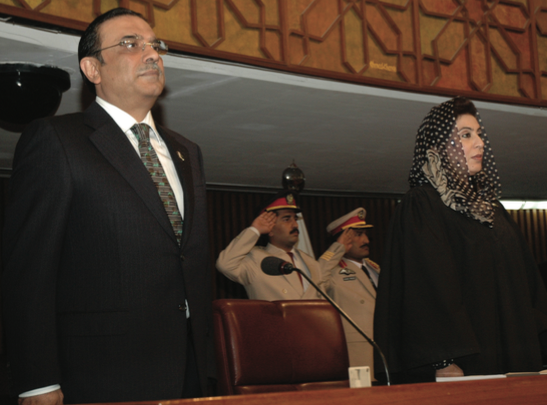
In its urge to fight the forces of evil, Washington seems ready to dance with the devil in nuclear-armed Pakistan. In the latest chapter of a tragic political saga, Asif Ali Zardari was elected president on September 6, a feat welcomed by Condoleezza Rice as “a good way forward.” The US Secretary of State praised Zardari’s will to fight terrorism and his warm words of friendship towards the US.

Zardari’s affability towards the US should not come as a surprise. Were it not for Washington, the 53- year-old would still be behind bars. His resurrection at the helm of troubled Pakistan is the icing on the cake of a very colorful career and must go down in history as one of the most dramatic political comebacks ever.
Born in Karachi as the son of a wealthy businessman, Zardari’s path to glory started with his marriage to the late former Pakistani Prime Minister Benazir Bhutto. Prior to that, his name was featured as a polo-playing playboy in the local gossip pages. His (arranged) marriage to Bhutto was widely seen as one of mutual convenience. He had his father’s money, but no name. She could do with the money, while a husband on her side greatly advanced her political prospects in conservative Pakistan.
Widely known as “Mr. 10%,” Zardari owes his nickname to the hundreds of millions of dollars he allegedly received in kickbacks on major defense deals and privatization schemes completed during his wife’s reign. The money trail leads well beyond the Pakistani border, as Bhutto and Zardari own a string of bank accounts and houses around the world, including a nine- bedroom mansion, complete with an indoor swimming pool and helicopter landing pad, in Rockwood, UK.
While never formally convicted in Pakistan, a Swiss judge in 2003 ruled that Zardari and Bhutto had accepted $15 million in bribes from two Swiss firms. Bhutto however, appealed the verdict. In Britain, Lord Justice Collins judged that there was a “reasonable prospect” that the Pakistan government would be able to prove that Rockwood had been bought and furnished with “the fruits of corruption.”
Interestingly, Zardari only avoided an embarrassing appearance in British courts by claiming dementia. Fortunately, according to his doctor, his mind is working just fine again. A comforting thought, as Bhutto’s widower presides over a nation in great political and economic turmoil, as well as a big red button saying “Doomsday.”
Other serious accusations against Zardari include having attached a remote control bomb to the leg of a businessman to force him to pay his 10% and the 1996 murder of his brother in law, Murtaza Bhutto, who had openly humiliated Zardari and called for his resignation. Zardari spent a total of 11 years in jail. He was only released in 2004, thanks (indirectly) to a US-brokered power-sharing deal between Bhutto and former military leader Pervez Musharraf.
Until then, the US administration had firmly supported Musharraf, yet grew increasingly frustrated with the latter’s tactics on the North Western Frontier, where al-Qaeda and the Taliban have found refuge. Musharraf refused to send in the Pakistani army in an all- out assault and refused to let American soldiers operate on Pakistani soil. And so, Washington decided he had to go.
Gradually, Musharraf was no longer portrayed as a steadfast partner in the war against terror, but as the military dictator he had been all along. Back came the call for democracy. Back came Bhutto. Having been ignored for years, she was dusted off and saddled up for a glorious return to her native country. In return, she was said to be greatly concerned about the rise of Muslim extremism and the need to tackle the safe havens near the Afghan border, which was no doubt one reason for her assassination in late 2007, arguably on the orders of tribal leader Baitullah Mehsud.
Her death came hardly as a surprise for Musharraf, who knew all too well how unhealthy it is to be considered pro- American in Pakistan. Nicknamed “Busharraf,” he survived several assassination attempts. In addition, the ousted military leader was well aware that the Taliban were, to a large extent, created by the Pakistani army, elements of which do not want to see their baby thrown out with the bathwater.
Finally, a significant part of the Pakistani population support or sympathize with their Muslim brethren near and across the Afghani border. In short, taking on Pakistan’s western tribes is likely to lead to a stepped-up bombing campaign within Pakistan, which could threaten the state’s very survival.
Add to this the opportunist Zardari with his alleged taste for easy money. Officially, he is only a caretaker until his son graduates from Oxford, yet many fear he may prove unwilling to give up his seat. He is yet to abolish the extra powers Musharraf had created for the presidency and is yet to re-install Iftikhar Muhammad Chaudhry and other judges, who aimed to tackle the country’s abysmal corruption record. Many analysts fear that Pakistan got rid of military rule, only to get a civilian dictatorship in return.

Peter Speetjens is a Beirut-based journalist

October 3, 2008 0 comments
0 FacebookTwitterPinterestEmail
  • 1
  • …
  • 506
  • 507
  • 508
  • 509
  • 510
  • …
  • 686

Latest Cover

About us

Since its first edition emerged on the newsstands in 1999, Executive Magazine has been dedicated to providing its readers with the most up-to-date local and regional business news. Executive is a monthly business magazine that offers readers in-depth analyses on the Lebanese world of commerce, covering all the major sectors – from banking, finance, and insurance to technology, tourism, hospitality, media, and retail.

  • Donate
  • Our Purpose
  • Contact Us

Sign up for our newsletter

    • Facebook
    • Twitter
    • Instagram
    • Linkedin
    • Youtube
    Executive Magazine
    • ISSUES
      • Current Issue
      • Past issues
    • BUSINESS
    • ECONOMICS & POLICY
    • OPINION
    • SPECIAL REPORTS
    • EXECUTIVE TALKS
    • MOVEMENTS
      • Change the image
      • Cannes lions
      • Transparency & accountability
      • ECONOMIC ROADMAP
      • Say No to Corruption
      • The Lebanon media development initiative
      • LPSN Policy Asks
      • Advocating the preservation of deposits
    • JOIN US
      • Join our movement
      • Attend our events
      • Receive updates
      • Connect with us
    • DONATE