• Donate
  • Our Purpose
  • Contact Us
Executive Magazine
  • ISSUES
    • Current Issue
    • Past issues
  • BUSINESS
  • ECONOMICS & POLICY
  • OPINION
  • SPECIAL REPORTS
  • EXECUTIVE TALKS
  • MOVEMENTS
    • Change the image
    • Cannes lions
    • Transparency & accountability
    • ECONOMIC ROADMAP
    • Say No to Corruption
    • The Lebanon media development initiative
    • LPSN Policy Asks
    • Advocating the preservation of deposits
  • JOIN US
    • Join our movement
    • Attend our events
    • Receive updates
    • Connect with us
  • DONATE
By Invitation

Procurement practice enhancements for Arab competitiveness

by Fabrice Saporito August 1, 2008
written by Fabrice Saporito

Not long ago, many global companies considered the GCC and broader Middle Eastern market to be somewhat un-charted territory. Despite its plentiful capital and business opportunities, the Gulf region was perceived as being a place where breaking into the inner circle of personal networks and friendships was the only way to tap into the region’s wealth.

This old reputation is changing now among foreign businesspeople who have experience with the ins and outs of the region. Most major GCC and Middle Eastern companies long ago replaced informal controls better suited for small family businesses with modern forms of corporate governance. However, the perception of the GCC and the broader Middle East as a fast-dealing market lingers in the mind of the broader global business community. Such concerns may even add more friction to many deals, by raising the level of due diligence potential foreign partners and investors demand.

One major step local companies can take to mitigate these concerns is to enhance transparency by improving procurement controls. Since most business-related malpractices stem from the awarding of contracts to private institutions, a tighter procurement system can go a long way toward reassuring suppliers, customers and investors that a company is a trusted partner.

A more transparent procurement system encourages stakeholders — customers, investors, employees and suppliers — to see the company as a modern enterprise run according to world-class, professional standards. As other companies in fast-growing emerging markets have found when they make similar improvements, strict procurement systems enhance outsiders’ perception of the company as an enterprise of integrity. This higher level of trust can serve the purpose of multiplying opportunities by reducing the potential partner’s need to conduct extensive due diligence.

Three keys to greater best procurement practices
In our experience with many private and public companies in the Gulf and Middle Eastern region, we have found that developing the higher level of transparency that international business requires of corporate procurement systems demands tightening three different practices: first, contracting processes and buying goods and services; second, supply chain governance; thirdly, improving the control and audit functions. Fortunately, other companies have dealt with these issues before, and have found that three corresponding steps can dramatically increase transparency:

1. Differentiate sourcing from procurement. Technically, sourcing is a matter of planning needs and identifying potential vendors, then negotiating an agreement for supplying the goods. Procurement, on the other hand, is mostly about concluding and fulfilling the transaction previously agreed to in the sourcing stage. A failure to plan often leads to some Gulf and Middle Eastern organizations rushing into the buying stage early and forcing buyers to make a spot purchase at precisely the moment when scrutiny of the product must be given first priority. In other words, most tenders that go out on the markets are already pre-assigned to the suppliers that have the most influence with the company.

2. Watch every purchase throughout the purchase cycle. In many Gulf and broader Middle Eastern organizations, tender boards are set up to be in charge of company purchases. However, tender boards typically engage in the purchase process only at the point of negotiations and award. This means that their role is often limited and their options narrowed by stipulations previously included in the tender. A better way to control purchasing is to create governance throughout the procurement process, beginning with demand definition and ending at the point of product or service delivery. This requires process standardization, more clearly defined authority roles throughout the process and the automation of as many steps as possible to keep the entire transaction under very tight controls.

3. Build auditing capabilities, as establishing boundaries around a process will not guarantee best procurement practices. The recent scandals at Siemens in Germany show that even in a company with world-class processes and systems, malpractice can take place. Yet while it is impossible to eliminate the potential for illicit self-dealing without shutting down a business altogether, auditing and controlling the purchasing system on a regular basis while continuously rotating teams and individuals can significantly reduce the chance of a developing malpractices.

The decision to follow such best practices can have a significant impact on an organization. The most evident, of course, is the impact on the bottom line where the organization and its shareholders have more money flowing in and staying in. Quality tends to increase as well, since suppliers’ choices are based on the vendors’ merits and abilities to support the objective of the company, not on the relationship with the owner or the vendor’s managing director. Even companies with good auditing practices can profit from improving this system: transparent practices create more confidence in the system, thus attracting more vendors and increase competition in the region. Finally, such practices allow GCC and broader Middle Eastern organizations to think strategically, reduce the level of waste and increase their overall efficiency.

Staying competitive
Economic competitiveness of a country is a function of the ability of its public and private sectors to deliver superior returns on their investments. This means that applying best practices is the only way to move forward for a country: competitiveness at the micro level (at the level of the firm) directly impacts competitiveness at the macro level (country level).

Corporations and public enterprises alike normally deliver such returns only when they have the ability to formulate very clear competitive strategies. They also must have the ability to execute such plans. In this networked era this means that strategy is not simply the province of sales and marketing or research and development, it is a broad organizational responsibility. Seamless execution requires the organization to ensure that companies can clearly articulate the role of each institutional or enterprise function.

In addition, good procurement controls can be quite helpful in building a capacity for strategy execution — and not just as a way to keep an eye on the cash register. At Zara, the trendy global clothing store, the role of procurement goes far beyond the simple purchase order. Procurement work includes an assessment of the supply base to ensure that selected suppliers have the capabilities to fulfill the overall strategic objectives of Zara.

In an endless balancing act between cost, quality, and speed, Zara’s procurement department takes the lead in ensuring that the company maximizes its long-term interests. Thanks to careful calibration by procurement, Zara is able to deliver up to 28 new collections a year, ensuring that the supply of cloth and new garments come on time and its new collections are distributed around the world in a seamlessly, while retaining the kind of transparency distribution partners and Western investors demand.

The wrap-up
Increasingly, the GCC and broader Middle East economy is becoming part of the wide world of global business. Cross-border mergers, for instance, have grown from six in 1997 to more than 250 in June 2008. 

This growth in openness to the outside world has led to many changes in how GCC and Middle Eastern companies are run. Many Gulf companies have already replaced old informal habits of corporate management — more suited for a cozier era when business was mostly an extension of long-time family relationships — with a number of practices borrowed from the West.

Improving procurement processes is another such step in the long-time quest of GCC and broader Middle Eastern companies to take their place among the world’s great enterprises. Following best practices for procurement allows public and private institutions to be more credible trading partners as they increase their M&A activities, make their home market a less risky destination for foreign capital in search for growth, and ultimately enhance the micro and macro-competitiveness of the region as a whole.

Fabrice Saporito is a Principal at Booz Allen Hamilton

August 1, 2008 0 comments
0 FacebookTwitterPinterestEmail
By Invitation

Fixing the fuse on Lebanon’s power woes

by Albert Khoury August 1, 2008
written by Albert Khoury

For any economy that can grow despite unnerving political uncertainties, for politicians who have stood firm despite large protests and for a people who faced death, destruction and hardship while defiantly sticking to their homes and lands, for all what the Lebanese have been put through, it is quite perplexing how we have not been able to solve our electricity problem, with power cuts part of our daily routine.

A couple of months ago, even Beirut became part of the axis of darkness, joining all other areas in suffering hours of warming fridges, idle AC units and candle-lit TV rooms. Getting round-the-clock power, just like Addis Ababa, Ramallah, Rome or Paris became an illusive dream for most of us.

When a number of people died protesting the power cuts in Beirut’s southern suburb Chiah on January 27, 2008, the only official response that was given to their families, friends and neighbors was that the state-owned Electricité du Liban (EDL) will publish on a regular basis the timing of the power cuts nationally (a promise that has not been kept). Do we not deserve more than a power cuts schedule?

According to various studies, in Lebanon today self generation is 38% of total demand. This capacity is generated by small units that are both polluting and very expensive or the capacity is effectively suppressed.

Private sector to the rescue
For most people, counting on the public sector to try to pull us out of this mess is no longer an option. For most politicians at least, there is now a realization that the private sector should be part of the solution.
Law 462 was a first step in getting the private sector involved. Passed on September 2, 2002, this law calls for the creation of a regulatory authority — similar to the very successful authority presently shaping the telecoms field — to set guidelines for granting licenses, permits and to try to unbundle EDL in into generation, transmission and distribution entities.

Problems in distribution
Distribution is the most politically charged problem facing the national electrical utility. According to a report published in 2006 by CRA, an international consultancy firm based in Boston, as much as 39% of the energy produced by EDL remains uncollected.

As far as we know, science has not yet proven any link between paying EDL’s invoices and religious or political affiliation. We firmly believe that the collection problem is solely due to lack of managerial capacity on the part of EDL. All three privately operating distribution utilities — Aley, Zahle and Jbeil — have diverse customer bases spanning the political and religious spectrum, and have regular collection averages of about 98%.
We believe that blaming any ethnic or political group for the woes in distribution is both misleading and highly unproductive.

Of the remaining 69% that is finally collected, the total amount is not even sufficient to cover the price of fuel used for generation in the first place, let alone pay for the operating expenses or debt repayment by EDL. According to government sources, the average kwh sold by EDL stands around 7.6 c/kwh as best case scenario. (In Aley, the average rate comes to 4.2 c/kwh.) The present cost of generation for EDL according to Kamal Hayek, chairman of the EDL, exceeds 20 c/kwh.
To generate at a cost of over 20 c/kwh and sell only 69% of quantities produced at a fraction of the price is a recipe for disaster.
Fortunately, a solution is presently being devised by EDL, the Ministry of Energy, the Higher Council of Privatization and CRA to invest in modern metering systems to help reduce the losses.

Over and above this effort, the government needs to take the courageous decision to adjust the tariff that it charges to large customers who can afford to pay higher prices. The reality of things is that the government cannot afford to charge the same price for power generated when the oil price was at $30/barrel that it charges when the price becomes $150/barrel. A change in tariff, we believe, is both necessary and inevitable.

Generation challenges
In terms of generation, we see a different type of problem. Today, Lebanon has a net capacity of 1,645 MW, according to figures compiled by our research team. On July 26, 2007, peak demand reached 2,275 MW. Generation capacity should be equal to peak demand.

Thus, we need an extra capacity of over 700 MW. According to the World Bank, by 2015 Lebanon needs an additional capacity of 1,500 MW.
The capacity available today is dangerously undiversified, with 95% of the generation based on heavy fuel oil (i.e. Jieh, Zouk) or gas oil (i.e. Beddawi, Zahrani). The cost of generation that is dependent on these types of fuels highly correlates to the price of the raw material, where the variable cost of energy is dominant in the cost structure. By contrast, nuclear energy or renewables require very high capital expenditure, but running costs are usually not volatile.

Even if we had enough money to pay for proper maintenance and operation and for the fuel for all our power plants, we would still urgently need additional capacity adapted to the available sources or fuels.

Solutions needed
We need to devise and enact plans to get gas to the Zahrani and Sour power plants, invest in renewable energy via the rehabilitation of existing hydro capacity and encouraging investments in new ones and, finally, prepare for the establishment of new capacity in Salaata, Chekka or wherever possible.

Most of these plans are not feasible for a number of years, especially if the government decides to get the extra capacity using clean coal technology, a source of energy that will help in diversifying our production capacity and lower our overall cost.

Today, the government would save large sums of money, and provide additional capacity, if it acts to make sure that we finally get Egyptian gas running to Lebanon’s Beddawi power plant thus saving us millions of dollars of unnecessary expenses every year. Also, plans to give another brown field license for a power plant next to Beddawi should be encouraged by the government, and the process should be speeded up. (Studies are presently being undertaken by the IFC, the private arm of the World Bank.)

Short-term generation projects, which are also very sustainable in the long term, should be supported by the government. That would make a very important first step in getting the private sector on board.

These projects are the results of an MOU which was signed with the government in November 2007 to add a total of 240 MW to the national grid. Of the four MOUs signed, our ISO 9001 certified company, a private distribution utility established in 1924 and based in Aley, signed the understanding to add 60 MW of additional capacity.

Electrical utility of Aley
We have finished our plans for the new power station some months ago, and it will be based on the most efficient technology to be used with heavy fuel oil, the cheapest type of petroleum product after natural gas. This technology will help save the government anywhere from $20 million per year (when compared to Jieh power plant) to $100 million (when compared to the Baalbek power plant).

Other advantages of the projects include:
• Short term delivery (by early 2010 with government support)
• Proximity to transmission grid
• Proximity to Beirut and Mount Lebanon (over half of national demand)
• Situated in an industrial area
• Could act as replacement capacity if existing power plants decommissioned as planned
• Meets World Bank and local environmental standards
• Provides base load, round the clock production with availability exceeding 95%
• 100% privately financed, without any debt carried by the government
• Privately built, operated and maintained with performance results guaranteed to the government via internationally recognized standardized contracts

We have been in negotiations with relevant ministries and are hopeful that, finally, the private sector will be allowed to share the responsibility with the government and provide the solutions for the crippled industry sooner than we’ve learned to expect. Also, we have received a lot of interest from private parties to support our efforts in the project.

Another interesting project is the one prepared by Lebanon Wind Power, a company founded by Robert Debbas, an established businessman with an outstanding reputation and Cesar Nahas, an authority in promoting wind farms throughout the world.
The company has developed plans for a 60 MW wind farm in northern Lebanon. Such a project will not only add much needed clean and sustainable capacity to the national grid, but could well be one of the most productive farms in the area.

In conclusion
The private sector can solve the problem that has crippled our country for over three decades. We can solve it faster and cheaper and are willing to bet our own money on results and not just on promises.

The government has been quite supportive, but this is not enough. Laws should be enacted quickly in order to give the private sector the assurances it needs to invest the large sums of money required. Once this is done, and the private sector takes its share of responsibility, then and only then can we see the light at the end of the tunnel.

Albert Khoury is the deputy general manager at the Electrical Utility of Aley

August 1, 2008 0 comments
0 FacebookTwitterPinterestEmail
By Invitation

A new Lebanese lira for economic renewal

by Armen V. Papazian August 1, 2008
written by Armen V. Papazian

The recent sociopolitical developments in Lebanon have created a mood for change and a hope for renewal. This is true for the political as well as economic future of the country. Indeed, the economy is in need of fresh air. A new Lebanese lira could stimulate the economy and fulfill positive expectations as a new symbol of societal trust and value creation.

Today, the Lebanese use liras for small transactions, like buying vegetables, and use US dollars for large transactions, like buying and selling their own land. A close look at dollarization levels reveals some interesting yet very worrisome facts. Lebanon is a partially dollarized economy. The simplest dollarization measure is the ratio of deposit dollarization. Deposit dollarization is calculated as the share of total deposits in foreign currency (FC deposits/Total deposits). This ratio was 70% in early 2005. The ratio increased immediately after the assassination of former Prime Minister Rafiq Hariri, and it now stands around 74%.

Deposit dollarization in Lebanon reveals the extent to which the lira, or the Lebanese Pound (LBP) as it is referred to today, is a marginal currency within the country. Theoretically and empirically, the reasons behind dollarization (partial or full) are linked to credibility issues. Indeed, high inflation rates and macroeconomic mismanagement have been considered the root cause of dollarization, which is a mechanism through which households and businesses protect their wealth from domestic instability. Lebanon’s case is not different. High inflation, currency collapse, and overall instability during the war years triggered deposit dollarization in Lebanon. However, inflation has been tamed since the mid-1990s and the exchange rate has been pegged to the dollar. And yet, dollarization rates are still very high.

Persistently high rates of dollarization to date can be explained by a number of reasons. Previous research suggests that there are high costs associated with financial adaptation. As such, de-dollarization is much harder to achieve. There are other reasons explaining the persistently high levels of dollarization in Lebanon. Some of the most important factors are: 1) the fact that the end of the war did not imply true and complete independence, 2) the gap between an open market philosophy and an unfree and co-opted post-war state; 3) high lira interest rates which made dollar loans more attractive given a fixed exchange rate, and last, but not least, 4) the design, colors, and name of the Lebanese ‘lira’.

Hope in the new lira
While exploring these factors further is crucial in understanding the current political economy of dollarization, suffice it to say here that the recent sociopolitical developments in the country give hope of a possible transformation in the near future. Indeed, Lebanon might be faced with a once in a lifetime opportunity to set things right. The issuing of a new lira could do justice to the recent changes in the political agenda. A new lira could be the result and midwife of a strengthened Lebanese consensus. It could give the state structures, the political elites, and the people the right incentives to pursue the path of healing and institutional reform.

A new lira could mobilize the necessary levels of trust if it is made, de jure and de facto, the sole legal tender within all regions and sectors of Lebanon. While the benefits of a new lira could be significant in creating the proper incentives for all involved parties, i.e. the state, the people, and the political elites, it cannot succeed as a strategy if real and serious institutional reforms are not implemented. In other words, without fundamental institutional reforms, issuing a new currency would typically be a theatrical performance with no real economic value, a simple paper change. The success and effectiveness of a new lira depends on the harmonious interaction and co-operation of elites, people, governments, institutions, and last but not least banks. Moreover, it will most certainly require rational policy making and a great leap of faith.

While institutional reforms are a necessary condition for the success of a new lira, they do not necessarily need to precede the introduction of a new lira. Indeed, a new lira could be the very incentive that would bring together the many different factions of Lebanon, in the pursuit and implementation of necessary reforms.

The new lira must be the only currency accepted inside Lebanon, and it must also be freely exchangeable with any other currency at a market price. While the exchange rate policy associated with the new lira is a subject of discussion in its own right, introducing a new currency could kick off the economic machine through a renewal of trust and give Lebanon a fresh start. The new lira must reflect Lebanon’s sense of self as it stands — a multicultural, multiethnic, multi-faith, free and creative psyche.

Trust in a currency comes from many different types of sources; some are pure economic and rational, others are emotional and irrational. As such, the physical appearance of the new lira is crucial. Its size and color must be attractive, serious, and meaningful. Finally, the new lira should be a lira and not a pound. All banknotes and coins issued by the Central Bank of Lebanon since 1964 have the title ‘lira’, and yet the Lebanese financial and economic authorities have opted for the name ‘pound’ throughout the last decade. Although a translation, there seems to have been a ‘self- denial’ in the very name of the Lebanese currency.

Making sure the new lira is not a paper tiger
With all this taken into account, if the use of the new lira is not compulsory across regions and sectors, the change would be purely a paper change and would not have any serious impact on the issues at hand. Moreover, if such a project is taken on, the value of the new lira and the denominations to be used can only be the outcome of an in-depth economic reappraisal. The possible effects of a new lira and its obligatory use across all sectors and regions of Lebanon are many. Any Lebanese asset, whether tangible or intangible, will have to be exchanged in the new lira. Enforcing such a policy across all sectors will create enough demand for the lira to allow for a freer floating rate. Although, a fixed exchange rate could still be maintained until the right policy environment is created.

A new lira enforced across the country will create the missing macroeconomic space. Moreover, a trustworthy lira with a widespread use will free local investment decisions from the much required US dollar, and reclaim the seignorage revenue that is currently directed toward the Federal Reserve. Ultimately, monetary policy will be more effective and fruitful.
Theoretically, enforcing the use of the current lira would also have the same positive effects. In reality, however, the last decade has shown that the current LBP has not been able to reclaim its due place as the sole medium of exchange in Lebanon. Moreover, mobilizing the trust of the Lebanese people in the current LBP might not be possible on the symbolic level.

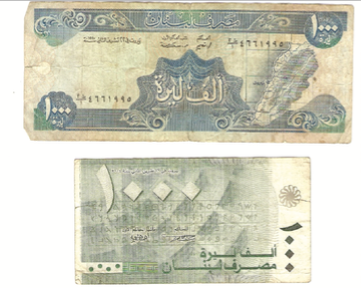
Also, the recent sociopolitical transformations and the intention of giving birth to new state structures deserve to be translated into the economic realm and a new lira could do justice to the envisaged rebirth of Lebanon. Moreover, the LBP banknotes currently in circulation reflect a serious confusion. Today, one can find a 5000 LBP note in different sizes, two different types of 1000 LBP notes, different sizes of other denomination notes, and so on.
It is important to introduce trust and confidence in the paper, by standardizing it and reorganizing its physical features. Moreover, a new lira could be an opportunity to cement the recent consensus through symbolic representations that would support and promote the key values and historic contributions of different segments in Lebanon.

States and governments can distribute wealth, and they can also distribute poverty. However, they cannot manage the economic game of a nation if citizens choose not to play. While governments must assume responsibility, the Lebanese people must choose to be proactive and determined to reap the benefits of mutual trust. The road ahead is determined by implemented policies.

The choice and the future is Lebanon’s. While choosing, the Lebanese have to keep in mind that the best they could ever be to the US economy is a non-voting province, whereas a new lira can open the gates of locally created and managed prosperity.

Armen V. Papazian is a senior vice president of market development at the Dubai International Financial Exchange

August 1, 2008 0 comments
0 FacebookTwitterPinterestEmail
By Invitation

A how-to guide for good country branding

by Ramsay G. Najjar August 1, 2008
written by Ramsay G. Najjar

Where are you taking your summer vacation this year? Chances are you’ve booked a trip to a country that passes the test of a strong “country brand.” This might sound strange given that people usually choose their destination of choice based on attractions, culture, food, shopping and other offerings, but all of these elements merely fall under the brand image that a country has created for itself and how successful it has been at capitalizing on these assets.

It also may seem as though many countries that are tourist and investment destinations sell themselves, while the image of a developing nation is too tarnished to be promoted. Country branding, however, has become a must today to rise above the media “noise” and communicate the essence of a nation and its identity. Effective country branding, in fact, not only boosts a country’s tourism industry, but also affects the way people view products from a particular region, can encourage foreign investment and propel a smaller state to international standing on the diplomatic scene.

Moreover, when a government takes the steps to brand their country, they can create a deeper sense of belonging for their citizens and rally their national pride, even adding to the nation’s culture and heritage by unifying national symbols, such as how Australia uses its kangaroo to uniformly represent it. Proactive branding, above all, is important for a country’s communication because it can prevent any outside influences from imposing their own image on the country and can even immunize the country from negative publicity.

This level of immunity continues to grow in importance as more and more travelers, political commentators and ordinary citizens log onto the web and voice their opinion or experiences traveling in a certain country. Blogs, photo sharing websites and travel review forums have as much power today to shape a nation’s image as media reports. As such, gaining the immunity to negative publicity necessitates a visionary but realistic brand strategy that translates what the country stands for into a unified positioning and identity. A country’s brand should capture the spirit, values and ambitions of the people of that nation, which add up to a whole that is unique, truthful, distinctive, sustainable, relevant and attractive, in order to be a powerful brand when communicated.

The country brands and communication campaigns that have struck a chord with audiences, such as “Incredible India,” Spain’s “España” and Canada’s “Keep Exploring,” communicate a picture of each country that is true to its nature, highlighting the many facets of its landscape, culture and people, while also being contemporary and relevant to audiences by focusing on their interests and what the country can offer them.

Yet, in order for any nation to communicate its brand effectively, it must first look internally to its government agencies, local companies and other parties that must buy into this vision to become ambassadors for the new country brand. In Britain, the Labour Party in 1997 decided to re-brand the country as “Cool Britannia,” but failed to get the British people’s support, because of the party’s over- emphasis on creative services rather than manufacturing and industry that make up the core of the nation. The result of this was that branding project ended up being shelved.

Once stakeholders believe in the brand, however, it can be communicated consistently throughout the country as well as externally, without becoming the political property of one particular administration or government, but rather considered a national treasure to be passed down from one guardian to the next.

When all parties are onboard, a country can then take an in-depth look at how it is perceived within its borders and by other people, as well as examining its strengths and weaknesses to form a clear strategy that will target all of its audiences, from tourists to potential investors to its own people. The key then to developing the strategy should be based on communicating the essence of the country, making certain that the image of the country is true and modern, communicating consistently, ensuring continuity in the strategy from one administration to the next and using creativity and innovation to translate the complexity of the country to the world in a simple, effective and memorable manner.

Only then can we lay out a clear action plan to communicate the brand, whether through different media campaigns, various events or activities that can promote the brand or other channels, such as a website dedicated to the brand that can cater to tourists interested in learning more about visiting the country.

Unfortunately, when probing Middle Eastern country brands, no single national brand stands out as a strong contender. Many have tried, including Egypt, Dubai and Lebanon and most recently Qatar and Bahrain, but all of these branding efforts lacked in one area or another. They were either missing the true “soul” of an effective country brand, being unable to consistently implement the brand across government agencies and enterprises, failing to differentiate the brand from other regional competitors, or mixing the country’s “soul” with the “flesh” by diluting the country’s essence with profit-driven messages.

This situation points at a lack of drive amongst regional nations to put their faith in the brand-building process and a misunderstanding of the branding exercise as one that can be done only superficially, touching-up the country’s outward image without tackling deeper- rooted internal issues.

For Middle Eastern countries to take the step towards timeless, internationally-recognized brands, they must first overcome the challenges before them. These range from defeating existing prejudices against many of the region’s countries to finding their unique inherent edge that truly entrench diversity in the region.

None of this can be done without instituting internal awareness within each nation to deepen the understanding of country branding amongst government officials and the local population, as well as the creation of a legal framework that can eradicate the current lack of conformity in national branding and symbols in the region. Finally, holistic reform is at the heart of a convincing and rooted country brand, as a strong brand needs strong leadership and a unified nation behind it to be communicated and embraced.

Until a nation has become successful in developing a powerful and mature country brand to represent itself, it is likely to always be regarded by others on the international stage as a hesitant adolescent who has yet to truly forge a personality.

RAMSAY G. NAJJAR is chairman of S2C

August 1, 2008 0 comments
0 FacebookTwitterPinterestEmail
Comment

Educated and out of work

by Riad Al-Khouri August 1, 2008
written by Riad Al-Khouri

Arab economies are experiencing a historic boom, but whether or not prosperity continues will depend on their ability to generate jobs for millions of young people seeking employment. In countries throughout the region, labor forces are growing at up to 4% annually, and Arab economies will have to create a total of around 60 million jobs over the next decade to bring the rate of unemployment down to the global norm.

Due to the boom, in the last five years unemployment in the Arab world fell to around 11%, but the rate of joblessness for people aged 15-24 is more than 25% — roughly twice the world average. One complication is that in some countries, mainly the smaller Gulf sheikhdoms, most new jobs have gone to foreigners.

However, this phenomenon is not limited to the rich oil- producers: in Jordan, for example, many new jobs go to non- nationals, especially garment and domestic workers from South and East Asia, as well as construction laborers from Syria and Egypt. In fact, the prominence of foreigners in employment is higher in Jordanian private businesses — a hoped-for source of job-creation — since nationals dominate public sector jobs. This phenomenon is replicated to some extent in Lebanon, with the Lebanese penchant for youth emigration acting as a safety valve. Yet, even there many young people stay at home and aggravate the unemployment situation.

An explanation of this complication in the labor markets of poorer Arab countries is that “educated young people are in effect playing the lottery,” according to Marcus Noland and Howard Pack in their recent article “Arab Economies at a Tipping Point,” by remaining unemployed at home, waiting for either a high- paying job in an oil state or a visa that would permit emigration to the West. The unwillingness of Lebanese, Jordanians, and other Arabs to fill less attractive jobs in their own countries, even at the risk of idleness, drives unemployment up and encourages labor importation.

Egypt is a case in point regarding issues such as youth, labor markets, and emigration; but also, as the populous Arab country, demographic and employment problems there can spill over into the rest of the region and beyond. Job creation is one of the most important challenges facing Egypt today. Like most of the rest of the region, the country has a young population and large numbers of youth entering the job market each year.

However, even in periods of prosperity, the job content of growth has not been strong enough to absorb fully new entrants to the labor market. Imbalances in education, training, and skills between jobs offered and qualifications of job seekers have also hampered employment, particularly among youth. In other words, young people are still seeking higher education that is often incompatible with the less sophisticated jobs on offer, preferring to be idle for some time while waiting to “win the lottery” and migrate.

This pattern has actually been evident for about three decades: following Egypt’s adoption of more liberal economic policies in the 1970s, unemployment climbed despite robust growth and joblessness among the young and better educated rose as the government curtailed guaranteed employment, which finally ended in the late 1980s. Since then, Egypt’s jobless rate has remained stubbornly high, up to 11%, and youth unemployment began to manifest itself forcefully, with emigration seen as a way out.

However, recent prospects are brighter as growth has picked up since 2005 in reaction to economic reform that the government began mid-2004, with favorable external factors providing support. This boom was reflected in higher overall employment, as growth became broad-based and more job-rich. According to official Egyptian statistics, unemployment declined from 10.5% to 9% during 2004-7, but the problem of youth joblessness continues. Currently, an estimated 2 million Egyptians are out of work and problems of high youth unemployment and widespread underemployment continue.

Thus, despite the positive effects of boom and reform, a central economic challenge confronting Egypt and the rest of the Arab world remains how to provide employment for the large numbers of young people entering the labor force. If progress is insufficiently rapid in creating jobs, when the boom is finally over the region will be caught in a vicious circle of unemployment, impoverishment, discontent, militancy and repression, impeding reform and growth.

The risk of externalization of discontent is also obvious: a widening economic gap between the Arab world and the industrial countries, particularly neighboring Europe, would spur transborder migration, mostly illegal under current rules, and contribute to problems with and among the countries of the EU. The newly launched Union for the Mediterranean will have to address this issue urgently.

Riad al Khouri is Member of the International Council of Questscope and Senior Fellow of the William Davidson Institute at the University of Michigan

August 1, 2008 0 comments
0 FacebookTwitterPinterestEmail
Comment

Demise of the dailies

by Paul Cochrane August 1, 2008
written by Paul Cochrane

Arecent trip to London and Rome brought home how precarious the future of newspapers is in Europe, particularly in the capitals where commuters are inundated with free tabloids.

Glancing around at fellow passengers on the London underground, few were reading ‘normal’ newspapers, but every other person was flicking through freebie Metro — found in most European capitals — or sister-paper London Lite.

Light these newspapers (if you can call them that) certainly are, all celebrity gossip with a splash here and there of local news; it was as if Britain were in no way involved on the international stage, or in Iraq and Afghanistan.
The rise of these dailies has hit the national newspapers doubly hard, struggling as they are for advertising in the midst of an economic slowdown while trying to retain a readership in an era of immediate news. This has had a direct impact on the news the papers are producing, with newspapers jumping on the bandwagon of reduced hard news and foreign coverage in favor of the sensational and glamorous. All these factors thrown together have resulted in gloomy prospects for the industry.

Total sales of national newspapers in the UK are down 2% year on year, with broadsheets falling 3.4%, while the tabloid press has only dropped 1.2%. In the United States it is a similar story, with all newspapers reporting a drop in sales, bar a few exceptions, with total newspaper advertising, combining print and online revenues, falling 9.4% last year.

Less disheartening is the fact that there are still people around who want serious news, with The Financial Times’ circulation growing 2.1%, while the Wall Street Journal’s circulation of 2.1 million copies has risen 0.4% over the past year.

However, the increased commercialization and sensationalism of newspapers is leading to much larger papers, page wise, giving people supposed value for money — with some Sunday editions weighing in at nearly 2 kg — but written by a skeleton staff and almost devoid of original content. This has led to what Nick Davies, author of Flat Earth News, has called ‘churnalism’.

In a study Davies carried out with Cardiff University on the sources for articles in British newspapers over a two- week period, they found that 60% of stories in the more serious newspapers were wholly or mainly wire copy (i.e. Reuters, Associated Press or the UK’s Press Association) or from PR firms, 20% had clear elements of wire copy or PR, and 8% were from uncertain sources. That left only 12% of articles that were actually researched by journalists in person or over the phone — real journalism, in other words.

But with Britain now having more PR people than journalists (47,800 vs. 45,000), it is perhaps no real surprise that PR is having an impact on a sector that is desperate for content while at the same time slashing their budgets for staff and expenses. Of further concern in our globalized world, and naturally for the Middle East, is that foreign coverage is on the decline. In 1970, for instance, CBS had three full-time correspondents in Rome alone, but by 2006 the entire US media, print and broadcast sector had only 141 foreign correspondents to cover the whole world.

While this is all bad news, particularly for newspaper journalists, it has meant that other media and entertainment outlets are picking up the slack. For instance, a recent PricewaterhouseCoopers (PWC) survey of 15 global media markets — from online, TV, and newspaper advertising to theme park and cinema ticket sales — estimated that these markets were worth $1.6 trillion, and will be worth $2.2 trillion by 2012.

The ad battle between online publications and newspapers is where things will get the bloodiest though, with PWC predicting that by 2012, newspaper print ads will be worth $123 billion, only $3 billion more than online advertising, while total newspaper revenue from ads and circulation is expected to rise to $208 billion from $186 billion last year. Notably, newspaper circulation is dropping in the US, UK and Europe, while there is a concurrent rise in the emerging markets of China and India. So while new media will make inroads everywhere, old media may see an upturn in newer markets.

The question plaguing journalists and people who like to be well informed though, is what kind of content these new publications will have as the battle between new and old media reaches epic proportions — ‘heavy on quantity but not much quality’ seems the obvious conclusion.

Ultimately, what is likely to happen is there will be an upswing in demand for specialized and niche publications catering to people’s specific business and personal interests, while general news becomes more marginalized, slotted in-between ‘churnalism’ — saucy sex scandals and photo shoots of what celebs were wearing at some cocktail bash.

PAUL COCHRANE is a freelance journalist based in Beirut.

August 1, 2008 0 comments
0 FacebookTwitterPinterestEmail
Capitalist Culture

Syria – France’s other cheek

by Michael Young August 1, 2008
written by Michael Young

In July, Syrian President Bashar Assad was received with high honors in Paris, shortly after Syrian political prisoners rioted at the Saydnaya prison near of Damascus, reportedly after their mistreatment by guards. The guards were said to have shot prisoners in reaction, before being overwhelmed, though the exact number of deaths was not clear. Some sources suggested around one or two dozen inmates had been killed.

That the two events occurred at around the same time was revealing, because the Saydnaya events in no way marred Assad’s French visit, which was surrounded by considerable publicity and countless interviews by French media outlets with the Syrian leader. Even though the regime in Damascus had once again displayed its indifference to human rights, a European government and European media had largely chosen to look the other way, on the grounds that “one has to engage Bashar.”

In that context, it is no surprise that European efforts in recent years to use multilateral processes — particularly heightened economic cooperation and the opening of markets — to strengthen democratic practices in the mainly Arab countries of the Mediterranean have failed miserably. Whether it is the contested Barcelona process, now more than a decade old, or most recently French President Nicolas Sarkozy’s wooly scheme for a Union of the Mediterranean, Arab autocrats have watched with considerable delight as Europe has rationalized their uninterrupted brutality.

Take, for example, Assad’s answer to the daily L’Orient-Le Jour when asked why Syria still held political prisoners in its jails, in particular Michel Kilo. The Syrian president replied that there were only terrorists behind bars or those who had transgressed Syria law, not people “opposed to us.” The distinction was odd, for what Assad seemed to be saying was that imprisonment in Syria was never personal, as if one could truly distinguish in a place like that between the objectivity of the law and the interests of the Syrian regime. Assad went on to defend himself by implicitly criticizing France for its laws against Holocaust denial, when he said: “But we don’t have in Syria cases like that of the writer Roger Garaudy who entered prison because he had contested the Holocaust…”

In reality, Assad’s example was a poor one. Garaudy never went to prison. He received a suspended sentence for his writings, rather unlike Kilo, who got a three-year sentence for being a key figure behind the 2006 Beirut-Damascus Declaration, signed by hundreds of Syrian and Lebanese intellectuals. The declaration supported an overhaul of Syrian-Lebanese relations through greater Syrian respect for Lebanese sovereignty and territorial integrity.

Kilo’s is a strange case. This is the second time that the writer finds himself in prison. The first time, he was accused of being a member of the Muslim Brotherhood. When he informed his interrogators that he was a Christian and could not possibly be a Brotherhood member, they responded that the Brotherhood was ecumenical. A character in Mustafa Khalifé’s novel The Shell (translated into French from Arabic, although few Arabic copies appear to still exist) is in a similar predicament: a Christian accused of collaboration with Islamist militants. Khalifé himself spent over 12 years incarcerated in Syria, and his novel describes the horrifying conditions at the military prison in Tadmur, “the prison in the desert.”

Another dissident, Yassin al-Hajj Saleh, described his experiences at Tadmur in this way: “The recurrent lesson the regime taught me is that it could always come up with things worse than our worst fears. After I completed my 15-year sentence they sent me to Tadmur prison, a place that literally eats men, that was worse than the ‘house of the dead’ described by Dostoyevsky. Fear is a way of life in Tadmur, where every day primitive and vengeful torture is carried out at the hands of heartless people.”

Yassin al-Hajj Saleh was released in 1996, at the age of 35. He had spent 16 years in prison, and during his final years in detention Syria’s then-president, Hafez Assad, was being feted by the international community as a man of peace. Today Bashar Assad finds himself in a similar situation: With Syria engaged in indirect talks with Israel, few in the international community seem preoccupied with what his regime is doing to its own people — let alone with seeing through the investigation into the assassination of the former Lebanese prime minister, Rafiq Hariri.

That split personality at the international level — the willingness to accept double standards of justice and accountability — can only ensure that the countries of the Middle East will not soon witness a culture of openness. Hypocrisy among the world’s democracies will only bolster the hypocrisy of the Arab world’s dictators. In July, Bashar Assad sat in on a commemoration of Bastille Day, when one of France’s most notorious 18th century prisons was stormed. If only the Europeans would better show their desire to see Tadmur and Saydnaya go the same way.

Michael Young

August 1, 2008 0 comments
0 FacebookTwitterPinterestEmail
Comment

A false choice for president

by Claude Salhani August 1, 2008
written by Claude Salhani

The gap between Senator John McCain, the Republican Party’s candidate for the United States presidency next November and the Democratic Party’s candidate, Senator Barack Obama, may well differ on social issues in the US, but when it comes to the war in Iraq it is becoming increasingly more difficult to differentiate between the two parties’ platforms.

On the domestic front the two political parties are poles apart on such issues as the reform of the health care system. The US remains the only country in the Western hemisphere not to provide universal health care for its citizens, something the Democrats have been trying to change for decades only to meet stiff resistance from the Republicans on Capitol Hill, and in the White House whenever the resident of 1600 Pennsylvania Avenue is a Republican, as is currently the case.

The American Left and Right clash over the question of drilling for oil in the great Alaskan reserve and they disagree over abortion rights; the Democrats are for leaving the decision to the individual woman, while the Republicans are opposed to the removal of the fetus, which they see as the taking of a human life.

However, as election day approaches, the Republican and the Democratic views on the war in Iraq — once diametrically opposed — now appear to be merging to the point where it is hard to tell them apart.
What happened?

What happened is election rhetoric, for the most part, with a good portion of battlefront realities and a rapidly developing political fait accompli in Iraq.

Throughout the campaign the Republicans have been saying what Republicans always say when it comes to war. McCain, while on his campaign trail around the country remained faithful to the George W. Bush dogma of “We shall stay the course.” Only the presidential candidate phrased it differently, stating that “United States’ military forces would remain in Iraq up to 100 years, if that’s what was needed.”

And Democrats, too, play the role Democrats usually play when they emphasized that a quick pullout from Iraq is needed, and that U.S. troops should be brought home within months.

As it turns out neither of the two policies are realistic and recent changes in Iraq will force both camps, but particularly the Republicans, to rethink their strategies, taking into consideration the rapidly shifting situation on the ground.

What appears to be happening is that the Iraqi Prime Minister, Nuri al-Maliki, is taking the reins of this country at a much faster pace than first anticipated by the Bush administration. The big fear amongst Iraqi politicians — that a premature American withdrawal from their country would plunge it into greater turmoil — no longer exists. In early July al-Maliki said what was until now unthinkable: there was a need for the US to establish a withdrawal timetable, a statement hardly appreciated by the White House, which has been resisting both domestic and international requests it do so.

That aside, the reality as both presidential candidates are finding out is that the 130,000 or so US forces serving in Iraq are highly unlikely to remain in the country “for up to 100 years.” Nor are they likely to remain in Iraq for 100 months either. If McCain wins the White House in November he will have to accept the fact that, at the end of the day, the US will be forced to take into account the will of the Iraqi people to see their country rid of foreign troops.

If however, it is President Obama who becomes the next commander-in-chief of all US armed forces, he will soon enough discover (as a number of his foreign policy advisers have no doubt already explained to him) that the repatriation, or simply the redeployment of such a large force, cannot be accomplished in just a couple of months, but that it will require about 18 months from the minute the order to redeploy is issued.

That being said, a more recent development may in fact leave the candidates little choice, as they will be forced to respond to the sudden shifts of violence in nearby Afghanistan. Last month the death toll of US military personnel on the Hindu Kush — with 15 killed — surpassed the number of GIs killed in Iraq, which stood at six.

Indeed, the resurgence of violence in Afghanistan comes at a time when Iraq appears to be heading towards relative calm. For the first time since the U.S. invasion which overthrew Saddam Hussein, Baghdad is beginning to be regarded more and more as the master of its own destiny by other Arab countries.

While the sudden increase of anti-coalition activity in Afghanistan may yet force if not the second major deployment of NATO and Western forces, at least a serious shift in US policy regarding the region.

Claude Salhani is editor of the Middle East Times.

August 1, 2008 0 comments
0 FacebookTwitterPinterestEmail
Comment

Millions applaud Zain’s African call

by Michael Karam August 1, 2008
written by Michael Karam

It is fair to say that most of the 50,000 concert-goers that rocked up to London’s Hyde Park in late June to wish former South African President and Nobel Prize winner, Nelson Mandela, a happy 90th birthday had never before seen the symbol of one of the concerts main sponsors. While the Mercedes star was a no brainer — even a Kazakh sheep farmer knows that one — the Zain Group’s mystical “swirl” might have proved problematic for cheery Londoners yet to experience the relentless march of what is arguably the most dynamic, daring, caring and innovative telecom company in the Middle East and Africa.

That the brand is not immediately recognized elsewhere is probably not of immediate concern to the Zain Group CEO Dr Saad Al-Barrak — known affectionately throughout the company as the “Doctor.” Formerly MTC, Zain only unveiled its new identity less than a year ago, initially to unite MTC’s five mobile phone operations in Sudan, Kuwait, Jordan, Bahrain and eventually Iraq. (In Lebanon, where 650,000 Lebanese use a Zain line in the guise of mtc touch, the brand will not be rolled out as long as the company only runs the network for the Lebanese government.)

But Al-Barrak is not known for sentimentality when it comes to effecting change, and his steely ambition is to propel Zain to the very forefront of global consciousness — it is no coincidence that the Mandela concert was broadcast live all over the world — in the presence of other blue chip names. Using his ACE — accelerate, consolidate and expand — strategy, the charismatic CEO who took over the then MTC-Vodafone in 2002, wants to take Zain into the top 10 global telecom companies by 2011 and eventually into the 100 leading global brands.

This in itself would be a mighty achievement for a Kuwait- based company that only six years ago was a one trick pony with 650,000 Kuwaiti customers. Since then, Al-Barrak has taken the operation into 22 countries on two continents, serving 50 million customers. In 2007, Zain posted revenues of $5.9 billion, and the first half of 2008 notched up a robust $3.5 billion. In terms of geographic presence, it is the fourth largest telecom company in the world.

In line with the consolidate part of the ACE acronym, on August 1 all the African operations, which had previously operated under the Celtel banner, officially became Zain. Al-Barrak’s corporate wheels are now beginning to mesh, working as one finely-oiled mechanism, linking customers — he does not like the word subscriber — from Baghdad to Kano. This mammoth transcontinental branding operation was an emotional milestone for those who had seen Celtel change — and in some cases save — the lives of millions of Africans.

Sponsoring the Hyde Park concert may have been a canny PR move, but the reality is that Mandela and Zain have much in common. It was a message that Al-Barrak could deliver with confidence. “Nelson Mandela has shaped modern Africa,” he said after presenting the beloved South African leader with a gold model of a traditional Arab Dhow. “His contribution is well known and stands as an example to those who are embroiled in fighting oppression and injustice in the same way Zain, through its subsidiary Celtel and the innovative introduction of the historic One Network system, has changed the face of this great continent forever.”

It is no exaggeration. There was a time, not so long ago when, if a young man from the Congo wanted to talk to his mother in his rural village, he had to make a two-day roundtrip on foot. Similarly, if a Nigerian businessman wanted to arrange a meeting with a colleague on the other side of Lagos, he would have to send his driver with a note suggesting a time. The driver would have to battle the notorious urban gridlock just to return with a note suggesting an alternative time. In the event, it would take at least two trips to confirm the meeting. Finally, a plumber in Dakar might have spent all day making house calls before returning to a pile of messages, which might take him three takes to reply to.

Yes, Africa was frustrating, but it was also filled with opportunity. It was a sleeping giant and, despite the nightly diet of civil war and famine on TV screens across the world, Celtel was forging ahead, establishing and operating networks in countries where there were few roads and even less land lines and where Celtel’s enterprising executives were forced to live, sometimes in zones of conflict, for several months in hotels that had no running water or windows.

But the tenacity paid off. Once word got out, African consumers would, in some cases literally, batter down doors to get their hands on a new mobile phone. On occasions, the local police had to be called to control crowds of over-enthusiastic customers. Sales targets in the thousands were recast in the tens or hundreds of thousands before being upgraded to the millions.

Celtel then went one step further by unveiling its One Network, the world’s first borderless phone system that linked countries without crippling customers with an extortionate roaming tariff system. In doing this it revolutionized the way Africans communicated on a social and economic level. Even the EU wanted to know how it could be duplicated.

Celtel was founded in Europe by Mo Ibrahim, a Sudanese, who had been a senior executive at UK mobile operator BT Cellnet before going it alone. Against all odds, he convinced skeptical international bankers to invest in his dream, and believe in his position as a man who operated “between cultures,” a status that allowed him to translate what was happening for those outside the continent.

He assembled a multinational team and insisted that Africans work in countries other than their own, while at the same time convincing them all to work for a common goal. Celtel executives were sent to the London Business School to sharpen their skills, while at shopfloor level the company became one of Africa’s major job providers. It was a prime place to work and it paid well. “When I arrived, everyone came to work on a bicycle or a motorbike,” recalled one employee. “When I left, the car park was full of cars.”
Since then, and its acquisition by Zain in April 2005, through strategic partners, most notably Ericsson, the Earth Institute and the GSM Association Development Fund, the company has revved up the CSR initiatives and intervened to make real and dramatic changes to the ways Africans live.

In March 2008, Zain and Ericsson were part of an operation that will eventually allow the 200,000 fishermen who ply their trade on Lake Victoria to use mobile phones on what is the world’s second largest inland lake, by upgrading existing infrastructure and building an additional 21 radio sites to provide mobile coverage up to 20 kilometers into the lake (covering 90% of the fishing zones) and reduce the estimated 5,000 annual deaths from accidents and piracy. In Kenya, Tanzania and Uganda, Zain, also with Ericsson but this time including the Earth Institute, has delivered mobile telephony to 400,000 people in rural villages.

Celtel will always have a place in African telecom history; under Al-Barrak and wearing a new brand, it is now part of Zain’s global campaign, one that will not only serve bottom line ambitions but also show that communication should be a right, not a privilege.

Michael Karam is Associate Editor-in-Chief of Executive

August 1, 2008 0 comments
0 FacebookTwitterPinterestEmail
Comment

The law unto themselves

by Peter Speetjens August 1, 2008
written by Peter Speetjens

“All animals are equal, yet some animals are more equal than others,” George Orwell famously wrote in his political satire Animal Farm, in which pigs rule over all other animals, using dogs as their foot soldiers. The novel has not lost an inch of its value in today’s “new world order.”

On July 14, the International Criminal Court (ICC) prosecutor Luis Moreno-Ocampo accused Sudanese president Omar Bashir of genocide, crimes against humanity and war crimes in Darfur. While every sane person wishes a rapid end to the tragedy that includes mass murder, rape and some 2.5 million people displaced, international prosecution of Sudan’s sitting head of state may bring more harm than good.

Legal action may not only jeopardize the UN peacekeeping operation in Sudan, but is likely to end all hopes for a negotiated settlement of the conflict. More importantly, the prosecution of Bashir may very well bury the ICC before it was even properly born.

Established by the 1998 Rome Statute, the ICC in The Hague currently has 106 member states. With the exception of Jordan, the Middle East is not represented among the signatories — a status quo unlikely to change any time soon. In order for the ICC prosecutor to investigate crimes it has to be be asked to do so by a member state or the United Nations Security Council (UNSC). Such was the case in 2005 when the UNSC adopted Resolution 1593, which referred the Darfur dossier to the ICC prosecutor.

Ironically, three out of five permanent UNSC members (Russia, China and the US) have not signed the Rome Statute and thus do not recognize the ICC’s jurisdiction. Hence the rather awkward situation has emerged that three nations refer a fourth to an international court, which none of them recognize, all the while referring to an international treaty none of them have signed.

As a consequence of this legal oddity, in Resolution 1593 the UNSC recognizes that “states not party to the Rome Statute have no obligation under the Statute,” yet ordered the Sudanese government to fully cooperate with the ICC investigation. The UNSC also determined that the ICC investigation will not be paid for by the UN, but by states who are signatories to the Rome Statute. As that does not include most permanent member states the UNSC added, “and states that wish to contribute voluntarily.”

The procedure only gains in ridicule, knowing that the driving force behind Resolution 1593 is the US, although from the start Washington has tried to torpedo the ICC. The Clinton administration hesitantly signed the Rome Statute, much to the dislike of its Republican successor, which has developed a severe allergy to the faintest of international flavors. The Bush administration could have simply not ratified the Rome Statute, yet in May 2002 it in fact decided to un-sign the treaty.

The US claims to be concerned with the fate of individual American peacekeepers around the globe, as they run the risk to be prosecuted “on political grounds,” even though the ICC is only authorized to judge “big” crimes, such as genocide and war crimes. According to journalist Jim Lobe, the US went on to lobby for a UNSC resolution that would exempt all American nationals from ICC jurisdiction.

The US did so by — among other measures — threatening to veto the renewal of the UN peacekeeping operation in the Balkan. Under pressure of mainly the EU, however, the US had to settle for a compromise. The UNSC adopted Resolution 1422, which exempts UN peacekeepers from prosecution, thus creating another legal anomaly: the international community has an international court, yet its own soldiers do not fall under the court’s jurisdiction.

To be absolutely certain that no American soldier will ever be tried by the ICC, Washington then adopted the American Service-Members Protection Act, which goes as far as to authorize the US President to use military force to free any US service member held by the court. And thus the legislation is also known as the “The Hague Invasion Act”

Ever since, the US has continued its opposition to the ICC by persuading third nations to sign bilateral agreements to not surrender or transfer US nationals to the ICC. On a diplomatic level, it pushes for a greater and preferably permanent role for the UNSC, which would mean that Washington could veto any ICC prosecution that does not conform with its or its allies’ interests. China and Russia will arguably be in favor of such an agreement, as they enjoy the same veto right.

Consequently, in sharp contrast with the nature of the Rome Statute, which aims to offer a system of justice for all victims of the world’s worst crimes, the ICC threatens to become a political toy in the hands of the happy few.

 Peter Speetjens is a Beirut-based journalist.

August 1, 2008 0 comments
0 FacebookTwitterPinterestEmail
  • 1
  • …
  • 517
  • 518
  • 519
  • 520
  • 521
  • …
  • 686

Latest Cover

About us

Since its first edition emerged on the newsstands in 1999, Executive Magazine has been dedicated to providing its readers with the most up-to-date local and regional business news. Executive is a monthly business magazine that offers readers in-depth analyses on the Lebanese world of commerce, covering all the major sectors – from banking, finance, and insurance to technology, tourism, hospitality, media, and retail.

  • Donate
  • Our Purpose
  • Contact Us

Sign up for our newsletter

    • Facebook
    • Twitter
    • Instagram
    • Linkedin
    • Youtube
    Executive Magazine
    • ISSUES
      • Current Issue
      • Past issues
    • BUSINESS
    • ECONOMICS & POLICY
    • OPINION
    • SPECIAL REPORTS
    • EXECUTIVE TALKS
    • MOVEMENTS
      • Change the image
      • Cannes lions
      • Transparency & accountability
      • ECONOMIC ROADMAP
      • Say No to Corruption
      • The Lebanon media development initiative
      • LPSN Policy Asks
      • Advocating the preservation of deposits
    • JOIN US
      • Join our movement
      • Attend our events
      • Receive updates
      • Connect with us
    • DONATE