• Donate
  • Our Purpose
  • Contact Us
Executive Magazine
  • ISSUES
    • Current Issue
    • Past issues
  • BUSINESS
  • ECONOMICS & POLICY
  • OPINION
  • SPECIAL REPORTS
  • EXECUTIVE TALKS
  • MOVEMENTS
    • Change the image
    • Cannes lions
    • Transparency & accountability
    • ECONOMIC ROADMAP
    • Say No to Corruption
    • The Lebanon media development initiative
    • LPSN Policy Asks
    • Advocating the preservation of deposits
  • JOIN US
    • Join our movement
    • Attend our events
    • Receive updates
    • Connect with us
  • DONATE
GCC

Probate headaches

by Executive Staff February 27, 2008
written by Executive Staff

In a country where East meets West and modernism mixes with tradition, a permanent dialogue between cultures has been established, increasingly blurring legal boundaries for business owners. Today, the United Arab Emirates seem to be oscillating between Islamic shari’a and Western jurisprudence, with a business often left in a haze upon the death of one of its owners. Executive talked to lawyers and specialists to help make sense of the UAE inheritance system.

In the UAE, the transfer of legal ownership of a deceased’s assets to his heirs is built primarily on Islamic law, based on religious texts, mainly the Qur’an and the Sunna. Far from being a codified law, shari’a is subject to various interpretations and is often the source of much controversy. While shari’a is applied to UAE nationals, the UAE Civil Code also rules that, “inheritance shall be governed by the law prevailing in the country of the deceased at the time of his death, in a reference to the large expatriate community established all over the United Arab Emirates,” according to Elias Hanna from Al-Quari, Hanna, Harfouch and Boulos, a legal firm.

New probate law for foreigners

In 2005, a new law was introduced, providing residents with the option to choose between the law of their home country or the national laws of the UAE regarding matters such as divorce and custody of minors. “This has led to much debate within the profession, but we still ignore the full repercussions of the law in matters of inheritance, and whether it will be contested or not by concerned parties,” explained Hanna.

Within this particular framework, lawyers advise foreign clients inheriting a business or personal property in the UAE to obtain from their home countries a probate to settle the estate of a deceased person and distribute it accordingly, which will be executed by UAE courts. “This solution is much simpler than going through the actual process of proving and applying foreign law in local courts. This option is also ideal for Lebanese, Turkish or Moroccan Muslim nationals who can revert to the law of their country of origin,” Hanna added. The process includes an application for representation to be filled in the deceased person’s country of domicile. Once the probate is obtained, it will be notarized and legalized before it is recognized and validated by UAE authorities, who will grant trustees the power to administer the deceased’s estate.

For Muslims, however, estates are always ruled by shari’a, which rules that any assets owned by the deceased, such as money, property, stocks, shares, bonds or jewelry, will be included in the estate. Pensions, however, are excluded from an inheritance, while debts and mortgages are always settled in full before any heirs may claim their share. Every Muslim is also allowed to donate one-third of his possessions to charitable causes, while the other two-thirds are earmarked for its rightful descendants as recognized by shari’a.

Other exceptions are also mentioned in UAE laws such as Article 17-5 in relation to real estate property. The text states that: “The law of the UAE shall apply to wills made by aliens disposing of their real property located in the State.” Hanna explained, “When real estate property is included in an estate, heirs have to submit a copy of the UAE court verdict to the developer for obtaining a change in ownership. Nonetheless, this can only be applied to property purchased in freehold projects, which allow for foreign ownership. Foreigners married to Muslim nationals can only inherit property located in such projects.”

In the UAE, only citizens or GCC nationals are allowed to own immovable property. However, recent developments with respect to foreign ownership of land in Dubai have altered this position. In 2003, the emirate’s ruler, Sheikh Mohammed bin Rashid, created 100% freehold ownership projects, made available to all nationalities.

As Karim Ghandour, managing director of Money Line, explains, regardless of the legal framework, the death of a shareholder holds three serious consequences for businesses: (1) the personal repercussions the death of a shareholder may have on the owning family, (2) the financial costs that dovetail such an occurrence, and (3) time-consuming administrative paperwork. When a family is involved, death of one of the shareholders weights heavily on a company and may often cause its demise when an amiable distribution of the deceased estate is impossible to achieve. As he pointed out, “It is a time bomb slowly ticking away,” adding, “The administrative costs incurred can also be massive. As an example, a widow of one of our foreign clients who owned a training company in Knowledge Village, had to allocate as much of her late husband’s company capital to insure ownership transfer.”

Foreign ownership structure

According to the specialists, most companies with foreign ownership in the UAE are structured following a simple 49/51 rule, whereby 49% of the company’s shares are owned by an expatriate while 51% are “owned” by a local partner. Two contracts consolidate the partnership: a power of attorney that grants full voting rights and managerial power to the foreign shareholder, and a loan agreement whereby the expatriate “lends” an amount of the capital’s money to the local, which “allows” him to set up the company. In this particular structure, two scenarios may take place depending on which shareholder — the foreign or local partner — will first pass away. In the first case, the power of attorney ends with the death of the foreign associate and his or her heirs have no other choice but to wait until completion of the estate’s probate. In the second case, when death of the local partner is somewhat expected, the foreign partner may be able to transfer the power of attorney to another local partner. “However, when death comes unexpectedly, the foreign associate has no other choice but to wait for the estate’s probate, which is always a lengthy process and has no quick solution,” said Ghandour.

Hanna advises business owners to set up an offshore company which will own 49% of the UAE company and will help circumvent the first scenario. “Perpetuity is one of the advantages offered by attributing ownership of a local company to an offshore mother company. In this case, the death of the foreign associate will not impact the company and its daily operations. In the UAE, offshore companies are also allowed to own property purchased in freehold projects such as ones developed by Emaar and Nakheel.” Ghandour concurred on the many advantages of owning an offshore company, which falls naturally under the jurisdiction of the country where the company has been established.

“Our advice to business owners is to establish an offshore company that will own UAE local operations, thus insuring perpetuity of the structure. This is one of our industry’s golden rules,” he said. The specialist also recommends taking the process one step further by creating a trust fund, which, in addition to safeguarding contracts underlying the company structure such as the power of attorney, the partnership and the loan agreement will also put an end to the question of asset distribution in case of death. “Well structured trust funds are bullet proof.”
February 27, 2008 0 comments
0 FacebookTwitterPinterestEmail
GCC

Looks good on paper

by Executive Staff February 27, 2008
written by Executive Staff

There were no celebrations, media coverage was minimal, and border crossings weren’t noticeably busier than any other New Year’s Day. But there is a flag, there are plans for a common currency, and there is certainly much ambiguity in the air about the launch of the Gulf Cooperation Council Common Market, which, for the lack of an official abbreviation, will be referred to as the Gulf Common Market (GCM).

The GCM came into effect on January 1, 2008, after 27 years in the pipeline, with the lofty aim of becoming the region’s equivalent to the European Union. At present the common market resembles the European Economic Community (EEC), the forerunner of the EU, or for that matter other regional blocs, such as the Central American Common Market (CACM), the Association of South East Asian Nations (ASEAN), and the Union of South American Nations (Unasul).

The GCM has a structure, a secretariat, a Supreme Council, and free trade, but like other regional blocs the goal of greater economic and political unification appears to be years away despite this year’s development.

Indeed, since the establishment in 1981 of the Cooperation Council for the Arab Gulf States, to use its official title, the regional body has to a large degree failed in its objectives, which, much like the EEC, were initially not about economic unification but rather to act as a forum for conflict prevention. After all, the body was established following a proposal by Saudi Arabia for an internal security pact among the Gulf monarchies after the Iranian Revolution in early 1979 and the Mecca rebellion later that year, and given further impetus after the Iran-Iraq war erupted in 1980.

The objectives of the council were to coordinate internal security, procurement of arms and national economies of member states, and to settle border disputes under the leadership of the Supreme Council. Yet despite the creation of a Saudi-led Rapid Deployment Force in 1984, the GCC could not broker a ceasefire between Baghdad and Tehran, and failed to present a united front in 1990 when Iraq invaded Kuwait. Even a committee to facilitate talks between Iran and the UAE over Iranian military exercises in the Strait of Hormuz in 1999 came to nothing.

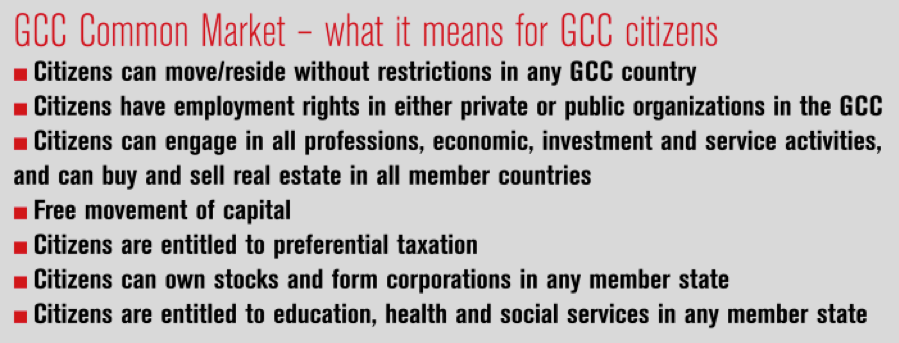
However, this time the GCC’s objectives deal with economics and the free movement of people, aims the region has been moving towards following a customs union agreement in 2003, a condition set by the EU for a FTA between the two blocs. For the GCM that means GCC citizens are now able to: live in any of the GCC countries as well as work in either the private or public sectors; buy and sell real estate; freely move capital; access preferential taxation details; own stock and form corporations in any member state; and access education, health and social services.

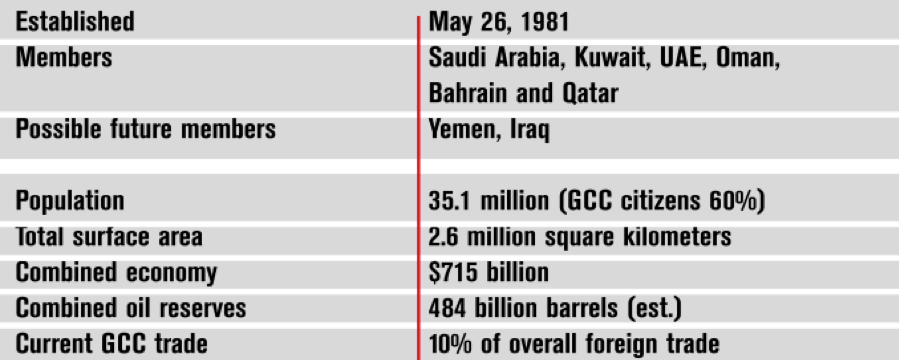
This is all very commendable, and the GCM certainly has a lot going for it, with a population of 35.1 million people, a combined economy of $715 billion, and an estimated 484 billion barrels of oil, more than half of the oil reserves of the Organization of Petroleum Exporting Countries (OPEC). Furthermore, with booming economies on the back of high oil prices, in addition to massive government surpluses, the GCM has real potential to succeed, at least on paper. But as analysts and businessmen point out, there is a great deal of difference between rhetoric and the facts on the ground.

“The GCM is supposed to create more business, more movement, but so many things have to be leveled and if not enough awareness is created, will not leverage the benefits of a common market,” said Dr. Fadi Makki, senior associate with Booz Allen Hamilton.

Time to unite

The biggest stumbling block of the GCM was evident at the very meeting that decided on the market’s launch this year. The annual GCC summit in Doha, in December 2007, failed to provide any leadership on the challenges the Gulf is facing, namely a decline in currency values and rising inflation. For the GCC, Qatar and Dubai in particular, these dual issues are of major importance, making the region less competitive in attracting skilled foreign labor. Equally, the depreciation in the dollar has had an impact on unskilled workers, with laborers striking last year in the UAE over the greenback’s slump (two years ago the Indian Rupee was valued at 44 to the dollar, compared to the current 39 Rps).

What the summit did achieve was a controversial proposal, by Bahrain, for a six-year residency cap on unskilled expatriate workers, and a focus on rapprochement with Iran. Indeed, Iran attended the summit for the first time, a significant indicator of the current, and future, importance of solid relations between Tehran and its southern neighbors. Equally, with the Bush administration still keeping pressure on Tehran — the use of force, we are told, is still on the table — Iran’s attendance sent mixed signals from the Gulf, particularly at a time when the region is acquiring $20 billion in arms from the US.

Just as puzzling as the summit’s inability to tackle pressing financial issues were the statements about a common currency for the GCC, the “Gulf Riyal”. Although Gulf leaders issued a public communiqué at the summit that reaffirmed commitment to a 2010 deadline for a monetary union, a classified document leaked to UAE daily Emirates Business 24/7 showed that finance ministers had told heads of state that the GCC would not be ready by 2010. No deadline was given in the report, but if an interview given by the governor of the UAE Central Bank late last year is anything to go by, he said the GCC was unlikely to have a single currency by 2015.

This is not overly surprising, given Oman’s decision in 2006 to opt out of the common currency over concerns that spending targets would constrain economic growth, and last year’s decision by Kuwait to de-peg its currency from the greenback, citing inflationary pressure.

Therein lies the crux of the problems the GCM faces: Gulf countries are still acting independently of one another on economic and political policies.

“There is of course a large degree of liberalization, on tariffs (to zero), on services, establishing a business in another GCC country,” said Makki. “But now there is more work to be done, just as when the European market started, through stronger institutions, which have to be put in place. This will be essential to keep the momentum going, otherwise there is a tendency for capital protectionist initiatives. And a lot of things will have to be done differently, such as trade agreements being done separately, that will have to come to an end.”

Indeed, some developments currently underway in the region are at odds with the very aims of the GCM. Bahrain for instance has just proposed a dual price plan where non-nationals will be charged more for basic commodities than Bahrainis. Although aimed at expatriates, the proposal is for nationals only, not GCC citizens, flying in the face of the rights entitled to them under the GCM.

Then there is an issue that goes to the very heart of the GCM — the movement of people and goods, which was supposed to have been fast tracked when a customs union was introduced.

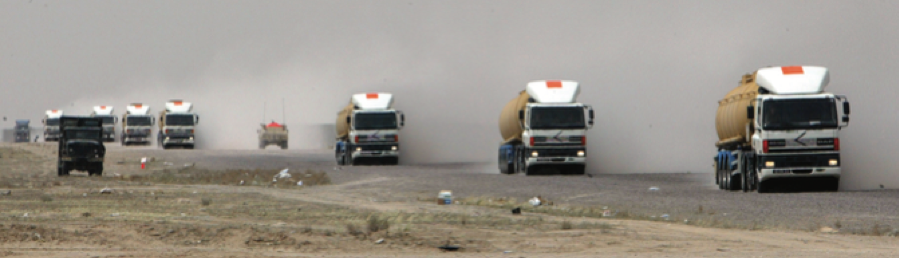
“They implemented GCC customs unification four years ago, and there are still hiccups,” said Ahmad Hammauda, assistant managing director of Global Logistics Services and Warehousing in Kuwait. “If we go to Dubai today, as a Kuwaiti company — a GCC company — we cannot have our own trucks in Dubai, you have to have an Emirati with you. The same was true for Saudi Arabia but the law was changed five months ago, now allowing GCC trucks into Saudi. We are building a depot in the Dubai World Center, but that is a free zone, whereas in Dubai we can’t — how free is that?”

Furthermore, the construction of barriers in the Gulf is presenting, quite literally, a physical obstacle for the GCM, with Saudi Arabia to spend between $10-$15 billion to secure its 6,500 kilometer border, which includes three GCC countries, the UAE, Kuwait and Oman, and potential future GCM members Yemen and Iraq.

“I’m pessimistic for security reasons. Saudi Arabia is building a wall with Iraq, Kuwait with Iraq and maybe there will be one between Syria and Lebanon. All this putting up of walls is not good for removing borders,” said Hammauda. “We hope that things will be easier. It would be great if goods can move freely within the GCC, but I don’t think that will happen anytime soon. In my book, the common market is similar to the EU or the US — a common market without borders,” he added.

Indeed, the postponement of the EU-GCC FTA is not only over the EU adding new conditions. Notably, the EU have pointed out a lack of coordination and uniformity among GCC countries as well as differences between governments in certain sectors such as labor laws, copyright and property rights.

As Eckart Woertz, program manager in economics at the Gulf Research Center, pointed out: “Legal codes and judicial regulations all need to be amended.”

Gulf Cooperation Council — quick facts

Source: AFP

Boom times ahead?

The need to amend GCM laws is crucial for the common market to flourish, particularly inter-regionally. Currently, trade between GCC states represents about 10% of overall foreign trade, which is expected to surge to 25% in the next two years, according to Bahrain’s Chamber of Commerce and Industry, bolstered by the new common market.

The GCM is also expected to be a boon for neighboring countries.

“It will encourage countries to go in the same direction,” said Makki.

“The GCM is symbolic, the first of its kind in the area, moving towards ever closer coordination and countries giving up some of their sovereign powers — that is very significant.”

But before this happens along the lines of the EU — with the potential for expansion of the bloc on the cards, as the EU has done in the past decade — the GCC will need to liberalize further.

Woertz thinks that cross-border mergers are likely to improve if capital markets get closer together, or even establish a GCC integrated stock market.

“It would help if there were some inter-linkages, trading platforms and so on. At the moment it’s pretty much fragmented. If they wanted to develop and attract international investment, the GCC would need to do something there,” he said.

Equally, the free movement of capital needs to be addressed by regulatory authorities, as a true common market would allow banks and financial services to set up in any GCC country.

The aim of giving GCC citizens equal rights in buying and selling property as well as shares also needs to be addressed. Currently, Dubai and Abu Dhabi allow international investors to buy combined stakes of 49% in listed companies, while certain companies are restricted to UAE citizens. Saudi Arabia, however, the seat of the GCM, has allowed GCC citizens to buy and sell shares since September last year, and Qatar allows foreign investors up to 25% of a company’s shares. But only four bourses allow cross-listing of shares — Bahrain, Dubai, Abu Dhabi and Kuwait.

This will all change though when institutions are created to unify the GCM, such as a central bank, courts of justice and a country chosen to represent, on a rotational basis, leadership of the GCM.

“Imagine how the GCM can negotiate with just one negotiator. They would have a lot of weight in a number of international institutions — the WTO, future trade negotiations with the EU and the US, and elsewhere,” said Makki. “Even in non-trade related institutions, the IMF, World Bank, OPEC. The GCC role in all these financial institutions is likely to grow, and grow significantly, but it all depends on how coordinated their stance is vis-à-vis the issues that are at stake, so really the sky is the limit.”

Ultimately, the GCM has a lot going for it — a common language, bourgeoning economies and the ability to act as powerful bloc on the world stage. But before the GCM can progress, the political will needs to be there, along with a clear vision for GCC citizens of what the common market is all about.

“What does this common market mean? I’ve not heard much,” admitted Hammauda. “I heard one currency, and moving goods without documentation, but that is not there. We haven‘t heard anything that this might change. To be frank, I don’t know what the GCM means.”

February 27, 2008 0 comments
0 FacebookTwitterPinterestEmail
Special SectionSubprime Crisis

GCC banks sitting safe

by Executive Staff February 27, 2008
written by Executive Staff

A study of rated Gulf banks by Standard and Poor’s analysts Emmanuel Volland and Mohammed Damak shows that the region’s banking sector has had a limited exposure to US subprime mortgage-related instruments. Executive interviewed Volland to assess his opinion of the study’s results.

E Which banks did Standard and Poor’s select for the survey and what was their exposure to subprime mortgage-related instruments?

We selected 20 of the largest banks in the Gulf region. Among those were the ones that have the largest subprime exposure. We came out with a figure of total exposure to subprime of less than 1% of total assets. At the time we did the survey, we did not include exposure to structured investment vehicles (SIVs). If you added the SIVs, the exposure would be higher.

E How much higher?

I would say it’s still below 2% of assets. Comparing exposure to assets is useful, but probably not the best ratio one can use. It’s probably better to compare it with the size of their equity base or the size of their net profit. If you look at the total equity the figure would be less than 10%. Also, with total exposure it is meaningful to look at the details in terms of what is investment grade and non-investment grade and the way things are moving. The assets that were investment grade at the time may no longer be investment grade. Some have seen significant downgrades from our structured finance group.

E Is the exposure still investment grade?

I would argue that the majority is still investment grade but that the proportion is lower than at the beginning. So overall I think we keep our roughly positive message on the Gulf banks’ exposure to the US subprime market and other structured instruments. We don’t expect a significant downgrade or change in our ratings. According to the results of our more detailed survey, overall the exposure is manageable. Also, some banks may have larger exposure than others. And the profile of the banks with more exposure would be the wholesale banks, including Bahrain and probably also a few banks in the UAE.

E Some programs, like Eurobonds and shari’a-based bonds, have postponed issuing debt. Could you please discuss this dynamic?

Well, as you said, since the beginning of the meltdown we have rarely seen any banks going on the market for debt. We don’t suggest that they would not be able to do so. It’s just that the pricing has increased substantially. These banks are not in desperate need of liquidity. So they took the decision to wait for the market to calm down and hope the spreads will go down. I don’t think the spreads will ever come down to the very low level they reached in early 2007. There were many investors claiming that while the spreads reached something like LIBOR plus 20 business points it was not reflecting the real credit risk of these institutions.

E Will we see GCC banks getting involved in bailouts of Western banks echoing the recent activity of sovereign wealth funds?

We will not see GCC banks providing a significant amount of liquidity for the US and European markets. We are talking about small institutions. I think the largest bank in the Gulf region has total assets of $50 billion and total equity of $6-7 billion. So they might have an extra liquidity of $2-3 billion, which they would have already partially placed in US or European equities. So we are not talking about hundreds of billions sitting on their balance sheets, waiting to be invested. This is a different story for sovereign investment funds like the Kuwaiti Investment Authority, the Abu Dhabi Investment Authority and private individuals like Al-Waleed bin Talal.

E What do investments in Western banks by these sovereign wealth funds tell us about the future of the Middle East financial sector?

First, it is a structural trend that started before the problem. There is a clear willingness by these governments to take into account that oil resources will disappear at some point and they need to diversify their investments outside of the Gulf region. So we’ve seen mainly investments in Europe and the US before the crisis. But at the same time this is an opportunistic strategy where we see a very low valuation for banks and they will try to take advantage of that.

E Are these investments by sovereign wealth funds in the banking sector wise at this time of financial uncertainty? Is this a new trend?

That’s a good question. We don’t know where market prices will go. There is potential for more of a drop in equity prices. But the sovereign funds really have long-term strategies. So there might be a point when they are underwater in terms of price of longer-term investments, but if you really believe there is not critical risk of bankruptcy then the market price will likely come back to higher levels. But then again, there is an intermediary risk that the problems will increase up to the point where you lose your investments. Obviously, it is more risky than investing in US Treasury bills or government debt. I would not argue that this is a new trend. We have seen massive investments from the sovereign wealth funds even before the crisis. Not so much in the banking sector, but definitely in the corporate sector.

E What can you tell us about sovereign wealth fund exposure to mortgage backed securities and the subprime crisis?

We don’t rate the sovereign funds and the level of public disclosure is close to nil for most of them. They are well-kept secrets. It may be that they don’t have any exposure or they may have large exposure. We just don’t know.

E How will the subprime crisis affect Q4 2007 and 2008 numbers?

The Q3 impact has not been significant. Very few banks have taken positions that reflect a lower valuation on structured instruments. I think we will see slightly more of that in Q4 numbers and maybe more in 2008. I think the banks have been relatively slow to change the pricing on their books. GCC banks have some of the best performance in the world, so performance in Q4 and 2008 will be pretty solid regardless. A small number of banks, maybe two or three, might need to do a massive cleaning of their balance sheets with regard to these instruments. But the impact should be manageable and will not be big. Also, some of the banks are owned by the government so this will make things easier. And finally in terms of raising capital, there is currently tremendous liquidity in the Gulf. In closing, the region’s financial sector does not have too much to fear from the ongoing American subprime crisis.

February 27, 2008 0 comments
0 FacebookTwitterPinterestEmail
Special SectionSubprime Crisis

The Subprime Crisis and the Middle East

by Executive Staff February 27, 2008
written by Executive Staff

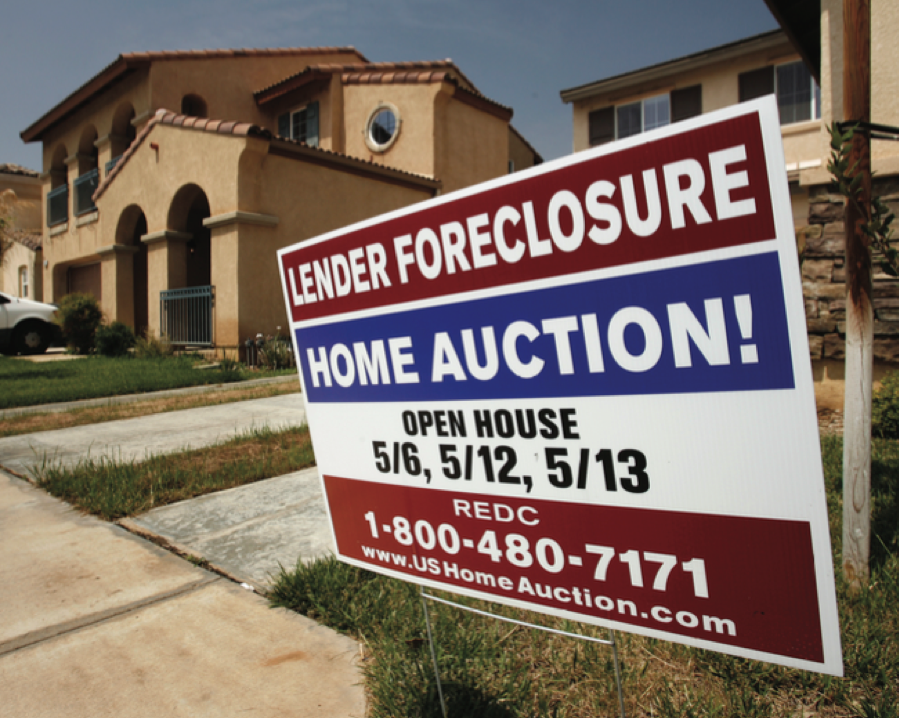
The US subprime crisis is having little impact on the Middle East financial sector; in fact the crisis turned out to be quite an opportunity for the region’s financial institutions. To date, the only direct loss reported was by Abu Dhabi Commercial Bank (ADCB), which wrote down $19 million in assets during the third quarter of 2007. A few other firms took indirect hits. One such firm was Emaar Properties. In August 2007, the Dubai-based property developer explained that its US subsidiary unit John Laing Home’s (JLH) third quarter results were lower than expected due to the subprime mortgage crisis and a possible implosion of America’s housing bubble. Emaar was unable to comment on this development for Executive. In a previously conducted interview with Reuters, however, Emaar Property’s chief financial officer, Amit Jain, noted “third-quarter JLH results are going to be lower than earlier estimates — not incurring losses, but profits won’t be high.” News of lower returns for JLH hurt Emaar Properties, as it posted its first decline in profit in the last three years. Its share price dropped to a 28-month low as investors sought out less-exposed options.

This decline came in sharp contrast to the optimism felt by Emaar in 2006 when they purchased JLH for $1.05 billion. While it finalized the deal before mass subprime defaults occurred in the later half of 2006, some analysts did question the rationale behind the decisions to acquire JLH as talk of a US housing bubble made its way into the media. Although American real estate woes have ultimately taken a toll on Emaar Properties, other regional institutions have avoided the same fate because of different asset allocation abroad and a strong domestic market.

Gulf property markets do not appear threatened

The subprime crisis does not appear to threaten Gulf real estate and Gulf investors remain confident in their domestic housing markets. In December 2007, the Khaleej Times noted that the subprime crisis would not hit the UAE’s property sector. The CEO of Rakaa Property, Abdulrahman al-Tassan, explained in the article that the Emirates’ property market has better standards than those in the US. To insure against defaults, the Gulf country makes sure underwriting standards are strict and borrowers undergo background checks before they are issued credit.

Banking on better days

Gulf banks also found themselves in safe waters. Banking institutions keep diverse portfolios in high-grade investments to mitigate risk, ensure positive returns and minimize the risk of defaults. They are also supported by high liquidity and government willingness to intervene if investments turn sour. Standard and Poor’s credit analysts Emmanuel Volland and Mohamed Damak found in a recent study only limited exposure by Gulf banks to US subprime mortgage-related instruments.

The study investigated 20 Gulf banks with the largest exposures to subprime mortgage-backed securities and found that less than 1% of total assets were exposed. Other indicators, such as total exposure to subprime mortgage-backed securities as a percentage of total equity were higher, nearing 10%, but the report took an optimistic tone, saying banks are not exposed enough to warrant any changes in policy, as long as all their subprime exposure remained in equities of high investment grade with ratings of ‘AA’ and ‘AAA’. In an interview with Executive, the analysts maintained that Middle East banks’ exposure to subprime securities is still investment grade.

Still, not all banks have had consistent performance during the subprime crisis. Bahrain’s Gulf International Bank (GIF) saw its Moody’s rating drop from stable to negative on its A2/prime – 1 deposit ratings and A3 subordinated debt ratings because of the bank’s holdings of US mortgage-backed securities. GIF can choose to either change its procedures to bring its ratings back to stable or it can ignore the rating and maintain this exposure to subprime-related securities. Moody’s decision is not likely to have a significant impact on Bahrain as most Gulf banks are supported by governments willing to bailout beleaguered firms and banks.

In step with the US Federal Reserve 

Although exposure remains low, Gulf banks and institutions are not moving forward as smoothly as they would in the absence of the subprime debacle and the ensuing credit crunch. The credit crunch is putting recessionary pressure on the US economy, which is currently being countered by the US Federal Reserve. All economies that peg their currencies to the dollar are affected by the Federal Reserve’s monetary policy. The list includes most Gulf countries, except Kuwait, which depegged its currency from the dollar in 2007. The six countries of the Gulf Cooperation Council have begun implementation of the Gulf Common Market (GCM) agreement and are preparing for a common currency to be minted in 2010.

The Federal Reserve’s main short-term worry since the apex of subprime defaults in October 2006, is that a recession in the US might follow resulting in far-reaching implications abroad. To preempt this, the Federal Reserve’s monetary policy is set to grow the economy through a series of interest rate cuts. The interest rate cuts are an attempt by policy makers to encourage lending by making money cheaper to borrow. Firms will, it is hoped, borrow rigorously and thereby promote economic growth. The Federal Reserve cut interest rates to the lowest level in two years when they hit 4.25 % in late 2007. Then on January 22, 2008, US Federal Reserve Chairman Ben Bernanke cut rates again to 3.5%.

The Gulf will have to follow suit, either by changing their pegs or by altering monetary policy to match the US changes. To maintain parity with the dollar and keep regional investors from engaging in interest-rate investment arbitrage on the US market, the central banks of the region must lower interest rates in turn. Although some of the greenback-pegged Gulf economies have revalued their currencies to the dollar, they will also continue to maintain the peg to keep parity with each other’s currencies until the GCC common currency begins.

According to chief economist and head of research at Jadwa Investment, Brad Bourland, Saudi Arabia’s currency peg to the dollar means that Saudi must echo US interest rates. If the Saudi Arabian Monetary Agency allows too much divergence between interest rates, investors will capitalize on the widening spread. Bourland also noted the harm interest rate cuts may have in encouraging inflation in a region that does not need to see any more of it.

Keeping prices and currencies happy

Gulf countries are battling double-digit inflation, because  the Fed’s interest rate cuts are putting expansionary pressure on their economies. To counter the pressure, some Gulf central banks have decided to raise their reserve requirements, exercising one of the few sovereign moves the region’s central bankers have left. By raising reserve requirements, the central banks are constricting the economy by keeping more money in the vault and less in the hands of borrowers. Qatar, which is battling 15% inflation, raised its reserve requirement by 50 basis points to 3.25%, which will force banks to stash away more of their capital with the central bank, leading to a contraction in the economy. The move will counter growth without disrupting Qatar’s interest rate parity with the greenback.

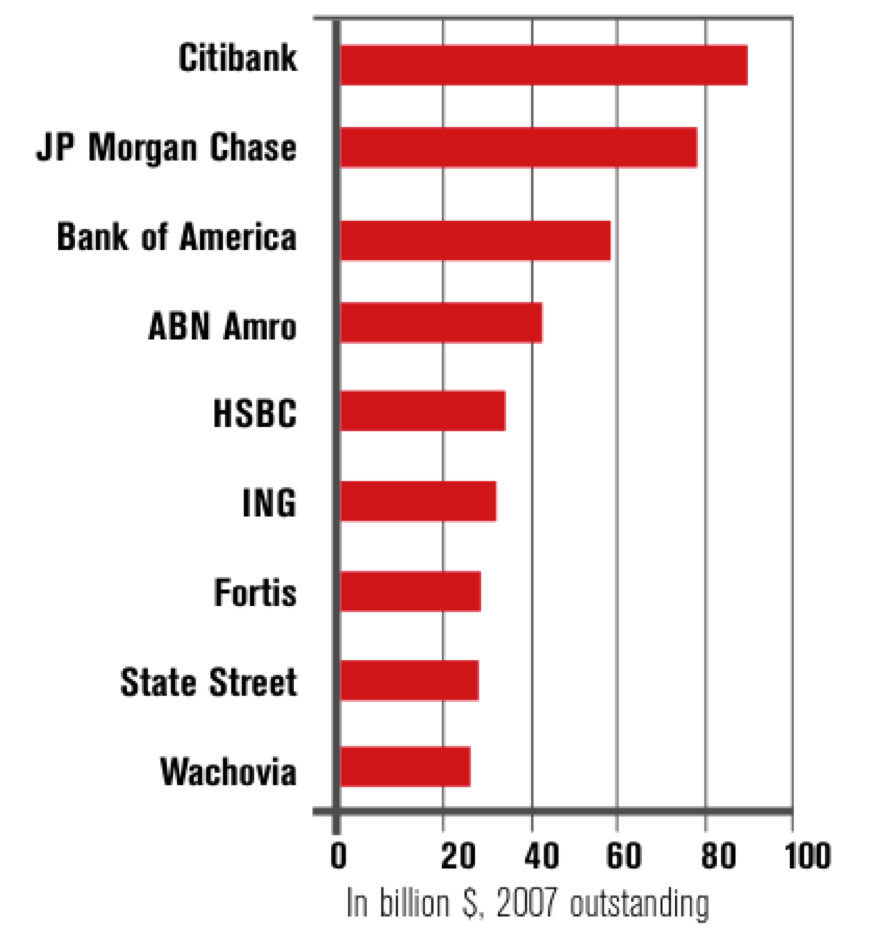
Potential Bank Liabilities

Top bank sponsors of commercial paper, 2007

Source: Economist/Fitch Ratings

When can the bonds start?

As Middle East central banks follow the increasingly active moves by the Fed to lower interest rates, many firms waited to issue bonds, opting instead to do so once the spread narrows, because bond valuations based on current spreads are likely to be undercut by reactionary interest rate cuts.

According to Dr. Eckart Woertz, program manager of economics at the Gulf Research Center, the main impact of the subprime crisis in the Middle East “has been the widening spreads and assets [that] have been affected. The financing condition is deteriorating, even for companies and issuers.” Looking forward to 2008, he noted that, “There are a lot of potential [bond] issues in the pipeline. Should markets calm down, then they will come to market. It tells of confidence in a fledgling bond market.”

Recent moves include the UAE’s Dana Gas postponement of a $1 billion Islamic bond issuance (sukuk) and Bahrain’s Ithmaar, which delayed sales of their five year bonds valued at $300 million. Abu Dhabi First Gulf Bank also postponed issuing its $3.5 billion Eurobond. Those who went ahead during a market with high spreads lost big. Among them was the Saudi Basic Industries Corp. (SABIC), which had aimed at raising $2.7 billion from a bond issue. In the end, they were only able to obtain $1.5 billion.

Middle East money saves Wall Street

The major players in the Middle East, in particular the Gulf, are the government-owned and operated sovereign wealth funds (SWF). In terms of the subprime crisis, these SWFs may come out on top as willing and able financiers, providing much needed liquidity for Western firms and banks. In January 2008 both Citigroup and Merrill Lynch solicited the help of sovereign wealth funds from Asia, including the Gulf.

In total, these funds manage as much as $2.9 trillion and have invested in everything from telecoms to aerospace. However, their entrée into the banking world has been the most impressive. According to a January 2008 report in the Economist, since the start of the subprime mortgage meltdown Gulf-based SWFs have shifted almost $69 billion into Western investment banks. As the magazine notes, “They have deftly played the role of savior just when Western banks have been exposed as the Achilles heel of the global financial system.”

The largest SWFs include the the Abu Dhabi Investment Authority with $875 billion in assets, various Saudi Arabian funds at together $300 billion, Kuwait’s Reserve Fund for Future Generations ($250 billion), Libya’s Oil Reserve Funds and the Qatar Investment Authority (both $50 billion), and Algeria’s Fond de Regulation des Recettes ($42.6 billion).

The common thread among the MENA funds is that the controlling governments are rich in natural resources, whether petroleum or natural gas. With recent oil volatility working to the region’s benefit, sovereign wealth funds have excess liquidity to diversify long term investments abroad and to provide the credit needed in US markets.

In 1991 Saudi Arabia’s Prince Al-Waleed bin Talal bought $590 million worth of shares in Citicorp. Now those same shares would be worth $5.36 billion. With today’s Citigroup offering 7% dividends on shares bought by the Abu Dhabi Investment Authority (ADIA) and others, it is easy to understand why during fallout of the subprime crisis they did not have to go looking for investors. These appealing terms are coupled with the fact that potential investors were fully briefed on the group’s upcoming forth quarter announcements and share prices are half of what they were last summer. In fact, Citigroup is well positioned to raise even more money from SWFs in the region should upcoming earnings reports bring more bad news, as is expected.

Future trends for sovereign wealth funds

In a report on Sovereign Wealth Funds and Bond and Equity Prices Morgan Stanley’s chief UK economist David Miles explained the difference in the amount of risk sovereign wealth funds are willing to take when compared to more traditional strategies. He suggested that because SWFs have vast assets, their investment patterns display a high tolerance to risk. In comparison, the wealth of more traditional governments is invested in foreign exchange reserves and most of that is sunk into low-risk, low-return instruments like government bonds. Miles added that the unusual appetite for risk and the eminent growth of sovereign wealth funds will likely have an impact on the degree of risk tolerance for investors the world round. He noted that should this occur, there ought to be a resultant effect on asset prices.

GRC’s Woertz noted that sovereign wealth funds “… have a lot of money. They have a serious liquidity problem in the sense that they have too much money. They have problems finding investment opportunities for their liquidity, so they will buy in the US but also in other places. They are not satisfied with just buying treasuries anymore.”

Citigroup’s losses prompted a $12.5 billion cash infusion from SWFs like the Kuwait Investment Authority (KIA). This large cash infusion had been preceded by one in November 2007 from the Abu Dhabi Investment Authority worth $7.5 billion. According to the International Herald Tribune, Citigroup Chairman Robert Rubin had made an eleventh-hour trip to secure the KIA funding. However, the bailout might work to the advantage of Gulf investors. If Citigroup’s shares are now at their low point, then its new Gulf investors will benefit in the long term. And the Citigroup deal is not the only one in the making right now. In December 2007 Zurich-based bank UBS received $1.8 billion from an anonymous Middle Eastern investor.

The following month Merrill Lynch saw share sales to the tune of $6.6 billion, bought by various entities in the region including Saudia Arabia’s Olayan Group, the Qatar Investment Authority and the Kuwait Investment Authority.

Where does the region go from here?

The subprime fallout has not caused any disruption on the Middle East markets, nor has it significantly damaged regional firms or banks. What the subprime crisis brought was a credit crunch desperate for foreign liquidity. Regional firms and banks are beginning to fill in the gap. Only in recent weeks have Western bankers begun to realize that Gulf liquidity is going to provide their cash-strapped markets with the funds needed to rejuvenate business projects and economic growth. Bailout by a mixture of institutional and personal investors for both Citigroup and Merril Lynch is just the beginning of a future trend by sovereign wealth funds and petrodollar beneficiaries to supply the capital demands of US and Western markets.

February 27, 2008 0 comments
0 FacebookTwitterPinterestEmail
Comment

Remembering Benazir Bhutto

by Norbert Schiller February 27, 2008
written by Norbert Schiller

After news filtered out from Pakistan that Benazir Bhutto had survived a suicide attack on the day of her triumphant return last October, I knew deep down that if she were to continue her campaign to become prime minister, her chances of surviving until election day were minimal. Pakistan had changed since the last time she campaigned and now the world, and particularly her home country, was far more dangerous than when she began her political career almost 20 years ago. On December 27, 2007, a little over two months after the first attack, she was killed doing what she was good at, getting close to the people.

In the summer of 1988, while a young Benazir was preparing to accomplish what no Muslim woman had done in modern history, I was covering the last days of a brutal eight-year war that began with no warning and was about to end the same way. The day the Iran-Iraq War ended, the few journalists still covering the war, including myself, were caught completely off guard. After a year and a half of being totally immersed in the Gulf conflict, we found ourselves with nothing to do. The agency that I worked for was also at a loss and, after looking around for other news events in the region, decided to send me to Pakistan to cover the elections.

It was hard not to get swept up in the Benazir Bhutto craze. She was young, only 35, beautiful, warm and inviting. And the foreign media could not get enough of her. When she toured the country we camped out in the same places that she was staying and followed her relentlessly throughout her campaign. Her tactics were the same up until the day she died: get as close to the people as possible. Day in and day out we raced around the countryside in 4×4 Pajeros covering her every move. When she reached a village she would stop, open the sun roof and with a megaphone address the crowd gathered around her vehicle. And then she would close the sun roof and race on to the next village. Everywhere we went throngs of supporters would line the way. If someone wanted to kill her back then, there would have been ample opportunity.

Occasionally, I would follow the campaign of her arch rival, Nawaz Sharif, but that was nowhere near as exciting and it seemed that nobody abroad was really interested in him. However, my own lack of interest in him changed after an unusual incident that brought us closer together. While he was taking a walking tour through a part of Lahore and I was back-peddling in front of him, I suddenly fell through an open manhole on the street. He quickly reached down with some of his aides and pulled me out. Noticing that I was covered in blood he stopped his campaigning, summoned his medical team to attend to me and waited in a nearby residence until I was bandaged and fit to continue before he carried on. After that incident, I made it a point to cover his campaign as well.

When it was announced that Benazir Bhutto’s Pakistan Peoples Party (PPP) had swept the majority of seats in the National Assembly I was in Rawalpindi, just south of the capital Islamabad. The city erupted in celebrations and fireworks and it took me hours to get back and file my images at the office in Islamabad.

Shortly after Benazir Bhutto’s election victory I was sent back to Pakistan to cover the South Asian Association for Regional Cooperation (SAARC) summit. This event was to be bigger than normal because the meeting not only brought together all the countries of the sub-continent, but more importantly it was the first time in 16 years that the leaders of Pakistan and India would meet one on one again. The sight of Benazir Bhutto walking alongside Rajiv Gandhi represented a chance for change and reconciliation. The last time such a high level meeting occurred was in 1972, at the signing of the Simla Agreement when Benazir’s father, Zulfikar Ali Bhutto and Rajiv’s mother, Indira Gandhi, had met and agreed to settle all their differences peacefully.

Sixteen years later, a new generation of leaders, part of the same dynasty, was meeting yet again. As before, they agreed never to attack each other’s nuclear facilities, to promote cultural exchanges between the two countries and to eliminate double taxation on international civil aviation transactions. In the same spirit as their parents, Bhutto and Gandhi signed the same vows their parents had done years before.

After only 20 months Benazir Bhutto was removed from office by Pakistan’s then President Ghulam Ishaq Khan over an alleged corruption scandal.  She would, however, come back and hold the office a second time between 1993 and 1996.

In a weird twist of fate Benazir Bhutto’s death signals an end to a relationship between India and Pakistan that began in 1972 and was strengthened again in 1988. Benazir’s father, Zulfikar Ali Bhutto, was executed in 1979 after a controversial trial where he was accused of being behind the murder of one of his opponents. Indira Gandhi was assassinated in 1984, and her son was killed in 1991. Sixteen years later Benazir Bhutto would suffer the same fate.

Norbert Schiller’s latest book Arak and Mezze: The Taste of Lebanon was published last month.

February 27, 2008 0 comments
0 FacebookTwitterPinterestEmail
Financial Indicators

Global economic data

by Executive Staff February 7, 2008
written by Executive Staff

Part-time employment as a % of total employment

Source: OECD

In 2006 countries showed a mixed percent of their workforce employed as part-time employees. OECD data refers to part-time employment as persons who usually work less than 30 hours per week in the main job (35 hours for Japan). The split which separates those with a large chunk of part-time employees is not easily definable and countries do not share similar economies, policies, histories, or geographic locations. OECD countries oscillate around the group’s total of 16.1%. The Netherlands’ workforce is comprised of the most part-time employees at 35.5%, followed by Australia and Switzerland at 27.1% and 25.5%, respectively. The economy with the lowest percent of part-time labor compared to the total workforce is the Slovak Republic where only 2.5% of employees are considered part-time. Other performers at the low end of the ranking include Hungary, with 2.7%, the Czech Republic, at 3.3%, and Turkey, at 7.9%.

Women as a percent of total part-time employment

Source: OECD

Although the preceding graph of part-time employment as a percent of the total workforce did not show any direct trend, the data as it pertains to women is useful for economists, policy-knacks, and company directors as woman seem to overwhelming make up a country’s part-time labor. In fact, all OECD countries see woman as over 60% of their part-time labor. The OECD total of 72.1% is unnaturally high, but perhaps for good reason. Woman are indeed facing new struggles as the nature of employment changes and two people are often needed to support a family. To be there for their children, women must have more free time at home, but while their children are at school during the day, women are able to take on part-time work. Luxembourg’s place as a bustling banking center might likely show favorable employment plans for part-time female professionals, accounting for the European country’s high score of 93.1% for woman as a percent of total part-time employees. Korea, with 58.5% and Turkey, with 58.6%, might rank lower because of traditional values over the woman’s place in a household or at least the man’s place as an owner. The culture of employing women is undoubtably one of pragmatism, which might explain why OECD countries, considered the world’s strongest economies, show such high figures.

Consumer price increases (as %)

Source: OECD

OECD annual inflation rates in 2007 remained relatively low, but some developing economies are nevertheless showing the expected hot flashes of a bustling market. The OECD total of 2.4% consumer price increase is dwarfed by Turkey, whose economy is heating up with 10.9%, a number they will need to cool down as they continue talks with EU negotiators over eventual accession talks. The Celtic Tiger Ireland is also showing economic growth’s effects on inflation, where consumer prices have jumped by 5.1%. Besides Japan, which in fact registered a deflation of 0.1%, Europe’s mature economies of France with 1.2%, Switzerland with 0.2%, and Norway with 1.1%, are reporting very stable price increases.

Trillion passenger-kilometers

Source: OECD

How mobile are citizens in OECD countries? Very, according to one composite score this accounts for passenger transport on rail, buses and coaches, and private cars. The scores, in trillions of passenger-kilometers, are indicative of how on the move some countries are and how they stack up against others. The US rises far above all other OECD members, with 7.4 trillion passenger-kilometers, perhaps because of the country’s close to 300 million population or because of the “go-go-go” nature of Americans. Japan, with 1.222 trillion passenger-kilometers and Germany with 1.0289 trillion rank second and third among OECD countries. The least mobile citizens come from Greece, Hungary, and the Slovak Republic, perhaps attributed to income, geographic location, availability of transport, or just being content with remaining still.

February 7, 2008 0 comments
0 FacebookTwitterPinterestEmail
By Invitation

Authoritarian CEOs are out, inclusive CEOs are in

by Bahjat el-Darwiche & Rabih Abouchakra February 3, 2008
written by Bahjat el-Darwiche & Rabih Abouchakra
CEOs today must work cooperatively with a variety of stakeholders, including proactive boards, involved investors and other vocal constituencies.

There has been a dramatic shift over the past decade in the role of the CEO in corporations across the globe. The time of the “authoritarian” CEO, who roamed the corporate landscape not so long ago, has passed, as we enter the era of the “inclusive” chief executive officer.

Whereas Authoritarian CEOs answered only to themselves, the power of today’s CEO is not as absolute: Boards of directors are becoming more critical and more closely involved in setting strategy, and are far more likely to insist that CEOs deliver acceptable shareholder returns and demonstrate ethical conduct. Boards are increasingly prepared to replace CEOs in anticipation of disappointing future performance, instead of merely as punishment for poor past performance. At the same time, large shareholders like private equity firms are taking a more active role in decisions that were once the sole purview of the CEO.

The emergence of this more demanding environment has accelerated CEO turnover. Our recent studies reveal that annual turnover of blue chips’ CEOs across the globe increased by 59% between 1995 and 2006. In those same years, performance-related turnover — cases in which CEOs were fired or pushed out — increased threefold. Whereas, in 1995, only one in eight departing CEOs was forced from office, last year, nearly one in three left involuntarily.

This new era will require new skill sets and impose new responsibilities on both chief executives and board members. Today’s inclusive CEOs must be willing to engage in dialogue with investors, employees, and government; to surround themselves with managers and advisors who complement their own capabilities; and to maintain transparency in their communications about financial results and compensation.
Boards are adapting 

The last decade has witnessed two fundamental shifts in the ways corporate boards address CEO selection and oversight: Boards are becoming less tolerant of poor performance, and they are increasingly splitting the roles of CEO and chairman.

Our research shows that CEOs who deliver below-average returns to investors don’t remain in office for long. Last year, a CEO in North America who delivered above-average returns to investors was almost twice as likely as one delivering sub-par returns to remain CEO for more than seven years. In contrast, in 1995, CEOs who delivered substandard returns to investors were just as likely to achieve long tenure — a perverse situation that reflected the durability of the Authoritarian CEO. The Middle East is catching-up fast with global CEO turnover rates as rapid-growing economies are bringing new pressures to corporate management and governance in the region.

The other major trend has been in governance, with both a shift toward separation of the roles of chairman and CEO and a shift toward chairmen who haven’t previously served as a company’s CEO. Splitting the roles of CEO and chairman while the former CEO stays on as chairman is a bad idea for three reasons: First, knowing that the former CEO will remain involved as chairman sometimes leads the board to embrace a candidate who was a great number two, but who’s unlikely to become an effective CEO; second, most chairmen who were CEOs protect their protégés, reducing the likelihood that the new CEO will be fired for poor performance; and third, some chairmen who weren’t really ready to give up their executive responsibilities go to the opposite extreme, firing their successor at the first sign of trouble and reassuming the chief executive position.

Inclusiveness, engagement, and involvement 

With the board of directors more deeply engaged and owners actively involved in governance and strategy, inclusiveness is the most critical new attribute for the CEO, starting with the ability to take into account the concerns and suggestions of investors, employees, and government. Given the unrelenting pace of change in global business today, stakeholders may see threats and opportunities sooner than the board and management team do. Listening to stakeholders increases the likelihood that a company will act quickly and effectively.

Transparency about results is another indispensable element of inclusiveness. Several CEOs have been dismissed in the last few years because of inadequate transparency — with regard to both the board and shareholders — about their compensation.

Including board members in the development of strategy — not merely asking them to approve a strategy developed by management — is the best way to gain the board’s confidence and buy-in. It’s an effort well worth making: Board backing is invaluable to CEOs who may face investor challenges while waiting to see if a new strategy will pay off.

The board of directors, in turn, must embrace deeper engagement. Because of intensifying global competition and ever-higher expectations about corporate performance, companies now need the board of directors to proactively offer suggestions, to debate threats and opportunities, to push back aggressively if management is heading in the wrong direction, and to make informed judgments.

Deep engagement requires directors to participate in dialogues with customers, channel partners, suppliers, and employees — not different in concept from the traditional role of the ideal director, but completely different from the usual practice. These dialogues in turn require directors to devote time beyond the quarterly board meetings, probably earning compensation greater than what they receive today.

Involved investors are also becoming the norm. Authoritarian CEOs survived because investors weren’t actively involved in the governance of publicly traded corporations, limiting themselves to selling off stock when they lost confidence in a company’s CEO. Today’s involved investors include not only members of family-controlled businesses, but also private equity buyout firms, raiders, and hedge funds that take a stronger hand in the actual running of the companies they’ve invested in.

New era challenges

Going forward, boards of directors will need to encourage constructive disagreement and debate, abandoning consensus habit as a vestige of the authoritarian age. They must also be proactive in grooming and retaining a sufficient bench of candidates for the chief executive position, and be creative and adaptable in searching for outside CEO candidates when necessary. In addition, they’ll have to address such new-era governance challenges as balancing the interests of active institutional shareholders — hedge funds and buyout firms, for example — against those of other investors.

This new age of corporate governance is still taking shape, with many of the rules of the new era still unclear and some probably yet to be written. What is clear is that all the constituencies interested in the health and welfare of the corporation — CEOs, boards of directors, investors, consultants, regulators, legislators, and the business press — should say goodbye to the era of the authoritarian CEO and prepare for change.

Bahjat El-Darwiche and Rabih Abouchakra are principals at Booz Allen Hamilton

February 3, 2008 0 comments
0 FacebookTwitterPinterestEmail
By Invitation

Global footprints of sovereign wealth

by John Defterios February 3, 2008
written by John Defterios

The last month will likely go down in the financial record books as the one which redefined how the world looks at sovereign wealth funds (SWFs). It is also part of a bigger geo-economic shift underway, which lends itself to the East-East moniker, meaning the wealth and trade belt from the Middle East to China.

While we have been covering the power of these government funds, where they are seeking to make a mark and the new emerging players within this space, it is only now that these funds are flashing on the global radar.

It is challenging to get hard figures on the total government investment funds under management, but there are a handful of Western banks attempting to do so. Standard Chartered Bank places the value at around $2.2 trillion dollars. I personally think this is off the mark since the Abu Dhabi Investment Authority may have more than half that amount itself.
SWFs — Big & Getting Bigger 

$2-3 trillion dollars in assets

$10-15 trillion dollars by 2015

Bigger than private equity

(source: Standard Chartered, Morgan Stanley)

More eye-popping clearly is the path ahead. If oil stays in the range of $60-$80 a barrel over the next five years, the amount will surge to $10-$15 trillion. To provide some context, the current sum is already bigger than the global private equity pool, which made all the headlines in the past two years with record buyouts.

Is this a new phenomenon? Certainly not. The Kuwait Investment Authority (KIA) can trace its roots back to 1953; the Abu Dhabi Investment Authority (ADIA) to the mid-

1960s. While they traditionally deployed assets in government bonds and currencies, that trend has changed over the past five years and accelerated in the last six months.

Chris Wheeler, banking analyst at Bear Sterns, points to global wealth surveys to illustrate the point that liquidity from record oil prices has to find a home. “A lot of excess funds are being generated which the SWFs are having to invest somewhere and they are finding interesting opportunities in difficult times in the banking sector.” Wheeler, like many others, believes the often talked about recession in the US will lead them to more bargains in other sectors.

This must sound familiar. Saudi Prince Al-Waleed bin Talal bought stakes in Citigroup back in 1991 at the equivalent of $2.75 a share. Even at the mid-twenty range it is today, he is (excuse the cliché) smiling all the way to the bank. He obviously thinks this latest downturn created a similar opportunity and so did others who jumped in this week. They are not traders, but investors who hold their stakes for years, sometimes decades.

Like the financial markets, which create buyers and sellers, this market and story will continue to evolve. One of the newer players on the scene, the Qatar Investment Authority, will re-emerge after its participation in the bid for UK supermarket giant J. Sainsbury, and Mubadala of Abu Dhabi has recently put itself on the map with its stake in investment banker The Carlyle Group.

G-8 Wish List

Invest on commercial grounds

Respect national transparency rules

Compete with private sector fairly

(source: OECD, IMF)

As the old and new sovereign funds begin to compete for Western assets, G8 countries are attempting to establish investment standards for all this capital. The US Treasury Department has lobbied to have the OECD, the Paris based think tank for industrialized nations, and the International Monetary Fund in Washington put forth guidelines for best practices and greater transparency.

That effort gathered momentum a few months ago, but the calls for concrete action have faded away, as the need for capital infusions on Wall Street rose rapidly.

The World Economic Forum in Davos provides a good opportunity not only for us to talk to the Middle Eastern and Far Eastern players making waves in global financial markets, but also to those who are trying to regulate their actions.

John Defterios is the presenter of CNN’s Market Place Middle East.

February 3, 2008 0 comments
0 FacebookTwitterPinterestEmail
By Invitation

Cheer up – the Arabian real economy steams ahead

by Imad Ghandour February 3, 2008
written by Imad Ghandour

As I am writing these words, stock markets around the world are witnessing one of the most dramatic free falls in their history. The subprime problem is now snowballing to become a global recession. Banks are hesitant to even lend to each other. Central bankers are panicking. The Federal Reserve dropped its benchmark discount rate by 0.75% — the largest single drop in seven years.

Despite the talk of gloom and doom, I am cheerful. 

The markets back in 2000 were hit by the burst of the technology bubble, and then in 2001, they were slammed again by the 9/11 attacks. Thereafter, economic growth slowed considerably. But for private equity, investments made after 2001 yielded excellent returns. As valuations plummeted from their 2000 highs, private equity players in US and Europe were able to close deals post-2001 at bargain prices. The graph below shows CalPers (the largest investor in private equity funds) returns on its private equity portfolio by fund closing year (also known as “Vintage Year”).

Arabia will not be insulated from the black clouds that will be downing on the world financial markets over the next months and years. The reaction from the regional stock markets on Monday, January 21, confirms that Arabia is not as decoupled from the global economy as some people like to think. Even the super-insulated Saudi stock market, Tadawul, dropped by more than 20% over the course of several days.

Yet the Arabian real economy will continue to steam ahead despite hiccups in some sectors. The financial sector will be affected by the global turmoil, but less so than other regions in the world. Real estate may also be affected as global, and even regional, financing sources dry up. Transportation and logistics growth will also slow down as growth of transit shipments and passengers from east to west will be influenced by the probable recession in the US and Europe.

The biggest question will be to what extent oil prices will drop in the wake of a global recession, and consequently, whether oil may drop below $50 a barrel. Oil prices are the biggest determinant of Arabia’s economic growth. Psychologically, they form a leading indicator of GCC economic outlook. They are the main source for financing governments, which are still the main economic drivers for the economy as a whole. Fortunately, GCC governments have accumulated huge reserves, and they will be able to easily weather any short-term drop in oil revenues.

Going back to private equity, the next few months will be difficult for all financial players. But as private equiteers come to grips with the consequences of the downturn, and as new realities settle in, the playground for private equity players in the region will be even greener. On one hand, as a result of dropping oil prices, stock markets’ downturn, and gloomy global economic prospects, valuations will be beaten down to reasonable levels. The market will shift to become more balanced, after being under the mercy of the sellers. Secondly, liquidity, although not easily accessible, will not evaporate. Whatever the severity of the global recession, the region still exports daily $700 million to $1 billion worth of oil. Furthermore, governments’ reserves will continue to trickle down to the rest of the economy — sustaining corporate profits and public investments. Last but not least, global funds will realize that growth in Arabia is more robust than in other regions, and hence, the theory of “Arabia is negatively correlated with the rest of the world” will translate into a shift towards further investment by global institutional investors in Arabia’s stock markets and funds. But this will probably happen after the recession settles in.

Be ready for a tumultuous 2008. Remember: Luck favors the prepared and the courageous.

Imad Ghandour is the chairman of the Information & Statistics Committee Gulf Venture Capital Association.

February 3, 2008 0 comments
0 FacebookTwitterPinterestEmail
Capitalist Culture

The American Empire – Contemplating isolation.

by Michael Young February 3, 2008
written by Michael Young

One of the more interesting subtexts of the presidential campaign in the United States has been the debate over whether the nation should withdraw from most of its foreign entanglements. The issue has not been at the center of voters’ concerns, however it has hit a nerve among them, because the proposal comes at a time when the US is bogged down in Iraq and is uncertain about its role internationally.

The candidate who has gotten the most mileage out of this is the libertarian Republican Ron Paul. He has situated his foreign policy aims between the twin goalposts of the ideas expressed by America’s Founding Fathers and a defense of state sovereignty. As his campaign website explains: “Both [Thomas] Jefferson and [George] Washington warned us about entangling ourselves in the affairs of other nations. Today, we have troops in 130 countries. We are spread so thin that we have too few troops defending America […] We can continue to fund and fight no-win police actions around the globe, or we can refocus on securing America and bring the troops home. […] Under no circumstances should the US again go to war as the result of a resolution that comes from an unelected, foreign body, such as the United Nations.”

Paul’s “republican fundamentalism” — the partial return to the principles of the republic of the late 18th century — is hardly new. Partly that’s because the Founding Fathers sought to achieve the right balance between liberty and stability, and that discussion is ongoing in a country where state power has reached troubling levels. Foreign entanglements, the early leaders of the republic felt, would not only force the US to pursue the more authoritarian (and implicitly more corrupt) ways of “old Europe”; it would, in effect, oblige Americans to behave like a continent from which separation had been a major factor in forging the US national identity.

Much like the Europeans, the US participated in the race for empire at the end of the 1800s and into the early 1900s. With the US the strongest world power after World War II, the republic’s internationalists (after an initial period of American retreat) defended extended American participation in world affairs. That logic was used to justify the open-ended, global commitment to fighting Soviet power that developed into an international cold war.

Whatever one thinks of American “republican fundamentalists”, and they have long served a valuable role in defining the necessary limits to state power on issues of domestic civil liberties, it’s not clear how realistic their views are when applied to the world today. There is also something remarkably self-centered in their advocacy of liberty at home next to their abandonment of that principle — behind a wall of sovereignty — overseas.

The Middle East is the ideal place to test the theory of American retreat from foreign entanglements. One can make a good case, for example, that advancing democracy by force is a mistake, and that argument has been often used to condemn the Bush administration’s policies in Iraq. Yet at the same time, it is true to say that Arab authoritarianism has been one of the most significant reasons for the expansion of militant Islam — in some cases, as 9/11 showed, a militant Islam that can wreak havoc against the US. If so, doesn’t American respect for the sovereignty of its Arab partners risk provoking blowback against the American homeland?

Paul’s campaign argues: “Too often we give foreign aid and intervene on behalf of governments that are despised. Then, we become despised.” That’s true. But it’s equally true that the US is often despised for not intervening. One could paper the sky with articles written by Arab critics of the US who unfailingly urge Washington to resolve everything from the Arab-Israeli conflict to Arab economic underdevelopment. It’s a case of America being damned if it does and damned if it doesn’t, and the republican fundamentalists have few real solutions to that conundrum.

There is also the matter of stability. Could the international system absorb the shock of a significant American retreat? What would happen in the Korean peninsula if the US pulled its soldiers out? Or Afghanistan? Or Iraq? What would happen if America’s refusal to “get involved” led to actions with a negative impact on global markets and the international financial system? As historians have long recognized, throughout history empires, good or bad, have helped stabilize the international system. As the Scottish historian Niall Ferguson has argued, the US is an empire, whether Americans like it or not, and must embrace its role as defender of a stable liberal political and economic international system, much as the British Empire did during the 1800s.

Not surprisingly, Ferguson is advising John McCain, Paul’s rival for the Republican nomination. That only shows the diversity of opinion within the same political party and how the destiny of the US continues to be a source of considerable national disagreement.

Michael young

February 3, 2008 0 comments
0 FacebookTwitterPinterestEmail
  • 1
  • …
  • 546
  • 547
  • 548
  • 549
  • 550
  • …
  • 696

Latest Cover

About us

Since its first edition emerged on the newsstands in 1999, Executive Magazine has been dedicated to providing its readers with the most up-to-date local and regional business news. Executive is a monthly business magazine that offers readers in-depth analyses on the Lebanese world of commerce, covering all the major sectors – from banking, finance, and insurance to technology, tourism, hospitality, media, and retail.

  • Donate
  • Our Purpose
  • Contact Us

Sign up for our newsletter

    • Facebook
    • Twitter
    • Instagram
    • Linkedin
    • Youtube
    Executive Magazine
    • ISSUES
      • Current Issue
      • Past issues
    • BUSINESS
    • ECONOMICS & POLICY
    • OPINION
    • SPECIAL REPORTS
    • EXECUTIVE TALKS
    • MOVEMENTS
      • Change the image
      • Cannes lions
      • Transparency & accountability
      • ECONOMIC ROADMAP
      • Say No to Corruption
      • The Lebanon media development initiative
      • LPSN Policy Asks
      • Advocating the preservation of deposits
    • JOIN US
      • Join our movement
      • Attend our events
      • Receive updates
      • Connect with us
    • DONATE