• Donate
  • Our Purpose
  • Contact Us
Executive Magazine
  • ISSUES
    • Current Issue
    • Past issues
  • BUSINESS
  • ECONOMICS & POLICY
  • OPINION
  • SPECIAL REPORTS
  • EXECUTIVE TALKS
  • MOVEMENTS
    • Change the image
    • Cannes lions
    • Transparency & accountability
    • ECONOMIC ROADMAP
    • Say No to Corruption
    • The Lebanon media development initiative
    • LPSN Policy Asks
    • Advocating the preservation of deposits
  • JOIN US
    • Join our movement
    • Attend our events
    • Receive updates
    • Connect with us
  • DONATE
North Africa

Tunisia  Emirati Dreaming in Tunis

by Executive Editors September 20, 2007
written by Executive Editors

Bilateral relations between the UAE and Tunisia are set to expand with leaders from both countries being keen on promoting joint-investment projects to enhance social and economic relations.

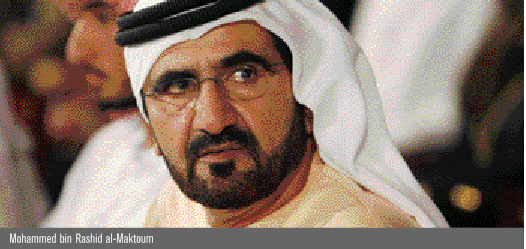
On his recent visit, HH Sheikh Mohammed bin Rashid al-Maktoum, vice president and prime minister of the UAE, expressed that the enhancement of bilateral relations is a starting point “towards wider avenues of mutual economic, technological and tourism cooperation.” He also added that such cooperation is a significant step in “embodying the deep fraternal relations and the common history of our two countries and peoples and building new bridges between the eastern and western Arab countries.”

The most recent joint-investment agreement between the two countries was part of a ceremony held during the visit of Sheikh Mohammed to Tunisia. Together with Tunisian President Zine El Abidine Ben Ali, the two leaders laid the foundation stone of a $14 billion real estate and investment development set to provide housing for half a million people. The mega real estate development project on the southern lake of the Tunisian capital is a joint venture between Sama Dubai, the international investment arm of Dubai Holding and the Tunisian government. The development will cover some 850 hectares and offer all the services of a satellite city, including retail and entertainment centers along with apartments, luxury hotels, a wide range of recreational and sports facilities, and up market housing.

Called the Century City and Mediterranean Gate, the development is intended to serve as a business hub, with office space for more than 2,500 international firms, with an emphasis on those in the financial sector. Businesses located there will benefit from state of the art communications infrastructure and impressive architecture. The centerpiece of the project will be two massive towers.

Additionally, the new city will play a major role in the country’s tourism industry, boasting 14 high class hotels and resorts, leisure and sporting facilities and a marina as part of the design.

Century City will be the single biggest investment project in Tunisia’s history, and will make Dubai the largest foreign investor in the country. The $14 billion price tag eclipses TECOM Investments and Dubai Investment Group’s acquisition of a 35% stake in Tunisie-Telecom in 2006 — valued at $2.25 billion.

According to Mohammad al-Gergawi, Dubai Holding’s chief executive officer, Sama Dubai expects to raise investment in Tunisia from $3 billion to $18 billion in the near future.

The potential for Century City to attract further foreign investment through companies relocating to the vast business district, drawn by the opportunities presented by a new city of up to half a million prospective customers, is undoubtedly welcomed by the Tunisian authorities.

State projections predict the work will add 0.6% to the country’s growth rate for a period of up to 15 years, and provide jobs for 130,000 people during the construction phase, pleasing statistics considering that unemployment is running at more than 14%, according to official figures.

Agreements signed between the state and Sama Dubai specify that most workers on the project will be Tunisians and the company will provide them with specialized training.

Al-Gergawi said actual work on the project will begin in the next few months. “The scheme is very important so it will be done in stages,” he commented. “It requires 10 years to be finished.” Al-Gergawi stated that Tunisia had been chosen as the site for the development by Sama Dubai because the country has potential to become a promising regional economic center, thanks to its position as a gateway to many other destinations. The growing services sector and the favorable investment regime were also strong attractions, he told a press conference in early August.

September 20, 2007 0 comments
0 FacebookTwitterPinterestEmail
North Africa

Morocco  Linking the continents

by Executive Editors September 20, 2007
written by Executive Editors

The construction of an undersea tunnel linking Morocco and Spain has been on both countries’ agenda for over 25 years now. Today, the idea is closer to materializing than it has ever been before.

After rounds of geological tests and feasibility studies run by specialist independent geotechnical consultants from the Swiss engineering company Giovanni Lombardi, the project looks to get a go ahead by the end of 2007. The cost of this project has been estimated to exceed $13 billion and initial studies by engineers forecast a project length of up to 25 years.

It is predicted that the tunnel could carry 9 million passengers and 8 million tons of freight annually. There is a potential for boosting the economies of both nations as well as mutually improving tourism and trade opportunities. Currently, Moroccan exports to EU countries account for 73.8% of total export revenues and generate $12.76 billion (or 22% of current GDP) annually. In return, Morocco receives 65.1% of its total imports from the EU, the bulk of which are transport equipment and machinery, which contribute to Morocco’s automotive industries. Additionally, agricultural exporters would be set to gain a strong advantage from this transport development, being able to send some of Morocco’s more delicate exports such as flowers and tomatoes by train instead of ship.

The growth in the number of European tourists to Morocco has given further impetus to ambitions to link Spain and Morocco across the Strait of Gibraltar.

Morocco’s tourist industry witnessed a successful first half of the year with EU figures showing over 2.26 million visitors from January to June 2007, representing a 7% increase in year-on-year terms. As such, the country is keen further to improve the accessibility of its tourist sites by moving ahead with the Gibraltar tunnel project.

European tourists

According to the Moroccan Ministry of Tourism, European arrivals to Morocco account for 83% of 2007’s arrivals to date, with French visitors leading the pack with 873,000 visitors in the first six months of 2007, an increase of 4% on last year. Visitors from Spain and Britain accounted for 479,000 and 175,000 visitors respectively, with British tourist arrivals recording a 43% increase as a growing number of no-frills airlines such as easyJet and Ryanair are making the country more accessible with flights to Marrakech, Casablanca and Fez. Germany, Belgium and Italy are also important markets, each accounting for approximately 100,000 visitors. The three most popular tourist destinations have recorded growth in the number of visitors in the last six months; Marrakech has seen a rise of 12%, Casablanca recorded a 9% rise and the coastal resort of Agadir saw a 3% more visitors than in the same period last year.

The construction of the proposed Gibraltar tunnel is a joint venture between government agencies Société Nationale d’Études du Détroit (SNED) in Morocco and Sociedad Española de Estudios para la Comunicación fija a Traves del Estrecho de Gibraltar (SECEG) in Spain. The tunnel would consist of a 39 km passenger, car and freight rail line running across the strait connecting the cities of Tarifa and Tangier. Its deepest point will be 300 meters.

The next step will be to consider a number of logistical challenges. Even though the distance across the Strait of Gibraltar is 14.5 km, the challenges posed to engineers by a Morocco-Spain tunnel are far greater than challenges facing engineers during the “Chunnel” construction between England and France, which lie 32 km apart at the Strait of Dover. The water is deeper; nearly 1000 meters at the shortest route across the strait, compared with just 61 meters in the English Channel. Another challenge is the texture of the earth. The first test diggings over 10 years ago revealed that the soft earth near Tarifa is not suitable for building a structure of this type. Recent tests have re-confirmed this and so Cape Malabatta has been selected as the entrance point to Morocco, after which the tunnel will continue to Tarifa. Additional concerns include securing the tunnel against human trafficking between Africa and Europe and whether the there will be a sustainable flow of goods and people in both directions given the economic disparities between the two continents.

Yet leaders of both countries are keen on proceeding. Spanish Prime Minister Jose Luis Rodriguez Zapatero has said that he is fully committed to the project. According to the minister the tunnel would “greatly speed growth, development and prosperity” on both sides of the Mediterranean. The goal behind the construction is to create “an integrated Euro-Mediterranean economic area” and possibly lead to developing the transport network further to include a link between Marrakech and Europe.

September 20, 2007 0 comments
0 FacebookTwitterPinterestEmail
North Africa

Algeria  Taking out Trabendo

by Executive Editors September 18, 2007
written by Executive Editors

The part-privatization of Algeria’s ports to major operator Dubai Ports World (DPW) has been hit by a series of rolling strikes by trade unions. The potential unrest stems from talks the government is holding with DPW over the company possibly taking a 50% stake in the container terminals at the ports of Algiers and of Djen Djen, in the eastern province of Jijel.

Algiers port has reached saturation point and will need considerable investment to extend it. However, the stumbling block at the moment is the plan to include the potentially highly lucrative Djen Djen port, and disagreement over the issue of bringing in a foreign owner. Some also point to the possible disquiet of those involved in the “trabendo” economy, or contraband imports, as looking to scotch the deal to preserve their lucrative, if illegal, niche.

Djen Djen’s port is something of an oddity, having been built to serve a steel plant that was never constructed. However, it has developed as a major point for container and dry cargo transport (notably grain) abroad. The purpose-built port also benefits from very good land transportation links, as well as deep water piers accessible to ships of up to 120,000 tons.

Local media have reported that DPW made a $70 million bid for the operation of the Djen Djen port, coupled with a $120-150 million investment program to upgrade it. In June, the transport ministry announced that negotiations were making good progress.

“Dubai Ports World took into account the principal requests of the Algerian side at the time of the first round of negotiations, which was held in Algiers on June 12,” the statement said. “We will be able to advance.” The deal seemed to be likely to be finalized by year’s end, officials have been reported as saying.

However, the umbrella union Coordination Nationale des Syndicats des Ports d’Algerie (CNSPA) has objected strongly to the plans to change the port’s ownership and their employer and threatened to block the deal.

One source of discontent is the government reneging on a pledge made by the minister for investment promotion, Abdelhamid Temmar, to tender the sale internationally rather than moving immediately to negotiate directly with DPW.

CNSPA has a membership of 14,000 across all of Algeria’s 10 most important ports, giving it a great deal of leverage in the situation, as has been show in the past. Strikes by CNSPA-affiliated unions in October 2005 against government privatization and labor restructuring plans left 100 ships abandoned by workers. The Port of Oran alone, where 15 ships were left stranded, hemorrhaged $130,000 a day during the industrial action. In May of this year, another anti-privatization strike shut down almost all Algeria’s ports, causing losses of up to $2.1 million in a single day.

Guermache Abbes Maamar, the secretary-general of the Algeirs port trade union, has said that opposition to the proposed deal with DPW was in the national interest and not only an issue of workers’ rights.

Maamar questioned the wisdom of “giving away” container activity, which generates 70% of the port’s receipts, in return for the proposed investments DPW has put on the table. The unions agree that Djen Djen is in need of an overhaul, but Maamar proposed that the government work with its port management authority Entreprise Portuaire d’Alger to develop the nation’s ports, rather than using foreign firms.

“We can do everything between Algerians: to buy gantries and all the equipment to improve the output. We cannot release sovereignty on the ports,” he added.

To break the current deadlock, it has been suggested that the unions should be involved in future privatization negotiations to ease the tension and distrust. However, it seems that the CNSPA is unlikely fully to embrace partial privatization to DPW. Meanwhile, private sector companies involved in trabendo activity at the ports are also against the deal. Many are believed to be involved in illegal practices which they fear the Emirati company might eliminate if the deal goes through.

September 18, 2007 0 comments
0 FacebookTwitterPinterestEmail
North Africa

Algeria  Building the Gas Bridge

by Executive Editors September 18, 2007
written by Executive Editors

Algeria, the world’s fifth largest gas producer, is supplying around a quarter of the EU’s gas imports, and is hoping to expand further into that market. Its valuable position is firming with pipelines under construction to southern Europe and liquefied natural gas (LNG) deals with northern Europe. And although Russia remains the major gas supplier for the EU, Algeria’s flexible gas sector and geographical location are factors playing in its favor.

On July 12, Algeria and the EU finalized an agreement dealing with territorial restrictions, allowing companies of EU member states that import Algerian gas the right to resell it either within their own domestic markets or to third-party countries.

In return, Sonatrach, Algeria’s state oil and gas company, will have the right to a share of the profits earned by European companies, for LNG contracts only. Sonatrach will also be allowed to sell LNG shipped by tanker directly on the European market.

The deal will consolidate Sonatrach’s position as one of the main suppliers of natural gas to the EU, with Algeria behind only Russia and Norway.

Deepening the Algeria-EU relationship

Chakib Khelil, the Algerian minister of energy and mines, said the agreement was a further step toward deepening the strategic relationship between Algeria and the EU. “Algeria supports the establishment of Sonatrach as an active player in an open, transparent and competitive EU gas market,” Khelil said at a signing ceremony in Brussels, where the final details of the deal were hammered out after lengthy negotiations.

The EU’s Competition Commissioner, Neelie Kroes, also attended the ceremony. “The agreement reached constitutes a major breakthrough in our relations with one of Europe’s most important suppliers of natural gas and eliminates an important obstacle for the creation of a single EU-wide market in gas,” said Kroes.

The agreement with Algeria was essential for the EU, having launched the fully deregulated energy market within the bloc on July 1, allowing clients to choose their preferred suppliers of electricity and gas, rather than be tied to state operated utilities that continue to dominate energy markets in some EU member states.

Algeria agreeing to allow the unrestricted sale of its gas to third parties means that its present and future contracts are now in keeping with the EU’s new open market policy. Algiers had long held out against the ending of destination restrictions, fearing the move could result in wholesale reselling of its gas without any benefits coming its way.

Algeria’s long running dispute with Spain, over restrictions on how much of the gas piped through the Medgaz gas pipeline Sonatrach is allowed to sell directly on the Spanish market, appears headed to the courts.

The Algerian company has been limited to selling no more than 1 billion cubic meters of gas annually in Spain, despite being the largest single shareholder in the Medgaz project, with a stake of 36%. Sonatrach hoped to sell up to 3 billion cubic meters of gas a year.

At the beginning of July, Khelil said that Algeria would lodge an appeal against the Spanish energy watchdog’s ruling to limit Sonatrach’s sales.

“We will lodge an appeal with the higher authorities in Spain …  as well as the European Commission,” Khelil said. “What we are asking is to be treated like any other operator, Spanish or otherwise, whether for the distribution of gas or for the shares in the Medgaz project.”

Algeria and Spain are also involved in international arbitration over Sonatrach’s demand that the price of Algerian gas imports be increased in two stages by 20%, to keep the tariff in line with world prices. At the present rate, Algeria stood to lose around $300 million annually, according to Khelil.

Only days after the agreement was signed, Algeria moved to strengthen its energy production infrastructure, announcing more than $4 billion worth of construction tenders for new processing facilities.

In mid-July, Algeria awarded French firm Total the $3 billion tender to construct and operate a cracking steam facility with the capacity to produce 1.4 million tons of ethane annually. The plant will also produce polyethylene and ethylene glycol, with Sonatrach funding 49% of the project and Total the remaining 51%.

The same day, Sonatrach and a consortium of foreign firms, including Mitsui of Japan and Kuwaiti company Qurain, were awarded the contract to build and operate a $1 billion methanol plant with a projected output of 1 million tons a year. Again, Sonatrach will hold 49% of the project, with the other members of the consortium combining to take the rest. With so many projects in the pipeline, the future of the petrochemical industry in Algeria seems to be brighter than ever.

September 18, 2007 0 comments
0 FacebookTwitterPinterestEmail
Comment

Musings from Arab America

by Norbert Schiller September 16, 2007
written by Norbert Schiller

During our holidays this summer we were fortunate to be able to stay with my wife’s extended Lebanese family on both the east and west coasts of the United States. It had been almost six years since we last visited, and I must say that staying in an Arab-American household lessened the shock of fitting into the American way of life; a kind of decompression chamber if you will. Behind closed doors nothing really changed; the family was as tight-knit as ever and if it wasn’t for the green lawn outside the window and the lack of blowing horns and shouting in the streets we could have all been sitting in Beirut.

Both Lebanese-American families we stayed with were forced to leave during war. The husband of my wife’s cousin, who is originally Palestinian, remembers when in 1948, at the age of eight, he was forced to flee his village in northern Palestine after the Arab armies advised the inhabitants to leave because “the Jews are coming to take your land.” He made his way to southern Lebanon by holding onto the tail of his uncle’s donkey. On the east coast, my wife’s brother and his wife fled Lebanon for the United States in the mid-1980s, during one of the darkest chapters of the civil war.

Obviously, for my wife and her family, the first few days were consumed by relaying and absorbing Lebanese and Diaspora news: the physical changes taking place in Lebanon (the pulling down of the grand old building around the corner that once belonged to so-and-so) and how much of the country has been restored a year after the war with Israel.

However, unlike previous visits, the solid opinions that my wife’s family once held true were now blurred and the issues watered down.

When we first traveled to the States in the early days of our marriage 15 years ago, Lebanon was always on the forefront of every conversation. One misplaced word or train of thought could trigger an all out major debate on Lebanese politics that would result in phone calls to friends and family across America and even a call to Lebanon if it meant proving a point. Now that has all changed.

It’s not hard to explain this waning interest. American press coverage of the Middle East is something you have to actively seek out. Even with the 500 plus stations available to most cable subscribers, if you don’t have your own satellite hook up, you are not privy to all the international news stations like CNN International, BBC World, Al Jazeera, and LBC International. The newspapers inundate readers with local news, followed by a bit of national news and then a blurb here and there from the rest of the world. If there is something from the Middle East, it will probably be about Iraq and even then there is a good chance it will have a local angle. 

In the past, I remember always seeing a second, more international, newspaper lying around — the New York Times or Los Angeles Times — but now, with time, I notice that my wife’s family are slowly becoming more interested in the news that affected them on a daily basis. Even when we were visiting, they tended to veer away from the Middle East if some local issues, like the rise in crime, a garbage collection strike, or the bridge collapse in Minneapolis there was more anguish — “Haraam, they were just going home from work” — than for any car bomb outrage in Iraq.

One family member told my wife that she felt that her generation had “missed all the boats.” They had missed Lebanon’s golden era, caught the war and then had to endure all the insecurities of living as immigrants in the United States. And then came 9/11 with all that feeling of not belonging and being seen as outsiders. Her only consolation is that her children will hopefully feel more grounded and not live forever in search of a homeland.

September 16, 2007 0 comments
0 FacebookTwitterPinterestEmail
Financial Indicators

Government deficits and debt

by Executive Editors September 13, 2007
written by Executive Editors

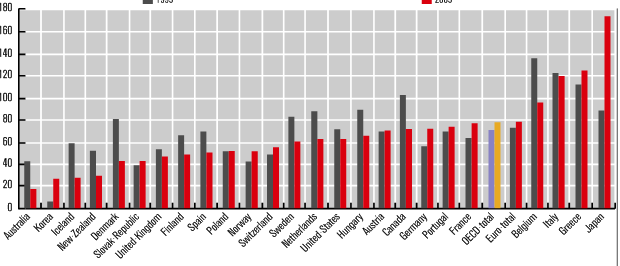
 Government deficits are sensitive to the economic cycle as well as to government taxation and spending policies. For the OECD as a whole, deficits as a percentage of GDP reached a peak in 1993 but then fell steadily over the next six years and had turned into surpluses (net lending) at the peak of the economic cycle in 2000. Since then, deficits have been growing and the deficit to GDP ratio had become high in 2003 for most of the larger member countries including France, Germany, the United Kingdom, the United States and, especially, Japan. In 2004-2005 the deficit to GDP ratios were reduced in most countries with the exception of Hungary, Italy and Portugal.

In the run-up to monetary union, EU countries that expected to adopt the euro followed fiscal policies aimed at reducing government deficits. Deficit reduction policies were successfully implemented in several other countries, including New Zealand (since 1994), Australia (since 1997), Denmark (since 1998) and Sweden (since 1998). Korea is the only country which has recorded surpluses throughout the period, although Norway has had surpluses in most years since 1990.

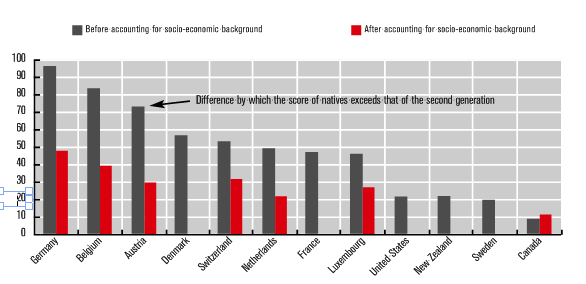
Gaps in the PISA score between native and second generation immigrant students in the OECD

 Second generation immigrants now constitute a significant and growing share of students in many OECD countries and their integration is of increasing policy concern, particularly in Europe. In the OECD area as a whole, they tend to perform better than immigrant students, as one would expect since the former have been born in the country of assessment and were entirely educated in the host country. In most countries for which data are available, there are nevertheless significant gaps between natives and the second generation. This is particularly the case for Germany and Belgium, where the gaps in the raw scores for the second generation amount to the equivalent of about two years of schooling. Gaps are also large in Denmark, Switzerland, the Netherlands, Austria and France, but tend to be small or even insignificant in the traditional immigration countries. Adjusting for socio-economic background generally reduces the gaps by about half, but even then, second generation students often remain at a substantial disadvantage, particularly in Germany, Belgium, Switzerland, Denmark, the Netherlands and Austria.

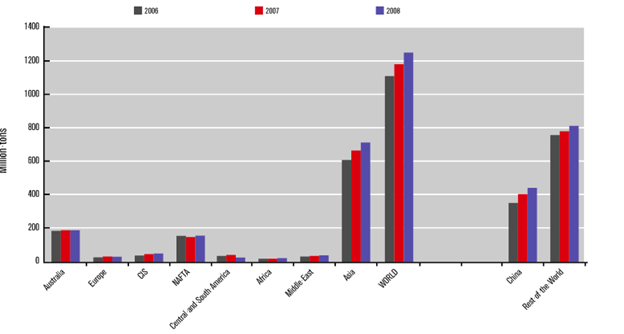
Outlook for Apparent Steel Demand 2007-2008

 2006 was a particularly strong year for steel use with a growth of 8.5% for the world. The forecast is a growth of 5.9% in 2007 taking the total to 1,179 million tons, an increase of 65 million tons over 2006. No deceleration in growth is foreseen in 2008 with a further increase of 6.1% bringing the total for the year to 1,250 million tons.

The particularly strong positive trend is foreseen for both years in Africa, Asia and South America. Growth continues in Western Europe and after an inventory draw down in 2007 in North America a positive trend is forecast in 2008.  China remains the largest single market and the strongest growth area. Steel use will increase by 13% in 2007 followed by another 10% in 2008, taking the total to 443 million tons — 35% of the world total.

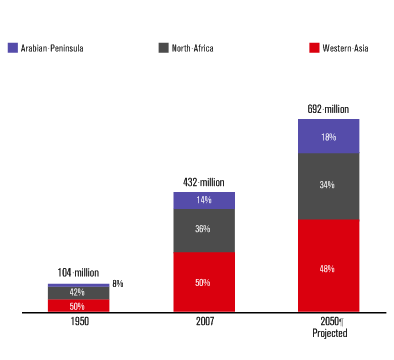
MENA Population: 1950, 2007, 2050

 In 2007, the MENA region has about 432 million people, making it one of the least populous world regions. But rapid population growth rates — second only to sub-Saharan Africa — caused MENA’s population to quadruple since 1950, and will propel its total to 700 million by 2050, exceeding the population of Europe in that year. This continuing growth is complicating the region’s capacity to adapt to social change, economic strains, and sometimes wrenching political transformations.

While the region embraces religious and cultural tradition, there has been a veritable revolution on many fronts. Just a few decades ago, illiteracy rates were quite high for women in many MENA countries. Women often married before age 20, and they rarely worked outside the home. Now, women are attending school and beginning to enter the labor force. Couples are waiting longer to marry and are deciding to have fewer children. Child and maternal health have improved, leading to longer life expectancies and plummeting infant mortality rates in many countries.

September 13, 2007 0 comments
0 FacebookTwitterPinterestEmail
Financial Indicators

by Executive Editors September 13, 2007
written by Executive Editors

 Investors on the Beirut Stock Exchange celebrated the summer last month, giving the market an additional break from the year’s customarily low trading volumes where politics and economic uncertainty are the bourse’s constant bothersome companions. The BSI index closed at 1,169.52 points on Aug 27. Construction supplies manufacturer Uniceramic announced that it lost $1.3 million in the first half of 2007, underscoring how Lebanon’s expected reconstruction boom has frayed after the Lebanese people were taken hostage by political figures that naiveté would have serve the country.

Beirut SE: Blom  (1 month)

Current Year High: 1,526.31         Current Year Low: 1,168.36

The Amman Stock Exchange had a slow month in which the ASE index fluctuated in the 5,700 range. It closed at 5,624.63 points on Aug 27, a tad below its standing at the start of 2007, which made the ASE the only noteworthy exchange in the MENA region to end August on negative territory for the year to date. The ASE accounts currently for about 3% of the combined market capitalization of Arab bourses. Trading volumes in August were subdued as per expectations for the vacation season; real estate stocks were under some pressure while the small insurance sub-index did better than other sectors in the second half of the month. Investment firm Tuhama had a successful start of trading on the ASE and Arab Jordan Investment Bank listed additional 42.8 million shares from a rights issue, increasing its share volume to 100 million shares. Insurance firm First Insurance commenced trading on Aug 27 with a first-day gain of 17% with trading volume of almost 950,000 shares.  

Amman SE  (1 month)

Current Year High: 6,543.67         Current Year Low: 5,267.27

The Abu Dhabi Securities Market showed a similar picture to its counterpart in Dubai, dropping slightly in the course of the month but suffering a very noticeable weak spell on Aug 22. The index clocked in at 3,436.11 points on Aug 27, down from 3,480.37 points on Jul 31. Energy company Taqa said late in the month that it has a war chest of $4 billion for international acquisitions. Energy sector stocks were among the ADSM’s leading performers along with real estate values that improved in the latter part of the month after they had been pushed down by investor fears over global and regional real estate trends in the first part. Financial talk in the UAE also had a lot to mull over the emergence of Dubai’s newly consolidated stock market operating entity, Dubai Bourse, and its attempt to expand into the international operator scene by making a $4 billion bid for the Scandinavian exchange operator, OMX, taking on a bidding competition with Nasdaq.

Abu Dhabi SM  (1 month)

Current Year High: 3,705.32         Current Year Low: 2,839.16

The Muscat Securities Market made gains in the first half of August but could not keep up its momentum when most GCC markets jittered around Aug 13. The index, which had reached a historic peak on Aug 12 at 6,793.91 points, retreated in the coming days and closed at 6,618.18 on Aug 27. However, it is still up on the month and, handsomely, on the year where it stands more than 18% up ytd. Investor attention focused on the $156 million initial public offering of construction firm Galfar Engineering and Contracting, which is set to be one of the MSM’s ten largest companies by market capitalization once it starts trading in October. Telecoms operator Omantel acquired a majority stake in Worldcell Telecom, a network in Pakistan.

Muscat SM  (1 month)

Current Year High: 6,504.18         Current Year Low: 4,718.74

The Bahrain Stock Exchange retreated from a year high of 2,592.02 points on August 8 to a close at 2,527.94 points on Aug 26. Like in some other GCC markets, mid-August was a period of regression under the impression of international stock price developments and credit crunch concerns in the global financial industry. Al-Baraka Banking Group, the Islamic finance specialist, reported that it was able to triple its profit in the second quarter of 2007, to almost $90 million. After failed takeover discussions in early August, Ahli United Bank rollercoastered on disappointed investor expectations.

Bahrain SE  (1 month)

Current Year High: 2,592.02         Current Year Low: 2,106.70

The Doha Securities Market closed August 27 at 7,456.4 points, representing a net contraction of about 130 points, or 1.6%, during the month. The DSM announced that combined profits of the exchange’s 37 listed companies in the first half of 2007 reached $2.4 billion, up 35% from the profits that listed firms had reported for the same period a year ago. Qatar’s Commercialbank and the United Arab Bank in the UAE emirate of Sharjah signed an agreement by which Commercialbank will seek to acquire a significant stake in UAB. International Bank of Qatar said it halted takeover tals with Bahrain’s Ahli United Bank.

Doha SM: Qatar  (1 month)

Current Year High: 7,957.72         Current Year Low: 5,825.80

Tunis SE  (1 month)

Current Year High: 2,712.33         Current Year Low: 2,004.02

The Tunisian bourse took the summer more relaxed than others, with the Tunindex moving sideways. The index closed at 2,493.67 points on August 27, quite insignificantly changed when compared with 2,474.26 points on Aug 1. A report in the Arab newspaper Al-Hayat said in August that the country is preparing a privatization move for a further stake in insurance provider Société Tunisienne d’Assurances et de Réassurances (STAR), in which state-owned entities currently hold about 50%. The insurer’s stock recently fluctuated around $15 per share. 

Casablanca SE All Shares  (1 month)

Current Year High: 12,723.23       Current Year Low: 7,704.66

The Casablanca All Shares Index, buoyed by the mandatory domesticity of its investor base, continued to amaze in August. It rose from 11,661.47 points on Aug 1 to 12,423.45 points on Aug 27 — not a historic high for the exchange but a gain of almost 762 points or 6.5%. The Moroccan bourse can boast of being the best climber in the MENA region for the first eight months of 2007; its year-to-date gain of 31.06% exceeds that of the Kuwait Stock Exchange. The Casablanca exchange also accounts now for a respectable 7% share in the combined market capitalization of MENA bourses. In company news, heavyweight Maroc Telecom reported an improvement in its first-half profit by 30%, to $477 million.

Cairo SE: Hermes  (1 month)

Current Year High: 74,964.86       Current Year Low: 52,654.94

No bourse in the Middle East presented its interaction with international market trends as strongly as the Cairo and Alexandria Stock Exchanges last month. After its rise of six months, the Hermes Index spiraled downward quickly as soon as August started with bad equity news from Wall Street, Asia, and Europe. The initial drop of almost 2,000 points took place still in July but the tremors continued with short interruptions until August 21 when it touched 67,000 points. The index recovered a bit by Aug 27, closing the day at 68,426.24 points but that was still a slide of 3,380 points — around 4.7% for the month. In company news, analysts lowered their evaluation of Orascom Telecom stock after the company pulled out of the bidding competition for a mobile operator license in Iraq but the analysts said the withdrawal was the right decision. Kuwait’s NBK offered the best bid for Al Watany Bank and wants to make a full acquisition of the Egyptian bank.

September 13, 2007 0 comments
0 FacebookTwitterPinterestEmail
Levant

Turkey Watch Out for the Risotto

by Executive Editors September 13, 2007
written by Executive Editors

Serefe! According to the latest survey from Ipsos KMG, the popularity of alcoholic beverages in Turkey appears to have increased by some 35% in 2007. This rise in popularity of alcohol in Turkey’s five largest cities (Istanbul, Ankara, Izmir, Bursa and Adana) came on the back of a modest fall in 2006, of some 9%. However, while the popularity of alcoholic beverages appears to be undergoing somewhat of a renaissance in recent times, there are still many issues facing both the local beverages industry and importers. High tax and customs duties have restrained growth within the sector, while an unsympathetic government may look to impose further restrictions on the sale and consumption of alcohol over the course of the new parliament. As always, those looking for a drink have found interesting, and at times dangerous, ways to get around the system.

The attitude towards alcohol by the ruling Justice and Development Party (AKP) returned to the fore in late August following accusations concerning a spirited serving of risotto. The dish in question was apparently ordered for the interior minister, Osman Gunes, by Mugla governor Temel Kocaklar and allegedly resulted in the latter’s sacking after the minister discovered that the sauce it came with had been made with wine. The incident sparked off discussions by Islamic theologians in the country, who broadly agreed that all of the alcohol would have either been “boiled off” or chemically converted into vinegar via the cooking process. While the minister denied the accusations, a sour taste was left in the mouths of those who enjoy a quiet tipple.

Turks consume less alcohol

According to the Ipsos KMG report released in late August, 82% of those who drank alcohol registered a preference for beer, 9% for the national drink raki, 7% for wine, while the remaining 2% was split among other beverages. The World Health Organization (WHO) estimates that Turks consume an average of 1 liter of pure alcohol per year, compared to 9.4 liters for the EU’s 25 countries. And the geographical spread of consumption tends to be concentrated in Turkish Thrace as well as along the Marmara, Aegean and Mediterranean coasts. Areas in the east of the country, and especially the south-east, are considered to have the lowest rate of consumption.

One of the biggest complaints of producers in Turkey, and those looking to import alcohol into the country, is the high level of tax placed onto these products. In 2006, some $8 billion was handed over by producers, importers and consumers to the government thanks to the “special consumption tax,” or OTV. The levels of tax charged on alcoholic beverages are significantly higher than the EU average. A single liter of wine is imposed a levy of 1.87 euros in Turkey, as opposed to 0.58 euro for the EU 25. The lowest rates for wine tax in the EU, unsurprisingly, are in France and Hungary, which impose a 0.03 euro per liter duty on the product. Other products are similarly taxed heavily, with beer at 0.68 euro per liter (EU 0.29 euro), while rates for spirits can vary from 9.22 to 16.21 euros per liter in Turkey, compared to the EU average of 6.27 euro. Sparkling wines and champagnes are hit the hardest by the OTV, having a 275.6% duty slapped onto them. According to figures released by the opposition Republican Peoples’ Party (CHP) before the 2006 election, the tax collected by the state under the AKP government had increased sharply, by 96.1% for raki, 185.6% for beer and 222.2% for wine produced by TEKEL, the former state monopoly producer.

As a result of these high duties, there has been a thriving market in black market or undeclared alcohol production. Up to 50% of all wine is considered to be produced without paying the requisite tax, while the rate for raki is lower at 5-6% of overall production. In order to combat the growth in illegal alcohol production and sales, the government instituted a new tax stamp, or banderole, system that went into force on July 24. According to the legislation, all alcohol and cigarette containers must have a new banderole placed on them before November 5, or be considered ineligible for sale. The EU representative office initially opposed the plan, believing its swift implementation would be in breach of Turkey’s World Trade Organization (WTO) responsibilities, although the Finance Ministry was little disturbed by the EU protest. Other complaints by importers include the extra duties placed on their products, which can almost triple the price of a foreign-made product on the local market. A USDA report prepared in 2005 estimated that a $10 bottle of US wine would, after taxes, be sold for a minimum of $30.47 on the local market. Equally, a tricky labeling and approval system from the Ministry of Agriculture and Village Affairs also complicates the problems of importers.

However, the news isn’t all bad for local producers, as rising consumption trends indicate. The alcohol industry changed significantly following the privatization of the alcohol wing of the former state monopoly producer TEKEL in 2003 and the liberalization of alcohol production in Turkey. The measures were required by the International Monetary Fund (IMF) in its bail out package for Turkey after the 2001 economic crisis. Following the liberalization process, the number of local producers and importers has grown from 900 to 2500 in the past two years alone. The size of the beer market in Turkey was estimated to be around 885 million liters in 2006, with the national staple raki coming in at 70 million liters, according to Referans Gazetesi.

Foreign investors taking an interest

Local producers also became a target of interest for foreign investors, with the former TEKEL company, renamed Mey Icki, bought for $900 million in 2006 by US firm Texas Pacific Group (TPG). Large local producers such as Anadolu Efes and Turk Tuborg are now also looking to increase their presence in foreign markets to escape the high taxes imposed at home. Anadolu Efes, producer of Efes Pilsen among other marks, now exports to more than 50 countries around the world, with particularly strong sales growth seen in Eastern Europe and the former Soviet Union, especially Russia. Anadolu Efes remains the dominant brewer in Turkey, with some 82% of all sales. Turk Tuborg, with around 12% of the market, is also looking to emulate its larger rival, and is now exporting to 20 countries.

Other good news could also be on the way for local alcohol producers and importers, in the form of the EU. Pressure has been mounting to normalize tax rates to those closer to the EU average. The high duties and complex procedures applied to imported products have also been coming under attack, and could also be the focus of challenges under WTO procedures. The state of Turkey’s alcoholic beverages market over the coming years and its increasing sophistication could be interesting for investors, and drinkers, to watch. As for risotto’s popularity, it too has undergone something of a renaissance of late according to the daily Hurriyet — the wine sauce being especially sought after accor

Iraq auctions off mobile licenses for $3.75 billion

Iraq’s Communications and Media Commission announced in mid-August that it has successfully auctioned off three mobile phone licenses for a total of $3.75 billion to Iraq’s Korek Telecom, Qatar-backed AsiaCell and Kuwait’s Mobile Telecommunications Company (MTC).

“To get the best return from the auction in such circumstances is a great vote of confidence in the Iraqi economy,” Iraqi Finance Minister Bayan Jabr told reporters in Amman.

TurkCell and Egypt’s Orascom had also expressed an interest in the licenses but dropped out of the race with the latter saying that a license cost of $1.25 billion and an 18% revenue sharing agreement with the government was too high a price to pay. The tendering process took a year and half and left five mainly Middle Eastern bidders in the running out of the 11 firms originally short-listed.

Jabr said each license was auctioned for $1.25 billion

a 15-year term and the companies would have to share 18% of revenues with the Iraqi government. Iraq has a mobile penetration of 37%, delivering services to 10 million current subscribers. Mobile penetration is expected to more than double in less than three years, according to experts.

Some of the conditions call on the winning companies to offer at least 45% of their equity to the Iraqi people in a form of initial public offering within four years. Iraq is expected to earn over $15 billion in revenues over the contract period. 

Observers were surprised when Orascom announced that it had pulled out as the operator was the first to provide a full mobile phone service in Baghdad after the 2003 invasion by the United States, through its Iraqna subsidiary. Orascom had invested close to $300 million in Iraq since it first won the rights to operate there in October 2003.

September 13, 2007 0 comments
0 FacebookTwitterPinterestEmail
Levant

Syria – China trade partners

by Executive Editors September 13, 2007
written by Executive Editors

Few people are more welcome in Damascus these days than Chinese businessmen packing large amounts of Chinese investment dollars. Syrian officials are working overtime to deepen economic relations with the emerging superpower and proposals for a joint Syrian-Chinese investment bank, a Chinese Industrial Zone, a Chinese Telecom Park — not to mention billion dollar oil deals — are all on the table. Syria’s new found interest in her far eastern neighbor is fuelling much talk of a new Silk Road.

China has become Syria’s number one supplier. While figures from Syria’s Bureau of Statistics put the value of Syrian imports from China at $691 million, Syrian officials have said the real figure is more likely to be close to double that at around $1.2 billion. What is not in doubt is that China easily outstrips Syria’s other major suppliers Egypt ($553 million), South Korea ($441 million), Italy ($356 million), Turkey ($338 million), Japan ($317 million) and Germany ($308 million). Bilateral trade surged to a record high of $1.4 billion in 2006 and Syrian officials are predicting it will double by 2011 — a far cry from the paltry $170 million trade balance the two countries chalked up at the turn of the millennium and a 55% increase since 2004. Trade volume is also likely to be higher than official figures show, given that Chinese products are re-exported to Syria from centers like Dubai and are therefore recorded as Gulf imports.

Investment is following a similar trend. China was the second largest non-Arab investor in Syria in 2006, accounting for $100 million out of the $800 million in non-Arab investment funds which flowed into the country last year (Iran easily took first place with $400 million). By the end of 2006, Chinese companies had signed project contracts worth $819 million and this amount is virtually guaranteed to be superseded this year with a billion dollar oil refinery deal near completion.

Bashar Nouri, Chairman of the Syrian-Chinese Businessmen Council, said interest from Chinese companies was growing and an investment conference to be held in the country’s oil capital Deir Al-Zor in November would be attended by 30 Chinese companies — their bill being picked up by the Syrian Ministry of Economy. “There are many Chinese companies asking about Syrian laws and economic openness in Syria,” Nouri said. “Big Chinese companies are planning to establish branch offices in Syria, since Syria is considered the northern gate of the Arab World.” Nouri said joint Syrian-Chinese projects in the textiles and IT industries were expected to be launched in the near future.

Syria’s decision makers see the burgeoning economic relations as a natural fit, citing a shared economic history dating back to the Silk Road which saw goods transported to Europe from China via Damascus. Syria was one of the first Arab countries to establish diplomatic ties with the People’s Republic of China in 1949, following Mao Zedong’s victory.

Despite the signing of a number of trade agreements, including the Accord of Trade Payment in 1955, Agreement of Trade and Agreement of Economic Technology Cooperation in 1963 and the Agreement on Encouragement and Protection of Investment in 1996, bilateral trade remained nominal during the last half of the 20th century.

Economic relations began to improve in 2000, following a number of government trade delegation visits, with total trade rising by 28 percent from $174 million in 2000 to $223 million in 2001, according to figures from China’s Economic and Commercial Counselors’ Office in Syria. The signing of an Agreement of Trade and Agreement of Economic Technology and Cooperation in 2001 — redefining the Syrian-Chinese trade framework — saw total trade jump by 66% to $371 million by the end of 2002. The exemption of double tariffs on trade between the two countries in 2003 provided further momentum, with total trade increasing an additional 37% to $507 million.

Syrian President Bashar al-Assad’s visit to Beijing in 2004 — the first visit to China by a Syrian President — cemented the country’s interest in China and the Syrian-Chinese Businessmen Council was established, charged with the task of fostering deeper economic integration between the two countries. Since then the trade balance’s skyward trajectory has only steepened, dominated by Syrian imports of machinery, textiles, electrical goods, communications equipment and hardware, as well as mineral products. Chinese imports from Syria are little more than oil and crude oil products.

Simple market forces over political master plans remain the main drivers of syrian trade

Syria’s newfound interest in Chinese markets is also redefining relations with her traditional trading partners, particularly the EU. Syria’s share of imports from the European bloc has fallen by around 15 percent in recent years from 50% of all imports in 2003 to now less than 35%. The country’s share of exports has followed a similar trend, falling by 17% over the same period. The decline in trade has many political analysts prophesying that Syria has given up on the West and is now turning East to secure its economic and political future.

While tensions between Syria and the West have not helped trade, simple market forces over political master plans remain the main drivers of Syrian trade, economist Samir Seifan said. He points to a strengthening euro, which has increased by close to 30% since the start of 2003, as the primary reason behind the rise in Chinese imports.

“Syria is certainly importing more from China, but the main driver is a strengthening euro which has made Chinese imports very competitive,” Seifan said. “At the same time, you’ve had China trying to suppress the prices of its products and given that Syria is not a market for expensive products, Syrian traders have taken advantage of the lower prices.”

Not that Syria’s trade is without political overtones. In 2004, when the US rolled out a new wave of sanctions against Damascus, Bush officials were predicting that prohibitions on US technology would near cripple Syria’s oil and gas sector. They have no doubt had an effect, but countries like China, India and Russia are increasingly getting the job done. “China is becoming one of the key economic players and there is opinion in Syria that the country can benefit from China’s technological capabilities,” Seifan said. “Countries like China, Russia and India don’t share the same level of technological capability as the US, but it is still high enough to cover the needs of Syria.”

Syrian officials have admitted as much. Announcing the finalization of a $1 billion oil refinery project with China’s major oil player the China National Petroleum Corporation (CNPC), Syrian Deputy Prime Minister for Economic Affairs Abdallah al-Dardari said: “If some countries do not want to share technology with us, others will.” Construction of the 70,000 barrel per day oil refinery at Deir Al-Zor is expected to start in 2008 and curb the country’s massive fuel imports. The deal will also see Syria import oil exploration and mining equipment from CNPC, using preferential loans from China. CNPC has also been awarded a contract to upgrade five existing oil fields to improve productivity, and China has being invited to conduct oil exploration in 5,000 square kilometers of Syrian waters.

The latest deal — which will be signed after technological and feasibility studies are completed — builds upon China’s already strong presence in Syria’s oil industry. In late 2005, CNPC joined forces with its usual rival, India’s Oil and Natural Gas Corporation (ONGC), to buy a $573 million stake in the Al-Furat oil and gas fields.

“When sanctions exist from the US it is natural for Syria to look towards other sources,” Seifan said. “Certainly there are political intentions to have good economic and political relations with emerging powers like China, India and Russia who can provide raw materials, as well as the all important technological and intellectual know-how.”

Syria has hinged much of its economic development on attracting foreign investment, with al-Dardari recently announcing that the country needs to obtain $15 billion of foreign investment over the next 3 years to sustain current growth rates. If Syrian authorities have their way, China will be a major component of the much anticipated river of foreign funds. Energy, electricity, infrastructure, communications, education, textiles and tourism have all been singled out by Syrian officials as areas in which they would like to see increased Chinese investment.

Damascus has also moved to recognize China’s market economy status, in which Syria accepts China has minimized state intervention into its economy. The move not only boosts Beijing’s standing in the international trade community, but protects China from anti-dumping claims, a frequent accusation from trade rivals.

Not that it’s all smooth sailing. The one-way nature of Syrian-Chinese trade — Syrian imports making up the lion’s share of a $1.4 billion trade balance — is causing concern. Damascus aims to restore balance to the trade relationship by promoting Syrian goods and services in China, while Beijing has committed to easing tariff and non-tariff barriers for Syrian imports.

Just what opportunities Syrian companies can eke out in China remains to be seen. Many in Syria’s business community remain doubtful. Daaboul Industrial Group CEO Mohammad Daaboul, who was part of a recent Syrian business delegation to Beijing, said considerable obstacles — namely price — stood in the way of Syrian companies exporting to China. “Until now, Chinese costs are lower than our costs so to enter the Chinese market is not easy,” Daaboul, who heads up one of Syria’s largest construction materials companies, said. “Furthermore, there is no indication that the Chinese consumer is willing to pay for quality. If the Chinese consumer is presented with the opportunity to buy a higher quality product from outside or a cheaper version made in China, they will purchase the cheaper version.”

Daaboul said the only Syrian companies likely to succeed in China were those offering a product or service that is not available locally. “In the areas of certain raw materials, cotton and olive oil there are opportunities. Syrian can increase the volume of imports to China, but in my opinion not by too much.”

The new Silk Road is up and running. For the time being, however, traffic is likely to remain all one way.

September 13, 2007 0 comments
0 FacebookTwitterPinterestEmail
GCC

Cyber squatting

by Executive Editors September 13, 2007
written by Executive Editors

If a Middle Eastern business owner came home from his summer vacation to find a stranger sitting on his patio with a business proposal, he might greet him with the typical Arab friendliness toward surprise guests. But if turns out that the stranger has pried open a backdoor and occupied the home, demanding payment to vacate the site, the owner would be outraged and unceremoniously evict the strange visitor. However, when it comes to the websites of newly announced projects, regional business owners are often in a pickle when it comes to guarding their property.

Researching the registration rates of online domain names by Middle Eastern companies, a UK-based marketing and public relations firm uncovered that many business owners seem rather careless in setting up their online presence. The three-month study conducted in the second quarter of 2007 by the firm Ultimate Media found that of 2,000 firms who have announced the name of major construction projects, at least 220 did not buy the internet domain in advance.

Dubai is really the only place where they’ve

realized the importance of securing a domain

In a significant number of cases, third parties have bought the domain name with an eye toward selling it to the project owner at a later date — a practice known as cyber squatting. It’s not quite as intrusive as a stranger raiding your cupboards and settling into your favorite chair while you’re out of town, but it could be much more financially devastating.

Although he declined to quantify the amounts under dispute or provide a list of companies afflicted by the problem, Arya Marafie, project coordinator with Ultimate Media, told Executive that in some cases, third parties are purchasing domains and designing websites for non-existent companies that share names with major construction projects. “It seems that project owners just don’t realize the significance of announcing a project without securing [a domain name],” he said.

Quite simply, the aim of cyber squatting is extortion. By grabbing a domain before a company with vested interest in the site, a cyber squatter can attempt to sell the domain to that company for an exorbitant price.

Registering the domain

Buying a domain — the address of a specific point on the internet — is easy and inexpensive. The most common domains — generic top-level domains (gTLDs) like dotcom, dotnet or dotgov — are all managed by US-based Verisign, Inc., which typically sells them to one of the hundreds of domain registrars operating worldwide. 

The average person or company looking to buy a domain will usually buy it from a domain registrar by providing some personal information and, depending on the registrar, as little as $9 per year.

Cyber squatting is not a new problem and has been addressed by landmark international treaties. In the early 1990s, when the internet’s surge in popularity surprised many companies, hordes of opportunist online entrepreneurs took to registering domain names for no other purpose than selling them later on. This led to a deluge of domain disputes between cyber squatters and companies (and celebrities) who argued that they have an intrinsic right to own the internet domain carrying their name (typically, these were dotcom domains).

Initially, however, companies that found their name had been registered by an usurper often had no other recourse than paying through the nose and booking the useless expense as learning experience. The party responsible for managing gTLDs, the Internet Corporation for Assigned Names and Numbers (ICANN), was not sure how to resolve the issue.

The UN’s trademark and copyright enforcement arm, the World Intellectual Property Organization (WIPO), conducted worldwide consultations to figure out how to establish a protocol for handling domain disputes. WIPO published a report that became the basis for the Uniform Domain Name Dispute Resolution Policy (UDRP). The policy was adopted by ICANN in 1999 with WIPO primarily resolving disputes. All 184 WIPO member states must comply with the body’s decisions.

Here’s where things start to get tricky. The key element of the dispute resolution process is whether the owner of the domain purchased and is using it in “bad faith.” If two legitimate companies have the same name, the domain goes to whichever purchased it first. If a cyber squatter purchases a domain with the aim of selling it to the company for an exorbitant amount of money, WIPO (or an ICANN-authorized body) will grant the rights to the domain to the company with a legitimate interest.

The loophole that cyber squatters are trying to exploit is the first-come first-serve rule for legitimate businesses. To do this, they not only buy the domain name as soon as a developer announces a major real estate project, which can be anything from a residential tower to a whole new city — they also fake the appearance of corporate activity through bogus site content. 

“There are people who are intentionally registering primary dotcoms related to projects as soon as they’re announced,” Marafie said. “Some of those people not aware of the regulations. They are just registering huge numbers of domains and keeping them in their own names, a bad business decision because they’ll probably lose them fairly easily when it comes to a dispute.”

The smart ones, however, can create serious problems for project owners. These cyber squatters establish an illusion of corporate life by moving those domains around on different servers and developing bogus sites on those domains. Project owners who failed to take advance action of registering a domain name will have “a major problem” if they find themselves having to deal with one of those smart occupiers and having to fight them in courts, according to Marafie. 

The cyber white knight

The PR expert has a stake in alerting companies to their oversights in domain registrations, by acting as a white knight. Ultimate Media conducted its research into site registrations to build a prospective customer list in the region. They found 221 domains of announced projects that were registered neither by cyber squatters nor by the respective project developers. In those cases, Ultimate Media bought the site pro forma and posted a message offering it to the project’s owner free of charge.

In so doing, Marafie even uncovered a secondary market of sorts, for hijacked domain names. For the domains they registered, Ultimate Media received offers from real cyber squatters. “What’s happening now is that the people who are registering the sites in order to try and get money from [project owners] in the end, are trading them with each other. Once we got [domains], people have been trying to buy them from us,” he said.

It seems that it is a detrimental habit of project owners and developers in the Middle East of generally not buying sites before releasing the names of their projects. For example, the $136 million property and entertainment venture Astrolab Resort planned for Dubailand, the Dubai mega project bigger in area than the Mediterranean nation of Monaco, does not own www.astrolabresort.com.

When Executive contacted the resort’s promoters, a firm succinctly named DotCom Real Estate, a secretary explained the company’s owners were on vacation but said the project did not have a website because “the project has not yet started. They’re still in the design phase and no project or marketing managers have been hired yet.”

That is all the more astonishing as Dubai is regarded as the region’s most advanced market in developing slick project websites.

“There is a big difference when you look at different countries,” Marafie said. “If you look at the whole Middle East, you see that Dubai is really the only (place) where they’ve realized” the importance of securing a “.com” domain.

The project site problem, it seems, results from a general indifference that businesses in the region show toward the internet. Companies may be somewhat aware that online presence is as much part of modern business practices as having a phone and fax, but websites are frequently of poor quality and contain “company news” with the most recent bulletin dated 2004 or 2005.

Research on the region in international comparison suggests that improvements in information age participation by countries of the region will need a lot more efforts than mailing a note to CEOs that they forgot registering a project domain. In annual rankings of information technology readiness of over 100 countries by the World Economic Forum, the Middle East has shown mixed performance in the past three years.

On the first list from 2004, the UAE, Bahrain, Jordan made the upper middle field with rankings of 23, 33, and 44, respectively. In the 2005 and 2006 rankings, however, the three countries dropped lower; the UAE slipped and was ranked 29th in the survey in 2006, Jordan fell to 57th place and Bahrain also dropped out of the top 50. On the upside, Kuwait temporarily climbed into the top 50 in 2005 but sled to 54 in 2006 and only Qatar proved a solid gainer — climbing to 36 in 2006. Such absence of internet savvy is a warning sign for problems beyond the danger of falling prey to extortionists which Ultimate Media’s research highlighted. As regional businesses strive to draw foreign investment and international customers, their quest will be exceedingly difficult if they neglect the medium that most

September 13, 2007 0 comments
0 FacebookTwitterPinterestEmail
  • 1
  • …
  • 561
  • 562
  • 563
  • 564
  • 565
  • …
  • 688

Latest Cover

About us

Since its first edition emerged on the newsstands in 1999, Executive Magazine has been dedicated to providing its readers with the most up-to-date local and regional business news. Executive is a monthly business magazine that offers readers in-depth analyses on the Lebanese world of commerce, covering all the major sectors – from banking, finance, and insurance to technology, tourism, hospitality, media, and retail.

  • Donate
  • Our Purpose
  • Contact Us

Sign up for our newsletter

    • Facebook
    • Twitter
    • Instagram
    • Linkedin
    • Youtube
    Executive Magazine
    • ISSUES
      • Current Issue
      • Past issues
    • BUSINESS
    • ECONOMICS & POLICY
    • OPINION
    • SPECIAL REPORTS
    • EXECUTIVE TALKS
    • MOVEMENTS
      • Change the image
      • Cannes lions
      • Transparency & accountability
      • ECONOMIC ROADMAP
      • Say No to Corruption
      • The Lebanon media development initiative
      • LPSN Policy Asks
      • Advocating the preservation of deposits
    • JOIN US
      • Join our movement
      • Attend our events
      • Receive updates
      • Connect with us
    • DONATE