• Donate
  • Our Purpose
  • Contact Us
Executive Magazine
  • ISSUES
    • Current Issue
    • Past issues
  • BUSINESS
  • ECONOMICS & POLICY
  • OPINION
  • SPECIAL REPORTS
  • EXECUTIVE TALKS
  • MOVEMENTS
    • Change the image
    • Cannes lions
    • Transparency & accountability
    • ECONOMIC ROADMAP
    • Say No to Corruption
    • The Lebanon media development initiative
    • LPSN Policy Asks
    • Advocating the preservation of deposits
  • JOIN US
    • Join our movement
    • Attend our events
    • Receive updates
    • Connect with us
  • DONATE
Levant

Hard assets: Region relies on cement

by Executive Contributor May 13, 2007
written by Executive Contributor

Mega construction projects are popping up everywhere in the Middle East: towers, hotels, shopping malls, artificial islands and space age luxury dwellings are appearing, not only the GCC countries, but in the Levant and North Africa as well. This boom in real estate comes hand in hand with a cost explosion for construction materials from steel and cement to bathroom fixtures and ceramic tiles.

The huge cost increases, which have tripled or quadrupled expenditure projections for some major industrial construction projects in the region, are partly related to international price pressures stemming from demand in China and elsewhere. But they are also linked to local supply bottlenecks and insufficient production capacities that have led to a region-wide race for building new state-of-the-art construction material factories to service the demand.

“Shortage of material is why construction prices have increased dramatically for the last couple years,” Elie Kfoury, the managing director for DG Jones’ Dubai branch, told Executive. DG Jones is one of the biggest construction cost control and quantity surveyors in the region. “Projects are becoming bigger and bigger—the Middle East has had a big boom in the last two years. Factories weren’t expecting this.”

Last year, regional business information platform Zawya estimated that ongoing MENA real estate investments totaled $387 billion compared to the regions’ combined GDP of $804 billion—a 48% ratio. Supply is at maximum capacity in most Middle Eastern countries, with demand swelling due to population increases and growing foreign direct investments.

As rising energy costs and increasing construction demands strain construction material supply in the Middle East, more local factories are being set up to slash import costs and to stabilize the growing prices incurred from undersupply. Syria opened up its cement sector in 2005 to private investments and granted licenses to private operators, which are expected to begin operations by 2009.

Steel prices have doubled in the GCC since 2003 with transport costs rising as much as 200% in recent years, prompting Oman to step up investments in steel factories to bolster production over the years. The region’s largest steel making group, Egypt’s Al Ezz Steel, also recently said it is looking at building a $700 million steel mill in Algeria, in addition to significant capacity expansions in Egypt. 

But considering that many countries are building their own construction materials factories to service local demands and that exporting these bulky goods is costly and an integral reason why local factories are emerging, who will benefit from an oversupply once construction stops?

Challenge for the Levant

For the Levant, the challenge is to keep Gulf cement and other materials out of their market as GCC factories receive subsidized energy, feeding lower production costs.

“The imbalance between supply and demand should not last much longer as many new cement plants are emerging in Jordan and the GCC. Within 18 months, I think there’ll be an oversupply in the region independently if the construction boom stays strong or weaken,” Pierre Doumet, CEO of Cimenterie Nationale (CN) cement company in Lebanon, told Executive. “Then, I think, the regional cement prices will decrease because there will be an oversupply.”

Apart from capitalizing on the short term opportunity that undersupply currently presents, the long term gain for CN and other companies is securing future competitiveness.

“We are using the boom years we have now to renew our equipment and be ready for the bad years, that’s why we are [expanding] our site. We are building a state-of-art site and reducing operational costs—especially energy—to withstand the lean years,” Doumet says.

CN is the second-largest cement producer in Lebanon, but will soon be the first, Doumet says, with factory expansion and energy-efficient plans near completion.

Energy prices for production are the main concern of building materials manufacturers. Other than cutting down on this cost via alternative energy sources, quality is the only other advantage.

“If we want to be competitive across the Gulf and Middle East, it’s not easy anymore. Gulf prices are cheaper but the quality is not good,” said an official with a Lebanese ceramic company who wished to remain anonymous. “What we are trying to do is improve quality and design and convert to cheaper energy to keep Gulf products out of our market.”

To remain competitive, companies are becoming creative in the energy department. Jordan Cement Factories (JCF) is looking into shale oil production as a way to trim down operational costs. Shale oil is a sedimentary rock with enough organic minerals that when distilled, yield oil for energy uses. JCF hopes to start tapping into its shale reserves by the end of 2007, once it receives a permit from the Ministry of Environment.

Turning to diesel and heavy fuel

For Lebanese construction material factories, diesel and heavy fuel are replacing natural gas to slim down costs for the likes of the Lebanese Ceramic Industries Company (Lecico).

The rising costs of exporting local production are also burdening oil-poor Levant countries. Rising oil prices are stimulating increased freight fares for bulky cement exports and growing energy production costs.

Lebanon is one of few MENA countries with an oversupply of cement, but exporting to multiple destinations is not monetarily feasible. The county does export to neighboring Syria and Iraq. But Syrian cement demand is so strong there’s a thriving black market for Lebanese cement, which Lebanese producers say account for 40% of their product.

For other countries, liberalization is a necessary step to keep up with already open and booming markets. Syria liberalized its cement sector to cut down on rising cement import costs. Syria’s cement sector has reached its maximum capacity of 5 million tons per year (tpy) but demand is at 8 million tpy with 5% increases per annum. Hassan Al Osh, production director at state-owned General Organization for Cement and Building Materials said last month that Syria hopes to become a cement exporter by 2010-2011.

In contrast to the Levant, the plan for the GCC is not only to satisfy domestic demand but to export elsewhere.

Gulf advised to invest more than $5 billion

The Gulf Organization for Industrial Consulting released a report last March advising GCC countries to invest more than $5 billion in iron and steel industries in the next three years to meet growing regional demand—as they expect imports to increase 19.6% annually until 2010—and then begin exporting. The report stated that the GCC supply-demand gap for iron and steel will persist until 2008. The 2008 surplus will lead them to find external markets due to internal saturation, to become a global center for iron and steel production.

“Factories have been under pressure from his highness in Dubai and in Abu Dhabi to focus on factories as real estate is situated in a way where it cannot be sustained for a long period unless there is a continuation of work from exports, imports and factories. So the UAE is very heavy on the drawing plans for glass, steel and aluminum factories,” Kfoury said. “This is the second thought—the first was to build up a tourist country and now it is to turn the tourist country into an industrial country.”

These countries can sideline the energy worries of the Levant by subsidizing the energy costs associated with producing and exporting such bulky materials. Saudi Arabia accounts for just over half of all GCC cement, but the country faces local shortages as exporting regionally yields higher prices and transportation costs are minimal due to oil wealth. Saudi’s largest export market is now Japan, mainly for refined oil products but also for commodities like cement.

Undersupply slowing down work

For most of the Middle East, current local undersupply is currently stimulating construction lags.

The CEO of the construction materials company Madar Emirates, Sameh Hassan, said at a company event in April that the biggest challenge for construction companies is getting raw materials on time. Hassan said he expects construction prices to increase by 30% this year.

Also, with the competitive edge the euro has over the dollar, many steel and wood imports go to service the construction boom in Europe, increasing the costs of these materials regionally.

As the construction materials industry is both capital-intensive and highly cyclical, whether or not building or revamping factories to bolster production will pay off has yet to be seen. Certainly, construction material costs need to go down and one way to do so is through government subsidies. Lebanese contractors threatened to suspend projects in April, unless the government alleviated some of their costs. At the moment, the burden of these rising costs rests squarely on the shoulders of all Middle Eastern construction companies.

Levant to GCC: Keep out

As building material factories swell in scope, GCC factories’ dreams of exporting large quantities throughout Asia may be not be as fruitful as they hope. As oil prices continue to rise, and East Asian countries experience further construction booms, they may have to seek local construction material alternatives.

Yet with a close-enough proximity, the Levant may have to keep an eye out for GCC competition, unless they can tap into alternative energy sources such as shale like Jordan, or for all regional countries, the undeveloped solar energy sector. The latter is not a saving grace, but any slight reduction in energy costs can help the Levant battle GCC products out of their turf.

May 13, 2007 0 comments
0 FacebookTwitterPinterestEmail
Lebanon

Incubating success For Lebanon’s small firms

by Executive Contributor May 13, 2007
written by Executive Contributor

The aim of the EU Small and Medium Enterprise Support Program (SMESP) in Lebanon is to offer young entrepreneurs guidance and better access to financing. To do so, it donated 2.8 million euro to establish the country’s first business incubators and 4 million euro to a Kafalat-run lending scheme. However, as the SMESP reaches the end of its mandate in October, people wonder to what extent these initiatives are self-sustainable and, indeed, if they have a future.

  Situated on the 9th floor of the Ministry of Economy and Trade, the SMESP was founded and funded by the European Union in April 2005. With a total budget of 17.8 million euro, the program aimed to improve the Lebanese business environment for small and medium enterprises in three primary areas: policy, business development and financial access.

According to Senior Enterprise Development Advisor Declan Carroll, the program first of all aimed at identifying the main barriers to entrepreneurship in Lebanon. Two surveys were conducted. The first concerned the country’s legal and regulatory environment, which is, to put it mildly, overdeveloped. The second was a market survey among SMEs to identify their main concerns.

It concluded that, in addition to political and economic instability, access to financing and business support access and the high cost of resources, including electricity, were mentioned most often. “Nearly everyone complained about electricity being too expensive, especially seeing the fact that it is cut half of the time, forcing companies to rely on generators,” Carroll said. “As a result, it is hard to remain competitive.”

It speaks for itself that solving the domestic power situation fell outside the EU mandate, yet improving business support and access to finances did not. Regarding business development and support, SMESP donated 2.8 million euro to help establish the country’s first business incubators in Tripoli, Tanayel (Bekaa), Saida, and Beirut.

An incubator is an organization that aims to support the entrepreneurial process by offering start-up companies an affordable physical space, as well as help in drawing up a sound business plan or marketing strategy, management coaching and training programs. An incubator differs from a classic consultant in offering a more active participation.

“A consultant generally is hired for a very specific job, while the incubator is involved from the start and may offer advice in every aspect of the business operation,” said Carroll.

There are 4,000 incubators worldwide, about half which are based in the United States. According to Tania Mazraani, Director of Business Development and Communication at Berytech (see box), a European survey showed that “50% of newly established companies fail to make the 5-year-mark, but 85% of businesses make it through the first five years when guided by an incubator.”

The four Lebanese incubators were not randomly chosen, but proved to be the winners in a national tender issued by SMESP. According to Carroll, they were judged on their business plan whereby sustainability and contacts with the local business and academic environment played a crucial role.

So, the incubator of Tanayel has a structural partnership with both American University of Beirut and Saint Joseph University. As it is situated in the Bekaa Valley, it will mainly focus on agro-industrial activities. Its counterparts in Saida and Tripoli are both located in the Chamber of Commerce and are supported by the Rafik Hariri Foundation and Rene Mouawad Foundation respectively.

Still, one of the main concerns regarding Lebanon’s incubators is that they will not be economically sustainable once the SMESP is terminated in October 2007. One thing is certain: Lebanon’s Ministry of Economy and Trade is both unable and unwilling to financially continue the European initiative.

“There is always a chance that an incubator fails,” Carroll admitted. “The reality is that even in Europe and the United States some 70% of incubators receive some form of federal support, and even then, some fail. That’s why, from the start, we have stressed on sustainability. Personally, I expect the EU to continue some form of support in the future.”

Lebanon’s incubators are expected to generate most of their revenue from rent income and the fees they charge for their services. To get an idea about future revenue, let us have a closer look at the Tripoli incubator, which opened April 26. Part of the new Chamber of Commerce, it consists of 22 executive offices and eight freelance desks that are meant for IT professionals and graphic designers.

“First of all, we receive rent and invoice our services,” said Fawaz Hamidi, Executive Director of the Business Incubation Association Tripoli (BIAT). “Currently, as part of the pilot program we offer up to a 100% discount, but in the future prices will be 10% to 20% below market prices. Secondly, we will gain revenue from the training and courses we give and thirdly we aim to take equity shares in start-up companies.”

Still, well aware that this may not be sufficient for long term survival, Hamidi pointed at donations it received from the Chamber of Commerce and the Rene Mouawad Foundation, and strategic partnerships with, among other institutions, the municipality, Balamand University and IDAL.

The SMESP also aimed to help SMEs find easier access to funding. With Kafalat it established the “No Collateral Guarantee Scheme.” Both SMESP and Kafalat brought in 4 million euro to create a fund for innovative start-ups and existing SMEs worth 40 million euro. Due to the 2006 war with Israel, the program only started in September 2006.

“To get a business loan in Lebanon,” Carroll explained, “one generally has to bring in a personal or collateral guarantee, which is often a building. It speaks for itself that most young entrepreneurs do not have a building. Through the fund set up with Kafalat we hope to introduce sound risk analysis into Lebanese banking.”

Anyone with a new product or service can approach Kafalat and ask for a loan. If the latter thinks the project is feasible, an innovative start-up can receive up 90% and existing SMEs up to 85% of the loan, without providing collateral or personal guarantee. The loan can amount up to LL600 million ($400,000). Kafalat will charge a commission of 2.5% of the loan, while the Lebanese Central Bank has subsidized a 7% interest rate.

Although most people welcome the EU-initiative, some wonder if the 17.8 million euro could not have been spent in a better, more economical way. As one critic said: “Probably half of the money flew back to Europe in the pockets of experts and consultants.”

Carroll however, made no secret of the money trail. “5.5 million euro went to the European Lebanese Center for Industrial Modernization (ELCIM), 2.8 million euro to the incubators, 4 million euro to the Kafalat fund, while 700,000 euro could not be spent, due to the war with Israel,” he explained, which leaves 4.8 million euro for daily operations of the SMESP unit, consisting of 10 employees.

“Indeed, we flew-in foreign experts,” Carroll concluded. “But let me ask you: How do you build an entrepreneurial support system in a country that doesn’t have one? What choice do you have other than flying them in? Which doesn’t mean, we did not use local experts; on the contrary.”

Berytech Technology & Health aims to build business for Beirut and beyond

Following the success of Berytech Technology & Health’s first business development center in Mar Roukoz, the non-governmental organization in December 2006 opened a second “business incubator” facing the Saint Joseph University (USJ) in Beirut. The goal is to help start up young entrepreneurs and turn innovative ideas into successful business models.

Berytech Technology & Health (BTH) is a non-profit organization that aims to create a dynamic business environment, in which small and medium enterprises active in the field of technology and health can flourish. The idea to establish Lebanon’s first incubator was born at the USJ in 2000.

“We realized that for students, once graduated from university, the future in Lebanon was essentially twofold: get employed or leave the country,” said Berytech Chairman and CEO, Maroun Chammas. “We want to offer a third way, by helping young entrepreneurs turn their ideas into a working business model and create employment in Lebanon.” 

USJ offered $5 million for Berytech to open, while a core of bankers and private institutions coughed up another $1 million. Last year, it obtained a 700,000 euro grant from the EU-funded SME program. BTH also nurtures strategic partnerships with, among other institutions, the Georges Frem Foundation, Foundation Saradar and the Sophia Antipolis Science Park in France.

Berytech offers the physical infrastructure a young company needs to start working. “Normally, it takes up to 35% of one’s time to actually set up a business,” said Chammas. “Here you can start immediately. Even if you do not have a laptop, we can provide you with one.”

Young entrepreneurs pay a rent of some $13/m2 per month in Mar Roukoz, and some $350 per month per person in Beirut, which includes all facilities, including Internet, electricity and telephone, as well as access to conference halls and meeting rooms. “In the United States you pay at least 3 to 4 times more,” said Chammas. “We also have special grants program of $8,000 each. Each year seven grants are given to the most original ideas, in which case the entrepreneur essentially pays nothing for the first year.”

Since 2002, some 70 companies were established and have operated in Berytech Mar Roukouz, creating a total of 250 jobs. Some 45 companies are still based there, mostly software development, Internet marketing and multimedia firms. So far, six organizations set up shop in Berytech Beirut, including a branch of the British Council and BADR, an association for young entrepreneurs.

As all incubators, Berytech offers more than physical premises and facilities. It offers anyone business counseling, which may include a SWOT analysis of ideas and products, developing a plan of action, as well as marketing and accounting. Berytech also offers help in gaining access to funding and offers training and courses.

May 13, 2007 0 comments
0 FacebookTwitterPinterestEmail
Lebanon

Lebanon’s ports zones for free trade

by Executive Contributor May 13, 2007
written by Executive Contributor

Despite Lebanon’s shaky political and economic situation, millions of dollars have been invested in state-of-the-art warehouse facilities in Beirut in an attempt to re-establish the Lebanese capital as a regional trading and transport hub.

The focus has been the Beirut Free Trade Zone, established in 1995 and which offers business and financial incentives, including the possibility of 100% foreign ownership, customs exemptions for goods entering and leaving the free zone, long-term, low-cost land and building leases and low-cost utility rates for industries. By the end of May, the free zone’s Logistics Center will be officially opened which brings together a core of transport and warehousing companies.

Beirut port covers a total area of 1,200,000 m2, of which 11,200 m2 is reserved for the free trade zone. Currently, the port handles some 6 million tons of cargo a year, which represents some 55% of all import and some 60% of all export, while some 20% of in and outgoing trade is handled by the airport. In addition to Beirut port, Lebanon has free trade zones in Tripoli port and Selaata, although industry chiefs are calling for more free trade zones, especially at the airport and Masna’a at the Syrian border.”

The global logistics market is reckoned to be worth some $320 billion annually with an annual growth rate of 3% to 10%. The MENA region represents just 10% of the global market. Yet with an annual increase of 10%, it is arguably the fastest growing market in the world.

Net Logistics, part of Net Holding, which also owns the express delivery company Skynet, opened its $750,000 facility within the Logistics Center of the Beirut port free trade zone and offers all services related to freight forwarding and supply chain management. In 2005, it had an annual turnover in Lebanon of some $6 million, which it hopes to increase by 50% in the coming year.

“Seeing the political situation, many people asked if we were crazy or just stupid to invest such a large amount of money in Lebanon,” said Mourad Aoun, CEO of Net Logistics. “But we strongly believe that, despite the political situation, the private sector can operate, and be of value in giving Lebanon its rightful place within the global economy.”

According to him, the ultimate aim of the Logistics Free Zone and Net Logistics’ investment is to reestablish Beirut as a regional trade and distribution hub and as such to reclaim its historic position. “Lebanon has always been a natural crossing point for trade between east and west,” he said. “Before the Lebanese civil war some 90% of trade was destined for Iraq.”

As Dubai is currently the main trading hub within the Persian Gulf for goods coming from the Far East, Beirut is perfectly located as the gateway between Europe and the Levant, in which Iraq is the most important market. By truck, it only takes two days to reach Iraq.

Currently, most trade from Europe to Iraq goes via Aqaba, which not only takes longer to reach, but is also heavily congested. Haifa is also trying to claim a piece of the trading pie, yet many traders prefer not to go through Israel, because of (obvious) political implications.

“As Iraq has the largest population it is our most important market,” said Aoun, “yet we operate, and are based in, all over the Levant, whereby one should realize that trade is a two-way traffic affair. Ideally, trucks deliver imported goods to say Damascus and Amman, and pick up goods destined for export, via Beirut.”

Modern day transport companies offer more than just transport. So, a clothes company may deliver a container of goods destined for three countries in the region, in which case the total logistics provider takes care of unpacking and repacking before re-exporting the goods. A computer firm may send several containers with computer parts, often coming from different parts of the world, the logistics firm will take care of assembling.

“If the political situation changes in Lebanon, we are to see a lot of changes,” said Asma Abboud, who is head of Lebanon’s Land Transport Committee, part of the Forwarders Syndicate. “Don’t forget that transport is arguably the most transparent and most fully prepared file regarding Lebanon’s bid for WTO membership.”

Can Free Trade Zones

make Beirut again

a player in region?

Part of a battle between the Levant and Gulf

for a greater share of the global shipping market

BEIRUT: Lebanon opened two free zones in Beirut and Tripoli in 2001 in an effort the recapture its role as a regional trading hub, joining an intensifying regional race between GCC and Levant countries to attract foreign corporations to set up shop in their respective tax-free havens.

Between Lebanon, Jordan, and Egypt there are at least 20 operational free zones and almost 30 in the UAE alone. With the proliferation of bilateral trade agreements between various Middle Eastern countries and the EU or the US, the number of free zones in the Arab world is sure to increase in the future.

Lebanon’s success luring global corporations has so far been muted, but the Beirut Port Authority hopes that will change with the launch of the logistics free zone in April.

Net Logistics, a Lebanese owned subsidiary of global shipping company Eagle, opened the first warehouse in the zone on April 11, and expects to channel 80 percent of its cargo through the Beirut Port. Global shipping firm CMA-CGM also announced plans last month to build permanent facilities accommodating 400 employees, as did Aramex.

All space in the logistics free zone is now occupied or booked by global firms, said head of the Beirut Port Authority, Hassan Qorteim.

“We looked at all other free zones in the world that had logistics areas, and tried to pin down why logistics companies did not come to Lebanon,” Qorteim said.  

The high cost of shipping from Lebanon was one of the biggest obstacles for the free-zone to flourish, so the Port Authority built container terminals to allow companies to store cargo at the port.

“The creation of container terminals decreased the costs of shipping through Lebanon, and increased the number of shipping destinations accessed to and from Beirut,” Qorteim said.

But there were also regulatory barriers to logistics firms operating from the Beirut Free Zone, namely a rule that goods could only be transported in and out of the free zone by their owner.

Qorteim said the rule has been “modified” in the logistics zone to allow companies to import and export other peoples’ property from Lebanon, and expects many of the zone’s occupants to use Beirut as the hub of Levant operations in the future.

Meanwhile Public Works and Transport Minister Mohammad Safadi announced plans in April to expand wharfs and free-zones at the Tripoli and Beirut ports in the “near future.” Though more companies are eyeing alternative free-zones given sky-rocketing inflation and the rising cost of doing business in Dubai, the government must do more to promote the country as regional trading hub if Lebanon is to shrug off the legacy of last summer’s sea blockade.

Qorteim said the government has yet to play any role in Lebanon’s free-zones.

May 13, 2007 0 comments
0 FacebookTwitterPinterestEmail
GCC

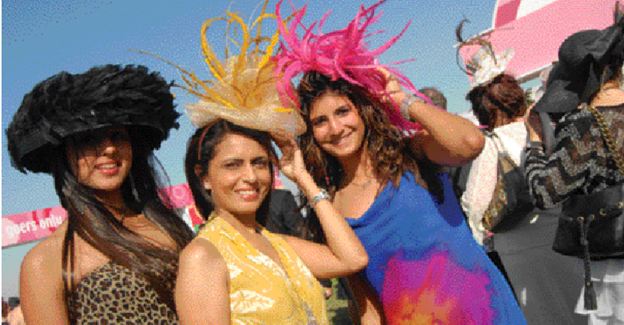
Letter from the Gulf: A (boring) day at the races

by Norbert Schiller May 13, 2007
written by Norbert Schiller

Racing season in the Persian Gulf has all but come to an end with the Formula One Grand Prix in Bahrain. Prior to Bahrain there was the annual Dubai World Cup, the richest horse race in the world; the Formula One power boat race in Sharjah; the Red Bull Air Race in Abu Dhabi; the Dubai off-road desert rally; a number of sailing regattas and oh yes, let us not forget the weekly camel races (though they have lost a lot of their pizzazz after child welfare groups forced the Emeratis to replace pre teen Indian and Pakistani boys with robotic jockeys).

The end of racing usually means the end of winter. From now on each day becomes hotter than the previous and the only thing to look forward to is an early exodus before the onslaught of summer.

This year I was fortunate to have covered two of the most prestigious races; the 12th running of the Dubai World Cup followed by Formula One in Bahrain. The last time I covered the Dubai World Cup was in 1996, the first year the race was held, when the American horse Cigar won then a record breaking $4 million. Today the prize has risen to $6 million with the total prize money for all seven races held on that day worth $21.25 million dollars.

There is a right way and a wrong way to host international events that are supposed to attract people from all over the world. Dubai with its vast financial resources never ceases to amaze, especially when it comes to its ability to momentarily morph from a desert kingdom to Kentucky or Ascot and over 12 years the World Cup has just gotten better and more exciting. Unfortunately, the same cannot be said for Bahrain’s Formula One.

Formula One racing is the richest and most powerful sport in the world. It ranks alongside football’s World Cup and the Olympics and according to Russell Hotten, author of “Formula One: the Business of Winning,” some grand prix races are watched by TV audiences of 800 million. And, unlike the World Cup or the Olympics which take place every four years, Grand Prixs are held 11 times a year. Formula One is more than just a race; it is an opportunity for the biggest players in the auto industry to test out hundreds of millions of dollars worth of research and development. I asked one long time Formula one journalist why the likes of Ferrari, McLarens and BMW Sauber are always atop the leader board. “$400 million dollars,” he replied. “Ferrari invests $400 million more than, let’s say, Etihad Aldar for the same car.”

Lacking in glamor

You would think that kind of money would come with a lot of glamour. But from what I saw in Bahrain, the glamour came only in the 90 minutes of racing. When you mention Monte Carlo, Indianapolis, Sao Paulo one not only conjures up visions of motor sports but more importantly the atmosphere that surrounds the sport.  Unfortunately that was all lacking in Bahrain. For the first two days of practice sessions and time trials there was hardly anyone to be seen in the stands. On race day there were more people but the race track was far from full capacity. When the final lap was finished, the stands emptied and everyone went home. The magic that attracts and the magic that makes people linger long after the checkered flag amid the whiff of burnt rubber and the stench of sweat and gasoline was not there.

Part of the problems was obvious. Tickets were expensive and even if you were willing to buy a ticket there was always the problem of getting to the track, a half hour drive from the capital. There was no public transportation, only taxis who were charging anywhere from 20 to 30 Dinars ($50 to $80 dollars) for a one-way trip. 

In a country that has always prided itself for its liberal stand on entertainment and alcohol, why did it suddenly clam up on race day and force the winners to celebrate with an alcohol-free rose-flavored carbonated beverage that came in what appeared to be a Champagne bottle? Why did the authorities revoke visas for single women who they deemed unfit and then prevented other single women from entering to the country. Celebrities? Hmmm. Ok, former tennis legend Boris Becker was present, as was a Porsche-sponsored Miss South Africa but where are all the western expatriates? It doesn’t take a genius to figure out why a bunch of fair skinned westerners didn’t show up at a race track in the middle of a desert just to sit in the sun and watch cars going round in circles without something refreshing in their hands!

Booze brings the people

Dubai, on the other hand knew what it had to do. Sheikh Mohammed Al Maktoum deemed the race venue an international zone and racing lovers partied all day. And guess what? An estimated 50,000 people attended the one-day event, many flying in on chartered planes from far-flung destinations.

But Dubai makes it a point of allowing in those less fortunate than the free-wheeling jet-setters. Since the first race back in 1996, the outer perimeter of the track below the grandstands is reserved for Sudanese, Egyptian, Somali and other laborers who set up small camps on blankets with their families. I compare them to the deck-class passengers on luxury liners of the early 20th century; everyone is going in the same direction it’s just a matter of in what comfort. Bahrain could learn a thing or two from the Emirates on how to run an event.

Next year, when Formula One comes back to Bahrain the authorities should put on some public transportation and offer discounted tickets. Most importantly, it should inject a bit of fun. For in 2009, Abu Dhabi will be added to the Formula One circuit. What that means for Bahrain is anyone’s guess given that their contract comes up for renewal shortly thereafter. What Bahrain does not want to happen is to be upstaged by Abu Dhabi, particularly when it was the Bahrainis who had the honor of bringing Formula One to this part of the world in the first place. Then again, isn’t competition what it’s all about?

May 13, 2007 0 comments
0 FacebookTwitterPinterestEmail
GCC

A global network in the making: Nokia and Siemens teaming up for mobile web of data

by Executive Contributor May 13, 2007
written by Executive Contributor

In the ever expanding telecommunications industry, rife with new acquisitions, joint ventures and mergers, the recently formed Nokia Siemens Network has ventured into the fray to connect a projected 5 billion people by 2015.

The Nokia Siemens Network (NSN), a 50-50 joint venture (JV) between the two European  telecommunications’ powerhouses that was pending agreement since last June, has a top three global position in the industry, valued at $31.6 billion.

The network was only launched in April this year, delayed due to Nokia’s concerns over bribery investigations at Siemens that had led to the arrest of several former Siemens employees, including Thomas Ganswindt, former head of the German company’s telecommunications equipment division.

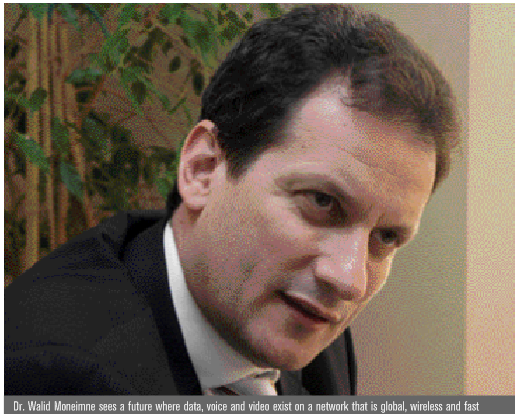
Based in Helsinki, Finland, NSN’s chairman for the Middle East and Africa, Dr. Walid Moneimne, said the motivation behind the JV was to consolidate the two companies’ research and development teams, and become the world’s No.1 communications enabler.

The merger of Siemens’ networks business group and Nokia’s carrier-related operations is also aimed at cutting costs to make the companies more effective in the global market. Expecting to slash annual costs by an estimated $2 billion by 2010, most of the savings will come from restructuring and a 10-15 percent reduction in the network’s 60,000-employee work force. Annual sales are projected at $20.2 billion.

Big future looming

“We see the telecommunications market by 2015 at five billion customers either connected by fixed line or broadband—about 70% of the world’s population. Bandwidth will grow a hundred fold, so that gives you an idea of the future—a 50% increase in requirement,” said Moneimne.

The Middle East and Africa (MEA) will be a major focus of NSN’s rollout worldwide, in addition to the rapidly emerging markets of India and China.

With only 300 million people connected out of the MEA’s combined population of 1.3 billion, that figure is expected to double to 600 million by 2010 as penetration rates increase and access to networks expand. “We are talking of a huge opportunity and demand to deploy these networks in the MEA region,” said Moneimne.

The network’s entry into the region is opportune, coming at a time when major regional operators such as MTN, MTC, Etisalat and Qtel are expanding and increasingly operating in new markets. The growth of regional operators, particularly Kuwait’s MTC through its acquisition of pan-African mobile operator CelTel in 2005, gaining access to 14 African markets and investing billions of dollars to bring infrastructure up to scratch, will also be a boon for NSN’s regional strategy.

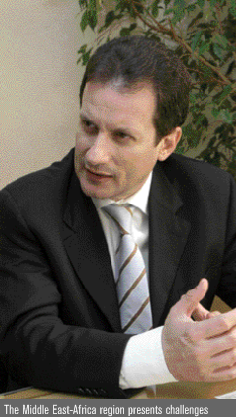
Region presents challenges to growth

NSN recognizes that the growth of the telecommunications sector in many markets in the MEA, particularly Africa, are being hindered by insufficient infrastructure and low incomes.

“There is a level of income that determines what people can do. Our goal is to work with operators to bring the best technology at the lowest price. On the other side of the spectrum are countries where there is a 100% penetration and handset replacement is high, so we will implement 3G networks and a major technology refresh as content (music, video) becomes more important,” said Moneimne.

In more advanced markets in the region, NSN are carrying out pilot tests on WiMax technology in certain cities, although Moneimne declined to say which ones.

“Our objective is really to see what the market needs, to put fixed and mobile together, 2G, 3G and WiMax solutions. All present a big investment for our customers,” he said.

The internet is also a major driving force for the network.

“When we look at 5 billion connected, the internet is at the center of that as all content is on the internet. Internet companies have a vested interest in this market,” Moneimne said.

However, expanding the network in Africa and the Middle East is not without its challenges,

Moneimne conceded. “Human resources are limited and it is a problem to deploy networks, particularly for issues of a high technicality,” he said. Lebanon was resultantly chosen as a platform for the region due to the high number of qualified and skilled employees and graduates.

Getting around the issue of inadequate electricity supplies in parts of Africa and the Middle East, NSN have been pioneering solar panels for sites, said Moneimne. “There is a lot of variation in how to use technology. Networks are not huge users of electricity, but will cause electricity generation expansion in certain countries,” he added.

But despite certain drawbacks, the relatively virgin markets of the MEA do present major opportunities compared to other markets worldwide.

“Despite the MEA having some of the highest penetration rates, it also has the least penetrated regions in the world and growing the fastest. Most developed countries are now just seeing mobile subscribers exceed fixed line subscribers, but in the MEA it’s already 75 million mobile subscribers,” added Moneimne.

The network has five product business units—Radio Access, Broadband Access, Service Core and Applications, IP/Transport, and Operations Support Systems—for fixed, mobile and converged networks.

“NSN has the size and resources to compete, but we also recognize that true competitiveness goes well beyond scale,” said Moneimne. The network’s competitiveness will draw on both companies’ research and development teams. Last year a R&D team that is now part of the network demonstrated the world’s first Long Term Evolution (LTE) radio access solution, transmitting data at a rate of 10 gigabits per second via an optical access network four times faster than rates achieved in the past.

Moneimne also said that there will be “major developments” in mobile phone handsets within the next two to three years. “Nokia calls them multimedia computers, so 3G networks are a must, but not just for 3G itself but the follow up, High-Speed Downlink Packet Access (HSDPA). The difference is in bandwidth speed: 2G dial up is roughly 100 bits, then the 3G at 384 kb/second and HSDPA 14 megabits a second. So clearly what all this brings is a HSDPA phone and network that will provide better customer experience and more available services,” explained Moneimne.

Although annual sales are projected at over $20 billion, the network announced in April that it only expects “slight” growth this year due to a “narrowing of visibility” and signs of a slowdown in spending by communications service providers in certain regions. As of April, the financial results of the network have been consolidated into Nokia.

May 13, 2007 0 comments
0 FacebookTwitterPinterestEmail
GCC

Fake or Real? Counterfeits major issue

by Executive Contributor May 13, 2007
written by Executive Contributor

Curbing the counterfeiting and smuggling of goods has become such a pressing concern for international businesses that last year 19 companies teamed together to create a Brand Owners’ Protection Group (BPG) in the Middle East to tackle the region’s part in the $500 billion global counterfeit trade.

According to the Dubai Economic Department between 2000 and 2004 the GCC authorities seized fake products worth $50 million, of which $35 million was confiscated in Saudi Arabia alone. In a raid on a warehouse in October last year, the Saudi authorities seized 90 tons of copycat Unilever products, worth $1 million.

Along with Saudi Arabia, the UAE has become a focus point for the BPG as the Emirates’ main port, in Dubai, is a major regional export hub.

“More than 7 million containers pass through Dubai with 20% annual growth according to Dubai Ports, so it is very important for brand owners to be protected,” said Omar Shteiwi, chairman of the BPG and regional intellectual property advisor for Nestlé Middle East in Dubai.

The BPG has been working closely with Dubai Customs, which has established an Intellectual Property Unit (IPU) and been on the offensive, seizing counterfeit goods estimated at $3.9 million between February and June last year. The IPU has the right to seize and destroy goods that are entering or in transit.

By comparison to Dubai’s IPU, set up in December 2005, seizing goods in other countries is not as easy said Shteiwi, despite trade, patent and customs laws in the GCC area.

To improve seizures at the point of entry, the BPG is providing educational workshops to inform customs what to look for in shipments. “Hopefully we will have a kind of engagement with the customs to train inspectors to differentiate between genuine and real products,” he said.

Robert Taylor-Hughes, CEO of Beiersdorf Middle East, said finding the source of the fake goods was the best chance of nipping the problem in the bud, but added that the judiciary system in the UAE lacked appropriate penalties.

“One seizure took place over a 10 month period where we found a ring that had been taking in goods from China. We allowed them to enter the Dubai Free Zone, leave and enter the warehouses of counterfeit traders to trace the distribution network. The downside was the judiciary system. Our legal and investigative costs were about 80,000 euro but when he appeared in court was fined $817. The threat of the deterrent is simply not large enough,” he added.

To try and improve legislation, the BPG has organized a one-day seminar with the UAE Ministry of Economy and Trademark Office to exchange information, come up with recommendations, and involve the enforcement agencies.

Although the UAE still has a way to go in handing out tougher sentences, some countries’ judiciaries are taking the issues more seriously, such as in Saudi Arabia and Iran.

Saudi Arabia carried out 100,831 inspections last year at stores selling foods and fast moving consumer goods (FMCGs) that resulted in the seize of 798 tons and 943,231 small pieces of food unfit for human consumption, according to the Saudi Ministry of Economy and Trade.

Iran has a massive problem with counterfeit goods entering the country, largely from China and Central Asia.

Taylor-Hughes said that last year, the Iranian authorities worked closely with Beiersdorf investigators to seize fake goods. “They not only work quickly but are very severe. Both violators were fined $50,000, the message got out, and (illicit activity) quietened down for a year,” he said.

Cosmetics and toiletries firms such as Beiersdorf have been particularly affected by the counterfeit trade, estimated as high as $210 million in the GCC last year—which could be as much as 10% of the overall Gulf market for cosmetics and toiletries.

In Egypt, the company had to pull its whole line of sun-creams following email complaints from customers that got badly sunburned in Sharm El Sheikh after using counterfeit lotions.

“We removed all goods from the market and are now holo-spotting in Egypt—you need a special eye glass to read the code, and counterfeiters can’t duplicate this new technology so far,” said Taylor-Hughes.

The holo-spot, which costs half a euro per spot, is solely being used in areas where the company has had problems, such as Egypt and in Russia, where Beiersdorf found counterfeit shampoos on sale.

A further issue brand owners face is the lack of statistics and data about the extent of the counterfeit trade in the region. To address this the BPG has commissioned international auditing firm KPMG to carry out an economic study on the counterfeit trade in the UAE that will focus on FMCGs, pharmaceuticals, cosmetics, and automotive spare parts.

“The added value of this study will be a roadmap for us and the government as to whether to adopt new intellectual property laws, improve existing laws, give more authority to customs, and enable brand owners to carry out investigations,” said Shteiwi.

The size of the Saudi market is a strong selling point and local banks will in any case make it a matter of their pride to be present and very visible in KAFD and later on in KAEC financial center. That will widen the Saudi financial scene and elevate its profile but it will not by itself fulfill the vision for the two huge projects. Then again, it must be true for new financial districts what is true for the whole world of finance: without risk, no profit.

May 13, 2007 0 comments
0 FacebookTwitterPinterestEmail
GCC

Time to invest in Arabia Felix?

by Executive Contributor May 13, 2007
written by Executive Contributor

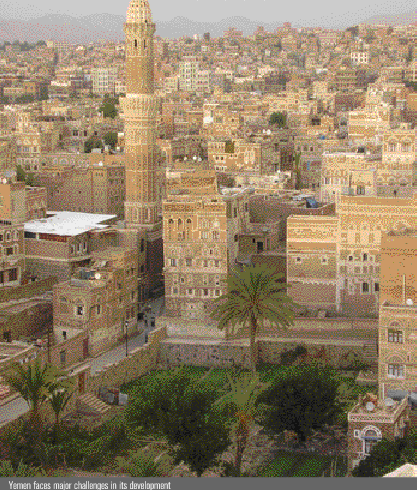
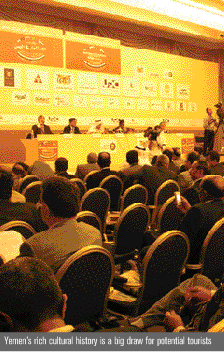
last month’s Investment Opportunities in Yemen conference was the first of its kind to be held in the country. It highlighted some of the striking challenges and opportunities in the Arab world’s poorest and most undeveloped state, which despite myriad difficulties now faces a period of transformation.

Long considered the backward underbelly of Arabia, one of the world’s poorest countries and certainly one with the highest number of weapons per capita, Yemen is stepping up efforts to entice investors into what is virtually a pristine economy.

A daunting host of political, social and economic problems currently lay siege to the country’s development, however, including a frighteningly high population growth, water shortages, weak government control, over-reliance on oil revenues and endemic corruption.

Nevertheless, Yemen’s investment authorities are doing all they can to attract a new influx of foreign capital—especially from the GCC—and reverse the economic misfortunes of recent times.

Getting it together

The Investment Opportunities in Yemen conference, which, after being postponed twice, eventually took place late last month in the capital, Sanaa, was largely designed as a private-sector follow-up to an international donors’ conference held for Yemen in London last November.

That event raised some $4.7 billion in pledges to support Yemen’s development, about half of which came from the GCC, to which Yemen wants—perhaps ambitiously—to accede within the next decade.

This time around, though, the focus of the conference was firmly on private investment. A packed house of some 650 delegates and 70 ministers from across the region gathered for a two-day series of speeches and debates on Yemen’s prospects, whilst a trade exhibition showed off some of the country’s key investment opportunities, mostly in the construction, manufacturing, real estate, tourism and energy sectors.

“Yemen is witnessing a significant transformation marked by a will and determination to create a prosperous future full of welfare and peace,” said President Ali Abdullah Saleh, the strongman who has managed to hold the country together through long decades of civil strife.

“We realize that today’s world is one of economic blocs, a world marked by heated competitiveness and rapid transformation in all economic aspects where there is no room for those who think traditionally,” he told the conference.

But although Yemen may lie in the same geographical zone as some of the world’s richest states, in most other respects it has more in common with Ethiopia than the Emirates—something which might not change too much in the near future.

Towards the edge

Crippling problems face Yemen as it looks to develop and diversify its economy. Amongst the most worrying of these is spiralling population growth, which at a rate of over 3% puts Yemen amongst the fastest-growing nations in the world, and will levy a even greater toll on some resources, especially water, which are already close to breaking point.

This population, whilst large in size, is small in purchasing power. About 45% of Yemenis live under the poverty line, according to the UN, and almost three-quarters reside in rural areas. Unemployment is unofficially over 40%, and a sizable chunk of the average male income (and waking hours) is dedicated to qat, a natural stimulant which is the country’s most lucrative cash crop and which occupies the majority of fertile land.

GDP growth, meanwhile, is barely keeping up with population growth, whilst inflation is equally onerous, reaching a peak of 18.4% in 2006 according to the World Bank.

As part of the aid deals and donor grants negotiated with external benefactors, a halting program of reforms has nevertheless been gathering pace over the past 18 months, although some measures may prove unpalatable to the local population.

“The government finds itself in a difficult position between keeping its promises to donors on one hand, and treading carefully with the local population on the other,” says Dr. Ali al Abdulrazzaq, Senior Economist with the World Bank in Sanaa.

 “They need to be very careful with measures that may have an effect on income levels, such as cutting fuel subsidies or raising taxes,” he told Executive.

And whilst the investment authorities have enacted specific reforms to attract capital, such as introducing a new investment law in 2003, modernizing real estate legislation and opening a “one-stop shop” for interested parties, Yemen is still an opaque place to do business.

Corruption is considered to be endemic and the entrenched tribal power in most parts of the country mean that it is often more valuable to have the backing of the local tribal power than that of the central government. 

Energy levels

Underlying all these issues is a fundamental over-reliance on oil, which constitutes 71% of government revenues and is already suffering from waning production as reserves dwindle.

Yemen presently pumps some 350,000 barrels of oil per day (bpd), and whilst the majority of the country’s exploration blocks have not yet been probed, analysts believe they are unlikely to wield any earth-shattering finds. Nevertheless, the Ministry of Oil and Minerals is about to launch a new bid round for interested parties, which include a number of big international names.

Yemen’s gas reserves have perhaps more to offer, with the country’s largest-ever single investment, the Yemen LNG project, currently under construction. A consortium made up of the Yemeni government, Total, Hunt Oil and two Korean companies is investing a total of $3.7 billion in the plant, which is set to come onstream in early 2009.

It will extract gas from an exploration block in the centre of the country, transport it by pipeline to a state-of-the-art plant on the Gulf of Aden and then convert it to LNG before shipping it on to clients.

“The plant will produce around 7 million tons of LNG per year, or about 180,000 barrels of oil equivalent [BOE]” said Joel Fourt, Chairman of the Yemen LNG Company. “In answer to the question: is it possible to build a world-class, world-scale project in Yemen, the answer is yes,” he told delegates at the conference.

The real question that many are asking, though, is how Yemen can diversify its economy away from this over-dependence on hydrocarbon revenues: LNG alone is not a long-term solution.

Milking the land of honey

One possible answer is tourism, a sector which the authorities seem particularly—and justifiably—eager to promote. Yemen’s rich cultural heritage, its old towns, unspoiled beaches, mountains and islands, theoretically put the country head and shoulders above regional tourist hotspots like the UAE in terms of natural attractions. 

Yet a consistently bad image, a lack of infrastructure and expertise, poor air connections and a meagre promotional budget mean that Yemen is light years behind its northern neighbors in terms of drawing in holidaymakers.

Speaking to Executive, Yemen’s Minister of Tourism, Nabil al-Faqeeh, says that the first priority is simply to build more infrastructure.

“In Yemen we have a lack of rooms, a lack of hotels, a lack of restaurants. We need to attract as many investors as possible for these kinds of projects,” he says.

“In 2006 we only had 382,000 tourists. We want to increase this by 20% in 2007 and we’re changing our strategy to try and attract more Arab tourists, especially from the GCC, where traditionally we have concentrated heavily on the European market.”

But finding the money for these projects is problematic. The state lacks the kind of disposable oil revenues which nearby countries like the UAE have been able to pour back into promoting tourism and real estate, whilst the local banking system in Yemen is too underdeveloped and illiquid to support start-up needs for new investors.

“Financing is the biggest problem for new tourist projects”, Alwan Saeed al-Shibani, Chairman of the Sanaa-based Universal Group, told the conference. “Our commercial banks don’t give out loans, and that needs to change. We have Gulf investors who want to start projects but they’re being held back by this.”

Yemen may also have to shrug off its image as a minor hotbed of kidnapping. Small groups of tourists travelling in rural Yemen, usually Europeans, are periodically spirited away by local tribes who treat their “prisoners” like guests whilst making modest demands on the government, such as building roads, hospitals or schools in their villages.

Island life

According to Al-Faqeeh, the government has no particular geographical priorities for tourist development, but one special area of opportunity is Yemen’s roughly 190 islands. Some have already caught the attention of regional powerhouses such as Orascom and the Mikati group, both of whom are reportedly finalizing agreements to develop islands in the Red Sea.

Yemen’s largest and best-known island is Soqotra, which lies in the Arabian Sea south-east of Aden and boasts a unique ecosystem which has evolved independently of the mainland. Potentially a tourist magnet, visitor numbers have been gradually on the up since an airport opened on the island several years ago, although the ministry are at pains to point out that no major developments will be allowed here: instead, they want to attract a classier breed of eco-tourists.

But although Soqotra looks as if it may thankfully be preserved from mass tourism, the mainland is already gearing up for some large-scale tourist and residential developments spearheaded by courageous investors.

The biggest and most ambitious of these is the Jenan Aden project, which will cover 14 km2 of pristine mountainside and beaches just outside of Aden. Phased over 10 years, the development is being led by a Saudi-Yemeni joint venture, Bin Farid and Baghlaf, and when complete will contain 4,000 residential units, four hotels, two marinas, a school and a university.

“There’s definitely an element of being pre-emptive in the market,” says Chris Orrell, Chief Operating Officer of the project. “But there’s also a belief that this is Yemen’s time. It is an exceptionally beautiful country with a great deal of potential.”

Most developers planning projects in the country say they are targeting a relatively small crust of high-income locals, but more importantly the Yemeni expatriate population, which is largest in Saudi Arabia, other Gulf states and also the UK.

Rise or fall?

No-one would argue that huge amounts need to be done in order to improve Yemen’s business climate, particularly, according to investors, in terms of the real estate registry and the commercial court system. But it seems that the government, at least, has realized the urgency of the need to diversify away from oil.

“I think many of the changes enacted over the past 18 months will really begin to bear fruit in 2008,” says the World Bank’s al-Abdulrazzaq. “The government is pushing for reforms, which is encouraging.”

Yemen is clearly only at the start of a long road to attract foreign capital, and it will need to create a positive track record that can earn the trust of investors, particularly those from outside of the GCC.

It is uncertain whether sufficient time remains to tackle critical issues like population growth and declining resources before it is too late, but there is enough excess cash available in the region, enough vested interest in keeping Yemen stable, and enough latent potential in the country itself to suggest that this could be the start of Yemen’s entry into the modern age.

Battling local tribesmen, Sanaa claims Iranian-backed militants wish to establish a Shia-run imamate

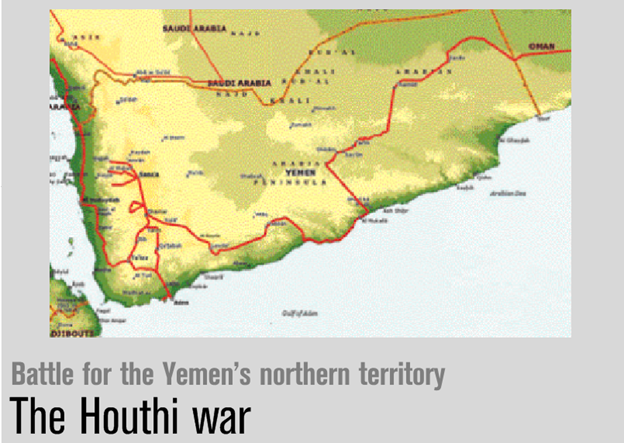
Yemenis are no strangers to unrest, having fought their way through a string of civil wars in the past half-century, but a longstanding dispute in the northern Sa’ada region of the country is now erupting into something approaching full-on warfare.

The conflict is the latest in a series of skirmishes between government forces and followers of the al-Houthi clan, who are based in the isolated mountains close to the Saudi border around the town of Sa’ada.

The sides have already crossed swords in two previous clashes, in 2004 and 2005, and the latest fracas has intensified rapidly since the start of 2007 to claim hundreds of lives on both sides.

Confusion surrounds the root cause of the fighting, which now appears to have spun completely out of control. The government claims that the Houthis, bankrolled by Iran and radicalized by the situation in Iraq, are attempting to establish a Shia-ruled Imamate in northern Yemen.

Others argue that the conflict has little to do with Sunni-Shia divides and is more related to the weakness of government power outside the main cities.

“It’s more a case of the government stepping on the toes of the local tribes and trying to extend its control in certain parts of the country,” said one western diplomat in Sanaa. “The system of power in Yemen means that these areas are largely autonomous, and they don’t like any outside interference—even from their own government.”

Beset by heavy losses and little progress, the army is pouring vast resources into Sa’ada. The local press reports that warplanes, tanks, artillery and thousands of soldiers are being dispatched northwards, although the region has been completely sealed off and it remains difficult to establish the reality on the ground.

“Even we can’t really understand what’s going on up there,” one civil servant in Sanaa told Executive. “Yemenis have never been religious extremists—both Sunnis and Shias in this country have traditionally been very moderate in their outlook.”

Whatever the case, the fighting has again shown up the fragility of a state in which allegiances are first and foremost tribal, not national, and in which the army is far from being the only significant military power.

May 13, 2007 0 comments
0 FacebookTwitterPinterestEmail
Cover storyGCC

Regional trade for China awakens dragon

by Executive Contributor May 13, 2007
written by Executive Contributor

In what is being dubbed “the New Silk Road,” trade and political ties between China and the Arab Gulf are growing stronger as both regions take an increasingly prominent role on the financial world stage. Politics is playing its part, with Saudi Arabia’s newly appointed King Abdullah opting for Beijing over Washington for his first trip overseas last year, and Chinese President Hu Jintao repaying the visit with trips to Riyadh and Dubai.

Bilateral trade between the United Arab Emirates and China is soaring as Emirati companies look eastward for investment opportunities to diversify away from oil, while Beijing secures energy sources and new export markets to keep its burgeoning economy afloat.

Strictly business

“Arabs see China purely as business, at least for the moment,” said Glen Osmond, managing partner for Middle East Strategy Advisors, a leading strategy consultant and investment advisory firm in the GCC.

“The Chinese don’t have problems such as political baggage or externalities like protecting the region, and are not here for consumers—the GCC is not a major consumer of Chinese goods compared to the EU or US—but for raw materials,” he added.

China has been quietly taking advantage of its negligible political history in the Middle East and Africa over the last five years, investing billions of dollars in infrastructure projects, signing energy deals, and attracting Gulf money, estimated as high as $20 billion in the past year from the GCC countries alone.

Although Saudi Arabia, the Middle East’s largest economy, has attracted the lion’s share of Chinese investment to the region and been more active in entering the Chinese market, the UAE is slowly catching up.

Since 2001, trade has grown by 30% per annum and the UAE is now China’s top export market in Western Asia and North Africa, according to Global Sources, with exports reaching $14.2 billion in 2006, up from $8.7 billion in 2005. Trade is likely to double by 2010 if targets projected by the Chinese government prove correct. Based on past trade growth, surging 45.5% in 2004 alone, this figure doesn’t seem to be overly optimistic.

“The UAE is a trading centre for the Middle East, so I think this year, or next, trade will grow at high speed,” said Han Xi, Vice Commercial Consul at the Consulate General of China in Dubai.

Dubai’s rulers are certainly aware of the potential.  “We want to be number one, and not second. If we join forces together (China and the UAE), we will be number one,” the UAE’s Vice President and Prime Minister Sheikh Mohammed Bin Rashid Al Makhtoum said at a recent press conference.

But Dubai’s ruler is also aware that China is not the only game in town. Trade between the UAE and Malaysia soared 20.7% last year to $3.4 billion while UAE-India trade not far behind China at an estimated $11 billion in 2006. India has emerged as Dubai’s largest export destination ahead of Pakistan, Iran and Kuwait, Indian investment in the UAE has doubled in the past four years and trade is expected to surge to $20 billion by 2010.

Indeed, in a seeming about face on the growing UAE-China relationship, Sheikh Mohammed also called for raising India-UAE bilateral trade to the ‘number one’ spot in the region.

But Sheikh Mohammed’s statement is perhaps more about pragmatism, realizing the UAE’s need to have its fingers in many pies. As Osmond pointed out, “the more buyers the better. It’s a souk mentality, and they have a huge machine and it needs to be fed.”

India certainly has a more established connection with the UAE, bolstered by approximately 1.4 million expatriate Indians working in the Emirates versus an estimated 50,000 Chinese expatriates.

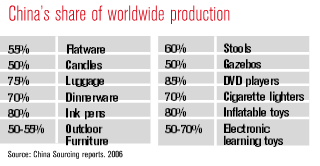
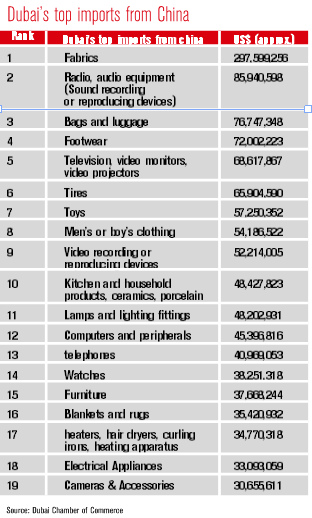
India however lacks the political and military position of China on the world stage (China is widely seen as a potential counterbalance to the US that Middle Eastern states are keen to develop), and is not a manufacturing powerhouse on par with China. Indeed, in terms of trade with Dubai the statistics speak for themselves: 36.6% of textile imports, 40.7% of furniture, toys and sports products, and 48% of all footwear, headgear, umbrellas and flowers came from China in 2005. And according to the Dubai’s Department of Ports and Customs, 17% of all of Dubai’s imports came from China in 2005, making China Dubai’s top supplier of imported goods.

“Dubai is the third largest re-export market in the world, after Hong Kong and Singapore—that is a very impressive statement,” said Bill Janeri, the Middle East general manager of Global Sources, a Hong Kong-based publisher and trade show organizer.

Enter the Dragon

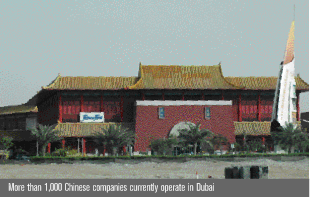
There are now more than 1,000 Chinese companies operating in the UAE, according to Standard Chartered, and that figure is expected to grow as investment floods in.

“China’s first export markets have traditionally been the US or Europe, but everyone wants to sell to these established markets,” said Janeri. “So over the years Chinese companies have either sold to there or been creative and looked for new markets when demand is equally strong—markets where they can be the number 1, 2, 3 player in their segment. Dubai has shown that it is a good location where these companies can ‘plant their flag,’ win new customers, and build market share where demand is strong.”

Global Sources will hold its first trade fair in the region, the China Source Fair, in Dubai in June—with over 500 exhibitor booths, it will be the largest ever exhibition of Chinese products in the Emirate, according to the Dubai Trade Center.

Although only $200 million was invested by private Chinese companies in the UAE in 2005, that figure surged to $800 million last year and UAE financial institutions are scrambling to procure a slice of the growing trade between the UAE and China.

Standard Chartered have recently rolled out a UAE-China ‘trade corridor’ to cater to small and medium-sized enterprises (SME’s) in the UAE and China.

“We felt this need as China kept the heat turned up on its Gulf marketing blitz to overtake such industrial giants as the US and Japan to become the top exporter to the UAE since 2004,” said Sandeep Bose, Regional Head of SME Banking at Standard Chartered in Dubai. “This is expected to continue as the most populous nation on earth is stepping up its export offensive, aided by the fact that its products are more competitive than the products of most other industrial nations.”

But the investment deals and joint ventures the Chinese government is most interested in are Abu Dhabi’s gas, petrochemicals, and aluminum nuggets.

 “I wouldn’t be surprised if China makes strategic investments in the region to develop the relationship in all the energy rich countries… Britain has been in the UAE for how long? China wants a piece of that,” said Osmond. 

Non-energy imports from the UAE are steadily growing however, up from $2 billion in 2005 to $2.8 billion last year. Investment in China’s booming economy, the fourth largest in the world, is also increasing, spurred on by high liquidity in the UAE and Gulf markets.

“Because oil prices are high there is more interest by UAE businessmen in worthwhile markets, and China has the economic and social elements for attracting such business,” said Han.

Dubai’s mammoth construction companies Emaar and Dubai Holdings, both responsible for tens of billions of dollars in real estate projects throughout the MENA region, have also opened offices in Shanghai. DP World, the world’s fourth largest port operator, also has a corporate division in the North-Eastern Chinese city of Tsingtao.

“I think this is the beginning of Dubai real estate coming to China,” said Han.

But it is not just real estate that is attracting Arab businessmen.

“I went to a trade show in Yiwu recently and part of the town is all Middle Eastern restaurants and businesses,” recalled Janeri. “It doesn’t surprise me that other markets are looking to invest in China. There is gaping wide demand for certain products—in fact, everything you can imagine,” he added.

Interest in China is certainly growing, with the consulate in Dubai China’s busiest worldwide. 

“Everyday we receive more than 300 visa applications—you can see more people want to go to China,” said Han.

An increase in airline flights is also indicative of the growing links, with China Southern Airlines opening an additional route between Dubai and Guangzhou at the end of last month.

Lost in Translation

Dealing with Chinese companies is not always easy—a common complaint voiced by businessmen ever since China opened its doors to the outside world in the 1980s, citing cultural differences and transparency in business practice.

“You hear stories of Chinese signing deals with companies and then reneging on the deal, saying it didn’t comply with their legal definitions or simply disappearing,” said a source at a real estate firm.

“There have also been cases of the Emirati authorities closing down construction sites as in the heat the Chinese workers strip down to their underwear and only wear hardhats, which is against UAE law—they have to cover up,” he added.

Han acknowledged that the consulate had received complaints, largely about wording and English terminology, but said the language issue and business transparency were being addressed.

“Both languages are difficult to learn, so it’s not a deep relationship but a growing one between the Arabs and the Chinese,” said Han.

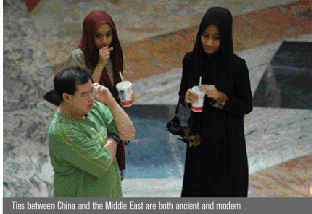
The relationship is in fact an ancient one that is being gradually rejuvenated.

According to historical texts, some 1,400 years ago there were an estimated 10,000 Arab and Persian traders in Guangzhou (Canton) plying the waters between China and the Middle East. Evidence of the ancient link is also present at Dubai’s Ibn Battuta Mall, where one section is devoted to the famous Tangerine’s travels in the 14th century to China—the exterior a partial replica of the Forbidden City and the interior painted red and offset with traditional Chinese woodwork.

The dark side of the relationship

But it is the Chinese Ministry of Commerce-supported Dragon Mart in Dubai that is the Emirates’ real China Town.

The China connection is not only bolstering official trade ties. As has been the case for most rapidly growing markets, organized crime is on the rise in Dubai. Russian and Indian money launderers are considered the main perpetrators in the financial line, taking advantage of Dubai’s construction boom and real estate speculation to launder money without paying out large commissions to “clean” the cash. But in terms of counterfeit goods, China is the bad guy.

One source likened China to a “massive Xerox machine,” ready to copy any product a buyer might want. China is indeed the No. 1 manufacturer of counterfeit goods, which are estimated at $500 billion worldwide.

Dubai has become the conduit for that illicit trade in the Middle East, with Dubai ports handling some seven million containers a year. Although most of the illicit trade transactions are between Chinese suppliers and Middle Eastern buyers, Dragon Mart, a mall and business center established three years ago, has become the hub for Chinese organized crime, according to a source in the real estate sector.

Earlier this year an undercover Dubai cop was sent to the Dragon Mart to investigate organized crime links at some of the center’s businesses. Told to call in on the hour, every hour, the cop suddenly disappeared. The Dubai police made a raid on the Dragon Mart and after kicking down a few doors, found the policeman dead in a freezer.

Such gruesome incidents are not the only illicit activity connected with China.

According to the real estate source, construction companies linked to the People’s Liberation Army—China’s largest business owner—were exporting convicts to work on sites in the UAE to cut overheads.

The issue has reportedly become so acute that the UAE government has recently banned Chinese construction workers. “It has become too much of a headache for both contractors and the government to regulate,” said the source.

China denies it is involved in such activity, however.

“It’s not true. China is now free, so if a construction company wants to go elsewhere, workers must have passports and visas,” said Han.

China is also reportedly trying to curb counterfeits. “China has a special department to regulate products, especially for exporting products as too many people want to do forgeries and sell low quality products to our friends—this is not good for business,” he added.

Even if this developing friendship will bring with it certain negativities, both economies are experiencing double-digit growth so bolstering such a relationship can only be prudent business for all concerned parties.

But as Han points out, the increasingly strong trade ties require political and economic stability in the Middle East for the relationship to warm any further.

“I think growth all depends on the regional situation, particularly over Iran. If Dubai keeps silent, like the present situation, China will pay more attention.”

May 13, 2007 0 comments
0 FacebookTwitterPinterestEmail
Comment

Wolfowitz at the exit door?

by Claude Salhani May 1, 2007
written by Claude Salhani

So far this has not been a good year for President Bush.First, his plan to pacify Iraq by “surging” more Americantroops appears to have backfired. Since the surge beganIraqis have been dying in far greater numbers than everbefore, and terrorist bombings are claiming nearly 120 livesa day. And, U.S. casualties are increasing, adding pressurein Washington for an early troop pullout.

But if Bush faces a tough time on his handling of foreignpolicies, he now has serious problems at home as well. Afterloosing the majority in both houses of Congress to theDemocrats last November, the president has had anotherawkward moment vis a vis Paul Wolfowitz his choice to runthe World Bank.

Wolfowitz was supposed to fight corruption and alleviatepoverty. To make the task easier, “Wolfie,” as he is know tothose who like him, as well as to those who don’t, was givena yearly salary of $400,000—tax free—and an expense accountto match the status of the job.

As World Bank president, Wolfowitz oversees some 10,000employees around the world. Among them was, ratherawkwardly, his girlfriend, Shaha Riza. Wolfowitz, appearedto be playing by the book. In order to avoid a conflict ofinterest, when he took up his new job it was decidedinternally that she be moved to the US State Department,along with a promotion and a hefty pay rise—due to the factshe was being professionally inconvenienced by the move asit derailed her World Bank career path.

Appointed to the job by President George W. Bush in the formof a golden parachute after leaving the Rumsfeld Pentagon,Wolfowitz, a neoconservative who played a major role inconvincing the Bush administration to go to war in Iraq,stated he would apply a zero tolerance policy regardingcorruption. Now he was being accused of finding ahigh-paying job for his girlfriend.

To make matters worse, the scandal reached a climax as theBank was holding its yearly spring session in Washingtonwith the participation of finance and foreign ministers,central bank directors and financial gurus from around theworld. As the scandal gathered steam, the World Bank’s 24-member board said that the situation regarding the fate ofthe former US deputy defense chief should be dealt with,"urgently, effectively and in an orderly manner."

Calls for Wolfowitz’s resignation began to trickle in withsome finance ministers saying he should step downimmediately. But the US, which appoints the bank’s head,said it still supports Wolfowitz, who they claim had nothingto do with her new appointment. Riza, they argue, wasappointed by a World Bank ethics committee (Wolfie hadpreviously excused himself from all matters pertaining tohis companion). When she was transferred to the StateDepartment she was given the mid-range salary for her newlevel was based on the bank’s existing pay scales.

Dana Perino, a White House spokeswoman, said that PresidentGeorge W. Bush "has confidence in Paul Wolfowitz." Wolfowitzmeanwhile was booed at a meeting with World Bank staff.

By mid April Wolfowitz was told directly by one of his twodeputies, Graeme Wheeler from New Zealand, to step down at asession attended by senior staff members, according to somenews reports. The Bank’s executive board, the Bank’sgovernor as well as a number of European shareholders becameeager to see him go. Senior managers within the bank seemedsplit however, some backing Wolfowitz, others calling forhis resignation.

One of the bank’s main functions is to fight poverty aroundthe world. Yet by the Bank’s own admission, there are stillmore than 1 billion people living on less than $1 a day, and2.5 billion, or 40 percent of the world population,subsisting on less than $2 a day. Wolfowitz’s critics—ofwhich he has many—say that since assuming his new functionsat the Bank he has run the institution “much like a Chicagoward boss or mayor.” He has been said to resort to employ“patronage and intimidation” tactics.

When he moved to the World Bank from the Department ofDefense Wolfowitz took along his political acolytes,upsetting scores of long-time bank senior personnel.

Now there is growing fear in the Republican Party that adragged out “Wolfie-gate” will not help the GOP at a timewhen a vital presidential election is looming just off thehorizon. Many are beginning to echo what World Bankemployees have been saying: it is time for Wolfowitz to go.

Claude Salhani is an international editor and political analyst at United Press International (UPI)


May 1, 2007 0 comments
0 FacebookTwitterPinterestEmail
Talking To

Inside Intel‘s brain: A talk with the boss

by Executive Staff May 1, 2007
written by Executive Staff

As part of Intel’s efforts to promote the use oftechnology with communities around the world and as arepresentative of the “Partnership for Lebanon,” IntelChairman Craig Barrett visited Lebanon last month. He alsospoke to Executive

How does the American Lebanese partnership andthe Berytech fund you contributed to, fit into the UnitedNations’ Global alliance for ICT you currently chair?

The UN Global Alliance has the same objectives as thePartnership for Lebanon, which aims to improve education,healthcare, economic development and the interaction betweengovernments and citizens. The partnership is obviouslyinvolved in Lebanon because of the destruction that resultedlast year from the conflict between Israel and Hizbullah. Weare not taking any sides on this issue, our concern is onlyfor the individual Lebanese citizen with the aim ofimproving his situation. On a much larger scale, the UNAlliance oversees what can be done to advance the status ofcitizens from emerging countries around the world. Theglobal goal is very similar to the Partnership’s one. As forthe Berytech fund, the issue of economic development is alsopart of the Partnership’s objectives and the UN GlobalAlliance. Economic development can come in various flavors:foreign investment, organic growth, economy, orentrepreneurial activity, in this last regard, Lebanonoffers a long cultural and societal history. The Berytechactivity aims to stimulate and promote economic growth,using education and potential young entrepreneurs. Berytechis unique in the sense that it is in an incubator: it takesideas, before they’re formed into business plans and givesthem a chance to grow and nurture. The investment inBerytech, a purely Intel venture, is totally consistent withthe partnership’s goals.

You’ve declared to the American congress that UScompetitiveness can only improve through education and R&D.Where do you see America standing in the economicenvironment in a few years, especially now that emergingcountries are slowly growing and siphoning off jobs?

The challenge the USA faces lies in the worldwidecompetition for educated workers and new ideas. It is thereason why so many of us lobby our own government for moreR&D and progress in education, especially in the areas ofmath and science. We are very concerned by the fact that ifthe US continue on their current course, it would faceserious problems in the future from a competitivestandpoint. We have proposed various efforts such as theincrease in research investment and improving the fields ofmath and science, which are both incredibly critical to thefuture of competitiveness.

You’ve said that “companies can’t save their wayout of a recession or even prosperity. Instead, they have toinvest in innovative products and technologies.” What isIntel doing in this respect?

If you look at our business at the beginning and the endof any year, separated only by a twelve-month period, about90% of our revenue in December is generated by products thatwere not available on the market in January. Unless you havea development machine that can create new products, androutinely achieve technology leadership, you cannot besuccessful. So when I say “you cannot save your way out of arecession,” it means that if you slow down the developmentmachine, trying to improve financial performance by onlycutting back on investments, you ultimately fail. If youlook at Intel’s general trend over its entire history, R&Dspending always tends to increase. We spend from $5.5 to $6billion every year on research and development, which is afairly large amount, larger by any country’s means.

E In a world where networking, computing andcommunications are converging even more, how is thisaffecting Intel’s overall vision and strategy?

The convergence of computing and communications is verycompatible with Intel’s philosophy and direction. Ascomputing, communication and rich content come together,more computing power to handle data is required. The trendis consistent with Intel’s generic approach, focusing onmicroprocessor power, on Moore’s law, continually improvingcomputing, generation after generation after generation. Idon’t see any disconnection between such a convergence andIntel’s direction.

As the economic environment evolves, Intel faceslower margins and increased competition from countries suchas China or India. How do you see the trend going and whatsteps is Intel taking to rise up to the challenge?

It is a rather interesting fact that people have beenwriting about Intel facing lower margins for years andyears. However, I am not sure the proposition is accurate.We have just announced, two or three days ago, that weexpect margins to increase for the second half of the year.For the past twenty years, margins have fluctuated betweenthe low and high fifty percent range. I also believe our CFOforecasted this year’s margins for the mid-fifties. Oursuccess is based on our leadership technology in the marketplace, providing us with a higher return on investment and ahigher margin on product. The challenge is to maintain ourmarket leadership position, which determines what marginswill look like. There is no question that the averageselling price for microprocessors has decreased over theyears, while our production machine is getting moreefficient, thus taking the cost down. As costs follow thefall in product prices, margin levels stay roughly constant.

How long will it take before we see seriouscompetition from countries like China and India in themicroprocessor industry? How does this affect Intel’s futureplans?

Intel has faced competition in the micro-processing area,from Europe, US, Japanese as well as Chinese companies.Competition is not something new to us, we respond to it byavoiding standstill, moving the technology forward instead,at a very rapid pace. This requires a very large investmentin R&D, which companies need to match if they want tocompete with us in the next generation of products. It isnot about figuring out how to make last generation productsat cheaper prices, but rather how to produce next generationtechnologies, which is what people in the market place want.I suspect we will continue to face competition in the nexttwenty years like we’ve done before, but the challenge forus remains the same.

Intel has long thrived by concentrating on PCmicroprocessors. Now Intel is trying to play the same rolein various fields such as consumer electronics, wirelesscommunications, and health care. What prompted the decisionto diversify your product base and which direction do yousee Intel taking?

The healthcare industry has not made very effective use ofcomputing technologies. It is a very large market withimportant opportunities for the sorts of products Intelmanufactures. In consumer electronics, the opportunityresides again in the convergence of computing,communications and content. The fact that computers havebeen built historically using Intel architecture, as digitalcontent becomes more important, consumer electronics, alsofocused on content, will become more computer-like. There isa definite opportunity to move our architecture intoconsumer electronics applications. This convergence ofcomputing, communications and content allows us to grow fromcomputers to consumer electronics devices.

How does this diversification affect the waychips are produced? Is it affecting collaboration withincompany teams as well as alliances with other marketplayers?

It actually expands the spectrum of companies you need todeal with. Historically, Intel always dealt with thecomputer industry, with large companies such as Dell,Packard and others. But as the convergence of computing,communication and content further increases, we end updealing more and more with consumer electronics and contentcompanies, we previously, were not much involved with. Weare still engaged in our standard computer business, towhich wireless communication capability and content are alsointegrated. These three elements coming together imply thatour products look less and less like standard computingplatforms, assimilating communication and contentinitiatives.

How difficult is it to brand an “ingredientproduct” such as Intel and convince customers to requireit?

You hire some very clever marketing people who create abrand like the “Intel Inside” branding campaign, the mostsuccessful “ingredient branding” campaign the world has everseen. We’ve been able to achieve this because of ourleadership position in the marketplace and used it toexpress the importance of our technology through aningredient branding campaign. If we had lacked leadershipposition from a technology standpoint, it would be verydifficult for us to convince anyone of the “ingredient’s”value. We were thus able to engineer a brand around ourpreeminent position in technology. Today, people are awarethat microprocessors are the PCs brains; everyone wants thesmartest brain and they want Intel. You need therefore bothgood technology and a very smart marketing person whosename, by the way, is Dennis Carter, to recognize this andconvince others to pursue it.

What is your view on the evolution of theinformation technology in the Arab world where, in somecountries, infrastructure is still nascent and monopoliesrun high?

There are excellent opportunities in the Arabic-speakingworld in this regard. Countries recognize the need for smartpeople and smart ideas as well as good infrastructure, andpart of this infrastructure relies on computing andcommunication. Many economies have weak communication orinefficient and extremely expensive infrastructures, such asin Lebanon, because of government control or actions on thesector. Ultimately those infrastructures need to become morecompetitive. There is great opportunity for investment,creativity and technology, which is what companies likeIntel are all about.

How do you picture the technology world in 15 years?

Fifteen years is such a long time in our industry, itmakes it very difficult to tell. The internet was born andgrew dramatically in the space of ten years. Digital camerasappeared, music also became digital, its delivery movingfrom a CD form to an internet feed. However, what is easy toproject is that there will be definitely huge changes andcompanies which are flexible and adaptable will be mostsuccessful in such a time frame. As an example, if you wereoperating like Microsoft in the software business ten yearsago, you could never have forecasted Google posing such abig challenge in the future. Google was born ten years agoin a university; it was not a product, not a business, butonly an idea. The beauty of our industry, its excitement,springs from the fact that concepts, often created by oneperson, can change the face of the whole sector. This meansthat any company wanting to be successful needs to keep itseyes wide opened continually for new ideas. This reasoningmotivates Intel’s involvement in so many joint researchprojects with universities and venture capital—the fundingof startup companies—and allows it to stay close to whatgoes on in the basic research and product worlds. As my bossAndy Grove used to say, only the paranoid survive,otherwise, one runs the risk of being defeated by newtechnologies.

May 1, 2007 0 comments
0 FacebookTwitterPinterestEmail
  • 1
  • …
  • 583
  • 584
  • 585
  • 586
  • 587
  • …
  • 688

Latest Cover

About us

Since its first edition emerged on the newsstands in 1999, Executive Magazine has been dedicated to providing its readers with the most up-to-date local and regional business news. Executive is a monthly business magazine that offers readers in-depth analyses on the Lebanese world of commerce, covering all the major sectors – from banking, finance, and insurance to technology, tourism, hospitality, media, and retail.

  • Donate
  • Our Purpose
  • Contact Us

Sign up for our newsletter

    • Facebook
    • Twitter
    • Instagram
    • Linkedin
    • Youtube
    Executive Magazine
    • ISSUES
      • Current Issue
      • Past issues
    • BUSINESS
    • ECONOMICS & POLICY
    • OPINION
    • SPECIAL REPORTS
    • EXECUTIVE TALKS
    • MOVEMENTS
      • Change the image
      • Cannes lions
      • Transparency & accountability
      • ECONOMIC ROADMAP
      • Say No to Corruption
      • The Lebanon media development initiative
      • LPSN Policy Asks
      • Advocating the preservation of deposits
    • JOIN US
      • Join our movement
      • Attend our events
      • Receive updates
      • Connect with us
    • DONATE