• Donate
  • Our Purpose
  • Contact Us
Executive Magazine
  • ISSUES
    • Current Issue
    • Past issues
  • BUSINESS
  • ECONOMICS & POLICY
  • OPINION
  • SPECIAL REPORTS
  • EXECUTIVE TALKS
  • MOVEMENTS
    • Change the image
    • Cannes lions
    • Transparency & accountability
    • ECONOMIC ROADMAP
    • Say No to Corruption
    • The Lebanon media development initiative
    • LPSN Policy Asks
    • Advocating the preservation of deposits
  • JOIN US
    • Join our movement
    • Attend our events
    • Receive updates
    • Connect with us
  • DONATE
Banking & Finance

Global private equity has a long reach

by Imad Ghandour April 1, 2007
written by Imad Ghandour

The Middle Eastern Private Equity Internationalconference, held each year in the third week of March inDubai, has become the annual hotspot for the region’s PEindustry. Heads of international PE funds, like Carlyle’sDavid Rubenstein and CD&R’s Joseph Rice, descended on Dubaito explore how to expand their sprawling reach to one of thefew remaining untapped markets. In addition, rising PE starsfrom the region lectured about their experiences and theirvisions, eyeing further international expansion, and aimingto attract the attention of global PE giants.

Carlyle’s Rubenstein, in his keynote speech, predictedthat the Middle East will be the fourth pillar in the globalPE industry after US, Europe and the Far East. The region,loosely defined from India to Morocco, has more than 2billion inhabitants, $1.5 trillion GDP, and is one of themain exporters of capital. Rubenstein is practicing what hepreached by setting up a $1.8 billion fund targeting theMiddle East and Turkey.

Sarah Alexander, President of Emerging Market PrivateEquity Association (EMPEA), noticed the remarkable evolutionbetween the first conference in 2005 and the 2007 edition. In 2005, the local presenters were inquiring if it can bedone, how it can be done, and how lucrative it will be ifdone well. Today, local PE champions are speaking withconfidence about deals closed, problems overcome, exits madeand real realized returns. Between 2005 and 2007, theprivate equity industry has quadrupled in size, and controlsnow more than $15 billion in assets under management.

Where to go from here?

Rubenstein and Rice’s appearance at the conferences onlyhighlight the increasing attractiveness of the region as atarget for global PE funds. Other PE heavyweights have beenscouting the region and assessing its potential. Secondtier global PE players, like 3i, Ripplewood, Actis, CVC,HSBC and Emerging Market Partnership, have already starteddeploying funds since 2003. By tying up the region to theglobal PE network, regional investment practices will besignificantly alleviated, and PE will rise further invisibility.

In 2007, the $2 billion fund benchmark will probably besurpassed with the closing of Abraaj’s Infrastructure fund.In 2005, PE practitioners could barely identify a dozensmall-size deals. Today, the prospects have improvedsignificantly. A multi-billion privatization program, a direneed for infrastructure investment, an active need forpre-IPO institutional investors and a relentless need forequity financing to support corporate growth are presentingfunds with a continuous stream of investment opportunities. Infrastructure funds will become larger and larger in orderto finance the privatization and infrastructure programs,but the mid-cap market targeting investments in the $25-150million range will remain very active as well.

Global private equity has been under scrutiny bygovernments and media in both US and Europe. However, localPE leaders have been from the onset more proactive,advocating the benefits of PE for the region’s economicdevelopment. PE is frequently prescribed as a remedy for the“unemployment bomb” threatening the social and politicalstability in the region and the institutionalization of theprivate sector.

Access to capital was definitely not an issue that cameacross the conference speakers’ minds. Unlike other parts ofthe emerging world, the GCC is one of the largest exportersof capital. This excess liquidity will fund PE investmentsand their IPO exits.

UAE as the fourth capital of private equity

UAE is already the regional capital for private equity:three quarters of all PE funds are managed out of UAE, andthe UAE is the largest recipient of PE investments. AbuDhabi Investment Authority (ADIA) is also rumored to be theworld’s largest investor in private equity funds.

But reaching global prominence over the next few years is,to a large extent, in the hands of the leading firms. Themacro environment is expected to remain favorable in themedium term and investment opportunities will be abundant. The biggest challenges for PE firms are to identify, train,attract and retain talented and experienced professionals,and build a competitive advantage through the development ofsystems and operations at par with international standards.

Imad Ghandour is head of strategy and research at Gulf Capital
April 1, 2007 0 comments
0 FacebookTwitterPinterestEmail
Comment

Iraq needs its own Ataturk

by Claude Salhani April 1, 2007
written by Claude Salhani

Some months after the fall of Saddam Hussein, I found myselfin Kuwait sharing a taxi from the airport to my hotel withan Iraqi journalist who had just come from Baghdad to attendthe same conference. We talked about the situation in Iraq,the violence and how it should be dealt with.

One of the first questions I put to my Iraqi colleague waswhat he thought should be done to bring stability to Iraq.Without a moment’s hesitation he said, “Iraqis need a‘Saddam-lite,’ a benevolent dictator. Someone not as bad andpowerful as Saddam, but someone who can frighten the peopleinto accepting discipline.”

It was a strange but nonetheless realistic point of viewthat chaos in Iraq could only be contained by installing aleader who could rule with an iron fist, while working tobring democracy to the country—an Arab Atatürk if you will.(Mustafa Kemal, better known as Atatürk or “father of theTurks,” emerged as a military hero in the Dardanelles in1915. He led the founding of the modern Turkish republic in1923, after the collapse of the 600-year rule of the Ottoman Empire. After a three-year war ofindependence, Atatürk led Turkey into the 20th century andmodernization, and did so with a firm rule.)

Indeed, at a time when President George W. Bush had highhopes that Iraq would be the new shining light from whichdemocracy would spread throughout the Arab world, similarthoughts were being put forward by moderate Arab countries.One was King Abdullah II of Jordan.

Abdullah saw that a possible solution out of the Iraqiquagmire would be to install a strong military leader. Sucha leader, said the king, could instill law and order in thechaos that is Iraq today.

“I would say that the profile would be somebody from inside,somebody who’s very strong, has some sort of popularfeeling,” said the Hashemite monarch in the InternationalHerald Tribune, on his return from Washington where he metwith President Bush. “I would probably imagine—again this isoff the top of my head—someone with a military background who has the experience ofbeing a tough guy who could hold Iraq together for the nextyear.”

Today, four years on, Iraq is experiencing an unprecedentedcrime wave. Aside from the politically-related violence, which is claiming hundreds of lives on adaily basis, the country is being hit by organized and pettycrime and the contrast between Saddam Hussein’s 30-year rule as an absolute dictator who cracked down hard oncrime, and the sudden void of authority felt in the countryafter the dissolution of the army and the Baath Party couldnot have been greater.

I remember asking my traveling partner what he expectedwould happen when the US-led coalition handed over partialsovereignty to an Iraqi government. “I fear there will becivil war,” he replied. “Perhaps not immediately, butcertainly in due course.”

He was equally skeptical about democracy. “Forgetelections,” he said.

“They are simply not ready for it,” he said, and then,echoing King Abdullah’s sentiments, he went on, “Give them astrong army man who can pull it together. Someone who canrule with an iron fist and bring back law and order. Someonenot as bad as Saddam, but who has experience in themilitary, and in getting respect. That’s what we need.”

But there are two problems in putting such an idea intopractice. First, it would be in-your-face evidence that theBush Doctrine of freedom for the Middle East, with Iraq as ashowpiece, was a failure—something this White House wouldsavagely oppose. And second, the mechanism needed to realizesuch a venture—mainly a strong military—is no longer present in today’s Iraq. Alas, this means Iraqmay be destined to live through more years of instabilityuntil a strong figure can emerge to lead the country out ofthe darkness.

It wasn’t exactly what President Bush had in mind,especially as it would mean accepting that the democracyexperiment in Iraq has failed, at least for the moment, butamid the mounting chaos that is gripping Iraq today, theidea of a benevolent dictator—an Iraqi Atatürk—is beingtouted as a genuine option, one that was even debated—“Thishouse believes only a new dictator can end the violence inIraq”—recently on the BBC’s Doha debate.

Identifying an Iraqi “Atatürk” might not be all that simple—just think of the ethno-religious hurdles: a Sunni would be rejected by Shi’ites and vice versa. For sadly, Saddam’s over-inflated megalomaniac ego did not leave room for any Iraqi heroes—at least not any whose hands are not stained with Iraqi blood.

CLAUDE SALHANI is international editor and a political analyst with United Press International in Washington

April 1, 2007 0 comments
0 FacebookTwitterPinterestEmail
Banking & Finance

Regulating the shadows – Hawalas test global financial system

by Executive Staff April 1, 2007
written by Executive Staff

During a recent conference at the Abu Dhabi Central Bankattended by members of the financial sector and experts fromthe region, Europe and the US, a focus was on how to betterregulate the informal money transfer system of hawala, whichhas been linked to money laundering, organized crime andterrorist financing.

Hawala, which can be traced back to the 8th century, is apopular, cheap and effective way to send money that isfrequently used by the Gulf’s massive expatriate Asianpopulation.

Money is transferred through a network of hawala brokers,or hawaladars. A customer approaches a broker in one cityand provides a sum of money to be transferred to a recipientin another country. The broker who has received the moneycalls his counterpart in the recipient’s city, providinginstructions on the disposal of the funds and promising tosettle the debt at a later date.

Although much of the money transferred is legitimate, adrug bust by the Italian police late last year connectedseveral Pakistanis with a Dubai-based Indian who receivedmoney through his informal bank to channel funds to drugcartels and arms dealers.

This incident is far from unique, with the UAE and Britishauthorities busting a drug network operating between the UKand Afghanistan only last month (March) that used the UAE asa ’cash pool’ to launder an estimated $194.7 million.

The ancient versus the modern

The problem facing central banks and regulatory bodies isthat the majority of hawala transactions are completelylegal and a primary source of income for many people aroundthe world. According to the UN, in 2005 there were 175million migrants worldwide sending remittances in excess of$300 billion, of which some $167 billion went to emergingeconomies and accounted for up to two-thirds of GDP incertain countries.

That trend is likely to increase, particularly as thedemand for young workers spikes in the aging populations ofEurope and North America.

The issue is of particular importance in Somalia, where upto 15% of the population lives abroad and remits $1.5billion annually to the Horn of Africa.

“The Somali economy is more dependent on remittances thanany other country on earth,” said Muhammed Djirdeh of theSomali Money Transmitters Association. Around 40% of theSomali population is reliant on remittances from relatives,and remittances are a source of finance for up to 80% of newbusinesses.

But with the recent clamp down on the hawala system,hawaladars are feeling the heat.

“We suffer, like all others in this business, from animage problem,” said Djirdeh, citing the example of theMogadishu-based Al Barakat money transmitter that was closeddown after 9-11 by the US authorities for connections toterrorism.

“Our problems are regulations, forcing some of us to quitthe business or work without compliance. The US is veryprohibitive for us to work in and with as we are the smallboy in the neighborhood—banks close our accounts, and wecannot do without working in the system. On top of that,transaction costs are going up. We charge 5% to send$100-$150, but have to pay agencies and commissions, so theoperator gets a small income,” added Djirdeh.

By comparison, a bank in Europe or the UAE will charge upto 20% for a transaction of the same amount.

But low costs are not the only reason for using the hawalasystem. In many developing countries, the banking system isso underdeveloped that informal money transmitters are theonly means to transfer money. In addition, hawala is highlyefficient, taking a maximum of two days to get to therecipient.

“What’s amazing is in today’s electronic world it takesfive days for a check to clear in the UK,” said ProfessorHannah Scobie of the European Economics and Financial Centerin London. “If there were hawala brokers between the UK andItaly, we would use them, as banks can take up to twoweeks,” she added.

Some observers also believe that hawala has been unfairlysingled out as a system abused by criminals and terrorists.As World-Check, a British company that runs an intelligencedatabase on financial risk, has pointed out, 60% of all bankfraud is internally driven. Equally, other forms oftransmitting funds are widely used but garner less attentionby regulators, the financial system or the press.

For instance, settlements can also be made via a cashcourier, as cargo, via diamond smuggling or through multi-country settlements.

“The latter is particularly popular as it is a way to cutcosts and make money on currency exchanges,” said NikosPassas, professor of criminal justice at NortheasternUniversity.

“The money of migrants wanting to send money goes into acash pool. The dollars go to an exporter of goods, and thenrupees go to the families—that’s how you minimizecross-border transactions and score tons of money,” headded.

As another example of avoiding cross-border transactions,Passas said Taiwanese boats going to meeting points ininternational waters to trade narcotics for commercial goodsthat will then enter Hong Kong, which acts as the financialhub to effectively launder the money.

“The other ways are through goods. The value of a good mayofficially be declared at $30, but only worth $1.20, whichis fraud,” said Passas.

Finding the right balance

The struggle for regulators is to find the right balancebetween over- and under-regulating informal moneytransmitters.

“It is difficult to regulate hawala without driving itunderground,” said Jean-Francois Thony, assistant generalcounsel of the financial integrity group at the IMF.“Regulations are not the panacea to avoid misuse,” he added.

If a regulatory body is particularly zealous, it will notonly be hawaladars and low-income workers that areaffected.

“Over-regulation can lead to capital flight,” saidProfessor Scobie. “But banks and regulators have gonecompletely wild following 9-11. Every time you turn around,there is a new form to fill in. This is very disturbing forcustomers, and on looking closer, these forms are for banksto get more information to sell more products.”

So what is the solution between excessive regulation thatcould drive informal transmitters underground and bankstrying to flog extra services?

In the UAE, the central bank has started encouraginghawaladars and exchange commissions over the last threeyears to come forward to register themselves.

“We realize hawala could be used to launder money andfinance terrorism, so we want to control—not end—hawala, asit is important for people in poor countries,” said AhmedIsmet of the UAE central bank

Initially expecting around 100 applicants, 215 dealershave been officially certified and 43 applications are stillpending.

“The first stage is registration [by hawaladars]. Morestringent and restrictive regulations will come in time asit could be counterproductive if done earlier,” said IbrahimAl Hosani of the UAE Central Bank.

Countering terrorist financing and money laundering is notconfined to reining in the hawala system, as such informalmoney transmitters also use official banking channels. Sothe financial community also needs to be brought onboard.

The issue is of major significance for banks, as evenallegations of being a channel for criminal activity couldhave long-lasting effects on a bank’s reputation and brandequity. Equally, Arab banks with branches in the US have tobe proactive in countering money laundering and terroristfinancing to comply with the USA Patriot Act’s InternationalMoney Laundering Abatement and Anti-Terrorist Financing Act of 2001.

But figuring out the bad transactions from the good is noeasy task.

“If every A4 paper transaction made by LloydsTSB worldwidewas piled up over a week, it would endanger a 747 jet flyingto the US—that’s 35,000 feet of paper. To single out one badtransaction is very difficult,” said Richard Stockdale, headof LloydsTSB Global Services.

Agreements between banks and central banks for automatedclearing houses to reduce the cost of money transfers inbanks was suggested as one way to wean customers off thehawala system.

Alex Cunningham, head of the New York-based Middle Eastand Balkans Program at the Financial Services VolunteerCorps, thought that one way out of the dilemma was a morerepresentative banking system.

“Banks need to become more focused on low-income bankingand offer different products, such as lottery tickets andphone cards in low-income branches,” he said.

Greater transparency between the private and public sectorwas also highlighted as necessary to make it easier to spotsuspicious activities.

“The whole financial control framework does nothing if tradeisn’t transparent,” said Passas. “Despite all thisinfrastructure for anti-money laundering and counter-terrorist financing, take a look at the business environmentand there are huge holes—not loop holes—but black holes thatany half-decent criminal entrepreneur can take advantageof.”

April 1, 2007 0 comments
0 FacebookTwitterPinterestEmail
Comment

Bush understands Lebanon

by Lee Smith April 1, 2007
written by Lee Smith

The US’s former ambassador to the UN, John Bolton, recentlyconfirmed that Washington rejected calls for a ceasefirethis past summer and let Lebanon wither under Israeli attackfor several more weeks. An early cessation of hostilitieswould have been “dangerous and misguided,” said Bolton, whowas “damned proud of what we did.” So, maybe it’s worthwhileasking, with friends like the Bush administration, who needsenemies?

And yet strange as it may seem, certainly to thoseunfamiliar with the tangled relationships that constituteMiddle Eastern politics, this White House, having sponsoredor backed a series of UN resolutions supporting Lebaneseindependence and pledging almost $1 billion in foreign aid,is probably the most pro-Lebanese US administration inhistory. And that’s no small feat, since the US has had astake in Lebanese affairs ever since it became thepre-eminent Western power in the region shortly after theend of World War II.

The key date is 1956, after the Suez crisis, leaving the USwith the primary responsibility for containing Sovietinfluence in the Middle East. Eisenhower’s sending troops toBeirut to shore up the Chamoun government suggests that forWashington, clarity in Lebanon has tended to look like twosharply polarized sides, with one clearly pro-Western, andthe other decisively not. When the internal Lebanesesituation is muddier, as it was during the fifteen-year-long civil wars, US officials have had a much harder timefiguring out where American interests lie—and hence whataction to take. Indeed, when Ronald Reagan dispatched theMarines in 1982, the only clear divide was in theadministration itself, which debated the wisdom of gettinginvolved for as long as US troops were based here.

It was partly because American blood was shed in Lebanonduring the ’80s for no apparent reason, as well as placatingHafez al-Assad, that the current president’s father showedvirtually no interest in Lebanon, a state of affairs thatcontinued through the Clinton years. And without aremarkable chain of events these last seven years, thingsprobably would’ve remained the same during the tenure ofthis administration.

It may seem paradoxical in light of last summer’s war withIsrael, but as I was reminded recently during the annualAmerican-Israeli Public Affairs Committee (AIPAC) PolicyConference, it was largely the power of the Israeli lobbythat kept Lebanon a live issue here in Washington when noone else was paying attention. In 2003, the US House ofRepresentatives passed the Syria Accountability and LebaneseSovereignty Act, largely meant to force the Executive branchto reconsider its dubious policy of constructive engagementwith Damascus.

Still, it wasn’t until the Iraq war that Washington realizedwhat it had in Lebanon—not just a staging ground to rollback a confrontational Syrian regime and a fight aregion-wide Iranian agenda, but a high-profile showcase forthe keystone of the administration’s new national securitystrategy: Middle Eastern democracy. It is hardly lost onthe White House that to date, Lebanon, for all its problems,is the most successful part of its regional portfolio.

What’s bizarre is not Washington’s support of Lebanesedemocracy, but that so much of the rest of popular USopinion seems to have turned its back on Beirut. Ever sincethe formation of James Baker’s Iraq Study Group, there hasbeen intense domestic pressure on the White House tonegotiate with Damascus. Though seriously weakened with itsfailing position in Iraq, the Bush administration does notbelieve that solving Baghdad means acquiescing to Bashar in Beirut.

And then there’s the American media. Bush, explains theclueless Seymour Hersh in a recent New Yorker article, isbacking Al-Qaeda militants through the offices of theSeniora government. Other media reports also contend that USfunds used to shore up the Internal Security Forces areessentially being used to create Sunni death squads to waragainst the Shia.

Through it all, the Bush administration has brought Lebanoneven further within the fold. To date, in addition todiplomatic support and financial aid, Washington has devotedan unprecedented amount of White House prestige to Beirut. And as for Lebanese officials making their way toWashington, the State Department, Pentagon and White Househave all thrown open their doors to leaders from every sect,including a host of younger Shia hopefuls who seek anotheroption for their community other than that articulated bythe grim Islamic resistance.

And now with Bush having only a little more than a year leftin office, the natural question is, what happens to the Washington-Beirut relationship when the most pro-Lebanese president in the shared history of the twocountries leaves the White House? As today, Washington’sinterest will be determined by circumstances, and mostimportant among them, it is the will of the Lebanese peoplethat will decide if in, say, 20 years time, we will lookback on the beginning of the 21st century as the goldenyears of the US-Lebanon alliance, or as merely the start ofa beautiful friendship.

LEE SMITH is a Hudson Institute visiting fellow and reporter on Middle East affairs. 

April 1, 2007 0 comments
0 FacebookTwitterPinterestEmail
Banking & Finance

Nixing GCC monetary union, Oman charts own way

by Jason J. Nash April 1, 2007
written by Jason J. Nash

Oman’s decision in early 2007 to opt out of the GCCmonetary union project has come as a blow to efforts by GCCstates to establish closer economic relations. However, thedecision was not necessarily based on a complete rejectionof the scheme. Rather, it is a reassertion of Oman’s need tofollow a different path until a more solid set of monetaryunion objectives is implemented by the other GCC states. Ithas also put under the microscope the GCC’s level ofpreparedness in dealing with its 2010 deadline for theproject.

Prime candidate to join… on paper

With the most conservative GDP growth of the GCC memberstates, Oman seemed likely to benefit from the much-vaunted ‘catch-up effect’ of monetary union, as seenfollowing the introduction of the euro. Oman was certainlynot struggling to meet the negotiated requirements in termsof fiscal policy: budget deficits are required to be cappedat 3%, while Oman had a fiscal surplus in 2005 of over 11%;public debt was well below the limit the GCC imposed onitself; and Oman’s foreign exchange reserves could easilyfinance four months of imports. Although Oman was meetingthe initial entry criteria, Ahmed bin Abdulnabi Macki, theminister of national economy, announced in January that thesultanate had decided to withdraw from the monetary unionproject.

He affirmed that Oman had reservations, both with the lackof progress made on obtaining prerequisites for successfulunion by 2010 (no agreed regional headquarters or commonmarket) and also cited Oman’s aversion to surrenderingeconomic sovereignty. He stated to Reuters that, “Thesultanate has its own economic and financial compulsionswhich do not offer room for meeting the criteria set for thesingle GCC currency.”

Oman has always sought to distinguish itself from its GCCpartners, both in its approach to oil and industry, and howit is now marketing itself as a tourism destination. Thegovernment is aware that the country does not have the samedepth of oil and gas reserves that most other GCC stateshave, and that the sultanate’s economic diversificationefforts could perhaps lose market competitiveness under aunified regional currency. The slowness of the other GCCstates to move on readjusting their currencies in step withone another to help fight dollar-inspired inflation wouldseem to validate its approach.

Interestingly, the other GCC state not flush with oil andgas reserves, Bahrain, is also now beginning to voice itsown concerns over the prospect of monetary union. Commonthemes of discontent include a lack of preparedness and theincomplete implementation of a common economic marketbetween the member states. At the same time, Kuwait ishoping its fellow GCC members will move faster onreadjusting the currency peg with the US dollar to helpstave off inflation.

Oman’s voice speaks strongly of independent economicconsiderations, and this is also reflected by itsindependent partnerships outside of the regional bloc.Recent bilateral developments have given Oman a new platformfor trade and investment. Whilst this may have not beenwell-received by some GCC member states, it has opened up anumber of opportunities for the sultanate’s economy.

The Oman-US FTA has so far generated large bilateral tradereturns for Oman (45% increase in export revenues from theUS over the last 12 months). This agreement also gives Omanunrestricted access to the US market, and eliminates the 5%tariffs previously in place. This is particularly useful asthe US is Oman’s fourth-largest import partner, responsiblefor $538.7 million worth of imported goods in 2005,according to the central bank of Oman.

Ties beyond the Gulf

The so-called “FTA effect” is evident across the region,with Bahrain also entering bilateral agreements earlier lastyear. FTA countries in the MENA region have experienced anaverage 33.5% increase in trade with the US during2005-2006. Although the FTA effect may well slow down incoming years, the extra trade created will remain. However,revenue is not the only factor to be considered in Oman’scase, as strategic partnerships with the US would stand tobenefit diversification options in the country.

Oman’s intra-regional trade ties should not be forgotten.The sultanate has significant trading interests with its GCCpartners, accounting for 18% total imports and 10.7% totalexports. The UAE is Oman’s fourth largest trading partnerand still a key part of the GCC market area. Should themonetary union continue without Omani membership, thesultanate may well find itself facing higher transactioncosts to deal with the Gulf Dinar.

Oman has managed to create new space for itself in theglobal trading network, establishing bilateral agreementsand partnerships promptly and efficiently which fulfill itsdevelopment criteria. Comparatively, the GCC as anorganization has repeatedly prolonged negotiations to forgeUS-GCC arrangements and has encountered many points ofcontention in aligning members’ independent economicpolicies. Bahrain was the first to observe that going italone on a trade deal with the US might better serve itseconomic need to generate growth and jobs, and Oman’s FTAreiterated the concern that the differing priorities of GCCmember states may be hampering the growth of the smallerplayers.

Oman also seems to be bearing its Asian priorities inmind, since its three major trading partners are Japan,China and Korea, who account for a collective 44.5% of totaltrade (21.5% total imports and 58.0% total exports). This isa regional alliance that Oman has successfully enticed andis continuing to pursue. Sinopec is the sultanate’s largestexporter of crude oil (30%) and has recently announced aproposal to increase term purchases by up to 20% for thisyear. China is also bidding on industrial contracts in thecountry and is seemingly paving the way for a longrelationship with Oman.

Asian loans have proved crucial to financing governmentprojects: the Japan Bank for International Cooperation(JBIC) loaned $150 million to Oman as contribution tofinancing part of the project of the second phase of Soharport, financing construction as well as infrastructure.Japan also participates in a “human resources transfer”program, dispatching ‘experts’ in response to requests madeby the government. The Omani-Asian links continue tostrengthen and Oman is taking care to ensure that thispartnership does not become neglected at the expense ofregional economic cooperation. The GCC priority is inestablishing a trade agreement with the EU, something whichhas moved very slowly since the opening of negotiations in1990. Despite the EU being Oman’s fifth-largest trading partner, the essential composition of theGCC presents many institutional barriers to trade alliances,and Oman’s branching out may indicate its lack ofwillingness to keep on waiting.

Although there has been criticism of Oman’s decision towithdraw from the monetary union process, the move may cometo be seen as very sensible regarding the sultanate’seconomic position. Oman has sent a clear message to the GCCthat it will not marginalize its domestic concerns for thesake of regional unity. This decision has already encouragedGCC scrutiny of what many now agree are unrealisticdeadlines and criteria. The concept of a fully operationalGulf Dinar by 2010 looks unlikely, though an ECU-styleaccounting unit used as a precursor is one course now leftopen for the GCC partners. As for Oman, it seems more intenton developing on its links with the US and Asia, increasingits competitiveness to benefit from more diverse foreigninvestment and partnerships. And just perhaps, through theOmani move, the other GCC states may take a long look at themonetary union plan and revise the steps needed to achieveit.

Jason J. Nash is Head of Research at the Oxford Business Group

April 1, 2007 0 comments
0 FacebookTwitterPinterestEmail
Financial Indicators

Global economic data

by Executive Staff March 22, 2007
written by Executive Staff

Prison population

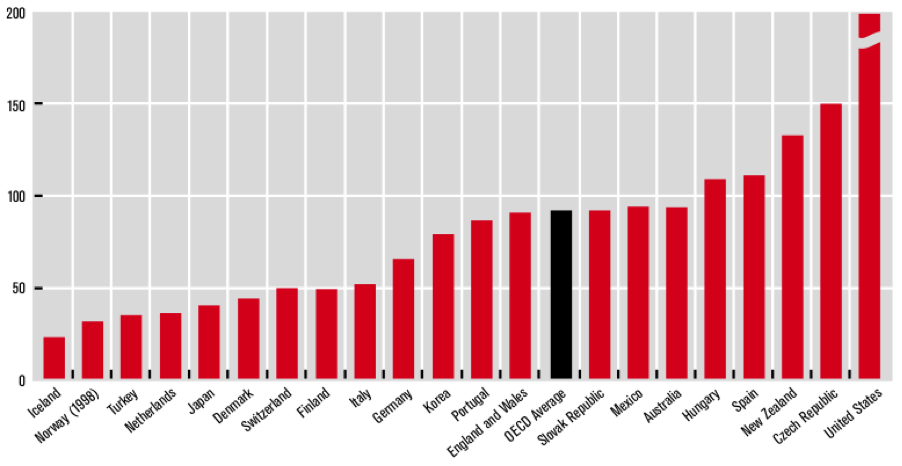
Convicted adults admitted to prisons

Number per 100,000 population

Since the 1970s, OECD countries have experienced steady increases in prison population, with the exception of Finland where the rate has continued to decline. Over the last 10 years, Portugal has recorded one of the largest increases together with Spain among European countries. However, levels in both countries remain far below the United States, where the prison population has witnessed a huge jump that bears no historical comparison, with a population in 2000 four times as high as in the early 1970s. Differences across countries have, surprisingly, only little to do with the prevalence and development of crimes but more likely to do with political factors and responses to the increasing belief in certain countries that prison is preferable to other alternatives. When comparing prison populations in 2000, the United States again stands far above the norm with an incarceration rate five times as high as the OECD average and three times larger than the Czech Republic, ranking second. More than 1.2 million convicted American adults are in jail (a little less than 2 million when pre-trial and non-guilty offenders are included), and this may have a significant distorting role on the labor market for young males. Rising prison populations, unless fully resourced, generally reduce the effectiveness of criminal re-education. Upward trends can pull down the staff-prisoner ratio, a key component for achieving effective prevention of re-offending and promoting reintegration in the community. Moreover, prison overcrowding tends to exacerbate already high levels of tensions and violence, raising the risks of self-injury, suicide and sexually transmitted diseases including HIV/AIDS. Overcrowded prisons are also more likely to act as “universities of crime.”

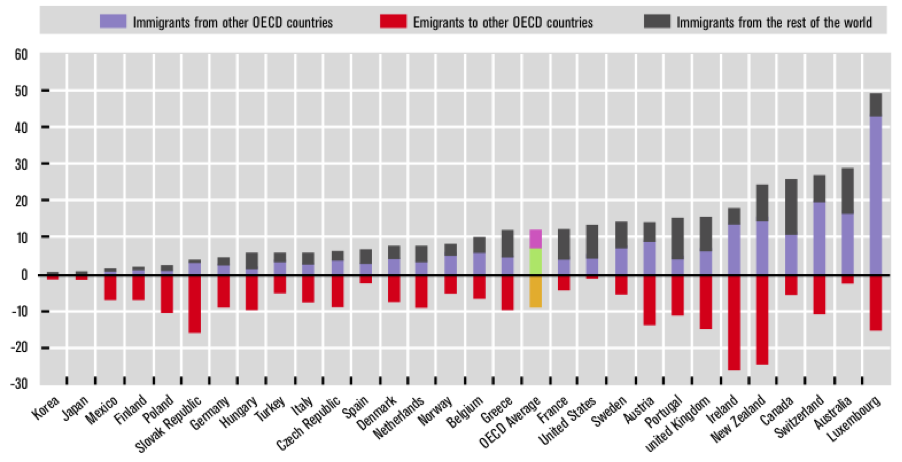
Migration of the highly educated

Foreign-born persons with tertiary education

As a percentage of all residents with tertiary education

In the total OECD area, about 4% of persons with tertiary education are immigrants from other OECD countries. Those from non-OECD countries account for about 6% of all current residents with tertiary attainment. Net stocks of foreign-born persons with tertiary attainment are highest in the traditional “settlement” countries of Australia, Canada and the United States, but also in Luxembourg and Switzerland. Other countries with a large excess of foreign-born persons with tertiary attainment relative to their nationals living in other OECD countries include Sweden and France (8-9%). On the other hand, countries having a large percentage of tertiary-educated former residents living in other OECD countries include Ireland and New Zealand (at close to 25%); Austria, Switzerland, the United Kingdom, Luxembourg, Poland, Portugal and the Slovak Republic (all at more than 10%); and the Czech Republic, Germany and the Netherlands (at close to 9%).

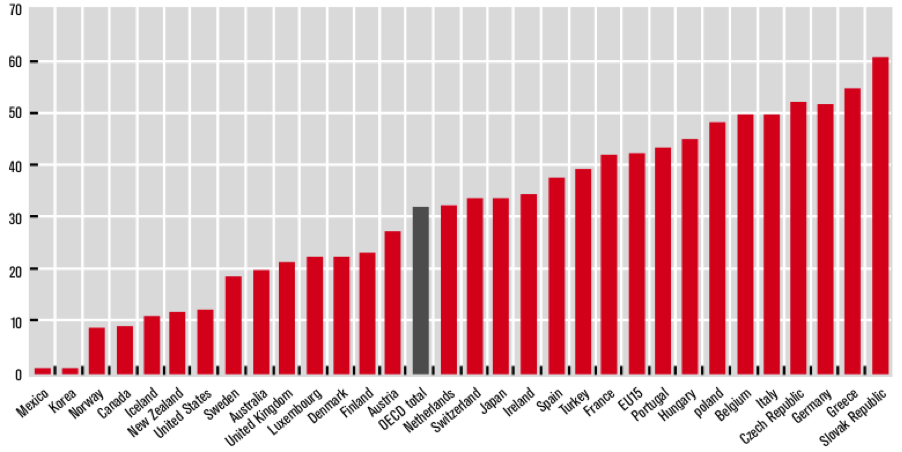
Long-term unemployment

Persons unemployed for 12 months or more as a percentage of total unemployed, 2004*

In 2004, rates of long-term unemployment varied from 10% or less in Canada, Korea, Mexico and Norway to 50% or more in the Czech Republic, Germany, Greece and the Slovak Republic. Lower rates of long-term unemployment are generally found in countries that have enjoyed relatively high rates of economic growth in recent years. There appears to be a two-way causal relationship here. On the one hand, jobs are easier to find in a fast growing economy and, on the other, economies may grow faster by making unemployment an unattractive proposition. Over the period shown in the table, long-term unemployment rates have been relatively stable for the OECD as a whole, but there have been some sharp rises in several countries and equally sharp falls in others. Rates of long-term unemployment have more than doubled in the Czech Republic, Hungary, Finland and the United States (albeit from low levels) and have also risen sharply in Iceland (although from very low levels), Japan and Switzerland. On the other hand, there have been large falls in the long-term unemployment rates in Belgium, Ireland, Italy, Luxembourg, Netherlands and Spain. It is noticeable that, since 1990, the share of long-term unemployed has halved in Korea, Norway, Luxembourg, Ireland and New Zealand.

*Latest available figures

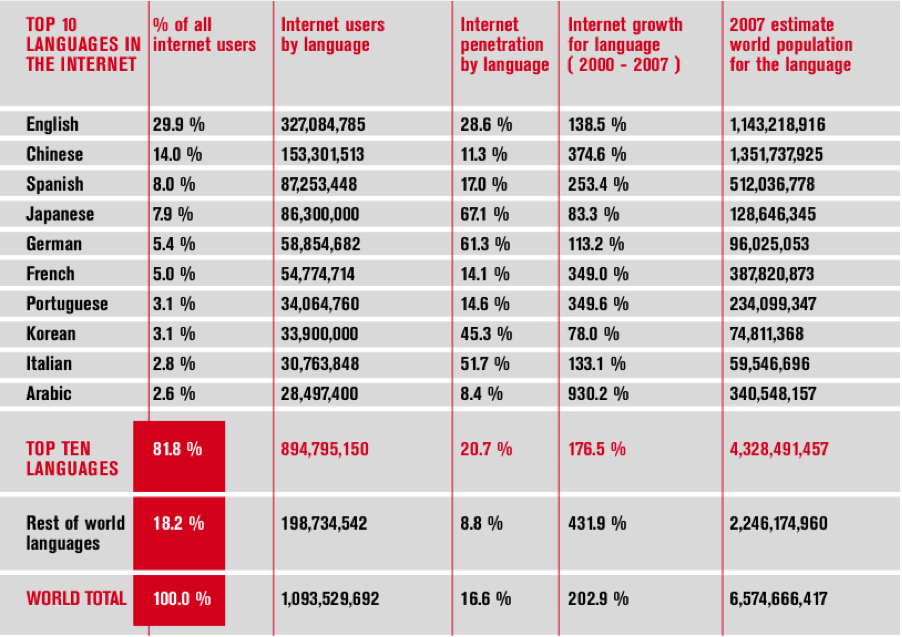
Languages on the Web

Top 10 languages used in the Web

( Number of internet users by language )

There are 87,253,448 Spanish speaking people using the internet, representing 8.0% of all the Internet users in the world. Out of the estimated 512,036,778 world population that speaks Spanish, only 17.0 % use the internet. The number of Spanish speaking internet users has grown 253.4 % in the last six years (2000-2007). Arabic speakers saw the largest growth—930.2%—although they still has the fewest speakers online (2.6%) and least penetration among speakers (8.4%).

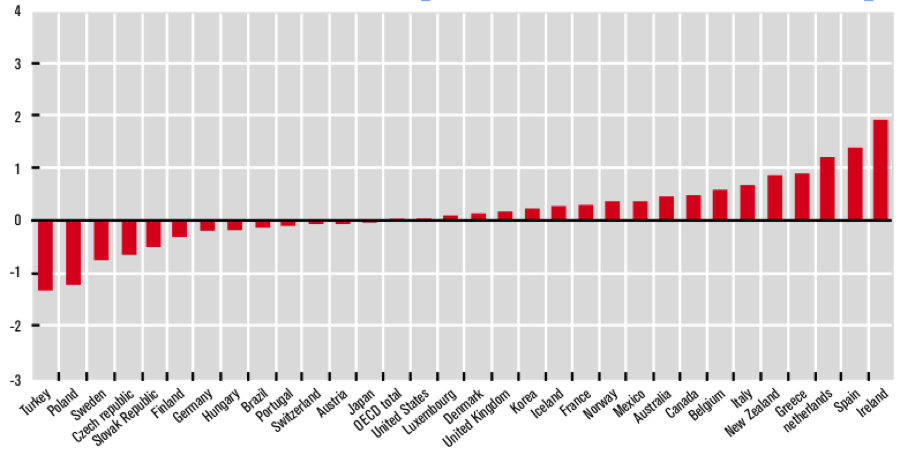
Employment rates by gender

Employment rates: total

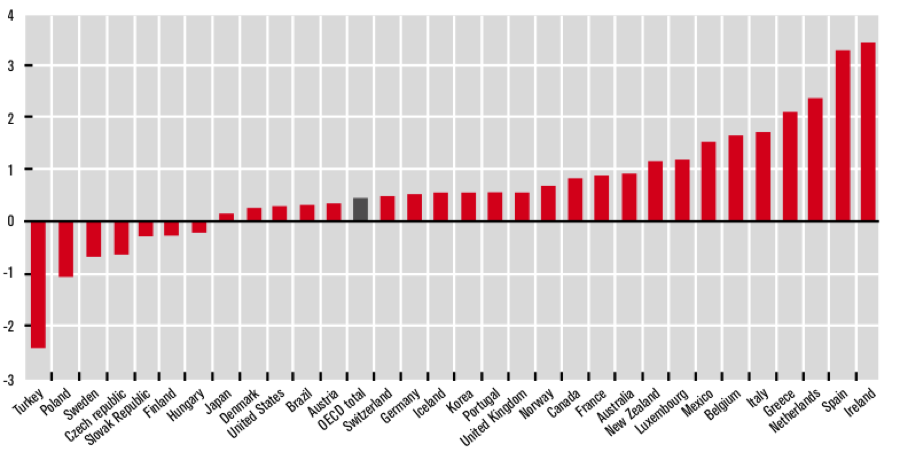
Average annual growth in percentage, 1991-2004 or latest available year

Employment rates: men

Average annual growth in percentage, 1991-2004 or latest available year

Employment rates: women

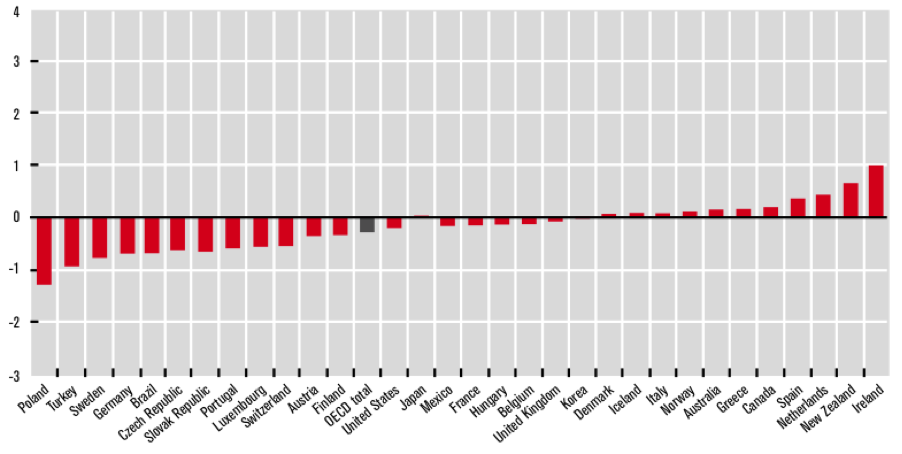
Average annual growth in percentage, 1991-2004 or latest available year

All OECD countries use the ILO Guidelines for measuring employment, but the operational definitions used in national labor force surveys vary slightly in Iceland, Mexico and Turkey. Employment levels are also likely to be affected by changes in the survey design and/or the survey conduct, but employment rates are likely to be fairly consistent over time. For the denominators—the population in each age group—the data are taken from labor force surveys. Over the period shown in the tables, total employment rates (men and women) have fallen in 13 countries and risen in 17. Particularly large falls were recorded in Turkey, Poland, Sweden, Czech Republic and Slovak Republic and particularly large increases occurred in Ireland, Spain and the Netherlands. Growth in employment rates was very different for men and women. Employment rates for men decreased in 19 countries during the period with an annual fall of more than 0.5% in Poland, Turkey, Sweden and Germany. For women, on the other hand, employment rates grew in 23 countries with increases of 1% per year or more recorded for Ireland, Spain, Netherlands, Greece, Italy, Belgium, Mexico, Luxembourg and New Zealand. Clearly, these differences in the growth of employment rates are leading to convergence in the rates for women and men although differences remain large in many countries.

March 22, 2007 0 comments
0 FacebookTwitterPinterestEmail
Financial Indicators

Regional equity markets

by Executive Staff March 22, 2007
written by Executive Staff

Beirut SE: Blom  (1 month)

Current Year High: 1,713.79  Current Year Low: 1,168.85

The BSE short seems inauspicious to inspire trading volumes these days, but the Beirut Stock Exchange undercut the Bahraini bourse in matters of confidence last month. After no more then a hiccup of an improvement to 1,208.57 points on January 26, the day after Lebanon was promised $7.6 billion in international funding, the Blom Stock Index went lower and lower to close at 1,171.47 on February 23. Solidere slumbered in the troughs while BLOM Bank did a bit better than its sector peers. Traders said they did not want to be quoted with comments on the whole market performance, because “nothing is happening, it is the same shit every day.”

Amman SE  (1 month)

Current Year High: 7,584.32  Current Year Low: 5,267.27

The Amman Stock Exchange continued a surprisingly strong show of growth to close at 6,467.63 points on February 25, representing a 17.2% improvement in the index for the year-to-date in the best two-month performance for any regional market at the start of 2007. On the month, the ASE index climbed by around 480 points since January 28. Top market power Arab Bank was strong in volume and share price development to JOD 27.50; it is now up by JOD 6.20 since the start of 2007. Select real estate stocks saw good volume, including Taameer Jordan and Arab East for Real Estate Investment. The share price of the latter advanced by 25% in the course of one month. Upstart Jordanian television station ATV said it wants to become the first station in the region to go on the bourse. 

Abu Dhabi SM  (1 month)

Current Year High: 4,648.80  Current Year Low: 2,925.03

The Abu Dhabi Securities Market had a U-shaped trajectory in February, with a hanging chad at the end. Starting at 3040.50 points on January 28, the ADSM index fell by over 90 points by February 1. It remained below the 3,000 line until it jumped to 3,035.12 points on the 20th of the month but retreated again to a close of 3,004.03 on February 25. Energy sector company Dana Gas saw strong trading volume and one of the interesting movers was oil sector company Aabar Petroleum, with a 44% rise to AED 2.21 in the latter part of the month. Some market traders thought that the rise was initiated by a case of mistaken identity, because a Kuwaiti company with similar call sign had been awarded a government contract in Kuwait. However, Aabar also had news of its own, with a new contract and production increases in Thailand.

Dubai FM  (1 month)

Current Year High: 6,731.63  Current Year Low: 3,997.29

The Dubai Financial Market moved with no clear direction in the range between 4,314 and 4,120 points. The start of the month saw the index drop by nearly 200 points but after some up and down, the market closed at 4.207.51 points on February 25. Earnings seasons added some spice to a not overly exciting month. After announcing 35% year-on-year higher net profits for 2006, market heavyweight Emaar Properties saw a spike in volume but the stock never moved far from AED 13 throughout the month. Investment bank Shuaa Capital share prices pointed downward in February, but the stock did not appear to suffer heavily from allegations by magazine Trends Arabies that the company had manipulated a Kuwaiti stock deal in 2005. Shuaa denied the allegations.

Kuwait SE  (1 month)

Current Year High: 11,542.90            Current Year Low: 9,164.30

The Kuwait Stock Exchange was one of three GCC bourses that traded lower in the fourth week of February than at the start of the year, with Bahrain and Qatar being the other two. The KSE rebounded from a month-low of 9,584.5 points on February 10 but closed not higher than 9,726.40 points on February 21. One of the market’s gainers was telecoms firm MTC, which released strong results on February 19. With most gains before the results announcement, MTC’s stock appreciated by 17% between the start of the month and February 21. Holding firm Kipco made news by saying late in the month that it is leading a consortium tasked with selling 51% of telecoms firm Wataniya. Share prices of Kipco and Wataniya are expected to benefit from the move.  

Saudi Arabia SE  (1 month)

Current Year High: 19,502.65            Current Year Low: 6,916.85

The Saudi Stock Exchange gently traversed the entire 7,000 points realm in February and reported in at 8,385.45 points on February 25. Dipping only slightly on profit taking early in the month, the Tadawul index over the period improved by 21% from 6,916.85 points on January 29. The big thing in the market for this month, and probably a few more times in the coming months, is insurance. Initial public offerings of insurers Medgulf and Malath were oversubscribed by healthy margins. Being the first two insurance IPOs in a lineup of recently licensed providers, the flotations will be followed by others and add a new dimension to the SSE.

Muscat SM  (1 month)

Current Year High: 5,956.46  Current Year Low: 4,657.16

The Muscat Securities Market closed at 5,780.39 points on February 25, up some 11 points when compared with January 28. Sailing southward in the first half of the month, the index turned back north after February 11. Flag carrier Oman Air was suspended from trading for most of February pending a capital restructuring. The sultanate’s government plans to infuse new capital into the firm, which would increase the government’s stake from 33 to 84%. Brokers on the MSM said that the shareholding of GCC investors in Omani listed companies at the end of January 2007 was substantially higher than a year earlier. GCC investors owned a total of 14% of MSM-listed stocks, up from 10% in January 2006. Shareholding by non-GCC investors remained basically unchanged at 6.5%.

Bahrain SE  (1 month)

Current Year High: 2,265.58  Current Year Low: 1,996.68

The Bahrain Stock Exchange closed February 25 at 2,160.65 points, down some 21 points compared with its close on January 28. Gulf Finance House, Nass Corporation, and Ahli United Bank were among the most active stocks in the muted market. Gulf Finance House announced a mixed cash and shares dividend of 75% after its 2006 results came with a 51% higher net profit of $212 million. The stock’s price dropped by $0.20 in the days after the announcement and closed at $2.03 on February 25. The BSE board issued a warning to one and a reprimand to another listed company for violating guidelines against insider trading and not following disclosure standards.

Doha SM: Qatar  (1 month)

Current Year High: 9,878.10  Current Year Low: 5,825.80

The Doha Securities Market had the roughest ride of all GCC markets last month, closing at 6,237.51 points on February 25, down from 6,781.08 points on January 28 and more than 12.5% down since the start of 2007. Industries Qatar climbed in the second half of the month and saw high trading volume on announcing a 50% cash dividend. Shipping company Nakilat with its capital call was also among the most active stocks; the company also announced new construction orders for six LNG vessels. In the second half of the month, government and central bank officials tried talking confidence into the market by highlighting the strong growth of the Qatari economy in 2006 and the good performance of the banking sector.

Tunis SE  (1 month)

Current Year High: 2,712.33  Current Year Low: 1,732.72

Like its colleague in Casablanca, the Tunindex conquered a new historic pinnacle in February, reaching 2,712.33 points on February 9. It slipped back by a bit over 100 points in the following week but then returned to growth, closing at 2,646.75 on February 23. The bourse is 13.54% up since the start of 2007; its market capitalization is closing in on the $5 billion mark but on our record date of February 23 it is not quite there yet, reporting $4.907 billion. The new market cap leader is drinks maker SFBT after a steep rise in its share price between the start of 2007 and mid February. Its market cap was $575 million on February 23, compared with $569.5 million for Banque de Tunisie whose stock in February retreated from historic highs in the TND 104 range and closed at TND 99.20 on February 23. 

Casablanca SE All Shares  (1 month)

Current Year High: 11,207.82            Current Year Low: 6,563.27

The Casablanca All Shares Index went up by 1,000 points in the first part of February, to scale a new record of 11,201.82 points on February 19. From that peak, however, it retreated back to 10,518.13 points at its close on February 23. It is too early to say if the market is turning. It is still up by more than 10% since the start of the year, but one reminisces about the experience of the Saudi market exactly 12 months ago. On February 23, the Casablanca Exchange saw 23 stocks go up and 29 stocks go down, with 4 unchanged.

Cairo SE: Hermes  (1 month)

Current Year High: 64,978.48            Current Year Low: 41,965.37

In the measurement of the Hermes Index, the Cairo and Alexandria Exchanges moved up nicely from 57,013.49 points on January 29 to 64,655.63 on February 25. Viewed together with the uptrend of the Saudi Stock Exchange, the 13% rise of CASE made February a gainful month for the region’s leading bourses by market size and by number of listed companies. Orascom Telecom Holding (OTH) and its chairman Naguib Sawiris were the Egyptian market’s international newsmakers last month, as OTH bid for Saudi Arabia’s third mobile license and as Sawiris-owned Weather Investments bought Greek operator TIM Hellas. The OTH share price chased new records in February and closed 19% higher at EGP 440 on February 25 when compared with its quotation on January 28.

March 22, 2007 0 comments
0 FacebookTwitterPinterestEmail
Banking & Finance

Money Matters by BLOMINVEST Bank

by Executive Staff March 22, 2007
written by Executive Staff

Regional stock market indices

Regional currency rates

Doha Bank opens representative office in japan

Doha Bank, established in Qatar in 1979, opened a representative office in Tokyo, Japan as part of the bank’s implementation of its globalization plan. Doha Bank, with 32 branches in Qatar as well as branches and representative offices in Dubai, New York, Japan, Turkey and Singapore posted net profits of QAR744m ($204m) in 2006 up down 5.81% year-on-year. The bank’s total assets rose 42.45% for the same period to reach QAR22 billion ($6 billion) in 2006.

UAE’s Etisalat 2006 net profits reached $1.6 billion

Etisalat, the sixth largest telecommunication corporation in the Middle East, declared a rise of 37.7% in 2006 net profits to reach AED5.9 billion ($1.6 billion) and a 91% rise in its 2006 total assets to reach AED45.9 billion ($12.5 billion). This rise in assets is mainly attributed to the company’s international expansion, through the acquisition of a 51% stake in Pakistan Telecommunication Company Ltd, in addition to negotiations with the Afghan government for the country’s third mobile license and the purchase of Egypt’s third mobile network license. The UAE government currently owns 60% of Etisalat while the public owns the remaining 40%.

Country profile: Saudi Arabia

Global Investment House (GIH) issued a report estimating Saudi Arabia’s nominal GDP growth at 12.4% in 2006 to SR1.30 trillion ($346.9 billion). In turn, real GDP grew 4.2% to SR799.9 billion ($213.3 billion) The Compounded Annual Growth Rate (CAGR) of Saudi Arabia’s nominal GDP growth for the period 2002-2006 was at 16.5%. According to GIH’s report, the Saudi Arabian private sector grew by 7.9% in nominal terms in 2006, while the oil sector registered a nominal growth of 16% for the same period. According to the Ministry of Finance 2007 budget report, the Kingdom’s public debt is estimated to drop by 23% to SR366 ($97.6m) in 2006, some 28% of GDP. The expansion in Saudi Arabia’s economy was not affected by the correction in the stock market as all indicators show an “exceptionally sound and robust” 2006 performance.  Standard & Poor’s Rating Services recently upgraded Saudi Arabia’s long term foreign currency credit rating to “A+” from “A” and affirmed the county’s long term local currency rating at A+ and short term sovereign credit rating at A-1, all with a stable outlook. Saudi Arabia is the largest oil producer among the Gulf Cooperation Council countries, producing around 10% of the world’s oil.

March 22, 2007 0 comments
0 FacebookTwitterPinterestEmail
Regional BankingSpecial Report

UAE banking executives On forecast for 2007

by Executive Staff March 22, 2007
written by Executive Staff

Executive talked to Hani Hamid, Marketing Manager at the National Bank of Umm Al Qaiwain, and Yousef Padganeh, Head of the Basel II Project at Bank Saderat Iran in Dubai, about the outlook for the UAE banking sector this year.

E  Is the UAE banking market as competitive as it could be? Specifically, do you expect greater competition this year on prices for core banking products? 

NBUQ: Definitely. Prices on interest will vary from bank to bank, so the sector will become more competitive. The sector will become more competitive this year—there are now 52 banks in the UAE.

Bank Saderat: Yes, there is growing competition. The UAE market is highly competitive and will become more competitive because the people are trying to find new markets.

E  Is the regulatory environment and enforcement of regulations fair and equitable for all banks in the UAE?  

 NBUQ: Yes, I think it is—but the UAE needs a credit bureau, which has been talked about for a long time.

 Bank Saderat: Yes, it is fair.

E  Will the UAE be able to defend its role as leading banking hub in the Gulf against the competition from Bahrain Financial Harbor and Qatar Financial Center? Does the function as banking hub benefit local banks or are there disadvantages?   

NBUQ: I think the UAE is one of the strongest banking hubs, so then it will be able to compete. It is competing with the Middle East, not just the Gulf. Local banks compete differently from international banks—a different environment and customers—so they have the edge on international banks for local and Arabic-speaking customers.

Bank Saderat: Yes, if you compare it to a few years ago you will see more and more companies and organizations are coming to the UAE, to the DISE. If we look at the whole Gulf region, the market share will decrease as more banking come to Dubai. Local banks will benefit as we [international banks] are limited—we cannot have more than eight branches, but foreign banks will try to have more branches. Local branches will open more and be more active, so they will benefit.

E  Should regulators modify their approach to the licensing of local and/or foreign banks in the UAE?

NBUQ: It could be possible, as I think there are too many banks in the UAE, even foreign banks. UAE has an open market so anybody can come.

Bank Saderat: I am not aware of this. Regulators are supporting local banks more than international banks.

E  Is the sector ripe for mergers? Should regulatory authorities do more to encourage consolidation? 

NBUQ: I think it is the right time for some merging. With all the money banks made last year, and in 2005 due to the stock market, there was talk before then for mergers, but if the market stays the way it is, or there is a drop in the market, mergers could happen.

Bank Saderat: One thing I am seeing is that Emirates groups will merge. For example, we are seeing new banks, but state banks will not like mergers.

E  Are UAE banks valued adequately in the Abu Dhabi and Dubai stock markets? Are 2006 earnings growth and performance reflected in recent share price developments?

 NBUQ: In terms of profit it has affected them, but in terms of value at the right level. Looking at the market it is good and healthy. I think the stock exchange will grow this year.

Bank Saderat: The price of the banking stock depends on construction. I think it depends on that area rather than banking. For instance, if Emaar goes up, the National Bank of Dubai will go up.

E  UAE banks have been looking east and west for cross-border expansion opportunities. Which markets are the most attractive for expansion in 2007?  

 NBUQ: I would say Iraq, but that’s not a good market right now. Africa is showing it is a competing market; Sudan and Libya have shown they are good markets. Egypt is also a good market, and there are some international banks are there. Qatar definitely a good market and competitive—a lot of banks are trying to open there, and in Bahrain. Syria is good, but tere are too many rules and regulations.

Bank Saderat: UAE banks are opening branches in Pakistan and India, and want immediate customers living in Dubai. Some 55% of workers in the UAE are from Pakistan, India and Bangladesh, so there is demand, particularly for retail banking. The other factor is based on trading, where they have the most trade. Some of these investors are looking for property investment so that is why they are opening in Morocco and North Africa. Banks are also trying to get into Iran and Iraq.

E  What obstacles do banks find most challenging when pursuing cross-border expansion, and are some of these obstacles higher for UAE banks than for international competitors in the same markets (e.g. regulatory requirements in other markets, competition with European banks in countries like Egypt, acquisition of skilled staff, integration of corporate cultures in takeovers)?  

NBUQ: In Egypt, rules are the obstacle, along with money transfers and exchanges. Sudan and Libya are much more open, but politically Sudan is not stable. Libya is an open market.

Bank Saderat: The first problem is regulatory. We should know what the rules are—and then new competition in the market. I also think they should have a good idea of customer needs and wants as they will differ from the UAE. For instance, just now regulations for foreign banks requires UAE-employees, so recruiting can be a problem.

E  Do staff shortages create problems for domestic growth of the bank?  

NBUQ: It definitely affects a bank’s growth. All banks have been affected by stock markets, and I don’t think there is a problem, but staff exchanges between banks are a problem, which affects banks moving ahead.

Bank Saderat: Getting staff in the UAE is a problem as there aren’t enough people. We may find a few post-grads, but they have no experience. In the long term it should be better.

E  Is the growth of Islamic banking the future of UAE banking?

NBUQ:  I think it is the future of everywhere, even the UK and now the US. It is a trend they follow, like changing clothes. They have used credit cards, car loans, and now trying Islamic banking. We have already started that here.

Bank Saderat: Islamic bank is rising. HSBC started and others too, so there is a market.

E  Do you expect shifts in the structure and importance of corporate banking? Where are the best options to expand and/or diversify financing portfolios for manufacturing ventures and corporate borrowers?   

NBUQ: Banks are doing corporate banking but retail banking is a lot more profitable, but I think they should change their policies, as the commercial banking is moving fast and changing, and it is a good banking product.

Bank Saderat: Diversified portfolios will minimize risk, so there will be a shift. We have corporate banking and the target market is changing. Nowadays competition is high so we need to find new markets.

E  What are the main challenges in retail operations? Given the rapid changes in costs of living and the scenarios in the housing market, what can banks do to keep their consumer loan portfolios profitable and lending growth sustainable? 

NBUQ: In retailing, the most popular products are mortgages, and banks are looking into priority banking due to customers having more wealth. We have 40-50,000 millionaires in the UAE, out of a population of 4 million, so priority banking will make some growth for banks and they are looking at this. Mortgaging is also booming.

Bank Saderat: The main challenge here is that the cost of living is rising. If banks can provide home loans they will benefit, and then what will happen is that people will try and invest in houses. Second, credit card users are rising, so savings will decrease. Loans will increase and repayment times. High rates of loans will also increase. Banks are now offering Dh120,000 loans.

E  Could the consumer lending and housing loan segments face problems from rising loan default levels in 2007? What mechanisms will banks use to avert the overheating of the retail lending market?

NBUQ: There have not been many defaults in the market—I have not heard of that many, more in cars than houses. It is a new loan through banks, so not many defaults, and people just sell out the deed. Definitely prices have hiked, and I think the surplus will drop. In three years, you might see more defaults.

Bank Saderat: Default will increase, particularly for homes. We should look at the political situation of the region, and consider that there has been an abnormal increase in property prices. There are also delays in construction times, and people still have to pay off loans. Salaries are also not increasing in relation to rising costs, with housing rising 100%. The onus should be on the government, as banks want profit. If the government increases salaries, that may help.

March 22, 2007 0 comments
0 FacebookTwitterPinterestEmail
Regional BankingSpecial Report

Banking sector in UAE expanded in 2006

by Executive Staff March 22, 2007
written by Executive Staff

Fast growth, cultural specialization, and segmentation are all to be found in the banking sector of the United Arab Emirates, whose results in 2006 reverberated with the dual themes of core banking growth and volatile stock markets.

Although the banking sector is large in proportion to the resident population, its 46 banks (plus 2 specialized banks and some 50 foreign rep offices) are fragmented by both territorial and topical categories. The territorial divisions are result of the fact that the seven emirates have local banks, often with ties to the respective governments or ruling families.

In topical differentiation, the sector’s strongest group by market share are listed commercial banks, followed by foreign banks, and then by Islamic and unlisted banks. Local commercial banks account for the lion’s share of retail branches, while foreign banks are restricted to eight branches each. In sheer operator numbers, however, the 25 registered foreign banks in the realm outnumber the 21 UAE-headquartered banks. By 2005 numbers, the asset distribution between Emirati and foreign banks was about four to one of total sector assets ($174 billion).  

As the listed banks have reported their 2006 preliminary results, the National Bank of Abu Dhabi (NBAD) took the crown of exceeding AED 100 billion ($27.2 billion) in assets with 19% growth reported for last year. Customer deposits increased at equal rate to reach AED 71 billion. NBAD, the largest bank in the UAE, reported its net profits as 18.4% lower, at AED 2.1 billion, compared with 2005 profits.

Profits contraction

The bank attributed the profits contraction to lower investment income and shrunken fee income from brokerage and asset management activities—earnings contraction themes that also drove profit developments at Mashreqbank, Union National Bank (UNB) and Commercial Bank International (CBI) into negative numbers for the year.

In 2005, the management of initial public offerings and the provision of equity market services along with gains from own GCC stock and investment portfolios were the big income boosters for UAE banks—which made it predictable latest by middle of last year that the correction year of 2006 would not offer the same profits harvest.

CBI reported the most extreme shrinkage, with a drop in net income from AED 239.7 million in 2005 to a paltry AED 8.7 million in 2006, because of revaluation of its investments portfolio. CBI, which is one of the smaller local players, on the other hand reported 41% growth in assets to AED 7.38 billion in 2006.     

Different to NBAD, other top banks kept the contraction dogs at bay at least to the point of maintaining profit increases. Top Dubai player Emirates Bank International (EBI) succeeded in 9% net profits growth to AED 1.9 billion on total revenues of AED 2.9 billion, the latter being a 29% improvement from 2005. However, also for EBI the growth in total assets and deposits outstripped profits growth. The bank reported assets of AED 95.6 billion and deposits of AED 40.9 billion—up by 69 and 39%, respectively. 

The runners up in Abu Dhabi and Dubai presented divergent result figures. Abu Dhabi Commercial Bank (ADCB) entered 2007 with assets of AED 81.1 billion, a gain of 41% when compared with 2005. ADCB upped its profits by 12% to AED 2.1 billion. Mashreqbank, headquartered in Dubai, reported its assets at year-end 2006 as AED 56.7 billion and customer deposits as AED 33.9 billion, 13% higher than in the previous year. The bank said its contraction in net profits, which were down 10% on the year at AED 1.6 billion, stemmed from the lower investment income of its subsidiary Oman Insurance.

Next in the sector are National Bank of Dubai (NBD) and the Abu Dhabi-based First Gulf Bank (FGB) and Union National Bank (UNB). NBD edged up 1% in net profits to AED 1.11 billion, improving its net interest income, however, by 17% to AED 1.2 billion. The bank’s assets grew 35%, to AED 51.4 billion and with AED 45.4 billion at the end of 2006, its customer deposits were 22% higher than a year earlier.

Achieving 45% improved net profits of AED 1.5 billion, First Gulf Bank stood out with reporting the highest growth in net profits among the larger conventional UAE banks for 2006. The bank, which has ambitious plans to expand its retail network beyond the 15 branches currently shown on its website, increased its assets last year by 82% to AED 47.7 billion and doubled its deposits to AED 34.4 billion. Net interest income and other income improved at rates of 37 and 56%, respectively, and other income represented 41% of total income.

Union National Bank improved its net interest income by 29% to AED 889 million but could only partially offset a 35.3% drop it incurred in investment income, resulting in a 12% contraction of UNB’s net profits to AED 1 billion. The bank, the only one in the UAE in which both the emirate of Abu Dhabi (40%) and the emirate of Dubai (10%) are direct shareholders, achieved 19% asset growth to AED 41.6 billion and a 17% increase in customer deposits to AED 30 billion.

FGB and UNB are favorites of regional stock market analysts. Investment houses Shuaa Capital, Global Investment House, and Prime Securities recently recommended UNB as buy or strong buy while Shuaa, Global, and EFG Hermes gave their nods to FGB.

Other stock picks of regional investment advisors in the UAE banking sector are fairly diverse, based on price to earnings ratios. Global Investment House, which issued an extensive report on UAE banks in January, liked—besides UNB and FGB—NBAD and NBD. Global also recommended buys on two Islamic banks, Abu Dhabi Islamic Bank and Sharjah Islamic Bank.

Shuaa Capital reviewed only Abu Dhabi based banks in August of 2006 and recommended NBAD, ADCB, and UNB. From EFG Hermes, recommendations came in December for NBD and Commercial Bank of Dubai (CBD). CBD is one of the sector’s smaller banks, with net profit of AED 601 million (up 9%) in 2006 on assets that grew 22% to AED 18.7 billion. 

Islamic banking growing the most

While conventional banks are far ahead overall, the UAE banking sector segment with the highest growth figures in 2006 was Islamic banking. Although the first fascination with Islamic banking seems to have diminished a bit last year in some Gulf countries, the UAE Islamic banks have made strides on their way of catching up with the GCC’s center for the specialty, Bahrain. Abu Dhabi Islamic Bank (ADIB) and Dubai Islamic Bank (DIB) both increased their stature greatly, amassing net profit growth of 66% and 47%.

Between the two, DIB showed the higher absolute figures with assets of AED 64.5 billion (up 50%), customer deposits of AED 47.7 billion (up 43.5%), and net profits of AED 1.56 billion.

The bank, which is the oldest shariah-compliant bank in the GCC, is still on a pronounced expansion course and in 2007 wants to add another dozen branches to its network, which it has multiplied in the past five years to 40 branches. ADIB, on its part, had the stronger relative asset growth as well as the stronger profits growth last year, reaching AED 36 billion in assets (up 63%) and net profits of AED 571 million. ADIB’s customer deposit base rose 33% to AED 24 billion.

Another bank to look out for in the Islamic field is Dubai Bank, a daughter of big real estate player Emaar Properties and government-owned Dubai Investment Group. Having received approval for tripling its capital to AED 1.5 billion, Dubai Bank aims to grow aggressively at home and abroad.

Such jumps in capitalization and deposits are hard to envision without the factor that has driven everything up in the GCC over the past two year—hydrocarbon revenues. Banks have been a natural beneficiary of the overspill in oil money and its accompanying economic effects, such as epidemic consumer demand growth, the construction boom, and stock markets craze.

While the story of UAE banking is numbers-driven, a side issue of some interest could be the evolution of corporate identities and marketing profiles. The sector, embedded in a GCC frame of corporate name selection where similarities create no apparent concerns, is (at least in English) a bland alphabet soup of location-laden and easy-to-confuse abbreviations.   

Regional expansion is another theme with some enticing questions. Based on their growing strength and the UAE’s far-flung trade ties, Emirati banks have been charting cross-border growth potentials in the MENA region but also in Sudan, Pakistan, India and even China.

It will be worth watching how UAE banks will sharpen the profiles and names they communicate and how they will navigate the challenges of expanding their corporate cultures into new markets and overcoming human capital restraints that are reflected already in the sector’s great need for skilled bankers and experts in Islamic finance, where almost every sizeable UAE bank is building its presence.

Looking forward, UAE banks are forecasting strong earnings forecasts based on the country’s rosy economic outlook. Analysts see core banking activities offering much space for development, from deposits and retail and mortgage lending to financing of the services sector, industrial projects and public sector spending. Funding gaps are being addressed through medium term note programs and the low risks attached to the UAE economy and its banking sector mean that the sector’s prospects are sound.  

At the top of the sector, where the three largest banks in the UAE control about half of the market segment covered by the top 10 banks, analysts do not expect tremendous changes. Foreign banks face hurdles through taxation and limits on their branch networks. In the market at large, retail network growth targets of domestic and Islamic banks are massive throughout.

But although the UAE is well-reputed as the competitive center of the GCC, competition in the banking sector may yet have to approach another dimension. Banks have intermingled ownership structures where governments, government-owned institutions, and state-dominant families play such a large role that the sector by default gives out an oligopolistic scent. With new trade agreements and changing market conditions, UAE banks will be tasked to transcend existing barriers.

March 22, 2007 0 comments
0 FacebookTwitterPinterestEmail
  • 1
  • …
  • 590
  • 591
  • 592
  • 593
  • 594
  • …
  • 696

Latest Cover

About us

Since its first edition emerged on the newsstands in 1999, Executive Magazine has been dedicated to providing its readers with the most up-to-date local and regional business news. Executive is a monthly business magazine that offers readers in-depth analyses on the Lebanese world of commerce, covering all the major sectors – from banking, finance, and insurance to technology, tourism, hospitality, media, and retail.

  • Donate
  • Our Purpose
  • Contact Us

Sign up for our newsletter

    • Facebook
    • Twitter
    • Instagram
    • Linkedin
    • Youtube
    Executive Magazine
    • ISSUES
      • Current Issue
      • Past issues
    • BUSINESS
    • ECONOMICS & POLICY
    • OPINION
    • SPECIAL REPORTS
    • EXECUTIVE TALKS
    • MOVEMENTS
      • Change the image
      • Cannes lions
      • Transparency & accountability
      • ECONOMIC ROADMAP
      • Say No to Corruption
      • The Lebanon media development initiative
      • LPSN Policy Asks
      • Advocating the preservation of deposits
    • JOIN US
      • Join our movement
      • Attend our events
      • Receive updates
      • Connect with us
    • DONATE