• Donate
  • Our Purpose
  • Contact Us
Executive Magazine
  • ISSUES
    • Current Issue
    • Past issues
  • BUSINESS
  • ECONOMICS & POLICY
  • OPINION
  • SPECIAL REPORTS
  • EXECUTIVE TALKS
  • MOVEMENTS
    • Change the image
    • Cannes lions
    • Transparency & accountability
    • ECONOMIC ROADMAP
    • Say No to Corruption
    • The Lebanon media development initiative
    • LPSN Policy Asks
    • Advocating the preservation of deposits
  • JOIN US
    • Join our movement
    • Attend our events
    • Receive updates
    • Connect with us
  • DONATE
Comment

Gulf airlines: Ego-trips or essential?

by Alex Warren April 1, 2007
written by Alex Warren

Is an industry, aviation has always attracted the wealthy.Tycoons rarely resist the chance to have their own airline, as Howard Hughes, Aristotle Onassis or Richard Branson are enough to prove, whilst virtually every country in the world proudly flies a national flag carrier, even if it makes a loss in doing so.

Little surprise, then, to observe the billions of dollars being poured by Gulf states into the expansion of airline sand airports. Thanks largely to this investment, the MiddleEast is now easily the fastest growing region in the world in terms of air traffic, which in 2006 rose by 16% compared to a global average of 5.1%.

But aren’t there just too many fish swimming in too small a pond? Despite the small size of the domestic market in theGulf, there are now at least eight airlines operating fromKuwait, the UAE, Bahrain, Qatar and Oman alone, with more set to arrive.

Older players like Emirates continue to expand, marketing themselves ever more aggressively in new markets like the US or the far East. Meanwhile, the original stakeholders ofGulf Air—the governments of Abu Dhabi, Bahrain, Qatar andOman—have gradually pulled out of the partnership to create new airlines.

Abu Dhabi launched its own carrier, Etihad, in 2005, whilstDoha has spent extravagantly on expanding Qatar Airways in the past few years. Low-cost carriers have also entered the market, and with great success. After its launch in 2003,Sharjah-based Air Arabia chalked up a $27.5 million profit in 2006 and offered a $700 million IPO last month. Jazeera Airways, a privately-owned Kuwaiti airline which began flying no-frills flights in 2005, already goes to 20destinations and says it also wants to list stocks.

Even more new airlines are on the way, including a fourthUAE carrier, the delayed RAK Airways, which will operate from the northern emirate of Ras al-Khaimah. Across the border, meanwhile, Saudi Arabia has said it will issue licenses for two low-cost domestic carriers in theKingdom.

On the surface of it, the preponderance of upstarts in such a tiny geographical area would seem to be nothing but an ego-trip, a publicity stunt designed to get names on the map and planes around the world. Yet whilst an element of that might be hard to deny, this lavish expense on aviation forms part of a longer-term, and fairly sensible, economic strategy for many of these countries.

Thus far, the growth of all these airlines can be attributed to a number of contributory factors. Most important is the wider economic boom in the region: the massive influx of immigrants to the Gulf, whether middle-managers from Europe or legions of construction workers from the subcontinent, has filled hundreds of thousands of plane seats, whilst long-haul tourism is developing quickly in places like Dubai and Oman.

Second, most airlines rely heavily on the so-called hub and spoke model for their business, bringing passengers in from a large number of cities around the world, connecting the mat the airport and then flying them out to their final destination. In some cases, like Qatar and Abu Dhabi, these kind of transit passengers make up more than 70% of total traffic.

With that in mind, it helps greatly that the Gulf lies between large centers of population with underdeveloped international airlines, namely Iran, the Indian subcontinent and Africa, as well as being a natural halfway point betweenEurope and the Far East.

The airlines can also benefit from airport investments whose size and cost seem to make no commercial sense. Over $40billion is earmarked for airports in the Gulf over the next10 years, with Dubai building what will be the largest airport in the world and Abu Dhabi, Qatar, Oman and Kuwait all spending combined billions on new infrastructure to support aviation growth.

Lastly, many suspect that these airlines are given an unfair leg-up from their government patrons. Some European carrier shave queried whether the Gulf airlines receive hidden subsidies, have access to cheap rates of borrowing or benefit from a privileged position at their hub airports—which are also owned by the state.

Whatever the case, though, this is missing the point. Even if they’re doing well now, these airlines don’t really need to make money in the short-term. Qatar Airways, for instance, doesn’t even expect to turn over a profit until2012. Instead, they should be seen as elements of a wider investment plan—which includes tourism, ports, media and finance—to sustain Gulf economies once the oil and gas dry up.

Many argue that everything epitomized by the Gulf boom is built on hydrocarbons and hyperbole. That may be true. But for now, there is more than enough money being spent to ensure that by the time economic growth slows down, the new arrivals become fewer and energy resources dwindle, these carriers will have been able to establish a global marketshare that will both sustain their businesses and, more importantly, keep bringing people into and through theGulf.

Perhaps not all of them will manage to be successful in the long-term, but there is at least some justification—apart from national pride—for so many apparently nonsensical airlines in such a small area.

ALEX WARREN is a freelance journalist based in Dubai

April 1, 2007 0 comments
0 FacebookTwitterPinterestEmail
Capitalist Culture

The battle for downtown: Solidere symbolizes much

by Michael Young April 1, 2007
written by Michael Young

Little has excited the Lebanese in recent months, thoughmuch has contributed to their anxiety. However, it was onenews item in February that seemed to hit public moralehardest. From an initial figure of around 250 establishmentsin the downtown area, we learned that around 80 had closeddue to the ongoing sit-in by opposition supporters. A 30%closure rate in three months is ominous by any standard.

A few years ago, I was chatting with the late SamirKassir, when he remarked about an odd habit he had noticedin the Solidere area, particularly its mostly emptynorthernmost quadrant: drivers stopped at red lights, thoughthere was little traffic, and even fewer pedestrians, tomandate such discipline. Why were Lebanese who would havebarreled through red lights in any another part of Beirut solaw-abiding?

Kassir wasn’t sure, but he was toying with the idea thatdrivers were somehow intimidated by Solidere’s modernity.Here was an area of town that imposed esteem, he speculated,that commanded respect.

Was that the case? Maybe it was, maybe it wasn’t, but onething is certain: very few Lebanese fail these days tomention the deep resentment they feel at what has happenedto the downtown area; and the vast majority of them reactnot from a political standpoint, but from the standpoint ofpeople proud of a part of town that had symbolized Lebanon’sbest qualities and its genuine emergence from civil warafter 1990.

This is not the place to discuss the opposition’smotivations in suffocating the downtown area. However, itmakes sense to ask why an action directed against thegovernment has ended up punishing the private sector. Partof the reason—and there are numerous examples of oppositionprotesters arguing precisely this line—is that thegovernment and Solidere have been regarded as synonymous byprotesters. Certainly, the company’s close and ongoingassociation with the state; certainly, too, the hazy barrierbetween what belongs to Solidere and what belongs to theHariri family, have helped reinforce this conviction.However, that doesn’t make it any less fallacious. Inturning Solidere into a hostage to politics, the oppositionhas, intentionally or not, widened its dispute so that it isnow one directed against the Lebanese economy, and moreparticularly against the better outgrowths of free-marketcapitalism.

Downtown once again a battlezone

It doesn’t take much to capture the symbolism of themoment—on either side of the political spectrum. For themajority, a part of town that for a long time embodiedLebanon’s ability to transgress war, has again become afront line in a domestic crisis. Where the late Rafik Haririsought, perhaps excessively, to banish war from the downtownarea (recall that a war memorial planned for the city centerwas, instead, trucked off to the Defense Ministry inYarzeh), those contesting Hariri’s legacy have never broughtLebanon closer to civil war. To borrow from sociologistSamir Khalaf, the reclaimed heart of Beirut may soon be incardiac arrest.

The narrative of the other side is no less evocative, andunconditional. Hariri’s Beirut, because of its exclusivity,was never a valid Lebanese symbol. It was perhaps a symbolof the bourgeoisie and entrepreneurial skill, but one whoseimpact most Lebanese never felt. Far from being therepresentation of a Beirut at peace, it personified acallous, unjust city. How could there be true harmony andserenity if a part of the population was not invited topartake of its postwar pleasures?

Whatever one thinks of either argument, neither reallyaddresses the much more mundane matter that cities are, inone way or another, reclaimed by businesses. Ideas count fora great deal, urban policies and politics the same, butultimately it is money that keeps cities going, and anability to use that money to develop. And neither narrative,as it has played out today, is satisfactorily keeping themoney circulating, even if the Hariri vision was always muchfriendlier to businesses.

Those who saw the Solidere area as the symbol of aresurrected Beirut never paused to wonder whether it wasalso an island that had merely kept Lebanon’s divisionsoutside its boundaries. Why does this matter? Because noprosperous free market can last if it is built on shakyfoundations nationally. If Lebanon is to thrive, then itsdifferent political forces will have to agree to a commonvision for the country’s economic future. The Lebanese arenot there yet. The downtown area may have epitomized postwarpeace, but not everyone bought into this, and that’s afailing that can be put at the door of the policymakers.

On the other side, the opposition seems to have little senseof the advantages of the free market, which doesn’tdifferentiate between political forces. If Solidere loses,so does Lebanon’s economy, and so do all Lebanese. Povertyand unemployment play no favorites. That’s why both sideshave a duty: the opposition should end to its protests inthe downtown area; and the government should oversee aprocess leading to a national consensus on Lebanon’ssocial-economic priorities, by spreading that concernoutside the boundaries of a contested Solidere.

April 1, 2007 0 comments
0 FacebookTwitterPinterestEmail
Comment

Lebanon: Privatization and its fiscal implications

by Mounir Rached April 1, 2007
written by Mounir Rached

The Lebanese government has proudly outlined itsprivatization program in the recovery paper presented toParis III donors, underscoring its crucial role in promotinggrowth, reducing public debt and fiscal deficits. The focusis on the most profitable privatization, the mobile sector,while electricity, the most destitute, is deferred to anundetermined future date.

Contrary to the general perception, these so-calleddinosaurs—or the non-financial public enterprise sector, togive it the boffin name—actually make money for thegovernment in the form of revenues from no-tax revenuetransfers to the treasury and VAT. Income transfers totaledLL8.2 trillion ($5.5 billion) during 2000-2006, mostly fromthe telecom sector. VAT contributions are not separatelycalculated but, at 10% since 2002, should have added sizableamounts to government coffers. EDL contribution has beenlimited only to VAT, due to its perennial losses.

During the same period, government expenditure, in the formof transfers to PES, to EDL in particular, amounted to LL3.5trillion ($2.3 billion). Even without taking VAT intoaccount, the net receipts accruing to the treasury during2000-2006 reached $ 3.2 billion ($5.5 less $2.3 billion).Thus, PES has had a mitigating effect on public finances.

This is not to say that this state of affairs should beapplauded, as the sector has been plagued by a combinationof poor quality, high operating costs and slowing growth,prompting consumers and businesses to call for its drasticreform. EDL alone has been suffering losses close to 40% ofits power generation and MEA (which is much better managed)has yet to make recurrent profits.

High revenues from PES, 28% of the total in 2006, are due tothe high rates (over pricing/taxing). Mobile telephonecompanies charge $0.13 per minute, compared to internationalrates of $0.4-0.5, while EDL’s rates are also high byinternational standards. Public sector privatization wouldlead to a restructuring of revenues in favor of tax receiptsand both would be expected to rise with a growing economy.

A third lump sum source of income would accrue from sale ofexisting PES assets and from licensing. The prime candidatesare telecommunications, electricity and Middle EastAirlines. Licensing, particularly the telecom sector, isexpected to generate most receipts. (The net worth of MTCTouch and Alfa, the two government-owned mobile companies,are not believed to exceed $100 million, as most of theirassets date back to 1994. EDL and Ogero have yet to beaudited, and MEA is burdened with debt.)

According to government sources, mobile licensing couldbring in $2.5-$3.5 billion per license. Two additionallicenses should bring in the same amount. Such high feeswill only be recuperated through high service charges—mobile or kilowatt use—and this will probably have astifling instead of rejuvenating impact on the economy.

An internationally competitive price should guide thedetermination of licensing value. The overriding objectiveof the privatization drive should not be to extract thehighest possible revenue (from sale of assets and licensing)in order to reduce public debt, but rather to provide themost efficient and competitive service to contribute togrowth and eventually enhance government revenue.

A simple proportional adjustment, for instance, in mobilelicensing proceeds, to reflect a reduction in its servicecharge to an international level (to 4 cents from 13 centsat present) could bring down a license value by severalfolds to few hundred million dollars—and rates would stillbe higher than what many countries, determined to providecompetitive service, charge. Furthermore, a priority inprivatization should be to concurrently address the leastprofitable enterprises. Sinking more funds in EDL beforeprivatization could defeat the purpose of reform.

In reality, only reaching a fiscal surplus will reduce debt.Privatization proceeds alone won’t cover cumulative publicfinance deficits—estimated at $11.8 billion—through 2011(see Executive March 2007). Proper accounting stipulatesthat privatization receipts be classified as a fiscalfinancing item, making the that law stipulates theirallocation to debt reduction redundant. The governmentshould focus on improving its public finances throughrecurrent receipts and continued streamlining ofexpenditure, and by seeking to raise the grant element andfiscal support of donors’ pledges. To use privatization as atool to reduce debt and fiscal deficits is a misguidedapproach to reform.

DR. MOUNIR RACHED is a senior IMF economist, and a founding member of the Lebanese Economic Association. The views in this article are those of the author and don’t represent those of the IMF

April 1, 2007 0 comments
0 FacebookTwitterPinterestEmail
Editorial

The new realpolitik

by Yasser Akkaoui April 1, 2007
written by Yasser Akkaoui

And so to another Arab summit. There was a time when the Arab street would shrug and say “so what?” The most we hoped for was that our leaders would not embarrass us, especially those who used the occasion to showboat and who would leave any feelings of national duty—assuming they had any in the first place—at home.

2002 changed all that. Saudi Arabia, already beginning to feel they had a new, more robust role to play in the region, put forward a peace plan that gave a patina of credibility to an occasion whose high point used to be the arrival of President Khadafy’s female bodyguards. The plan was rejected by the Israelis but five years on, we detect a political change in the wind and the initiative, while not embraced, has not been rejected out of hand.

There are reasons for this. There is Iraq; Saudi Arabia has a new king and new wealth through oil, capital markets and real estate. Because of the terrible outcome of the Iraq war and the American need for regional chums, the Saudis today are closer to the Americans and no doubt feel that the way forward in regaining Arab prestige and dignity, not to mention being taken more seriously by the international community, is through leveraging economic success and consolidating alliances. It is the new regional realpolitik.

That the Arabs are re-submitting a peace plan also restores another important dynamic: Arabs are reclaiming ownership of Arab issues. Palestine is an Arab problem not an Iranian problem and Saudi Arabia, along with the other gulf powerhouses, Qatar, UAE and Kuwait and Jordan can make a difference. They are credible nations that have made economic growth a priority.

And finally we have Syria, the current enfant terrible of the region and a country on whom the international jury is still out. Should the world cozy-up to Damascus or watch the regime wither on the bow? Here Saudi Arabia can also help. As we pointed out in our last issue, Saudi businessmen are already investing in Syria; the next step should be to warn Damascus of the dangers of isolation and the price it may have to pay for its outrageous insolence in Lebanon. It should also remind the regime that the international community will not tolerate its bull-headed belligerence forever.

But can Syria ever be a positive force for good in the region under the current regime?

Sadly, as history has demonstrated, it has yet to prove it can.

April 1, 2007 0 comments
0 FacebookTwitterPinterestEmail
Comment

Formerly a haven of small-town trust, UAE sees rise in crime

by Norbert Schiller April 1, 2007
written by Norbert Schiller

I recently stepped out of my apartment in Sharjah and absentmindedly forgot to lock the door behind me. I have always lived in places where doors lock automatically. I wasn’t gone for very long, but long enough for someone to enter and rifle through all the drawers and take any money that was lying loose. Fortunately, the burglar only got away a bunch of spare change left on a table and both my children’s wallets

We live in a big complex—33 floors with over 100apartments—lived in by relatively well-to-do, conservative expatriate families from the Arab world and Indian sub-continent. I thought the building was secure, but what surprised me the most was that someone would risk being caught in a country that comes down hard on crime. I’m sure that after serving the sentence, the perpetrator (if he were a foreigner) would never be let back into the country again—a serious consideration when so many guest workers are dependent on the Emirates for their livelihood.

Twenty years ago, when I lived here before, there was virtually no crime. There were times where I would be in a rush to get to the bank before it closed and I would unconsciously leave the car doors unlocked with thousands of dollars worth of camera equipment lying on the back seat.Back then, the cops were everywhere. They were bored—it was a time when a small dent on the side of your car would warrant a fine—and we had to be on the lookout. Now, with so many cars on the roads, police have their hands full with real traffic problems. Gone are the days of cruising for dents, or burglars for that matter.

Part of the problem is that the UAE, and in particularDubai, is growing at such an alarming rate that the locals represent less than 20% of the population. Background checks on cheap immigrant workers—from Pakistan, India, andBangladesh—are not as thorough as before. Once inside, if a person then wants to quit his job, it’s harder to keep track of them. They can just disappear, blending into the migrant population. Then there is the criminal element—the pimps, the drug dealers and the human traffickers. Crime breeds crime.

Near my home, they recently opened a Carrefour mega-market. To get there, I need to cross a few streets, one of which is a busy highway. In order to make it safe for pedestrians, an underpass was built; a very good idea in a country where so many pedestrians are lost to traffic accidents each year. However, I was shocked to see women with babies at either end of the pedestrian underpass—In the years before, I had never seen a single beggar. Begging is against the law and punishable by prison and deportation.And then if you think about it, why would anyone have a need to beg in a country that is so prosperous with a foolproof system? Emiratis are looked after, while foreigners are hereto work and therefore have a sponsor that looks after them.

Like Beirut and Cairo, the beggars are not begging for their own well-being; rather they are taken advantage of to make money for small time gangs that protect them in return for a cut of the proceeds. It appears the underworld is moving in.

The bottom line is that as Dubai and all the otherEmirates grow, the small-town feel that once made living here so attractive is all but disappearing; now suddenly, the Emirates are beginning to suffer from the big time problems that plague large cities around the world. Now the talk at dinner parties never drifts too far from the subject of crime—not the lack of it, as was the case in the ’80s.And even though the authorities do not publish figures, it is obvious that crime is on the rise. Everyone seems to have a horror story to tell, from gang rape to petty theft. Even the locals have been arrested and convicted of crimes, ranging from theft to murder. Dubai, it seems, offers more than just tourism and duty free shopping.

Maybe I protest too much. Maybe I’m just getting old. Yes, the UAE is still one of the safest places on earth to live.But my question is—for how much longer?

NORBERT SCHILLER is a photo editor and photographer at large with United Press International (UPI)

April 1, 2007 0 comments
0 FacebookTwitterPinterestEmail
Financial Indicators

Global economic data

by Executive Staff March 22, 2007
written by Executive Staff

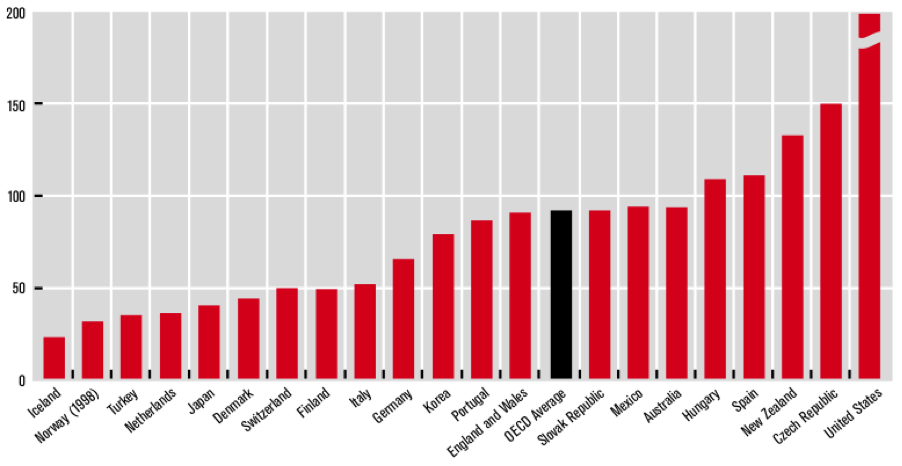
Prison population

Convicted adults admitted to prisons

Number per 100,000 population

Since the 1970s, OECD countries have experienced steady increases in prison population, with the exception of Finland where the rate has continued to decline. Over the last 10 years, Portugal has recorded one of the largest increases together with Spain among European countries. However, levels in both countries remain far below the United States, where the prison population has witnessed a huge jump that bears no historical comparison, with a population in 2000 four times as high as in the early 1970s. Differences across countries have, surprisingly, only little to do with the prevalence and development of crimes but more likely to do with political factors and responses to the increasing belief in certain countries that prison is preferable to other alternatives. When comparing prison populations in 2000, the United States again stands far above the norm with an incarceration rate five times as high as the OECD average and three times larger than the Czech Republic, ranking second. More than 1.2 million convicted American adults are in jail (a little less than 2 million when pre-trial and non-guilty offenders are included), and this may have a significant distorting role on the labor market for young males. Rising prison populations, unless fully resourced, generally reduce the effectiveness of criminal re-education. Upward trends can pull down the staff-prisoner ratio, a key component for achieving effective prevention of re-offending and promoting reintegration in the community. Moreover, prison overcrowding tends to exacerbate already high levels of tensions and violence, raising the risks of self-injury, suicide and sexually transmitted diseases including HIV/AIDS. Overcrowded prisons are also more likely to act as “universities of crime.”

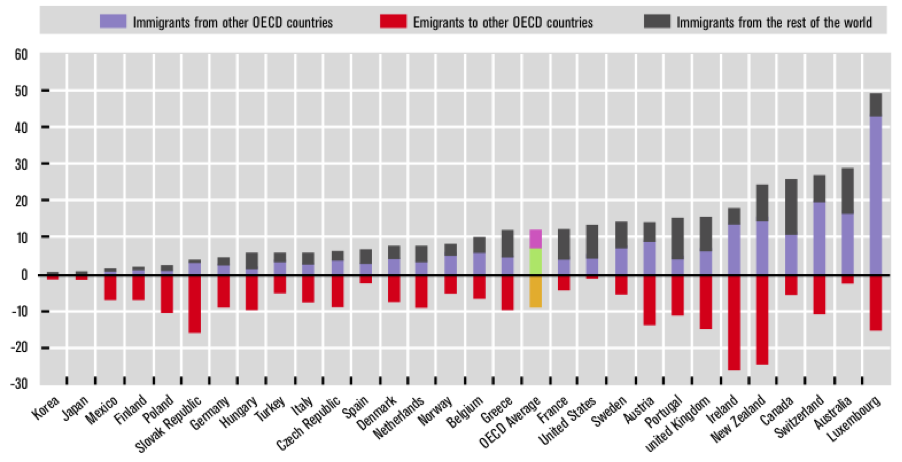
Migration of the highly educated

Foreign-born persons with tertiary education

As a percentage of all residents with tertiary education

In the total OECD area, about 4% of persons with tertiary education are immigrants from other OECD countries. Those from non-OECD countries account for about 6% of all current residents with tertiary attainment. Net stocks of foreign-born persons with tertiary attainment are highest in the traditional “settlement” countries of Australia, Canada and the United States, but also in Luxembourg and Switzerland. Other countries with a large excess of foreign-born persons with tertiary attainment relative to their nationals living in other OECD countries include Sweden and France (8-9%). On the other hand, countries having a large percentage of tertiary-educated former residents living in other OECD countries include Ireland and New Zealand (at close to 25%); Austria, Switzerland, the United Kingdom, Luxembourg, Poland, Portugal and the Slovak Republic (all at more than 10%); and the Czech Republic, Germany and the Netherlands (at close to 9%).

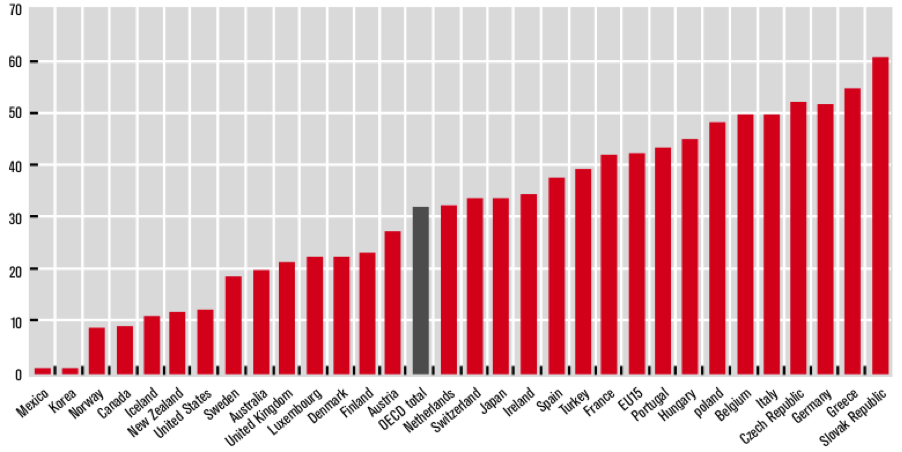
Long-term unemployment

Persons unemployed for 12 months or more as a percentage of total unemployed, 2004*

In 2004, rates of long-term unemployment varied from 10% or less in Canada, Korea, Mexico and Norway to 50% or more in the Czech Republic, Germany, Greece and the Slovak Republic. Lower rates of long-term unemployment are generally found in countries that have enjoyed relatively high rates of economic growth in recent years. There appears to be a two-way causal relationship here. On the one hand, jobs are easier to find in a fast growing economy and, on the other, economies may grow faster by making unemployment an unattractive proposition. Over the period shown in the table, long-term unemployment rates have been relatively stable for the OECD as a whole, but there have been some sharp rises in several countries and equally sharp falls in others. Rates of long-term unemployment have more than doubled in the Czech Republic, Hungary, Finland and the United States (albeit from low levels) and have also risen sharply in Iceland (although from very low levels), Japan and Switzerland. On the other hand, there have been large falls in the long-term unemployment rates in Belgium, Ireland, Italy, Luxembourg, Netherlands and Spain. It is noticeable that, since 1990, the share of long-term unemployed has halved in Korea, Norway, Luxembourg, Ireland and New Zealand.

*Latest available figures

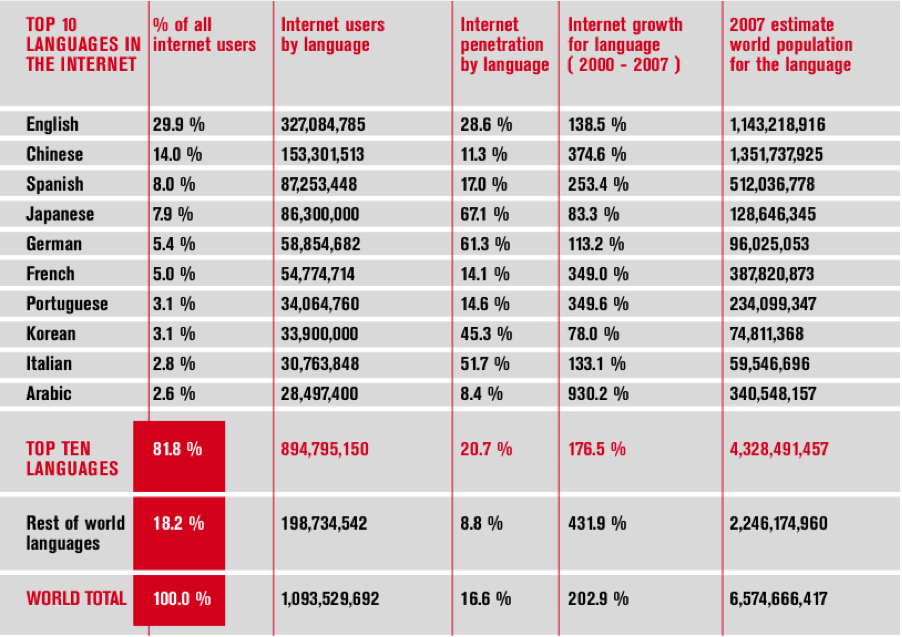
Languages on the Web

Top 10 languages used in the Web

( Number of internet users by language )

There are 87,253,448 Spanish speaking people using the internet, representing 8.0% of all the Internet users in the world. Out of the estimated 512,036,778 world population that speaks Spanish, only 17.0 % use the internet. The number of Spanish speaking internet users has grown 253.4 % in the last six years (2000-2007). Arabic speakers saw the largest growth—930.2%—although they still has the fewest speakers online (2.6%) and least penetration among speakers (8.4%).

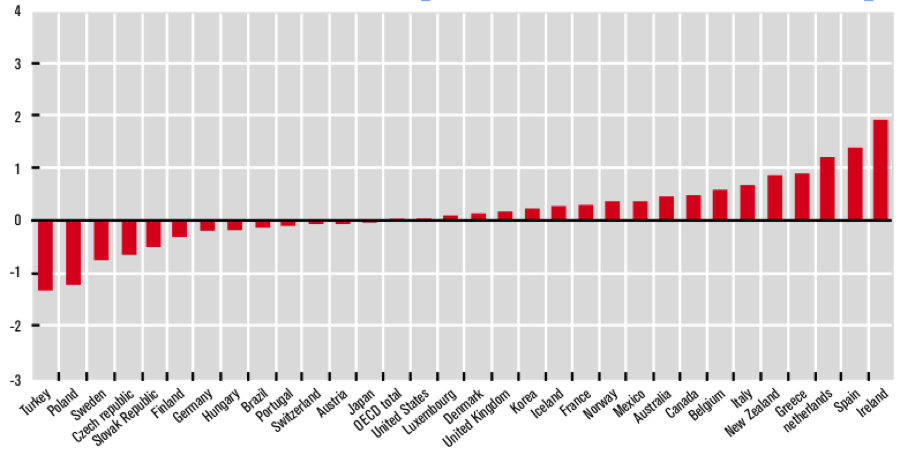
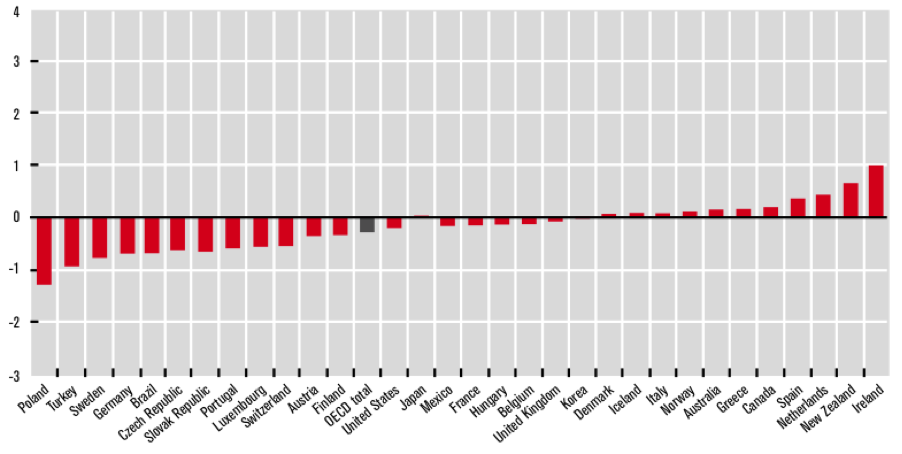
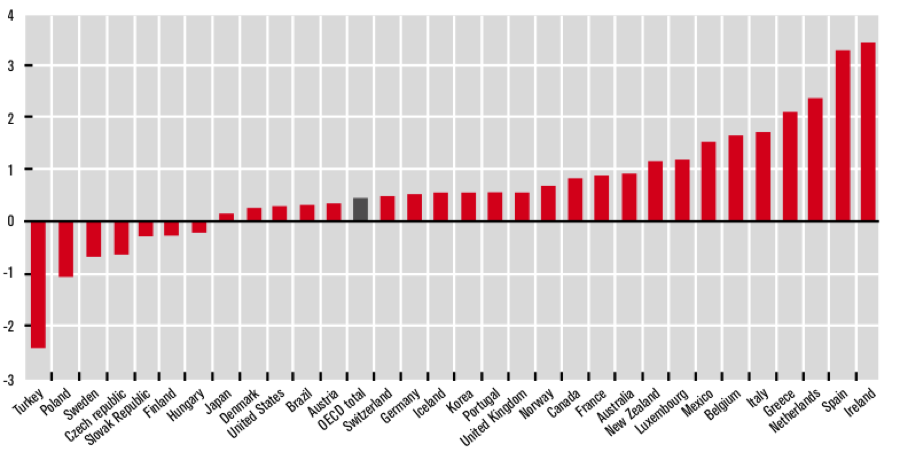
Employment rates by gender

Employment rates: total

Average annual growth in percentage, 1991-2004 or latest available year

Employment rates: men

Average annual growth in percentage, 1991-2004 or latest available year

Employment rates: women

Average annual growth in percentage, 1991-2004 or latest available year

All OECD countries use the ILO Guidelines for measuring employment, but the operational definitions used in national labor force surveys vary slightly in Iceland, Mexico and Turkey. Employment levels are also likely to be affected by changes in the survey design and/or the survey conduct, but employment rates are likely to be fairly consistent over time. For the denominators—the population in each age group—the data are taken from labor force surveys. Over the period shown in the tables, total employment rates (men and women) have fallen in 13 countries and risen in 17. Particularly large falls were recorded in Turkey, Poland, Sweden, Czech Republic and Slovak Republic and particularly large increases occurred in Ireland, Spain and the Netherlands. Growth in employment rates was very different for men and women. Employment rates for men decreased in 19 countries during the period with an annual fall of more than 0.5% in Poland, Turkey, Sweden and Germany. For women, on the other hand, employment rates grew in 23 countries with increases of 1% per year or more recorded for Ireland, Spain, Netherlands, Greece, Italy, Belgium, Mexico, Luxembourg and New Zealand. Clearly, these differences in the growth of employment rates are leading to convergence in the rates for women and men although differences remain large in many countries.

March 22, 2007 0 comments
0 FacebookTwitterPinterestEmail
Financial Indicators

Regional equity markets

by Executive Staff March 22, 2007
written by Executive Staff

Beirut SE: Blom  (1 month)

Current Year High: 1,713.79  Current Year Low: 1,168.85

The BSE short seems inauspicious to inspire trading volumes these days, but the Beirut Stock Exchange undercut the Bahraini bourse in matters of confidence last month. After no more then a hiccup of an improvement to 1,208.57 points on January 26, the day after Lebanon was promised $7.6 billion in international funding, the Blom Stock Index went lower and lower to close at 1,171.47 on February 23. Solidere slumbered in the troughs while BLOM Bank did a bit better than its sector peers. Traders said they did not want to be quoted with comments on the whole market performance, because “nothing is happening, it is the same shit every day.”

Amman SE  (1 month)

Current Year High: 7,584.32  Current Year Low: 5,267.27

The Amman Stock Exchange continued a surprisingly strong show of growth to close at 6,467.63 points on February 25, representing a 17.2% improvement in the index for the year-to-date in the best two-month performance for any regional market at the start of 2007. On the month, the ASE index climbed by around 480 points since January 28. Top market power Arab Bank was strong in volume and share price development to JOD 27.50; it is now up by JOD 6.20 since the start of 2007. Select real estate stocks saw good volume, including Taameer Jordan and Arab East for Real Estate Investment. The share price of the latter advanced by 25% in the course of one month. Upstart Jordanian television station ATV said it wants to become the first station in the region to go on the bourse. 

Abu Dhabi SM  (1 month)

Current Year High: 4,648.80  Current Year Low: 2,925.03

The Abu Dhabi Securities Market had a U-shaped trajectory in February, with a hanging chad at the end. Starting at 3040.50 points on January 28, the ADSM index fell by over 90 points by February 1. It remained below the 3,000 line until it jumped to 3,035.12 points on the 20th of the month but retreated again to a close of 3,004.03 on February 25. Energy sector company Dana Gas saw strong trading volume and one of the interesting movers was oil sector company Aabar Petroleum, with a 44% rise to AED 2.21 in the latter part of the month. Some market traders thought that the rise was initiated by a case of mistaken identity, because a Kuwaiti company with similar call sign had been awarded a government contract in Kuwait. However, Aabar also had news of its own, with a new contract and production increases in Thailand.

Dubai FM  (1 month)

Current Year High: 6,731.63  Current Year Low: 3,997.29

The Dubai Financial Market moved with no clear direction in the range between 4,314 and 4,120 points. The start of the month saw the index drop by nearly 200 points but after some up and down, the market closed at 4.207.51 points on February 25. Earnings seasons added some spice to a not overly exciting month. After announcing 35% year-on-year higher net profits for 2006, market heavyweight Emaar Properties saw a spike in volume but the stock never moved far from AED 13 throughout the month. Investment bank Shuaa Capital share prices pointed downward in February, but the stock did not appear to suffer heavily from allegations by magazine Trends Arabies that the company had manipulated a Kuwaiti stock deal in 2005. Shuaa denied the allegations.

Kuwait SE  (1 month)

Current Year High: 11,542.90            Current Year Low: 9,164.30

The Kuwait Stock Exchange was one of three GCC bourses that traded lower in the fourth week of February than at the start of the year, with Bahrain and Qatar being the other two. The KSE rebounded from a month-low of 9,584.5 points on February 10 but closed not higher than 9,726.40 points on February 21. One of the market’s gainers was telecoms firm MTC, which released strong results on February 19. With most gains before the results announcement, MTC’s stock appreciated by 17% between the start of the month and February 21. Holding firm Kipco made news by saying late in the month that it is leading a consortium tasked with selling 51% of telecoms firm Wataniya. Share prices of Kipco and Wataniya are expected to benefit from the move.  

Saudi Arabia SE  (1 month)

Current Year High: 19,502.65            Current Year Low: 6,916.85

The Saudi Stock Exchange gently traversed the entire 7,000 points realm in February and reported in at 8,385.45 points on February 25. Dipping only slightly on profit taking early in the month, the Tadawul index over the period improved by 21% from 6,916.85 points on January 29. The big thing in the market for this month, and probably a few more times in the coming months, is insurance. Initial public offerings of insurers Medgulf and Malath were oversubscribed by healthy margins. Being the first two insurance IPOs in a lineup of recently licensed providers, the flotations will be followed by others and add a new dimension to the SSE.

Muscat SM  (1 month)

Current Year High: 5,956.46  Current Year Low: 4,657.16

The Muscat Securities Market closed at 5,780.39 points on February 25, up some 11 points when compared with January 28. Sailing southward in the first half of the month, the index turned back north after February 11. Flag carrier Oman Air was suspended from trading for most of February pending a capital restructuring. The sultanate’s government plans to infuse new capital into the firm, which would increase the government’s stake from 33 to 84%. Brokers on the MSM said that the shareholding of GCC investors in Omani listed companies at the end of January 2007 was substantially higher than a year earlier. GCC investors owned a total of 14% of MSM-listed stocks, up from 10% in January 2006. Shareholding by non-GCC investors remained basically unchanged at 6.5%.

Bahrain SE  (1 month)

Current Year High: 2,265.58  Current Year Low: 1,996.68

The Bahrain Stock Exchange closed February 25 at 2,160.65 points, down some 21 points compared with its close on January 28. Gulf Finance House, Nass Corporation, and Ahli United Bank were among the most active stocks in the muted market. Gulf Finance House announced a mixed cash and shares dividend of 75% after its 2006 results came with a 51% higher net profit of $212 million. The stock’s price dropped by $0.20 in the days after the announcement and closed at $2.03 on February 25. The BSE board issued a warning to one and a reprimand to another listed company for violating guidelines against insider trading and not following disclosure standards.

Doha SM: Qatar  (1 month)

Current Year High: 9,878.10  Current Year Low: 5,825.80

The Doha Securities Market had the roughest ride of all GCC markets last month, closing at 6,237.51 points on February 25, down from 6,781.08 points on January 28 and more than 12.5% down since the start of 2007. Industries Qatar climbed in the second half of the month and saw high trading volume on announcing a 50% cash dividend. Shipping company Nakilat with its capital call was also among the most active stocks; the company also announced new construction orders for six LNG vessels. In the second half of the month, government and central bank officials tried talking confidence into the market by highlighting the strong growth of the Qatari economy in 2006 and the good performance of the banking sector.

Tunis SE  (1 month)

Current Year High: 2,712.33  Current Year Low: 1,732.72

Like its colleague in Casablanca, the Tunindex conquered a new historic pinnacle in February, reaching 2,712.33 points on February 9. It slipped back by a bit over 100 points in the following week but then returned to growth, closing at 2,646.75 on February 23. The bourse is 13.54% up since the start of 2007; its market capitalization is closing in on the $5 billion mark but on our record date of February 23 it is not quite there yet, reporting $4.907 billion. The new market cap leader is drinks maker SFBT after a steep rise in its share price between the start of 2007 and mid February. Its market cap was $575 million on February 23, compared with $569.5 million for Banque de Tunisie whose stock in February retreated from historic highs in the TND 104 range and closed at TND 99.20 on February 23. 

Casablanca SE All Shares  (1 month)

Current Year High: 11,207.82            Current Year Low: 6,563.27

The Casablanca All Shares Index went up by 1,000 points in the first part of February, to scale a new record of 11,201.82 points on February 19. From that peak, however, it retreated back to 10,518.13 points at its close on February 23. It is too early to say if the market is turning. It is still up by more than 10% since the start of the year, but one reminisces about the experience of the Saudi market exactly 12 months ago. On February 23, the Casablanca Exchange saw 23 stocks go up and 29 stocks go down, with 4 unchanged.

Cairo SE: Hermes  (1 month)

Current Year High: 64,978.48            Current Year Low: 41,965.37

In the measurement of the Hermes Index, the Cairo and Alexandria Exchanges moved up nicely from 57,013.49 points on January 29 to 64,655.63 on February 25. Viewed together with the uptrend of the Saudi Stock Exchange, the 13% rise of CASE made February a gainful month for the region’s leading bourses by market size and by number of listed companies. Orascom Telecom Holding (OTH) and its chairman Naguib Sawiris were the Egyptian market’s international newsmakers last month, as OTH bid for Saudi Arabia’s third mobile license and as Sawiris-owned Weather Investments bought Greek operator TIM Hellas. The OTH share price chased new records in February and closed 19% higher at EGP 440 on February 25 when compared with its quotation on January 28.

March 22, 2007 0 comments
0 FacebookTwitterPinterestEmail
Banking & Finance

Money Matters by BLOMINVEST Bank

by Executive Staff March 22, 2007
written by Executive Staff

Regional stock market indices

Regional currency rates

Doha Bank opens representative office in japan

Doha Bank, established in Qatar in 1979, opened a representative office in Tokyo, Japan as part of the bank’s implementation of its globalization plan. Doha Bank, with 32 branches in Qatar as well as branches and representative offices in Dubai, New York, Japan, Turkey and Singapore posted net profits of QAR744m ($204m) in 2006 up down 5.81% year-on-year. The bank’s total assets rose 42.45% for the same period to reach QAR22 billion ($6 billion) in 2006.

UAE’s Etisalat 2006 net profits reached $1.6 billion

Etisalat, the sixth largest telecommunication corporation in the Middle East, declared a rise of 37.7% in 2006 net profits to reach AED5.9 billion ($1.6 billion) and a 91% rise in its 2006 total assets to reach AED45.9 billion ($12.5 billion). This rise in assets is mainly attributed to the company’s international expansion, through the acquisition of a 51% stake in Pakistan Telecommunication Company Ltd, in addition to negotiations with the Afghan government for the country’s third mobile license and the purchase of Egypt’s third mobile network license. The UAE government currently owns 60% of Etisalat while the public owns the remaining 40%.

Country profile: Saudi Arabia

Global Investment House (GIH) issued a report estimating Saudi Arabia’s nominal GDP growth at 12.4% in 2006 to SR1.30 trillion ($346.9 billion). In turn, real GDP grew 4.2% to SR799.9 billion ($213.3 billion) The Compounded Annual Growth Rate (CAGR) of Saudi Arabia’s nominal GDP growth for the period 2002-2006 was at 16.5%. According to GIH’s report, the Saudi Arabian private sector grew by 7.9% in nominal terms in 2006, while the oil sector registered a nominal growth of 16% for the same period. According to the Ministry of Finance 2007 budget report, the Kingdom’s public debt is estimated to drop by 23% to SR366 ($97.6m) in 2006, some 28% of GDP. The expansion in Saudi Arabia’s economy was not affected by the correction in the stock market as all indicators show an “exceptionally sound and robust” 2006 performance.  Standard & Poor’s Rating Services recently upgraded Saudi Arabia’s long term foreign currency credit rating to “A+” from “A” and affirmed the county’s long term local currency rating at A+ and short term sovereign credit rating at A-1, all with a stable outlook. Saudi Arabia is the largest oil producer among the Gulf Cooperation Council countries, producing around 10% of the world’s oil.

March 22, 2007 0 comments
0 FacebookTwitterPinterestEmail
Regional BankingSpecial Report

UAE banking executives On forecast for 2007

by Executive Staff March 22, 2007
written by Executive Staff

Executive talked to Hani Hamid, Marketing Manager at the National Bank of Umm Al Qaiwain, and Yousef Padganeh, Head of the Basel II Project at Bank Saderat Iran in Dubai, about the outlook for the UAE banking sector this year.

E  Is the UAE banking market as competitive as it could be? Specifically, do you expect greater competition this year on prices for core banking products? 

NBUQ: Definitely. Prices on interest will vary from bank to bank, so the sector will become more competitive. The sector will become more competitive this year—there are now 52 banks in the UAE.

Bank Saderat: Yes, there is growing competition. The UAE market is highly competitive and will become more competitive because the people are trying to find new markets.

E  Is the regulatory environment and enforcement of regulations fair and equitable for all banks in the UAE?  

 NBUQ: Yes, I think it is—but the UAE needs a credit bureau, which has been talked about for a long time.

 Bank Saderat: Yes, it is fair.

E  Will the UAE be able to defend its role as leading banking hub in the Gulf against the competition from Bahrain Financial Harbor and Qatar Financial Center? Does the function as banking hub benefit local banks or are there disadvantages?   

NBUQ: I think the UAE is one of the strongest banking hubs, so then it will be able to compete. It is competing with the Middle East, not just the Gulf. Local banks compete differently from international banks—a different environment and customers—so they have the edge on international banks for local and Arabic-speaking customers.

Bank Saderat: Yes, if you compare it to a few years ago you will see more and more companies and organizations are coming to the UAE, to the DISE. If we look at the whole Gulf region, the market share will decrease as more banking come to Dubai. Local banks will benefit as we [international banks] are limited—we cannot have more than eight branches, but foreign banks will try to have more branches. Local branches will open more and be more active, so they will benefit.

E  Should regulators modify their approach to the licensing of local and/or foreign banks in the UAE?

NBUQ: It could be possible, as I think there are too many banks in the UAE, even foreign banks. UAE has an open market so anybody can come.

Bank Saderat: I am not aware of this. Regulators are supporting local banks more than international banks.

E  Is the sector ripe for mergers? Should regulatory authorities do more to encourage consolidation? 

NBUQ: I think it is the right time for some merging. With all the money banks made last year, and in 2005 due to the stock market, there was talk before then for mergers, but if the market stays the way it is, or there is a drop in the market, mergers could happen.

Bank Saderat: One thing I am seeing is that Emirates groups will merge. For example, we are seeing new banks, but state banks will not like mergers.

E  Are UAE banks valued adequately in the Abu Dhabi and Dubai stock markets? Are 2006 earnings growth and performance reflected in recent share price developments?

 NBUQ: In terms of profit it has affected them, but in terms of value at the right level. Looking at the market it is good and healthy. I think the stock exchange will grow this year.

Bank Saderat: The price of the banking stock depends on construction. I think it depends on that area rather than banking. For instance, if Emaar goes up, the National Bank of Dubai will go up.

E  UAE banks have been looking east and west for cross-border expansion opportunities. Which markets are the most attractive for expansion in 2007?  

 NBUQ: I would say Iraq, but that’s not a good market right now. Africa is showing it is a competing market; Sudan and Libya have shown they are good markets. Egypt is also a good market, and there are some international banks are there. Qatar definitely a good market and competitive—a lot of banks are trying to open there, and in Bahrain. Syria is good, but tere are too many rules and regulations.

Bank Saderat: UAE banks are opening branches in Pakistan and India, and want immediate customers living in Dubai. Some 55% of workers in the UAE are from Pakistan, India and Bangladesh, so there is demand, particularly for retail banking. The other factor is based on trading, where they have the most trade. Some of these investors are looking for property investment so that is why they are opening in Morocco and North Africa. Banks are also trying to get into Iran and Iraq.

E  What obstacles do banks find most challenging when pursuing cross-border expansion, and are some of these obstacles higher for UAE banks than for international competitors in the same markets (e.g. regulatory requirements in other markets, competition with European banks in countries like Egypt, acquisition of skilled staff, integration of corporate cultures in takeovers)?  

NBUQ: In Egypt, rules are the obstacle, along with money transfers and exchanges. Sudan and Libya are much more open, but politically Sudan is not stable. Libya is an open market.

Bank Saderat: The first problem is regulatory. We should know what the rules are—and then new competition in the market. I also think they should have a good idea of customer needs and wants as they will differ from the UAE. For instance, just now regulations for foreign banks requires UAE-employees, so recruiting can be a problem.

E  Do staff shortages create problems for domestic growth of the bank?  

NBUQ: It definitely affects a bank’s growth. All banks have been affected by stock markets, and I don’t think there is a problem, but staff exchanges between banks are a problem, which affects banks moving ahead.

Bank Saderat: Getting staff in the UAE is a problem as there aren’t enough people. We may find a few post-grads, but they have no experience. In the long term it should be better.

E  Is the growth of Islamic banking the future of UAE banking?

NBUQ:  I think it is the future of everywhere, even the UK and now the US. It is a trend they follow, like changing clothes. They have used credit cards, car loans, and now trying Islamic banking. We have already started that here.

Bank Saderat: Islamic bank is rising. HSBC started and others too, so there is a market.

E  Do you expect shifts in the structure and importance of corporate banking? Where are the best options to expand and/or diversify financing portfolios for manufacturing ventures and corporate borrowers?   

NBUQ: Banks are doing corporate banking but retail banking is a lot more profitable, but I think they should change their policies, as the commercial banking is moving fast and changing, and it is a good banking product.

Bank Saderat: Diversified portfolios will minimize risk, so there will be a shift. We have corporate banking and the target market is changing. Nowadays competition is high so we need to find new markets.

E  What are the main challenges in retail operations? Given the rapid changes in costs of living and the scenarios in the housing market, what can banks do to keep their consumer loan portfolios profitable and lending growth sustainable? 

NBUQ: In retailing, the most popular products are mortgages, and banks are looking into priority banking due to customers having more wealth. We have 40-50,000 millionaires in the UAE, out of a population of 4 million, so priority banking will make some growth for banks and they are looking at this. Mortgaging is also booming.

Bank Saderat: The main challenge here is that the cost of living is rising. If banks can provide home loans they will benefit, and then what will happen is that people will try and invest in houses. Second, credit card users are rising, so savings will decrease. Loans will increase and repayment times. High rates of loans will also increase. Banks are now offering Dh120,000 loans.

E  Could the consumer lending and housing loan segments face problems from rising loan default levels in 2007? What mechanisms will banks use to avert the overheating of the retail lending market?

NBUQ: There have not been many defaults in the market—I have not heard of that many, more in cars than houses. It is a new loan through banks, so not many defaults, and people just sell out the deed. Definitely prices have hiked, and I think the surplus will drop. In three years, you might see more defaults.

Bank Saderat: Default will increase, particularly for homes. We should look at the political situation of the region, and consider that there has been an abnormal increase in property prices. There are also delays in construction times, and people still have to pay off loans. Salaries are also not increasing in relation to rising costs, with housing rising 100%. The onus should be on the government, as banks want profit. If the government increases salaries, that may help.

March 22, 2007 0 comments
0 FacebookTwitterPinterestEmail
Regional BankingSpecial Report

Banking sector in UAE expanded in 2006

by Executive Staff March 22, 2007
written by Executive Staff

Fast growth, cultural specialization, and segmentation are all to be found in the banking sector of the United Arab Emirates, whose results in 2006 reverberated with the dual themes of core banking growth and volatile stock markets.

Although the banking sector is large in proportion to the resident population, its 46 banks (plus 2 specialized banks and some 50 foreign rep offices) are fragmented by both territorial and topical categories. The territorial divisions are result of the fact that the seven emirates have local banks, often with ties to the respective governments or ruling families.

In topical differentiation, the sector’s strongest group by market share are listed commercial banks, followed by foreign banks, and then by Islamic and unlisted banks. Local commercial banks account for the lion’s share of retail branches, while foreign banks are restricted to eight branches each. In sheer operator numbers, however, the 25 registered foreign banks in the realm outnumber the 21 UAE-headquartered banks. By 2005 numbers, the asset distribution between Emirati and foreign banks was about four to one of total sector assets ($174 billion).  

As the listed banks have reported their 2006 preliminary results, the National Bank of Abu Dhabi (NBAD) took the crown of exceeding AED 100 billion ($27.2 billion) in assets with 19% growth reported for last year. Customer deposits increased at equal rate to reach AED 71 billion. NBAD, the largest bank in the UAE, reported its net profits as 18.4% lower, at AED 2.1 billion, compared with 2005 profits.

Profits contraction

The bank attributed the profits contraction to lower investment income and shrunken fee income from brokerage and asset management activities—earnings contraction themes that also drove profit developments at Mashreqbank, Union National Bank (UNB) and Commercial Bank International (CBI) into negative numbers for the year.

In 2005, the management of initial public offerings and the provision of equity market services along with gains from own GCC stock and investment portfolios were the big income boosters for UAE banks—which made it predictable latest by middle of last year that the correction year of 2006 would not offer the same profits harvest.

CBI reported the most extreme shrinkage, with a drop in net income from AED 239.7 million in 2005 to a paltry AED 8.7 million in 2006, because of revaluation of its investments portfolio. CBI, which is one of the smaller local players, on the other hand reported 41% growth in assets to AED 7.38 billion in 2006.     

Different to NBAD, other top banks kept the contraction dogs at bay at least to the point of maintaining profit increases. Top Dubai player Emirates Bank International (EBI) succeeded in 9% net profits growth to AED 1.9 billion on total revenues of AED 2.9 billion, the latter being a 29% improvement from 2005. However, also for EBI the growth in total assets and deposits outstripped profits growth. The bank reported assets of AED 95.6 billion and deposits of AED 40.9 billion—up by 69 and 39%, respectively. 

The runners up in Abu Dhabi and Dubai presented divergent result figures. Abu Dhabi Commercial Bank (ADCB) entered 2007 with assets of AED 81.1 billion, a gain of 41% when compared with 2005. ADCB upped its profits by 12% to AED 2.1 billion. Mashreqbank, headquartered in Dubai, reported its assets at year-end 2006 as AED 56.7 billion and customer deposits as AED 33.9 billion, 13% higher than in the previous year. The bank said its contraction in net profits, which were down 10% on the year at AED 1.6 billion, stemmed from the lower investment income of its subsidiary Oman Insurance.

Next in the sector are National Bank of Dubai (NBD) and the Abu Dhabi-based First Gulf Bank (FGB) and Union National Bank (UNB). NBD edged up 1% in net profits to AED 1.11 billion, improving its net interest income, however, by 17% to AED 1.2 billion. The bank’s assets grew 35%, to AED 51.4 billion and with AED 45.4 billion at the end of 2006, its customer deposits were 22% higher than a year earlier.

Achieving 45% improved net profits of AED 1.5 billion, First Gulf Bank stood out with reporting the highest growth in net profits among the larger conventional UAE banks for 2006. The bank, which has ambitious plans to expand its retail network beyond the 15 branches currently shown on its website, increased its assets last year by 82% to AED 47.7 billion and doubled its deposits to AED 34.4 billion. Net interest income and other income improved at rates of 37 and 56%, respectively, and other income represented 41% of total income.

Union National Bank improved its net interest income by 29% to AED 889 million but could only partially offset a 35.3% drop it incurred in investment income, resulting in a 12% contraction of UNB’s net profits to AED 1 billion. The bank, the only one in the UAE in which both the emirate of Abu Dhabi (40%) and the emirate of Dubai (10%) are direct shareholders, achieved 19% asset growth to AED 41.6 billion and a 17% increase in customer deposits to AED 30 billion.

FGB and UNB are favorites of regional stock market analysts. Investment houses Shuaa Capital, Global Investment House, and Prime Securities recently recommended UNB as buy or strong buy while Shuaa, Global, and EFG Hermes gave their nods to FGB.

Other stock picks of regional investment advisors in the UAE banking sector are fairly diverse, based on price to earnings ratios. Global Investment House, which issued an extensive report on UAE banks in January, liked—besides UNB and FGB—NBAD and NBD. Global also recommended buys on two Islamic banks, Abu Dhabi Islamic Bank and Sharjah Islamic Bank.

Shuaa Capital reviewed only Abu Dhabi based banks in August of 2006 and recommended NBAD, ADCB, and UNB. From EFG Hermes, recommendations came in December for NBD and Commercial Bank of Dubai (CBD). CBD is one of the sector’s smaller banks, with net profit of AED 601 million (up 9%) in 2006 on assets that grew 22% to AED 18.7 billion. 

Islamic banking growing the most

While conventional banks are far ahead overall, the UAE banking sector segment with the highest growth figures in 2006 was Islamic banking. Although the first fascination with Islamic banking seems to have diminished a bit last year in some Gulf countries, the UAE Islamic banks have made strides on their way of catching up with the GCC’s center for the specialty, Bahrain. Abu Dhabi Islamic Bank (ADIB) and Dubai Islamic Bank (DIB) both increased their stature greatly, amassing net profit growth of 66% and 47%.

Between the two, DIB showed the higher absolute figures with assets of AED 64.5 billion (up 50%), customer deposits of AED 47.7 billion (up 43.5%), and net profits of AED 1.56 billion.

The bank, which is the oldest shariah-compliant bank in the GCC, is still on a pronounced expansion course and in 2007 wants to add another dozen branches to its network, which it has multiplied in the past five years to 40 branches. ADIB, on its part, had the stronger relative asset growth as well as the stronger profits growth last year, reaching AED 36 billion in assets (up 63%) and net profits of AED 571 million. ADIB’s customer deposit base rose 33% to AED 24 billion.

Another bank to look out for in the Islamic field is Dubai Bank, a daughter of big real estate player Emaar Properties and government-owned Dubai Investment Group. Having received approval for tripling its capital to AED 1.5 billion, Dubai Bank aims to grow aggressively at home and abroad.

Such jumps in capitalization and deposits are hard to envision without the factor that has driven everything up in the GCC over the past two year—hydrocarbon revenues. Banks have been a natural beneficiary of the overspill in oil money and its accompanying economic effects, such as epidemic consumer demand growth, the construction boom, and stock markets craze.

While the story of UAE banking is numbers-driven, a side issue of some interest could be the evolution of corporate identities and marketing profiles. The sector, embedded in a GCC frame of corporate name selection where similarities create no apparent concerns, is (at least in English) a bland alphabet soup of location-laden and easy-to-confuse abbreviations.   

Regional expansion is another theme with some enticing questions. Based on their growing strength and the UAE’s far-flung trade ties, Emirati banks have been charting cross-border growth potentials in the MENA region but also in Sudan, Pakistan, India and even China.

It will be worth watching how UAE banks will sharpen the profiles and names they communicate and how they will navigate the challenges of expanding their corporate cultures into new markets and overcoming human capital restraints that are reflected already in the sector’s great need for skilled bankers and experts in Islamic finance, where almost every sizeable UAE bank is building its presence.

Looking forward, UAE banks are forecasting strong earnings forecasts based on the country’s rosy economic outlook. Analysts see core banking activities offering much space for development, from deposits and retail and mortgage lending to financing of the services sector, industrial projects and public sector spending. Funding gaps are being addressed through medium term note programs and the low risks attached to the UAE economy and its banking sector mean that the sector’s prospects are sound.  

At the top of the sector, where the three largest banks in the UAE control about half of the market segment covered by the top 10 banks, analysts do not expect tremendous changes. Foreign banks face hurdles through taxation and limits on their branch networks. In the market at large, retail network growth targets of domestic and Islamic banks are massive throughout.

But although the UAE is well-reputed as the competitive center of the GCC, competition in the banking sector may yet have to approach another dimension. Banks have intermingled ownership structures where governments, government-owned institutions, and state-dominant families play such a large role that the sector by default gives out an oligopolistic scent. With new trade agreements and changing market conditions, UAE banks will be tasked to transcend existing barriers.

March 22, 2007 0 comments
0 FacebookTwitterPinterestEmail
  • 1
  • …
  • 590
  • 591
  • 592
  • 593
  • 594
  • …
  • 696

Latest Cover

About us

Since its first edition emerged on the newsstands in 1999, Executive Magazine has been dedicated to providing its readers with the most up-to-date local and regional business news. Executive is a monthly business magazine that offers readers in-depth analyses on the Lebanese world of commerce, covering all the major sectors – from banking, finance, and insurance to technology, tourism, hospitality, media, and retail.

  • Donate
  • Our Purpose
  • Contact Us

Sign up for our newsletter

    • Facebook
    • Twitter
    • Instagram
    • Linkedin
    • Youtube
    Executive Magazine
    • ISSUES
      • Current Issue
      • Past issues
    • BUSINESS
    • ECONOMICS & POLICY
    • OPINION
    • SPECIAL REPORTS
    • EXECUTIVE TALKS
    • MOVEMENTS
      • Change the image
      • Cannes lions
      • Transparency & accountability
      • ECONOMIC ROADMAP
      • Say No to Corruption
      • The Lebanon media development initiative
      • LPSN Policy Asks
      • Advocating the preservation of deposits
    • JOIN US
      • Join our movement
      • Attend our events
      • Receive updates
      • Connect with us
    • DONATE