• Donate
  • Our Purpose
  • Contact Us
Executive Magazine
  • ISSUES
    • Current Issue
    • Past issues
  • BUSINESS
  • ECONOMICS & POLICY
  • OPINION
  • SPECIAL REPORTS
  • EXECUTIVE TALKS
  • MOVEMENTS
    • Change the image
    • Cannes lions
    • Transparency & accountability
    • ECONOMIC ROADMAP
    • Say No to Corruption
    • The Lebanon media development initiative
    • LPSN Policy Asks
    • Advocating the preservation of deposits
  • JOIN US
    • Join our movement
    • Attend our events
    • Receive updates
    • Connect with us
  • DONATE
Banking & Finance

Foreign firms ready to Bank on Egypt

by Executive Staff February 1, 2007
written by Executive Staff

Egypt’s banking sector is set to become hotly competitive in 2007. Strong international and regional banks that have entered the market in the past two years are aggressively hunting for market share in what observers are calling a very “new and lucrative” market. These growth-hungry banks will meet new competition from big local banks whose survival after privatization will allow them to restructure and reinvent themselves as modern risk management institutions.

The new competitive environment goes hand in hand with the banking sector reform, and a reduction in the number of Egypt’s banks from 53 to 35 since the reform program was launched in 2004. Although it brought the number of operating banks down, the reform program’s consolidation of the sector was conducive to increased productivity and competitiveness because it forced inefficient state-run banks with opaque loan portfolios out of their pampered and protected positions into the harsh “real world” of commercial banking.

Seeing the fruits of reforms and privatization, Arab and other foreign banks have started to expand their presence in Egypt and established footholds by acquiring local banks.

Lebanese banks are at the forefront of the trend. BLOM Bank beat out competitors to take over Misr Romanian Bank in late 2005 and quickly announced that plans to develop the retail business of the renamed Blom Bank Egypt. Only weeks later, Bank Audi acquired Cairo Far East Bank for $94 million, and said recently that it wants to expand the branch network for the bank, now called Bank Audi Egypt, from the current three to 20 before the end of the year.

Other entrants include Bahrain’s Ahli United Bank which bought 89.3% of Delta International Bank in August for LE1.65 billion. And in July, UAE’s Union National Bank acquired the government’s stake in Alexandria Commercial & Maritime Bank for LE65.3 billion; it is now preparing to acquire Arab Investment Bank.

Foreign players eager to enter market

Foreign players can currently only enter the Egyptian market by buying into existing banks. Thus international banks having acquired and rebranded local banks in a number of bidding contests.

In July 2005, Greece’s Piraeus Bank bought 70% of the Egyptian Commercial Bank and renamed it Piraeus Bank Egypt. The Greek bank increased its stake in the subsidiary to over 95% and announced plans to add 220 branches by 2010. The National Bank of Egypt (NBE) sold its 18.7% stake in Commercial International Bank (CIB) for $236 million in February of last year to a consortium led by American private-equity giant Ripplewood Holdings.

Some foreign banks saw 2006 as good year to grow their existing operations through M&A action. Paris-based Societe Generale, which already had a presence in Egypt through National Societe Generale Bank, last November received final approval for merging Misr International Bank into its operation—a move that made it the largest private commercial bank in the country. Credit Agricole, France’s largest banking group, likewise repositioned and expanded its Egyptian operation by creating Credit Agricole Egypt last year after its existing local subsidiary, Calyon Bank, purchased Egyptian American Bank. Credit Agricole Egypt is now Egypt’s third-largest private commercial bank by assets.

However, the biggest deal of 2006 was the sale of state-owned Bank of Alexandria (BA), the smallest of the Big Four state-owned banks, to Italy’s Gruppo Sanpaolo IMI. Sanpaolo purchased 80% of BA for a whopping $1.6 billion or six times the bank’s book value. The bank aims to double its size and market share in Egypt and also plans regional expansion.

With the rush of foreign banks to the market, government officials say that investments by foreign banks in 2006 increased by a sum of LE4.2 billion.

Solid grounds

Analysts consider the Egyptian banking sector under-penetrated, with only 10% of Egyptians having bank accounts. In general, private sector banks operating in Egypt are today financially more solid than they were, and the market can be considered a more competitive place compared to a few years back.

Egypt also offers growing potential to Arab regional banks and joint venture banks with Gulf-based partners.

Former president of the National Bank of Egypt Ahmed Karat sees the presence of Arab banks in Egypt as a natural consequence of the interest of regional and international players in this market.

Seasoned Arab banks that have been operating in Egypt for some time and have recently announced plans to increase the breadth and depth of their operations include Jordan’s Arab Bank, the National Bank of Abu Dhabi, and Faisal Islamic Bank of Egypt, which has Gulf-based shareholders.

Regional banks and governments also have stakes in Cairo-based commercial and wholesale banks such as the Arab African International Bank, Arab International Bank, Egyptian Gulf Bank, Egyptian Saudi Finance Bank, Suez Canal Bank, and the Arab International Banking Corporation. The National Bank of Oman added two more branches to its network in Egypt in 2005, and the Bahrain-based Arab Banking Corporation strengthened its presence under the name ABC Egypt to become the fifth Arab bank in the country.

More Arab banks

However, although Egypt has a substantial number of Arab banks, their total market share does not exceed an estimated 10%. Experts say that in light of the recent reforms, Arab banks would have no difficulties increasing their market share to between 25% and 28%, especially because these banks have enough experience in similar markets.

According to the experts, the weak performance of Arab banks is due to a structural obstacle, which these banks must overcome. If they succeed in opening new market segments, regional banks could benefit from customer sentiment that favors them over European or American competitors.

Opposition groups in Egypt have always resisted and attempted to block the sale of local banks to foreign concerns. However, banking experts say Arab banks in Egypt might be under threat from their bigger European counterparts who have longer experience in serving large markets and can provide financial services for corporate clients, investment and private banking, capital markets, asset management and, increasingly, also Islamic finance. A Fitch ratings report issued in late 2006 said that “foreign banks have brought in more innovative products and new delivery channels and are attracting the best skills.”

Most analysts agree that the presence of foreign banks is not a threat to Egypt’s existing public sector banks, and the government prefers buyers to be big name banks capable of introducing new technologies and developing banking services. “Foreign banks will create more competition that will force the local banks to shape up and improve their services,” explained Nabil Hashad, an Egyptian banking expert, adding that foreign investors are needed to “maximize the cost efficiency, productivity and profit efficiency of banks and not just reduce costs.”

Challenges for 2007

Credit must be given to the Egyptian government for sticking to its plans to open up the banking sector and forge ahead with its privatization program. Egypt has succeeded where several other countries in the region have failed. The challenge moving forward will be whether this momentum and excitement will continue. Although much has been accomplished—with serious delays—much more needs to be done. Several global rating agencies such as Moody’s are still cautious with their rating and assessment of the economic condition for Egypt.

One highly anticipated development for 2007 is the merger of Banque Misr and Banque du Caire, Egypt’s second and third largest banks, into the largest bank in the country. Both are state-owned and their merger and privatization will add an important milestone to the conversion of the backward state banking sector into a private sector powerhouse.

To sustain growth, another big push for consolidation, while improving supervision and solving the sector’s chronic NPL problem would do miracles. The government must also provide special incentives to Arab banks so that they can increase their market share. Currently, European banking institutions have the upper hand and benefited the most from the privatization drive. GCC-based banks have many opportunities to enter the market and efforts to encourage these banks to get involved should be priority for the Investment Ministry.

2007 should be the year the government completes it reform and privatization drive. Additional focus must be placed on creating an interbank market and pushing for more transparency and better laws to protect depositors. The big mergers and deals in 2006 must now be replicated in 2007, because these reforms are necessary to keep the economy and banking sector on track.

As Egypt’s Minister of Investment Mahmoud Mohieldin put it, “Today, we are talking about a banking sector that is not going to show any mercy to those who are incompetent, inefficient or unable to stand up to the challenges of competition.”

February 1, 2007 0 comments
0 FacebookTwitterPinterestEmail
Comment

The year that brought globalization to the Arab World

by Executive Staff February 1, 2007
written by Executive Staff

Since the current wave of global change accelerated after the end of the Cold War, mention of globalization has tended to upset Arabs. However, 2007 could be the year that the Arab World really moved closer to the rest of the globe. Politically, this was evident in the Annapolis conference, where — under watchful American eyes — for the first time high-level representatives of Saudi Arabia and Syria sat down in public with Israeli officials, a powerful symbol of the region’s engagement with the West and its stepchild Israel. In the economic sphere, vast Arab investments were welcome in Western countries, sometimes as sizeable, controlling interests in big-name global companies. Not all deals went off without a hitch, witness the Qataris backing off over the takeover of the major British retail chain Sainsbury’s. But it will soon be forgotten, as the 2005/06 failed attempt by Dubai World Ports to invest in the US was forgotten, while Arab money poured into shaky Western stock markets. Moves in the opposite direction were also evident, as global businesses headed in greater numbers to Arab countries.

Along with these developments, the message that finally started to come across in 2007 is globalization is neither necessarily good nor bad, but it is here and it is important. The term still has negative connotations in the region, but 2007 has shown that to integrate into the world does not mean that Arab countries will have to surrender their identity.

Nevertheless, the big deal for the eastern part of the Arab region remains the Israeli-Palestinian conflict. Annapolis has not of course resolved the problem, but things may be better after that meeting than they were before. In the Maghreb on the other hand, the major issue is closer relations with Europe and it is important that French president Sarkozy chose to roll out his Mediterranean Union initiative in that corner of the Arab World. Like Annapolis to the eastern Arab countries, the launch of the idea of a Mediterranean Union does not signal that all of the Maghreb’s problems are over. However, this indication of an increased European role in the region is critical. In the East too, greater EU involvement in the peace process could help. Europeans being involved more in the Arab World means more emphasis on the bright side of globalization and this seems to have gained ground in the Arab World during 2007.

Turning from the big picture to nitty-gritty issues at the center of globalization, such as logistics, is also revealing, in terms of changes taking place within the Arab World. For example, the World Bank’s first Logistics Performance Index ranked Lebanon 98th among 150 countries worldwide and 13th among 17 Arab states. The index covers ability to track and trace shipments, timely arrival, customs procedures, logistics costs, infrastructure quality, and competence of the domestic logistics industry. Globally, Lebanon tied with Zambia and ranked behind Papua New Guinea, and was below both the global average and the Arab score. Examples of Lebanon’s performance vis-à-vis Arab states in individual sub-indices were especially grim: tying Syria and behind Yemen on the customs sub-index, below Mauritania on the infrastructure measure, behind Tunisia on logistics competence, and weaker than Egypt on tracking and tracing. To mention Lebanon’s logistics in the same breath as most of these countries would have been unthinkable a generation ago. But today, while much of the region advances and globalizes, the Lebanese wallow in instability.

However, even considering Lebanon, the past year appears to have been better for the Arab World as a whole, at least in terms of macro-economic indicators. Was the same true regarding the average person living in the region? Maybe not, so how can the benefits of growth and globalization that accrue to the rich and well-connected help the average person in 2008? The answer may be larger doses of democracy and liberalization to bring the region into better harmony with the forces of globalization. Well thought out democratic practices and properly introduced liberalization are valuable in making the best of globalization. Take as an example the recent and continuing entry of Arab countries into trade agreements. The experience of various regions, including Latin America and South and East Asia, suggests that the negotiation capacity of states seeking to join trade pacts actually increases in the presence of pressure groups. By contrast, in many cases Arab negotiators themselves monopolize, and so weaken, their own countries’ negotiation position. The challenge remains to revitalize labor unions, professional syndicates, and business associations as partners in public decision-making, to make the best of globalizing. The alternative is globalization for the rich and powerful and a doubtful future for the rest of the population.

February 1, 2007 0 comments
0 FacebookTwitterPinterestEmail
Banking & Finance

Strong regulations benefit Turkey’s bank industry

by Executive Staff February 1, 2007
written by Executive Staff

Foreign banks are continuing to show strong interest in Turkey’s banking sector, as demonstrated by the upcoming sale of state owned HalkBank and privately-held Oyak Bank. While the inflow of foreign blood over recent years has elevated the standards of the banking sector, Turkey’s bank regulator has forced local players into shape.

Since its establishment in 2000, some local bankers have lauded the independent Banking Regulation and Supervisory Agency (BDDK) for the discipline it has instilled in the sector. Non-performing loans (NPLs) have been whittled down and are not considered to pose a problem, while loan volumes—specifically retail loans and SME loans—have increased. The minimum capital adequacy ratio was recently increased from 8% to 12%. The sector is well regulated and the level of transparency and reporting mechanisms are extremely good, says Levent Celebioglu, the assistant general manager and head of the financial institutions group of TEB-BNP Paribas.

Regulatory scheme praised, but doubts remain

While the majority of market observers praise Turkey’s regulatory authority, others take a more qualified stance. The BDDK’s interventionist approach could be dangerous. Having broader and more sophisticated regulatory parameters—as for instance in Europe—is safer as it means that the entire sector will not suffer should the regulatory authority make a miscalculation or misjudgment, said a foreign bank executive. Control of interest rates on credit cards has also been a source of complaint for some in the sector, limiting returns and business expansion. This is not to deny that the regulatory authority’s more accommodating approach on card interest rates has offset much sector-wide disgruntlement, resulting in a broader consensus between the regulator and regulated. Restricted consumer credit though is still raised as an issue by some insiders. Limiting the total amount of credit available to each person protects those banks that already have customers. The emphasis rather should be on educating consumers on how to avoid debt, according to the observer. Providing safeguards against debt, regulatory fans retort, is the safest track.

Yet, the BDDK’s strong mandate as a hands-on regulator should be placed in the context of Turkey’s turbulent economic past, when stringent regulation of the banking sector was clearly lacking. Many observers blame the 2001 financial crisis on the lax banking safeguards of the time. While 85 banks were operating in Turkey in 2000, the number decreased to 51 by 2005 following liquidations, mergers and acquisitions.

An evolving industry

The industry has evolved since the BDDK emerged as regulator but risks nonetheless remain. A recent report by international ratings agency Fitch Ratings underlined that Turkish banks needed to closely monitor asset quality, diversify earnings and improve efficiency as the sector experiences rapid growth in loans and ever increasing competition from constituent players. In November, BDDK head Tevfik Bilgin also warned that money from deposits alone was currently not sufficient to fund the banks, with foreign borrowing filling the gap.

Foreign banks shrug at such concerns. The banking asset to GDP ratio Turkey is approximately 85 to 87% in 2006, whereas for the EU 15 members it is 280%, or 110% for the EU 25 members, said Celebioglu, pointing to the scope for growth in the Turkish market. Likewise, Bilgin underlined the fact that the market was potentially worth between $700 billion and $800 billion, as opposed to the $323.03 billion registered towards the end of 2006. Turkey had previously lived in a high inflation environment with high interest rates, which forced consumers to hold back on spending. But the tide has shifted, with consumers showing greater confidence on the back of the government’s economic policies.

Meanwhile, the sector as a whole will continue to benefit from the entry of foreign players. The total foreign shareholding at Turkish banks is expected to reach 18% of total paid-in capital by the end of the year, according to the 2006 Fitch report.

February 1, 2007 0 comments
0 FacebookTwitterPinterestEmail
Capitalist Culture

A step back for freedom? US must choose

by Michael Young February 1, 2007
written by Michael Young

Amid all the hoopla over how the United States should conduct its war in Iraq, very little attention has been paid to what looked like a good idea when President George W. Bush first sought to justify his invasion of Iraq: the spread of democracy to the people of the Middle East.

Indeed, in recent weeks some American pundits and former officials have taken a decidedly dim view of US ambitions in the region. For example, in a much-listened-to radio program, Richard Haass, president of the Council on Foreign Relations and a former State Department official, pointed out that democracy should not be an American priority. More generally, Haass has been peddling a pessimistic line on American power, arguing in a recent issue of Foreign Affairs magazine that the end of US dominance in the Middle East had arrived. “[B]y tying down a huge portion of the US military, the war has reduced US leverage worldwide. It is one of history’s ironies that the first war in Iraq, a war of necessity, marked the beginning of the American era in the Middle East and the second Iraq war, a war of choice, has precipitated its end.”

Haass is a political ‘realist,’ one whose approach to foreign affairs is defined by advancing American interests rather than defending values. Realism was for a long time the foundation of US policy in the Middle East, and justified Washington’s interactions with despotic regimes; that is until Bush complicated matters by placing democracy at the heart of his regional agenda, even as he continued to uphold good relations with dictators in Arab countries from the Gulf to the Atlantic.

‘Realists’ on the upswing, but they’re still on the wrong track

Haass is not the only realist to take such a jaundiced view of democratization. In summer 2004, Brent Scowcroft, national security advisor to former President George H.W. Bush, had this to say to a reporter from the New York Observer: “It’s not that I don’t believe Iraq is capable of democracy. But the notion that within every human being beats this primeval instinct for democracy has not ever been demonstrated to me.” That Scowcroft and his onetime boss had sponsored a policy in the Middle East that granted America’s despotic comrades wide latitude to suffocate any “primeval instinct for democracy” was left unmentioned.

The question today, however, is whether the US has the same option as it once did to ignore the abuses carried out by its Arab allies—in effect to ignore a capitalist culture of free minds and free markets. The Middle East is changing, and while despotism endures, the alternative to despotism is far clearer today than it was when people like Haass and Scowcroft were at the helm. Against the dictators stand angry Islamists—themselves as undemocratic, if not more so, than the men in power, and often far more destructive. In other words, reheated realism is not really an option anymore in the shadow of the 9/11 attacks, when it has become quite obvious that despotism only makes violent Islamism stronger.

That message has yet to sink in among the halls of government and Congress in Washington, where the failure of one foreign policy school tends to mechanically lead to embrace of the other. Because the neoconservatives who gave ideological sustenance to Bush’s Middle Eastern policies after 2001 are said to have failed, the pendulum has shifted back to the realists. The fact is, however, that both sides are guilty of failure in the region. The neocons wanted grand change, but all they have ceded us until now is instability; the realists pray at the altar of stability, but left behind a Middle East with an anti-Americanism that made possible the attacks against New York and Washington. Neither side has offered a convincing template for a new US approach to the region.

However, the neocons did hand us something genuinely new in their defense, hypocritical or sincere, of democracy and human rights. For the US to give up on these values or practices is not only impossible at this stage (since, for all his faults, Bush has imperceptibly welded those concepts into the edifice of Middle Eastern thinking), it is also bad politics. Human rights and democracy are powerful ideas that, when properly defended, give the US considerable leverage in the Arab world. No sensible state surrenders a good thing, even if that means it has to reshape and refine an agenda to convince the agnostics or detractors.

Not many Arabs are willing to give the US the benefit of the doubt on democracy. But no one is particularly eager to be indefinitely ruled by the tyrants who hold sway in the region either. There is room in that gap for a liberal American approach to the region, one that first advances then defends democracy where possible. The approach might be haphazard, deliberate, and contradictory, but a return to a past of benign neglect for human rights in the Middle East is neither feasible nor defensible.


February 1, 2007 0 comments
0 FacebookTwitterPinterestEmail
Comment

Even big powers want friends

by Lee Smith February 1, 2007
written by Lee Smith

A friend at the State Department relates a meeting he had recently with a high-level official from a one-time Soviet satellite state, one in fact where the US waged a major, and very unsuccessful, war. But with the Cold War over and the US having won it, this nation, like most others, wants a deal with Washington.

“We are looking for a Category One relationship,” the official told my friend. “But there’s no such thing as ‘Category One,’” the man from State explained. “Washington doesn’t work like that.” My friend continued: “The United States has bilateral relationships with a number of different countries and explores various ways of strengthening ties.” “Ah, OK,” the foreign official said, indicating that he fully understood. “But we want a Category One relationship—just like Israel!”

Israel is perhaps the US’s most famous—and most controversial—ally, but it is hardly the most privileged one. After all, Washington’s most enduring alliance is its “special relationship” with the United Kingdom, which partly explains why Tony Blair was one of the few European leaders to stick his neck out on behalf of the Bush administration and join the coalition of the willing.

The fact is that Washington has plenty of friends the world over—including the Middle East, though many of them think it best to play down their relationship with the Great Satan. For instance, the centerpiece of US-Middle East policy for the last 60 years has been the Kingdom of Saudi Arabia, home to the world’s largest known reserves of oil. And the US taxpayer keeps the Bahrain-based 5th Fleet afloat to make sure that Gulf Arab energy stays readily available, a boon to the US and Khaliji kings and sheikhs alike, as well as markets around the world.

The White House stands with the Seniora government not just because Lebanon is a front, among many others, to advance democracy and fight Iran’s project in the region, but because Washington believes business is good for America and Beirut believes doing business is good. Egypt is another regional ally, the second largest recipient of US aid, getting $2 billion a year, partly as a bribe to maintain its peace treaty with Israel, but also because the US thinks it wise to be on good terms with the most populous Arab state. Indeed, the US spends loads of cash on its friends in the Middle East, including non-Hamas Palestinian institutions, and has free-trade agreements with a host of nations here, like Morocco and Oman.

Washington is not friendly with the Jewish state instead of the Arabs, but in addition to them.

The fact is that the US does not see the world as a zero-sum equation. The United States is perhaps unique in history among all Great Powers insofar as its default strategy is not “divide and conquer”; nor, unlike many other actors, does Washington typically seek to destabilize other states to knock rivals and friends off kilter. Rather, the US usually seeks to keep the peace around the globe and maintain the balance of power by using local actors. And this brings us back to Israel.

It is true that the United States was the second nation in the world to recognize the State of Israel (the USSR was first), but the relationship didn’t kick into high gear until later. After the Arabs’ catastrophic 1967 defeat, Washington recognized that the Jewish state could be a useful ally against the Soviets’ Arab proxies. But it was the 1973 October War that really cemented the US-Israeli alliance.

The 1973 oil embargo keyed in on the Americans’ Achilles Heel—their dependence on Gulf energy sources. In turn, Washington took advantage of the Arabs’ glaring weakness—their fanatical hatred of Israel. By arming Israel to the teeth so that the Arabs had little real hope in driving the Jews into the sea, the US ensured that if the Arabs wanted concessions from Israel they would have to go through Washington to get them, thereby securing the Americans’ position as the region’s prime mover. In lesser hands, the “Peace Process” may seem a maudlin exercise in fruitless diplomacy, but it is a masterstroke of realpolitik—one however that has probably outlived its usefulness with a Hamas government in power and Israel coming off of two wars along pre-67 borders this past summer.

All this has thrown a number of US policymakers and other experts into a state of confusion. Pity poor James Baker and his stillborn Iraq Study Group report. And then there’s sorely confused ex-President Jimmy Carter, who owes his place in history to the Israeli-Egyptian peace deal and yet whose new book now describes Israel as an apartheid state. No one however has misunderstood the principles of American foreign policy as dramatically as the authors of “The Israel Lobby,” Stephen Walt and John Mearsheimer. In following the Aljazeera line, and recommending that dumping Israel will lessen anti-American terrorism, they have posited a superpower without a spine. Imagine if during the midst of “the Troubles,” the Irish Republican Army had targeted the US for its alliance with the UK—would any serious analyst argue that Washington drop the Brits because of it?

Great Powers, as we have seen, make all sorts of alliances for all sorts of reasons; however, they are no longer Great Powers once they begin to accept terms dictated to them by terrorist gangs.

LEE SMITHis a Hudson Institute visiting fellow and reporter on Middle East affairs 

February 1, 2007 0 comments
0 FacebookTwitterPinterestEmail
Comment

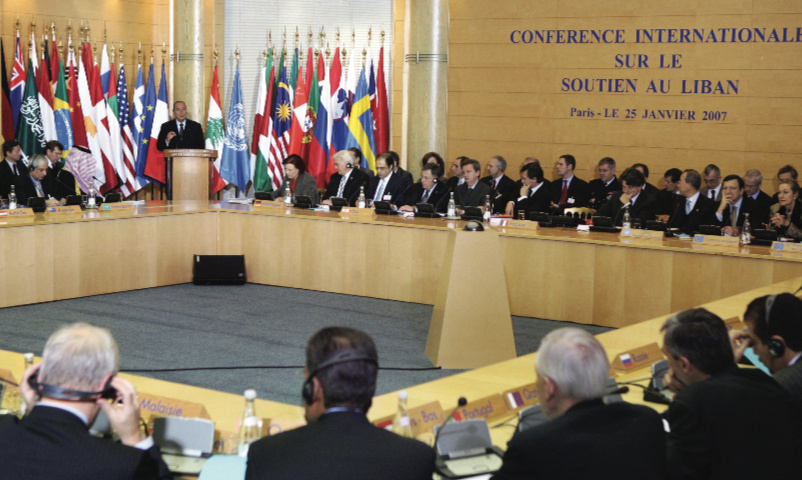
Government vague on Paris III

by Michael Karam February 1, 2007
written by Michael Karam

If I appear vague, forgive me, but looking at the document the Lebanese government was supposed to show the assembled international donors in Paris, a group that included sovereign governments, the IMF, the World Bank and other supranational institutions, one can only have a deep feeling that it was published half-cocked. Based on this, we were lucky to get the money.

The contents are undeveloped and some important parts of the economic and social reform program appear blurred and unconvincing, leaving the reader with the nagging feeling that the government is too fearful to upset certain political parties or even entire communities.

There is also a significant lack of any data projecting anticipated future economic performance. Parameters are limited in number and, wheere they do exist, they are insufficiently substantiated. Moreover, there is no executive summary that clearly itemizes the reform program.

The reader reads on and on and never sees any clear-cut proposal on how to reform the country as a whole. Instead, the reform program seems to be: Yes, we need a capital markets authority, to reduce interest rates, etc. But we never find out what is the end game.

So what does it say? The privatization section is limited, includes no details and is by and large superficial. Privatization is the key issue for donors like the World Bank and the IMF, who have insisted on it as a condition for the Paris I and II conferences. It’s as if the government has not yet learned that it needs to take the bull by the horns on the privatization issue and elaborate the privatization program in the future. Securitization is only briefly mentioned yet it is a crucial part of the process. The document does not say what will be privatized, how it will be privatized and how long the process will take. In short, the government appears not to want to commit itself.

And still the fluff appears. Governance and good practice measures are not comprehensive. These are major issues in Lebanon and although the will to tackle them is apparent in the document, the method is not clearly laid out. Transparency of the non-banking sector is not really mentioned, neither are the ways as to how it is going to be tackled. There is no description of the corporate sector’s physiognomy.

The banking section is supremely lightweight when it should have been a major focus for the government. Basel II should have been be mentioned, as should the plans to make Lebanese banks compliant and the problems of raising capital to achieve this compliance. All this would facilitate arguments with donors.

There is also no clear explanation as to how the government is going to push banks to become intermediaries in government paper and the central bank’s latest measures are nowhere to be seen. One wonders whether the BDL and the Ministry of Finance even liaised on this report.

There is an absolute need to create (or reactivate) a small claims tribunal. There are lots of private entrepreneurs in Lebanon who don’t get paid by their customers and the law is too slow and weak to enforce their claim expeditiously. This should be included in the governance and best practice section. Delays in claim payments are plaguing the economy and are slowing down GDP growth and private consumption. Given the entrepreneurial nature of the Lebanese and their economy, an efficient small claims tribunal can only contribute towards GDP growth.

The document does not mention in any detail how the government intends to develop new franchises and create diversity for the economy. This is a part the donors would be really interested in. Raising taxes and VAT (to 12% by 2008 and to 15% by 2010) is merely a partial solution to increase government revenues, and the government does not even attempt to propose innovative ways to increase revenues without affecting the purchasing power of the population. The document’s plan to increase and diversify government revenues and reduce the budget deficit is incomplete, scattered and, yes, once again, blurred.

Ordinarily, donors are in no mood to fill in the blanks. They want to see a more detailed analysis of the economic and social dynamic, as well as details on how these problems are going to be sorted. We can conclude therefore that the government relied more on its pals in the international community—French President Jacques Chirac and the majority of the European Union—to convince them to hand over the money and that the Paris III document appeared to have been drafted for cosmetic purposes only.

Michael Karam is the managing editor of EXEVUTIVE

February 1, 2007 0 comments
0 FacebookTwitterPinterestEmail
Comment

Abizaid: the Mad Arab who disagreed with the President

by Claude Salhani February 1, 2007
written by Claude Salhani

Gen. John P. Abizaid, the most senior military officer of Arab descent to serve in the US armed forces, disagreed with President Bush over the president’s Iraq strategy—and he is out.

On Dec. 20, 2006, the Pentagon announced that Abizaid, an American of Lebanese origin, would step down from his position as Commander of CENTCOM (US Central Command) and retire in March 2007. Abizaid said he would have liked to retire later but that these decisions are never made alone, a subtle way of saying he was pushed. “At the Pentagon, the knives are inserted so slowly that they are hard to notice,” said one long-timePentagon observer.

Abizaid, who as a cadet at West Point was nick named the “Mad Arab,” is considered a no-nonsense man, someone who is not afraid to speak his mind or to take the initiative. During the 1983 invasion of Grenada, Abizaid and his unit jumped from a helicopter onto a landing strip. Under fire from Cuban troops and lacking proper armor, Abizaid ordered one of his Rangers to drive a bulldozer toward the Cubans as he advanced behind it—a scene reenacted in Clint Eastwood’s 1986 film, “Heartbreak Ridge.”

But acts of derring-do aside, he was a realist, one who dared oppose the White House over Bush’s surge of US forces in Iraq. “You have to internationalize the problem,” Abizaid said. “You have to attack it diplomatically, geo-strategically. You just can’t apply a microscope on a particular problem in downtown Baghdad and a particular problem in downtown Kabul and say that somehow or another, if you throw enough military forces at it, that you are going to solve the broader issues in the region of extremism.”

The problem is that his opinions clashed with those of the White House. Abizaid was the first officer to officially call the fighting in Iraq a guerrilla war, despite denials from the White House and the Pentagon. He was the first to raise the alarm that sectarian violence was spreading. Abizaid saw the rising civil war in Iraq as replacing terrorism as the biggest threat to Iraq’s stability. He was the first to tell Congress that Iraq faced the risk of slipping into civil war.

Abizaid opposed Bush’s troop surge on the grounds that he felt the answer to Iraq’s problems lay more in a political settlement than in escalating the conflict. Senate Armed Services Committee, Senator John McCain, Republican of Arizona, told the general during a heated debate, “I’m of course disappointed that basically you’re advocating the status quo here today, which I think the American people in the last election said is not an acceptable condition.”

Abizaid also coined the phrase “the long war” to describe the challenges in fighting radical Islamist terrorism. He believed the United States is not properly organized to face the emerging threat of Islamist terrorism head-on. “I think our structures for 21st century security challenges need to adapt to this type of an enemy,” he said. “The 21st century really requires that we figure out how to get economic, diplomatic, political and military elements of power synchronized and coordinated against specific problems wherever they exist.”

He was the first to publicly say that a solution in Iraq required talks with Iran and Syria. The dispute over the increase of troop levels brought out in the open the schism between the uniforms and the suits. Testifying before a Senate committee on Nov. 15, Abizaid said, “I do not believe that more American troops right now is the solution to the problem. I believe that the troop levels need to stay where they are.”

Abizaid predicted that the insurgencies in the four Sunni provinces in northern and central Iraq will be there for the foreseeable future (a view that goes against President Bush’s hopes that by deploying an additional 21,500 soldiers and Marines, the insurgency may be somehow contained) and believes that the U.S.’s primary enemy in Iraq is al-Qaeda, whose plan is to keep casualties in the media until the American public becomes convinced that victory is impossible and leaves the region.

“When you take a look at the reach of the extremism as exemplified by al-Qaeda, it’s not just in Afghanistan, it’s not just in Iraq—it’s in Pakistan, it’s in Saudi Arabia, it’s in Great Britain, it’s in Spain,” he said. “It attacked the United States. It is organized in the virtual world in a way that is very unique, very modern, very dangerous.”

But then what does he know? He’s just a mad Arab, isn’t he?

CLAUDE SALHANI is an international editor and political analyst at United Press International (UPI)

February 1, 2007 0 comments
0 FacebookTwitterPinterestEmail
Comment

Ras Al Khaimah set to grow

by Riad Al-Khouri February 1, 2007
written by Riad Al-Khouri

Ras Al Khaimah (or RAK as it is affectionately known by the sprinkling of expats that have lived and worked there) was the Gulf’s best kept secret—until it positioned itself as a serious investment destination. An important milestone in this respect was the May 2005 investors’ conference held in the emirate by the RAK government and the World Bank. Setting the tone of that high-profile event, HH Sheikh Saud bin Saqr al Qasimi, Crown Prince and Deputy Ruler of RAK in his opening address said, “I believe the economy of RAK is on a verge of a tipping point after which we will see exponential change and growth that will be unstoppable.”

He turned out to be right, with RAK now rapidly attracting investment. While RAK products like glass and sanitary goods already export to over 100 countries, there is vast potential for more investment in industry, which remains the emirate’s “engine room” generating income and jobs, as well as inputs for building other sectors. According to Dr. Khater Massaad, who runs RAK Ceramics and helped develop it from humble beginnings to become the world’s largest single ceramic tile manufacturer, the emirate’s investment authority (which he also heads) has “been able to attract over $1 billion of investments in various industry segments” since its inception two years ago. That includes cement, in which RAK is undergoing a massive capacity boost to become a leading producer in the Gulf, with the emirate’s 2005 capacity of 3 million tons planned to exceed the 10 million ton mark once expansion is complete.

The extra volume will be needed, as demand for cement and other building materials is set to increase in a big way in RAK with the launch of several mega-projects. RAK has just begun to develop it tourism capability, and hopes to attract investors for constructing more hotels, golf courses and many forms of water-based recreation and sport. Tourism can showcase the emirate’s economic development, attracting people to RAK and further proving to regional and international investors that it is on the map and open for business.

All of this, of course, will act to promote other sectors, including real estate development. The logic behind this emphasis is simple: much of the growth in the UAE over the coming decade will require high-value workers. One of the advantages of RAK is a location close to Dubai with potential for development of working space and lifestyle accommodation meeting requirements of high-end human resources. Explosive growth in Dubai has created considerable pressure on real estate. Land prices there have increased markedly in the last fifteen years, while people find it increasingly difficult to move about as growing road traffic has increased travel time significantly.

By contrast, RAK has considerable land that can be made available for residential, commercial, and service industry development. At the same time, strengthening of land use planning and management institutions is one of the priorities of the emirate. A comparison of land prices between RAK and other emirates indicates great potential. Besides lower-cost land, RAK is also capitalizing on its good environment and recreational facilities to attract visitors and new residents. The road trip to Dubai has been cut to about 45 minutes and RAK airport facilities are being revamped and expanded to allow better access to the emirate by plane. This enhanced connectivity makes it easier for people and businesses to locate in RAK and take advantage of the lower cost land there, further establishing the emirate as a world-class residential destination in its own right.

The main lesson to learn from RAK’s investment drive is to profit from the boom in Dubai and the rest of the region, but avoid mistakes that led elsewhere to overcrowding and other problems. The emirate is undertaking comprehensive and realistic land-use to guide future development, and RAK’s capacity to enforce well-designed standards of zoning and environmental management will be an important complement to such planning. This will keep the industrial “engine room” and the touristic “showcase” in a healthy, mutually-enforcing relationship, attracting more people and businesses alike. The strategy is nicely encapsulated by Matt Sawaqed, board member of Rakeen, one of the emirate’s flagship real estate developers, who presents his firm’s core values as “Sustainability, Responsibility, and Prosperity” – which could also apply to the emirate as a whole. As RAK’s boom gathers steam, the emirate is starting to become prosperous like its neighbors, but in a sustainable and responsible way. The challenge facing the RAK public and private sectors alike will be to keep things moving in that direction: raising incomes, profits, and living standards while caring for the environment and safeguarding core values.

RIAD KHOURI is an economist, director of MEBA Ltd Amman and a senior associate at BNI, Inc. New York

February 1, 2007 0 comments
0 FacebookTwitterPinterestEmail
Comment

Sri lankans still opt for Lebanon

by Zvika Krieger February 1, 2007
written by Zvika Krieger

Sharjah International Airport looks exactly like you would expect for an airport in the United Arab Emirates: drop boxes collect money for your favorite Islamic charities and Qur’anic societies; security checkpoints have separate rooms for women to preserve modesty during frisking; and more than half of the airport is “under construction,” an adequate description of the desert boomtown itself. There is only one thing missing: Arabs. Instead, I am surrounded by Sri Lankans.

Thousands of Sri Lankans (mostly women) pass through Sharjah every month, flying on the emirate’s budget airline AirArabia to fan out across the Middle East. But these women aren’t here to ride the camels or see the pyramids; they make up Sri Lanka’s legion of migrant laborers, and the Middle East is their biggest market. According to the International Organization for Migration, more than 1.5 million Sri Lankans work in the Middle East, mostly as domestic servants. What started as a trickle in the 1970s has quickly become a pillar of Sri Lanka’s economy—in 2005, annual remittances from Sri Lankan migrant workers totaled almost $2 billion, surpassing tea exports as the country’s top source of foreign income. As I wait in the Sharjah airport for my flight to Sri Lanka, I strike up a conversation with the two Sri Lankan women sitting next to me. One of them, a twenty-year old from a village three hours outside of Colombo, has been working in Lebanon for over two years. This is her first time home since arriving in the Middle East and, she admits after looking over both shoulders, one of the first times away from the watchful eye of her “madam.” But she is thankful—most domestic workers don’t get to come home at all during their time working abroad. Her friend sitting next to her has it a bit easier—her employer allows her to go to church once a week, where she has the opportunity to socialize with fellow Sri Lankans. But both are quick to emphasize how lucky they have been, considering the horror stories they have heard from friends. The Arab world has become infamous in Sri Lanka for its horrible treatment of Sri Lankan migrant laborers. Though usually happening behind closed doors, human rights organizations have begun to chart abuse to foreign house servants—including widespread physical and sexual abuse. Even those that are not assaulted in the traditional sense are often forced to work seven days a week with no holidays, their passports confiscated upon arrival in order to keep them prisoners. If they try to run away, their employers often accuse them of stealing and, when inevitably caught by the police, they are thrown in jail with scant legal representation. Some Middle Eastern countries have taken measures to protect these foreign workers. Lebanon, for example, has formed a task force comprised of representatives from the Lebanese government and security forces, United Nations, International Labor Organization, foreign embassies, and local NGOs to confront the issue. But since many of these workers are undocumented and most abuse happens in private homes, there is little governments can do in practice. Abuse has become so prevalent in countries like Lebanon that the certain governments (such as India and Bangladesh) have barred their women from traveling there to work.

Such restrictions are not an option for Sri Lanka, whose migrant laborers are yet another casualty of the country’s 20-year civil war. Jobs are scarce and salaries rarely support the average Sri Lankan family. Women are forced to turn to the dozens of foreign employment agencies and sell themselves into servitude for upwards of three years. “People move on their own two legs, so restricting labor isn’t like restricting tea,” said David Soysa, director of the Migrant Workers Centre in Sri Lanka. “People are going for better prospects, so if they want to go, there is little the government can do to stop them.”

The situation does not look to improve any time soon. Combined with years of war and the effects of the 2004 tsunami, Sri Lanka’s increasing reliance on remittance payments from migrant labor does little to bolster its development prospects. According to a new study by the Marga Institute for Development Research in Sri Lanka, over 50% of these remittances travel back to Sri Lanka through unofficial channels, causing substantial foreign exchange leakage and depriving the economy of much-needed foreign currency reserves. The report also emphasizes that the use of unofficial channels, rather than banks, encourages Sri Lankans to spend the money they receive from abroad rather than depositing it in savings accounts—thus perpetuating the cycle of poverty.

The tales of abuse that filter back to Sri Lanka have not stemmed the tide of migrant laborers to the Middle East. Both of the women I am sitting with in the Sharjah airport had heard such stories before they left Sri Lanka, but came anyway. They call over a third friend, who decided to come back to Lebanon even after being heavily abused by her first employer. “My husband is drunk all the time because he cannot find a job, so he abuses me too,” she says matter-of-factly. “What options do I have?”
ZVKA KRIEGER is currently in Lebanon writing for the Washington Monthly

February 1, 2007 0 comments
0 FacebookTwitterPinterestEmail
Banking & Finance

Of royals and rotors: Choppers taking off

by Executive Staff February 1, 2007
written by Executive Staff

In the Middle East’s market for executive travel, business jets have a well-established presence. Another segment of privileged transportation, one with underused potential, is the market for helicopters.

Demand drivers for helicopters in the region have traditionally been oil, royals and defense—three components of a flourishing helicopter market that many Arab countries have no shortage of. Additionally, the region has been engulfed by the increased security concerns in the post-9/11 world that have pushed global helicopter sales upwards.

“Helicopter sales are not only increasing in the Middle East but really worldwide, the primary reasons being increased oil prices and the need for security post 9/11,” Dan Pranke, Middle East sales director for American helicopter manufacturer Bell, told Executive.

Nonetheless, sales of helicopters between Dubai and Cairo have been less than they could be, especially in the corporate and VIP markets. Sales managers for some of the industry’s major manufacturers blame restrictive regulations and reluctance of governments to license operators.

Oil boom boosting chopper market

In Arab oil-producing countries, the rise in oil prices from $15 a barrel five years ago to levels of $60 or more has induced oil companies to enhance their exploration and exploitation efforts onshore and offshore, meaning more helicopters needed to transport crews and supplies to digging sites.

The mid-sized workhorse helicopters used in the international oil industry constitute a substantial investment, as illustrated last month by delivery of three 19-passenger Sikorsky helicopters to Brunei Shell Petroleum for its oil service operations. The choppers were said to cost $18.5 million apiece.

GCC countries naturally have a strong role in this market. Companies like Saudi Aramco, the world’s largest oil producing company, operate veritable helicopter fleets to support oil field exploration, drilling and production. In Qatar, Gulf Helicopters, a firm established in 1970 by Qatar Petroleum, has a fleet of 24 helicopters consisting mostly of Bell’s model 412.

Military and security forces worldwide and in the Middle East are prime customers for helicopter manufacturers, accounting for around half of global sales for leading producers. The other half of the market is the civilian sector, including uses in offshore, corporate transportation, medical and emergency services, sightseeing and media, which are served by manufacturers such as Eurocopter, a daughter of Airbus maker EADS, and American firm AgustaWestland, in addition to Bell and Sikorsky.

Although most helicopter sales in the Arab world are military and police-related, industry experts say that there is a rise in commercial and civil helicopter use in recent years and the market is tipped to become more lucrative.

“I see a great deal of potential in the market because unlike Europe, this market is still in its infancy. There will be a couple of drivers for it in the next five years, especially Dubai with the World Islands and Palm Islands projects,” said Pranke, adding that sales in the Europe, Middle East, and Africa region represent about a quarter of Bell’s global sales.

A worldwide demand survey by turbine manufacturer Honeywell and others projected in its latest (2005) edition that the Middle East, Oceania, Asia and Africa will account for 16% of global deliveries of new civilian helicopters between 2006 and 2010.

The United States is the world’s leading market for helicopter sales, followed by Europe. The survey said more than 2,600 civilian helicopter deliveries are expected in the five years from 2006 to 2010. Total deliveries of both civilian and military helicopters are estimated to reach in the neighborhood of 12,000 units during the period from 2006 to 2016, and analysts forecast substantial growth rates that will hike the value of the global helicopter market to $15 billion in 2011, up by about 50% when compared with 2005.

Well over 500 sold civilian units per year is not bad for an industry where a manufacturer like Sikorsky reported 2006 revenues of $3.2 billion from all its activities (they delivered 110 helicopters last year) and Bell last month peddled some 10-year old “pre-owned” units at prices of up to $5.5 million on its web site. They don’t publish retail prices for new machines.

No wonder that new trade fairs for the helicopter buyer are in the Middle East. The Dubai Helishow is a biennial industry show which debuted in 2004. It reported 30% exhibitor growth to 104 participating companies in its December 2006 show.

For Bell, the Dubai Helishow in December was good in terms of contacts and future leads, said a manager for the company while refusing to give any information on unit sales in the Gulf region.

“While we did not sign any deals in the Dubai Helishow, there were numerous conversations and meetings with very senior people in the region that opened or furthered negotiations that will lead to conclusion of deals,” said Mike Cox, vice president of communications at Bell Helicopter.

Another helicopter conference, Heli Mideast 2007, is scheduled to be held in May to address the growing needs for helicopters for emergency and rescue services, firefighting, industrial and private ownership.

Loosening their grip on airspaces

Organizers of the event, the UK-based aviation publisher Shephard’s, say the event will also tackle the issue of governments relaxing their grip of the airspace.

That’s where the issue of the royals comes in. While persons of royal blood in the various countries of the region are excellent customers for expensive flying gear, helicopter manufacturers bemoan the fact that many countries of the region lack regulations that authorize commercial operators.

In Saudi Arabia, people other than the royal family are not allowed to own helicopters. “It’s a security issue because helicopters can land anywhere, so the Saudi government limits the ownership of helicopters to special government agencies,” Pranke said.

“It really comes down to how senior the royal person is and how much clout they have with the relevant police force,” said Andrew Drwiega, publishing director of the Shephard’s Defence Helicopter magazine.

“Rolls-Royce has a 42% share of the civil engine market in the region,” said Martin Brodie, communications director at Rolls Royce, adding that the main engines are for civil airlines like Emirates and Etihad.

Abu Dhabi Aviation, which has a paid-up capital of $110 million and is 30% owned by the emirate’s government, operates a fleet of 38 helicopters and fixed wing aircraft to the private and public sectors, signed a deal in December with AgustaWestland to become its regional spare parts and repairs center. The value of the deal remained under wraps.

AgustaWestland have also sold choppers to the Libyan Red Crescent and the Abu Dhabi police. AgustaWestland said in December its Middle East sales in 2006 increased by 15%. It said sales from the region will contribute around $260 million, or 11.8%, of its $2.2 billion global sales, according to Gulf press.

Helicopters will continue to claim a growing role in corporate transportation in the Middle East. It is entirely predictable that the rapid growth of population centers and the high-speed commercial development of office cities, industrial cities, special trade zones and super-luxury residential towers in emerging regional centers will create demand and outright need for wider VIP and executive travel options by helicopter, given the security, prestige, and time benefits accorded by these super-convenient transportation machines.

Additionally, helicopters can be expected to even start playing a new role in short aerial commutes in association with commercial air travel in an age where the drive to the airport and security check in the terminal sometimes take as long as a flight to a nearby country. Last year, a member company of Korea’s Tongil Group launched a manufacturing project to develop helicopters that will be used in the framework of mass transport.

The Middle Eastern helicopter market may still require some time to develop into a civilian market but manufacturers will not want to miss it. “I think in today’s market any potential market is important for any manufacturer, even if it’s a small number. They are all in competition for the ones out there and also if there are rulers and royals who want to have extras on their rotors,” said Drwiega.

Industry representatives and observers agree that states like Abu Dhabi and Dubai will lead the market opening for commercial operators and private ownership of helicopters in the Middle East. If you have your million-dollar abode on the Palm, the Pearl or the World islands, where will the fun be if you and your neighbors can’t drop in on each other in a stylish chopper.


February 1, 2007 0 comments
0 FacebookTwitterPinterestEmail
  • 1
  • …
  • 597
  • 598
  • 599
  • 600
  • 601
  • …
  • 686

Latest Cover

About us

Since its first edition emerged on the newsstands in 1999, Executive Magazine has been dedicated to providing its readers with the most up-to-date local and regional business news. Executive is a monthly business magazine that offers readers in-depth analyses on the Lebanese world of commerce, covering all the major sectors – from banking, finance, and insurance to technology, tourism, hospitality, media, and retail.

  • Donate
  • Our Purpose
  • Contact Us

Sign up for our newsletter

    • Facebook
    • Twitter
    • Instagram
    • Linkedin
    • Youtube
    Executive Magazine
    • ISSUES
      • Current Issue
      • Past issues
    • BUSINESS
    • ECONOMICS & POLICY
    • OPINION
    • SPECIAL REPORTS
    • EXECUTIVE TALKS
    • MOVEMENTS
      • Change the image
      • Cannes lions
      • Transparency & accountability
      • ECONOMIC ROADMAP
      • Say No to Corruption
      • The Lebanon media development initiative
      • LPSN Policy Asks
      • Advocating the preservation of deposits
    • JOIN US
      • Join our movement
      • Attend our events
      • Receive updates
      • Connect with us
    • DONATE