• Donate
  • Our Purpose
  • Contact Us
Executive Magazine
  • ISSUES
    • Current Issue
    • Past issues
  • BUSINESS
  • ECONOMICS & POLICY
  • OPINION
  • SPECIAL REPORTS
  • EXECUTIVE TALKS
  • MOVEMENTS
    • Change the image
    • Cannes lions
    • Transparency & accountability
    • ECONOMIC ROADMAP
    • Say No to Corruption
    • The Lebanon media development initiative
    • LPSN Policy Asks
    • Advocating the preservation of deposits
  • JOIN US
    • Join our movement
    • Attend our events
    • Receive updates
    • Connect with us
  • DONATE
Banking & Finance

European – Lebanese partnership on tap

by Executive Staff February 1, 2007
written by Executive Staff

New seeds for economic growth were engineered last month in Beirut when the European Investment Bank and Byblos Bank Group announced that their collaboration had progressed another step towards establishing an investment company, which will take private equity stakes in small and medium enterprises in Lebanon and three other Middle Eastern countries—Syria, Jordan and Egypt.

The joint venture of Byblos and the EIB’s Facility for Euro-Mediterranean Investment and Partnership (FEMIP) involves EIB capital participation of up to 7.5 million euros ($9.8 million) in the private equity firm which plans to formally commence operations in the middle of this year.

According to Byblos Bank, the investment company by name of Byblos Ventures will initially work with a capital of $20 million, but the partners have made provisions to be able to expand this amount to up to $50 million if the project sprouts with full vigor.

Private equity projects taking off Private equity projects are a hot issue in the Middle East. A new lobby group for this financial method said last month that private equity funds in the GCC countries last year attracted investor interest to the tune of raising $10 billion in 2006, an almost 76% increase in new funding over 2005. As recently as three years ago, private equity funds in the GCC had to get by on managing only a handful of billions in investments, but this volume has grown to $18 billion last year and is poised to increase by further leaps and bounds, said the Gulf Venture Capital Association in January.

In this part of the region, Byblos Ventures is the third recent private equity project announced in Lebanon and the second that is funded in part by the EIB.

The first launch party happened last spring when Capital Trust and EIB teamed up for the EuroMena Fund, aiming at investments in companies in the Levant and North Africa that are ready to make the step from national to regional players and require funding for expansion. EuroMena was promoted at the time as EuroMena 1, to be followed by EuroMena 2. However, the fund’s growth seems to have been more cautious in its early phase as its managers told Executive at the Byblos Ventures press conference that they have so far entered into two participations ranging in size “between $3 and $15 million.”

The third new private equity fund that just started approaching hopeful investors is the Building Block Fund, which centers on companies with a Lebanese angle and new enterprises with emphasis on technology and services companies. It is a brainchild of Bader Lebanon, an initiative of young business personalities, and aims at raising a capital of $20 million, half of that before the end of March.

Bullish on Lebanon

Speaking to media at the signing of the partnership agreement with Byblos, EIB vice president Philippe de Fontaine Vive was all praise and cheer for Lebanon. The work on creating the private equity project with Byblos Bank Group took 18 months but was “not at all” delayed by the conflict between Israel and Hizbullah last summer and recent internal political disputes between Lebanon’s cabinet and opposition groups, de Fontaine Vive told Executive. “Lebanon will recover with Paris III and we have full optimism that this is the time to invest in Lebanon,” he said.

Byblos Ventures is based on a two-year-old ongoing technical collaboration for which Byblos, according to de Fontaine Vive, volunteered as the only Lebanese bank at that time. An earlier fruit of the collaboration was a $60 million global loan agreement, signed in February 2006.

Under a complex structure for creation and management of Byblos Ventures, the Lebanese banking group will take responsibility for supplying 50% of the capital in the new firm while FEMIP is committed to a 25% stake. Both will adjust their actual dollar contributions in the equity of Byblos Ventures to reflect the percentage stakes agreed upon. This would set the practical ceiling for the project at closer to $40 million, based on a statement by de Fontaine Vive that the capital participation authorized by EIB is capped at 7.5 million euros.

According to Paul Chucrallah, assistant general manager for Byblos Invest Bank in charge of managing Byblos Ventures, the structure to establish and manage Byblos Ventures will entail the creation of another new subsidiary in Byblos Group, which will be named Byblos Management and run Byblos Ventures on the legal basis of minimal stake holding.

As a time-limited project, Byblos Ventures has an investment horizon of ten years, maximum twelve years, divided into two stages of activity. These stages—that can partly overlap—are an investment phase of three to five years and an exit phase for the remainder of the project’s lifespan.

Expanding Byblos Management’s mandate

Byblos Management, however, could pursue projects beyond this first private equity undertaking, Chucrallah told Executive. He characterized the transfer of knowledge and the development of advanced professional skills as benefits from the collaboration between the Lebanese bank and the EIB that are even more important than their financial cooperation.

Based on this knowledge transfer and skill development, Byblos Ventures will be able to participate in the equity of traditionally family-owned firms in the region on an unprecedented level and function as accelerator for the growth of invested companies, Chucrallah said.

In other practical manners, investments into individual companies will vary between $1-2 million in size and no single investment will exceed 10% of Byblos Ventures’ equity base. Per sector, investments will be limited to 40% of the investment company’s equity, and its private equity participations are intended to focus 50% on Lebanon but this rule is flexible.

Byblos Ventures is geared to help in the development of companies by contributing both funding and expertise and Chucrallah said the project team could start engineering equity participations even before the formal launch later this year. No one could have appeared happier about this than an exuberant Joseph Raidy, the chairman of Beirut-based Raidy Printing Group.

“Byblos Ventures will help industrialists in two ways, through bringing money and through improving the structure of companies, because these are very professional people,” Raidy told Executive, adding that his company will be perhaps the first to benefit from the equity participation. He called the arrival of Byblos Ventures, “a great step for Lebanon.”

February 1, 2007 0 comments
0 FacebookTwitterPinterestEmail
Retrospective

Saddam Hussein: 1937-2006

by Executive Staff February 1, 2007
written by Executive Staff

In February 1991, former Indian Prime Minister Rajiv Gandhi, visited Tehran and met with Iran’s president, Ali Akhbar Rafsanjani. Neighboring Iraq figured high in the conversation. The US and its allies had just launched the ground war to liberate Kuwait from Iraqi occupation forces, this coming three years after the end of the disastrous Iran-Iraq war which cost over a million lives and devastated the economies of both countries.

During the meeting, Gandhi asked Rafsanjani whom he thought should and could rule neighboring Iraq. Rafsanjani thought for a moment and then replied, “Saddam Hussein.”

What a depressing assessment it was that, in the mind of Rafsanjani, only a pitiless despot like Saddam could hold Iraq together and prevent its sectarian and ethnic divisions from plunging the country into a Hobbesian bloodbath.

Doubtless, that was one of Saddam’s final thoughts as he meekly accepted the noose around his neck and scoffed at the jeers and taunts of his Shi’ite executioners, telling them that Iraq today was like hell without his iron grip.

An apposite finale

Still, his execution—for all its sordidness—was perhaps an apposite finale for a man whose brutal role over Iraq and reckless foreign entanglements shaped the course of history in the Middle East for over a quarter century.

“He was a catalyst, he made things happen and usually they were not positive and constructive but he constantly kept the Middle East in a state of turmoil,” says Gary Sick, professor of International Affairs at Columbia University.

Saddam was perhaps the last of the ‘great’ Arab nationalist dictators, his rule being founded in an ideology of left-leaning secular and militaristic nationalism; he became little more than a vicious sectarian mafia boss, plundering the wealth of his country and murdering its people to maintain his grip on power.

Iraq was always fated to play a key role in the Middle East due to its massive oil wealth, geographical proximity to non-Arab, mainly Shi’ite Iran, and potential financial and military weight in the Arab-Israeli conflict. But it was the potent mix of Saddam’s over-arching ambition and sense of destiny combined with an impulsive and vengeful nature that propelled Iraq into a series of disasters that has left an indelible mark on the region.

Saddam’s rise to absolute power began in 1968 when he participated in a bloodless coup that saw his cousin Ahmad al-Hassan al-Baqr become president. In the 1970s, Saddam, who gradually came to overshadow the president, helmed an economic modernization program, funded by the proceeds of the 1973 oil boom. Iraqis were granted free education and hospitalization and campaigns were launched to eradicate illiteracy. Saddam also helped forge a sense of national unity rooted in Baath Party ideology, smothering Iraq’s diverse ethnic and sectarian composition.

Despite his later tendency to make colossally bad foreign policy decisions, he had some success during the mid-1970s in outflanking Israel and US Secretary of State Henry Kissinger. In the wake of the 1973 Arab-Israeli war, Kissinger conspired with the Shah of Iran and Israel to foment a Kurdish uprising in northern Iraq. The goal was to tie down the Iraqi army and prevent it from coming to the assistance of Syria if another war with Israel were to break out. But Saddam made a separate deal with the Shah, offering to share the Shatt al-Arab waterway between their two countries if Iran dropped its support for the Kurds. Iran closed its border to the Kurds, allowing Saddam’s army to crush the rebellion.

However, Saddam continued to resent the deal he struck with the Shah and it was one of the reasons why he went to war with Iran five years later.

“He was able to bring to Iraq a sense of development for a period … Then it was all destroyed year after year with adventurous decisions,” says Shafeeq Ghabra, a Kuwaiti professor of politics.

Saddam pushed aside the ailing al-Baqr and became president in 1979, the same year that the Shah was toppled by the Islamic revolution that brought Ayatollah Ruhollah Khomeini to power. The rise of a militant Shi’ite theocracy in Iran alarmed the Sunni Arab Gulf. Saddam, fearing Khomeini’s influence over Iraq’s restless Shi’ites and tacitly backed by his Sunni Gulf neighbors, invaded Iran in 1980, setting in motion the devastating eight-year war.

Saddam intended to smash the disorganized fledgling Islamic regime in Iran, an act that would confirm his leadership of the Arab world and earn the gratitude of his neighbors in the Gulf. But the war had the unintended consequence of strengthening Khomeini’s rule.

“It forced the Islamic revolution to get out of its zealous craziness and begin to organize itself and pull itself together,” says Professor Sick, an Iran specialist. “In a way, Saddam stabilized the Iranian revolution and kept the mullahs in power.”

Bringing Iran and Syria together

The conflict also triggered an alliance between Iran and Iraq’s arch enemy, Syria, which was ruled by a rival branch of the Baath Party. The Iranian-Syrian relationship has proved enduring: in the past year, it has further strengthened to become one of the region’s most significant geo-strategic alignments.

When the Gulf war ended in 1988, the Iraqi economy was in ruins with some $75 billion owed to Iraq’s Gulf backers. Relations between Iraq and Kuwait steadily deteriorated over the next two years with the latter’s refusal to forgive the war debt and cut oil production to raise revenues for Iraq. A bitter Saddam sent his war-weary army into Kuwait in August 1990, triggering a fresh convulsion in the Middle East.

The US assembled an unprecedented coalition of Arab and European allies to remove Iraqi forces from Kuwait. The second Gulf war also marked the beginning of a prolonged US military deployment in Saudi Arabia, which would later be used by Osama bin Laden to partly justify his anti-American actions, culminating in the attacks of September 11, 2001.

The crippling UN sanctions on Iraq during the 1990s, the most severe against any country in UN history, devastated an already weakened economy, but failed to bring down Saddam’s regime.

Although the 2003 US-Anglo invasion of Iraq finally ended his long tyrannical rule, its aftermath has turned Iraq into a byword of sectarian violence and bloodshed with no end in sight.

Although Saddam is dismissed by most Arabs as a tyrant who ran a regime of unmitigated brutality and greed, some regard him as a champion of Arab steadfastness against American “imperialism” and Israeli aggression. Indeed, it is a telling indicator of how badly the Americans have messed up in Iraq that the cruel, corrupt despot they removed in the name of democracy and freedom ended his days akin to a folk hero for many embittered and nervous Arab Sunnis, who resent the empowerment of Shi’ites in Iraq and fear Iran’s hegemonic designs on the Middle East. The poor, crushed and abused Palestinians have long looked up to Saddam, gratefully receiving his millions of dollars and words of support while overlooking the fact that his actions were little more than a cynical manipulation of their plight to curry popularity and burnish his Arabist credentials.

Although the main pretext for toppling Saddam was his alleged arsenal of weapons of mass destruction, the American architects of the invasion also hoped that the Iraqi dictator’s demise would trigger a domino-effect in the Middle East, with other Arab autocracies falling to be replaced with Western-friendly democracies.

Saddam’s downfall empowered the despots of the region

But US mismanagement of occupied Iraq, the tenacity of the Iraqi insurgency and the rise of Shi’ite-Sunni hostilities has had the opposite effect, dealing a blow to the democratization project in the Middle East. Indeed, the violence has grown so bad that recent polls suggest that most Iraqis believe life was better under Saddam. The implicit message has reassured to the region’s autocrats, who can point to the chaos in Iraq to justify their own iron-fisted rule and clamp down on calls for democratic reforms.

“The downfall of Saddam and its aftershocks only empowered the regimes of the Middle East,” says Sami Moubayed, a Syrian political analyst. “Leaders can now say, ‘Look to Iraq. This is what the Americans will bring.’”

Truly, Saddam was a monster, but given America’s failure in Iraq and the sectarian disaster it has spawned, Iraqis and other Arabs could be forgiven for thinking that perhaps there was something after all to Rafsanjani’s discouraging recognition of Saddam’s qualities as ruler.

February 1, 2007 0 comments
0 FacebookTwitterPinterestEmail
Banking & Finance

Foreign firms ready to Bank on Egypt

by Executive Staff February 1, 2007
written by Executive Staff

Egypt’s banking sector is set to become hotly competitive in 2007. Strong international and regional banks that have entered the market in the past two years are aggressively hunting for market share in what observers are calling a very “new and lucrative” market. These growth-hungry banks will meet new competition from big local banks whose survival after privatization will allow them to restructure and reinvent themselves as modern risk management institutions.

The new competitive environment goes hand in hand with the banking sector reform, and a reduction in the number of Egypt’s banks from 53 to 35 since the reform program was launched in 2004. Although it brought the number of operating banks down, the reform program’s consolidation of the sector was conducive to increased productivity and competitiveness because it forced inefficient state-run banks with opaque loan portfolios out of their pampered and protected positions into the harsh “real world” of commercial banking.

Seeing the fruits of reforms and privatization, Arab and other foreign banks have started to expand their presence in Egypt and established footholds by acquiring local banks.

Lebanese banks are at the forefront of the trend. BLOM Bank beat out competitors to take over Misr Romanian Bank in late 2005 and quickly announced that plans to develop the retail business of the renamed Blom Bank Egypt. Only weeks later, Bank Audi acquired Cairo Far East Bank for $94 million, and said recently that it wants to expand the branch network for the bank, now called Bank Audi Egypt, from the current three to 20 before the end of the year.

Other entrants include Bahrain’s Ahli United Bank which bought 89.3% of Delta International Bank in August for LE1.65 billion. And in July, UAE’s Union National Bank acquired the government’s stake in Alexandria Commercial & Maritime Bank for LE65.3 billion; it is now preparing to acquire Arab Investment Bank.

Foreign players eager to enter market

Foreign players can currently only enter the Egyptian market by buying into existing banks. Thus international banks having acquired and rebranded local banks in a number of bidding contests.

In July 2005, Greece’s Piraeus Bank bought 70% of the Egyptian Commercial Bank and renamed it Piraeus Bank Egypt. The Greek bank increased its stake in the subsidiary to over 95% and announced plans to add 220 branches by 2010. The National Bank of Egypt (NBE) sold its 18.7% stake in Commercial International Bank (CIB) for $236 million in February of last year to a consortium led by American private-equity giant Ripplewood Holdings.

Some foreign banks saw 2006 as good year to grow their existing operations through M&A action. Paris-based Societe Generale, which already had a presence in Egypt through National Societe Generale Bank, last November received final approval for merging Misr International Bank into its operation—a move that made it the largest private commercial bank in the country. Credit Agricole, France’s largest banking group, likewise repositioned and expanded its Egyptian operation by creating Credit Agricole Egypt last year after its existing local subsidiary, Calyon Bank, purchased Egyptian American Bank. Credit Agricole Egypt is now Egypt’s third-largest private commercial bank by assets.

However, the biggest deal of 2006 was the sale of state-owned Bank of Alexandria (BA), the smallest of the Big Four state-owned banks, to Italy’s Gruppo Sanpaolo IMI. Sanpaolo purchased 80% of BA for a whopping $1.6 billion or six times the bank’s book value. The bank aims to double its size and market share in Egypt and also plans regional expansion.

With the rush of foreign banks to the market, government officials say that investments by foreign banks in 2006 increased by a sum of LE4.2 billion.

Solid grounds

Analysts consider the Egyptian banking sector under-penetrated, with only 10% of Egyptians having bank accounts. In general, private sector banks operating in Egypt are today financially more solid than they were, and the market can be considered a more competitive place compared to a few years back.

Egypt also offers growing potential to Arab regional banks and joint venture banks with Gulf-based partners.

Former president of the National Bank of Egypt Ahmed Karat sees the presence of Arab banks in Egypt as a natural consequence of the interest of regional and international players in this market.

Seasoned Arab banks that have been operating in Egypt for some time and have recently announced plans to increase the breadth and depth of their operations include Jordan’s Arab Bank, the National Bank of Abu Dhabi, and Faisal Islamic Bank of Egypt, which has Gulf-based shareholders.

Regional banks and governments also have stakes in Cairo-based commercial and wholesale banks such as the Arab African International Bank, Arab International Bank, Egyptian Gulf Bank, Egyptian Saudi Finance Bank, Suez Canal Bank, and the Arab International Banking Corporation. The National Bank of Oman added two more branches to its network in Egypt in 2005, and the Bahrain-based Arab Banking Corporation strengthened its presence under the name ABC Egypt to become the fifth Arab bank in the country.

More Arab banks

However, although Egypt has a substantial number of Arab banks, their total market share does not exceed an estimated 10%. Experts say that in light of the recent reforms, Arab banks would have no difficulties increasing their market share to between 25% and 28%, especially because these banks have enough experience in similar markets.

According to the experts, the weak performance of Arab banks is due to a structural obstacle, which these banks must overcome. If they succeed in opening new market segments, regional banks could benefit from customer sentiment that favors them over European or American competitors.

Opposition groups in Egypt have always resisted and attempted to block the sale of local banks to foreign concerns. However, banking experts say Arab banks in Egypt might be under threat from their bigger European counterparts who have longer experience in serving large markets and can provide financial services for corporate clients, investment and private banking, capital markets, asset management and, increasingly, also Islamic finance. A Fitch ratings report issued in late 2006 said that “foreign banks have brought in more innovative products and new delivery channels and are attracting the best skills.”

Most analysts agree that the presence of foreign banks is not a threat to Egypt’s existing public sector banks, and the government prefers buyers to be big name banks capable of introducing new technologies and developing banking services. “Foreign banks will create more competition that will force the local banks to shape up and improve their services,” explained Nabil Hashad, an Egyptian banking expert, adding that foreign investors are needed to “maximize the cost efficiency, productivity and profit efficiency of banks and not just reduce costs.”

Challenges for 2007

Credit must be given to the Egyptian government for sticking to its plans to open up the banking sector and forge ahead with its privatization program. Egypt has succeeded where several other countries in the region have failed. The challenge moving forward will be whether this momentum and excitement will continue. Although much has been accomplished—with serious delays—much more needs to be done. Several global rating agencies such as Moody’s are still cautious with their rating and assessment of the economic condition for Egypt.

One highly anticipated development for 2007 is the merger of Banque Misr and Banque du Caire, Egypt’s second and third largest banks, into the largest bank in the country. Both are state-owned and their merger and privatization will add an important milestone to the conversion of the backward state banking sector into a private sector powerhouse.

To sustain growth, another big push for consolidation, while improving supervision and solving the sector’s chronic NPL problem would do miracles. The government must also provide special incentives to Arab banks so that they can increase their market share. Currently, European banking institutions have the upper hand and benefited the most from the privatization drive. GCC-based banks have many opportunities to enter the market and efforts to encourage these banks to get involved should be priority for the Investment Ministry.

2007 should be the year the government completes it reform and privatization drive. Additional focus must be placed on creating an interbank market and pushing for more transparency and better laws to protect depositors. The big mergers and deals in 2006 must now be replicated in 2007, because these reforms are necessary to keep the economy and banking sector on track.

As Egypt’s Minister of Investment Mahmoud Mohieldin put it, “Today, we are talking about a banking sector that is not going to show any mercy to those who are incompetent, inefficient or unable to stand up to the challenges of competition.”

February 1, 2007 0 comments
0 FacebookTwitterPinterestEmail
Comment

The year that brought globalization to the Arab World

by Executive Staff February 1, 2007
written by Executive Staff

Since the current wave of global change accelerated after the end of the Cold War, mention of globalization has tended to upset Arabs. However, 2007 could be the year that the Arab World really moved closer to the rest of the globe. Politically, this was evident in the Annapolis conference, where — under watchful American eyes — for the first time high-level representatives of Saudi Arabia and Syria sat down in public with Israeli officials, a powerful symbol of the region’s engagement with the West and its stepchild Israel. In the economic sphere, vast Arab investments were welcome in Western countries, sometimes as sizeable, controlling interests in big-name global companies. Not all deals went off without a hitch, witness the Qataris backing off over the takeover of the major British retail chain Sainsbury’s. But it will soon be forgotten, as the 2005/06 failed attempt by Dubai World Ports to invest in the US was forgotten, while Arab money poured into shaky Western stock markets. Moves in the opposite direction were also evident, as global businesses headed in greater numbers to Arab countries.

Along with these developments, the message that finally started to come across in 2007 is globalization is neither necessarily good nor bad, but it is here and it is important. The term still has negative connotations in the region, but 2007 has shown that to integrate into the world does not mean that Arab countries will have to surrender their identity.

Nevertheless, the big deal for the eastern part of the Arab region remains the Israeli-Palestinian conflict. Annapolis has not of course resolved the problem, but things may be better after that meeting than they were before. In the Maghreb on the other hand, the major issue is closer relations with Europe and it is important that French president Sarkozy chose to roll out his Mediterranean Union initiative in that corner of the Arab World. Like Annapolis to the eastern Arab countries, the launch of the idea of a Mediterranean Union does not signal that all of the Maghreb’s problems are over. However, this indication of an increased European role in the region is critical. In the East too, greater EU involvement in the peace process could help. Europeans being involved more in the Arab World means more emphasis on the bright side of globalization and this seems to have gained ground in the Arab World during 2007.

Turning from the big picture to nitty-gritty issues at the center of globalization, such as logistics, is also revealing, in terms of changes taking place within the Arab World. For example, the World Bank’s first Logistics Performance Index ranked Lebanon 98th among 150 countries worldwide and 13th among 17 Arab states. The index covers ability to track and trace shipments, timely arrival, customs procedures, logistics costs, infrastructure quality, and competence of the domestic logistics industry. Globally, Lebanon tied with Zambia and ranked behind Papua New Guinea, and was below both the global average and the Arab score. Examples of Lebanon’s performance vis-à-vis Arab states in individual sub-indices were especially grim: tying Syria and behind Yemen on the customs sub-index, below Mauritania on the infrastructure measure, behind Tunisia on logistics competence, and weaker than Egypt on tracking and tracing. To mention Lebanon’s logistics in the same breath as most of these countries would have been unthinkable a generation ago. But today, while much of the region advances and globalizes, the Lebanese wallow in instability.

However, even considering Lebanon, the past year appears to have been better for the Arab World as a whole, at least in terms of macro-economic indicators. Was the same true regarding the average person living in the region? Maybe not, so how can the benefits of growth and globalization that accrue to the rich and well-connected help the average person in 2008? The answer may be larger doses of democracy and liberalization to bring the region into better harmony with the forces of globalization. Well thought out democratic practices and properly introduced liberalization are valuable in making the best of globalization. Take as an example the recent and continuing entry of Arab countries into trade agreements. The experience of various regions, including Latin America and South and East Asia, suggests that the negotiation capacity of states seeking to join trade pacts actually increases in the presence of pressure groups. By contrast, in many cases Arab negotiators themselves monopolize, and so weaken, their own countries’ negotiation position. The challenge remains to revitalize labor unions, professional syndicates, and business associations as partners in public decision-making, to make the best of globalizing. The alternative is globalization for the rich and powerful and a doubtful future for the rest of the population.

February 1, 2007 0 comments
0 FacebookTwitterPinterestEmail
Banking & Finance

Strong regulations benefit Turkey’s bank industry

by Executive Staff February 1, 2007
written by Executive Staff

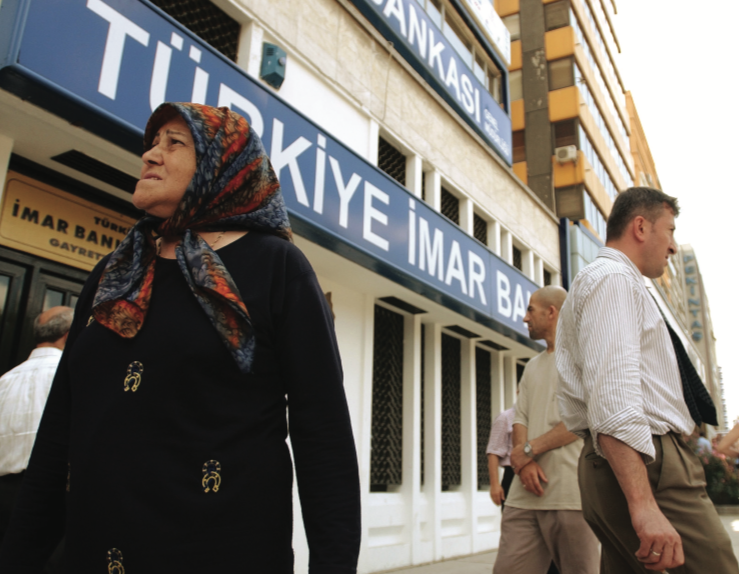
Foreign banks are continuing to show strong interest in Turkey’s banking sector, as demonstrated by the upcoming sale of state owned HalkBank and privately-held Oyak Bank. While the inflow of foreign blood over recent years has elevated the standards of the banking sector, Turkey’s bank regulator has forced local players into shape.

Since its establishment in 2000, some local bankers have lauded the independent Banking Regulation and Supervisory Agency (BDDK) for the discipline it has instilled in the sector. Non-performing loans (NPLs) have been whittled down and are not considered to pose a problem, while loan volumes—specifically retail loans and SME loans—have increased. The minimum capital adequacy ratio was recently increased from 8% to 12%. The sector is well regulated and the level of transparency and reporting mechanisms are extremely good, says Levent Celebioglu, the assistant general manager and head of the financial institutions group of TEB-BNP Paribas.

Regulatory scheme praised, but doubts remain

While the majority of market observers praise Turkey’s regulatory authority, others take a more qualified stance. The BDDK’s interventionist approach could be dangerous. Having broader and more sophisticated regulatory parameters—as for instance in Europe—is safer as it means that the entire sector will not suffer should the regulatory authority make a miscalculation or misjudgment, said a foreign bank executive. Control of interest rates on credit cards has also been a source of complaint for some in the sector, limiting returns and business expansion. This is not to deny that the regulatory authority’s more accommodating approach on card interest rates has offset much sector-wide disgruntlement, resulting in a broader consensus between the regulator and regulated. Restricted consumer credit though is still raised as an issue by some insiders. Limiting the total amount of credit available to each person protects those banks that already have customers. The emphasis rather should be on educating consumers on how to avoid debt, according to the observer. Providing safeguards against debt, regulatory fans retort, is the safest track.

Yet, the BDDK’s strong mandate as a hands-on regulator should be placed in the context of Turkey’s turbulent economic past, when stringent regulation of the banking sector was clearly lacking. Many observers blame the 2001 financial crisis on the lax banking safeguards of the time. While 85 banks were operating in Turkey in 2000, the number decreased to 51 by 2005 following liquidations, mergers and acquisitions.

An evolving industry

The industry has evolved since the BDDK emerged as regulator but risks nonetheless remain. A recent report by international ratings agency Fitch Ratings underlined that Turkish banks needed to closely monitor asset quality, diversify earnings and improve efficiency as the sector experiences rapid growth in loans and ever increasing competition from constituent players. In November, BDDK head Tevfik Bilgin also warned that money from deposits alone was currently not sufficient to fund the banks, with foreign borrowing filling the gap.

Foreign banks shrug at such concerns. The banking asset to GDP ratio Turkey is approximately 85 to 87% in 2006, whereas for the EU 15 members it is 280%, or 110% for the EU 25 members, said Celebioglu, pointing to the scope for growth in the Turkish market. Likewise, Bilgin underlined the fact that the market was potentially worth between $700 billion and $800 billion, as opposed to the $323.03 billion registered towards the end of 2006. Turkey had previously lived in a high inflation environment with high interest rates, which forced consumers to hold back on spending. But the tide has shifted, with consumers showing greater confidence on the back of the government’s economic policies.

Meanwhile, the sector as a whole will continue to benefit from the entry of foreign players. The total foreign shareholding at Turkish banks is expected to reach 18% of total paid-in capital by the end of the year, according to the 2006 Fitch report.

February 1, 2007 0 comments
0 FacebookTwitterPinterestEmail
Financial Indicators

Global economic data

by Executive Staff January 16, 2007
written by Executive Staff

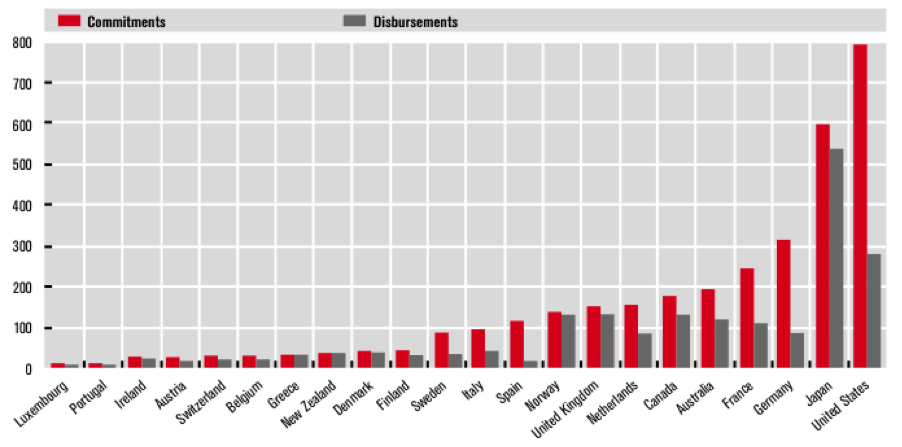
OECD’s Development Aid Committee (DAC) member country responses to tsunami disaster

Millions of US dollars

The unprecedented humanitarian response to the Indian Ocean tsunami prompted governments, international organizations, private individuals, charities and companies to pledge $13.6 billion to the affected countries. Of that, $5.3 billion was from OECD member governments, and a further amount from private citizens in OECD countries.

Donor governments and the European Commission have committed $1.7 billion to emergency aid and $1.9 billion to longer-term reconstruction projects, to be spent by 2009. More than 90% of the emergency aid – nearly $1.6 billion – was spent in the nine months immediately following the disaster. For reconstruction, $473 million has been spent, leaving $1.4 billion committed and in the pipeline for spending over the coming years.

Together, Indonesia and Sri Lanka have received more than 60% of the funds committed so far.

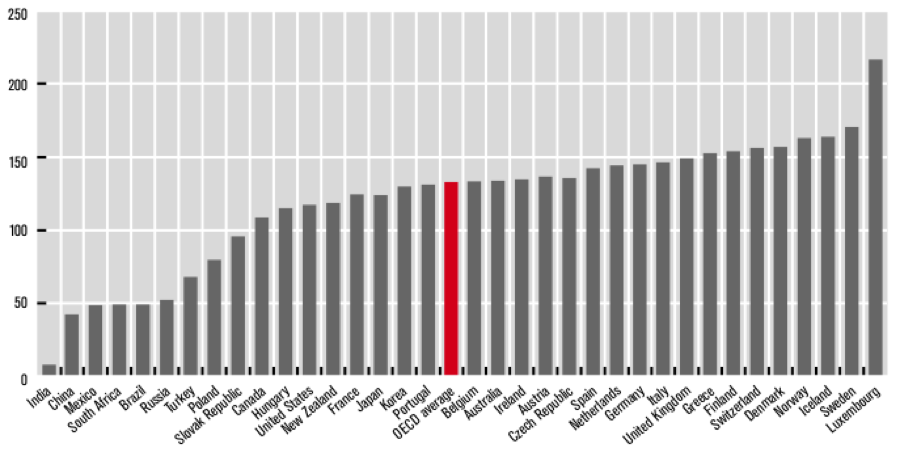
Telephone access

Number of telecommunications access paths per 100 inhabitants in 2003

Access to communication networks continues to expand in all OECD countries. At the end of 2003, the total number of fixed and mobile telecommunications paths had increased to more than 1.4 billion. This represented a 6.7% increase over 2002 and an average increase of more than 12% in each year since 1998.

For the first time, however, growth was not occurring across all access paths. The number of cellular mobile communication subscribers continues to climb. An additional 69 million mobile subscribers were added in 2003. By way of contrast, some segments of the fixed connection market have begun to decrease. The number of fixed access lines decreased in both 2002 and 2003 and will most likely continue to do so over the coming years.

Since 1991, growth in access paths per inhabitant has been particularly high in those countries that started from a low base – Hungary, the Czech Republic and Mexico – and somewhat slower in those where the number of access paths per inhabitant were already quite high, such as Canada and the United States.

By 2003, all but four OECD countries – Mexico, the Slovak Republic, Turkey and Poland – had more than one telecommunications access path per inhabitant and eight countries reported more than one and a half per inhabitant – Denmark, Finland, Greece, Iceland, Luxemburg, Norway, Sweden and Switzerland.

Among the five non-OECD countries, growth has been spectacular in China, which had less than one access path per 100 inhabitants in 1991, but more than 40 in 2003. For four of the five non-members, access paths per inhabitant are between 40 and 50, with India as the exception. Although there has been steady growth over the period, there were still only about six access paths per 100 inhabitants of India in 2003.

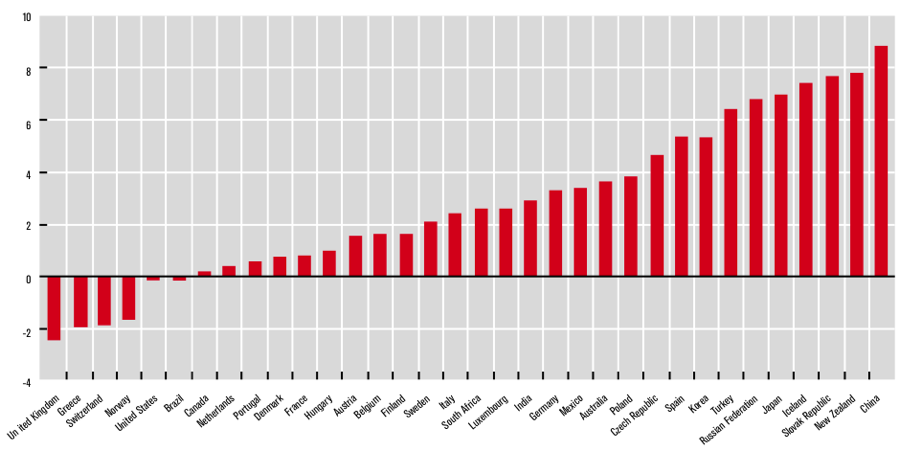
Arrivals of non-resident tourists staying in hotels and similar establishments

Average annual growth in percentage, 1998-2005

Over the period as a whole, the United States recorded the largest number of arrivals in hotels and similar establishments followed by France, Italy and Spain. In general, the larger countries record the highest number of arrivals, although Austria and Greece are relatively small countries with a high number of arrivals, and Japan and Mexico are large countries but record relatively low numbers.

The 9/11 terrorist attacks resulted in sharp falls in arrivals in the United Kingdom and the United States but did not noticeably affect arrivals in most other countries. Countries in central and eastern Europe have recorded strong increases in arrivals since 1990. The above graph shows annual growth in arrivals of non-residents averaged over the period since 1998. Arrivals declined in the United Kingdom, Greece, Switzerland, Norway and the United States, but grew at 6% per year or more in Turkey, Japan, Iceland, the Slovak Republic and New Zealand. Among the five non-members, growth was particularly high in the Russian federation and China.

Tourism 2020 Vision is the World Tourism Organization’s (WTO-OMT) long-term forecast and assessment of the development of tourism up to the first 20 years of the new millennium. Although the evolution of tourism in the last few years has been irregular, the WTO-OMT maintains its long-term forecast for the moment. The underlying structural trends of the forecast are believed not to have significantly changed. Experience shows that in the short term, periods of faster growth (1995, 1996, 2000) alternate with periods of slower growth (2001 and 2002).

WTO-OMT’s Tourism 2020 Vision forecasts that international arrivals will reach over 1.56 billion by the year 2020. East Asia and the Pacific, South Asia, the Middle East and Africa are forecasted to record growth at rates of over 5% per year, compared with the world average of 4.1%. The more mature tourism regions, Europe and the Americas, are expected to show lower than average growth rates. Europe will maintain the highest share of world arrivals, although there will be a decline from 60% in 1995 to 46% in 2020.

January 16, 2007 0 comments
0 FacebookTwitterPinterestEmail
Financial Indicators

Regional equity markets

by Executive Staff January 16, 2007
written by Executive Staff

Beirut SE: Blom  (1 month)

Current Year High: 1,934.21  Current Year Low: 1,187.86

The Beirut Stock Exchange in the occupied Central District of the Lebanese capital saw trade volumes melt to new lows. The BSE entered the Christmas holidays 9.68% lower than the index had been at the start of the year and at a, yes, new low for the year with 1,182.69 points. While under siege of what politically correct locals call “political disturbances”, the BSE management put on a good face and announced a number of plans for service improvements in 2007. These plans include remote trading facilitation for brokers (operating in a test phase from the last week of 2006), as well as creation of a new BSE website that will finally provide live tracking of traded securities. Not to forget that the bourse will set up auxiliary premises at a location outside the Beirut Central District – for “disaster recovery” in case of emergencies.

Amman SE  (1 month)

Current Year High: 9,015.94  Current Year Low: 5,267.27

The Amman Stock Exchange, not to be left out of the regional contraction crowd, reached its new index low for 2006 a few days after GCC peers at 5,267.27 points on December 17. The ASE index ended the third week of the month at 5,357.11 points, 328.4 points lower than its November 26 close. The ASE said it will introduce a system for electronic initial public offerings in the first quarter of 2007. Royal Jordanian Airlines said it expects to be partly privatized by end of 2007. In a curious December tale, a hitherto unknown holding company held a press conference announcing plans to operate with $4.23 billion in capital and establish 10 new companies over the next two years, including a $2.82 billion real estate company in Jordan.

Abu Dhabi SM  (1 month)

Current Year High: 5,253.99  Current Year Low: 2,936.40

Trading on the Abu Dhabi Securities Market was unexciting in terms of volume and after a 64-point dip below the 3,000 point level in the first week of December the index kept around 3,000 points through the middle of the month before sliding into another minor downtrend in the week ended December 21, which it closed at 2,968.52 points. The ADSM management announced a plan to enforce stricter rules aiming to thwart insider trading, including new disclosure requirements for listed companies to publish the names of shareholders with stakes of more than 3% and an extension of off-limits periods during which company officers may not buy or sell shares in their companies in reporting seasons. After signing a cross-listing agreement with the Muscat Securities Market in early December, the ADSM is set to also enter a cross-listing agreement with the Lahore Stock Exchange.

Dubai FM  (1 month)

Current Year High: 8,013.99  Current Year Low: 3,997.29

After establishing a new year-low of 3997.29 points on December 4, the Dubai Financial Market went on a 350-point hike upwards, but weakened again in the week ended December 21. The new Dubai Financial Market General Index, which was launched in early December, closed the week down by 2.57% at 4,153 points. There was no indication that the market has settled and could not go down any further. The DFM added Bayan Investment and Markets Complex companies, both Kuwaiti, to its traded equities. Bourse officials said that trading in the shares of the DFM, which undertook the region’s first flotation of a stock market, will commence in January. The DFM management denied that the IPO was the reason for the slump in the market’s liquidity this month.  

Kuwait SE  (1 month)

Current Year High: 12,054.70            Current Year Low: 9,164.30

Trading activity on the Kuwait Stock Exchange was more solid than that on some other GCC bourses and the index ended the third week at 9,892.90 points, but not before the KSE recorded a new year-low of 9,164.30 points earlier in the month. The KSE supervisors took measures to temporarily ban shareholders in 13 companies, among them three banks, from voting in stockholder meetings on account of disclosure violations. Government decisions to stop ongoing contracts with some companies, most prominent among them the recently renamed logistics firm Agility (previously known as Public Warehousing Company) resulted in critical reviews of government announcement practices as Agility shares suffered an exaggerated drop upon the cancellation news found in a newspaper.

Saudi Arabia SE  (1 month)

Current Year High: 20,634.86            Current Year Low: 7,665.73

The Tadawul index rebounded early in the month from a drop to 7665.73 points, another new low for the year. But, after reaching nearly 8,250 points it did not succeed in staying above the 8,000 points level at the end of the third week in December, with the TASI down 53% in the year to date. Industrial group Al Abdullatif said its initial public offering on the SSE was oversubscribed 162% with $352 million in subscription amounts. Retailer Al Hokair debuted on the SSE after formalities were resolved which had delayed the start of trading. The Capital Market Authority found an investor guilty of fraudulent behavior, ordering him to pay a fine of $640,000 and pay back $24 million in illegal gains.

Muscat SM  (1 month)

Current Year High: 5,799.77  Current Year Low: 4,657.16

The Muscat Securities Market remained undisputed as best performing GCC bourse in 2006 in terms of index development, closing the third week of the month almost 15% higher year-to-date. The market, which had drifted slightly lower in the first half of December, climbed rather nicely to 5,659.31 points on December 21 in a 260-point rally over 10 days. A new brokerage, Al Amana Securities, received its license from the Sultanate’s Capital Market Authority. The brokerage, owned by Oman National Investment Corporation, brings to 20 the number of financial intermediary and asset management companies registered with the MSM. In a step to enhance trading activity on the bourse, which Omani regulators said has grown organically this year but could benefit from increasing volumes, the MSM entered a cross-listing agreement with the Abu Dhabi Securities Market. 

Bahrain SE  (1 month)

Current Year High: 2,347.01  Current Year Low: 1,996.68

The Bahrain Stock Exchange ends 2006 with low volumes, moving sideways from 2,152.62 points on November 27 to 2,160.95 points on December 21. Fluctuations of 35 points up and 45 points down early in the month marked the exciting points in the market that stayed true to its reputation as being disassociated from trends on larger GCC markets. Value buying, institutional buying, bargain buying were the buzzwords for the month whose third trading week was shorter than usual due to the national holiday. The BSE reported that corporate results of listed Bahraini companies improved year-on-year by 29.9% in the first nine months of 2006 and reached $1.26 billion. Ithmaar Bank stock was moved to the regular market after trading for six months on the BSE’s IPO market. 

Doha SM: Qatar  (1 month)

Current Year High: 11,279.98            Current Year Low: 5,825.80

The Doha Securities Market was in step with several GCC peers and weakened to a new year-low in early December at 5,825.80 points. In the third week of the month, however, the DSM sped ahead and climbed to 6,536.99 points on December 21 – still about 40% down year-to-date but 711 points better than its low. Doha Bank successfully completed its first subordinated bond issue, a $340 million issue under the bank’s $1 billion Euro Medium Term Note Program and the first such bond by a Qatari bank. Gulf Commercial Bank, another DSM banking mainstay stock, launched a new $275 million mutual fund with two investment classes for domestic and foreign subscribers. Gulf Commercial Bank said it will offer 120 million shares in a $275 million IPO in the first quarter of next year.

Tunis SE  (1 month)

Current Year High: 2,339.55  Current Year Low: 1,597.73

The Tunisian Stock Exchange kept on rolling in December, and although trading sideways during the month, its almost uninterrupted rise over the past five months made the TSE the region’s only bourse to approach the yearend with a new 12-month high. The Tunindex’s December 21 close of 2, 343.38 put the TSE 16.58 points up compared with November 27 and 45.09% up year-to-date. Over the past four years, the number of TSE-listed companies almost tripled. The bourse’s index committee announced the composition of the Tunindex for 2007, which includes 32 stocks that were traded during more than 60% of the TSE’s trading days in 2006. In FDI news, Dutch drinks manufacturer Heineken bought just under 50% of unlisted Tunisian beverages firm SPDB for $35.3 million and wants to build a new brewery in the country.

Casablanca SE All Shares  (1 month)

Current Year High: 9,109.55  Current Year Low: 5,337.53

The Casablanca Stock Exchange climbed to a peak above 10,000 points in December, with the Casa All Shares index reporting in at 10,132.61 points on the 13th of the month. However, the index dropped back to 9,583.96 points on December 21 in the market’s first slight weakening in a while. The Moroccan bourse went into the Christmas season still more than 500 points better than its position had been on November 28 but market watchers started to say that it may be time for an adjustment in the bourse’s path. Valuations have been driven up to a price to earnings ratio estimation of 19.5 times for 2006, placing Morocco now above PE ratios of GCC markets, although the Casablanca rally has so far not ventured into valuation territories as excessive as those scaled by the Gulf bourses last year.   

Cairo SE: Hermes  (1 month)

Current Year High: 68,994.73            Current Year Low: 41,965.37

In the lead-up to the 2006 Christmas season, the regional investor tip is go north – North Africa that is, not Santa’s HQ at the pole – and see where shares are moving north too. The Hermes index of the Cairo and Alexandria Stock Exchanges didn’t quite make it back to the 60,000 points before Christmas but nonetheless came close with 59,800.23 points, and stood 2,322 points higher than on November 29. Deutsche Bank issued a Buy recommendation on the shares of Orascom Telecom, giving the stock a 10% upside potential. The MobiNil phone operator, in which Orascom Telecom is a major stakeholder, meanwhile announced a 46.2% cash dividend to be paid before year’s end. Government officials in Cairo said Egypt Air will be going for a 20% initial public offering, presumably in 2007, to obtain cash for its expansion.

January 16, 2007 0 comments
0 FacebookTwitterPinterestEmail
Retrospective

A chip off the old block

by Norbert Schiller January 2, 2007
written by Norbert Schiller

Iraq’s former leader Saddam Hussein was more than just a ruthless dictator. Like most psychopaths, he could be likable—even charming—when he wanted. Saddam Hussein was a survivor. He came from peasant stock and learned early on that in order to move up, he had to make the right friends, use them and dispose of them.

However, his eldest son and “original” heir-apparent Uday inherited none his father’s manipulative charm, and all of his ruthlessness. Uday, who was born into power, used only fear to move through life.

Whereas Saddam was omniscient figure that the average Iraqi saw only in newspapers, on street murals and on television. Uday, on the other hand, was much more visible in person, with his entourage of shady characters driving expensive cars. He appeared in public mostly at night, going from one upscale nightclub to another. He was even known to crash the weddings of women he had previously been interested in.

During my travels to Iraq over the past three decades, I came face to face with Uday on a few occasions. The first encounter was in 1990, four months after Iraq invaded Kuwait. In order to stall the imminent invasion, Iraqi authorities rounded up all the male westerners they could find in Kuwait and Iraq and held them against their will at strategic installations they believed would be targeted by the American-led coalition. As international pressure mounted to release the “Human Shields,” Iraq decided to host an international Music and Sports Peace Festival as a way of gaining sympathy for their country. The host of the festival was none other than Uday Hussein.

People from across the world flooded into the Iraqi capital. A Japanese senator arrived with an entourage of wrestlers, musicians, and kite flyers. A group came from the US, claiming to be an all-in-one basketball/volleyball team and singing troupe. Even former heavyweight boxing champion Mohammed Ali showed up with assorted peaceniks and businessmen.

Uday was the center of attention, dividing his time between listening to impassioned pleas from politicians and housewives to release the “Human Shields” and attending almost every festival event. He beamed when Iraq’s national basketball team demolished the American singing troupe.

When the festival ended, everyone nervously waited to see if the Iraqi parliament would vote in favor of releasing the hostages. Was the festival a success? Was Uday pleased by the turnout? The parliament met in an emergency session and within a few minutes declared that the Iraqi military was now strong enough to defend the ‘homeland,’ so there was no need to hold any foreigner against his will.

The years which followed the first American invasion of Iraq took a high toll on the country. The sanctions slapped on Iraq hardly affected the ruling party. Instead, it was the poor and middle classes that suffered. Those who could leave the country did and with them went the vibrancy of Iraqi society. From one visit to the next, I would see shops boarded up. Restaurants and cafes shut down, and Baghdad’s once throbbing night life was reduced to the disco in the Rasheed hotel, one of Uday’s favorite haunts.

One evening a group of friends and I headed to the disco, hoping to cheer ourselves up. By then, Saddam Hussein had put a ban on selling alcohol in public places but the Rasheed disco was left untouched. After too much Johnny Walker Black Label, we hit the dance floor. As the only nightspot still open, Baghdad’s high society was out in numbers. Men and women danced to the Arabic top 40, seemingly oblivious to the hardships the rest of society was facing. Suddenly, I awoke from my alcohol-induced daze and realized that I was dancing alone, with only a few other men scattered across the dance floor. I stumbled back towards my friends and in a loud and boisterous voice asked where all the women had gone.

An Iraqi friend motioned to me to come close and keep my voice down; then he pulled me even closer and said in my ear, “Don’t make it obvious when you turn around, but the party-pooper just arrived.”

NORBERT SCHILLER is a photographer/editor

January 2, 2007 0 comments
0 FacebookTwitterPinterestEmail
Special FeatureTelecom

Disappointing performances Oh-Gero

by Executive Staff January 2, 2007
written by Executive Staff

Both provide telecommunications services. Both have postponed going public. Both are linked inextricably to Lebanese issues. But there is much more than one tiny ‘o’ in difference between Oger Telecom, the Gulf-based multi-market provider of mobile and landline services associated with the Hariri family empire, and Ogero, the landline phone division attached to Lebanon’s ministry of telecommunications and would-be operator of a third mobile network in the country.

Would be – if plans for evolving Ogero into a modern company called Liban Telecom – were implemented with key components of getting the government entity ready for privatization and adding a mobile operator license to its portfolio to make it more attractive to buyers.

Lagging behind

In more real terms, Ogero is the entity that brought Lebanon public pay phones early in the 21st century, rolling out some 2,700 by the end of 2004. It is also in all probability – although the hypothesis has not been verified by global research – the world’s premier telecommunications services provider to confess on its home page that a customer service project of mailing phone bills to subscribers “is suspended for the time being”.

Other operators may have discontinued putting the bill in the mail because of paperless notification and payment; countless Ogero customers still queue in the “centrals” on payment date and never experienced the luxury of a mailed invoice. When the entity one day is turned into a customer-centric corporation and finds a way to deliver invoices electronically (rather than making customers ask for the invoice info), it will probably claim that it leapfrogged over the paper age.    

But that is a long ways off. Ogero is not going to push for an initial public offering in 2007. According to Lebanon’s Higher Privatization Council, the operator could be transformed into Liban Telecom in late 2007 and be ready for partial privatization toward the end of 2008. The privatization act could involve taking a stake in Liban Telecom public.  

Oger Telecom, by contrast, may very well do an IPO in 2007. The company actually stepped back from a planned $1.25 billion initial public offering on the London Stock Exchange and the Dubai International Financial Market in November, preferring an embarrassing last-minute withdrawal of the offer – which was overpriced by judgment of analysts – over the possibility that it would be a financial disappointment to its investors and greater damage to its corporate reputation.

Avoidance of disappointments has not been a priority for Ogero, or rather the decision makers who derailed the entity’s privatization with embarrassing repetitiveness since the national privatization debate started around eight years ago with plans developed by the administration led by Salim Hoss.

In 2000, for instance, Ogero was slated to be prepared for sale before 2004. World Bank (WB) documents show how the institution was committed more than five years ago to assist the government of Lebanon in readying Ogero for privatization, at the time expected to be “the next major transaction” after selling off Middle East Airlines with help of the International Finance Corporation.

According to the WB, the preparation for Ogero’s privatization was to include establishment and operation of the Telecommunications Regulatory Authority (TRA), to act as supervisor of the sector and provide support for severance payments associated with the privatization transaction. The estimated mid-point project cost of these measures was estimated at $27 million, out of a $90 million privatization support package to which the WB was willing to contribute $70 million.  

On average once or twice per year since then, the issues of telecommunications liberalization, auctioning of mobile operator licenses, and privatizing Ogero have ruled the political and public debate in one form or another. The TRA was legislated; mobile phone license auctions were announced, delayed, called off and reshaped into management outsourcing agreements; Ogero employees protested against restructuring plans; network and service improvements were presented with fanfare and postponed without them. All that and more happened with the well-known triple effect of stifling investments into new technology, eroding anyone’s confidence in governmental announcements on telecom restructuring, and dooming the country to be an overpriced underperformer in telecommunications, period. 

In June 2006, the situation had moved so far into the absurd that a – however laudable – student initiative by the Lebanese club at MIT was hailed as the solution to the country’s telecom misery. The group had a plan to draw up another road map for making Lebanon “a vibrant and sustainable technology hub in the Middle East and North Africa region”.

The good news in the current situation is that the transformation of Ogero and privatization of Liban Telecom does not play a central role in debt reduction plans associated with the hoped-for Paris 3 donor gathering.

Privatization plan sabotaged?

As the minister of economy and trade, Sami Haddad told Executive in late December that the Lebanese government’s main revenue proposition for sellable assets in connection with Paris 3 negotiations is again telecommunications. But it is the mobile sector which, according to the government’s international advisors, could fetch $5 billion.

This revenue would be used for debt reduction, Haddad said, but equally important, the privatization of the mobile sector would be the “largest inflow of foreign direct investment in Lebanon”, creating new jobs and possibly expanding the mobile phone sector from the current one million to three million subscribers within a year.     

For Sami Haddad – who also says that MEA should have been privatized “yesterday” – the ogre factor in the Lebanese telecom story is political resistance to getting telecommunications privatization off the ground. “What stands in our way is that the TRA has been sabotaged by [President] Emile Lahoud. At every cabinet meeting, he sabotaged it,” Haddad said.

“The main thing for privatization is telecommunications and we have a strong parliamentary majority for it,” the minister added. “I think we should privatize the two mobile companies to 100%.”

In Haddad’s opinion, privatization of the mobile companies should take place through IPOs and that the government should ascertain, as laid out in its ministerial declaration on the issue, that no single person or company will own more than a stake of “x” in an operator. This limit has not been decided, but Haddad indicated there is wide agreement that it should be 50%. 

By reaching market penetration rates of 70% or more in a short time, private sector mobile operators in Lebanon would reach goals that the old BOT operators in the 1990s, FTML and LibanCell, had seen as attainable for the year 2000.

And here, high growth stories from the private sector, like that of Oger Telecom or those of Kuwait’s MTC and Egypt’s Orascom, can today serve as examples. They show how companies with ambitious strategies could set and achieve not only good economic performance in regional markets, but expand outside of the Middle East with equal or larger success. They also illustrate how to handle setbacks that may arise en route to implementing targets – as Oger Telecom did with its IPO withdrawal, which did not discernably dampen the company’s plans for further acquisitions and growth.   

Over the past five years, developments of the regional telecommunications industry have established new leaders in markets that were only vaguely defined a few years earlier. The sector’s rapid evolution has moreover shown that even several staid, state-owned landline companies and incumbents could transform into transnational corporations with tremendous performance under gradual privatization schemes.

In this, Batelco, Etisalat, and QTel stand in the same line as Saudi Arabia’s STC and Egypt’s Telecom Egypt. Compared to the un-dynamic bureaucratic bodies that some of these companies once were, their modern incarnations are centers of functionality that are well taking advantage of the region’s present favorable climate for telecommunication expansions and privatization measures.  

The Lebanese government will see a major headache dissolve if its plans for privatizing the mobile operators finally come to fruition within 2007. For the transformation and privatization of Ogero, a question will remain if the currently strong hunger of potential telecom investors will stay strong, or if price scenarios will change by the time the company is ready for an IPO and sale to strategic partners. But, in any case, Liban Telecom will need time and will arrive on a regional communications landscape long after territories have been marked and bigger fish have built their markets.

January 2, 2007 0 comments
0 FacebookTwitterPinterestEmail
Real estateSpecial Report

New city in the making The Dubai effect

by Executive Staff January 2, 2007
written by Executive Staff

Across the Arab world, Gulf-based property developers are changing the face of the region’s capital cities – and their real estate markets too.

Dubai today is a new city in the making. The seafront on the road south to Abu Dhabi is a forest of cranes, all operating ceaselessly at the hands of imported labor. Further west, just behind the skyscrapers on Sheikh Zayed road, is the prefabricated skeleton of the Burj Dubai, which when completed will be the tallest building on earth. It is reportedly going up at the rate of a floor every four days, while the overall level of construction in the Gulf Emirate is second only to the Chinese city of Shanghai.

Some within the market find Dubai’s breakneck speed of development hard to comprehend. They say the pace at which projects are announced and constructed is unreal.

But so far, there is no sign of a slowdown, and the naysayers, who have long predicted a crash or were doubtful that the Emirate’s property market had real substance to it are watching on with growing incredulity. Believers simply point to the fact that Dubai is stamping 60,000 new residential visas a month, and all of these people will need somewhere to live.

Contagious development

But, while Dubai is a master of attracting media attention, it is not the only city in the Arab world whose real estate sector is being transformed by the huge levels of capital derived from the high oil prices of the last three years.

Right across the region, from Rabat on Morocco’s Atlantic coast to Muscat in the Gulf of Oman, property developers – and mainly those based in the Gulf – are literally changing the face of most capital cities.

Over the last three years, real estate markets in the Arab world have benefited from surplus oil capital, the repatriation of investments following 9/11 and the increasing demand created by urbanization and population growth within the Arab world.

An improvement in property legislation in some countries has also been a factor contributing to a steep rise in property prices, which in some Arab cities have doubled in recent years.

The most visible effects are in the Gulf itself: drive 70 kilometers down the coast from Dubai to Abu Dhabi, where the capital of the UAE is planning around $270 billion in new construction projects over the coming years. Some $8 billion is set aside to build a new island city that will house 100,000 people, while plans are afoot to develop several other natural islands, one of which will feature a Ferrari museum and another a branch of the Guggenheim Museum – as well as, so it is rumored, an offshoot of the Louvre.

This level of construction and development will also be seen in most of GCC states in the coming years. In Bahrain developers are responding to the chronic shortage of land by “reclaiming” it from the sea, the prime example being the $3 billion Durrat Bahrain development on the south-eastern tip of the main island that planners say will accommodate 50,000 people.

New pastures

Yet while such monumental levels of activity within the GCC will continue, investors are starting to realize that saturation is possible. In order to spread risk, new opportunities should be sought, and sought largely on home ground.

The signatures of gargantuan developers, such as Dubai Holding and Emaar, are those most often found on the resulting string of mega-projects, which are signed on a seemingly daily basis across the entire region. The latter in particular has embarked on a monumental spending spree across Asia and the Middle East, spearheading Gulf-sourced investment in real estate.

The fact that these are inherently unstable areas has so far not been a turn-off. Lebanon is probably the best example of a country whose real estate sector is able to shrug off conflict and instability and still attract investors. Abu Dhabi Investment House (ADIH), for instance, has said that it will push on with its $600 million Beirut Gate development despite current travails, supporting the maxim that Beirut real estate never loses its value – no matter what else happens in the country.

Across the border in Syria, hardly considered an easy or stable place to do business, Emaar has announced two projects worth a combined $3.4 billion. In Amman, the government’s decision to move a military base out of the centre of the city has created 2,592 hectares of prime real estate in the heart of the capital. Abdali, as the project is known, has already seen $1.5 billion of investment.

Into Africa

Further afield, North Africa is also attracting serious interest, particularly since it is often perceived as offering the familiarity of the Arab world but also a certain insulation from Levantine instabilities.

With probably the largest middle class in the Arab world, Tunisia has recently hosted a number of Gulf suitors studying retail and residential projects in the country. Emaar has lead the way – this time with an $1.88 billion marina investment – but Dubai Holding and other developers are also tentatively exploring the market.

Morocco, despite an economy still highly dependent on rainfall, has in the past year launched a series of large-scale joint ventures with Gulf-based investors on the Atlantic coastline in and around Rabat and Casablanca. Many now feel the country is on the verge of a property boom, given heightened interest not only from the Arab world but also from Europe, where developers see great potential in a tourist industry whose hotel capacity will struggle to keep up with demand.

And, while neighboring Algeria is still emerging from more than a decade of debilitating civil conflict, Emaar recently announced plans to construct a tourist development on the Mediterranean. Others will surely follow. Even in Libya, one of the most untouched markets in the region, the Dubai-based developer last month signed a deal with Muammar Gaddafi’s son to build a free zone in the north.

Is it viable?

So far, property prices in the greater Middle East show no sign of being dented by the worsening situation in Iraq, Palestine and Lebanon. If anything, these conflicts are fueling a rise in some places. Jordan, for example, is now a center for the Iraqi middle class who have fled the violence in their country and are pushing up property prices in Amman.

It appears that buyers and investors alike are indifferent to the potential risk that exists within many of the region’s property markets. Indeed, in some Arab countries real estate is one of the only segments of the economy to show any serious activity, which makes it even more difficult for governments to resist the advances of mega-projects whose less-publicized effects include raising wider property prices out of the reach of most locals, pushing up inflation and blotting out historical skylines.

Spurred on by double-digit yields and apparently undeterred by the swaths of bureaucracy and corruption evident in most of these markets, developers are likely to continue their investment drive across the region. This kind of inter-Arab economic activity should be applauded. But, whether the investment is the result of genuine financial logic or simply a bubble inflated by countries with massive amounts of capital and a pressing need to invest, is another question.

Another issue to be examined is whether these investments create communities that will guarantee the long-term social health of Arab cities. In Beirut, for one, there are fears that the luxury apartments sprouting up in the city centre will be empty for most of the year, only occupied while their owners visit during the summer holidays. Some projects are seeing the same problem in Dubai, with developers gradually realizing the importance of creating mixed-use communities as well as making good investments.

Whatever strategy is adopted, the urban landscape of the Arab world is undergoing an unprecedented period of change. Not even mentioned here are yet more giant developments in Egypt, Saudi Arabia, Oman and Qatar, all of which suggest that this could be just the start of a wider transformation. How that will change everyday life for the average citizens living in these countries remains to be seen.

January 2, 2007 0 comments
0 FacebookTwitterPinterestEmail
  • 1
  • …
  • 599
  • 600
  • 601
  • 602
  • 603
  • …
  • 696

Latest Cover

About us

Since its first edition emerged on the newsstands in 1999, Executive Magazine has been dedicated to providing its readers with the most up-to-date local and regional business news. Executive is a monthly business magazine that offers readers in-depth analyses on the Lebanese world of commerce, covering all the major sectors – from banking, finance, and insurance to technology, tourism, hospitality, media, and retail.

  • Donate
  • Our Purpose
  • Contact Us

Sign up for our newsletter

    • Facebook
    • Twitter
    • Instagram
    • Linkedin
    • Youtube
    Executive Magazine
    • ISSUES
      • Current Issue
      • Past issues
    • BUSINESS
    • ECONOMICS & POLICY
    • OPINION
    • SPECIAL REPORTS
    • EXECUTIVE TALKS
    • MOVEMENTS
      • Change the image
      • Cannes lions
      • Transparency & accountability
      • ECONOMIC ROADMAP
      • Say No to Corruption
      • The Lebanon media development initiative
      • LPSN Policy Asks
      • Advocating the preservation of deposits
    • JOIN US
      • Join our movement
      • Attend our events
      • Receive updates
      • Connect with us
    • DONATE