• Donate
  • Our Purpose
  • Contact Us
Executive Magazine
  • ISSUES
    • Current Issue
    • Past issues
  • BUSINESS
  • ECONOMICS & POLICY
  • OPINION
  • SPECIAL REPORTS
  • EXECUTIVE TALKS
  • MOVEMENTS
    • Change the image
    • Cannes lions
    • Transparency & accountability
    • ECONOMIC ROADMAP
    • Say No to Corruption
    • The Lebanon media development initiative
    • LPSN Policy Asks
    • Advocating the preservation of deposits
  • JOIN US
    • Join our movement
    • Attend our events
    • Receive updates
    • Connect with us
  • DONATE
Business

Coming in from the freez

by Michael Karam July 1, 2006
written by Michael Karam

This month will see the launch of Château Ka, the latest recruit to the steadily growing roster of local wineries. Ka is the brainchild of Akram Kassatly, chairman of Kassatly Chtaura, the company that at various stages in its life has brought concentrated syrups, preserves and fruit juices to generations of Lebanese. His first wines will include 15,000 bottles of Blanc de Blancs, 15,000 rosés and 60,000 reds – called Source de Rouge. There are also plans for a “Château” level wine.

Six years of innovation

The wine initiative is the culmination of six dizzying years of successful innovation for Kassatly. In 2000, the company spotted the commercial potential in alcoholic ready-to-drink-beverages (RTDs) and within a year launched the multi-flavored Buzz, Lebanon’s own vodka-based RTD to rival Smirnoff Ice. Buzz was followed up a year later by Freez, a non-alcoholic RTD, which has become so successful in the GCC that it makes up nearly 70% of the company’s $15 million revenues. With Château Ka, Kassatly now has three high-profile brands.

The company spends around $500,000 a year, mainly on billboards, advertising Buzz and Freez. The aim is to gently push the Kassatly name into the background. “This way we can build our brands and make them more attractive to potential buyers,” explains Nayef Kassatly, Akram’s son and Kassatly’s Vice President.

So is the foray into wine merely another well-spotted opportunity, given the wine sector’s elevated profile in recent years? Nayef disagrees and explains that the move is rooted in a solid commitment. “Wine runs deep in my father’s veins. He always wanted to make wine. He studied enology in Dijon in the 60s.”

In fact, the building that houses the factory in Makse, just outside Chtaura, was originally a winery (the original concrete vats are still in place) but the war put those plans on hold. “We had made our first wine but a militia raided us, removed the caps from the vats and the wine leaked out. We were a family making alcohol in the Bekaa. It was a difficult period for us, so we went back to producing concentrated syrups.”

Bottling jallab

In 1982 the company began the first of its marketing brainwaves by putting jallab, until then a drink that could only be bought from street vendors, into bottles. This was followed up in 1983 by the production of a crème liqueur similar to Bailey’s Irish Cream. “We were taking the basis of an established international drink and giving a local name and a local brand,” says Nayef, who joined the company in 1994 and helped start the juice line as well as consolidate jams and pickles.

And that was how things chugged along until 1999, when Akram awakened his dormant dream of producing wine. “My father got his hands on a bottling machine from a bankrupt winery in Switzerland,” recalls Nayef. “I was sent with some technicians to dismantle it and ship it back to Lebanon.”

It was then that the wine dream was again sidetracked. “While in Switzerland, I learned that Smirnoff was launching Smirnoff Ice. I thought, ‘we should be doing this,’ and realized that we could use the bottling plant to make carbonated drinks, as it was originally used to produce sparkling wines.”

Marketing Buzz

In June 2001, Kassatly bottled its first run of 25,000 cases of Buzz. With Smirnoff launching in Lebanon at the same time, Buzz was able to hitch a ride on the coattails of a global brand while offering a competitive alternative with a wider range of flavors. “It gave us it a good image,” explains Nayef. “We were able to undercut the local market by 20%. We could not go any lower, as that would have given a negative perception to the brand. You know what the Lebanese are like. If it’s too cheap, they aren’t interested.”

Buzz buzzed, and in 2002, the company upped production to 50,000 cases. But Kassatly still wasn’t getting the most out of its plant. Then came the masterstroke. “I was sitting with my Saudi associate,” says Nayef. “I asked if he would take a non-alcoholic Buzz, and he said, ‘Sure, why not?’ He wanted to call it Buzz non-alcoholic, but I wanted it to be a different product and I came up with Freez. We made two flavors, lemon and grenadine and I gave him I gave him 2,000 cases (48,000 bottles) as a trial batch. I put them on the lorry and they vanished.”

Today the company sells 40 million bottles. At least 75% or $11 million worth of both Freez and Buzz are exported. Freez has found a huge following, not only in Saudi Arabia, but also in the UAE, Kuwait, Qatar, Bahrain, Jordan and Syria, while Buzz has a loyal customer base in Syria, Jordan and Iraq.

The key to Freez’s success is that it lets the youth and young adults of the conservative Gulf States enjoy the image of being seen drinking an RDT while remaining true to their Islamic principles. “We are currently launching a limited edition Freez,” says Nayef, plonking a matte silver bottle on his desk. “We added volume and put it in a funky bottle. It has a sporty look, almost like a scuba tank. Red Bull was doing it and charging a premium. I felt we could too.”

Kassatly has not ignored Buzz. It recently launched Buzz Strong, which now accounts for 50% of Buzz sales, and this summer will launch the beefy Buzz Extra Strong (10% alcohol). According to Nayef Kassatly, Buzz is the king of the off-trade but cannot get a look-in at the bars, nightclubs and beaches. “We just don’t have the budgets the big distributors have to pay establishments a pouring fee. A supplier will pay a club to put its brand of whisky into a whisky and coke, for example, as well as telling them to take their RTDs and give them exclusivity. What we’ve learned is that people drink Buzz at home before going out and then buy one or two drinks at the bar.”

Building the winery

So we come full circle and back once again to wine. “The money was coming and it was time to reinvest,” says Nayef. The winery, set in the grounds of the Kassatly factory in Makse, took only six months to build at a cost of $1.5 million. Running costs will stretch to a further $500,000 annually.

Grapes were particularly expensive in the first year. Akram found that as a new producer he just couldn’t waltz in and place an order for 300 tons of premium grapes. “We were forced to pay top dollar, as much as $0.80 per kilo.” Within three years, Chateau Ka will harvest its own grapes. The company has planted 60 hectares just outside Baalbek.

At our next meeting, Nayef has begun introducing his wines to a few of Beirut’s most popular restaurants. He is confident that Kassatly’s established distribution network will be a considerable asset in introducing the wines into the local market. “But you know what is good about showing someone your wines? No one wants to talk about price in the same way they do with other products. It’s different.”
July 1, 2006 0 comments
0 FacebookTwitterPinterestEmail
Economics & Policy

Crude Reality

by Faysal Badran July 1, 2006
written by Faysal Badran

As tensions between Iran and the US have subsided somewhat, it may be time to revisit the crude oil market that monopolized so many headlines in recent weeks. While we rejected outright the claim that $100-a-barrel oil was around the corner, the geopolitical risk pushed oil briefly up to the mid-70s per barrel. Things have cooled down and in our view may cool down further.

Even at the height of the Iran news, oil was showing technical signs of fatigue in its advance. This was confirmed by a retrenchment, not only in the price of oil, but of other commodities closely linked to oil such as copper and silver, which have dropped by nearly 25%.

This exhaustion of the oil and commodity trend demonstrates first, that oil speculators had gotten ahead of themselves, and second, that the global economy is slowing down.

Passing the oil debate peak

At the peak of the oil debate, speculators had rushed into the crude oil market. Most of the hedge funds involved were unequivocally positive on the black gold, a reliable sign of an imminent pullback.

There have also been signs of slowing in the two main engines of world growth: the US housing market and China and other emerging markets. The big drop in emerging markets clearly showed that their breakneck momentum had waned, and the correspondingly high levels of demand for oil were soon to fade. As the world economy slows down, oil will continue to correct downward.

It is also estimated that about $5 to $7 of the current oil price comes from a geopolitical risk premium. Since a full-blown conflict involving Iran no longer appears likely, thanks to that country’s new readiness to talk, this premium will probably be wiped out in fairly short order.

Checking the charts

As a technical analyst, I view charts as my guide. Let’s look at the chart of oil to get a feel for where things have been and where they may be heading.

Since 2003, oil has been in an upwardly sloping channel that contained prices in an almost textbook manner. Intensified demand pressures and political issues led to two attempts to break the upper boundary of the channel as the mainstream media speculated about $100-a-barrel oil. These two attemps failed, resulting in what is termed “false breaks,” and oil has resumed its orderly upward course.

The latest attempt on the chart to run away to the upside featured excessive positive sentiment (nearly 94% of market players saw nothing but upside), demonstrating just how crowded the oil trade was. Again, the market returned to the channel, and the technical view is that oil should be poised for more losses, down toward the $55-a-barrel area.

This is still a much higher price than the oil market saw throughout the last decade, so energy issues will remain on the forefront of the global debate. But a cooling-off in oil prices is welcome news, especially for struggling economies such as ours! This is not the time to bet against oil, since the overall trend is still up. But it does seem that predictions of oil-based Armageddon were at the very least premature.

July 1, 2006 0 comments
0 FacebookTwitterPinterestEmail
Comment

Now I am mad

by Yasser Akkaoui July 1, 2006
written by Yasser Akkaoui

There I was, at Orchid beach in Jiyyeh, when I saw our finance minister eating a salad (perhaps to demonstrate that our ministers stay in shape while putting our country to right). He was sitting with the resort’s developer and extolling the glories of the modern Lebanese tourist industry. Where else, the minister asked, could one find such a location? Where else could one get this standard of service, food, facilities and ambiance? Although the minister’s misty-eyed patriotism was no doubt clouding his view, we might excuse him; Lebanon has come a long way in recent years.

Or has it? Later that day, I carried my beach chair to the shallow water to enjoy the sunset as I always do, only to find that the sand had disappeared. Gone. Vanished. Not just on my spot, but along the whole bay, where at least three resorts operate. It turns out the sand had been literally vacuumed up and sold.

Apparently, excessive amounts of sand were getting into the guts of the electrical plant at Jiyyeh, which is cooled by sea water. A dredging company, allegedly owned by the son of a prominent politician, was brought in to remove the offending sand, but the government was unable to pay the $7 per m3 it costs to carry out such an operation.

No problem. A deal was struck whereby the dredging company was entitled to sell any sand it removed. But when the state discovered that sand can be sold for $21 per m3, a joint venture was formed. The dredging company took $14, while the state pocketed $7. The electricity plant was free of sand, and the government had made a tidy sum out of selling public property.

It was an act of naked theft.

Where the authority to do this came from, and where the money went (not to mention the sand), is anyone’s guess. We do know that the beach resorts of Jiyyeh – prime examples of Lebanese enterprise – have been robbed of a crowd-pulling asset.

If it weren’t so sad, it would be funny.

This is not the only example of state vandalism in Jiyyeh. Resort owners complain of the blanket of soot that settles on their property every time the plant’s turbine is cleaned by a giant vacuum pump, as well as the raw sewage pumped into the Mediterranean and the surrounding beaches (even though the EU has allegedly earmarked around $150,000 to keep Lebanon’s part of the sea clean). The sewage was such a serious threat to business that one developer spent $300,000 of his own money to do the government’s job and divert the waste.

One wonders who should really be running the country.
 

July 1, 2006 0 comments
0 FacebookTwitterPinterestEmail
The Buzz

Hewlett-Packard gets personal

by Executive Staff July 1, 2006
written by Executive Staff

Last month, Hewlett-Packard glided into Amman with its “Personal Again” roadshow. “The Computer is Personal Again” is not an obvious choice for a campaign slogan: it almost automatically prompts the question, “When did computers stop being personal?

” For consumers, they haven’t. As technologies stride forward, computers have become not only an archive of their users’ personal, academic, and professional lives, but have come to serve as photo albums, music collections, media players, and a primary mode of communication.

Nonetheless, the intensely personal nature of PCs is often overlooked by manufacturers and vendors. Emphasis is placed on specifications like processing speed, hard disk capacity and wireless capabilities. “Over the past decade, the Personal Computer has become simply the PC,” observed Salim Ziade, Category and Marketing Manager for the Personal Systems Group at HP Middle East.

More than just commodities

The significance of HP’s Personal Again campaign is not that the company is making computers more personal for their users; it’s that HP is presenting itself as a manufacturer that recognizes just how personal its machines already are and is adapting its strategies accordingly. Personal Again tells consumers that for Hewlett-Packard, computers are more than commodities.

Whether or not HP manages to successfully re-brand itself and market its new products in the Levant, the company is working from a position of relative security. Hewlett-Packard is the largest technology and solutions provider in the Middle East. International IT research and advisory firm Gartner reported HP as the top PC vendor in Europe, the Middle East and North Africa in the fourth quarter of 2005, with a 15.5% market share. The sector itself, moreover, grew 16.3% compared with a year previous. Globally, HP was up 5-8% in the second quarter of 2006 from the same period in 2005, with the strongest growth (10%, with revenues of $7.0 billion) reported in the Personal Systems Group—the group responsible for the Personal Again campaign and the hardware it encompasses.

According to Marketing Communications Director Lana El Husseini, HP sees huge potential in the Levant region, as demonstrated by their investment in current and future events and advertising campaigns (in Lebanon, look for “Personal Again” billboards in the near future). Ziade, however, is more cautious in his assessment. HP established a legal presence in Lebanon several years ago, but a “bumpy” market and political climate have kept the company from expanding further. Nonetheless, all of the products launched in Amman are currently being introduced in the Levant, and should be on the market within the month.

When buying a new computer, consumers face a wealth of selection among similarly priced and equipped machines from various manufacturers. Apple and Sony sell image with sleek designs, while Dell offers straightforward dependability. HP’s new campaign seeks to blends the functional and the cool: the company is a standard-bearer among manufacturers in terms of quality while the Personal Again campaign is clearly designed, with its stylized logos and celebrity-heavy advertising, to be trendy.

A focus on relationships

But what HP’s campaign really wants to say is that it understands the relationship users have with their computers, as well as the needs and frustrations that arise from ownership. HP says it wants to meet the demands of customers’ daily life, including the ones they may not be thinking about as they browse through laptops at Virgin.

From the beginning, the HP experience is designed to be straightforward. “After all,” Ziade argues, “computers should be there to help people, not the other way around.” The crux of this is making computers easy to use, and it starts with what HP calls the Out of Box Experience, essentially a pledge that all HP products are built to be up and running 15 minutes after they are removed from their packaging.

HP’s new products endeavor to reflect the attention to personal detail the campaign implies. In their consumer line, HP gave particular emphasis to the growing importance of media capabilities to PC users. The new DV1000 entertainment notebook doubles as a portable media player: using the quick play button, DVDs and music can be launched without booting up, and the laptop even comes with a remote control.

For business users, fresh HP offerings include the DC7600, an integrated work center that can be configured in several different ways to maximize desk space, and the NC2400, the lightest 12” notebook on the market with an integrated optical drive. HP challenges traditional limitations on mobility with a detachable travel battery that offers up to 15 hours of life for their business laptops. Seamless mobile computing is undeniably a priority in the market today, and new products in both HP’s consumer and commercial lines aim to meet the challenge.

Global features may not work locally

Although Personal Again is a global campaign, it is unclear how much attention was given to regional needs. One of the most touted features of the new iPAQ Pocket PC, for example, is a Global Positioning System (GPS) capability. GCC maps are already available, and HP claims to be “developing” maps for the Levant, but in a country where addresses are haphazard, one wonders how smoothly such a system will work; the infrastructure for other features – such as wireless broadband, which enables users to connect to the internet wirelessly without the need for a hotspot – is still unavailable in Lebanon.

Many of the products showcased are intriguing and integrate cutting-edge technologies, but it’s not completely clear how they are any more “personal” than the competition. The campaign stands on firmer ground, however, when it comes to the area of services.

In his opening presentation, Ziade noted that computers are basically autobiographies of their users: anyone who looked through a computer’s documents and folders would come out knowing almost everything about its owner. This observation suggests the major threat of making computers too personal – it leaves users vulnerable to everything from invasions of privacy to data and identity theft.

Thus, security forms a major component of the Personal Again program. HP acknowledges that different types of users have different security needs. For ordinary customers, explains Ziade, virus protection is paramount – HP’s new consumer line comes standard with a one-year subscription to Norton Antivirus on most models. Business customers, on the other hand, usually have an IT department to handle basic security issues, so the focus shifts to privacy. HP’s commercial line offers the highest level of security available on the PC market today, consisting of three security layers: fingerprint authentication; the Trusted Platform Management chip, which prevents unauthorized software from running on a computer; and a privacy filter permitting only the person directly in front of the computer to view its monitor. Although other companies offer similar filters, HP’s is the only removable privacy filter on the market today: users can snap it on while working in public or on an airplane, then remove it to share a presentation with coworkers back in the office.

Also launched at the roadshow was HP’s new Total Care system, offering customers “a full circle of personalized services for every stage of their computers’ life: from choosing it, to configuring it, to protecting it, to tuning it up – all the way to recycling it.” Despite the hype, most of these services are also offered by HP’s competitors; according to Ziade, the genuinely unique aspects of Total Care relate to the commercial line. All business laptops, for example, are sold with a three-year global warranty. This includes on-site repairs by the next business day, or within four business hours for “critical users.”

More “personal” or not, HP has introduced a solid line of fresh products, and offers some of the best security and customer care packages available in the Middle East. The new campaign may not be fully embodied in HP’s offerings, but it has the potential for a broader appeal than rival marketing strategies. Hopefully, HP will stick to its guns, continue to work with customer feedback and keep in mind that computers are a lot more than machines to most consumers. Mixed success in this initial stage need not detract from a very positive step in HP strategy.


July 1, 2006 0 comments
0 FacebookTwitterPinterestEmail
The Buzz

Hop on board the sole train

by Alex Warren July 1, 2006
written by Alex Warren

Sometimes the simplest ideas work the best. When former winemaker Mario Polegato came up with the concept of a breathable sole whilst walking in the Nevada desert, he hardly imagined that within a decade he would become one of the biggest shoemakers in the world. Now, guided by a messianic vision of forever eradicating sweaty feet, GEOX is one of the most profitable fashion brands in Europe. Polegato currently finds himself ranked 350th on the Forbes Rich List, with a fortune estimated at $2.2 billion. During a whistle-stop tour of GEOX shop openings across the Middle East last month, he talked exclusively to Executive magazine in Beirut.

E The idea of having a breathable sole is actually pretty simple. Were you surprised that no one else had thought of it already?

Ideas start in different ways. Sometimes the very strong innovations begin at university or school and sometimes they come from a personal experience, like mine did. It depends.

When I first thought of the idea I didn’t think it would be a success. I just thought that I could use it for myself. I’m telling you this because there are many, many possibilities for new inventions every day, but sometimes we don’t pay attention to them. Maybe people invent something, and then lose the idea or don’t act on it.

E But you started out on your own?

I patented the idea, then I took it to the biggest shoe companies in the world, who turned it down. Then I decided I would do it myself as a business. Combining the two like this is not easy because there are many inventors out there who are not educated in business, and don’t have the ability or even the interest to commercialize the idea. It’s another world. Fortunately my family was able to help me with the first steps.

E So you made the jump from wine to shoes?

It’s incredible. Now I’m a graduate in about five different things, including agriculture, winemaking, law and administration.

E How did you deal with being initially rejected by the big shoemakers?

From my point of view, it was impossible not to understand this technology. It’s too simple. Everybody understands the concept of a breathable sole. Maybe I was lucky that the big companies didn’t want to take it.

My life has changed completely. Before, I had time to see my friends, ride horses, go skiing, go to the gym a few times a week. Now I travel the world with my two prototype soles – I call them my children – which I carry around in a plastic bag.

E GEOX is now the biggest shoe manufacturer in Italy and the third-biggest in the world, all within a very short period of time. Has this speed surprised you and can you continue to grow?

At the moment we’re working at full pace, this is our maximum capacity. But if we want, it is possible to grow even further. We want to take a look at every aspect of shoes, including production, profitability, research and technology, retail support and so on.

E Your breathable sole is patented, but are you worried about competitors?

The largest problem was in China. There are many entrepreneurs who run into trouble with Chinese fakes. It’s necessary to protect everything in China.

Eight years ago, I went there and asked the patent department in Beijing to recognize our patent. They got us a patent after five years. As soon as we received it, we came back to China and within two years we opened 140 points of sale across the country.

Within Europe, where GEOX is the number one brand in this business, no one copies us. But in case someone does try, we’re able to defend ourselves because we have the patents.

E When students are taught entrepreneurship, the problem of access to capital can be bewildering. Whenever we have a good idea that we really believe in, it’s access to funds that’s the biggest obstacle. What kind of advice can you give to young Lebanese entrepreneurs?

When I was beginning, I started slowly because I didn’t have any experience in business issues or running a factory. I went to see the local bank in Treviso, and talked to the manager. I convinced him to give me a very limited season credit – there are two seasons for shoes, summer and winter.

I fulfilled my obligations and the next season he agreed to renew the credit. This went on for three or four seasons, and my family didn’t put money into the operation.

Later, when GEOX was profitable, I didn’t use any of the company money for any personal use but instead reinvested it all. Gradually, as we did better and better and became known, banks from all around Europe came to offer us money.

Most recently, our listing on the stock exchange in Italy has been fantastic. With it, GEOX has international visibility. Now that we are a listed company, we are in a strong position to negotiate agreements with clients and buyers, and we’ve also been able to consolidate our position with managers because we offer them stock options on three levels – top manager, manager and technician. That makes them partners in the company, not employees. Lastly, of course, we offer shareholders the chance to invest in our capital.

E You’ve said that you emphasise four key points in your business model – managers, HR, technology and communication. Did you look to a specific company as a role model?

It’s more of an international and American model. There’s no particular name we looked at, but business is changing – in the EU, in China, in every part of the world. It’s turning into a single way of doing business. If you want to do business, you do it this way, wherever you are. Investing in technology, working closely with your managers, investing in HR and communication is more important than making the product itself. It’s a very US mentality.

E Looking ahead, you’re planning to get into clothing, and even suits. How far down that road are you?

We’ve done a prototype for a breathable suit – I’m actually wearing it right now. At the moment we only do casual jackets, but in the future we will move into this kind of formal wear.

E In five years’ time do you see GEOX in clothing just as much as shoes?

It’s possible to accelerate in this direction, as GEOX is now an international brand, has loyalty from the customer and has its own private distribution. That means it’s easy for us to distribute new products and potentially arrive at a 50-50 split between clothing and shoes.

E And in ten years time?

As you know, GEOX is now a listed company so I can’t make any predictions. But I can say I’m very optimistic for the future, and my vision is for GEOX to become the biggest shoemaker in the world.

July 1, 2006 0 comments
0 FacebookTwitterPinterestEmail
Finance

Bank capital increase

by Nicolas Photiades July 1, 2006
written by Nicolas Photiades

Lebanese banks have increased their capital significantly over the last decade, as consolidated equity moved from less than $500 million in the early 1990s to slightly more than $6 billion today due to external capital increases, capital injections from existing shareholders and, above all, organic growth. Indeed, the significant profitability of Lebanese banks during the mid to late 1990s facilitated the increase in capital through internal injections of revenues. The allocation of assets to extremely high-yielding government securities – and corporate and retail lending at prohibitive rates – boosted profitability and allowed banks to increase capital without necessarily relying on external investors. This relatively easy profitability was achieved with a majority of banks not having to bother to set up efficient diversification strategies, as the government’s policy of continuously issuing debt securities meant that banks had their strategy practically decided for them.

Paris II cuts off government largesse

The radical decrease in interest rates in the aftermath of the Paris II donors’ conference led bank profitability to decline, forcing banks to establish their own financial and operational strategies without having to behave reactively and rely on the government’s monetary policy. The radical reduction in government bond and Treasury bill issues also meant that banks had to start thinking about serious asset and revenue diversification strategies to produce a recurrent income stream and reduce the reliance on interest income (more than 50% of which stems from government debt securities). At the same time, a substantial growth in deposits and a rising level of problem loans (as the operating environment became increasingly difficult) required even more capital, which decreasing profitability could no longer provide.

The announcement of the Basel II capital regulations in 2000 accelerated the need for capital. Banks had to start focusing on efficient risk management, on dealing with risk weights, which under Basel II are determined by credit ratings (internal or external), and on developing a diversified and recurring earning stream. A few banks reacted with the development of a capital financing strategy, which mainly consisted of issuing hybrid capital instruments such as preferred shares.

A preferred share is a capital security which carries a “dividend” or a fixed interest rate. It has a long maturity and is classified as equity and not as debt. Lebanese banks have used preferred shares extensively in the last few years and have even transformed the dividend into a fixed interest payment for its subscribers. Banks such as Byblos Bank, Lebanese Canadian, Bank Audi, BLOM Bank, Crédit Libanais and more recently BLF and BEMO have carried out more than one issue of preferred shares, with very generous interest payments. Byblos’ first preferred share issue carried an interest of 12%, while more recent issues by a variety of banks carried rates of around 8%. The reason for these high interest payments is that, in case of liquidation, a preferred shareholder is paid after depositors and senior debt holders, but before shareholders. In the international capital markets, a preferred share normally carries a rating two or three notches below the rating of the senior debt of the issuer.

The preferred shares issued by Lebanese banks succeeded because these issues contained several essential characteristics:

* They provide new value to the bank.

* They are permanent or at least have a very long maturity.

* They have contingent payment terms (i.e. payment can be stopped without precipitating default or regulatory intervention).

* They are ranked behind all creditors in liquidation.

Beyond preferred share offerings

The problem today is that banks cannot afford to issue preferred shares frequently and in large amounts. Preferred shares are expensive and can eat up a significant portion of revenues, which still need to be diversified and increased. What banks need now is to open up their capital and invite in new shareholders, whether they be financial or strategic. However, the decision of many Lebanese banks to increase their capital via the international capital markets at almost the same time is a cause for concern. Markets don’t like it when many issues from the same sector and the same country come out all at once, and Lebanese banks still need to coordinate a more effective timetable. This partly entails an extensive roadshow agenda, as most international investors who are targeted for these issues are unfamiliar with banking in Lebanon and need to be convinced of long-term strategies. In a market where size counts, the smaller banks will have to be on top of their game if they want to emulate BLOM’s successful $276 million capital gain through Global Depository Receipts issuance this February.
 

July 1, 2006 0 comments
0 FacebookTwitterPinterestEmail
The Buzz

Minority shareholders rights

by Norman Bishara July 1, 2006
written by Norman Bishara

How would you feel if you owned 49.9% of a company and could not elect even one member of the company’s board of directors? How would you feel if you owned 49.9% of a company without being able to access its corporate and financial information? How would you feel if you had recently invested few million dollars in a company and were excluded from making or even monitoring important corporate decisions? Would you invest in such companies? Lebanese corporate law does not guard effectively against such risks.

Rational investors, predictably, will run from the risk of companies lacking transparency, and will be more likely to invest in companies that conform to modern standards of corporate governance. Lebanese companies need to work to attract investors by improving their governance systems and practices instead of scaring them away with outdated, opaque mechanisms.

A new code of corporate governance

A June 13 event held at the Lebanese Federation of Chambers of Commerce, Industry and Agriculture witnessed the release of the first Lebanese Code of Corporate Governance (CG). The event was held in the presence of Sami Haddad, the Minister of Economy and Trade, along with prominent figures from the academic, banking, business, legal, accounting, public and private sectors, as well as representatives of commercial and business associations and international institutions. The Code, which was written under the auspices of the Lebanese Transparency Association (LTA), is the first true CG Code in the region in terms of its comprehensiveness and practical applications. The drafting of the Code involved the input and review of many individuals and institutions, including AUB, IFC, LAU, RDCL and the Lebanese Association of Accountants as well as members of the Lebanon Corporate Governance Taskforce.

The Code formalizes in legal yet accessible language a set of international “best practice” standards for how Lebanese (often family-owned) joint-stock companies should function.

For example, the Code provides guidelines for protecting shareholders who own less than a majority stake. Ultimately, companies with minority shareholders will grow and prosper; as larger, more sustainable businesses they will also be able to better withstand political and economic shocks and see a smooth transition between family generations. The ideals of the Code are drawn from research into CG reforms around the world and applied to the realities and challenges of the Lebanese business environment. While LTA hopes to eventually have these principles added to the Lebanese Code of Commerce, for now companies will be encouraged to voluntarily adopt them.

The Code has been recognized for its practical enunciation of how Lebanese companies should be run, but as a set of voluntary guidelines it will only be useful if it is actually put into practice by those same companies.

Why accept the code?

What are the incentives for a Lebanese company to voluntarily take on additional burdens in terms of legal structures, investor relations and protections? Why should families or founders loosen their control of their own firms?

The answer is simple and based on common business sense. Businesses are formed to make profits, and the businesses which implement the principles in the Code will be better positioned to attract and retain investors and, ultimately, generate better returns than their local and international competitors. Not adopting these CG ideals would result in falling behind the competition – something that defies centuries of Lebanon’s mercantile sensibilities. If Lebanese companies stagnate with regard to corporate frameworks and resist CG reform, they will be punished severely by the global economy and risk becoming obsolete.

Lebanese companies, like all companies, need capital to survive and grow, but most of them currently lack the corporate governance to provide access to adequate financing. Lebanese companies in need of expansion today find themselves forced to rely on high-interest bank loans because they are unable to attract equity investors.

Serving both companies and investors

To illustrate this point, take the perspective of two key figures in the life of a Lebanese company – a current shareholder and a potential investor – and then imagine how adapting the principles of the Code can effectively serve their mutual goals. As shareholder in a small Lebanese company, your investment is potentially subject to the whims of managers and directors who may not be inclined to act in your best interest, preferring to fill their pockets at your expense. The Code provides for shareholder protection by imposing specific duties on managers and directors, encouraging director independence, and requiring that investors be adequately informed of the company’s finances and fundamental decisions – as is the case in other regions.

Next, and perhaps more importantly, what does a Lebanese company look like to an independent investor – from Lebanon or abroad – who is considering making an investment? Essentially, such an investor would have to buy shares in a Lebanese company on faith, usually based on family or personal relationships. An investor without such links risks losing the investment through poor corporate governance structures. This situation pushes investors to countries with better corporate rules. It is this structural disincentive to invest in Lebanese small- and medium-sized companies that the Code specifically addresses.

To ignore the value of corporate governance reform is to accept unnecessary risk and doom a company to remain small and perpetually starved for capital, and as a result doom the country’s market to marginality and immaturity. The Lebanese Corporate Governance Code is part of a way out of this unfortunate fate. Adopting the reforms detailed in the Code is essential to any innovative Lebanese company that has prospects of local and regional growth.

Norman D. Bishara and Nada Abdel Sater-Abu Samra are the co-authors of the Code. Badri El-Meouchi is the executive director of the Lebanese Transparency Association


July 1, 2006 0 comments
0 FacebookTwitterPinterestEmail
Dispatches

Car or fighter jet?

by Yasser Akkaoui June 29, 2006
written by Yasser Akkaoui

last night, I was recuperating, full-bellied, in a comfortable Fairplay Golf Hotel & Spa bed, after a tiring journey from Beirut via Rome, Madrid, and Jerez de la Frontera to the white-painted town of Benalup in the tranquil southern Spanish province of Cadiz – venue for the press launch of the new 911 Turbo. This morning, travel-induced fatigue has been replaced by boyish excitement: I’m at the wheel.
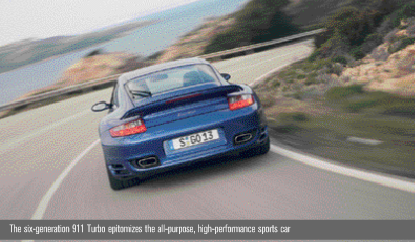
We’ve been briefed at a pre-start press conference, but nothing could have prepared me for this. You’d think a motorized vehicle would shatter the poetic tranquility of the sleepy Andalusian countryside. The Porsche 911 Turbo doesn’t. It fits right in. Its athletic, panther-like chiseled form is poetry in motion. The fluid, lightweight, aerodynamically-sculpted body is an uncomplicated extension of rolling hills. The aluminium hood and doors shimmer in the early morning light. The flawless, smooth thrum of the car’s 3.6-litre engine is at one with nature. Even the suppressed growl as I rev is sublimely natural, more tiger- than car-like.

Stepping on the gas
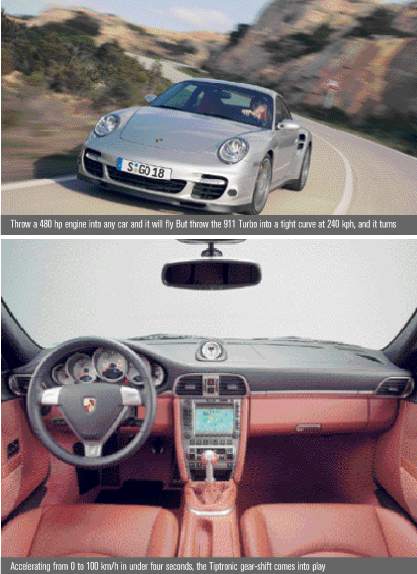
Sleepy Andalusian idyll aside, I really step on the gas – and surge into another world. The question ‘car or fighter jet?’ flashes across my mind, as the car’s two exhaust gas turbochargers with variable turbine geometry in the gasoline engine – a milestone in drivetrain technology – propel me forward with an astounding roar. The turbochargers give the six-cylinder boxer power unit an awe-inspiring 133 horsepower per litre output, translating into 480 BHP engine output and 620 Newton-metres, or 457 pounds-feet, maximum torque. The effect is breathtaking. Top speed is a shattering 310 km/h. It takes a trifling 3.7 seconds to accelerate from zero to 100 km/h, and 12.2 to reach 200 km/h, with the new five-speed Tiptronic S transmission system.
I’m a real man. I like stick shift. But in the 911 Turbo, accelerating from zero to 100 km/h in under four seconds, there’s no time for it. With that kind of thrust, you want the gears quite literally at the tips of your fingers. Tiptronic has to be the name of the game. Speaking of fingertips, if you want to shave 0.3 seconds off the 3.8 second 80 km/h to 120 km/h run, make sure your 911 Turbo is equipped with the optional Sports Chrono Package Turbo, now available for the first time. When accelerating all-out, all you need to do is press the Sports Button next to the gearshift lever for instantaneous Overboost, to raise charge pressure. Remember super-car KITT, in the TV series Knight Rider? No wonder the 911 Turbo uses special extreme-heat resistant materials carried over from aerospace applications; with its 1,000ºC exhaust gas temperatures. I feel like I’m in an F-16.
Endow any car with a 480 HP engine, and it’ll fly. But throw the 911 Turbo into a tight curve at 240km/h, and it turns. Its grip is stunning, thanks to the new Cayenne-style all-wheel-drive Traction Management system, with its electronically-controlled multiple-plate clutch. Traction is managed through the PTM control unit in accordance with steering angle, wheel speed, and dynamic driving signals such as over- and under-steer, translating into optimum distribution of power tailored to current driving conditions. This explains the 911 Turbo’s stunning agility, driving dynamics, high-speed driving stability, and increased traction on slippery surfaces.
On the suspension front, drivers of the new 911 Turbo can choose between Porsche Active Suspension Management (PASM) Normal, which enhances motoring comfort, and PASM Sports, which is for speed-freaks like me. This morning, on a blissfully congestion-free road (traffic in Beirut is apoplexy-inducing), I am needless to say in a sporting frame of mind. Of course, if I did need to come to a fairly forceful halt, I’d be able to rely on the car’s upgraded brake system – front wheels come with six-piston fixed calliper brakes (effective swept area up 42%), and four-piston fixed calliper back wheel brakes which are also more powerful than their predecessors.


Today, the sixth-generation 911 Turbo epitomizes the all-purpose, high-performance sports car. Small wonder that over 50,000 top-end Turbos have been sold since 1974, 22,000 of them the latest Turbo’s predecessor, which contributed significantly to Porsche’s 12-year-long upward trend, after a period in the doldrums.
The sixteen men – myself included – who have been invited to this launch spend the morning in blissful Porsche abandonment, our macho rivalry occasionally bubbling over into gut-wrenching automotive antics. Occasionally, my driving partner, cigar-loving Mohamad Zein of Dubai, and I attribute Arabic origins to village names as they fly by. After all, southern Spain was ruled by Arabs for hundreds of years. Indeed, much of the soothingly scenic Andalusian countryside reminds me of the verdant Bekaa valley in Lebanon. All that’s missing is some traditional Arabic music on the car’s 13-speaker, seven-channel digital amplifier.

No wonder the 911 Turbo uses special extreme heat-resistant materials carried over from
aerospace applications. I feel like I’m in an f-16.

The professional takes over
After a buffet lunch at the delightful Dehesa Montenmedio restaurant, and another hour and a half’s riotous test-driving, we are treated to five pulse-racing minutes each, along a closed-off stretch of road, with famous former German rally and racing driver and current Porsche test-driver Walter Röhrl, who, at breakneck speed and with a limits-pushing style born of decades’ top-level racing experience, unveils the 911 Turbo’s secret inner sanctum, and shows me that, simply put, I don’t know how to drive. Oh, by the way, in the new 911 Turbo Röhrl laps the Nordschleife of the Nurbürgring in 7 minutes 49 seconds, leaving the car’s predecessor – and more powerful competition – far behind.

Back to reality
We’d harbored grandiose plans for the evening. But reduced to languid contentedness by the day’s driving, after a post-exertion massage and sauna at the hotel spa and a satisfying meal and drinks, we fell into bed. The next morning, after an early-bird breakfast, it was off to the airport for my flight back to Beirut. Shaking me from my leather upholstery-scented, turbocharger Porsche reverie, the plane accelerated along the runway. No comparison, I grinned.
The Turbo will retail in Germany at Euro 133,603, and at $122,900. In Lebanon, it will cost considerably more, thanks to high customs taxes.

June 29, 2006 0 comments
0 FacebookTwitterPinterestEmail
Finance & EconomyUncategorized

World Markets

by Faysal Badran June 29, 2006
written by Faysal Badran

This year’s poster child for financial excess surely had to be the Gulf stock markets. We warned on several occasions, in past issues of Executive, that the level of gambling in those markets had reached mega-bubble proportions. In fact, our cautionary words were worth about $350 billion in Saudi alone, where the leading index fell from 20,000 points to 10,000, leaving many small players and late entrants in ruin. The near vertical moves in the Gulf were not an isolated event, and while the players were mostly locals, the folly for shares was symptomatic of a larger, more global drop in risk premiums and an almost unquenchable thirst for outsized returns.


The investment landscape had been uneventful for a couple of years now. It was a simple rule of thumb: the more risk one took, the better the returns. In this environment, cautious managers were shunned and everyone, even mainstream investors, looked for “the big play”. The commodity markets obliged as they rallied dramatically, starting with oil, which as we all know rocketed from $30 to nearly $75 and then moved to metals (see last month’s Executive), which nearly doubled in price.

The mad rush continues
So, as the mad rush for performance continued, so did the parabolic rises in these markets. What seems eye catching here is that rather than serving as a so-called hedge or protection against paper assets, stocks and bonds, commodities were moving up along with them. In fact, since October 2002, when the US market hit a peak after the NASDAQ bubble popped, every single investment market has been rising in an equally fearless manner.
While it is tough to find exact cause in the markets, and thus difficult to determine which markets led the advance, it is clear that overall, globally, investors had become almost fearless. This type of liquidity-driven market is usually impossible to time, and is devastating in its randomness, much the same as crashes. When we asked an associate who manages $500 million at Societe Generale why it was that over the last three years markets had been moving up so relentlessly, he said, “think of this as an upside-down crash, a mad rush to own assets.”
Real estate, whether through funds or directly, took off nearly in a synchronized fashion worldwide, carrying with it mortgage-backed and linked securities. Meanwhile, global IPOs flourished and carried a bonanza for the ultra-wealthy and the brokerage firms. The explosion in derivative instruments, especially credit-related, swelled the earnings of multinational financial firms to preposterous, unsustainable levels.

Should investors opt for prudence in this
environment? The answer is a resounding yes.

Booms in many markets
There are many arguments as to why this near-perfect correlation in world markets produced a rave-like euphoria in all asset markets. Even the art and collectibles markets boomed and accelerated over the same period. One could argue that globalization was bound to produce more harmony in global market and investment returns. Some argue that a more global and connected world is prone to deliver contagion on the upside. This is true and verifiable, even before the internet, but somehow it has been amplified over the last few years. What has amplified this is the existence of actively managed funds, especially hedge funds. We noted in past articles that hedge funds now rule the day and with 8,000 of them currently operating, they have fostered a constant, mad, sometimes reckless search for return. Rather than being alternatives, derivatives and hedge funds have now become the norm, well entrenched into the product factories of nearly all banks and insurance companies.


Is this healthy? And could this propagation of hedge funds actually lead to greater risk ahead? Those questions are worth trillions of dollars and difficult to answer, but let’s look at the current investment climate and try to pinpoint what is relevant for readers: should they opt for prudence in this environment? The answer is a resounding yes.
Many people like to look at fundamentals, and reason that since the world economy is growing this can only be good for their investments. If only things were this simple. For one, there is way too much financial leverage in the global system, so economic growth is not the single most important piece of data to decide on. We have included a chart of the World Bank showing natural wealth creation, versus the wealth created by derivatives and the picture is frightening. While derivatives, as many central banks like to console themselves, do in fact add liquidity to the global financial system, they become a source of concern when they reach several multiples of the world’s real productive capacity.

The derivatives game
Wherever you look, banks are more and more involved in the derivatives game, either for their own book or in their product offerings to clients. We should point out that derivative instruments are genial and they have opened up horizons to companies and even individuals, simplified transactions, and served as insurance in many cases against financial calamities. But what is at stake here is a world too crowded with hedge funds, derivatives, and risk-taking. This cocktail will be lethal going forward.
Since early May, the more mature markets, such as the US, UK, Europe, Japan, and Hong Kong have slid down from their peaks, dropping an average of 6% in a couple of weeks. This may seem like peanuts but what is telling is that this seems to be coinciding with other indicators that foretell a long, hot, nasty summer.
This drop is also occurring in areas such as real estate and commodities that seemed to be the last bastion of upside. In the US, the leader of this particular pack, the drop is coming on the heels of the largest margin debt level in history. Investors are now more up to their necks in borrowed investment than they were just before the 2000 collapse. This is an ominous situation to say the least. Usually, healthy sustainable up markets need some degree of skepticism by investors, and not the near uniform excitement we see now. Most financial mainstream media today is even more encouraging than it was before the internet bubble burst. Odd, isn’t it, that the market participants are now even more committed to and excited about technology shares, for instance, than they were in January 2000, before they dropped nearly 70%? This can only mean one thing: trouble ahead.
A burst global stock bubble, which seems now inevitable from the Gulf to Brazil to China, along with a substantial drop in asset prices generally, including real estate, will have a dual effect of cooling global economic growth and easing pressure for monetary tightening (raising interest rates). Because most markets have been so tightly correlated, the debacle ahead will hit most investment markets except maybe the highest rated bond issuers.

Time to reduce investment risk
This may sound like absorbable news, but given the amount of leverage and the extent of the vast credit bubble which has mushroomed, the coming deflation in asset prices will be devastating to non-prudent investors, over-leveraged new hedge funds, and anyone who has not stepped away from risk-taking. In cycle terms, it has been a great three years to assume risk, and it seems now essential to reduce risk in investment terms and stay as close as possible to problem-free money market investments, at least until the end of 2006.

June 29, 2006 0 comments
0 FacebookTwitterPinterestEmail
Uncategorized

Zombification And its discontentsZombification

by Executive Editors June 28, 2006
written by Executive Editors

ALMATY, Kazakhstan. At first glance, Almaty, the former capital of this once Soviet republic in Central Asia, offers the typical drab of Soviet-style graying buildings, some badly in need of a new coat of paint. The city’s wide avenues, initially designed to allow official Communist Party Zil limousines to race through the city unhindered, are now filled with shining new European and Japanese luxury cars, all vying for space. The Zils, along with their center lanes reserved for high-ranking party apparatchiks are long gone – though the system from those darker days still lingers.
It’s a big step from the Soviet days, yet Kazakhstan’s political system is not exactly Jeffersonian democracy. Call it democracy-lite, if you will. At least that is the view adopted by the Bush administration, which wants to keep Kazakhstan as a friend in a part of the world where making, and keeping friends, is not easy.

A “clannish regime”
As Washington continues to call for democracy and political reform in the greater Middle East, it partially closes its eyes to what critics of President Nursultan Nazarbayev – a leftover from the Soviet era – call the “zombification” of Kazakhstan.
Of the former Soviet republics of Central Asia, Kazakhstan is the largest as well as the most stable. The country is doing well financially thanks to oil revenues, and sits on 20% of the world’s known uranium deposits. It’s roughly four times the size of Texas, and its population of 15 million is evenly made up of Muslims and Russian Orthodox Christians.
At a time when pro-Islamist sentiments are making headway in neighboring Uzbekistan, Kazakhstan has allowed the US rights to military bases and officials are not afraid of voicing their support of their new ally, a move sure to irritate Moscow. “The United States is a really great nation,” said Dariga Nazarbayeva, the President’s daughter, during her closing statement at the end of a three-day Eurasian Media Forum in Almaty last April. In contrast to Iran’s attempts to enter the “nuclear club,” Kazakhstan agreed to give up its nuclear weapons shortly after the breakup of the Soviet Union. Under the Threat Reduction program the United States spent $240 million to assist Kazakhstan in eliminating weapons of mass destruction.
Since independence from Moscow in December 1991, the country has been governed by Nazarbayev, whom opposition leaders accuse of installing a “clannish regime.” They say they government is conducting a campaign of political assassinations, and accuse Dariga of “monopolizing the media.”

Assassinations and media monopoly
Rysbek Sarsenbayev, the brother of assassinated politician Altynbek Sarsenbayev told a group of visiting observers last April that the government was using its secret service “to suppress the citizens,” and asserts that officers of an elite unit of the KNB (the former KGB), were involved in his brother’s death on 11 February of this year. There were others: Ashkat Sharipzhanov, a well-known journalist, Oxana Nikitina, the daughter of an opposition activist, and Zamanbek Nurkadilov. The latter was said to have committed “suicide,” in spite of the fact that he was found with two bullet wounds in his chest and one in his head.
“In Kazakhstan it is common for an innocent man to be thrown in jail. When they cannot make you obey, they simply kill you. The regime uses medieval methods in governing the country,” said Sergey Duvanov, an opposition journalist.
Foreign diplomats suspect that Dariga was being groomed to replace her father. Recent indications, however, hint at disagreements mounting between the two. The president, for example, failed to show up at the Media Forum’s opening session.
While no one knows the reasons behind the rift, some observers say it could be due to Dariga pushing for greater freedom. One example was the row over Sacha Baron Cohen, a British comedian better known as Ali G, who portrays a Kazakh character named Borat as a crude, lecherous drunk. The comedian has angered many Kazakhs. Government officials threatened to sue him.
Dariga defended Borat in her closing remarks Saturday: “We should not be afraid of humor and we shouldn’t try to control everything. Those who felt offended by his humor suffer from a concealed complex of inferiority.” Many say this was a direct jab at her father.
Opposition members, however, accuse her of monopolizing the country’s media and closing opposition newspapers and television stations. They claim that Dariga’s 21-year-old son was recently given the management of a television station.
Opposition leaders say that one family controls practically all the media in Kazakhstan, where any criticism of the president is excluded. “It is the zombification of Kazakhstan.”
They could be describing the situation in a number of countries.

June 28, 2006 0 comments
0 FacebookTwitterPinterestEmail
  • 1
  • …
  • 614
  • 615
  • 616
  • 617
  • 618
  • …
  • 688

Latest Cover

About us

Since its first edition emerged on the newsstands in 1999, Executive Magazine has been dedicated to providing its readers with the most up-to-date local and regional business news. Executive is a monthly business magazine that offers readers in-depth analyses on the Lebanese world of commerce, covering all the major sectors – from banking, finance, and insurance to technology, tourism, hospitality, media, and retail.

  • Donate
  • Our Purpose
  • Contact Us

Sign up for our newsletter

    • Facebook
    • Twitter
    • Instagram
    • Linkedin
    • Youtube
    Executive Magazine
    • ISSUES
      • Current Issue
      • Past issues
    • BUSINESS
    • ECONOMICS & POLICY
    • OPINION
    • SPECIAL REPORTS
    • EXECUTIVE TALKS
    • MOVEMENTS
      • Change the image
      • Cannes lions
      • Transparency & accountability
      • ECONOMIC ROADMAP
      • Say No to Corruption
      • The Lebanon media development initiative
      • LPSN Policy Asks
      • Advocating the preservation of deposits
    • JOIN US
      • Join our movement
      • Attend our events
      • Receive updates
      • Connect with us
    • DONATE