• Donate
  • Our Purpose
  • Contact Us
Executive Magazine
  • ISSUES
    • Current Issue
    • Past issues
  • BUSINESS
  • ECONOMICS & POLICY
  • OPINION
  • SPECIAL REPORTS
  • EXECUTIVE TALKS
  • MOVEMENTS
    • Change the image
    • Cannes lions
    • Transparency & accountability
    • ECONOMIC ROADMAP
    • Say No to Corruption
    • The Lebanon media development initiative
    • LPSN Policy Asks
    • Advocating the preservation of deposits
  • JOIN US
    • Join our movement
    • Attend our events
    • Receive updates
    • Connect with us
  • DONATE
Business

Coming in from the freez

by Michael Karam July 1, 2006
written by Michael Karam

This month will see the launch of Château Ka, the latest recruit to the steadily growing roster of local wineries. Ka is the brainchild of Akram Kassatly, chairman of Kassatly Chtaura, the company that at various stages in its life has brought concentrated syrups, preserves and fruit juices to generations of Lebanese. His first wines will include 15,000 bottles of Blanc de Blancs, 15,000 rosés and 60,000 reds – called Source de Rouge. There are also plans for a “Château” level wine.

Six years of innovation

The wine initiative is the culmination of six dizzying years of successful innovation for Kassatly. In 2000, the company spotted the commercial potential in alcoholic ready-to-drink-beverages (RTDs) and within a year launched the multi-flavored Buzz, Lebanon’s own vodka-based RTD to rival Smirnoff Ice. Buzz was followed up a year later by Freez, a non-alcoholic RTD, which has become so successful in the GCC that it makes up nearly 70% of the company’s $15 million revenues. With Château Ka, Kassatly now has three high-profile brands.

The company spends around $500,000 a year, mainly on billboards, advertising Buzz and Freez. The aim is to gently push the Kassatly name into the background. “This way we can build our brands and make them more attractive to potential buyers,” explains Nayef Kassatly, Akram’s son and Kassatly’s Vice President.

So is the foray into wine merely another well-spotted opportunity, given the wine sector’s elevated profile in recent years? Nayef disagrees and explains that the move is rooted in a solid commitment. “Wine runs deep in my father’s veins. He always wanted to make wine. He studied enology in Dijon in the 60s.”

In fact, the building that houses the factory in Makse, just outside Chtaura, was originally a winery (the original concrete vats are still in place) but the war put those plans on hold. “We had made our first wine but a militia raided us, removed the caps from the vats and the wine leaked out. We were a family making alcohol in the Bekaa. It was a difficult period for us, so we went back to producing concentrated syrups.”

Bottling jallab

In 1982 the company began the first of its marketing brainwaves by putting jallab, until then a drink that could only be bought from street vendors, into bottles. This was followed up in 1983 by the production of a crème liqueur similar to Bailey’s Irish Cream. “We were taking the basis of an established international drink and giving a local name and a local brand,” says Nayef, who joined the company in 1994 and helped start the juice line as well as consolidate jams and pickles.

And that was how things chugged along until 1999, when Akram awakened his dormant dream of producing wine. “My father got his hands on a bottling machine from a bankrupt winery in Switzerland,” recalls Nayef. “I was sent with some technicians to dismantle it and ship it back to Lebanon.”

It was then that the wine dream was again sidetracked. “While in Switzerland, I learned that Smirnoff was launching Smirnoff Ice. I thought, ‘we should be doing this,’ and realized that we could use the bottling plant to make carbonated drinks, as it was originally used to produce sparkling wines.”

Marketing Buzz

In June 2001, Kassatly bottled its first run of 25,000 cases of Buzz. With Smirnoff launching in Lebanon at the same time, Buzz was able to hitch a ride on the coattails of a global brand while offering a competitive alternative with a wider range of flavors. “It gave us it a good image,” explains Nayef. “We were able to undercut the local market by 20%. We could not go any lower, as that would have given a negative perception to the brand. You know what the Lebanese are like. If it’s too cheap, they aren’t interested.”

Buzz buzzed, and in 2002, the company upped production to 50,000 cases. But Kassatly still wasn’t getting the most out of its plant. Then came the masterstroke. “I was sitting with my Saudi associate,” says Nayef. “I asked if he would take a non-alcoholic Buzz, and he said, ‘Sure, why not?’ He wanted to call it Buzz non-alcoholic, but I wanted it to be a different product and I came up with Freez. We made two flavors, lemon and grenadine and I gave him I gave him 2,000 cases (48,000 bottles) as a trial batch. I put them on the lorry and they vanished.”

Today the company sells 40 million bottles. At least 75% or $11 million worth of both Freez and Buzz are exported. Freez has found a huge following, not only in Saudi Arabia, but also in the UAE, Kuwait, Qatar, Bahrain, Jordan and Syria, while Buzz has a loyal customer base in Syria, Jordan and Iraq.

The key to Freez’s success is that it lets the youth and young adults of the conservative Gulf States enjoy the image of being seen drinking an RDT while remaining true to their Islamic principles. “We are currently launching a limited edition Freez,” says Nayef, plonking a matte silver bottle on his desk. “We added volume and put it in a funky bottle. It has a sporty look, almost like a scuba tank. Red Bull was doing it and charging a premium. I felt we could too.”

Kassatly has not ignored Buzz. It recently launched Buzz Strong, which now accounts for 50% of Buzz sales, and this summer will launch the beefy Buzz Extra Strong (10% alcohol). According to Nayef Kassatly, Buzz is the king of the off-trade but cannot get a look-in at the bars, nightclubs and beaches. “We just don’t have the budgets the big distributors have to pay establishments a pouring fee. A supplier will pay a club to put its brand of whisky into a whisky and coke, for example, as well as telling them to take their RTDs and give them exclusivity. What we’ve learned is that people drink Buzz at home before going out and then buy one or two drinks at the bar.”

Building the winery

So we come full circle and back once again to wine. “The money was coming and it was time to reinvest,” says Nayef. The winery, set in the grounds of the Kassatly factory in Makse, took only six months to build at a cost of $1.5 million. Running costs will stretch to a further $500,000 annually.

Grapes were particularly expensive in the first year. Akram found that as a new producer he just couldn’t waltz in and place an order for 300 tons of premium grapes. “We were forced to pay top dollar, as much as $0.80 per kilo.” Within three years, Chateau Ka will harvest its own grapes. The company has planted 60 hectares just outside Baalbek.

At our next meeting, Nayef has begun introducing his wines to a few of Beirut’s most popular restaurants. He is confident that Kassatly’s established distribution network will be a considerable asset in introducing the wines into the local market. “But you know what is good about showing someone your wines? No one wants to talk about price in the same way they do with other products. It’s different.”
July 1, 2006 0 comments
0 FacebookTwitterPinterestEmail
Economics & Policy

Crude Reality

by Faysal Badran July 1, 2006
written by Faysal Badran

As tensions between Iran and the US have subsided somewhat, it may be time to revisit the crude oil market that monopolized so many headlines in recent weeks. While we rejected outright the claim that $100-a-barrel oil was around the corner, the geopolitical risk pushed oil briefly up to the mid-70s per barrel. Things have cooled down and in our view may cool down further.

Even at the height of the Iran news, oil was showing technical signs of fatigue in its advance. This was confirmed by a retrenchment, not only in the price of oil, but of other commodities closely linked to oil such as copper and silver, which have dropped by nearly 25%.

This exhaustion of the oil and commodity trend demonstrates first, that oil speculators had gotten ahead of themselves, and second, that the global economy is slowing down.

Passing the oil debate peak

At the peak of the oil debate, speculators had rushed into the crude oil market. Most of the hedge funds involved were unequivocally positive on the black gold, a reliable sign of an imminent pullback.

There have also been signs of slowing in the two main engines of world growth: the US housing market and China and other emerging markets. The big drop in emerging markets clearly showed that their breakneck momentum had waned, and the correspondingly high levels of demand for oil were soon to fade. As the world economy slows down, oil will continue to correct downward.

It is also estimated that about $5 to $7 of the current oil price comes from a geopolitical risk premium. Since a full-blown conflict involving Iran no longer appears likely, thanks to that country’s new readiness to talk, this premium will probably be wiped out in fairly short order.

Checking the charts

As a technical analyst, I view charts as my guide. Let’s look at the chart of oil to get a feel for where things have been and where they may be heading.

Since 2003, oil has been in an upwardly sloping channel that contained prices in an almost textbook manner. Intensified demand pressures and political issues led to two attempts to break the upper boundary of the channel as the mainstream media speculated about $100-a-barrel oil. These two attemps failed, resulting in what is termed “false breaks,” and oil has resumed its orderly upward course.

The latest attempt on the chart to run away to the upside featured excessive positive sentiment (nearly 94% of market players saw nothing but upside), demonstrating just how crowded the oil trade was. Again, the market returned to the channel, and the technical view is that oil should be poised for more losses, down toward the $55-a-barrel area.

This is still a much higher price than the oil market saw throughout the last decade, so energy issues will remain on the forefront of the global debate. But a cooling-off in oil prices is welcome news, especially for struggling economies such as ours! This is not the time to bet against oil, since the overall trend is still up. But it does seem that predictions of oil-based Armageddon were at the very least premature.

July 1, 2006 0 comments
0 FacebookTwitterPinterestEmail
Comment

Now I am mad

by Yasser Akkaoui July 1, 2006
written by Yasser Akkaoui

There I was, at Orchid beach in Jiyyeh, when I saw our finance minister eating a salad (perhaps to demonstrate that our ministers stay in shape while putting our country to right). He was sitting with the resort’s developer and extolling the glories of the modern Lebanese tourist industry. Where else, the minister asked, could one find such a location? Where else could one get this standard of service, food, facilities and ambiance? Although the minister’s misty-eyed patriotism was no doubt clouding his view, we might excuse him; Lebanon has come a long way in recent years.

Or has it? Later that day, I carried my beach chair to the shallow water to enjoy the sunset as I always do, only to find that the sand had disappeared. Gone. Vanished. Not just on my spot, but along the whole bay, where at least three resorts operate. It turns out the sand had been literally vacuumed up and sold.

Apparently, excessive amounts of sand were getting into the guts of the electrical plant at Jiyyeh, which is cooled by sea water. A dredging company, allegedly owned by the son of a prominent politician, was brought in to remove the offending sand, but the government was unable to pay the $7 per m3 it costs to carry out such an operation.

No problem. A deal was struck whereby the dredging company was entitled to sell any sand it removed. But when the state discovered that sand can be sold for $21 per m3, a joint venture was formed. The dredging company took $14, while the state pocketed $7. The electricity plant was free of sand, and the government had made a tidy sum out of selling public property.

It was an act of naked theft.

Where the authority to do this came from, and where the money went (not to mention the sand), is anyone’s guess. We do know that the beach resorts of Jiyyeh – prime examples of Lebanese enterprise – have been robbed of a crowd-pulling asset.

If it weren’t so sad, it would be funny.

This is not the only example of state vandalism in Jiyyeh. Resort owners complain of the blanket of soot that settles on their property every time the plant’s turbine is cleaned by a giant vacuum pump, as well as the raw sewage pumped into the Mediterranean and the surrounding beaches (even though the EU has allegedly earmarked around $150,000 to keep Lebanon’s part of the sea clean). The sewage was such a serious threat to business that one developer spent $300,000 of his own money to do the government’s job and divert the waste.

One wonders who should really be running the country.
 

July 1, 2006 0 comments
0 FacebookTwitterPinterestEmail
Dispatches

Car or fighter jet?

by Yasser Akkaoui June 29, 2006
written by Yasser Akkaoui

last night, I was recuperating, full-bellied, in a comfortable Fairplay Golf Hotel & Spa bed, after a tiring journey from Beirut via Rome, Madrid, and Jerez de la Frontera to the white-painted town of Benalup in the tranquil southern Spanish province of Cadiz – venue for the press launch of the new 911 Turbo. This morning, travel-induced fatigue has been replaced by boyish excitement: I’m at the wheel.
We’ve been briefed at a pre-start press conference, but nothing could have prepared me for this. You’d think a motorized vehicle would shatter the poetic tranquility of the sleepy Andalusian countryside. The Porsche 911 Turbo doesn’t. It fits right in. Its athletic, panther-like chiseled form is poetry in motion. The fluid, lightweight, aerodynamically-sculpted body is an uncomplicated extension of rolling hills. The aluminium hood and doors shimmer in the early morning light. The flawless, smooth thrum of the car’s 3.6-litre engine is at one with nature. Even the suppressed growl as I rev is sublimely natural, more tiger- than car-like.

Stepping on the gas
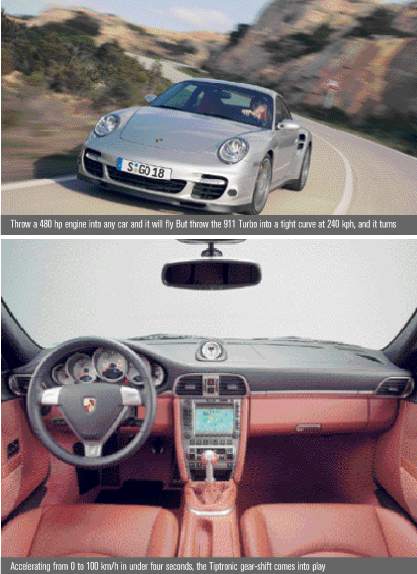
Sleepy Andalusian idyll aside, I really step on the gas – and surge into another world. The question ‘car or fighter jet?’ flashes across my mind, as the car’s two exhaust gas turbochargers with variable turbine geometry in the gasoline engine – a milestone in drivetrain technology – propel me forward with an astounding roar. The turbochargers give the six-cylinder boxer power unit an awe-inspiring 133 horsepower per litre output, translating into 480 BHP engine output and 620 Newton-metres, or 457 pounds-feet, maximum torque. The effect is breathtaking. Top speed is a shattering 310 km/h. It takes a trifling 3.7 seconds to accelerate from zero to 100 km/h, and 12.2 to reach 200 km/h, with the new five-speed Tiptronic S transmission system.
I’m a real man. I like stick shift. But in the 911 Turbo, accelerating from zero to 100 km/h in under four seconds, there’s no time for it. With that kind of thrust, you want the gears quite literally at the tips of your fingers. Tiptronic has to be the name of the game. Speaking of fingertips, if you want to shave 0.3 seconds off the 3.8 second 80 km/h to 120 km/h run, make sure your 911 Turbo is equipped with the optional Sports Chrono Package Turbo, now available for the first time. When accelerating all-out, all you need to do is press the Sports Button next to the gearshift lever for instantaneous Overboost, to raise charge pressure. Remember super-car KITT, in the TV series Knight Rider? No wonder the 911 Turbo uses special extreme-heat resistant materials carried over from aerospace applications; with its 1,000ºC exhaust gas temperatures. I feel like I’m in an F-16.
Endow any car with a 480 HP engine, and it’ll fly. But throw the 911 Turbo into a tight curve at 240km/h, and it turns. Its grip is stunning, thanks to the new Cayenne-style all-wheel-drive Traction Management system, with its electronically-controlled multiple-plate clutch. Traction is managed through the PTM control unit in accordance with steering angle, wheel speed, and dynamic driving signals such as over- and under-steer, translating into optimum distribution of power tailored to current driving conditions. This explains the 911 Turbo’s stunning agility, driving dynamics, high-speed driving stability, and increased traction on slippery surfaces.
On the suspension front, drivers of the new 911 Turbo can choose between Porsche Active Suspension Management (PASM) Normal, which enhances motoring comfort, and PASM Sports, which is for speed-freaks like me. This morning, on a blissfully congestion-free road (traffic in Beirut is apoplexy-inducing), I am needless to say in a sporting frame of mind. Of course, if I did need to come to a fairly forceful halt, I’d be able to rely on the car’s upgraded brake system – front wheels come with six-piston fixed calliper brakes (effective swept area up 42%), and four-piston fixed calliper back wheel brakes which are also more powerful than their predecessors.


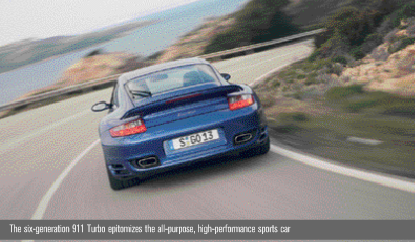
Today, the sixth-generation 911 Turbo epitomizes the all-purpose, high-performance sports car. Small wonder that over 50,000 top-end Turbos have been sold since 1974, 22,000 of them the latest Turbo’s predecessor, which contributed significantly to Porsche’s 12-year-long upward trend, after a period in the doldrums.
The sixteen men – myself included – who have been invited to this launch spend the morning in blissful Porsche abandonment, our macho rivalry occasionally bubbling over into gut-wrenching automotive antics. Occasionally, my driving partner, cigar-loving Mohamad Zein of Dubai, and I attribute Arabic origins to village names as they fly by. After all, southern Spain was ruled by Arabs for hundreds of years. Indeed, much of the soothingly scenic Andalusian countryside reminds me of the verdant Bekaa valley in Lebanon. All that’s missing is some traditional Arabic music on the car’s 13-speaker, seven-channel digital amplifier.

No wonder the 911 Turbo uses special extreme heat-resistant materials carried over from
aerospace applications. I feel like I’m in an f-16.

The professional takes over
After a buffet lunch at the delightful Dehesa Montenmedio restaurant, and another hour and a half’s riotous test-driving, we are treated to five pulse-racing minutes each, along a closed-off stretch of road, with famous former German rally and racing driver and current Porsche test-driver Walter Röhrl, who, at breakneck speed and with a limits-pushing style born of decades’ top-level racing experience, unveils the 911 Turbo’s secret inner sanctum, and shows me that, simply put, I don’t know how to drive. Oh, by the way, in the new 911 Turbo Röhrl laps the Nordschleife of the Nurbürgring in 7 minutes 49 seconds, leaving the car’s predecessor – and more powerful competition – far behind.

Back to reality
We’d harbored grandiose plans for the evening. But reduced to languid contentedness by the day’s driving, after a post-exertion massage and sauna at the hotel spa and a satisfying meal and drinks, we fell into bed. The next morning, after an early-bird breakfast, it was off to the airport for my flight back to Beirut. Shaking me from my leather upholstery-scented, turbocharger Porsche reverie, the plane accelerated along the runway. No comparison, I grinned.
The Turbo will retail in Germany at Euro 133,603, and at $122,900. In Lebanon, it will cost considerably more, thanks to high customs taxes.

June 29, 2006 0 comments
0 FacebookTwitterPinterestEmail
Finance & EconomyUncategorized

World Markets

by Faysal Badran June 29, 2006
written by Faysal Badran

This year’s poster child for financial excess surely had to be the Gulf stock markets. We warned on several occasions, in past issues of Executive, that the level of gambling in those markets had reached mega-bubble proportions. In fact, our cautionary words were worth about $350 billion in Saudi alone, where the leading index fell from 20,000 points to 10,000, leaving many small players and late entrants in ruin. The near vertical moves in the Gulf were not an isolated event, and while the players were mostly locals, the folly for shares was symptomatic of a larger, more global drop in risk premiums and an almost unquenchable thirst for outsized returns.


The investment landscape had been uneventful for a couple of years now. It was a simple rule of thumb: the more risk one took, the better the returns. In this environment, cautious managers were shunned and everyone, even mainstream investors, looked for “the big play”. The commodity markets obliged as they rallied dramatically, starting with oil, which as we all know rocketed from $30 to nearly $75 and then moved to metals (see last month’s Executive), which nearly doubled in price.

The mad rush continues
So, as the mad rush for performance continued, so did the parabolic rises in these markets. What seems eye catching here is that rather than serving as a so-called hedge or protection against paper assets, stocks and bonds, commodities were moving up along with them. In fact, since October 2002, when the US market hit a peak after the NASDAQ bubble popped, every single investment market has been rising in an equally fearless manner.
While it is tough to find exact cause in the markets, and thus difficult to determine which markets led the advance, it is clear that overall, globally, investors had become almost fearless. This type of liquidity-driven market is usually impossible to time, and is devastating in its randomness, much the same as crashes. When we asked an associate who manages $500 million at Societe Generale why it was that over the last three years markets had been moving up so relentlessly, he said, “think of this as an upside-down crash, a mad rush to own assets.”
Real estate, whether through funds or directly, took off nearly in a synchronized fashion worldwide, carrying with it mortgage-backed and linked securities. Meanwhile, global IPOs flourished and carried a bonanza for the ultra-wealthy and the brokerage firms. The explosion in derivative instruments, especially credit-related, swelled the earnings of multinational financial firms to preposterous, unsustainable levels.

Should investors opt for prudence in this
environment? The answer is a resounding yes.

Booms in many markets
There are many arguments as to why this near-perfect correlation in world markets produced a rave-like euphoria in all asset markets. Even the art and collectibles markets boomed and accelerated over the same period. One could argue that globalization was bound to produce more harmony in global market and investment returns. Some argue that a more global and connected world is prone to deliver contagion on the upside. This is true and verifiable, even before the internet, but somehow it has been amplified over the last few years. What has amplified this is the existence of actively managed funds, especially hedge funds. We noted in past articles that hedge funds now rule the day and with 8,000 of them currently operating, they have fostered a constant, mad, sometimes reckless search for return. Rather than being alternatives, derivatives and hedge funds have now become the norm, well entrenched into the product factories of nearly all banks and insurance companies.


Is this healthy? And could this propagation of hedge funds actually lead to greater risk ahead? Those questions are worth trillions of dollars and difficult to answer, but let’s look at the current investment climate and try to pinpoint what is relevant for readers: should they opt for prudence in this environment? The answer is a resounding yes.
Many people like to look at fundamentals, and reason that since the world economy is growing this can only be good for their investments. If only things were this simple. For one, there is way too much financial leverage in the global system, so economic growth is not the single most important piece of data to decide on. We have included a chart of the World Bank showing natural wealth creation, versus the wealth created by derivatives and the picture is frightening. While derivatives, as many central banks like to console themselves, do in fact add liquidity to the global financial system, they become a source of concern when they reach several multiples of the world’s real productive capacity.

The derivatives game
Wherever you look, banks are more and more involved in the derivatives game, either for their own book or in their product offerings to clients. We should point out that derivative instruments are genial and they have opened up horizons to companies and even individuals, simplified transactions, and served as insurance in many cases against financial calamities. But what is at stake here is a world too crowded with hedge funds, derivatives, and risk-taking. This cocktail will be lethal going forward.
Since early May, the more mature markets, such as the US, UK, Europe, Japan, and Hong Kong have slid down from their peaks, dropping an average of 6% in a couple of weeks. This may seem like peanuts but what is telling is that this seems to be coinciding with other indicators that foretell a long, hot, nasty summer.
This drop is also occurring in areas such as real estate and commodities that seemed to be the last bastion of upside. In the US, the leader of this particular pack, the drop is coming on the heels of the largest margin debt level in history. Investors are now more up to their necks in borrowed investment than they were just before the 2000 collapse. This is an ominous situation to say the least. Usually, healthy sustainable up markets need some degree of skepticism by investors, and not the near uniform excitement we see now. Most financial mainstream media today is even more encouraging than it was before the internet bubble burst. Odd, isn’t it, that the market participants are now even more committed to and excited about technology shares, for instance, than they were in January 2000, before they dropped nearly 70%? This can only mean one thing: trouble ahead.
A burst global stock bubble, which seems now inevitable from the Gulf to Brazil to China, along with a substantial drop in asset prices generally, including real estate, will have a dual effect of cooling global economic growth and easing pressure for monetary tightening (raising interest rates). Because most markets have been so tightly correlated, the debacle ahead will hit most investment markets except maybe the highest rated bond issuers.

Time to reduce investment risk
This may sound like absorbable news, but given the amount of leverage and the extent of the vast credit bubble which has mushroomed, the coming deflation in asset prices will be devastating to non-prudent investors, over-leveraged new hedge funds, and anyone who has not stepped away from risk-taking. In cycle terms, it has been a great three years to assume risk, and it seems now essential to reduce risk in investment terms and stay as close as possible to problem-free money market investments, at least until the end of 2006.

June 29, 2006 0 comments
0 FacebookTwitterPinterestEmail
Uncategorized

Zombification And its discontentsZombification

by Executive Editors June 28, 2006
written by Executive Editors

ALMATY, Kazakhstan. At first glance, Almaty, the former capital of this once Soviet republic in Central Asia, offers the typical drab of Soviet-style graying buildings, some badly in need of a new coat of paint. The city’s wide avenues, initially designed to allow official Communist Party Zil limousines to race through the city unhindered, are now filled with shining new European and Japanese luxury cars, all vying for space. The Zils, along with their center lanes reserved for high-ranking party apparatchiks are long gone – though the system from those darker days still lingers.
It’s a big step from the Soviet days, yet Kazakhstan’s political system is not exactly Jeffersonian democracy. Call it democracy-lite, if you will. At least that is the view adopted by the Bush administration, which wants to keep Kazakhstan as a friend in a part of the world where making, and keeping friends, is not easy.

A “clannish regime”
As Washington continues to call for democracy and political reform in the greater Middle East, it partially closes its eyes to what critics of President Nursultan Nazarbayev – a leftover from the Soviet era – call the “zombification” of Kazakhstan.
Of the former Soviet republics of Central Asia, Kazakhstan is the largest as well as the most stable. The country is doing well financially thanks to oil revenues, and sits on 20% of the world’s known uranium deposits. It’s roughly four times the size of Texas, and its population of 15 million is evenly made up of Muslims and Russian Orthodox Christians.
At a time when pro-Islamist sentiments are making headway in neighboring Uzbekistan, Kazakhstan has allowed the US rights to military bases and officials are not afraid of voicing their support of their new ally, a move sure to irritate Moscow. “The United States is a really great nation,” said Dariga Nazarbayeva, the President’s daughter, during her closing statement at the end of a three-day Eurasian Media Forum in Almaty last April. In contrast to Iran’s attempts to enter the “nuclear club,” Kazakhstan agreed to give up its nuclear weapons shortly after the breakup of the Soviet Union. Under the Threat Reduction program the United States spent $240 million to assist Kazakhstan in eliminating weapons of mass destruction.
Since independence from Moscow in December 1991, the country has been governed by Nazarbayev, whom opposition leaders accuse of installing a “clannish regime.” They say they government is conducting a campaign of political assassinations, and accuse Dariga of “monopolizing the media.”

Assassinations and media monopoly
Rysbek Sarsenbayev, the brother of assassinated politician Altynbek Sarsenbayev told a group of visiting observers last April that the government was using its secret service “to suppress the citizens,” and asserts that officers of an elite unit of the KNB (the former KGB), were involved in his brother’s death on 11 February of this year. There were others: Ashkat Sharipzhanov, a well-known journalist, Oxana Nikitina, the daughter of an opposition activist, and Zamanbek Nurkadilov. The latter was said to have committed “suicide,” in spite of the fact that he was found with two bullet wounds in his chest and one in his head.
“In Kazakhstan it is common for an innocent man to be thrown in jail. When they cannot make you obey, they simply kill you. The regime uses medieval methods in governing the country,” said Sergey Duvanov, an opposition journalist.
Foreign diplomats suspect that Dariga was being groomed to replace her father. Recent indications, however, hint at disagreements mounting between the two. The president, for example, failed to show up at the Media Forum’s opening session.
While no one knows the reasons behind the rift, some observers say it could be due to Dariga pushing for greater freedom. One example was the row over Sacha Baron Cohen, a British comedian better known as Ali G, who portrays a Kazakh character named Borat as a crude, lecherous drunk. The comedian has angered many Kazakhs. Government officials threatened to sue him.
Dariga defended Borat in her closing remarks Saturday: “We should not be afraid of humor and we shouldn’t try to control everything. Those who felt offended by his humor suffer from a concealed complex of inferiority.” Many say this was a direct jab at her father.
Opposition members, however, accuse her of monopolizing the country’s media and closing opposition newspapers and television stations. They claim that Dariga’s 21-year-old son was recently given the management of a television station.
Opposition leaders say that one family controls practically all the media in Kazakhstan, where any criticism of the president is excluded. “It is the zombification of Kazakhstan.”
They could be describing the situation in a number of countries.

June 28, 2006 0 comments
0 FacebookTwitterPinterestEmail
For your information

by Executive Editors June 28, 2006
written by Executive Editors

Bank of Beirut links up with IFC
Bank of Beirut has become the third bank in Lebanon to join the International Finance Corporation’s Global Trade Finance Program, which supports trade with emerging markets worldwide and promotes the flow of goods and services between developing countries. The IFC provides guaranteed coverage of bank risk, allowing recipients to expand their trade finance transactions within an extensive network of countries and banks and to enhance their trade finance coverage.


The Global Trade Finance Program offers confirming banks full or partial guarantees against underlying trade instruments and covers the risk of participating issuing banks. It allows issuing banks to increase the volume and value of trade transactions with enhanced tenors and access to competitive pricing terms.
According to Bank of Beirut’s chairman and general manager Salim Sfeir, “Bank of Beirut has long been at the forefront of commercial banking in Lebanon, mainly trade finance, and we deal in this respect with an extensive network of correspondent banks throughout the world. By joining IFC’s Global Trade Finance Program, we will further expand this network and hence create new opportunities for our customers.”
The IFC first engaged with Bank of Beirut in 1997, with an eight-year credit line for industrial and housing loans for Lebanese private-sector businesses and individuals.
In another development last month, the Bank received a $10 million soft loan from the Abu Dhabi-based Arab Trade Financing Program, to finance foreign trade in Lebanon. The ATFP is a specialized multi-Arab financial institution set up in 1989 to help develop Arab trade and increase the competitiveness of Arab producers and exporters.

More regional activity
Lebanon’s banks continue to escape the confines of a limited local banking sector through regional expansion and development. In a further manifestation of the trend, Byblos Bank Syria – the Syrian arm of Lebanon’s Byblos Bank – in April signed a euro 40 million long-term project development financing partnership agreement with the European Investment Bank (EIB), the Commercial Bank of Syria, and the Unit of Finance Management for Small and Medium Syrian Enterprises (FMU). The agreement is the first of its kind in Syria, according to Byblos Bank, and was inked within the framework of the Euro-Mediterranean agreement.
Byblos Bank Syria will on-loan the EIB funds to its clients, owners of Small and Medium Enterprises and other applicants who fulfill the loan criteria, covering up to 50% of the cost of certain investment projects in Syria. Amounts totaling not less than euro 100,000 will be on-loaned to applicants whose fixed assets do not exceed euro 75 million and who do not have more than 500 employees. The loans will be for a duration of four to five years. Premiums must be settled semi-annually, with a one-year grace period.
“It fits in very well with our overall regional expansion strategy,” said Byblos Bank Assistant General Manager and Head of Business Lines Fadi Nassar. “Lebanese banks are growing bigger, and since Lebanese markets are very small and Lebanese banks have expertise in terms of human resources and know-how, we are expanding. Naturally, you are going to expand into markets where you don’t have huge banks that are going to compete with you. So we are entering emerging markets, where spreads are still attractive and where a presence for huge institutions is risky or not very attractive. Syria is an example. It’s developing very fast and is a very promising market.”
He said Byblos Bank was already also active in Sudan and Algeria, has a representative office in the UAE, and is currently seeking a license for Iraq.
Meanwhile, Bank Audi SAL – Audi Saradar Group obtained an investment banking license for Saudi Arabia, allowing it to launch Audi Saudi Arabia, which will offer a full range of investment banking services. The Audi Saradar Group is contributing 70% of Audi Saudi Arabia’s capital. The remaining 30% belongs to prominent Saudi individuals and business groups. It is the first Lebanese financial institution to recently enter the Saudi market.
“In tandem with its vision for regional expansion, Bank Audi aims at positioning itself as a regional financial group that serves its clients across increasingly integrated markets,” said Bank Audi SAL – Audi Saradar Group Chairman and General Manager Raymond Audi.
Audi Saudi Arabia will officially launch this autumn, and will be based in Riyadh. Outside of Lebanon, the bank is already active in Syria, Jordan, Egypt, France and Switzerland, is planning to start up in northern Iraq by the end of the year, and is eyeing Algeria, Sudan and Yemen.
Finally, Bank of Beirut SAL has been given permission to open a branch in the Omani capital Muscat, with start-up capital of $26 million. It also operates in the United Kingdom, through a wholly-owned subsidiary in London, runs an offshore banking unit in Cyprus, and has representative offices in Dubai, the Nigerian capital Lagos, and Baghdad.

Investcom comes
in on the inside
Investcom started off its operations in 1984, during the height of the Lebanese civil war, by providing telecommunications engineering services in Lebanon. It later constructed, implemented and launched Lebanon’s first AMPS-based mobile network in 1991 – the first such privately owned and operated network in the Middle East. In 1994, it acquired its first GSM license when it won a BOT contract put forward by the late Rafik Hariri, allowing it to operate the France Telecom Mobile Liban (FTML) network – more commonly known as Cellis. It expanded its GSM operations into 10 countries in Africa (Liberia, Ghana, Benin, Guinea Bissau, Guinea and Sudan), the Middle East (Syria and Yemen), Asia (Afghanistan) and Europe (Cyprus), effectively offering services to over 4.8 million customers by the end of 2005. And it made a bang when it listed its shares on the London and Dubai stock exchanges which valued the company at some $3.3 billion.
And Investcom is at it again. However, instead of talk that Azmi Mikati’s firm has acquired a new license or company that would allow it to further expand its operations, the Lebanon-based operator has effectively been gulped up by Johannesburg-listed MTN for $5.5 billion – creating one of the largest emerging market companies in the world. The cash and shares deal – one of the biggest foreign takeovers by a South African group – will give MTN a presence in 21 countries, compared to 11 at the moment, and increase its subscriber base from 23 million to 28 million. The combined company will create an enterprise worth over $23 billion – a new force to be reckoned with.
The deal was a surprising move, and no one saw it coming. It is true that analysts have continuously tagged Investcom as a perfect company to take over since it is neither too big nor too small, however, days before the takeover announcement news reports were touting it as the front-runner for a $5 billion takeover of Nasdaq-listed Millicom. If the reports were accurate, Investcom’s bid for Millicom would have beaten state-owned China Mobile. Since MTN’s takeover, Investcom backed away from the Millicom bid, as well as bids for licenses in countries such as Egypt.
In early May, Mikati told the Financial Times that “being bought by MTN was more attractive than buying Millicom… We think this transaction makes much more sense for the shareholders of both companies.” Rest assured that after the Mikati family sold its 70.6% stake in Investcom and now owns 10% of MTN, the deal was not only attractive, but also made a lot of sense.

Movenpick takes top spot
Luxury spas only really began to appear in Lebanon after 2000. Although spa treatments were already familiar to Lebanese clientele, the “spa experience” was not.
This has changed very quickly. There are currently eight “elite” spas in Lebanon and many more slated to open in the next few years. With much of the domestic market still untapped and tourism and business travel expected to rise, the potential for growth is enormous.
Earlier this month, the Movenpick Hotel & Resort Beirut’s Essential Spa took home the Gold Award for “Best Spa in the Middle East” at the annual MENA Travel Awards in Dubai. Not even four years old, the Essential Spa has already reached the top of the industry.
The Essential Spa’s success is indicative of the sector as a whole. Despite the industry’s youth, Lebanon’s spas are all reporting operating profits.
In part, Lebanese spas have been able to succeed because none is a stand-alone venture. Most spas are affiliated with hotels, providing them with a financial safety net and built-in client base. Despite this, local residents are their main customers. Although hotel guests comprise as much as 90% of clientele at the Essential Spa during peak seasons, local visitors still represent 65% of clients overall.
These affiliations have also enabled Lebanese spas to bring in innovative and experienced managers. When Johan Hellstrom began as spa manager at Le Royal Hotel one year ago, the spa was breaking even. Since then, Hellstrom claims he has managed to triple revenues.


Many spas are now moving towards holistic treatments and the “wellness” concept, to enthusiastic response. Lebanon’s newest spa, which will open at Edde Sands Beach Resort this summer, is entirely designed around wellness, and will offer packages integrating everything from treatments and exercise to cooking classes and lifestyle consultation.
Spas are also working to remove the “elite” stigma associated with the industry. With costs for basic treatments under $100, the spa experience can be accessible to a much broader clientele base. As the Intercontinental Phoenicia’s spa manager John Hopp explains, a spa visit can be “a vacation in a day.” And who in this country couldn’t use a holiday from the stresses of daily life?

Syria looks cautiously ahead
to new economic plan
In a move that some analysts are interpreting as the glimmerings of reform towards a market economy in Syria, Damascus has approved the country’s ambitious Tenth Five-Year Plan (FYP).
President Assad ratified the new economic program in mid-May after the document had received the green light from various state bodies, including the ruling Baath Party, which despite significant opposition had approved the plan’s concept of a “social-market economy” at its annual congress in June 2005.
With the door now effectively open for meaningful economic reform, many progressive economists are urging the government to make concrete and rapid preparations for the potentially catastrophic effects of falling oil income. These currently account for some 15% of GDP and 70% of Syria’s export revenues, a figure which is predicted to shrink to 10% by 2010 as oil reserves dwindle.
To soften the blow, the 1000-page FYP – in some ways more a policy reform document than a classic plan – aims to attract higher foreign investment, reform the subsidies system, prioritise regional development and enhance the role of the private sector. It hopes to achieve a 7% GDP growth over 2006-2010, halve the poverty rate and create 1.45 million new jobs in the process.
Seen as the driving force behind the plan is Abdullah Dardari, a former UNDP advisor who in December 2003 was appointed Deputy Prime Minister of Economic Affairs. Dardari also heads the State Planning Commission (SPC), an independent body which has traditionally been in charge of economic planning.
In drawing up the plan, the SPC received technical assistance from GTZ, the international cooperation arm of the German government, as well as the local UNDP office.
“This is the first FYP to be based on indicative planning,” says Dr. Albert Kraft, who leads the GTZ team in Syria. “In previous plans there was no proper macro-economic targeting based on past data. Although obtaining accurate statistics to work from is highly difficult here, the plan is not based purely on ideas this time.”
Overhauling the subsidies system will perhaps be the most delicate challenge, with the threat of price increases already causing public concern.
The Syrian government currently spends the equivalent of 14% of GDP on subsidizing a number of basic products and services, including water, electricity, sugar, rice, wheat, diesel and fuel oil, in order to keep such commodities affordable.
But white-hot international oil prices mean that the state’s energy burden is becoming heavier, a burden which Prime Minister Najib Otri said last October “cannot be endured any longer.”
These are early days for the new plan, but for many observers this is a window of opportunity to make concrete steps towards a market economy before the oil runs dry.
“It will be a gradual learning curve,” says Kraft, “but economic reform has begun now, and the process will not stop.”

Messing about in boats
It may not have the glamour of Dubai, but following a Hariri-assassination-induced hiatus, the regional Beirut Boat Show returned to the Joseph Khoury Marina in Dbayeh. IFP Group hosts the show in conjunction with Messe Düsseldorf, hosts of the world’s biggest boat show. According to Edward Aoun, director of IFP, exhibitor numbers – both on land and in the water – were up 30% on 2004.
Aoun said the growth in exhibitor figures could be attributed in great part to marketing by IFP’s international network of representative offices and agents, and to the benefits of being associated with one of the world’s leading exhibition organizers.
“There’s a lot of opportunity here, but a lot of things have to be made easier, such as customs and transportation,” said German exhibitor Hartmut Neugen, managing director of marina consultants and equipment suppliers Marinetek Neugen.
The show counted over 100 stands, Aoun said, from at least 20 countries. Aoun declined to reveal how much the show cost but did say that every dollar invested by an exhibitor yields between four and eight times as much to the host city.


The Boat Show focused, for the second time, on the region’s growing marina-building industry, with a ‘Seafront Development & Real Estate Conference.’ Aoun claims that “billions” of dollars have been invested in the marina sector in Lebanon alone, and over $300 billion in the Arab world as a whole.
Emphasis was placed on the importance of constructing environmentally-friendly marinas. Dan Natchez, of waterfront design consultants Daniel S. Natchez & Associates said: “Done right, waterfront development improves the quality of life. Done wrong, you can have problems.”
Asked if Lebanon, with its notorious disregard for seafront water pollution, was ‘doing it right,’ he said: “New York City used to have a very polluted waterfront. In ten years they have massively improved their water quality. It takes time.”

Prefab sprout
While gleaming tower blocks and corporate HQs rear their heads across central Beirut, another more modest aspect of Lebanon’s property boom also seems to be on the up.
A Lebanese firm called Megabox has recently been marketing prefabricated concrete houses, which it bills as “the concrete modular housing system.” Megabox manufactures the buildings at its own special plant in Batroun, close to the cement-producing plants at Chekka, and says it is able to deliver the finished products to customers roughly a month after orders are placed.
“We’ve been making prefab warehouses and storage hangars for about 15 years,” says Pauline Roukos, a sales and marketing representative at Megabox. “But it’s only in the last year that we’ve started selling prefab bungalows too. It’s a new product, and has only just begun to take off within the last few months, but we’ve already sold five houses and actually have a waiting list of orders.”


Roukos says that demand is coming from more rural regions outside of Beirut, especially in the Bekaa valley, where Megabox has just delivered a house to Zahle. The buildings, for which customized designs are available, come with all mod cons, including a fully-equipped bathroom, kitchen, water tank and even an inclined roof as an added extra.
And while concrete prefabricated buildings might not have the same kind of allure as an internationally-designed seafront apartment block in downtown, their own brand of appeal is fairly obvious.
“A 127 m2 house costs about $28,000,” says Roukos, who expects demand from residential clients to grow over the coming months. “Plus, all of our houses come with a lifetime guarantee.”

Forum for reform
The region must take advantage of the oil boom to push through much-needed reforms to help create jobs for a young population and lay the groundwork for sustainable, long-term economic growth.
That was the message hammered home by the Arab world’s top CEOs, ministers, bankers, investors and analysts, who gathered at the Arab Economic Forum in Beirut to analyze the collapse in Gulf stock markets, work out how best to invest petrodollars and how to open up their economies.
Henry Azzam, chairman of the new Dubai International Financial Exchange, warned investors who lost when the stock market bubble burst against repeating the mistake by pouring their cash into huge real estate projects and losing out when the property bubble bursts and the region is left littered with empty glass towers.
While the Gulf economies are growing fast – most notched up GDP growth levels around 7% last year – buildings do not create jobs in the long run.
Key to a productive economy is a dynamic private sector, and executives complained that governments still play too big a role in Arab economies, with many of the largest Gulf conglomerates either wholly or partially state-owned.
Privatization is a sensitive issue in any part of the world, but ministers as well as senior businessmen and experts concurred that there was no better time to push through reforms and increase cooperation than when the Arab Gulf is awash with cash to absorb what can be painful measures.
The timing of the conference, which came a day after over 200,000 people demonstrated against the Lebanese government’s planned reform program to cut the ballooning public debt, drove home just how hard it can be to take such steps.
Prime Minister Fouad Seniora, who opened the gathering at the Phoenicia Hotel with around 1,000 delegates promised to seek consensus over reforms but not to abandon the program. Without reforms, Lebanon cannot hope to attract the assistance it needs at the Beirut I debt aid summit, which was meant to take place last year but has been delayed by political squabbling.


Coming from a country with a long history of missed opportunities when it comes to sorting out its finances, and calling on Gulf countries to continue investing in Lebanon, Seniora warned that the oil boom presented the region with an opportunity it would be foolish to waste.
“Global economic changes are forcing us Arab states to move quickly to confront new challenges effectively, armed with the resources provided by the large increase in the price of crude oil that has created a lot of liquidity looking for new investment opportunities,” he said.
“We face the challenge of seizing this rare opportunity to move towards sustainable development.”

‘Enterprising’ solutions from Nokia
During a May workshop in Dubai, Nokia launched its latest range of phones, the E series, which includes the E50, E60, E61 and E70. The four models are the company’s answer to enterprise solutions, aimed at businesses in the new age of mobile email and the emergence of the now ubiquitous Blackberry. The good news for Lebanon is that while the technology to support Blackberry devices is not available in the country, Nokia E series phones use independent servers so the mobile’s wireless email functions can be accessed pretty much anywhere in the world.
Nokia has been developing the various E series components for the past two to five years after research showed that of the 360 million corporate email boxes in the world, only 1% (about 6 million) are mobilized making the potential for growth an attractive incentive. Although primarily a mobile email device, the E series also provides other broad range services for enterprises, including remote data management, whereby the mobile acts as an extension of a work station, accessing a company’s main IT server so that one is never really away from the desk. The E60 Smartphone even allows for a connection to a company’s main phone line, so that when an employee’s extension is dialed, the call is directly transferred to the mobile.
“In Lebanon, we expect to sell more of the E50,” explained Eric Anderbjörk, the business unit head of Nokia Enterprise Solutions. Expected to retail for about $300 when it hits the local market in September, the E50 is, the “cost-effective” version of the series, which comes with or without a camera and includes wi-fi or 3GPP (used for multimedia playback). Internationally, Anderbjörk maintained that the $440 E61 – already available on the market, along with the E60 and the E70 – is proving the most popular in terms of volume sales thus far.


Although no exact figures were readily available regarding sales of the E series in Lebanon, global figures for the company indicate that in the first quarter of 2006, Nokia sold 75.1 million units overall, representing 40% year-on-year growth and 35% of the global market share (an increase from 32% over the same period last year).

Garden delight
Displaying everything from plant bulbs to palm trees and (rather bizarrely) leather TV recliners, Lebanon’s third Garden Show was held last month on 30,000m2 of the capital’s 200,000m2 race track. The event was hosted by Beirut-based Hospitality Services and garden event organizer Myriam Shuman.
Of the 150 exhibitors hosted at the show, “around 70 were related to gardening and the art of gardening,” said Shuman. “Our goal is to really make it a garden show,” she said, “but that’s not easy. If people don’t see florists or big-name landscapers they say there’s no garden.”
Among the host of non-florists and non-landscapers represented at the show were wine producers Ksara, the Children’s Cancer Center of Lebanon, the Municipality of Broummana, the Beirut Marathon and the Embassy of the Netherlands.
“When you associate the image of your company with events like this, it pays,” explained Ksara General Manager Charles Ghostine. “It gives a young, cultured, artistic and environmental image.” Ksara spent around $15,000 on their 100m2 ‘garden’.
“We want companies to understand that they can exhibit at the Garden Show for their image,” said Shuman. “You can have a garden, even if you are in banking. Then people will say, ‘Oh, have you seen the Merrill Lynch stand?’”
According to Shuman, the show attracted around 24,000 visitors – some 2,000 less than last year. She put the dip down to unusually cold weather on the first two days of the show.


“We were hoping the show would be profitable after three years,” Shuman said, “but I think we’re going to need more time.”
Among the highlights of the show was the presentation of a Dutch technique, the fruit of 15 years of research, used to create tablecloths with natural flowers, and another employed to print messages and photos on the petals of fresh roses.

June 28, 2006 0 comments
0 FacebookTwitterPinterestEmail
Feature

Iran on the spot

by Gareth Smith June 11, 2006
written by Gareth Smith

TEHRAN: Motorists queuing in Niavaran Street, north Tehran, for gasoline at 8 cents a liter show no sense of crisis at the growing pressure on Iran. “What’s new?” says one, nozzle in hand as he steps around large puddles of petrol.
President Mahmoud Ahmadinejad, meanwhile, tours the country promising crowds his government will prioritize development and cheap bank loans. “Nuclear energy is our legitimate right,” they chant for a man whose election slogan last year was “putting oil money on the sofreh”, the cloth Iranians place on the floor for meals.
Vilified in the west, Ahmadinejad has showed himself an adept politician. Nasser Hadian, politics professor at Tehran University, says his friend from school is a quick learner.
“Once he got the reaction [from the west], he saw the chance to establish himself among the Muslim masses outside Iran, standing against the US and Israel.”
In the process, Iran’s president has complicated the politics of Iran’s nuclear program, alarming Washington, Europe and some of the Arab Gulf. But the opportunity cost of nuclear power drops as oil prices rise.
Ali Akbar Salehi, Iran’s former representative at the International Atomic Energy Agency and now dean of Tehran’s Sharif University of Technology, explained that the Natanz plant, even at full capacity, could supply only one reactor: “We are to construct seven, so we need to buy uranium from outside. This is a bargaining chip for us.” Hence Iran says it’s open to joint ventures with western companies – at the right price.
But it’s not just economics. The nuclear issue is a piece of a wider jigsaw of geo-politics as Iran tries to build bridges to the east, enhance a regional role and resist the US. Ahmadinejad’s government often disparages foreign investment – even as its rhetoric undermines the private sector.
The Tehran stock exchange index plunged from highs of 13,800 in mid-December 2004 to around 9,500 in mid-May. Iran’s credit rating fell further in April as Fitch Ratings downgraded ratings from BB- to B+, four levels below investment grade, citing increasing risk of sanctions.
With the world’s second largest reserves of both oil and gas, Iran’s largely state-run economy is kept afloat by an average daily production of 4.04 million barrels per day of oil and 3.22 million cubic feet of natural gas. Without disruption, oil and gas income for the Iranian year March 2006-7 will top 75bn dollars, up from 55bn in 2005-6.
But while every extra $1 per barrel adds $4 million daily to Iran’s coffers, rising tension also threatens the energy deals Iran needs.

Asian oil deal tensions
Growing questions are asked over a deal with Tokyo inked two years ago for developing the Azadegan oil field. Iran is unhappy at the pace of development by the Japanese company, Inpex. Political clouds also hover, with Mohsen Talaei, Iran’s ambassador to Japan, last month speaking of “action against Japan” if Tokyo joined sanctions on Tehran.
Even the $100 billion deal with China to supply natural gas for 25 years and give Chinese company Sinopec a 49% stake in Yadavaran oil field faces problems. Kazem Vaziri-Hamaneh, the oil minister, warned Iran would make other plans if negotiations “do not reach a satisfactory conclusion”. The Chinese press has reported Tehran wants a yield of 300,000 barrels per day from the field, whereas the Chinese are unwilling to commit beyond 180,000.
Uncertainty is enhanced by the growing debate within Iran’s political elite over international policy. Pragmatic conservatives including Hassan Rowhani, the former top security official, argue for “less emotion”. Mr Rowhani, a close ally of former president Akbar Hashemi Rafsanjani, is unhappy at Ahmadinejad turning the nuclear issue into a crusade.
Some Ahmadinejad allies leave little doubt where they think things are heading. “All signs show Iran and America are about to grab each other by the scruff of the neck,” Mohsen Rezaei, the former Revolutionary Guards commander, told a recent conference. “On the one hand the Americans say the issue is our nuclear program, and on the other they allocate $70 million to overthrow the Islamic Republic.”
Rezaei was referring to President George Bush’s decision to fund exiled opposition groups, but the real concern is over military intervention. However calm the motorists in Niavaran street, Iran’s political class now wonders if the 26-year conflict with the US is entering a decisive stage.

Gareth Smyth is the Financial Times Tehran
correspondent and a former Executive contributing editor

June 11, 2006 0 comments
0 FacebookTwitterPinterestEmail
Feature

Asian Assertion

by Nicholas Blanford June 11, 2006
written by Nicholas Blanford

With Asian economic powerhouses such as China and India aggressively hunting new sources of energy to fuel their expanding economies, new opportunities beckon for the oil- and gas-rich states of the Middle East.
Iran and Syria, under stiff international pressure and US sanctions, are strengthening their ties to the Far East and South Asia – eyeing up new markets for their oil and gas and hoping to win powerful new political allies in the process.
Saudi Arabia and other key Gulf states are also looking to lessen their reliance on the West by entering the booming markets of the East, a swing that could have geo-strategic implications for Western influence in the Middle East.
“I think we are in a very fluid transitional period not just in terms of energy factors but geo-political factors,” says John Calabrese, an energy specialist with Washington’s Middle East Institute. “I think every country is recalibrating its relations in order to try and, at least in the short term, achieve a better balance.”

Converging interests
The convergence of economic and political interests between Iran and Syria and Asia is evident from recent developments in the United Nations Security Council. Both Russia and China opposed a French-drafted resolution against Syria which demanded Damascus accept full diplomatic relations with Lebanon and demarcate the border between the two countries. Syria countered that diplomatic relations between two countries was a bilateral issue and not the affair of the UN, an argument that won the sympathy of Russia and China, two of the five permanent members of the Security Council.
Although the objection of Russia and China was insufficient to block the adoption of the resolution, it appeared to have thwarted a more strongly worded version proposed by the US.


Iran is also gaining political benefits from the lure of its enormous energy resources. Russia and China were the two most powerful hold-outs in the Security Council over a draft resolution that would oblige Iran to halt its uranium enrichment program. The draft, co-sponsored by Britain and France and backed by the US, the other three permanent member states, would come under Chapter 7 of the UN charter which allows for sanctions or even military action as a last resort.
“The reason we don’t think that Tehran will be hit by sanctions is because Russia and China won’t let that happen,” says Said Ghusayni, vice-president of Mitsui Bussan Commodities in London. “There will be a much more even playing field in the Security Council than when Saddam Hussein was causing problems.”
China is the world’s second largest consumer of petroleum products after the US and is the source of about 40 percent of world oil demand growth over the past four years, according to the US government’s Energy Information Administration. With worldwide oil production stretched to the limit and the price of a barrel of oil hitting near record highs, every drop counts if China is to sustain its high economic growth.
“Asia is the natural market for Middle East oil and gas,” says Hossein Ebneyousef, a consultant with the Washington-based International Petroleum Enterprises. Middle East oil fueled South Korea’s economic boom, but, according to Ebneyousef, what is relatively new is the phenomenal demand of other parts of Asia, China and India in particular. “Obviously the Persian Gulf region with its huge reserve space offers excellent opportunities for them.”
And excellent reciprocal opportunities for Middle East oil producers looking to diversify their markets and win greater political leverage.
“Here’s where it gets interesting,” says Calabrese, “because they run the risk – Syria, Iran and Sudan – of seeing the East as being not just their economic salvation but also their political salvation and I’m not totally sure about that. At the end of the day, the relationship with the US, particularly as far as China is concerned, means far more than the relationship with Iran.”

Washington concerned
Still, Washington remains concerned that its opponents in the Middle East will gain greater leverage through increased ties with Asian nations like China.
“Part of the problem is that some of the nations we rely on for oil have unstable governments, or agendas that are hostile to the United States,” President George Bush said in a speech to ethanol producers in Washington last month. “These countries know we need their oil, and that reduces our influence, our ability to keep the peace in some areas.”
Meanwhile, Chinese President Hu Jintao’s visit to Saudi Arabia in April, part of a whirlwind international tour of oil-producing states, resulted in multi-billion dollar deals not only in the energy sector but also defense and security, traditionally the preserve of US and European companies. Hu’s visit followed on from a trip to China and other Asian countries by Saudi King Abdullah in January, underlining Riyadh’s desire to foster stronger commercial and political links with Asia.
Oil production is also a vital component of the Syrian economy, generating almost 70 percent of its export revenues. But output has been in decline for a decade, dropping by just over 25% from over 600,000 barrels per day to 460,000 barrels per day. At the current rate, Syria could be a net oil importer within a decade, a stark fact that has galvanized the Syrian government to intensify oil exploration and production.
Two years ago, the Bush administration slapped limited sanctions on Damascus, banning the export of all American goods to Syria except for humanitarian supplies. Last month, Bush renewed the sanctions for another year. Although the sanctions regime does not prevent American companies from investing in Syria, the prohibition on importing US goods has an adverse impact on high-tech industries such as oil and gas which often rely on specialized equipment manufactured in the US. That, combined with the prospect of incurring the Bush administration’s ire, has spurred several American oil majors to reduce their investment profile in Syria or pull out of the country altogether. US oil giant ConocoPhilips withdrew from Syria in 2004 and Devon Energy left last year.
“The majority of Western companies are not interested in investing in Syria because an investor always calculates risk and any country that is under sanctions or could face sanctions is going to be regarded as a higher risk,” says Samir Saifan, a Syrian economist. “Naturally Syria will look for other sources, and they are China, India, Malaysia and other Asian countries.”
Enter Texas-based Marathon Oil, which had been locked into a long-running dispute with the Syrian government after discovering two oil and gas fields in central Syria in the 1980s. However, in early May, Marathon Oil signed a $127 million deal with the state-owned Syrian Petroleum Company, ending a freeze in the company’s activities in Syria. But this was not an American oil major investing in Syria. The agreement allows the company to sell its interests to a third party, allowing it to exit Syria altogether if it so wishes.


“That’s definitely one option,” says Scott Scheffler, a spokesman for Marathon Oil. “Part of the contract did review that as an option.”
With American companies departing, Russian and Asian companies are more than willing to fill the gap. Devon Energy sold its interests in Syria to Gulfsands, its partner in a joint exploration contract. Gulfsands then sold 50 percent of the project to SoyuzNefteGas, a Russian oil and gas company.
At the end of 2005, the Syrian oil ministry and the Russian Company for Investment Credit Line signed a memorandum of understanding for the construction of a $2.7 billion oil refinery and petrochemical complex in Deir ez-Zor in central Syria.
Normally competitors in the pursuit of fresh energy sources, an Indian oil and gas major teamed up with a Chinese rival to win in January a 37% stake in a Syrian oil and gas field in a $573 million deal with Petro-Canada, which said it was selling its share to reduce its political risk profile due to the prevailing political uncertainty in Syria.

Reduced American private presence
The reduction in American oil and gas majors is a trend reflected throughout the Middle East, a result of political pressure on US companies combined with the closed-door policy of many Arab oil producers toward foreign companies.
According to Ebneyousef, only about 4% of US oil giant Exxon’s total investments in the last few years have been allocated to the Middle East.
“And they know this region is rich [in energy reserves],” he says. “They know that they are not welcomed in certain parts [of the Middle East]. They know there is a closed-door policy existing, they know they don’t have the support of the US government, they know that sanctions exist. These are the factors and until and unless we see a major change, we have to expect China and India and others to take the lead.”

“We have to expect China and India to take the lead.”


The eagerness of Russia and Asian countries to invest in Syria is a source of irritation for Washington which is seeking to isolate and squeeze the Syrian regime. In response to the Indian-Chinese oil and gas deal with Petro-Canada, the Bush administration failed to convince the Indian government to reconsider. For its part, Delhi said it was a private sector transaction and therefore outside its remit, while Petro-Canada said that the deal was not a fresh investment in Syria but a sale of existing equity.


Asian interest in Iran’s energy reserves is also complicating US efforts to isolate Tehran. The US is attempting to persuade India and Pakistan to drop out of the proposed $7 billion Iran-Pakistan-India (IPI) gas pipeline linking Iran’s massive gas reserves, the second largest in the world, to India’s soaring economy. In April, the Bush administration reportedly made an unofficial offer to the Pakistani government to provide funding and security guarantees for an alternative $3 billion gas pipeline linking Turkmenistan, Afghanistan and Pakistan if Islamabad abandoned the IPI pipeline. The recent nuclear cooperation deal between the US and India was an attempt to woo New Delhi away from cooperating with Tehran.
But it could prove difficult for the US to undermine the strengthening economic ties between the Middle East and Asia, particularly as many analysts view the relationship as a perfect match.
“If you look at the future of the global energy market there are areas known to have substantial reserves and there are customers who are heavy hitters on the demand side, and they’re in Asia,” says Calabrese.

June 11, 2006 0 comments
0 FacebookTwitterPinterestEmail
Special Section

Talking Banking

by Executive Editors June 11, 2006
written by Executive Editors

4Ronald Yazbeck,
Assistant General Manager, Banque BEMO

E Your bank has been involved in many diversification activities, including geographic expansion and securitization. How has this shaped your strategy for 2006?
We are still following our main strategy as a specialized bank in Lebanon, as the specialized bank in private and corporate banking. We don’t intend to change that strategy. Our focus will be on expanding within the strategy, as you can see from the opening of our first specialized branch for corporate banking in Sin al-Fil. This is our new point-of-sale. It is not a general expansion in view of regional coverage. It is more within the scope of our business, giving corporate clients and companies a dedicated space in a branch that is located in the same area as these companies and factories, where tailored products for corporate clients are available from a dedicated team and sales manager who are pleasant and available. We’re talking about quick cash, cash delivery, cash collection, and many other services.
We have also opened a branch in Verdun that is dedicated to private banking, mainly for Arab investors who have a residence in the area. This summer in the branch we will have special representation for Banque Saudi Fransi customers.
We are focusing a lot on the Gulf region by giving more push to services specially dedicated to Arab investors in Lebanon. We have been increasing our physical presence in the Emirates and Saudi Arabia – strengthened by the participation of Banque Saudi Fransi in our capital and the joint venture we have in Syria. We are always trying to support our line of business through our affiliated company BEMO Securitization, which is also a specialized financial company dealing mainly with securitization products. So we are still within the scope of our business, within our specializations, continuing to try to find growth within them. We are not expanding in other ways, like retail banking or branches. We have been successful in obtaining a very good increase in our profits for the first quarter. We are launching now a preferred share that we will be closing in the coming ten days. There’s another $30 million that was privately placed that will also enhance our corporate business by giving more strength to our shareholder equity and enhancing our ratios, which are still very far from the requested ratio internationally. We are already well-prepared for any ratio coming from Basel II.


We have a history in Syria. We are present in Syria now in a totally different way, under a universal bank, doing all the commercial business of a bank from commercial trade to retail. This has enhanced our presence in Syria, mainly on the offshore business side of the market.
But we also have very strong partners in the Gulf. The Gulf is for us an open door. It is totally different. The services we provide in the Gulf are usually tailored within the group of banks that we have under BEMO Europe, with a presence in Paris and Luxembourg. That’s a French-entity bank, completely separate from Lebanon. And in Lebanon, as a private bank, we do some business in joint venture with our European banks. Lately we have launched the family service office, which is fully dedicated to high net worth customers. It is a very specialized part of private banking in which we talk about structuring families, consolidating wealth, and auditing actual performance of portfolios of wealth. We’re not really doing wealth management directly. It’s more on a consultancy and mandate basis. That’s what we do in the Gulf. In Syria we are still private bankers. We cash deposits and work on wealth management. It’s a little bit different. The Gulf has already been fully covered by the international private banks and the big names. So going there and trying to do what the others are doing will not really provide anything value-added. Instead, we go there with a new product. Being a small bank that is fully dedicated to relationship management, we can provide this kind of business.
Stock market losses in the Gulf have convinced people that the services we sell are very important. When you audit risk, wealth repartition and wealth return, automatically you are going to see how much people have emphasized one aspect of the market, thinking that it will offer an open-ended return – which is not true. In many cases, we have seen there is a limit for everything and a return for everything. The Gulf market crashes have shown people that it’s very important to know your total exposure, to consolidate your wealth. Let us tell you where the weak points in your wealth are. That’s very important when you are talking about wealth per client which is now on average $100-200 million and not anymore like in our markets in Lebanon and Syria, where it averages between $30 million and $50 million. The difference is really very big.
We are not looking into regional expansion because we are not a retail bank. We are present in Jordan, Qatar, Abu Dhabi, Bahrain, Dubai, Saudi Arabia, Syria and Cyprus. We have enough now to conduct our business. We prefer to be small and smart.

4Philippe
El Hajj,
Head of Retail Banking Division, Fransabank

E Can you bring us up to date on Fransabank’s investment and retail banking activities? How important have they been to the bank’s operations in 2006?
Fransabank is the oldest bank in Lebanon. Its foundation dates back to 1921. It had a French name before. Within the last decade it became Fransabank. Since then it has worked as a retail bank. Three years ago, the bank decided to expand its retail presence and so a separate retail division was founded within the bank. The bank’s policy is to expand retail products and services. The bank has set a target, an objective, because it sees a substantial importance in the profitability of retail business, for the profits of the bank. On the customer side, if you expand your retail business you please the customer. And on the other hand, for shareholder value, retail business is positive as well. We have created within the retail division a business development department that takes care of improving existing products and services and introducing new ones. We have also set a mechanism for communicating with our nearly 60 branches, whereby the retail business, loan approval and so on have been speeded up substantially in a way that pleases the customer and the branch as well.


We have a 24/24, 7/7 call center. We are planning to educate our clients to use as much as possible the services of the call center rather than those of the branches. It’s difficult in this part of the world, but we are improving in that respect. When you improve the service of the call center, the client will be pleased because there is a one-stop shop for him, single window access. And our service-people in the branches will be free to do other jobs, such as sales. We have introduced new loan products, such as the car loans, the PC loan, the housing loan for Lebanese expatriates working abroad, and many types of accounts that serve the needs of clients, for example marriage accounts, ‘newly-married’ accounts, domiciliation accounts, payroll accounts and so on. Our retail portfolio over the last three years has witnessed more than a 50% increase. In the credit card sector for example, three years ago we had a MasterCard market share of 13%. That rose by the end of 2005 to 21%. I’m talking in terms of the number of cards. We are rapidly increasing our cardholder numbers. Our aim is for all of our customers to hold at least one credit card. We are improving very well in that respect. Of course, communication with the market is important. Our marketing department is transferring these developments to the market. We are on TV, in newspapers, on billboards, everywhere.
In 2004 and 2005, we invested in introducing new products. In 2006, we will be improving sales among our points of distribution. But this year we will be focusing mainly on electronic banking. We are heading quickly towards internet banking and SMS banking. They will be an excellent backup to what we have done over the last three years.
We have also opened branches in the last couple of years. And we will open more this year and in the years to come. We will reach more people and be present in many areas in which we are not for the time being. For the coming two years our objective is growth. We have built a very important infrastructure as far as products, services and technology are concerned. Now we want to grow. In the coming five years, as well, our plan is growth in terms of profits and numbers.
Electronic banking has been around for some time in Lebanon. But electronic banking, call centers and even credit cards require very significant client education. Take credit cards for example. We are trying to educate our clients first of all to use the credit card. Then we are trying to educate them to use them at points of sale and not only at ATM machines, because the cards are mainly used at ATMs in Lebanon. We are also trying to get clients to use the call center and e-banking. This needs client education and persistence from the bank. Of course we have offers and incentives for the clients to do so.
We were one of the leaders in introducing reward, loyalty or points systems for credit card users. This year we will be renovating our system completely and introducing, maybe within the coming two months, something to encourage clients to use the card at the point of sale. They will get points, rewards, and cash rebates if they use it at points of sale.


4Anthony Usher,
Head of Consumer Banking, Standard Chartered
E You are known as an emerging markets bank with a strong presence in Asia. What is the bank’s strategy for the Middle East in general, and Lebanon in particular?
As far as the strategy in the Middle East is concerned, it’s pretty obvious that with rising, and likely continuing high energy prices, that the Middle East is going to continue to be a focus of attention – especially, right now as far as Standard Chartered is concerned, in the UAE and Bahrain. Qatar is a big focus. We see that probably as an emerging opportunity at the moment. The UAE is a continuing opportunity – has been for some years, and will continue to be like that. As far as this part of the world is concerned, there’s a sort of spillover effect especially in Jordan – we’re seeing huge growth there. And there’s some spillover effect in Lebanon too. But of course that is muted by the political situation. Actually right now there’s quite a boom in the real estate market in Lebanon. That bodes well for the future. So I think that in general the bank would say that we’re very optimistic about the Middle East. Oman is another area that is developing for the bank – and we’re looking at other places within in the region to expand our reach. But right now our focus is on making the most of the franchises we have in the Middle East – Lebanon, Jordan, UAE, Bahrain, Qatar, and developing in Oman. We’re really piggybacking on the energy boom. It makes sense to be in there, both on the consumer banking side as well as the wholesale banking side. There are clearly opportunities in both areas, pretty much across the region, virtually wherever you look.
Our strongest profit earner or revenue generator right now is the UAE. The bank’s been there for 50 years plus. Bahrain is going well. Jordan is a bit of a latecomer but it’s generating very good revenue, so probably the growth is highest in Jordan on a percentage basis. But obviously compared to the UAE, gross numbers are much much higher in the UAE. We’re really trying to make the most out of that franchise, meanwhile trying to develop the lesser franchises like Bahrain and Qatar. Qatar is coming back. And now with the LNG prices being so high as well, it clearly makes sense to make the most of that. We have a fairly strong franchise there, too. We’ve been there for multiple decades. And so we’re doing our best to make the most of that on the consumer as well as wholesale sides.
With respect to Lebanon, the franchise in Lebanon has only been here for roughly five years. It’s a consumer banking franchise, predominantly, and that’s been our strategic position from day one. Lebanon’s doing well on the real estate side. There’s a lot of direct investment coming in from non-resident Lebanese as well as Gulf Arabs and that’s really what’s driving the economy right now. And obviously we’re benefiting from that. The consumer banking side in Lebanon has done extremely well over the past two years. In percentage terms again it’s very small if you compare it to the bigger markets. And that’s our challenge right now – to get a place on the table as against the bigger markets so that we can get listened to as well.
We are growing very fast. We have an excellent franchise here with a superb team, good branches, super service, and good products. There’s really very little excuse for us not to do well going forward.
Our emphasis from last year was on building the asset side, the consumer lending. We’ve been very, very aggressive in credit cards, personal loans, and auto loans. We’re going to continue that focus but that will become business as usual.
Now we’re moving much more onto the wealth management side. I think that’s where you’ll see the bulk of our enhancements coming along in the future. We’re introducing a number of innovative products on the investment services side. We have now our own dedicated sales team who work on nothing but building up wealth management clients. We’re developing our high net worth service. That’s coming along very well, too. That’s focused towards wealthier local clients as well as non-resident Lebanese. So I think you’ll see that’s the emphasis, so that we end up with a matched revenue stream from both areas, because it is a bit unbalanced at the moment towards the asset side.
The general target market that we’re looking for is sort of middle market and above. That’s not particularly selective, because we can cater to virtually everyone.
The global decision was taken to look at consumer banking in Lebanon because it’s a more diversified risk. At the time, and I daresay even now, the decision was made that given the amount of capital we’re devoting to Lebanon, it’s better placed in the consumer market than in the wholesale.
Middle to long-term our vision would be to be the biggest foreign bank in Lebanon. We’re never going to be the largest bank in Lebanon but we certainly want to give the local banks a run for their money.

4Walid Raphael,
Deputy General Manager, Banque Libano-Francaise

E The bank has a strong Syrian portfolio both in terms of clients and board members. How will this affect your proposed move into Syria and how will it affect the bank’s positioning in the Syrian market?
Banque Libano-Francaise has historically been very active in the Syrian market. Several shareholders are of Syrian origin and are also board members. The bank was active in the Syrian market before the bank was Libano-Francaise, when it used to be Compagnie Algerienne de Credit et de Banque. We had a base in Syria and since then we have had very strong ties with the business community in Syria. We have since increased our portfolio of clients in this region.
We are seeing very strong growth and development in the Syrian market. Large investments are being made in industry and businesses. There is, however, a potential risk that the economy will suffer fron an economic embargo.
We’ve been looking at establishing operations in Syria. We had some constraints with French majority shareholders, who had different views about the region. But we have since made a first step with the acquisition of Banque SBA, which is very active in Syria and has an office in Syria’s free zone, and we are currently working on a license to operate in Syria. We are currently in the application process, the duration of which will depend on the Syrian authorities.
In Syria, we plan to continue our commercial and corporate banking activities but also to develop the retail business, and also to some extent introduce private banking and insurance products. Retail will take time to build. If you look at how other banks have developed in Syria, they have been very fast at developing a network and increasing the level of deposits, but on the retail side it takes time to adapt to the market and structure the right products for it. On the commercial banking side, there is huge demand. So our clients are expecting us to be there as soon as possible.
It is clear today that Lebanese banks need to expand abroad; the market is too small for them, and it is true that the opportunities for them are in countries that are not yet covered by large international banks. In these markets there are very few institutions, and business is based on direct personal relationships. You really need to know the people and how the system works. There is a lack of transparency. People are afraid to show their numbers. You have very few competent auditors. It works on trust, and an understanding of business in the region. Of course, Syria is a risky country. They only recently opened the market. For several years, the market was run completely by the public sector. So it’s quite rusty. The regulations should evolve. You still have a lot of restrictions. It’s not easy to make profitable investments.
The challenge, also, is human resources. It is very difficult to find people who are trained to the standards that we are used to here in Lebanon. For the moment, skilled executives are dispatched from Lebanon.
We are looking at some other countries. But it’s too early to say. Right now we have finalized the acquisition of the Banque SBA in Paris, with a subsidiary in Geneva, which is a very important acquisition. It’s a bank with around Euro 66 million of equity and around Euro 600 million in assets. We want to develop this bank as a platform for international business, not only for the Lebanese and Syrian diaspora in Europe, but also those in North Africa. Private banking will get a boost with business in Geneva.
The Lebanese market has experienced a lot in the last year. We are looking forward to developments on structural reforms.
4Dr. Marwan Barakat
Head of Research Bank Audi SAL – Audi Saradar Group

E What are the banking areas Audi Saradar is addressing in 2006? What are the plans for revenue diversification,
geographical expansion, and product and activity development? Which areas of banking appear most promising?
As a result of exceptional growth performances and a strong earning power, Bank Audi now ranks among the first 25 Arab banking groups, according to the most important criteria such as assets, deposits, shareholder equity and net profits. The bank was able to realize over the 2001-2005 period a yearly average growth in assets of 25.9%, which corresponds to three times the average of the sector, and an average growth in net earnings of 32.0%, equivalent to 2.5 times the average of the sector. Based on these performances, the bank has consolidated its universal banking profile, covering the whole spectrum of banking services, i.e commercial banking, retail banking, private banking and investment banking. Non-interest income now accounts for 43% of net financial income, evidence of successful diversification by business lines over the past few years.
Following this successful diversification of its business lines, the bank is now looking at regional diversification by market of its presence. Total assets actually represent 52% of Lebanon’s GDP, giving to the bank a regional dimension that lies at the basis of its cross-border expansion strategy. Out of $15.6 billion of total footings, the Bank has today 77% in Lebanon and 23% abroad. It is targeting, in the medium term, balanced activity between Lebanon and its affiliates abroad. The new strategy can be summarized by the strengthening of the bank’s domestic franchise, the reinforcement of its immunity against domestic conditions and the enhancement of cross border activity in high value added markets.
It is within this context that the regional expansion policy has gained ground recently. The bank has formulated a regional expansion strategy for the Middle East and North Africa. Against that backdrop, the expansion of Bank Audi within the targeted regions is evolving rapidly. Established in July 2004, the bank’s Jordan network now consists of eight operating branches out of ten licensed branches, dedicated mainly to retail banking and related commercial banking activities. Activity in Jordan has actually taken off nicely, allowing the Group to build assets of above $300 million in 18 months of activity, which ensures the bank a privileged position in this market. The 2005 performance ensured a break even in net earnings, prior to the preset target, with a strong growth in bottom line expected for 2006.
Activity in Syria took off last September with very encouraging first results, exceeding $100 million in assets in less than a half-year period. Bank Audi (Syria) was established in September 2005, with a capital of $47 million. The bank in Syria is 47% owned by Bank Audi SAL – Audi Saradar Group, after an initial public offering for 25% of the bank’s capital that was significantly oversubscribed (about ten times). Bank Audi (Syria) has a targeted network of 20 operating branches, covering the majority of Syrian territories, mainly dedicated to commercial, retail and corporate banking activities.
In addition, the Group just won a public offer on an Egyptian bank, the Cairo Far East Bank, which ensures a good platform from which to launch its activities in Egypt – a market it considers very promising. Bank Audi’s action plan in Egypt mainly hinges on the development of extensive retail activities based on its acquired expertise in that field with the aim of turning it into the main activity of the new entity. In parallel, Bank Audi is looking to enhance the existing businesses of the acquired bank at the level of commercial, corporate and correspondent banking activities.
The bank also obtained in 2005 a license to operate in Iraq. In order to consolidate its presence in the Levant, the Bank considers Iraq to be a market with very high potential, notwithstanding the uncertainties that continue to characterize its overall environment. Despite the persisting volatility in political and security conditions, the bank believes that the probability of normalization in Iraq is higher than the opposite. As such, it cannot neglect a huge potential like the one currently prevailing in such a neighboring country. Bank Audi is actually targeting the launch of activities in Iraq in 2006 in the North of the country, the Kurdistan region, as a first step. The region offers an interesting and secure infrastructure and is currently witnessing booming economic activity.
The prospect for new regional markets with high potential is now in progress, with plausible perspectives in Algeria and Sudan. The expansion of the Bank to these countries is a key prerequisite for its regional positioning, with the aim of firmly integrating, within a five-year horizon, the restricted Group of large regional banks.

4Roger Dagher
Manager­–Financial Control, Bank of Beirut

E Bank of Beirut made significant profits in 2005. How was the bank able to achieve this and what are its strategic aims for the next five years? Will there be any expansion and if so will it be domestic or regional or both? How has not being a family-owned bank contributed to the success of Bank of Beirut?

Bank of Beirut SAL was able, in 2005, to achieve a net profit of $35 million (post dividends). This high profitability was attained due to efficient management of interest rate margins, despite the high pressure resulting from the rise in financing costs in both Lebanese and international markets; increased net commissions, primarily derived from trade finance activities, credit card business and other banking services, in compliance with the bank’s strategy of nourishing its revenues from this source in order to diversify its income and moderate its interest rate risk; cost control and efficiency where Bank of Beirut was able to decrease its cost-to-income ratio despite the growth in assets and number of employees; and finally, the outstanding increase in the profitability of the Bank’s international arms, namely the wholly owned subsidiary in London (Bank of Beirut (UK) Ltd) and the branch in Cyprus, both backed by the three representative offices in Dubai, Lagos and Baghdad.
Bank of Beirut’s strategic aim for the next five years is to strengthen its competitive position by expanding its presence in Lebanon whether through internal growth or selected acquisitions which ultimately would result in further developing consumer (mid-market and retail) banking business; enlarging the network of delivery channels and providing customers with all types of innovative services and products; expanding regionally in countries with large Lebanese/Arab communities where Bank of Beirut has a competitive advantage; improving the bank’s performance management via increased use of technology; and investing further in human capital by hiring the best talents and continually training our staff.
Bank of Beirut has very clear, short, medium and long-term expansion plans. The key here is to seize the good opportunities that would provide BoB with the highest risk adjusted return on investment and meet its long-term strategic goals. Currently, Bank of Beirut is looking for domestic acquisition opportunities and to incorporate and/or acquire banks in the regions where the Lebanese/Arab diaspora is well in place and benefiting from political stability and adequate law enforcement.
We have been recently granted a license by the Central Bank of Oman to open a branch in the Sultanate. With time, Bank of Beirut intends to open several branches in Oman and to focus on both the commercial and retail banking sectors, as well as become a trade channel between Oman and the UK.
The license for Syria (with Qatar National Bank and Emirates Bank International as partners) is in its final approval stage. Bank of Beirut is also contemplating expansion beyond the MENA region. In this respect, we are planning to enhance the activities of our subsidiary in the UK Bank of Beirut (UK) Ltd, as this has already established a success story and a great deal of room for further growth is envisaged. Most recently, we have acquired the UK private banking arm of a major North American bank.
Finally, as to not being a family-owned bank, this fact has definitely contributed to make Bank of Beirut one of the few banks in Lebanon and in the whole region that have applied the highest level of risk management standards, the internationally recognized corporate governance guidelines and the most accepted transparency principles and practices. Actually, BoB has applied written “Corporate Governance Guidelines” approved by the board of directors. The board itself is composed of two executive members with prominent banking experience, Emirates Bank (Dubai – UAE), two high experienced bankers (both of whom were Chairman and CEOs of banks acquired by BoB) and two very successful businessmen. The number of shareholders is close to 2,000, and the bank listed its shares on the Beirut Stock Exchange starting in 1997.
Additionally, Bank of Beirut has several committees that actually have a notable role in the decision taking process in connection with the investment strategy, risk control and operational efficiency.

June 11, 2006 0 comments
0 FacebookTwitterPinterestEmail
  • 1
  • …
  • 615
  • 616
  • 617
  • 618
  • 619
  • …
  • 696

Latest Cover

About us

Since its first edition emerged on the newsstands in 1999, Executive Magazine has been dedicated to providing its readers with the most up-to-date local and regional business news. Executive is a monthly business magazine that offers readers in-depth analyses on the Lebanese world of commerce, covering all the major sectors – from banking, finance, and insurance to technology, tourism, hospitality, media, and retail.

  • Donate
  • Our Purpose
  • Contact Us

Sign up for our newsletter

    • Facebook
    • Twitter
    • Instagram
    • Linkedin
    • Youtube
    Executive Magazine
    • ISSUES
      • Current Issue
      • Past issues
    • BUSINESS
    • ECONOMICS & POLICY
    • OPINION
    • SPECIAL REPORTS
    • EXECUTIVE TALKS
    • MOVEMENTS
      • Change the image
      • Cannes lions
      • Transparency & accountability
      • ECONOMIC ROADMAP
      • Say No to Corruption
      • The Lebanon media development initiative
      • LPSN Policy Asks
      • Advocating the preservation of deposits
    • JOIN US
      • Join our movement
      • Attend our events
      • Receive updates
      • Connect with us
    • DONATE