• Donate
  • Our Purpose
  • Contact Us
Executive Magazine
  • ISSUES
    • Current Issue
    • Past issues
  • BUSINESS
  • ECONOMICS & POLICY
  • OPINION
  • SPECIAL REPORTS
  • EXECUTIVE TALKS
  • MOVEMENTS
    • Change the image
    • Cannes lions
    • Transparency & accountability
    • ECONOMIC ROADMAP
    • Say No to Corruption
    • The Lebanon media development initiative
    • LPSN Policy Asks
    • Advocating the preservation of deposits
  • JOIN US
    • Join our movement
    • Attend our events
    • Receive updates
    • Connect with us
  • DONATE
Special Section

Riad Salameh

by Executive Editors June 8, 2006
written by Executive Editors

Governor of the Central Bank Riad Salameh has been widely credited with steering a prudent monetary course during his time in office, especially during moments of national crisis. Salameh talks to Executive about the outlook for GDP growth, Basel II compliance, the war on money laundering and the selling off of Central Bank assets, as well as the ongoing problems of convening a donor conference.

E Given the current political impasse, what is the Central bank’s outlook for GDP development in 2006?
Our economic research department, in compliance with the INSEE [National Institute for Statistics and Economic Studies], is predicting a growth rate of between 4% and 5% for 2006. Of course this can be altered if we have political or security problems.

E What is your view?
I have to go along with the statistics of the departments.

E The heady events of 2005 seem a distant memory. Did we make a mistake in not taking advantage of this period to gather a donor conference and can we realistically expect one in 2006?
The donor conference was on the table immediately once the parliamentary elections were complete. The delays in convening that meeting were related to an agreement on a reform program.
The reform program has been prepared and presented in an initial draft to the government, but it has not been approved. The backing is still on offer, but we haven’t agreed on a reform program that we can present to a donors’ meeting.
E What conditions need to be in place?
We need a political agreement on a program, because the idea, contrary to Paris II, is to have funding that is conditioned on the execution of structural reforms in the country.

E Do you think we can reach such a consensus in 2006?
This is a political issue that is beyond our ability to predict.

E There has been talk that the international community believes Lebanon will not reach a consensus and that the political gulf is too wide. What has the Central Bank done to allay these fears?
The international community has given its full backing to Lebanon. Two meetings have taken place involving participants from the major organizations and major countries, one in New York in September and one in April in Washington. The support is there and continues to be there. These organizations are waiting for us to present a comprehensive project. Their commitment and belief is still alive – the delay is from our part.
E What has the Central Bank agreed
with the BIS for Lebanon to ensure
that Lebanon fulfills all its
Basel II obligations?
The Central Bank has decided that the Lebanese banks should abide by the criteria of Basel II by January 2008. The standard approach will be adopted in the five years after 2008, by 2013. This can be absorbed by the banking sector according to the stress test that we and the IMF carried out. On the other hand, a circular was issued asking the banks to appoint a coordinator to work with the BCC [Banking Control Commission] on implementation. Lebanon is going to be compliant and has the capability to do it and we see it happening with no problems.

E There have been plenty of conferences on Basel II compliancy but do you believe that the sector is still not taking Basel II seriously?
By law they will have to abide by the circulars of the Central Bank. The fact that we have asked for a coordinator will improve the participation of any bank not yet prepared. In fact, it is not only a regulatory matter; if you want to expand internationally and keep up with your international obligations, adoption of Basel II criteria becomes a business obligation so I think this, and not regulations, will force the banking sector to follow and apply the criteria.

E Are there are any Central Bank assets that are ripe for privatization?
The Central Bank is independent of the government. The assets we hold are legally commercial asserts so we don’t need a law to dispose of them. We have successfully sold the BLC bank and now we are preparing to float 25% of the shares of Middle East Airlines. The Central Bank is also selling real estate. Given the positive momentum of the markets, the sales are going well.

E Why only 25% of MEA?
It’s a matter of strategy. We want to approach this as a sale to the people and have a real public issue traded in the market. We believe the value of the shares will be more in keeping with the value of the company if the market sees there is a strong shareholder still in the company.

E What’s MEA worth?
We are presently evaluating the company with three investment banks.

E A ballpark figure?
We will arrive at a figure as we have always operated in the previous sales. We are fully transparent and put the info in a prospectus available to the public. It’s our intention to announce an offering price and from there one can conclude on the value of the company.

E Were there any political obstacles in the selling of MEA shares?
Politically we have been able to gather a consensus on the operation. It is important, and this has happened in all countries that have gone through sales of assets that used to belong to the government, to communicate with and win the backing of the political groups. With the privatization of Japan Post the [Japanese] Prime Minister had to dissolve parliament and call elections on that issue. Therefore political discussion on these operations is a normal process that you can see in all countries.

E Around 80% of corporations are indebted. There has been a proposed debt for company share swap inspired by the article 41 debt for land exchange.
Our proposition is to amend the law in order to allow banks to appropriate shares provided they sell then seven years later and are on the board of these companies. We are talking about shares both private and public. They would turn them around and do IPOs. This would profit the economy, decrease the bank risk and enrich the capital markets, which we believe is essential for Lebanon. The idea is to capitalize the private sector which is handicapped in terms of returns and investment by debt. We believe that this will be good for the economy, although we would be departing from the traditional role of banking.

E How many developmental bank licenses are still dormant? Is the Central Bank planning to resurrect any of these banks and prepare them for sale?
No. No licenses are dormant or in our portfolio.

E Money laundering is still a hot topic. Would you agree with those who say it can never be stamped out especially in Lebanon, given the laws, and that there can be an acceptable level of money laundering in all economies?
Today there are criteria and standards set by the FATF [Financial Action Task Force] on money laundering. Lebanon has complied and we are considered a fully cooperating country in the fight against money laundering. We have received positive feedback from the FATF and the international community on our performance. This is our job.
Now I would not like to go into a subjective evaluation on the topic. Lebanon needs to preserve its reputation and I think that what we have done and what the SIC [Special Investigation Commission] has succeeded in doing has served this purpose.

E Can you bring us up to date on any rules and regulations the Central Bank is considering to boost the economy and the capital markets?
As you know, the Central Bank, through appropriate monetary policy, has been able to stabilize prices, create flexibility and with good [monetary] engineering has maintained confidence in the worst days of 2005. We have been instrumental in creating the appropriate environment to enhance investment and consumption. We are going to maintain these policies although there may be some regulations to help the extension of credit or help banks to participate in capitalization. But these will complement the essential and fundamental role of the Central Bank, which is to maintain price stability and confidence.
June 8, 2006 0 comments
0 FacebookTwitterPinterestEmail
Special Section

Developing the communityDeveloping

by Executive Editors June 8, 2006
written by Executive Editors

On May 17, Lebanon was on top of the world. Literally. A Lebanese flag had been planted at the summit of Mount Everest, the world’s highest point. And what then, according to the Daily Star, did mountaineer Maxim Chaya do?
“He contacted his sponsor, Audi Bank, and thanked them for making his dream come true.”
Call it community outreach, or charity, or Corporate Social Responsibility. Banks’ logos can be seen in the sponsor’s position at athletic contests, concerts and art exhibits, and other cultural events around the country. And they also lend their support (and their brand names) to educational, environmental and development efforts.
Marwan Kheireddine, General Manager of Al Mawarid Bank, rejects the idea that publicity is the primary goal of CSR spending, at least for his bank. “The objective is not really exposure. The objective is community development.”
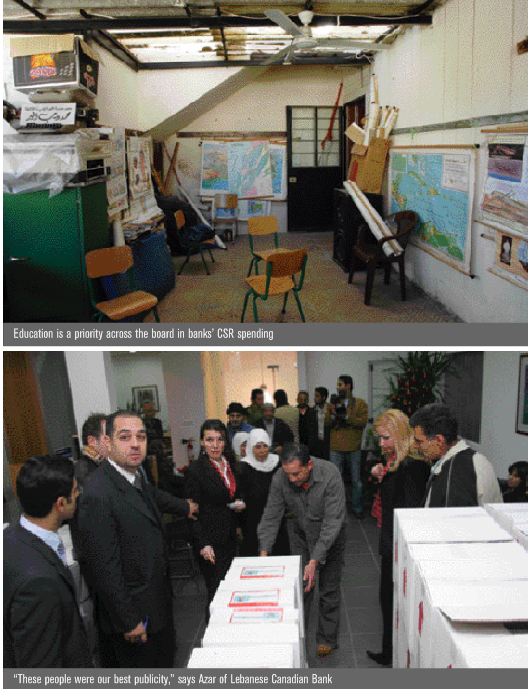
But Elie Azar of Lebanese Canadian Bank doesn’t see publicity as a bad thing. “When we opened our new branch in Halba,” he says, “we didn’t do an expensive advertising campaign. We gave away 180 boxes of food and provisions to the needy families there. These people were our best publicity.”

No bright lines
Azar does not see a bright line between a bank’s service to the community in its charity spending and its service as a commercial entity. “When we opened our branch in Hermel in 2003,” he says, “we were the first bank in the area, and we gave the people there access to a number of services they needed if there was going to be development, if they were to be able to stay there.” This value notwithstanding, the bank also contributed to a UNDP project bringing clean water to five hundred homes in the province.
This “both-and” approach informs another Lebanese Canadian Bank initiative. At the beginning of May they started to offer a unique loan program, offering loans of up to $5,000 at a 9% interest rate to homeowners in order to install solar water heaters in their homes.
“It’s a win all around for everyone,” says Azar. “The loans are profitable for us, and the customers save much more in heating costs than they pay over the time of the loan. And then you can add in that it saves the environment and reduces the pressure on our electrical and fuel infrastructure.”
LCB has been getting 5-10 applications a day for the loans. “This is the future,” says Azar. “If you look at the other countries in the region, in Israel 80% of the houses are using these heaters – in Greece, it’s 60%.”
In their more traditional CSR spending, Azar says, his bank concentrates on finding “effective projects that will have a positive impact.”

Relying on local knowledge
To identify the projects they wish to fund, banks rely on their local managers’ knowledge of their own communities.
“We work with each branch to discern the needs of each region,” explains Nahla Bou-Diab, assistant general manager of Al Mawarid. “The needs in rural areas are different from major cities. We have a branch in the village of Dmit, in the Shouf mountains. The community there are not well-off – their needs are for assistance in terms of developing a medical center – we helped them with basic necessities, schools, medicine, and so on. In another village in the Shouf area, the community were a bit more affluent, so in that particular area we designed a garden.”
Individual branch managers for Al Mawarid analyze the opportunities in a community and submit recommendations to the central branch. Some ideas come from formal or informal requests by NGOs or other organizations, and others come from the managers themselves. “Our manager in one area knew of a medical center that was crucial to the community – it was a poor area, and people were reliant on it every day. He knew that this center had a number of needs, and proposed to us that we help with them.”
Byblos Bank trusts its managers to decide on much of its educational spending. “In all the regions in Lebanon, our branches have a lot of schools as customers,” says Joumana Chelala, Senior Manager at Byblos Bank. “Our managers each have a budget to use towards educational needs, whether scholarships or something else.”
Banks are eager to get their employees involved. “Social responsibility is not just about contributing money to the community,” says Bou-Diab. “The other part that’s really essential is highlighting that these areas are really important in the eyes of management. One example of that was when we offered to match our employees’ contribution to St. Jude’s Children’s Cancer Care Center. We had 90% participation among our employees.”
“The salary structure in Lebanese companies is not very high,” she adds. “So these employees who contributed are not, financially, very very comfortable.”
The banks’ representatives show the pragmatism of a hardened loan officer in assessing their choices. Khaireddine says that Al Mawarid stopped funding concerts because “they were not doing anything for the community. We financed a few classical concerts in the Shouf, but the people who came, came at night, and didn’t even spend dinner up there. We felt like we were just making the events more profitable for the promoters.”
Chelala came to the opposite conclusion about cultural events, but arrived there by a very similar line of reasoning. Discussing her bank’s support for the Byblos festival, she says, “Before the festival, Byblos was not a destination for Lebanese. But now, even when the festival is not going on, many people from Beirut go up for dinner, or to visit the old souq.”

Focused on tangible outcomes
Perhaps because of their pragmatic approach, banks’ spending tends to be focused on tangible outcomes; medical centers refurbished or trees planted or schools equipped and teachers trained. Buzzwords common among the NGO community, like “civil society” or “dialogue,” don’t come up much.
“The private sector is becoming very active in supporting work in the environment, education, and so forth,” says Gilbert Doumit, who works both in education and in civil society areas. “Lebanon is well ahead of most Arab countries in this. But in more political, civil society, or citizenship-related areas, they are not so eager.”

To identif the projects they wish to fund, banks rely on their local managers’ knowledge of their own communities.


Education is a priority across the board. Kheireddine points to a library and computer training center near Shebaa. “We’ve taught people how to use computers there, and more importantly, we’ve given the young people there, right next to the Shebaa farms, access to the internet. Now they have access to the world.” Azar discusses a new library in Hermel. But it’s Byblos Bank that has taken on perhaps the most ambitious project.

Adopt-a-school
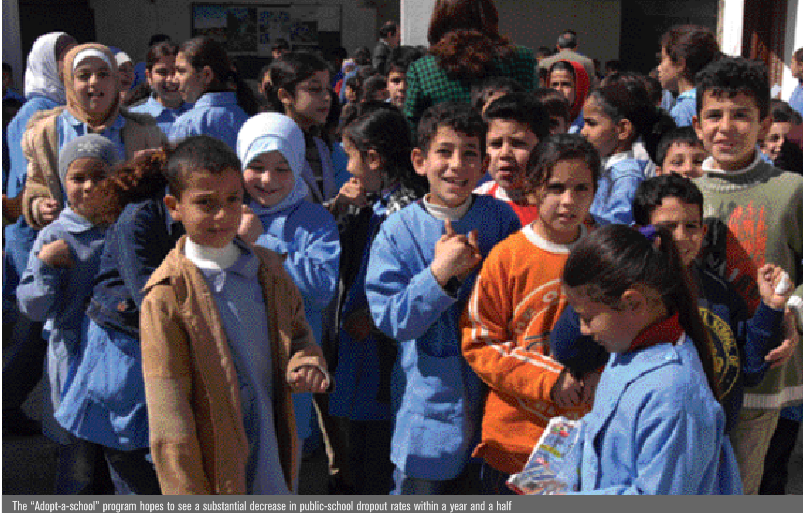
In a partnership with UNICEF, International College, and a large network of NGOs, Byblos Bank launched an “Adopt-a-school” project. The $200,000, three-year project, whose goal is to reduce the drop-out rates at a pair of public schools in Tripoli and Kesrouan, aims at attacking the problem from a number of different angles simultaneously.
There will be physical upgrades to the schools, especially to the bathroom and sanitation facilities. There will be training for teachers and administrators in identifying and helping children with special needs. But possibly the most important factor is literacy classes for the parents of children in danger of dropping out.
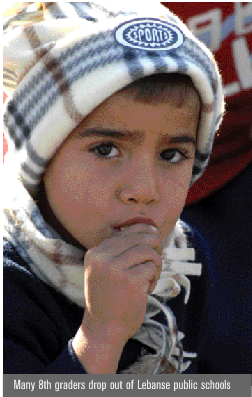
With an illiteracy rate as high as 20% in Northern Lebanon, children are “not given the support they need at crucial points in the curriculum,” says Roberto Laurenti, head of the project for UNICEF. “As the curriculum becomes more difficult, illiterate parents are unable to help those children who are already struggling.” As a result, the drop-out rates among 7th and 8th graders in Lebanese public schools are 9% and 11%, respectively, twice as high as at private schools. And once they drop out, they become vulnerable to any number of problems, from child labor to drugs and violence. “It costs much less to invest in keeping these children in school than to pay the social consequences later,” notes Laurenti.

“It costs much less to keep these children in school than to pay the social consequences.”


He emphasizes that all of the resources for the program, from expertise in training to monetary resources, are coming from within the country. “UNICEF is acting as a broker, bringing the people with the monetary resources in contact with the NGOs who can make use of them. We’ve been able to provide an opportunity to narrow the distance between financial and human resources in this country.”
The program differs from much charitable giving, Laurenti says, in that it is focused on dealing with a specific problem through a wide variety of needs, rather than on focusing on physical infrastructure. “We hope to see measurable improvement in the drop-out rate within a year and a half,” he adds.
This focus on a measurable outcome is a major step forward for CSR spending in Lebanon, says Isabelle Naoum, head of PR for Byblos Bank. “It helps us move towards a more formal CSR program, one where we can quantify the results of our action, and better fulfill our responsibility to our shareholders.”

June 8, 2006 0 comments
0 FacebookTwitterPinterestEmail
Special Section

In their debt

by Nicolas Photiades June 8, 2006
written by Nicolas Photiades

The affinity of Lebanese banks for government Treasury bills and other fixed income securities has always been strong, but the love affair intensified significantly in the early 1990s with the Hariri-inspired Horizon 2000 reconstruction program, which forced the government to resort to domestic and foreign issues of government fixed income securities or bonds to finance the project.

Rebuilding the country and the pound
Back then the country was in tatters. Not only was there an urgent need to rebuild, but the Lebanese pound, which by the fall of 1992 nearly hit LL3,000 to US dollar, also had to be saved. Rafik Hariri was quick to realize that the only way to obtain fast financing was to resort to debt via the issuance of domestic, Lebanese pound denominated Treasury bills. Loans from international banking institutions or supranational organizations such as the World Bank or the IMF would have been too slow to come in, too expensive and insufficient in terms of amount. On the other hand, Treasury bills in local currency, provided they carried a very attractive yield, would be easy to print, issue and place in a large domestic banking sector, which, although under-developed, lacking in significant human resources and strategic guidance, did have sufficient funding that needed optimization.
The banking sector at the time had succeeded in attracting around $6 billion in deposits from expatriate Lebanese but did not have the human resources or managerial quality to employ these new funds efficiently. Banks urgently needed to allocate their funds in such a manner as to boost their stagnating profitability and hence increase their capital base, which at the time was extremely insufficient and well below the international capital adequacy ratio of 8%. By subscribing to high yielding Treasury bills, the banks would not only help finance the government and the reconstruction program, but also buy themselves valuable time for the development of their own banking activities.
The government used the domestic banks to the full and issued significant amounts of Treasury bills, distributing them among the 83 banks from 1992-1996. Although the national debt level was increased significantly and debt service began eating up most of the government’s revenues, the reconstruction program was well under way and would be used as the main marketing tool for the government in its efforts to issue dollar-denominated Eurobonds. The first Lebanese Republic Eurobond of $400 million in 1994 was voted Bond Deal of the Year 1994 by the international bond community and was placed evenly among Lebanese and foreign investors. It would be the first of many to come in subsequent years, although the investor base for this particular instrument became 100% Lebanese (mostly Lebanese banks) as foreign investor enthusiasm waned.

Trading in government securities
Since then the Lebanese banking sector has increased its profitability significantly and boosted its capital adequacy to better cover the risks of the domestic operating environment. Some banks even made it their specialty to trade in government securities, while the sector as a whole started to appear more as a sector of deposit and savings banks rather than a real commercial banking sector.
Until recently, Lebanese banks appeared as financial institutions whose main function is to attract retail deposits and to place such deposits in government Treasury bills and Eurobonds. The diversification of activities, the expansion of typical banking activities such as retail banking, and the diversification of revenues are more recent developments for the Lebanese banking sector, which for a long time relied on the yield of government debt securities to finance and develop traditional commercial banking activities.

For a long time, the lebanese banking sector relied on the yield of government securities


What developed was a tacit understanding between the banks and the government, whereby the government would reward the banking sector with high yields, which would be instrumental in strengthening this vital economic sector, while the banks would use their funding to continuously follow the government in its reconstruction and now debt management efforts, and to support the stabilization of the local currency.
Non-Lebanese investors take part
Non-Lebanese banks and investors also took part in the Lebanese government’s fixed income securities issue drive. Indeed, by the mid 1990s, many Gulf banks and high net worth investors had subscribed to the high yielding Lebanese T-bills and Eurobonds (interest rates on T-bills denominated in LBP had reached 45% by 1995), considering these instruments to be a risk worth taking. The rating of Lebanon for the first time back in 1996 (ratings of B+ by Standard & Poor’s and Ba3 by Moody’s first came out, but were subsequently brought down by four notches to the current level of B-) did not make a difference in terms of yield and certainly did not decrease the appetite of Lebanese and Arab investors. Only Western investors, who are significantly more risk-minded, withdrew, considering Lebanon to be risky over the medium term. For Arab investors, it was a case of being well rewarded for taking on Lebanese risk, while some reciprocation would be reflected by investments in Lebanese real estate and projects.
By the end of the 1990s, more than 35% (35.8% in 1999) of the balance sheet of Lebanese domestic banks was accounted for by government Treasury bills and Eurobonds denominated in both Lebanese pound and foreign currency (mainly in US dollars). At one stage, in the mid 1990s, the proportion of government debt securities to total assets for most banks, including the larger ones, stood well above 50%. The government debt securities to total assets ratio for the banking system has gradually decreased since the mid 1990s, having gone as low as 23.2% in 2003 and 23.6% in 2004, in the aftermath of the Paris II donors’ conference, when interest rates on assets and deposits were decreased significantly by both the government and the banks. By February 2006, the ratio had gone up again to 25.9%, although it remains significantly below the proportions seen in the mid and late 1990s.
Since the Paris II conference, the Lebanese government has changed its attitude toward its borrowing and debt security issues policy. Pressured by international donors and relieved by cheap financing (around $4 billion in subsidized and soft loans), the government and the central bank had to improve the overall liquidity and foreign currency reserves by encouraging local banks to reduce their exposure to government debt securities and by requiring that a certain proportion of deposits (15% of foreign currency deposits for instance) be allocated in regulatory cash reserves at the central bank. By the beginning of 2006, cash reserves and deposits at the Banque du Liban (BDL) accounted for almost 30% of total consolidated assets for the banking sector. Such cash reserves coupled with the stock of government debt securities make up for almost 60% of total consolidated assets, leaving little room for local banks to lend to the private sector. Loans to the private sector accounted for around 23% of total consolidated assets by the end of February 2006.

Government exposure remains high
Coverage of almost 30% of customer deposits remains very high by international standards and the balance sheet of Lebanese banks appears to be reassuringly liquid. However, exposure to the lowly rated Lebanese government remains extremely high. If we add reserves at the central bank to government debt securities, then we can only realize that the banks’ exposure to the government dangerously approaches 60% of total consolidated assets. Furthermore, given the very difficult operating environment in Lebanon that makes lending to the private sector very onerous, any excess liquidity the banks might get is automatically invested or placed in cash reserves at the central bank or in Lebanese Treasury bills or other bonds issued by the government.
Today, the exposure to the government or cash reserves, deposits at the BDL and government debt securities account for around 8.5 times the banking sector’s consolidated shareholders’ equity. This means that any significant devaluation of the Lebanese pound or the US dollar, and/or a drop in the value or yield of government debt securities as a result of a rating downgrade (which remains a constant possibly) by 10% or more, would wipe out the banking sector’s equity base. What is also worth mentioning is that the significant maturity mismatch between funds and assets (in other words deposits carrying an average maturity of around 1.5 months and assets such as Treasury bills carrying a maturity of more than 15 months) makes Lebanese banks very vulnerable to any potential hike in interest rates. Indeed, if Lebanon is downgraded as a result of a failure to carry out economic reforms and privatization, then interest rates on deposits would have to be raised at a time when returns from assets are not yet available. This would erode the banks’ shareholders’ equity and reserves, and affect profitability.

Doomed from the start?
Hariri’s fiscal brainchild would indeed have been perfect were it to be accompanied by economic reforms, privatization, economic diversification, long term strategies, plans to eradicate corruption, racketeering, and so on. In their absence, the state is suffering from over-indebtedness; there is little government revenue and economic diversification and the non-bank private sector is suffocated by insufficient economic growth and inefficient and corrupt public utilities. The banks have had to continue operating in a constraining operating environment and are still heavily exposed to a sovereign which carries one of the lowest ratings on the planet. They also suffer from low revenue and asset diversification, are exposed to interest rate risk, and have low economic capital.


Perhaps it would have been more judicious to privatize public utilities immediately through Built Operating Transfer (BOT) and/or concessions (a longer term form of privatization), or even outright sale rather than borrow significant amounts to rehabilitate a still inefficient infrastructure. Privatization, even on the cheap, would have modernized the country at no expense, left debt levels very low, brought in revenues for the government (in the form of taxation and concession/BOT fees), and created jobs, while simultaneously diversifying the economy. But again, maybe we all lost the plot and confused the end of the shelling with the end of the civil war back in 1990, not realizing during the last sixteen years that the dice were loaded and that our reconstruction funding plans were doomed from the start.

June 8, 2006 0 comments
0 FacebookTwitterPinterestEmail
Special Section

The Lebanese banking sector shows little structural change in its consolidated balance sheet

by Executive Editors June 8, 2006
written by Executive Editors

The striking thing about the latest consolidated balance sheet of the Lebanese banking sector is the lack of change in its structure. After a period of ten to twelve years at least, assets are still split between cash reserves and deposits at the Banque du Liban (BDL), Treasury bills and other government debt securities, and loans to the private sector. As at the end of 2005, government securities accounted for 25.2% of total consolidated assets, while cash reserves and BDL deposits accounted for 29.2% and loans to the private sector for 23.1%. Foreign assets, which principally include inter-bank deposits with banks abroad accounted for 18.8% and fixed assets for 3.3%.


Funding, as has always been the case for the last 15 years, came principally from customer deposits, which accounted for 72% of total liabilities or interest-bearing funding. Total customers’ deposits, excluding deposits from non-residents, amounted to almost $48 billion by the end of 2005 and to $48.2 billion by the end of February 2006. The customer deposits figure has not increased significantly in the last three to four years, reflecting a sort of optimization of the consolidated balance sheet. Indeed, banks have slowed down their race to attract deposits by offering high interest rates, as placement of funds opportunities are scarce in a very difficult and deteriorating domestic operating environment. Moreover, the Paris II donors’ conference in November 2002 forced interest rates on both assets and liabilities to be decreased. Today, many of Lebanon’s larger banks are offering interest rates on customer deposits which are almost on par with what’s being offered by large international banks in AAA-rated countries. This is mainly due to the gradual rise in US dollar interest rates since 2002, which have today reached 4.75%.

Dollar accounts lose edge
When Lebanese banks offered 4.75% on US dollar savings accounts, the US dollar Libor (London inter-bank offer rate) was slightly below 4% at around 3.5%-3.75%. When the US Federal Reserve raised the US dollar Libor rate to 4.75%, Lebanese banks did not react and kept their own deposit rates relatively unchanged plus or minus a quarter of a percentage point. The compulsory tax on interest rates of 5%, which is imposed by the Lebanese government on both residents and non-resident depositors, brings any rate offered on deposits with Lebanese domiciled banks down to the same level as international rates.
Given the above considerations, a dangerous conclusion for the banks and the country can be drawn: why would anybody keep his savings in a bank domiciled in a B- rated and volatile country, and pay taxes on his interest receipts, when he or she could easily place his/her savings in an international AAA rated bank domiciled in a AAA rated country, get world class service and the same level of interest rates, and not pay taxes? Were a critical number of depositors to realize such a state of affairs, it would be highly likely that the liquidity of some banks may be tested again.

Relying on customer deposits
Lebanese banks seldom diversify their funding and continue to rely on customer deposits, which are nevertheless recurrent in nature despite having on paper an average maturity of 1.5 months. The maturity mismatch that characterizes the Lebanese banking sector does not appear to be a problem, as banks succeed in maintaining and even increasing their deposit base year in and year out. The only problem is that if the country is downgraded or there is a major external blow, such as last year’s assassination of former Prime Minister Rafik Hariri, then interest rates on both assets and liabilities may go up. Given the maturity mismatch, the higher rates on deposits, which have a much shorter maturity than assets, would then have to be implemented immediately, while valuable time would pass before the higher rates on longer assets are received. The ultimate price for Lebanese banks would be to see their profitability affected in the short term, and to witness depletion in equity and provisions, which would be difficult to compensate at a later stage if the interest rate hike is significant.
Straight, plain vanilla bonds accounted for 0.08% of total assets and amounted at year end 2005 to a measly $58.7 million. This is surprising, given the previous success banks had in the international capital markets when they last issued large size bonds back in the late 1990s. It is worth noting that the fact that the Lebanese government is still a frequent issuer of Eurobonds should make the banks equally attractive amongst local and international investors when issuing bonds. Issues of medium to long-term bonds would improve the maturity mismatch of most banks, while this other form of funding could be placed in new, but badly needed projects and/or products.

Medium and small banks clearly lack sufficient capitalization. They have been warned.


The Lebanese banking sector’s equity base has increased by a little bit more than 10% from the end of 2004 to the end of 2005, reaching a consolidated figure of almost $4.3 billion. The same figure has increased by almost 7% in just two months since the end of 2005 to reach $4.6 billion at the end of February 2006. The reason for this rise in equity is partly due to a frenzy of preferred share issues and to capital increases, which were mostly subscribed to by wealthy Gulf investors. Shareholders’ equity also rose because of better than expected profitability for the larger banks which were able to allow for an organic growth of their equity.

Insufficient capitalization
The consolidated equity figure for the banking sector is still regarded as barely sufficient, as reflected by an equity/assets ratio for the whole sector of 6%. With the implementation of Basel II requirements starting in 2008, the domestic banks’ current economic and regulatory capital would not be enough, as Basel II promises to hike risk weighting on assets significantly. For the moment, risk weightings are excessively generous and do not reflect the reality of credit risk in a volatile country such as Lebanon. It is also worth mentioning that from the consolidated figure of $4.6 billion of February 2006, at least $1 billion was accounted for by one bank, BLOM, which is the largest bank in the country. That particular statistic should be considered alarming for the medium and small banks, which clearly lack sufficient capitalization. They have been warned.

June 8, 2006 0 comments
0 FacebookTwitterPinterestEmail
Special Section

Profitability

by Executive Editors June 8, 2006
written by Executive Editors

The hey days of the mid to late 1990s in terms of bank profitability are now over for most Lebanese banks. During that period, local banks were able to create significant interest rate margins between deposits and other funding on the liability side, and loans and government debt securities on the asset side. At that time, yields on government debt securities, whether Eurobonds or Treasury bills, were very high and well exceeded the 10% mark for both Lebanese pound and US dollar denominated fixed income securities, while deposits carried average interest rates (albeit, higher than current levels).
Profitability at Lebanese banks has been on a declining trend for some time, as some banks have slowed down their growth, while others find it extremely difficult to lend to viable and creditworthy companies, individuals or projects, given the deteriorating general operating environment. But the main reason for a depleted profitability is the enforced provisioning by the BDL, which requires a certain percentage of customer deposits to be kept in the form of cash reserves and deposits at the BDL, mostly at an interest rate of 0%.

Interest income still accounts for around
80-90% of total banking income


Since Paris II, when interest rates were brought down to more normal levels, banks have been left cogitating about ways to improve their profitability. Additional provisioning requirements to cover for an increasing level of non-performing loans (as the operating environment is still depressed), subdued loan growth and limited options for low-risk profit-generating investments, and escalating costs for IT investments, the expansion of the branch network, product development and foreign acquisitions, are all factors that have contributed to a slowdown in growth, in addition to the enforced over-liquidity of the balance sheet.
Profitability remains at risk, as Lebanese pound operations (mainly Treasury bills denominated in LBP) are in fact subsidizing US dollar operations. If the Lebanese pound devaluates (the risk still exists), the profitability of Lebanese banks could be wiped out. Moreover, interest income still accounts for around 80%-90% of total banking income and the banks are still at a level where earning diversification is still “under study.” Some banks, particularly the larger ones, have acted more swiftly in the issue of earning diversification by establishing operations abroad and expanding retail activities. This explains the rise in profitability in 2005 for most of the larger banks.

Large banks increase profits
For example, Bank Audi, or the Audi-Saradar group as it is currently named, witnessed an increase in net profits of 48% by year end 2005 to around $106 million. This was due mainly to a rise in commission income and to better profits on financial or treasury operations. Bank Audi’s foreign investments are clearly starting to pay off, and the bank’s recent merger with Egyptian investment banking group, EFG Hermes, bodes well for the future. However, a return on assets (net income divided by total assets) of less than 1% (0.9% in Audi’s case) still shows a very average profitability. Truly profitable banks worldwide usually register ROAs of well above 1% and more in the 2% waters.
Byblos Bank’s performance was similar to Audi’s, in the sense that it too had an ROA of 0.9% at year end 2005. Profit growth was less significant, as net profits grew by 28.5% to $69.3 million. Profits would have been higher were it not for a 157% rise in allocations to loan loss provisions. But the bank was able to more or less compensate with more commission income and financial and treasury operations.
BLOM Bank’s profitability rose significantly by 72.2% for the year ending March 2006, to $44.2 million. However, this profitability could have been higher given the size of Lebanon’s largest bank’s balance sheet and equity base. BLOM is known for its conservative and prudent approach to lending, but nevertheless holds the most important franchise in the country.
On an annualized basis, Banque Libano-Francaise shows an ROA of 0.5%, for an annualized net profit for 2005 of $18.9 million. This bank is still considered to be in a transition phase, as its previous French 51% shareholder, Credit Agricole, sold its stake to regional investors a little bit more than a year ago. The bank is currently going through some changes in management, in culture, and in business philosophy, and significant provisioning is also gradually taking place. BLF should be expected in the medium-term to become increasingly more profitable as its new strategy falls completely into place.
Bank of Beirut, one of the best-managed banks, saw a profit growth slightly below the 10% mark. Its ROA is similar to its peer group at around 0.6%. Net interest income and non-interest income were slightly reduced in 2005, and the rise in net profitability to $28.3 million (unaudited accounts) was mainly due to less allocations to loan loss provisions. Given these figures, one can only feel that the bank is currently optimizing its balance sheet.
The only audited accounts for 2006 came from Crédit Libanais, a traditionally well-managed institution, with state of the art systems, policies and procedures. This bank’s profitability also improved in 2006 by 22% to $23.3 million, which is a step closer to its profitability of $25 million+ during the peak period of 1999-2000. However, ROA remains lower than a standard 1% at 0.7%, reflecting a further need to diversify earnings and invest in some form of product and geographical expansion.
Other high growth banks, such as Intercontinental Bank of Lebanon (IBL) and Lebanese Canadian Bank have witnessed significant growth in profitability in the last few years, which was commensurate with their impressive asset and deposit growth. Although IBL did not publish end of year accounts, its June 2005 figures show an ROA of 1.08% and a 65% net profit growth on an annualized basis. Lebanese Canadian, which had grown substantially in the last five years, is showing signs of profit slow down, as the net income increase dropped to 16.8% in 2005 compared to 65% in 2004.

Profitability depends on stability
As seen above, Lebanese bank profitability would highly depend on the stability of the operating environment, which itself depends on the political situation and the ability of the government to implement an efficient economic recovery and debt repayment plan. Given the socio-political mess of the last few months and the desperate lack of light at the end of a very long tunnel, banks are strongly advised to look elsewhere for profitability.

June 8, 2006 0 comments
0 FacebookTwitterPinterestEmail
Uncategorized

Apprenticeship put on hold

by Executive Editors June 3, 2006
written by Executive Editors

The Lebanese Broadcast Corporation (LBCI & LBC-SAT) much trumpeted plans to launch a pan-Arab version of NBC’s hit business TV show The Apprentice have been put on hold.

The 15-part series, scheduled to air in October, a month after the premiere of the rival CEO show, had already made announcements for casting and had signed up business mogul Mohamed Ali Alabbar as host.

Yet a media spat between Alabbar and the producers of CEO clouded the show in controversy from the start, leading to rumors of a pullout by the colorful chairman of the real estate development company Emaar-Dubai.

“The decision to put the show on hold until a more appropriate time was a unilateral decision made by LBC, which we were merely informed of,” an aide said, on condition of anonymity. “Mr. Alabbar will abide by their decision, but he had not expressed any desire to pull out of the show.”

LBC has refused to issue a public statement on the matter, but sources close to the production team say the casting has been put on hold and the shooting of the show postponed.

As of yet, none of the leading advertising agencies in Lebanon have entered negotiations on a sponsorship contract for the show, one of the largest sources of revenue for reality TV shows – another indication of the delays in launching the program.

A FreemantleMedia franchise, The Apprentice pits several contestants against each other in a bid to showcase their business savvy. Contestants are teamed up and made to solve a variety of business problems, negotiate deals and manage projects. The winner of LBC’s Apprentice was scheduled to walk away with a $300,000 a year senior position at Emaar-Dubai, working alongside Mr. Alabbar.

June 3, 2006 0 comments
0 FacebookTwitterPinterestEmail
Business

LEBCAN multitasking on strategies

by Executive Staff June 3, 2006
written by Executive Staff

The term to best describe the approach of Lebanese Canadian Bank to its current development strategy is multitasking – but what the bank does in pursuit of its second five-year growth program actually goes a bit beyond the range of activities associated with that word. Lebanese Canadian is in fact making an attempt at multi-directional multitasking.

The core objectives of the program apply the tried-and-true pattern of Lebanon’s banking leaders seeking to achieve vertical and horizontal growth through diversification of business lines and through geographic expansion into regional markets. Lebanese Canadian, however, stands out among its peers by pursuing this path with more than common vigor. For example, the bank is looking seriously at joint ventures and new operations in at least half a dozen countries. At the same time, it is seeking to stack its activities in a vertical structure reaching from Islamic banking and asset management on the one hand to retail lending and insurance brokerage on the other.

First growth plan

To back up these lofty ambitions, Lebanese Canadian has the accomplishments of its first growth plan to show for itself. The bank devised this plan during an establishment phase following upon the majority entry of Lebanese shareholders and transformation from being the Lebanese branch of the Royal Bank of Canada into Lebanese Canadian Bank in 1988.

Implemented with the start of the new millennium, the first five-year plan took Lebanese Canadian from being a midsized bank with assets below $500 million at the beginning of 2001 to a five times larger asset base by the end of 2005, making it a solid member of Lebanon’s alpha group of banks (by the definition that banks in this group have deposits of more than $2 billion each) in late 2004.

At the end of 2005, the bank’s deposits stood at around $2.3 billion and assets reached $2.8 billion. In terms of market share, Lebanese Canadian clocked in at around 4% at end of last year, up from 1.5% at the commencement of its five-year growth program in 2001.

In embarking on its second five-year strategy, the bank met and exceeded its profit target of LL 10 billion ($6.65 million) for the first quarter of 2006 by reaching over LL 11 billion in [unaudited net] profits in the three-month period. The asset and deposit figures did not change greatly in the first quarter, according to the bank’s chief financial officer, Charles Skaff.

Over the past five years, Lebanese Canadian also advanced from a position of relative obscurity to that of an operator with a high visibility profile. It refurbished and expanded its domestic network, establishing 21 new branches (advancing from 10 branches at start of 2001 to 31 this month). Moreover, Lebanese Canadian maximized the publicity benefits of gaining ISO 9001-2000 certification or excelling among its peers by highlighting its performance peaks such as being the top bank in the alpha group last year in terms of its growth in deposits (18.21%) and total assets (21.16%), as well as achieving the alpha group’s highest percentage return on average equity with 25.23% RoAE.

For its cross border outreach, the bank opened a representative office in Montreal, Canada’s epicenter for the Lebanese community, and started offering products tailored to Lebanese expatriates in the Gulf region while it staked out its domestic claim to prominence with acquisition of a downtown Beirut plot of land for its headquarters project smack on the Martyrs’ Square axis. In other visibility enhancing steps, Lebanese Canadian undertook sponsorship of events in both the professional realm – i.e. conferences and trade fairs – and the corporate citizenship area, through social, cultural, and environmental ventures.

Based on the groundwork of the years 2001 – 2005, the year 2006 appears to easily be one of the most important for the bank’s development plans. In the first quarter, a main target was increasing its capital, along with making preparations for an initial public offering (IPO). The bank is further seeking to make a domestic acquisition before the end of the year, and is angling for joint venture activities with an international banking institution.

The 2006 capital increase program, which was still in progress at time of writing, had been planned for a while. Lebanese Canadian spelled it out as a three-layered project that includes issuance of new common shares, a preferred shares issue, and launch of Global Depository Receipts (GDRs). However, while the combined growth horizon for these three measures had been an increase in the bank’s capital to about $250 million at end of 2006, the target figure has recently been revised upwards and now stands at over $300 million.

Two steps out of three

In the first two steps of this three-tiered capital increase program, Lebanese Canadian this year issued new common shares and preferred shares to the tune of $35 to $37 million per measure, which together would boost the bank’s capital base by about 50%, from $140 on December 31, 2005, million to $210 million by end of May.

The $35 million increase of common capital proceeded as planned, with participation from existing and new shareholders, and led to a 4.95% equity participation of Gulf-based investors, Skaff told Executive.

The primary objective of this increase was to enhance the bank’s ability to ready itself for the Basel II banking standards, which will govern the industry as of 2008. For alert banks, Basel II risk management rules are already the yardstick by which they are shaping policies.

The preferred shares issue, however, encountered over-demand from the bank’s existing shareholders, attracting almost 25% more applications than could be filled under the planned issue size of $30 million – although this was double what the bank had offered in each of its two earlier preferred shares issues in 2002 and 2003. Thus, Lebanese Canadian decided to increase the issue to $37 million, for which it was expecting approval from Lebanon’s central bank at the end of May.

While these capital raising initiatives were fully accomplished, some of the bank’s other new development projects have been evolving slower than Lebanese Canadian’s chairman and top management hoped for. The first measure to progress less speedy than programmed was the IPO plan. Mostly, this was due to unfavorable influences on the timing. As the regional stock and equity markets caught the severe correction jitters in February and March, Lebanese Canadian thus missed out on its IPO dream timeframe of realizing the flotation in the first quarter of the year.

A bitter second place

Also on the acquisition front, Lebanese Canadian had to wrestle with the fact that buying a decently performing Lebanese bank is easier said than done. In December of last year, Lebanese Canadian made an attempt at what would have been a dream acquisition, according to its chairman, George Zard Abou Jaoude. The takeover of Lebanon’s BLC bank, for which Lebanese Canadian claims to have been the second highest bidder, would have satisfied the bank on two of its top strategy objectives – a massive domestic market share boost factor and a readymade expansion platform in the Gulf region.

Lebanese Canadian’s bid for BLC encountered overly strong competition from the cash-heavy Higher Investment Council of Qatar but it also got derailed by the bank’s downward revision of a higher bid threshold which it had been preparing earlier, in partnership with a potent corporate partner from the Gulf region. Here, according to Abou Jaoude, the bank’s double aim of applying the most aggressive and the most conservative principles in unison, did Lebanese Canadian a disfavor and made it emerge a bitter second place in the contest for BLC.

This means that Lebanese Canadian has still to go through the rituals of courtship and assimilation of a target bank in the Lebanese market, a process which Skaff said it hopes to complete by the end of the third quarter of 2006. This acquisition is highly important if the bank wants to carry forward its strategy that calls for reaching a domestic market share of around 10% by 2010. While organic growth might suffice to add another percent in market share by the end of 2006, when Lebanese Canadian intends to account for 5% of domestic market share, and yet another point or two in the following years, a takeover is a necessity for reaching the 2010 market share target which would make the bank “a major player,” by its own reckoning.

Geographical expansion

Also fully loaded is the bank’s geographic expansion agenda. According to Abou Jaoude, Lebanese Canadian is not only pursuing the takeover of a controlling majority in an Algerian bank in addition to having bought a small stake in Sudan’s Al-Salam Bank, but it also is looking at establishing a brokerage unit in a GCC country, at buying a bank in Egypt, at creating a new bank in Iraq, at branching out into Syria, at Bahrain and at Qatar. All this in conjunction with developing its private banking business, an Islamic window, and an investment banking line and while continuing to expand its retail operations.

At the end of this growth cycle, Lebanese Canadian expects to stand as a banking institution high up in Lebanon’s alpha group, and achieve a diversified income with operations abroad contributing at least 40% to its profits.

With its past five years of rapid growth and its self-perception of being a young and flexible, aggressive institution with clear-cut principles that seek more than a role in profit making, Lebanese Canadian has nurtured seedlings for the whole plantation of its expansion objectives. Its targets, which are driven with great personal investment and enthusiasm by Abou Jaoude, destine the bank to a pursuit of power growth for at least its second five-year plan.

In developing its long-term vision, however, it is pivotal for Lebanese Canadian to accomplish its IPO, implement its joint ventures with international partners, and buy a local bank. The bank is subject to the same country risks and political factors which constitute the vagaries of doing business in Lebanon and the Middle East region. The bank’s executive leadership presents an optimistic view on their ability to succeed without improvements in the political and fiscal climate but admits that a successful “Beirut I” conference for Lebanon would serve as welcome enhancer of its potentials.

June 3, 2006 0 comments
0 FacebookTwitterPinterestEmail
Real Estate

What’s the difference anyway

by Safa Jafari June 1, 2006
written by Safa Jafari

Lebanon has been going through ups and downs, cycles of joys and woes, repeated phases of history. It waddles along both victorious and defeated. How do its people feel about this? Are they aware of the issues at hand? Do they have an opinion or a preference? Absolutely. Are they hopeful? Unlikely. The result is a numbing state of indifference.

This article is based on information gleaned from informal interviews with Lebanese citizens – although the word ‘citizen’ does take on an ironic twist, assuming, as it does, a sense of ownership, stake-holding and awareness of their rights and duties vis-à-vis their country. Of course, citizenship also implies the presence of a functional state. The aim was to see if today’s Lebanese are politically indifferent. If so, why and what does it mean?

What is indifference?

The dictionary definitions of indifference include: privation of passion, emotion, or excitement; a state of indolence or apathy, and being incapable of being ruffled or roused to active interest. Etymologically, the word means “no difference,” an unnatural state in which the lines blur between light and darkness, good and bad. Indifference is often an outcome of a crippling set of excuses. Sometimes it is based on ignorance but often comes despite knowing that things are not going well. Finally, it is choosing to ignore that kind of knowledge and waiting for things to become better, allowing the problem to continue. As indifference by definition is being passive and inactive, it also implies no change towards the better and a definite lack of planning. It is the loss of hope and the bottling up of intense feelings that may cause sudden societal rage or lead to indoctrination by extremist groups, such as we have seen in France and the UK among disaffected Muslims. Indifference, far from being stagnant, can be very dangerous indeed.

Arab political indifference

In his article “What on earth is it with the Arabs” Robert Fisk speaks of Arab apathy. Invasions, interferences, injustices and occupation come frequently and are challenged rarely. The fact is that the West objects more than the Middle East. Whether it is violence in Sudan or the removal of Saddam Hussein and the occupation of Iraq, the Arab people simply move on. The Palestinians have been feeling Arab indifference for decades; the Lebanese felt it throughout the civil war and now the Iraqis are also feeling it.

Internally, the heavy hand of the oppressive state has been historically responsible for the apathy which grips Arab societies. They can speak of injustices in other countries but not within their own borders for that is going against the law. As Adnan El Amin says, it is as if the law is to “stay sedentary, within a circle of nonchalance and disgust.”

The sorry state of Arab societal organizations is equally to blame. The Oxford-based academic, Nadim Shehadeh, recently told Al Ahram that “too much has been expected from the man on the Arab street… The people are more cynical and just want to get on with normal life rather than pursue high ideals and become revolted and frustrated.” The public is also feeling deep distrust of their representatives who, as Talal Salman told The Weekly, have started buying their survival from the United States by discreetly agreeing to American plans, while publicly denouncing the US and suppressing all forms of public resentment. The Arab public sees this, loses faith in the regimes, realizes it can neither change the regime nor the way it functions and just gets on with life.

The Lebanese Scenario

The situation in Lebanon is different. The Lebanese allow politics into every part of their daily lives. Compared to other Arab nationals, the Lebanese have more space to express their political opinions while their political energy is more consumed by internal affairs than issues in other Arab countries.

But this does not mean they are not indifferent. If indifference is defined as lack of interest or caring, then the Lebanese are not indifferent. If, however, indifference is taken to mean a lack of hope, then, yes, they are. Elie Wiesel wrote about ‘The Perils of Indifference’ in 1999, he defined indifference as the blurring between good and bad. In the Lebanese case, the people do see the difference. It is just that they are currently in a state of feeling no differently whether they experience the good or the bad – as, you see, the good cannot be so good, the good might just as well be bad. The Lebanese spoken to in these interviews realize what it is like to have a functional, developed Lebanon. But due to a state of hopelessness, they do not see this coming any time soon.

Politics politics everywhere – show me change and not despair

Politics plays a major role in daily life in Lebanon. Jokes, cartoons, comedies and even songs revolve around political reality. “It is the bread we eat,” commented one young Lebanese. One hears political discussions everywhere: coffee shops, the living room, even the gym where small TV sets airing heated political debates grab the attention of those working out.

The space allowed for venting, however, if accompanied by the possibility for action (as in joining political parties, organizations, and demonstrations) is not accompanied by change. The act of political discussion has become an art of deliberation, as in a school debating society, if not a pastime. But what happens after one has spoken one’s mind? What happens beyond polling and opinion surveys? Democracy is only part expressing one’s opinion; the other part is being heard and taking action accordingly. The Lebanese citizen is aware of this incomplete picture. Loss of democracy then results in apathy, and apathy, in turn, results in further loss of democracy. And yet the curve of hope has waxed and waned, affected by incidents, speeches, alliances and shocks.

The shock

For 30 years, the main obstacle on the road to prosperity was considered by many to be the Syrian presence in Lebanon. This alone bred inertia, as a justifying excuse was present, obvious and persistent. There was an obvious stagnation in political feeling among the Lebanese public for many years (44.6% of interviewed Lebanese youth in 1997 stated no political preference). However, a revitalization of political energy occurred with the assassination of Former Prime Minister Rafic Hariri, and the return of both Samir Geagea and Michel Aoun to the political scene. Lebanon received international attention and support, and a happy ending was perceived when the Syrian forces pulled out of Lebanon. For once, the Lebanese felt they could take their destiny into their own hands. But more recently, the feeling that different leaders had failed to demonstrate genuine concern for the state, has left the people wondering about their loyalties and judgment.

Reasons for hopelessness

It is not lack of information that makes some of the Lebanese indifferent. Information can be incomplete and it can be incorrect. It is mainly the fact that there is no new information and too much of the same morale-defeating information that has led to this inertia.

Indifference can occur as a result of a lack of awareness and interest in current issues as well as a lack of a sense of belonging to one’s country. In Lebanon, several possible reasons for indifference have surfaced:

n A feeling that one cannot do anything about the status quo, coupled with a heavy dose of cynicism.

n A lack of faith in the state, the political system, the law, the institutions, and the politicians as well as a lack of confidence in the ability to organize and achieve institutional reform.

n A feeling that the same tribal and political leaders that have ruled the country for years will continue to do so.

n Voter apathy in the election process, law and candidates.

Indifference in Lebanon

Although the 2005 elections were the first free elections in 30 years, the voter turnout was still not high. The first round turnout was 28%. In the second, third and fourth round, the turnout was between 43% and 55%. Meanwhile, citizens’ rights remain unclaimed, be they the Sheba’a dispute and war crime compensations, while national files – the disappeared, the cellular phone dispute and the quarrying scandal – remain closed. But utilitarian theory dictates that, unless the people see benefit from a certain change, they will not put the effort to bring it about. If two scenarios are similar in weight, there would be indifference in the choices on offer.

People want a dignified daily life. They want to know that they are not being robbed by the VAT and phone and water and electricity bills. They want to know where their money goes. Is the debt being paid off?

Ironically, there is a separation between daily struggle for economic and social security on one hand, and politics on the other hand, which, although very linked to the reality of the people, is often perceived as an accessory or social activity. With a growing economic gap, there has been significant growth in dissatisfaction with present political parties, and this has led to a decline in political trust. People have been marginalized by the complication of ongoing politics. As Walter Lippman pointed out in 1913, ‘indifference prevails insofar as political paradigms propose differences that are irrelevant to the lives and actions of persons.’ But maybe it was Plato who summed it up best when he wrote that, “the price of apathy towards government is to be ruled by evil men.”

June 1, 2006 0 comments
0 FacebookTwitterPinterestEmail
Business

Greenhouse Revolutionary

by Michael Karam June 1, 2006
written by Michael Karam

According to Etienne Debbane, chairman and CEO of Exotica, the horticultural and contracting company, the key to success has been to exploit the synergy of opposites: war and peace, indoors and outdoors. A bit of flair, an emphasis on service, staying tightly competitive and a strong regional presence have also helped the corporate cause.

“When we started in 1978 and opened our 5,000m2 outlet in Zalka, the doubters all said, ‘these people are crazy. They have more money than sense and they will soon be bankrupt’,” he recalls.

Debbane is sitting in his office at Exotica’s 100,000m2 nursery and head office in Louaizeh in Zouk Mosbeh. “They were wrong. People were spending more time indoors because of the war and they needed something to make their living environment more agreeable. They needed plants. Till then it had been an alien concept. It was the same with the offices. We won contracts with banks, insurance companies and other major businesses to supply and maintain plants in the work environment.”

With peace, the Lebanese emerged, blinking into the sunlight. “The stress was on gardens. Again we were pioneers. Look at Fakra. It is arguably the greenest area in Lebanon. Why? Because the promoters of the development were crazy enough to go for our idea to plant around the hotel. Again we had our doubters. They said we were crazy putting plants in the snow. They will die, they said. But tell me, who builds a chalet in Fakra today and doesn’t plant a garden? Who today invites people to dinner and doesn’t put flowers on the table? We have created or at least contributed to this culture.”

A household name

Exotica’s origins are embedded in Societe Debbane Freres, the agricultural arm of the Debbane group. Etienne’s father was what he calls “a pioneer farmer” who began the importing and contracting of pesticide application in Lebanon and abroad. “I joined the group in 1971 and my father told me to bring new business ideas, so I implemented the greenhouse and plastic undercover business to Lebanon in 1971 and 1972 and then began producing ornamental plants in 1979. This is how we started the distribution company. We then moved to Kuwait and Saudi Arabia, and grew from there.”

Today, Exotica is a household name with annual revenues in the range of $10 million. With five points of sale and the mammoth Zouk nursery, it can sell you a dozen home grown roses, a 2,000 year old olive tree or ranks of fast-growing, Leylandi conifers to block out nosey neighbors. It will landscape, plant, irrigate, and maintain your garden, manicure your lawn, plant a golf course or lay a football pitch. Exotica produces 2 million plants a year and imports those it can’t grow locally or which are too expensive to grow locally. Today, the retail side accounts for 50% of business, landscaping 30% and plant production 20%.

Regional roles

Exotica has been a regional player from almost the very beginning. In 1981 it established one of the largest companies for landscaping in Saudi Arabia and for 22 years worked on palaces, universities, golf courses and sports pitches. Does this entity still exist? If not, what happened?

In 2004, the company embarked upon its second regional project and now divides its Middle East activities between two corporate entities. Exotica SAL today serves the Levant – Jordan, Syria and Iraq – and North Africa – Egypt and Algeria, while Exotica LLC, an Emirati company with local partners, conducts business in the UAE, Qatar, Bahrain and Kuwait. Both companies are looking to target regional markets with renewed vigor. “We have just built a 50,000m2 nursery in al-Rahba area of Abu Dhabi. It will be fully operational by September 2006 and is geared to outdoor plants,” explains Debbane.

In the last three years, Exotica has been more active in the region, a strategy born out of a gradual contraction in the Lebanese market. “We need to focus on countries where there is wealth and demand. Lebanon is getting poorer. You need a consumer to sell and today there is less money to spend. Big jobs have been delayed or even stopped.”

Still, the infrastructure was in place to serve regional demands, while the know-how built up over a quarter of a century of working in the region has, claims Debbane, given Exotica a genuine edge. “We are executing gardens by shipping straight from the source or Lebanese nursery,” he explains. “If you want to be a big player you have to be there as a legal entity and to have a nursery producing plants that others don’t have and to be price competitive with other local producers. And this is what we have done. Today 20% of our business is outside Lebanon but within five years, we expect this to climb to 50% with overall revenues hitting $30 million.” According to Debbane there are no plans to undertake an IPO. “There is no need. We have a very powerful partner in the Emirates and in Lebanon we are doing well.”

A unique selling point

Despite the regional push, Exotica’s main hub is still in Lebanon. The Zouk nursery is a source of immense pride for Debbane. “It is probably the largest in Lebanon with the widest selection of plants, around 3,000 items.” Debbane points out that due to Lebanon’s unique range of microclimates – tropical, sub-tropical, desert and alpine – the company finds itself in the unique position of being able to cater to all zones, including the Gulf countries. “We are probably the only company in the world that caters to all these climates.”

Self-production and slavish attention to the bottom line has also sharpened Exotica’s competitive edge. It is an area of the business of which Debbane is particularly proud. “When it comes to quality and price on the plants we produce, we are unbeatable. We are highly mechanized and professional. For instance here in Zouk we produce 1 million rose stems, using hydroponics, a soilless culture in an ultra-sophisticated computer-controlled greenhouse system. The investment has been extremely expensive but we sell what we produce and we make the best roses in the country. Whether it’s annuals, perennials, small plants, or shrubs, we are also unbeatable because we use mass, mechanized production. We handle the plant once, put it in its pot and when it is ready for sale, we unplug and sell it.”

Debbane is also keen to stress that while Exotica is a successful family business, it is run as a corporation. “We have rules. We are clearly regulated, well-organized and financially transparent. There are two ways of running a family business. There is the family way: low cost, no investment and where everyone in the family works haphazardly and then sells without calculation. We do it in reverse. We look at it as an industry. We say the end product is this. What should we do to get it at price of not more than this? How many should we produce and what are the means of producing?”

The result is a competitive pricing policy that is often at odds with the company’s glamorous image. “People are normally shocked by our the prices. They think we charge for our name. This is not true,” claims Debbane. “The name is the gravy. All our plants have prices and are fixed. This is security to the consumer. Customers can come here and book a tree and come back for it in two months.

Exotica grows 1.5 to 2 million plants each year. “Everything that we can grow that is cheaper than importing we grow and in the same vein everything that we can’t grow here or is cheaper to import we will. For example, we used to get Palm trees from the North but now it is cheaper to ship them in from Egypt. They may not be as good as ours and a few may be diseased but it is still worth it. The plants we grow here are plants that reach maturity in 1-4 years and which we can sell easily. There is no point in investing in long-term trees when the market is so uncertain and in the contracting game you have to keep overheads low all the time as a precaution against the lean periods.”

The Debbane Group

Precaution or not, Exotica’s fortunes have been firmly rooted in the solidity of the Debbane Group, without which Debbane says Exotica would probably not be around today. “We owe our success to the support of the Debbane group. We have had highs and lows.” The lows were…well, pretty low, especially a particularly lean spell at the end of the civil war. “When things went bad, no one would have come in. Who was going to pay $500,000 for 90% of Exotica when they see you are bankrupt, even though 50% of the company should be worth $4-5 million? The Debbane Group, with income from other sectors in other countries, has been the key to our success.”

Debbane is one of six family owners in the group which established Exotica and which has revenues of around $100 million. The core activities are spread over seven other companies: Societe Debbane Freres, importers and distributers of agricultural material; Sodap, Insulco and BCL, which make construction material, insulation and cement respectively, Pesco Telecom and Evert M which provide telecom and data transmission services, and Enoteca, the upmarket wine importers and retailers, a business that grew out of a hobby and which now serves both the on and off-trade. It is another area in which Debbane feels the group has contributed to new trends in modern Lebanese living. “People used to serve whisky and arak with a meal. Now it has to be wine.”

The CSR experiment

Exotica devotes 5% of its revenues to advertising, “the norm by western standards.” Given the company’s green – metaphorical and literal – profile, surely it must be heavily involved in corporate social responsibility, working among the community and leading the way to a greener Lebanon? Debbane sighs. “To be honest, most of our efforts to help the public sector have failed. We have planted roundabouts, medians and trees on pavements mostly without success because the day we hand them over to the municipality, they are not well looked-after. We have planted some areas as much as six times. If we had been allowed to do it properly they would be fantastic places by now. It kills you. I was involved in a roundabout project with Pikasso [billboards]. When we maintained it, it was fine but when we left it, it died and had to be replanted within two years, probably at a higher cost. So you can see there is little incentive for us when we are let down all the time.”

Yet Debbane has sympathy for the Ministries, who he says are underfunded. “Look at the ministry of agriculture. It has 0.04% of the national budget for a sector that employs 25% of the workforce. In 1974, we were pioneers. Today, Lebanon has fallen behind its neighbors in this field, while other have learned new methods or brought in know-how.”

Value-added service and know-how

Know-how is a key strut in the Exotica corporate structure. “You have to get the best people. Without people there is no business. The key is that we have always invested in people. We have found the best and brought in the best and trained our staff abroad on the latest techniques, buying know-how when we have to.”

As a result, Exotica has 15 technical teams supervised by engineers that are on call to visit the nation’s gardens, assessing, planting and maintaining. It is, claims Debbane, all part of the total care package. “We guarantee everything. You can call us and say, ‘I have a garden in Tyre. Can I plant lavender?

’ We will ask if you have checked your water. Is it too salty? We will check the water and the conditions and if you can’t plant lavender we will tell you why. Others retailers will just say, ‘You want lavender? Take three plants, what’s the problem? If they die, come and take three more.’ We are still maintaining gardens that we planted years ago.”

June 1, 2006 0 comments
0 FacebookTwitterPinterestEmail
Real Estate

Forum Diary

by Executive Staff June 1, 2006
written by Executive Staff

Many Arab countries are realizing that the call for political, economic and social reform is getting louder, especially since the spontaneous democratic groundswell that shook the region in 2005. Participants at the World Economic Forum meeting that took place in the Egyptian resort of Sharm el Sheikh last month debated the lengths to which Arab countries should go in pursuit of reform. Executive reports the highlights.

Saturday 20 May

Hosni Mubarak opens World Economic

Forum on the Middle East

Egyptian President Hosni Mubarak opens the World Economic Forum on the Middle East with a call to the international community to work together to resolve regional conflicts. “Peace and development are indivisible,” the president tells more than 1,200 government, business and civil society leaders from 46 countries meeting in Sharm el Sheikh.

“The Middle East stands at a crossroads and it is up to us to make choices. Egypt’s choice is peace as it is the only path to development. We seek international partnership based on investment and not on aid and assistance. We are confident that building democratic societies is the only way to a better future that we seek,” he says.

Klaus Schwab, founder and executive chairman of the World Economic Forum says the meeting is “the most powerful demonstration of hope and will and determination to create the necessary conditions for economic, social and political development.”

World Economic Forum on the Middle East sets action priorities

The co-chairs of the Forum set five pillars for action to help prepare the way for a more prosperous future for the region. Over the course of the three-day meeting, participants focus on democracy, peace and stability; youth and understanding; global integration; investing in the future; and the business agenda.

“Peace is the crucial component upon which all the pillars of this summit can be achieved,” says Shafik Gabr, head of Artoc Group for Investment and Development. The prosperity of future generations depends on stability in the region, he argues.

H.R.H. Princess Lola Al Faisal, vice-chair of the board of trustees and general supervisor, Effete College, Saudi Arabia, describes the next generation as a “population bulge” in which 60 million people in region are under 25-years-old. “I see this youth bulge as an asset” in which the region needs to invest through education.

The private sector will lead the way in creating jobs for the region’s youth, says Nemir Kirdar, founder, president and CEO of Investcorp. Mohamed Al Mady, vice-chairman and CEO of Saudi Basic Industries Corporation (SABIC), notes that investing in human resources through education, technology and creativity would give the young the tools needed to fill the jobs crucial to economic development.

Oil Boom: sedative or stimulant for economic reform?

The hike in oil prices has completely changed the economic climate that forms the background to reform in the Middle East. Top leaders are asked if governments are using the new budgetary resources to push forward reform or if the tough decisions are now on hold.

“Cautiously optimistic” is the reaction of Mustapha Nabli, chief economist and director, Middle East and North Africa, of the World Bank. “But the potential is still big to do better.”

William Rhodes, chairman, CEO and president, Citicorp Holdings and Citibank; and co-chair of the meeting, draws a distinction between the oil boom of the 1970s and the present one. Whereas much of the money left the region in the first boom, “I think a lot of this money will remain in the area now,” he tells a packed session audience.

He continues that this was thanks to strengthened financial systems and large-scale privatization. Rhodes calls on the private sector to “step up,” to “really get involved in working with government and international investors” to drive reform. Improved corporate governance, transparency and a proper regulatory framework in place, he argues, would only expand private sector participation in the economy which is crucial to job creation and development.

Sunday 21 May

US and Middle East set development,

reform agendas

“This is an era where ground is shifting in the Middle East,” states Robert Zoellick, US deputy secretary of state, when asked to define US policy in the region. “We can help empower. We can help the process in terms of political engagement. But it has to come from the people themselves,” he says. Amre Moussa, Arab League secretary-general, agrees that reform is necessary in the Arab world. But that change has to come from Arab societies on their own terms.

“Reform is one of the priorities of the Arab world,” Moussa says. “All countries and societies want to move ahead and have their own views of how to move ahead. Reform is an item for all of us to support but we have to be cautious because of the fragility of the security situation and uncertainty on the international scene.”

Referring to the situations in Iraq, Iran, Palestine and Darfur, Moussa says that “we have to get back to a situation of dialogue.”

Getting to work in the Middle East

Generating new jobs for a rapidly growing labor force is an imperative for most Middle Eastern countries – even the relatively wealthy members of the Gulf Cooperation Council. Participants in a session on the topic discussed the additional challenge of creating jobs that would satisfy the career aspirations of their highly educated nationals. Traditionally, local college graduates have been absorbed into an oversized public sector. In an era of privatization and liberalization, however, this solution is no longer viable.

H.E. Sheikh Mohammed Bin Essa Al Khalifa, chief executive of the Bahrain Economic Development Board, Bahrain, says his country’s objective was to create incentives for private employers to hire Bahraini nationals, without resorting to quotas or expensive government subsidies.

Labor market reform can help create the conditions for employment growth, but it won’t generate jobs themselves, notes Augusto Lopez-Claros, chief economist and director of the Global Competitiveness Network for the World Economic Forum. For that, he says, the GCC countries need an “engine of job creation.” Increased trade – particularly increased intra-regional trade – could be that engine. “But this is an area where the Middle East, including the Gulf countries, are falling behind with respect to the rest of the world,” Lopez-Claros says.

Israel and Palestinians hold highest level talks in 11 months

Israel and the Palestinians hold their highest-level meeting since June 2005 at the Forum. Both sides say the meeting between Tzipi Livni, deputy prime minister and minister of foreign affairs of Israel, and Mahmoud Abbas, president of the Palestinian Authority, is the first, and that more will follow. Livni also announces that Israel will release a part of the frozen tax revenue due to the Palestinians.

Abbas and Livni both call on the Hamas-led Palestinian government to recognize Israel’s right to exist, to renounce violence and to recognize international peace agreements made by their predecessors as a crucial step towards continuing the peace process.

Saeb Erekat, head of PLO Negotiations Affairs Department of the Palestinian Territories, urges the international community to help ease the crisis facing the Palestinians.

Meanwhile Munib Masri, Chairman, PADICO (Palestinian Territories), unveils a new private sector initiative to push for a Palestinian government of national unity. “The private sector took its place to say we want to be part of this process and have a national unity government which could be the answer to the wishes of the Palestinians and Israelis,” he says.

“Red carpet in, red tape out”: rebranding the Middle East

Business leaders discuss the roles of marketing and branding in the promotion of the Middle East as a destination for tourism and inward investment. During a WorkSpace session, participants consider how the image of the Middle East might be revolutionized and propose a number of innovative campaign ideas.

The main outcomes are:

n Create a task force of stakeholders from the private sector to fund a marketing campaign for the Middle East. Appoint a campaign champion.

n The private sector will work to ensure that sufficient money is made available to fund the campaign.

n Bring Middle Eastern leaders together so that stakeholders can understand better what the region offers and represents.

n Efforts will be made to project Middle Eastern opinion leaders onto the international stage.

n Proposals to progress a campaign entitled "Red Carpet In, Red Tape Out" greeted with enthusiasm by participants.

Trading the way into the global economy—

Increasing trade ties at the multilateral, regional and bilateral level will enhance the Middle East’s participation in the global economy, agree panelists in a session devoted to trade.

Trade officials from Egypt, India and the US discuss the importance of trade in creating jobs, increasing competitiveness and driving development.

They stress the need for not only free trade among nations, but also fair trade that has benefits for both the developing and developed worlds.

World Economic Forum launches Egyptian Education Initiative

Egypt adopts the Forum’s Education Initiative, which aims to improve schooling in the country through information and communication technologies. Launched with the First Lady of Egypt, Suzanne Mubarak, and the Prime Minister of Egypt, Ahmed Mahmoud Nazif, the Egyptian Education Initiative (EEI) is announced at the Forum.

“Investing in our children’s education is investing in Egypt’s future,” says Yousry El Gamal, Egyptian minister of education.

The EEI will focus on four tracks: pre-university education, higher education, lifelong learning and e-learning industry development. The first phase of the EEI will impact 820,000 students in 2,000 schools and over 300 colleges.

Monday 22 May

World Economic Forum on the Middle East outlines action agenda

The 1,100 participants at the World Economic Forum on the Middle East commit to increase the role of the private sector in driving the Arab world development agenda. The meeting’s co-chairs deliver a joint list of outcomes from the three-day conference which includes restarting Israeli-Palestinian talks after 11 months and the launch of the Egyptian Education Initiative to benefit 820,000 children in 2,000 schools.

Other achievements of the meeting include:

n Participants expand a valuable network fostering communication and exchange among young people through the Forum’s Young Global Leaders community.

n For the first time, the Women Leaders Program brings together women ministers from across the region to construct a five-year action plan for public- and private-sector policies to address the region’s gender gap.

n The Forum takes initial steps in launching a private sector-funded branding campaign for the Middle East under the banner “Red Tape Out, Red Carpet In.”

n The Forum recognizes social entrepreneurs for their achievements in promoting sustainable business practices in Egypt.

n Egypt’s National Competitiveness Council publishes its third report.

n Agreement is reached to consider amendments to the open skies policy for Egypt.

Queen Rania sees winds of change blowing in right direction

Queen Rania of Jordan closes the Forum with a positive review of reform sweeping the Arab world. In a conversation with Professor Klaus Schwab, founder and executive chairman of the Forum, the Queen says “when we look at reform in our part of the world, different countries are moving at different paces but there is reason to be optimistic.”

The Queen says she hoped that when the World Economic Forum on the Middle East convenes in Jordan next year, greater regional stability would bring “a bit more clarity and visibility into the future.”

Touching on the theme of the meeting, “The Promise of a New Generation,” Queen Rania says that to realise such a promise, the Arab world needed to “implant the right values.” Principal among these she says was communication, both within and across borders.

Leave the business of business

to business

Middle Eastern business leaders urge governments around the world not to intervene in free trade. “Governments should not meddle with these issues… if we believe in free markets, then they have to be free,” says Naguib Sawiris, chairman and CEO of Orascom Telecom Holding. His comments follow several well-publicized cases including Dubai World; Mittal Steel and Enel’s failed bids for their foreign competitors.

Despite his decision to cede control of US ports acquired in a P&O takeover because it sparked a US political outcry, Dubai World Executive Chairman, Sultan Ahmed Bin Sulayem, remains upbeat. “America is an exception… it’s a misperception and a political battle that we got caught between and this won’t deter us. This doesn’t make it a no-investment area,” he tells session participants.

Panelists says they as the business community would work closer with governments to fight negative perceptions of the Arab world following September 11. These perceptions are not only a political problem, but negatively impact business activities.

June 1, 2006 0 comments
0 FacebookTwitterPinterestEmail
  • 1
  • …
  • 616
  • 617
  • 618
  • 619
  • 620
  • …
  • 696

Latest Cover

About us

Since its first edition emerged on the newsstands in 1999, Executive Magazine has been dedicated to providing its readers with the most up-to-date local and regional business news. Executive is a monthly business magazine that offers readers in-depth analyses on the Lebanese world of commerce, covering all the major sectors – from banking, finance, and insurance to technology, tourism, hospitality, media, and retail.

  • Donate
  • Our Purpose
  • Contact Us

Sign up for our newsletter

    • Facebook
    • Twitter
    • Instagram
    • Linkedin
    • Youtube
    Executive Magazine
    • ISSUES
      • Current Issue
      • Past issues
    • BUSINESS
    • ECONOMICS & POLICY
    • OPINION
    • SPECIAL REPORTS
    • EXECUTIVE TALKS
    • MOVEMENTS
      • Change the image
      • Cannes lions
      • Transparency & accountability
      • ECONOMIC ROADMAP
      • Say No to Corruption
      • The Lebanon media development initiative
      • LPSN Policy Asks
      • Advocating the preservation of deposits
    • JOIN US
      • Join our movement
      • Attend our events
      • Receive updates
      • Connect with us
    • DONATE