• Donate
  • Our Purpose
  • Contact Us
Executive Magazine
  • ISSUES
    • Current Issue
    • Past issues
  • BUSINESS
  • ECONOMICS & POLICY
  • OPINION
  • SPECIAL REPORTS
  • EXECUTIVE TALKS
  • MOVEMENTS
    • Change the image
    • Cannes lions
    • Transparency & accountability
    • ECONOMIC ROADMAP
    • Say No to Corruption
    • The Lebanon media development initiative
    • LPSN Policy Asks
    • Advocating the preservation of deposits
  • JOIN US
    • Join our movement
    • Attend our events
    • Receive updates
    • Connect with us
  • DONATE
Best Sellers

Dealing with adversity

by Hadi khatib February 22, 2000
written by Hadi khatib

So Lebanese industry has a checkered past; that doesn’t mean there are not some truly decent operations out there. Bassile Freres is one of them. From a tiny outlet in Hazmieh half a century ago, this modest binding company has become one of the major players in the local stationery manufacturing industry.
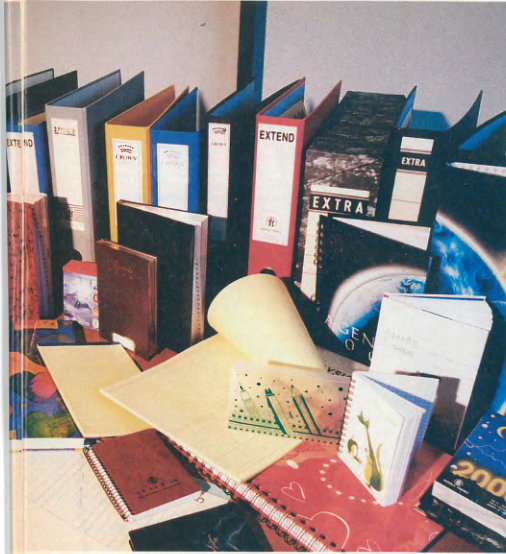
Bassile’s market is school and office supplies. It is so dominant in the latter that competitors such as Stationers, a school supplies importer, and Oriental Paper Products, a local school stationery manufacturer, call it a “monopoly.”

Milad Bassil, the company’s financial manager and one of the eight current owners, is more modest. “Though statistical data is lacking in our line of business, I can safely say that we have a fair market share in office supplies and we are a leader in some 50 to 60 items. But I wouldn’t call that a monopoly.”

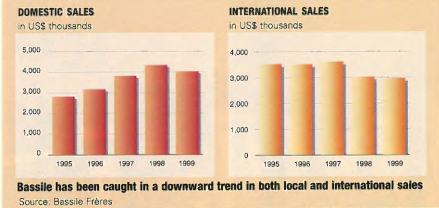
Picture perfect? Unfortunately not. Since the early 1990s, Bassile’s local sales have been growing at around 15% annually, from about $2 million in 1993 to $4.4 million in 1998, with exports adding a respectable $3 million. That, however, is the catch. The export market used to represent 75% of Bassile’s sales during the war years, but has been in a steady annual decline of 5-8% for the last five years.

Cheap stationery imports from Indonesia and increasing industrialization in the region have exposed the uncompetitive operating conditions for Lebanese industry. Fadi Bekdash, for example, was once a part-owner of stationery manufacturer OPP but left five years ago to concentrate on importing from Indonesia. Now the general manager and part-owner of Stationers, Bekdash doesn’t miss the manufacturing side of the business. “The local manufacturing industry is not much appreciated by the government or the consumer,” he says. “Although equal in quality, people would rather buy imports.”

And now with the recession biting, Bassile’s total sales have dropped by 5% last year, $4 million, with a corresponding 3% drop in its net profits.

The timing wasn’t good. In 1997 it embarked on a $6.5 million investment strategy to solidify its position locally and compete regionally by adding 3,500 m² of warehousing space, renovating and increasing manufacturing capacity and expanding printing operations.

So while GDP growth slipped from around 4% in 1996 to an estimated -1% in 1999, Bassile’s new machinery came online in the first six months of last year. The result was stacks of inventory it could not sell. In 1998, Bassile’s stocks increased by a typical $400,000 between January and the end of September. But during the same period last year, inventory jumped $1 million in preparation for the school term and business.

To make matters worse, in the second half of the year last-minute buyers, who represent 10-20% of Bassile’s business, did not come through. That brought the company’s extra inventory to $400,000 near the end of 1999. Bassile froze its investment program with only two-thirds complete and cleared $130,000 worth of products at 20% of their market value, around $22,000.

Adapting to these conditions has meant big changes. Most importantly, Bassile introduced a whole new brand last year called Quest. “The best way to compete in these conditions,” says Bassil, “is to compete against yourself.” Although the new brand covers the company’s traditional product range such as files, indexes, account and office books, school notebooks and diaries, its target is different.
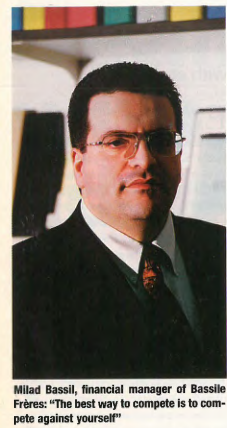
Instead of focusing on good quality items with standard specifications and constant prices for all his clients, Bassile will target the low-end buyer. Quest uses 60-gram paper instead of a good quality 80-gram paper, uses smaller-sized paper instead of A4 and lower quality binding and covers. “If people today cannot afford good quality stationery, I’m giving them a choice. We cut corners here and there and offer cheaper prices, even giving discounts for large orders,” says Bassil. “And since the product doesn’t carry our name we protect our image.” The brand now represents 8% of Bassile’s total sales.

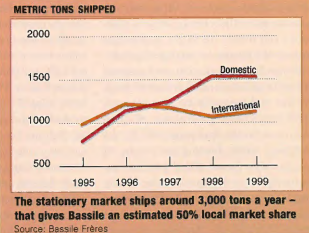
And although Bassile’s investments did not come at the best time, they have helped it cut costs by improving on efficiency. In order to satisfy its yearly production of some 2,674 metric tons of products, an employee earning $300 and producing 4,000 items daily can now earn $500 and produce 10,000 items using the new machinery. Speed of production also goes towards better servicing of clients. For example, it used to take the company one month to produce 10,000 notebooks, but now an order of 10,000 privately labeled notebooks can be delivered within one week. Bassile’s competitors have not had that luxury for lack of serious investments in that type of machinery.
Bassile could go a step further by dropping unnecessary employees to compensate for overproduction or to cut costs even further, but it won’t. “We don’t have the heart to do what it takes, which is send a few employees home and stuff like that,” says Bassil.

Additionally, the company needs to compensate for the high hidden costs of storing raw materials and finished products, which run at 25-30% of the total cost. Bassile uses around 800 different types of raw materials, such as paper, plastics, glue, steel plates, just to name a few. Company suppliers have not been able to commit to just-in-time delivery, where the material gets used at the same time it is needed. So when looking at the aggregate between raw materials, storage and finished product stock, they end up with a 1.1 turnover ratio, ratio of goods sold over raw materials and finished goods in dollar value. “For us that ratio is too low, because the quality of some paper adhesive deteriorates, and paper products get damaged from moving equipment for lack of maneuvering space,” says Bassil.

OPP, on the other hand, is fully aware of cost cutting and has set out a plan to streamline operations and management to cut costs by 5% a year, even if it means reducing the labor force while trying to maintain the same efficiency.

OPP approached the economic slowdown differently. Instead of investing heavily in its core stationery manufacturing business, it put money into diversifying. It decided not to build more on producing seasonal goods that create a lag time, but rather move into year-round products. OPP invested $500,000 in 1997-98 to produce computer paper, using available space within its factory. It quickly grabbed about a 20% share of the market, competing with four other producers. It also invested in a sheeting and cutting business, which cuts reels of paper into standard-sized paper used, for example, for photocopying.

Bassile is still standing strong with a wide customer base of about 450 clients, mostly bookstore owners, but also small businesses, banks, insurance companies and other stationery wholesalers, both locally and abroad. It now distributes directly to its customers, doing away with the distributors it used to rely on. This came about partly because it could not reach some areas during the war. In order to maintain a constant price, the company used to take 2% out of its profits to compensate for the distribution costs, but not anymore.
Bassile has also done well in financing half of its investments. While 50% was self-financed, Bassile utilized the Arab Trade Finance Program (ATFP) to secure investment at an interest rate of Libor + 1.5%, now around 6.5%. By comparison, OPP resorted to local bank financing for its expansion program at rates of 8% or more. And for once, some outside forces were there to help Bassile’s business. After a five-year fight lobbying the government, customs on stationery imports went up by 50% last year.

If the economy improves, Bassile will benefit. The company is highly liquid, having the benefit of using the ATFP fund. This is a revolving credit line that finances the company in an amount equal to 80% of its export invoices any year it wants it. Still, OPP has a solid 40% market share in a business that grew with the generations of students using notebooks, note pads and school copybooks with OPP printed in bold.

It might be a good idea for Bassile to concentrate on its strengths in supplying office stationery. Will its ‘monopoly’ be broken up?
February 22, 2000 0 comments
0 FacebookTwitterPinterestEmail
Best Sellers

The right flush

by Kirsten Vance February 22, 2000
written by Kirsten Vance

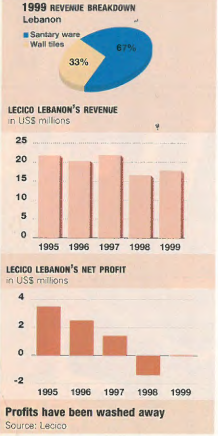
The last few years haven’t been easy for local industry. And the Lebanese Ceramic Industries Co., which is owned by the Garghour Group and Finland’s Sanitec, is no exception. A local manufacturer of sanitary ware and tiles, Lecico saw its profits go down the toilet in 1998, when it registered a net loss of $1.4 million, and barely managed to break even last year. Not the direction anyone wants to see their business take after a net profit of $3.5 million in 1995.

Output in tiles has remained steady at 1 million m², but Lecico decreased production in sanitary ware, which includes toilets, sinks and bidets, from 730,000 pieces in 1995 in order to off-load excess stock. Last year it produced 490,000 pieces. At the same time exports dropped from a level of 50% to 55% of production in the 1980s to about 25%.

In Egypt, where Lecico also has manufacturing facilities, it’s a different story. There the company has been dealt a royal flush. Lecico Egypt dwarfs its Lebanese cousin; though the company would not release exact figures for each year, its Egypt operations have generated yearly net profits of between $8 million and $11 million since 1995. Its annual production of sanitary ware increased from about 2.2 million pieces to 3 million last year, with export markets soaking up 800,000 to 1.1 million. About half is destined for England, where the firm claims to have a 7% to 8% market share. Last year the group’s revenues totaled almost $90 million, while Lebanese operations accounted for just $17.8 million.

So why has the company taken a turn for the worse in Lebanon despite having a 58% market share and being the sole local manufacturer of sanitary ware, while its Egyptian operations remain strong? “Lecico has definitely been affected by the freeze in construction activity in Lebanon and the lack of opportunity to develop new export markets in the Middle East,” says Georges Ghorayeb, general manager of Lecico Lebanon and the group’s technical manager. While exports to the region shrank with the economic downturn in the Gulf, Syria and Iraq have remained closed and low-cost manufacturers have wreaked havoc on Lecico’s market share, explains Ghorayeb.

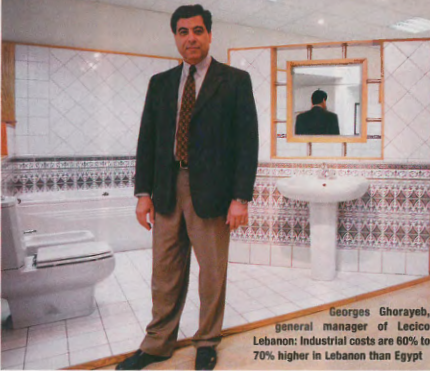
To add insult to injury, industrial costs in Lebanon are high. Ghorayeb should know, being the beneficiary of low-cost production at Lecico Egypt. “There is no comparison at all between the structure of cost in sanitary ware manufacturing in Egypt and Lebanon,” says Ghorayeb. He estimates that direct industrial costs are 60% to 70% higher for energy and labor in Lebanon than Egypt.

Faced with such a drain on profits, Lecico has begun implementing a strategy to boost its local operations and reap greater rewards in Egypt. Staff in Lebanon have been reduced from 670 at the start of 1997 to 500. Further reductions will come through attrition. Last year, Lecico invested close to $900,000 to upgrade the tile-making facilities in Kfarchima. That is expected to reduce costs by 18% to 20% on energy and labor. It also allowed the company to introduce floor tiles to the market this year, having previously been restricted to wall tiles. “That should help diversify our market share, but on the other side it will make a more complementary product,” says Ghorayeb.

That’s an advantage that Uniceramic, the other local manufacturer, doesn’t have. Uniceramic, which is 39% owned by the Ghorra family, produces just floor and wall tiles at its factory in Chtaura. Nonetheless, it has the larger market share in tiles with about 30%, while Lecico claims 15%. Imports account for the rest of the estimated 8 million m² market. More importantly, Uniceramic is in a profitable position, with 1999 showing an increase of 15% over 1998’s net profit of $1.05 million, unless provisions are increased.

“Lecico’s going through restructuring and this is costing them a lot of money today … we had done that in the previous three years so we were a little bit ahead,” says Nabil Ghorra, the assistant general manager, explaining his company’s better fortunes despite the downturn. Joseph Ghorra was among the founders of Lecico, which held a 36% share in Uniceramic until two years ago. The $4 million raised was reinvested into Lecico.

At $7 to $8 per m², Uniceramic’s prices are comparable to Lecico’s $6 to $8.25 per m². But Ghorra insists he’s targeting the import market share. To that end, the company is monitoring trends in colors and designs from Europe and expanding its size variations from 11 to 15 by the end of 2000. Lecico counts three sizes and will increase that to four. Ghorayeb acknowledges that Lecico cannot compete with the sophisticated manufacturers from Italy and Spain. His strategy is to protect the company’s current share of the tile market, and target growth in sanitary ware.

In this connection, Lecico was given a boost by its joint venture with Sanitec, a Finnish manufacturer of sanitary ware, which has operations in Europe, Southeast Asia and the Middle East and recently acquired the Dutch company, Sphinx. Last year’s net sales of Sanitec and Sphinx combined are expected to total about $800 million. Sanitec purchased a 50% share of the controlling stake in Lecico in 1997. Sanitec’s Wolfgang Molitor came on as Lecico Group’s managing director, while Gilbert Garghour retained his position as president. Together they own 96% of the Lebanese operations and 76% of Lecico Egypt.

“Lecico is pushing more on the sanitary side because that is Sanitec policy, they’re not in the tile business at all,” says Ghorayeb. Now comes the move to modernize the local sanitary ware facilities, which will suck up a yearly investment of $600,000 to $700,000 over three years, and gradually return to full capacity.

In Egypt the company is undergoing expansion. With an investment of $21 million, Lecico opened a second plant. Starting with a production level of 1 million pieces a year, the factory’s output will gradually be increased to 4 million. That would bring Lecico group’s total production to 7 million if the Lebanese plant reaches its full capacity of 800,000.

Increasing production is one thing, but what’s the firm’s strategy to sell more? In 1997, Lecico began creating a greater presence by establishing an active marketing division and building showrooms. Currently at three, that number will be increased to five or six in three years. Through its technical agreement with Sanitec, Lecico will begin producing European models here, including brand-name items. Ghorayeb also hopes that the new Lebanese norms for sanitary ware, established in late 1999, will be enforced and keep poor quality products off the market. But for Mansour Ayoub, sanitary division manager of Abdulrahim Diab, agent of American Standard and Ideal Standard, it’s another bureaucratic nightmare, requiring certification with each shipment. He questions the timing and reasons behind Lecico’s push for norms.

Lecico is also pushing for an increase in customs duties, which are about 25%. Unless the government can decrease energy costs and assure fair bilateral agreements, Ghorayeb sees higher tariffs as the only way to save Lebanese industry from a certain death in the face of low-cost imports. Importers disagree, and say it goes against the trend of opening world markets.

“Customs duties have never been effective in protecting industry, because if you can’t compete you shouldn’t be there. It’s artificial competition,” says Mazen Zantout, managing director of Wafco, a local distributor of Spain’s Roca sanitary ware.

Nonetheless, neither Zantout nor Ayoub consider Lecico as direct competition. Targeting largely the medium to high-end market, they believe the local manufacturer could only soak up some of the higher quality portion of the low-end market if prices are bumped up with higher duties. A sanitary set, bath tub not included, from Abdulrahim Diab sells at a low of $400 and an average of $800 to $900, and for Roca the low end is $500 and average $650. Lecico says it can supply the low, medium and high end of the market with prices at $120 to $500, and claims a 58% share of the low-end and 59% of the mid- to high-end market. Importers aren’t having an easy time either. Abdulrahim Diab has seen its sales drop by 16.6% since 1995, though it staved off a worse fate by bringing in more medium to low-end products.

From Egypt, where Lecico has a 40% share in sanitary ware, the firm hopes to expand further into the European market. That will be given a boost through its partnership with Sanitec. Exports will also target the south of the Arabian peninsula. From here, Ghorayeb is eyeing the Syrian market, which he currently gauges at 700,000 to 750,000 pieces a year, and Iraq for 2001. Sanitary ware and tiles were included in the Lebanese-Syrian free trade agreement last fall. Lecico estimates it can supply 150,000-160,000 pieces, having already established a chain of dealers.

With that, Lecico would move back into the black for 2000. Ghorayeb has received confirmation from Lebanese officials that the Syrian market will be open to tiles and sanitary ware starting in February. “We hope it will be a good year,” he says. But trade between the two countries has declined in the past two years, while industrialists complain that red tape has kept the border from opening up. Lecico Lebanon will still have to fight hard not to sink further, while its Egyptian sister looks ready to clean up.

February 22, 2000 0 comments
0 FacebookTwitterPinterestEmail
For your information

Energy Crisis

by Executive Contributor February 22, 2000
written by Executive Contributor

TRABOULSI: Our capacity for producing electricity is around 2,200 megawatts. The Beddawi and Zahrani plants produce 900 megawatts, Zouk 550 megawatts, Jieh 300 megawatts, Litani about 150 megawatts, Baalbak and Tyre together produce about 150 megawatts and Hreishe about 40 megawatts. We currently consume about 1,600 megawatts. In reality, when there is a malfunction with certain facilities, then we have some problems and some areas get temporarily cut off. The reason is that when Zahrani and Baddawi were commissioned, there was no simultaneous installation of a power grid or network. So although they can produce 900 megawatts, we can only benefit by about 300 megawatts. We are currently executing the installation of these power grids in order to be able to fully access the 900 megawatts those facilities can produce. Because we can’t currently make full use of these capacities, we are sometimes forced to buy about 150 megawatts from Syria, 50 from the Bekaa and 100 from the North.

But what about EDL’s finances?

TRABOULSI: The financial situation is known. The projects that were undertaken by the government and delivered to the electricity authority have a total value, including interest rates, of about $1.3 billion. It is our responsibility to make the credit and interest payments. In addition to that, the fuel prices went up by $50 per ton and EDL uses about two million tons per year. So there were additional expenses on electricity of about $80 million to $90 million. We also have the burden of paying our employees and other expenses and additional equipment. There’s also about LL700 million worth of uncollected money on the market.

Has collection improved?

TRABOULSI: There is a collection problem, of course, as a result of some residents not cooperating or paying and others illegally using electricity. We expect to accomplish the installation of meters, transformers, low-tension wiring, and accurate billing and collection as an attempt to reduce debt as much as possible, within an acceptable period of time. This is what keeps us awake every night.

Will there be a rate increase to cover the debt?

TRABOULSI: We have noticed that our receivables have increased, but only slightly. Of course, a study made by the electricity authority in France suggests we should increase the fare; the World Bank also recommends that we should increase the fare. But there are also social and economic considerations to consider; we shall see what the appropriate thing to do is.

Will EDL be privatized? Is deregulation an alternative?

TRABOULSI: I am preparing a ‘project law’ for electricity, which I will submit to the council of ministers. But electricity will not be privatized soon. However, its operations will become more flexible, and its primary rules of operations will be set in place as well as the conditions involving the private sector in its operations. There is nothing prohibiting private companies from distributing and competing against EDL in the future, but it all hinges on this ‘project law’ and reorganization of EDL.

What about converting to natural gas instead of oil as the fuel for generating electricity?

TRABOULSI: There is an American company studying the feasibility of converting EDL’s operations into gas: liquid gas would probably originate from Qatar and natural gas from Syria. Our Syrian neighbors have natural gas and so they commissioned EDL to design the plans to lay pipes from Homs to the Beddawi at a cost of about $50 million to $60 million. Then there is the issue of financing the project. The Syrians will probably look to finance their end by selling some gas or oil supplies to the company that will finance construction. As for our part, the electricity authority is still studying how the project will be financed. In Beddawi and Zahrani, our consumption will be 3 million m³ daily. The cost to build the pipeline from the Syrian/Lebanese border to the Zahrani power plant is about $200 million. Using gas is cheaper and the facilities are cheaper to maintain because mazout (diesel) is more difficult to handle than gas. For this project to happen, we have to look for a source to finance it that will not burden the treasury.

What about liquid gas from Qatar, which has been suggested by the French petroleum giant ELF?

TRABOULSI: This is a very recent project. It is big, and costs a lot, around $1 billion. We still have to look at the findings of the study and how much Lebanon will have to bear by way of financing costs. This project not only involves using liquid gas for the facilities producing electricity like Beddawi and Zahrani, but also for Jieh and Zouk, which need to be rehabilitated to allow for such use. The government will not go for such a project unless the feasibility study is favorable. Within two or three years we aim to have private partners help run EDL, but you cannot burden them with unfavorable economic considerations.

Switching to another of your responsibilities, oil. Petroleum companies in Lebanon have been very unhappy with the ministry’s role in regulating the distribution of gasoline. Why not let the market adjust the price of gasoline?

TRABOULSI: In 1977, a law was drafted to restrict the import of gasoline to the ministry of industry and oil, as it was called then, and to organize a system that would take care of its distribution. At the time, the ministry was responsible for all oil imports. In the 1990s, the ministry released control over the import of oil, kerosene, asphalt and gas to the private sector, but retained responsibility for importing mazout and fuel oil to satisfy the needs of the country. However, the ministry of oil is the one that issues the schedule of prices for distribution of private sector imports for a simple reason: You cannot leave it up to the importer to set his own price of gasoline. We have implemented a schedule of prices that is built on adequate numbers that are well studied, where profits are secured, as it is done in all parts of the world. If we let the importer set his own market prices, the price of the 20 liters tomorrow would jump to LL50,000. We guarantee the importer’s profit to cover his expenses and give him a profit margin. It is fair for the consumer and for the importer. Now we are using a variable scale ladder that adjusts the pump price to the increase or decrease in the price of oil imports. Previously, when the fixed scale ladder was used and when the oil price was in decline, we as a government were making more money from increased customs. It might have been the case that importers were making less money but they were still making their set profit margins. The only loser in this equation is the government.

Is there a plan to upgrade the refineries?

TRABOULSI: The cost of rehabilitating the refineries is around $1 billion, for both Zahrani and Tripoli. But as they only refine 34,000 barrels per day, this alternative doesn’t make sense. To justify this cost, they would have to be refining about 100,000 barrels per day. In this case, the government doesn’t have the capability to do this and, furthermore, we live in an area where oil is plentiful. It is not economically feasible to ship oil, refine it and then compete with other oil companies that are already selling oil derivatives to the region

February 22, 2000 0 comments
0 FacebookTwitterPinterestEmail
For your information

Help to the GDP

by Sami Atallah February 22, 2000
written by Sami Atallah

The banking sector in an economy is an important determinant of economic growth. It raises funds from those who have an “excess” of capital and lends them to those with a shortage. In this process of transferring funds, banks collect information, evaluate alternative investment projects, and monitor borrowers to ensure that loaned funds are efficiently utilized. Generally, the more effective the function of screening and monitoring, the more productive the financed investment and the higher the economic growth rate in the economy. It is through this role that economists find a statistically significant link between commercial banks’ allocation of credit to private firms and real per capita GDP growth.

In the post-war period, Lebanese banks have made major improvements. Their ability to mobilize savings went up; that is, the deposit-to-GDP ratio is 170%, exceeding that of developed countries, whose ratio ranges between 70% and 130%. Additionally, the banks’ total assets are around 200% of GDP, while profitability in terms of net return on average equity is 28% in 1997. Nevertheless, the growth rate in the economy has been declining. So the question remains: Why, despite the rosy numbers, has the banking sector failed to reverse the economic decline? There are four reasons.

First, while enjoying high returns and low risk on government treasury bills, the banking sector initially found little incentive to develop its credit assessment technology, which would allow banks to identify, assess, and finance projects. Its lending to the private sector has been confined to areas where credit can be easily assessed and monitored. It should come as no surprise, then, that trade, services, and construction absorb two-thirds of the banking sector’s credit. The majority of the loans are short-term, which allows the banks to closely monitor their performance.

Lending on such a basis can be detrimental to the economy since it may discriminate against sectors that require closer credit assessment and monitoring on one hand and medium- and long-term credit on the other hand. The most obvious victim is the agricultural sector, whose contribution to GDP was 12.4% in 1995 and yet whose share of credit was a dismal 1.6% in 1997.

The second major problem is a lack of reliable information on borrowers. The majority of private sector firms in Lebanon fail to publish accurate balance sheets. To avoid such risks, banks have concentrated lending to known, trustworthy clients, who are generally large borrowers. Credit in Lebanon is concentrated in the hands of very few people: 81% of the total credit goes to 9% of borrowers. In other words, roughly 4,500 people absorb four-fifths of credit. These are the well-known clients of the banks with large assets and/or who have been doing business with banks for many years.

Another consequence of the paucity of information is simply a lack of lending. Although the Central Bank of Lebanon allows banks to lend up to 70% of their foreign currency deposits, many of the large banks have lent much less than that. In fact, the average for the top 17 banks in Lebanon is 52%. A rough calculation shows that in 1997, an additional $3 billion could have been lent to the private sector. Such low lending and high liquidity are damaging to the banks’ profitability. And they deprive unknown and particularly small firms, generally the source of employment opportunities, of access to capital.

A third problem is collateral. A study shows that countries with a legal environment emphasizing creditor rights and enforcing contracts have better-developed banks and higher per capita growth. The absence of these two ingredients may discourage lending by banks in the first place. In Lebanon, although creditor rights are ensured, collection and enforcement are more problematic. Banks consider court procedures too complex, time-consuming, and uncertain.

According to a survey conducted by the Lebanese Center for Policy Studies, over 45% of banks consider the unpredictability of the judicial system a major problem for business. This is in contrast to a lower level of dissatisfaction expressed by other sectors. Banks also seem to want to avoid going to court as much as possible; it was cited as the last option for solving a dispute. They are discouraged from using the formal appeal process since it is considered to be time-consuming by fully 90%. Furthermore, the high formal and informal costs of property and mortgage registration unnecessarily increase the cost of borrowing for entrepreneurs.

The final problem is that despite the fact that banks have mobilized savings, the average maturity of deposits is too short, around 45 days. This has negative repercussions on the banks’ ability to lend to firms on a medium- and long-term basis.

One of the things that could be done to get the economy out of the recession is to work on building a stronger link between the banking sector on one hand and the productive sectors on the other hand. The objective of this is straightforward: get the money stacked in the banks’ coffers into the cash-strapped productive sectors. But for this to happen, the private sector must publish transparent and accurate balance sheets and income statements. The government could streamline bureaucratic procedures to facilitate collateral collection. In addition, it must prepare coherent strategies for the productive sectors to become competitive and hence profitable enough to pay back the loans. And finally, the banks should develop loan technology that can better assess and monitor loans to these sectors. Some have already begun doing this. At least it is a start.

February 22, 2000 0 comments
0 FacebookTwitterPinterestEmail
For your information

The low-end strategy

by Hadi khatib February 22, 2000
written by Hadi khatib

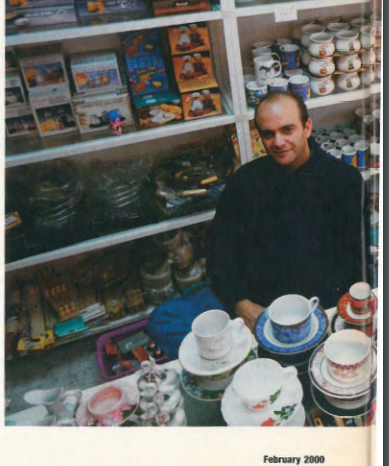
Sell Fast, a company founded by Kheireddine Fakhoury and Kamal Sinno in 1994, is a concept designed for an economically challenged country like Lebanon. The idea was to stock a store full of items where everything goes for a buck. After opening the first $1 store late in 1993, Fakhoury cleared his $30,000 inventory of shampoo, plates, and kitchenware in less than two weeks, selling around 4,000 items per day.

“Business was so good and more people kept coming in asking me to supply them with goods that I invested every penny I had in this business,” says Fakhoury. Six months after sourcing more items from the US, the company went from just retail to wholesale operations with a $300,000 investment. Today, besides its four retail shops, called Shop One, Sell Fast supplies over 600 clients including BHV, Spinneys, Monoprix, Vendome Hotel, and others. The products range in price from $1 shampoos, soaps and cotton buds up to $150 for 123-piece dinner sets. With an average sale of $10 per client, the company turned over $2 million its first year of operation and has been growing at an average of 20% yearly, prompting the owners to reinvest their capital each time to upgrade their operations.

Now Sell Fast imports from China, the Far East, Italy, the US, France, Belgium, Malaysia, Thailand, and Indonesia and sells to $1 stores, supermarkets, wholesale operations, houseware and kitchenware stores, and exports directly to similarly economically challenged countries such as the African states, Bulgaria, Romania and Cyprus. “We will double our turnover in 2000,” says Fakhoury.

Sell Fast is not alone, either. Another successful wholesaler that targets the low end is Bitar Trading Co. For the last ten years, Saad Bitar took his father’s business, set up in 1965, and focused the company’s products mainly on inexpensive glass kitchenware imported from Southeast Asia. And it’s working. Bitar is now a holding company, 15% foreign-owned and comprised of four companies designed to support the glassware business.

With an annual turnover of more than $5 million, Bitar distributes to 120 wholesalers and some 50 retailers of kitchenware, porcelain and enamelware products to clients such as BHV, Fahd Supermarket, Achik and Arout. Bitar’s porcelain items range in price from $1 to $200, but in glassware, most products are in the range of $1 to $10. Bitar reckons that only 15% of his business caters to lower-middle-income earners ($1,000 to $1,500 per month), but the rest is geared to low-income earners.

Reasons for their success are not hard to fathom. “Selling on the low end is more in tune with the current market conditions,” says Marwan Iskandar, an economist with M1 Associates. “People are shifting down their consumption.” Fakhoury agrees: “Consumers are looking for bargains and we have to tempt them heavily to get the money out of their pockets.” Louis Hobeika, an economist at the American University of Beirut, believes that the phenomenon is fundamental: “Selling to the low end is gaining popularity because the recession means that consumers who were once middle class are now moving to the lower class.”

Still, Fakhoury reckons that his business has potential not just in the low-end market. The fact is, he argues, consumers of greater purchasing power will not balk at a bargain opportunity for a good-quality product. But is it good quality? “The Lebanese are shrewd, educated consumers,” says Fakhoury. “They won’t pay for rubbish, even when spending LL 1,000, they want to know it’s worth it.” The fact that big supermarket chains and even five-star hotels are buying those items only proves the point that the products are not cheap, just inexpensive.

That’s the good side, though. Most low-end sales are for non-branded products that carry no warranty. Additionally, branded goods need not be stocked in a wide variety of items to attract customers; the brand sells the product. But when selling low-end coffee cups, photo albums, glassware or porcelain, the trader needs to change with the trends in tastes and fashion. “The pressure is to counteract the lack of brands by supplying a million new things, and for a growing company that’s a headache,” says Fakhoury.

Bitar has the same problem trying to attract women, who are interested in new designs, colors and a variety of sizes. “The market is too small to try to satisfy the changing tastes of my consumers, but we have to do it if we want to stay in business,” says Bitar.

Retailers are not particularly overwhelmed with the benefits of selling low-end. According to a major department store general manager, a drop in purchasing power over the last few years has been noticeable, but the larger sale volumes for cheaper products have not generated significantly higher profits than the slower-selling high-end items. For example, in one month, they could sell five sets of plates valued at LL 5 million and equally sell 100 sets valued at LL 250,000.

Tambourgi is a retail store at ABC, selling high-end glassware, tableware and a variety of household silver items. “I’ve had the same high-end customers for years and they buy with or without a bargain sale,” says owner Edna Tambourgi. Middle-class buyers, however, need to see at least a 30% discount before buying, she says.

The problem, of course, is that getting started on the high end means a larger capital investment and greater risk. So what about developing a low-end one-stop-shop retail concept? For example, Wal-Mart, which operates under a similar concept, is one of the most successful US companies of the past 30 years.

Both Bitar and Fakhoury doubt the likelihood of anyone risking the investment required to see something like this happen in Lebanon anytime soon. “Although the market is waiting for such a place,” says Fakhoury, “I will only open one or two stores just for kitchenware, for example, but not for the entire range of products.”

February 22, 2000 0 comments
0 FacebookTwitterPinterestEmail
For your information

Short-changing town hall

by Samia Jouzi February 22, 2000
written by Samia Jouzi

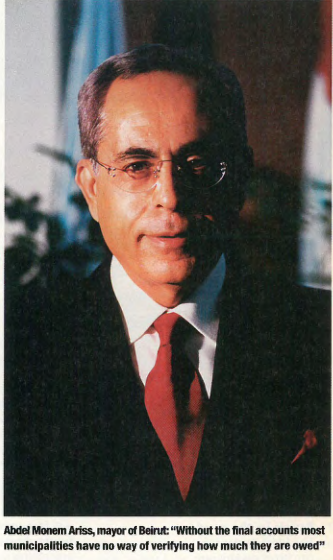
Beirut’s experience is typical. The city is owed money by just about everybody. “Nobody is paying us on time. The Independent Municipal Fund is way behind and we’re concerned that there should be a final audit of what they owe us. And the three utility authorities, water, electricity and telephone, have not sent us final accounts of their debts to us,” says Abdel Monem Ariss, the mayor of Beirut. Without the final accounts, most municipalities have no way of verifying exactly how much they are owed and how the money from the municipal fund is spent. Faced with high salary costs because of overstaffing and uncertain sources of revenue, municipalities are strained to provide the bare essentials.

Municipal budgets are sourced from 23 different taxes: 16 are local and the rest are central government taxes. The local taxes are the backbone of every municipal budget, because they are usually easier to collect. Beirut collected $33.2 million in 1999, while Ariss estimates that another $13.3 million went uncollected. The collection rate is respectable, he says, because the longstanding employees know who owes what, so the city can eventually collect.

But not all municipalities find it so easy. In Mazboud, a village of 4,200 in Mount Lebanon, the tightly knit nature of the community can make prosecution for tax evasion or raising property rates difficult, says town mayor Muhammad Habanjar. The resort town of Aley has a large number of emigrants and Gulf property owners who are difficult to track down for payments. Down south in Nabatiyeh, the council isn’t strict on collection, says Bassam Fahs, a council member, because of the economic hardship suffered by locals due to the town’s proximity to the Israeli-occupied zone. He does, however, believe that property taxes are ridiculously low and should be reviewed. Charging a homeowner $50 a year on average in return for municipal services is not practical.

The direct taxes are only part of the revenue equation; the other half is the government contributions. These include funds funneled through the municipal fund, which is run by the Ministry of Rural and Municipal Affairs (MRMA), and contributions from the utilities.

Taxes collected by the government on behalf of municipalities include a percentage of customs receipts, a 10% tax on cellular phones, a portion of the built property tax, as well as a surcharge on fuel and tobacco products. Each year, the MRMA should pass a decree to apportion the funds to the different municipal councils, usually by September for the previous year’s revenues. Last year, the Ministry of Finance disbursed about $126 million, but that was only a portion of the dues for 1997. Mazboud is still owed $23,700, and should receive another $67,000 for 1998. Beirut received $6.6 million for 1997, but it is still owed another $18.6 million. A similar decree for 1998 has been included in the proposed 2000 budget.

If getting paid on time is a problem, the portion being allocated to each municipality is another. For starters, divvying up the municipal portion of the property tax can be difficult when owners have real estate in more than one area. And while total allocations are based on the number of registered voters, that may no longer reflect the actual number of residents in the municipalities, argues Kassem Rahal, the interim mayor of Burj el Brajneh in the southern suburbs. His area, which includes Burj, Ramel el Ali, Ouzai and the Palestinian camp, counts some 13,000 voters over the age of 21 on the electoral roll but is congested with new emigrants who may actually vote elsewhere.

This is because in Lebanon, people are registered to vote in their family’s place of origin, which is often different from their place of residence. Re-registering in a different municipality is such a bureaucratic nightmare that most don’t bother. His local data, in the absence of an official census, shows the district is home to some 300,000 to 350,000 people, with 50,000 homes and commercial establishments. Last year, his municipality received only $165,000 from the municipal fund, whereas Rahal believes that figure should be higher based on the number of actual residents in his area.

Another headache comes in trying to collect from the delinquent utilities, even though by law utilities are supposed to pay their dues to municipalities every three months. “We have asked the Ministry of Post and Telecommunications (MPT) to pay us, but we haven’t seen a penny since 1994, although every resident pays a 10% tax on phone bills,” says Sheikh Wajdi Mrad, the mayor of Aley. He does receive payments from the water authority and electricity, however. The electricity facility in Aley is privately owned. Beirut’s municipality is owed $23.7 million by Électricité du Liban, and $20.9 million by the MPT. Those debts date back to 1995.

The Beirut water authority is more up-to-date, having paid the bulk of outstanding debts in 1999, with about $1.6 million remaining, says Ariss. In Nabatiyeh, where residents are exempt from paying water and electricity, the council does not expect much. But the MPT has expanded its service and improved collection, while the council has only received $12,600 for the first quarter of 1999.

On top of the problems with collection and allocations, staff wages eat up a huge chunk of municipal budgets, 60 to 70% for Nabatiyeh and as much as 87% for Beirut. This leaves little money to funnel into services. The responsibilities of municipalities include the supervision of schools and hospitals, zoning, health inspections, traffic police, road signs, street lighting, as well as clearing drains, maintenance and construction of inner roads.

In order to fund new projects, Fahs says the council lobbies members of parliament to volunteer some of their money received from the Ministry of Public Works. Municipalities also stretch out projects over time to help cover costs. When the projected budget of $172,000 did not materialize due to unpaid government disbursements, the municipality of Mazboud cut back and spent $107,000.

Despite Ariss’ concern for funding, Beirut, as the capital, probably has the most options. The city council has been studying schemes to raise money. “The two most rewarding would be municipal bonds and BOT projects,” says Ariss. “The money raised by bonds should mainly be used to improve tax collection and the quality of services.” The city is also looking for individual contributions, such as the fence that was put up for the planned Horsh of Beirut park, on the old road to the airport.

The city hopes to receive foreign funding from either the Arab, Saudi or Kuwaiti development funds, or by signing agreements with overseas municipalities. Île-de-France, for example, has agreed to pay $300,000 annually over a period of five years to rehabilitate the Horsh area. The Beirut municipality is expected to match that amount. The main stumbling block to these projects is the lack of qualified staff. Meanwhile, there is a freeze on hiring and the city has between 1,000 and 1,300 excess unskilled employees.

Fortunately, successive governments have recognized that municipalities lack proper means and have taken over the maintenance of storm drains, highways and main roads, although the money is sourced from the municipal fund. Beirut is the exception, where the administration’s involvement is not restricted to main byways. Maintenance projects have been awarded through the Council for Development and Reconstruction, but those contracts expired at the beginning of 1999 and were not renewed until October. That, unfortunately, was too late to get ready for the deluge of late January and avoid the flood damage.

February 22, 2000 0 comments
0 FacebookTwitterPinterestEmail
Editorial

Just do it

by Dany Rizk February 15, 2000
written by Dany Rizk

When EXECUTIVE selects a company to write about, it indicates that the business has achieved some level of success, regardless of whether it is raking in the profits or experiencing difficulties. Even a casual reader will recognize that companies we have covered are experiencing extremely tough times. Industrialists cannot produce competitively, traders are hobbled by indirect taxation, agricultural producers are in decline, and the government seems impotent in its attempts to provide the services and regulatory environment that the private sector needs to function effectively.

This issue contains another example. Lecico, a venerable Lebanese industry, is going great guns with its investments in Egypt. Netting around $10 million a year in profits over the last few years and exporting, it has nearly 8% of Britain’s sanitary ware market and can’t put a foot wrong. But the same operation in Lebanon is struggling to make a dime. It managed to break even last year but lost money in 1998, and production and exports have fallen. Lecico’s case demonstrates that even successful and well-managed companies can struggle to do well in this country.

That’s why our cover story makes such enjoyable reading. Known as Concord here, the company is part of a group that makes refrigerators in Lebanon, Syria and Saudi Arabia. Local production has increased by more than 1,000% since the war. By providing affordable products that don’t fall apart within months, Concord has shouldered aside big-time international competitors to take the largest chunk of the refrigerator market in Lebanon for a single company. In a land where the locals seem to prefer imports, not many domestic manufacturers can make that claim.

From real numbers to more intangible development plans, our stories on the nascent e-banking industry and entrepreneurial plans to make Lebanon a regional Silicon Valley report on how technology could transform the way the Lebanese do business and the nature of the economy itself. Both are ambitious and admirable in concept, but EXECUTIVE was inclined to adopt a “we’ll believe it when we see it” attitude. Past experience teaches that grand plans do not always bear equally impressive fruit in Lebanon. Still, if they do achieve even some of what they are proposing, we’ll be the first to cheer

February 15, 2000 0 comments
0 FacebookTwitterPinterestEmail
  • 1
  • …
  • 705
  • 706
  • 707

Latest Cover

About us

Since its first edition emerged on the newsstands in 1999, Executive Magazine has been dedicated to providing its readers with the most up-to-date local and regional business news. Executive is a monthly business magazine that offers readers in-depth analyses on the Lebanese world of commerce, covering all the major sectors – from banking, finance, and insurance to technology, tourism, hospitality, media, and retail.

  • Donate
  • Our Purpose
  • Contact Us

Sign up for our newsletter

    • Facebook
    • Twitter
    • Instagram
    • Linkedin
    • Youtube
    Executive Magazine
    • ISSUES
      • Current Issue
      • Past issues
    • BUSINESS
    • ECONOMICS & POLICY
    • OPINION
    • SPECIAL REPORTS
    • EXECUTIVE TALKS
    • MOVEMENTS
      • Change the image
      • Cannes lions
      • Transparency & accountability
      • ECONOMIC ROADMAP
      • Say No to Corruption
      • The Lebanon media development initiative
      • LPSN Policy Asks
      • Advocating the preservation of deposits
    • JOIN US
      • Join our movement
      • Attend our events
      • Receive updates
      • Connect with us
    • DONATE