
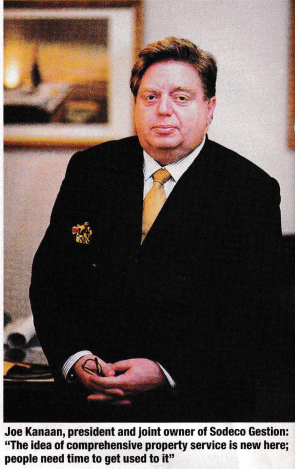
The empty properties scattered around town show how few and far between the Gulf sheikhs on white chargers are. While some real estate dealers have pursued the quick-fix Big Deal, Joe Kanaan has been quietly charging $100 per unit a year to manage the common areas of office blocks or apartments. His company, Sodeco Gestion, last year made a profit of $30,000 on a turnover of $450,000, its first year in the black since being formed in March 1996.
Despite the recession, Sodeco Gestion has a staff of 20 working out of a small office in Rue Sodeco, Ashrafieh. Managing the common aspects of condominiums—the technical term for a situation where individual owners or tenants pay a management company to look after all common aspects—is just one aspect of Sodeco Gestion’s operation.
Joe Kanaan, who is company president and joint owner, says the company’s flagship service is comprehensive management, which includes accountancy, legal aspects, rent collection, arranging and supervising maintenance, even finding new tenants. For this, the owner is charged about 4-5% of rental income.
Although common in Europe and the United States, this overall service is new in Lebanon and can, Kanaan believes, yield long-term profits. His strategy rests on an incremental approach that slowly realizes economies of scale:
“We lost over $400,000 in our first three years,” says Kanaan, “but you cannot create a new area of business overnight. The idea of a comprehensive property service is new here, so people need time to get used to it. I know I have to work hard, but gradually I will expand and open new branches.”
Solidere is developing something similar downtown, both for its own properties and for those owned by others. It charges 10% of rental income.
“Property management is an image of professionalism, of know-how,” says Georges Nour, head of Solidere’s property management department. “In Lebanon, you have lawyers, good contractors, good brokers and engineers, but you don’t have one professional who can cover all these.”
Like Sodeco Gestion, Solidere has found that an income stream from property management is slow to arrive. Its department began in 1998, but its function so far is primarily one of PR—attracting clients to downtown so as to help the area gain critical mass. The department has scored some notable success in this regard—including brokering the deal that took French bankers CCF to 170 Marfaa—but it has yet to generate an income.
It manages just ten buildings not owned by Solidere, which total around 25,000 m² in floor space. This reinforces the point made by Kanaan: to be profitable, property management requires the economies of scale that can come only from a large base. Nour estimates that his department needs around 300,000 m² of floor space to begin contributing to Solidere’s coffers.
His optimism is dependent both on the fact that his department carries the Solidere brand name, unique within downtown, and on the prospect of specific projects he knows will come on stream sooner or later, including the 132,000 m² souks.
Achieving the critical mass for economies of scale is a key challenge in developing a comprehensive property management service, and it isn’t easy in a market where there are relatively few large buildings.
Operators, which was established in 1997, has reached critical mass through its relationship with large developers, especially Jamil Ibrahim, who is a partner. Operators manages Sodeco Square (at 36,000 m², it is one of Lebanon’s largest buildings), Ahlam and Sursock 135—all Jamil Ibrahim developments—and Doha Hills, which is under the rubric of the Ali Ahmad Group.
Working for developers has enabled Operators to reach 1,000 units and 250,000 m² within three years of launch. Even so, it wasn’t until 1999 that the company broke even, with a turnover of about $500,000.
Property management reflects the changing face of real estate away from bricks and mortar. The managing partner of Operators, Bernard Saghbini, is from a construction family, but after a master’s in management in Paris and experience with General Electric in Europe and the United States, he found himself more attracted to management than to construction.
“I was managing my father’s Racquet Club buildings in Hazmieh, and Jamil Ibrahim asked me to manage Sodeco Square. Operators as a company came out of those discussions. Our relationship with developers has given us a kind of model, which we can now apply elsewhere.”
This, insists Saghbini, reflects a change of attitude in the sector, which is partly the result of a new generation:
“Construction and management are different things and require different skills. Eventually the promoters will come to understand that: you need a third party.”
The shift takes time. This kind of management is traditionally done in-house in Lebanon, especially in family-owned businesses, which tend to believe that it’s a routine matter they can easily handle themselves.
Times are changing, though. Some of Kanaan’s clients live mainly abroad. Others, including corporates, are ready to shift the responsibility for managing their property to a specialist.
Kanaan worked in France as a developer between 1984 and 1996, mainly with residential but with some offices. He keeps a real estate business in Paris, but now spends most of his time in Beirut.

“Part of the reason I came back to Lebanon was that real estate dropped in Paris,” he says. “I faced the choice of recapitalizing and starting anew there or coming to Beirut with a concept that was new here.”
The launch timing, he readily admits, was less than ideal:
“I started with zero clients. We sent out our first mailing in April 1996, just in time for the Israelis to launch Grapes of Wrath. Everything stopped until July, people just weren’t in the mood for business.”
Today the company is the managing agent for over 2,000 apartments and offices. The offices under its wing include the Credit Lyonnais building near Sofil, the Dolphin Center in Raouche and the Koyoumji Building on the Zalka highway. Sodeco Gestion also manages the Espace 2000 cinema complex, which is mixed retail and office, in Jounieh. The Rizk Tower and the Abouhammad building, next to Hotel Gabriel, are among the residential buildings.
“Sizes vary as much as location,” says Kanaan. “Our residential buildings can be as small as four to five apartments or as large as 100. Most are around ten to 12. Office buildings usually contain around 30 to 50 different units.”
Kanaan believes his prices are unbeatable. Other than some special cases, the $100-a-year figure per unit in a condominium is a maximum, he says:
“If I manage a bigger building, and the lots are together, I take less. After all, I’m responsible just for the common area, and there are bulk savings to be made.”
Many in the business consider the Sodeco Gestion prices—$100 or 5% in the case of full management—very low.
“It seems they’ve gone for bulk,” said one real estate consultant. “Even so, I’m puzzled how they can make money.”
The difference between Sodeco Gestion and Operators—$100 and $1,400—suggests we are not comparing like with like. The comparison is difficult to make. Operators’ charge is an inclusive one, including security, electricity, cleaning and maintenance as well as administration: the company has also invested in computers programmed with Canadian software specifically designed for building management.
Sodeco’s $100 fee is its own charge for accountancy and legal supervision. Residents also face separate charges for utilities and maintenance, and these can vary, says Kanaan, from less than $1,000 to as much as $6,000 yearly, depending on the building and services involved.
There are two other interesting aspects to Kanaan’s strategy. Firstly, he set out to involve banks. This not only helped attract capital: the banks also refer potential clients.
Sodeco Gestion was originally 50% owned by Banque Libano-Française, 15% by Byblos, 15% by Banque Libanaise pour le Commerce, and 20% by Kanaan. BLC recently bought Byblos’ share.
Secondly, Kanaan has also developed brokerage, which has been an important income-generator. Property management, although increasing, only represents about 40% of Sodeco Gestion’s business, while 60% is renting and selling for clients.
The company always prefers to put prices on adverts, believing a transparent approach will attract customers fed up with the expensive mystique of the ‘samsarr’ (broker). The company insists on exclusivity—rare in Lebanon—and charges 2.5% each from vendor and buyer.
For arranging rentals, the charge is one month’s rent each from the owner and the tenant. In the current economic climate, renting is holding up better than selling.
Brokerage has also raised the company’s profile. Clients can be introduced to the concept of property management and, Kanaan hopes, impressed by the professionalism of the company.
Operators has, by contrast, only recently developed brokerage, which brings in just 10% of turnover. The company is now looking to expand brokerage, because the returns are quicker than in property management.
While in the long term Kanaan believes that more and more clients will want a comprehensive service, he stresses that any company in property management must have the flexibility and expertise to respond to whatever the market requires.
“Property services are all the same business, really,” he says. “We did all this in Paris. Why not here? I think we have around 3,000 clients overall, for everything. It’s good to be diversified, especially in a recession: it means that if we lose one building it’s not a catastrophe.”
Given the prevailing uncertainty in the market, he is unwilling to make precise projections. But having emerged into the black during recession, he is convinced that things will get better.
“Our costs are now more or less constant. If there is peace, then the supply of property will go up, and any increased activity will automatically be reflected in higher profits.”
