
T he optimism following the Israeli
withdrawal is wearing thin.
Although some property prices
have fallen up to 50% from the peaks of
1995-6, most analysts and practitioners
fear that the market has yet to bottom out.
Bernard Mouchbahani, senior manager of
project finance at Lebanon Invest, is just one
who thinks prices are too high: “We are still
overvalued when you look at the state of the
economy and what property costs in the rest
of the world.”
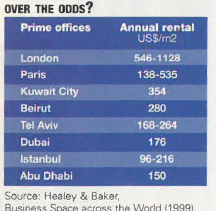
Despite prices that are high compared
with Dubai, Abu Dhabi or Istanbul (see
table), there is a crucial oversupply in many sectors of Lebanon’s real estate market.
Even if the economy were to pick up, there
is a huge slack to be taken up, says economist
Marwan lskandar: “Eighteen percent of
residential is unoccupied, as is 20% of nonresidential.
The total investment in these
properties could be around $6-7 billion, and
it might take seven or eight years for this
oversupply to be removed.” Others believe
there is not so much of an oversupply, but
rather the wrong kind of supply. “Much of
the vacant stock is of very poor quality,” says
Michael Dunn, general manager of Healey
& Baker in Beirut. “Cheaper and better
alternatives are available already, and if the
overall demand increases, the supply of
better stock will increase as well.”
The crucial issue is demand. Whatever the
quality of supply, economic growth at the
moment remains an aspiration. The key
issue for those who don’t see an upturn in
real estate is the failure of the government’s
fiscal policy, which they say is leading
the country toward an economic shakedown
that will hammer real estate as surely
as any other sector.
Many have lost any belief that the government
can turn the macro-situation round.
Each month, economic indices emerge that
chart recession. Last year’s GDP growth was
-1 % and is forecast at a mere 0.5% for 2000,
according to the Economic Intelligence Unit.
The ballooning deficit has topped 50%,
while the debt to GDP stands at 140%. “The government says don’t rock the boat, but the
boat is sinking,” says a leading financial services
manager. “Assume a six-month delay
after the elections until they all settle down in
their new p01tfolios. Remember the weight
and speed of the bureaucracy. Assume the government
does nothing, or rather that it makes
mistakes. Then, you must assume a macroeconomic
shakedown.”
The country, he says, is heading firmly
down that road. “The private sector is creeping
into default. The government will be
doing the same, or worse.” Such pressure
would clearly be deflationary. People and
businesses would have less to spend.
Demand for goods, services and homes
would fall. So, as a consequence, should
property prices. If they did not fall (because
would-be seUers continued with the so-called
‘comparative’ methods, or simple wishful
thinking, rather than looking at yield), then the
market would become even more illiquid.
Underlying the economic indices are the
political failures that undermine confidence.
The saga of the Beirut Trade Center – aka the
Murr Tower – has done nothing to improve
matters. When the Solidere general meeting
in June deferred a proposal to sell the 40-storey
building to interior minister Michel Murr,
many in the real estate business bemoaned
what they saw as yet another postponement of
overdue progress in downtown. “We expected
this sale would speed up the supply of permits,”
says one real estate expert. Solidere’s
land sales, tumbling from $118 million in1998 to $37.5 million in 1999, are one indication
of declining demand that no amount of
political posturing can change.
But against the deflationary pressure
there would be a contrary pressure, which is
where things could get interesting. This
would come from the upper middle class and
above, who have savings. “They haven’t
been investing in real estate because of the
excellent returns on the Lebanese pound,
Nasdaq or whatever,” says the financial
services manager. ” In a shakedown, they
may move money into real estate on the
assumption that it’s better to trust the land
than the government. If the desire to invest
in real estate is as strong as the deflationary
pressure, then prices won’t fall.” According
to Karim Salameh, director of the Property
House, prices have already been falling
since 1996 or 1997. “But there is a certain
floor,” he says. “If at that point, a virtuous
circle of investment is created, then prices
could go up again.” Perhaps. But with the
slack in the market and current macroeconomic
s ituation, most analysts believe
prices are unlikely to rise across the board.
Recession does, however, bring its own
opportunities. Benefiting from steady yields
in a falling market is part of the thinking
behind the Real Estate Investment
Company (REIC), Eagle One, which the
Property House announced in February.
The plans for a ten-year, close-ended fund
have been delayed by the fears and uncertainties
that surrounded the Israeli withdrawal.
The company’s strategy is to buy
properties with good existing tenants whose
prices have fallen but whose yields have
remained constant. Such opportunities
should increase as pri1.:es fall – giving the
investor both the income from the yield,
either directly or in the case of REIC
through a dividend and capital gains as and
when the market improves.
Whatever happens to the market overall,
there are always prices that buck the general
trend. Picking the right spot – in time and design as well as space – is what turns real
estate from a passive resource into a marketable
commodity. In retail, BHV and
Monoprix, Spinney’s and ABC have all
been successful despite the recession. At the
same time, Hamra and Verdun have managed
to maintain prices at around $5,000 and
$5,000 to $7,000 respectively and have
attracted high-profile brands like Etam,
The Body Shop, Mothercare and DKNY.
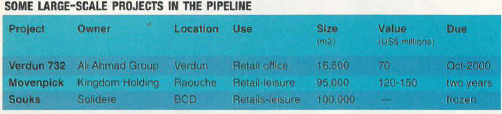
The Ali Ahmad Group is confident that
Verdun 732, which is nearing completion,
will repeat the success of Verdun 730.
Consumer attraction to high-profile brands
is clearly increasing. International retailers
have increased their numbers of shops from
110 in 1997 to 144 today, with those held by
US retailers rising from 26 to 38, according
to a recent survey by Healey & Baker.
Raja Makarem, managing partner of
Ramco and broker of the recent deal that will see Virgin open in downtown, believes that
in general prices are about as low as they will
go. “I think we’re now at the bottom of the
hole, and people are already sniffing round
for bargains,” he says. “Don’t forget that
Lebanon is a small country, and that many
people would like a foothold here.” And
despite the construction downturn, a number
of ambitious large-scale schemes are steaming
ahead. Down by the sea at Raouche,
Kingdom Holding is well into the construction
of a complex with a Movenpick hotel
(see box). Like Solidere’s souks, such a
development is large enough to have strong
knock-on effects elsewhere. Whatever happens
to prices, it will be the ability to see and
take the opportunities that will distinguish the
sheep from the goats
