
Downtown is the heart of Beirut. Without an expanding market in the area, there can be no wider recovery of the city’s real estate market. Nothing grows in isolation. The office space market is very important to the development of downtown. The master plan envisages an eventual 1.58 million m² of offices occupying 4.69 million m² of total floor space. But offices cannot be separated from other parts of the Beirut Central District.
The freeze on the relocation of government institutions to BCD, for example, makes attracting leading companies to the area more difficult. Furthermore, offices need shops. These days, potential investors look for offices that are served by nearby amenities like cafes, restaurants, convenience stores, bookstores and coffee shops. For this reason, completion of the souks is essential if office development in downtown is to proceed.
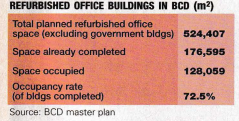
The supply exists. Fully 176,595 m² of refurbished office buildings are completed. The overall occupancy rate is 72.5%, including the buildings occupied by Solidere itself. The level of occupancy varies. The most successful area has been Riad el Solh Street, both because it is the center of financial activity and was the least damaged during the war. By contrast, occupancy in the Azerieh building is under 10%.
In the medium to long term, the BCD will surely succeed in attracting companies. It is the only area in Beirut that meets international standards. Unsurprisingly, most of the demand for office space in BCD comes from international and leading Lebanese companies seeking to relocate. With the country in a recession, it is inevitable that they will drive down prices as they search for the best bargain.
So far, new office development has been limited. For now, the main supply is refurbished buildings. They have been restored to the high standards set by Solidere, and their main competitive advantage over other locations in Beirut is their strategic location. The BCD has an important plus: Unlike other prime locations in the city, it has a car parking capacity of 10,000 spaces that is accessible to all offices.
The occupancy rate in the BCD started to increase in the autumn of 1999. New bank branches (21 banks are already operating) opened in the area as well as four insurance companies and a few multinational companies such as Coca-Cola, Microsoft and Ericsson. The take-up will rise this year with nine banks expected to relocate to the BCD, including Standard Chartered Bank. The American Lebanese Chamber of Commerce, Merrill Lynch and a number of other prominent companies are also planning to move into the area.
The opening of the Phoenicia Inter-Continental hotel will have a positive influence on the take-up of space in the city center. Within two to three years, demand—especially from international companies—will be for buildings that offer large floorplates (floor area per story), such as the Atrium, the first purpose-built office building in the BCD. New-build will tend to offer larger platforms, allowing greater flexibility to clients.
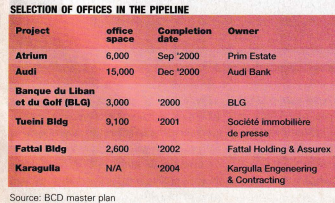
There is already high demand for office buildings with a floor size of more than 1,000 m², which offer more flexibility. Around 38,357 m² of newly built offices will be ready within the next two years. This will give BCD a competitive edge over other Beirut locations in terms of efficient floor planning and add to its current advantages: location, architecture and parking.
In the pipeline, there are a variety of new office buildings that will house banks, insurance companies, engineering firms and consultants. The majority of these office buildings are still under study and preliminary design. All will have a combination of medium and high development density based on the master plan.
The future of office space in downtown is in rental, which, in line with international trends, has already become more important than sale. Rental price levels for prime offices in Beirut have fallen from $400 per m² in 1997 to $250 in 2000. In downtown, where offices came on the market in 1999, prices have been in line with these levels. Compared to new developments, the cost of office accommodation in refurbished buildings is cheaper, with owners generally willing to accept less than $200 per m².
But the outlook is good: My feeling is that with increasing take-up, prices will remain stable for this year and then begin to increase.
