
Bou Khalil Markets recently shifted
into expansion overdrive. In 1999,
the supermarket chain listed on
the Beirut Stock Exchange opened outlets
in Tripoli and Mkalles and built a central
distribution warehouse in Hadath. In early
2000 another outlet popped up in Ras
Beirut, bringing its number of stores up to
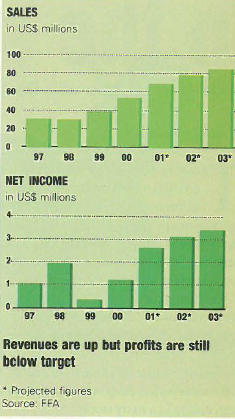
six. A greater reach pushed up sales 30% last
year, from $29.6 million in 1998 to $38.7
million. But with expansion costs and
increased competition driving prices
down, earnings dropped from $1.9 million
to $377,000, an 81 % drop.
According to Shawki Bou Khalil, one of
the owners, last year’s low profits were just
a glitch: “It was rapid expansion, all in only
13 months,” says S. Bou Khalil. “It’s time to
get results from our expansion.
Then after two years we’ll expand some more.”
Financial Funds Advisors (FFA), which
helped Bou Khalil go public in 1998, estimates
earnings to reach $ 1.25 million this
year and $3.4 million in 2003 (see graph).
But for earnings to reach FFA’s target,
momentum has not been enough so far this
year. Although sales jumped 49.4% in the
first half of 2000, pre-tax profits reached
$364,000, lagging behind FFA’s projected
profit figures by 43%. Operating expenses
increased, which hindered better profit
growth. This year’s projected sales were $55
million, but the first six months added up to
$23.1 million.
Reaping handsome rewards from expansion
may not be easy. Tough competition,
especially in the midst of the recession, has
put pressure on prices. Spinney’s invasion
into the market in 1998 brought with it
ongoing promotional deals that made an
impact. Last year Lebanon’s consumer
price index (CPI)-now compiled at the ministry
of economy and trade – dropped
2.13%. By the end of June 2000, CPI fell
another 2.16%. “More supermarkets promote
products and cut prices,” says Zena
Sara, communications manager at
Spinney’s. “You cannot fool the customer
anymore. The consumer knows what are the
best prices, what are the cheapest.” In 1999
Bou Khalil’s gross revenue margin dropped
below 12% from over 14% the year before.
Probably a more serious threat that may
hinder Bou Khalil’s growth is the new
supermarket philosophy brought by
Spinney’s and Monoprix, which opened in
summer 1999. ”There has been a change in
attitude with the consumers,” says Ali
Berro, director of the ministry’s research
center for pricing policies. “It’s not only
prices. They are now looking for convenience,
space, location and atmosphere.”
According to Michel Abchee, chairman of
ADMlC, which runs BHV and Monoprix,
that was precisely his aim. “It’s the comfort
of shopping that counts,” says Abchee.
“There has to be enough space for the customers
to feel relaxed, there must be easy
access to products making it easy for customers
to find everything and the environment
must be comfortable.” Visit a Bou
Khalil outlet and you’ll find the store in a
smaller space, more congested and more difficult
to find your way around. As one analyst
says, “l got lost in Bou Khalil in Ras
Beirut. Plus, at Monoprix it has a personality.
Bou Khalil has no character.”
So far, the two foreign chains have proved
their strategy well with just one outlet each to
date. Projected revenue for Monoprix’s first
full year of operations is just over $40 million.
Spinney’s will not disclose an exact figure but
claims that it~ projected revenue will be more
than FFA’s estimated revenue for Bou Khalil
at $55 million. And the two are making
moves to cover more ground. Abchee says
plans to open another outlet will be finalized
in the next few months. Spinney’s plans to
invest up to $20 million to open four more outlets
over the next two years. There are also
rumors that one of France’s leading supermarket
chains, Carrefour, is planning to set up
shop in Lebanon.
The number one supermarket in sales has
been Co-op, pulling in around $ J 50 million in
revenues with 47 outlets operating. Famous for
selling at low prices, Co-op has been a challenge
to the rest of the market. But its status is
now in question. Cash strapped and burdened
with debt, Co-op has been negotiating with
Saudi Arabia’s AJ-Mouhaidib in hopes of
getting a new lease on life. When EXECUTTVE
went to print, no deal was signed. While suppliers
and other creditors will suffer if Co-op
isn’t saved, other supermarkets would celebrate.
But a rescue plan with foreign help
might be worrying to the competitors.
With its first phase of expansion completed,
Bou Khalil is working to be more
competitive. Instead of suppliers running
haphazardly to reach Bou Khalil’s outlets,
its central warehouse takes on responsibility.
This facilitates inventory control and
timely delivery to keep shelves adequately
filled. According to Wajih Bou Khalil, in
charge of IT, outlets and the distribution center
might be connected online by the end of
the year, making the supply chain faster and
more efficient. The central warehouse will
eventually become a wholesale/retail outlet
selling in bulk at lower prices. Prepared for
the launch, S. Bou Khalil predicts that the
transformation will happen towards the
end of the year or in the first quarter of 2001.
Bou Khalil’s margins are moving up. In the
first six months this year, the gross revenue
margin increased to over 14%. S. Bou Khalil
gives credit to economies of scale. With
more outlets, Bou Khalil has the leverage to
negotiate with suppliers to bring down the
cost of goods. Also, promotional deals on the
market have diminished. That is part! y due to
pressure on Spinney’s to limit its price tactics.
“We cannot do promotions unless they are
previously cleared by the ministry of economy,”
says Sara. ‘This has changed Spinney’s
policy. We want to sell at prices we want, but
are not allowed.” Although government
interference on prices in a free market economy
is ironic, breathing space on margins
could help Bou Khal.il ‘s profit growth.
FFA has faith in Bou Khalil reaching projections
this year. It argues that there have
been seasonal patterns in grocery sales, with
55% to 57% of sales generated in the second
half of a year. FFA claims that sales were
higher in July and August and that once the
central warehouse includes a point of sale,
earnings will get a boost. S. Bou Khalil
holds that the increase in operating expenses
was expected. A number of expenses
were one-time charges that will not affect
profits in the second half of the year. An
increase in salaries came soon after the new
outlets opened, and he expects an increase in
customer turnover to lessen the effect.
“Earnings in the short term can be dampened
by expansion,” says Jean Riachi, chairman
and general manager of FFA. “Competition
is so tough that you have to grow and take
advantage of economies of scale. You have
to sacrifice short term for the long term.”
FFA also gave a buy recommendation on
Bou Khalil’s shares, which have been dormant
with the rest of the Beirut Stock Exchange. If
the market comes alive, Bou Khalil will have
to get the new outlets and profit growth up to
full speed to attract investors’ attention.
