
You’ve heard it before, we’re sure,
that old adage everyone so likes to
repeat: Lebanon — the region’s
entrepreneurial spirit and center of free
market capitalism. It seems, however, that
somebody forgot to tell the government.
The two cellular companies, LibanCell and
Cellis, have found that out recently, with
the government threatening to cancel their
contracts if they didn’t pay up. “It’s like a
soap opera with dark forces working
behind the scenes,” says Ziad Maalouf,
vice president at Middle East Capital
Group (MECG). “This could tarnish the
image of Lebanon in the eyes of investors.”
While it’s not clear who’s right or wrong
in the heated cellular row — or even if there
is fault on both sides — many in the business
community agree with Maalouf’s assessment
and feel the matter could have been
dealt with better.
Rather than being handled discreetly
with negotiations out of the spotlight, the
brawl has been all too public and loud. “If
what the government claims is legitimate,
they should have done it quietly,” says
Nassib Ghobril, an analyst at Lebanon
Invest. “We’re not exactly in the most stable
and peaceful environment for investors
— you don’t scare foreign investors.”
Instead, the government has brandished
swords, fencing LibanCell and Cellis into a
corner with a $300 million fine each.
With LibanCell’s five-year profits
through 1999 at $141 million and Cellis’ at
$124 million, the move looks like the government’s
attempt to turn the two companies
into non-profit organizations — as if making
profits was some sort of a sin.
The milking
machine had already been turned on once
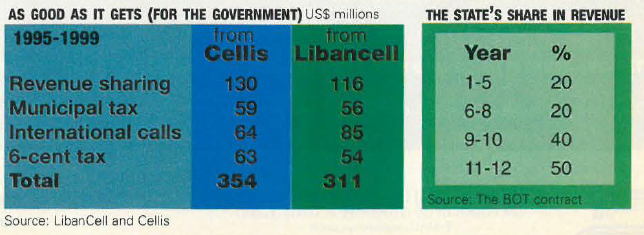
before, when a six-cent tax was slapped on
each minute of talk time last June in an effort
to increase revenues to government coffers.
LibanCell, which is owned by Finland’s
Sonera and a consortium of local investors,
has a case pending in the Shura Council to
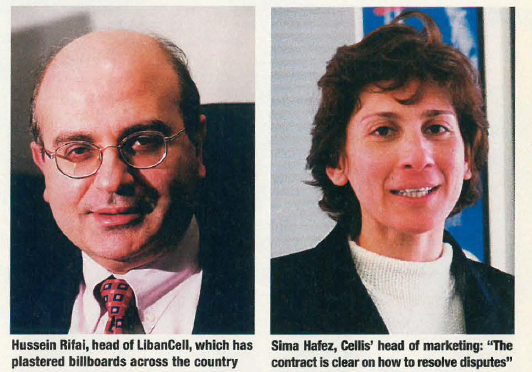
have that tax overturned. (Hussein Rifai, the
company’s chairman, declined repeated
requests for an interview, as did Issam
Naaman, the minister responsible.)
And where did that $300 million figure
come from anyway? “We don’t understand,”
says Sima Hafez, marketing director
of Cellis, which is two-thirds owned by
France Telecom and one-third owned by the
Mikati Group. “All they’ve said is ‘you’ve
done damage to the government. Pay.'”
The two companies weren’t the only ones
confused. While Naaman did list numerous
violations, there was a lack of documentation
or supporting evidence put forth.
Even
members of parliament, who approved the
cabinet’s decision to deliver the ultimatum,
were ill-equipped to give any kind of
verdict. “When we discussed the issue, we
didn’t have any documents,” says Boutros
Harb, a lawyer and MP. “We needed the
whole file in order to discuss it properly and
make a decision.”
The cellular operators appear to have done
much better in the media wars, returning the
government’s hardball with facts and figures.
The duo churned up the PR machine
with adverts splashed all over billboards and
in newspapers, spelling out which party
pockets the largest share of phone bills paid
by customers — the cellular companies at
4.63 cents and the government at 8.43 cents
per minute.
If LibanCell and Cellis already
had the sympathy of the business community
and investors, that move swayed general
public opinion in their favor.
And there’s
more to come. Cellis compiled 1,000 binders,
enclosing copies of the contract with other
supporting documents, destined for the
desks of prominent business leaders, as well
as 5,000 smaller pamphlets. LibanCell has prepared
its own thick file to present its case.
For the cellular companies, the government
demonstrated the worst of its bad
faith when Naaman pulled a flip-flop that
would be the envy of any Olympic gymnast.
In mid-April, the minister turned 180
degrees, bringing an abrupt end to negotiations
with LibanCell and Cellis without any
prior warning.
That was just one day after the
two cellular operators claimed they had
signed an agreement in principle to turn
their build-operate-transfer contracts into
licenses by the start of 2001. The operators
offered to pay $1.2 billion, according to
Georges Kassardji, a battler on the
front lines against the cellular companies.
While EXECUTIVE did receive an unsigned
copy of the agreement, Hafez claims the
signed version is at the offices of law firm
Booz, Allen & Hamilton (BAH). However,
the firm would not comment on the matter.
So what would be the next step to resolving
the stand-off professionally? “You can’t
sign contracts with two leading international
companies, abrogate the contract, and
expect to maintain goodwill,” says Marwan
Iskander, an economist. “The government
should agree to go to arbitration.”
Those sentiments
are echoed by many analysts, business
people, and MPs alike. It is also the
preferred choice of LibanCell and Cellis.
The government does, however, have the
right to terminate (see box) the contract for
any reason it sees fit.
But outside termination, there are other procedures
stipulated in the contract. “The
contract is clear about how to resolve a dispute,”
says Hafez, listing off the steps: the
coordination committee, the appointment of
outside experts, arbitration according to the
rules set out by the International Chamber of
Commerce. “This is what we should follow,”
she says. “We should abide by this contract.”
Further, the International Finance
Corporation, which provided Cellis with a
line of credit, received a letter of guarantee
from the previous government that the termination
clause would not be used. The
World Bank organ has since warned that
such a move could damage Lebanon’s ability
to attract future foreign investment.
The threat to give the cellular companies
an early exit visa stems from 17 alleged
violations. These include not providing sufficient
geographical coverage, not allowing
government audits of their accounts, failing
to pay taxes in full, and cheating the government
on its share of revenues. LibanCell
and Cellis have denied the accusations.
The most hotly disputed allegation concerns
the number of subscribers and
whether or not the contract stipulates a
ceiling of 250,000. Two independent
lawyers consulted by EXECUTIVE interpreted
the said figure as a ceiling, and that any
expansion of the subscriber base should
take place within that limit.
According to the
cellular operators, however, BAH said
there are two possible interpretations.
When the dispute first arose following the
change of government, the companies put
a hold on new subscriptions. That created a
black market. “We asked several times for
a meeting of the coordination committee,
but it hasn’t met in over two years,” says
Hafez. “They didn’t abide by the procedures
in the contract, so we put more lines on the
market and continued our expansion.”
The
government has said it wants 50% of revenues
from the lines in excess of 250,000,
rather than the usual 20% stipulated in the
contract for years one through eight.
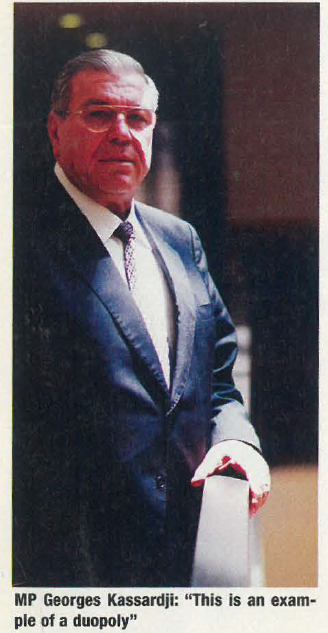
According to Kassardji, the expansion was
a move to control the market before a third
player could enter the fray. “This is not
a good example of privatization; it’s an
example of a duopoly,” he says, presenting
a list of unfair practices and violations.
Regardless of the outcome, this doesn’t
bode well on the eve of privatization. Now that
parliament has passed the privatization law, the
government needs to sell off state assets to
reduce its huge debt. But in the aftermath of
such a disastrously mismanaged dispute, will
there be any buyers? And if so, will they pay
as much as the government hopes to get?

