
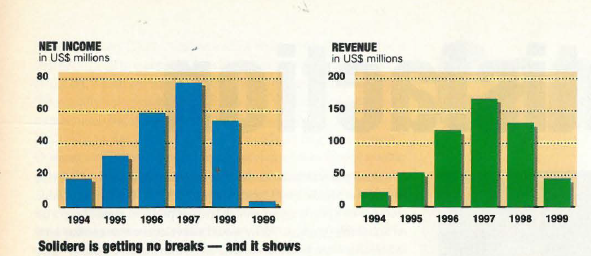
Condolences to Solidere shareholders. Profits of the real
estate company, responsible for rebuilding the Beirut
Central District (BCD) and the largest business in
Lebanon, plummeted from $54.2 million in 1998 to $3.7 million
last year. That’s a 93% free-fall! It won’t be decided until June,
but you can bet your shorts that Solidere won’t pay dividends this
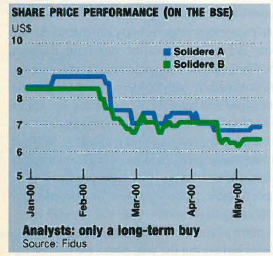
year. Share prices have more than halved since peaking in
1997. This year alone, Solidere’s A and B shares traded on the
Beirut Stock Exchange (BSE) have dropped more than 22%. Its
market cap, which takes up nearly 70% of the BSE, has shrunk from
$1.4 billion to $1.1 billion in the last 12 months. Expecting bigger
and better things in the near future? You may have to wait.
Land and real estate sales, the company’s main source of revenues,
fell 68% in 1999, from $118 million in 1998 to $37.5 million,
according to Solidere’s finance division manager Mounir
Douaidy. Sales contracts worth $79 million that were supposed to
come through last year were either cancelled or postponed.
Douaidy points to three factors contributing to Solidere’s dramatic
decline in sales: the stagnant economy, investors’ jitters about
political uncertainties and the snail’s pace of building permits.
There’s no doubt that Solidere isn’t immune to the economic slowdown
and political uncertainties. But according to Ziad Maalouf, vice
president at Middle East Capital Group (MECG), if there is economic
recovery or a peace agreement, the permit problem would keep a lid
on Solidere’s progress. “Why would a developer come and buy land
in Solidere when he knows that he’ll run into massive delays?” says
Maalouf. “Holding back permits is paralyzing Solidere 100%.”
The problem begins with the differences between the old construction
code and Solidere’s building decree 4830, which was
passed in 1994 for the purpose of rebuilding BCD, according to
Oussama Kabbani, department manager for urban management at
Solidere. “In principle you only have to pass through 4830, but it
doesn’t cover every detail,” he says. “Whenever the decree doesn’t
cover something, the municipality of Beirut goes back to the original
code. You’re using two laws that in principle should complement
each other. But when found in the grey zone, they apply the
old one and suddenly there are discrepancies.”
He claims that the
government was more flexible with 4830 under the old regime. But
things have changed under this administration. “When discrepancies
are found, nobody wants to take responsibility,” says Kabbani.
George Khouzami, head of the engineering department at the
municipality of Beirut, admits that his team is running into discrepancies
that delay the permit process but denies that the change
of government has altered the way the municipality works. “During
the previous government, we never bypassed the law,” he says. “We
followed the law then as now.”
But talk to anybody related to rebuilding downtown and they’ll tell
a different story. What motivated the powers-that-be to alter the process
is anyone’s guess. Analysts argue that there is an anti-Hariri campaign,
since he was the mover-and-shaker for Solidere while prime minister
and is a major shareholder in the company. Some at Solidere believe
that this government’s drive for law and order has forced those
working with permits to follow the rule book down to every detail.
“The government said that everybody must follow the law, so suddenly
everybody started getting scared,” says one Solidere official.
“Everybody says that it’s not their responsibility and throws the ball
in a different direction.”
Some developers and consultants that have
had a hand in the rebuilding program since the beginning have a different
theory and don’t sympathize with Solidere. “I feel sorry for the
developers that bought land and have permit problems, but not for
Solidere,” says one developer. “Solidere used to be the government,
it had power and it had a free hand in doing what it wanted to do. There
used to be pressure on the municipality. Now those at the municipality
are fed up with Solidere and are taking revenge.”
Regardless of who’s at fault, the government has stepped in to
offer a little help by passing two decrees. One was to make it easier
to get occupancy permits that were on hold because legal documents
had been destroyed during the war. Since the decree was implemented
in mid-February, only five permits have made it; 30
are pending. “Not good enough,” says one Solidere official.
The
second decree created the high council of urbanism to deal with discrepancies
found by the municipality. But according to Kabbani,
the council was given limited power. “In some cases there are five
problems, and the council can only decide on three, not the rest,”
he says. “We thought the council would get things rolling, but we
get stuck again and again.” Since the decree emerged early this year,
no construction permits have been issued — 24 are pending.
Since these decrees are merely patchwork, Solidere is anxiously
waiting for five more. One is supposed to clean up the discrepancy
mess. But there’s a problem: The council is only supposed to last
for six months, so it will expire in three. Watching how slow the
decree is moving, Solidere expects it to take one to two years to be
finalized. (It’s already been sitting at the Council for Development
and Reconstruction for over four months.) “They will probably
extend the council,” says Kabbani. “It’s better than nothing.”
Also critical are the souks. “It’s the vital part of BCD,” says
Douaidy. “It will energize the atmosphere, draw commercial life and
create traffic, which will bring in more investors.” With the souks
including 20,000m² of office space, 10,000m² of residential units and
70,000m² of retail space, not only would it bring in a new, healthy cash
flow from sales and rental income, but it could trigger a domino effect.
A decree to let Solidere develop the souks has been approved all the
way up to the last chain of command: the council of ministers.
According to Solidere, it has been waiting for the final signature for almost two
months.
The new decrees, which include dealing with the marina and property
given to government, are not only important to
Solidere. Those who have invested
in the BCD have been caught
in the crossfire.
“We are worried about how long it will take for the
decrees to be passed,” says Essam
Makarem, speaker for a group of
investors in BCD. “We’ve already
invested around $500 million in the
land, with another $1.5 billion in the
banks ready to invest; all we need is
to be sure that the other five decrees
are passed by the government.”
Is Solidere in a position to withstand
the outside forces if they continue to drag on? “Their fundamentals are
still sound,” says Maalouf. “The company is healthy in terms of financials.”
He notes that Solidere is sitting on $77 million in cash, its debt-to-equity ratio stands at an
acceptable level (22%), most of the infrastructure projects are nearly
completed and even though its net interest earnings have decreased
over the years, they’re still in the black. “And the land Solidere is sitting
on is strategic land, prime real estate, and its value can only increase
over time,” says Maalouf. “It’s a strong fundamental.”
Solidere is taking precautions to weather the storm. By downsizing
(mostly by reducing its staff by over 30%), general and administrative
expenses dropped from $16.4 million in 1998 to $14.3 million last year.
Cost cutting will mostly be felt this year, with Solidere aiming for
expenses to hit $10 million.
It has had plans to generate a new income
stream through rental income to help offset slow sales (see “Hedging
its bets,” July/August 1999). But with no substantial contracts developed
last year, its main source of rental income is still the ESCWA building —
rental revenues inched up only 0.5% ($6.9 million).
The Saifi project,
set up with an option to lease or buy, will be completed by the end
of the year and has booked 55% of space available. With Solidere’s aim
to increase its rental revenues, according to HSBC’s latest report, it will
climb steadily to reach around $19 million in 2002.
There’s also a backlog
of land and real estate sales amounting to $49 million that could
come through this year. But with the permit problem, Saifi’s results not
showing up on the books until 2001, and, most importantly, not
knowing if contracts for land and real estate will come through, it’s difficult
to predict if Solidere will show profits this year.
With economic conditions stagnant, uncertainty about the
peace issue and the permit problem dragging on, HSBC and
MECG recommend “hold” on Solidere’s shares. Some investment
firms have pulled back and stopped giving recommendations, not
knowing where the company is heading. “There are too many variables,”
says an analyst at the Merrill Lynch branch in
London. “We have to wait until things are clear before we can present
our view again.”
But analysts still believe that if there’s peace, Solidere’s shares will
jump. “The share prices will shoot up if there’s peace,” says Jean
Riachi, chairman and general manager at Financial Funds Advisors.
History offers some support: When peace talks were temporarily
revived a year ago, Solidere’s shares had a quick rally.
But if there is peace and the permit problem remains, the flurry would
probably lose momentum. What is needed is the government to grease
the wheels of Solidere; otherwise, it will just sit there idling
