
Coming home has paid off so far
for Societe de Grands Hotels du
Liban (SGHL). After opening
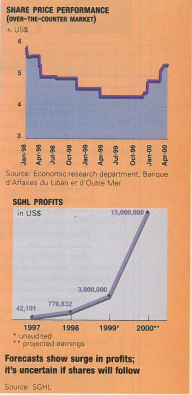
Vendome Hotel in 1996, its profits jumped
from $42,101 in 1997 to $3 million, unaudited,
last year. SGHL believes that this
was just a small step towards a real profit
surge. Last March it reopened what was
once one of the most prestigious hotels in
the Middle East before the war: Phoenicia
Hotel. Earnings are forecast at $15 million
for 2000, according to Mazen Salha, chairman.
That’s an increase of 400% – far above
what other companies on the
Lebanese stock market anticipate.
SGHL has a good chance to meet its target.
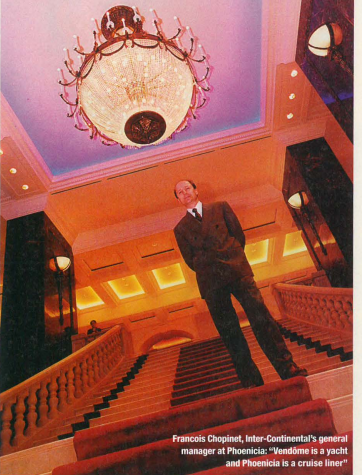
“Vendome is a yacht and Phoenicia is a
cruise liner,” says Francois Chopinet, InterContinental’s
general manager at Phoenicia
(InterContinental runs both SGHL’s hotels).
Unlike Vendome**,** which is a medium-sized
boutique hotel, Phoenicia will function on a
much grander scale. It has the largest conference
room and, once fully operational, will
have more rooms than any competitor in the
local hotel industry. Size matters. Existing
hotels, such as the Marriott, Savoy, Le
Bristol, Al-Bustan, Summerland and
Commodore, can house 300 to 1200 people in
a conference hall and have around 85 to 210
rooms. Phoenicia’s conference hall can hold
2000 guests and will have 450 rooms when
completed this month. According to Ghassan
Matar, previously an independent consultant
for the ministry of tourism, Phoenicia’s competitors
often can’t accommodate all their
guests when hosting events. “At Phoenicia,
with accommodation available in the same
hotel, convenience for the participants, organizers
and tourist agencies will attract many clients away from its competitors,” he says.
Big brand names in the hotel industry
have been scrambling to get in and set up
shop or manage local establishments. Many
believe that international chains, such as Le
Meridien, Starwood, Marriott, Holiday Inn
and InterContinental, will soon dominate the
Lebanese market. Others like Movenpick and
Four Seasons are on the way. “Lebanon is
opening up to the world, and local hotels need
international chains to market worldwide,”
says Tanios Kassis, development manager at
Choice Hotel International, which encompasses
Clarion, Quality, Comfort and Econo
Lodge. “To attract people from other countries,
a hotel needs a brand name,” says
Kassis. “And to market abroad, it takes
expertise and the ability to absorb costs.
Local owners are unable to do it.”
SGHL teaming up with InterContinental to
manage Phoenicia should pay off. InterContinental,
which belongs to Bass Hotels and Resorts, was the driving force that enabled
Vendome to become a moneymaker in a
short period of time. Bass Hotels and Resorts,
which includes Holiday Inn, Crowne Plaza,
Holiday Inn Express and Staybridge, is one of
the leaders in the global hotel business**,** generating
revenues of about $7.43 billion. In the
last three years, the average occupancy rate for
the hotel sector was 40.5% compared to 90%
for Vendome.
SGHL allocated InterContinental an initial
marketing budget of $500,000, to be followed
by 5% to 7% of revenues.
Marketing regionally and internationally,
InterContinental focuses exclusively on
corporate clients. “The hotel has been built
around targeting corporate clients. This is a
businessman’s hotel,” says Salha.
Phoenicia’s location in the Beirut Central
District will also be beneficial as businesses
are expected to migrate to the city center.
And according to Chopinet, corporate
clients are eager to find a new destination in
this region. “On our conference business, we
have 30,000 room nights booked between
March and the end of September,” he says.
“Two thirds of these clients had plans to go
to other destinations, but we stole them
from places like Dubai, Cairo and
Istanbul.” InterContinental, which has a $2-
million stake in Phoenicia, calculated a
conservative 50% occupancy rate for the
first six months. It has already been running
above expectations at 62%.
SGHL has one advantage that its competitors
do not: the name. “Phoenicia is one of the
oldest brand names in Lebanon,” says Pierre
Achkar, the president of the Lebanese Hotel
Association. “It was the first InterContinental
in the Middle East and was the
biggest. Everyone knows Phoenicia.”
SGHL doesn’t plan to stop there. “We
want to develop more hotels in Lebanon
and in neighboring countries,” says Salha.
Following a peace agreement, SGHL plans
to open a hotel in Damascus. Cairo will
probably come next year, while other spots
in North Africa and Iran are being considered.
But can SGHL attract investors? Its shares
have had a bumpy ride on the over-the-counter
market (OTC). Between early 1997
and late last year, its prices bounced
between $3.85 and $5.75. A positive sign: a
23% increase in the last few months, settling
in around $5.38. The recent jump came
from Vendome’s higher-than-expected
results last year and anticipation of
Phoenicia’s opening, according to Nicolas
Sawan, head of trading at Lebanon Invest,
which handled SGHL’s private placement in
1996. Sawan believes there could be more
movement to come, but it may take time.
“This year’s results should affect the share
price,” he says. “What drives share price
movement is psychological. If SGHL meets
its profit target, prices should move.”
But there are forces in Lebanon working
against the traditional rule of thumb of
stock prices moving upward as earnings
improve. “With all the bookings at the hotel
this year, it will be a successful beginning,”
says Nabil Aoun, general manager at Fidus.
“I’m very optimistic about SGHL, but its
shares won’t follow. The market is dead.”
Lebanon’s economic and political uncertainties
have killed investor interest. A good
example is BLOM’s GDRs, which are traded
on a more liquid market than the Beirut
Stock Exchange (BSE) or the OTC. The
largest bank in Lebanon, BLOM increased
earnings by 20%, from $58.7 million to $70.4
million, in 1999, and in the first quarter of
2000 profits jumped 14.5% over the same
period last year**,** despite recessionary pressure
taking its toll on the banking sector.
Even though international investment firms
recommend a buy and target its share price
as high as $44, its GDRs have dropped 9%,
down to $24.68, so far this year.
SGHL has received approval to move its
shares onto the BSE. “We are waiting for the
market to be more active,” says Salha. But
when that will happen is anyone’s guess.
Total trading volume dropped from $640
million in 1997 to $90 million in 1999. It has
sunk even further this year, down 19% in the
first quarter. There is a question of interest
being generated in SGHL itself. Several
analysts at local investment firms claim that
they tried to study the company and report on
its progress for investors, but were rejected.
“We tried to get information from SGHL, like
income statements, but no luck,” says one
analyst. “It’s not transparent at all.”
There is also concern about SGHL’s debt. To
rebuild Phoenicia, the company had to borrow
a total of $80 million. There is a chance that
SGHL will sell off Vendome to help reduce its
