A visitor arriving in Lebanon might be impressed by the bustle
of construction at the new airport. Estimates indicate
that by completion, the total cost will run upwards of $800
million. But not all that glitters is gold. Problems at the airport are
affecting trade and the livelihood of companies operating there.
A big problem, not surprisingly, is customs. “The customs
building is something out of the middle ages, it’s dirty, littered
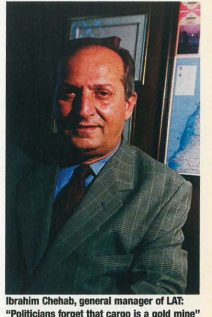
with garbage and nothing works,” says Ibrahim Chehab, general
manager of Lebanese Air Transport (LAT). The erratic customs
procedures and charges, which are often subject to bribes or
wasta, slow the passage of goods. An organized and efficient customs
system would increase cargo and ultimately increase the revenue
for the government, says Chehab. He previously worked as
a cargo manager at Sharjah airport. “It’s small compared to
Dubai’s airport, but their warehouses are full because the government
has a flexible policy and business is booming,” says
Chehab. LAT does cargo and passenger handling as well as
maintenance assistance for 17 international airlines, including Air
France, British Airways and KLM.
The government halted a $15 million BOT project to build a modern
customs building with a warehouse capacity of 200,000 tons a year
and where airlines could have bonded warehouses. “The existing facilities
can absorb 100,000 tons, but Lebanon is only getting 50,000 tons**;**
that’s what stopped the project,” says Fadi Saab, chairman of Trans
Mediterranean Airlines. Customs regulations can impact the cargo
business, adds Saab, but other areas such as industry and trade also
need a boost for the sector to improve. The plans to modernize and
computerize the facilities are encouraging for Saab.
But Chehab believes a better option would be to create a ‘cargo village.’
For 15 years, land would be given rent-free to airlines and cargo
companies to build their own offices and warehouses. “Politicians think the airport is only for
passengers and forget
that cargo is a
gold mine,” says
Chehab. He cites
Singapore as one of
many cities that have
become hubs as the
result of such a project.
The government
did have a plan
to take ownership of
additional land. But
the project failed
because it exceeded the allocated budget for the airport, and
there was political pressure due to its proximity to residential areas,
according to an engineer at the airport’s civil aviation department. “We
don’t have an inch of land to give to companies,” he says.
But land aside, politics have already scuttled one similar completed
project. Last October DHL (see “Down and out in Beirut,” January
2000) invested $2 million in new airside offices that included warehousing
and an area for customs clearance. Those facilities are sitting
idle because no customs officers have been stationed there,
despite promises from both the current and previous government.
Another problem is the high rental fees. Last August, law number
nine increased the rent for offices occupied by airlines or
appointed agents from LL 100,000 to LL 500,000 per m2 and the rent
of hangars and warehouses from nothing to LL 250,000. For LAT
that meant an increase from $7,500 to $35,000 per month.
The new law gave a 50% exemption to local companies that
have scheduled flights, but LAT doesn’t have scheduled flights.
Though the law has since been modified to include companies
without scheduled flights, the ministry of transport is trying to
collect the full fee. The civil aviation authority disputes complaints of high
fees. “It was proven that we have the lowest such fees in the
world, and we need them to cover the operating costs of the airport,”
says one official.
The companies that LAT represents also complain about additional
fees, such as $150 per hour to use the travel counters and
charges of LL 50,000 to LL 150,000 on outgoing passengers. And
on top of the substandard warehousing facilities, the airport has yet
to install telephones and televisions as well as sufficient passenger
seating, arrival and departure monitors. Even with all the
fees it collects, the airport management has failed to provide
good services in return.