
In the first month after the Israeli pullout
from the South, there were no skirmishes
at the border and no air attacks on
power stations. Some believe that Bashar
Assad as the new leader of Syria might bring
in a new era. There is hope for economic
reform that would offer a new market to
Lebanese businesses and peace talks may
resume, which would give the stagnant
economy a boost. But just when Lebanon was
starting to feel more at ease, the country was
ambushed and is now under attack. Not from
warplanes or a standing army. From
Standard & Poor’s (S&P).
The international credit agency put
Lebanon’s long-term ratings under
CreditWatch. If some things don’t improve
quickly, the country might be downgraded
in the fourth quarter this year. Is this a real
threat? According to Navaid Farooq, S&P’s
sovereign analyst for the Middle East and
North Africa, the downgrade would, for
example, increase Lebanon’s cost of capital.
That in turn would push up debt servicing
and the debt, which has already surpassed
130% of GDP. It would also hurt
investors’ confidence, something that is
already lacking. “How do you get out of a
recession?” asks Kamal Shehadi, a consultant
on telecom and privatization.
“Economically speaking, there’s just one
way to do it. You have to get from the low
level of investment as a percentage of GDP,
which is around 15% to 17% [in Lebanon],
to about 27% to 28%. That means we need
additional investments and most of these
investments will have to come from
abroad. That’s what creates jobs, that’s how
you pay your bills, that’s how you create
prosperity and wealth.”
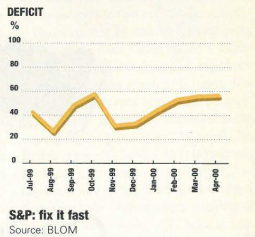
S&P doesn’t want to see the government
miss its budget deficit targets. The target for
2000 is 37.3%. Through April this year,
the deficit reached 52.45%, way above
42.06% for the same period in 1999.
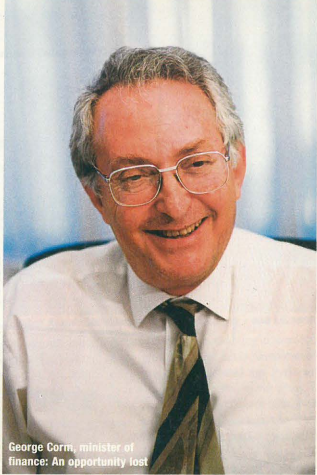
“There was slippage,”
admits Georges Corm,
the minister of finance.
“I allowed public
administration and
public entities to draw
more heavily on the
budget in the first few
months of the year to
activate economic
growth. We have spent
24% of budget appropriations
instead of
16% last year. Nothing
abnormal. Revenues
are going to pick up
and expenditures are
going to begin declining.”
For revenue,
Corm stresses a change
in amnesty on tax penalties. “The budget
depends a lot on whether the amnesty flies
or not. It’s still under discussion. The business
community is ready to get back to the
statute of limitations and create a much
better atmosphere to pay more and pay
their taxes more easily,” says Corm.
Whether his attempt to improve tax
collection works or not, Corm’s best chance
to take a bite out of the debt was snatched
right out from under him. In the middle of the
ongoing dispute over the contract between
the government and LibanCell and Cellis (see
pp. 6-7), the mobile phone operators offered
a combined $2.7 billion for 20-year licenses.
A third operator could eventually be added to
reach over $4 billion in proceeds. The council
of ministers decided not to make a decision
and passed the dispute over to the
auditing department. “The only way the
government could have pleased S&P would
have been a concrete move, which was selling
the licenses,” says an analyst. “They
desperately need the proceeds. Looking at the
fiscal situation, as far as I can see this would have been the only thing the government
could have done.” Corm and Nassar Saidi,
minister of economy and trade, were for
selling the licenses, but were outnumbered.
“Corm has made mistakes and he is always
under fire,” says the analyst, “but this time he
is a victim.”
Instead of receiving a handsome windfall
in revenues, Corm is back to square one facing
fiscal imbalances. “I was not particularly
happy,” says Corm. “Given the deficit situation, it would have been good to enter the
agreements.” If the licenses had been sold,
it would have taken a good chunk out of
Lebanon’s debt. And, “if the government
had agreed with LibanCell and Cellis,
they could have reduced the budget deficit
below 35%, which is well below their target
this year,” says Marwan Iskandar, an
economist. S&P’s opinion on the government
not selling the licenses? “What happened
was deplorable,” says Farooq. Not
only despicable. S&P gave Lebanon
October as the deadline to resolve the
issue, and to eventually turn the $2.7 billion
into revenue.
Next up is value-added tax (VAT). “We
are preparing VAT for next year,” says
Corm, “and it is going smoothly.” Not so,
according to Iskandar: “They haven’t
been preparing adequately for it to be
introduced in early 2001. It could be introduced
in mid 2001 or early 2002.” Worse
yet, “The VAT law is with the parliament,”
says Corm. “It now depends on parliament.
They will discuss it in July or with the
new parliament after the elections.”
Hopefully before the elections. One
demand by S&P is that parliament pass the
law prior to the elections in August in
order to make sure it is implemented in
early 2001. Many doubt that will happen,
considering politicians never like to make
big decisions close to election time.
Some are now on alert and here to
defend the country from a credit rating
assault. “You must be impartial for an economic
assessment,” says Saidi. “For
example, the South is now liberated which
changes economic scenarios. This has
reduced political and economic risk.
Countries and donors were previously
reluctant to assist Lebanon because of
Israeli occupation but are now willing to do
so. This means it’s more likely to be successful
with our reconstruction program,
which improves economic prospects.
S&P doesn’t want to look at this. It’s not an
impartial rating.”
Whether the minister is right or wrong,
S&P has the artillery to downgrade
Lebanon if the government doesn’t mobilize.
Anxiety from the pullout has subsided. But
tension from internal problems for the rest
of this year will continue to rise.
