
Imagine you arrive home to
find that your landlord has
stuck the phone bill in
your apartment door. Shock. For
three months of local calls and
Internet use the total is a whopping
$450. Stuffing the offensive
bill in your pocket and
opening the door, you flip the
light switch. Flick, flick. No use,
you’re the victim of a power
shortage, again. After fumbling
around for matches, you head
for the fridge under the warm
glow of candlelight. You are
dying of thirst and can already
feel the cool, refreshing water
wash over your tongue. Out of
luck. There’s no bottled mineral
water left in the fridge. You’re
almost thirsty enough to stick
your head under the tap and
guzzle, but there’s no telling
what’s in the water. Great. A perfect ending to
a perfectly crappy day: you just arrived
home frazzled and a day late because of
a screw-up at Middle East Airlines.
Sound far-fetched? Not entirely. These are
a combination of true-life experiences of the
EXECUTIVE editorial staff, some of which
you have undoubtedly experienced yourself.
These events underscore the government’s
inability to efficiently operate such services
and the desperate need for privatization.
But there are other reasons to privatize.
And perhaps the most obvious is that the
receipts from privatization could bite a
sizeable chunk out of Lebanon’s massive
debt, now almost $22 billion, or 136% of
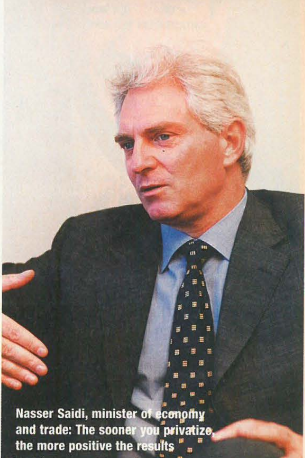
GDP. “A major purpose of privatization,
the law was specific in terms of that, is that
all privatization proceeds would be used to
reduce the debt,” says Nasser Saidi, minister
of economy, trade and industry. “And the
sooner you do it the more positive the
results.” That in turn would decrease debt-servicing
costs and therefore the deficit,
which is currently running at about 52%.
According to the government’s fiscal readjustment
plan, privatization is expected to
bring in $4-5 billion over a five-year period.
“But I think we could easily double
that amount,” says Saidi.
Privatization would create a ripple effect
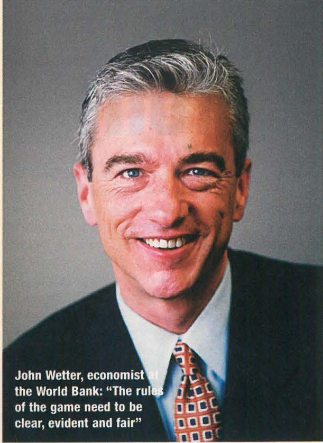
throughout the economy. “Experience
throughout the world in virtually every
sector shows that the economic benefits to
privatization are considerable,” says John
Wetter, country economist with the World Bank office in Beirut. Kamal Shehadi, a
consultant on telecom privatization in the
region, concurs: “It means new investments,
new job opportunities, especially
for the highly skilled Lebanese graduates.
You’re reforming sectors, making these
sectors more competitive and that will
allow all the businesses which rely on
these services to become more competitive
internationally.” Take foreign direct investment
in Jordan as one example. In 1999,
there was an additional inflow of $700 million
as a result of three privatizations,
while the yearly total had previously averaged
$250 million. And revenues from privatization are not simply
one-off sales transactions:
The government will
expand its tax base with the
privatized enterprises and
new economic activity that
is generated.
The lifeless Beirut Stock
Exchange (BSE) would also
get a much-needed boost as
long as privatization goes
hand-in-hand with listing the
new companies. Currently,
the capitalization of the BSE
is just $2 billion. The telecoms
alone, fixed and
mobile, are expected to bring
that to about $5 billion, or
30% of GDP, the first notch
in the development of stock
markets. Egypt was at that
level two years ago and is
now at 50% of GDP. “These
big companies would break
the cycle of illiquidity,” says
Fadi Khalaf, chairman of the
BSE. “And that would encourage other
companies to list.” Societe Nationale
d’ Assurance is one such example. Its listing
has already been approved, but the insurance
company is waiting to see an upturn on
the local market first.
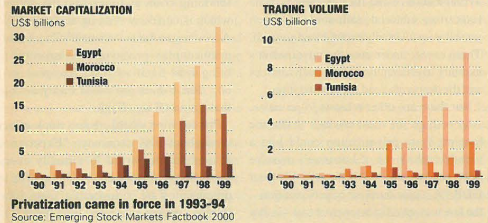
Many stock exchanges in Latin America,
Eastern Europe and the Middle East have
developed thanks to privatization. In Egypt
the previously state-owned Mobinil
accounts for 50% of trading. Even in
France the former state-owned telecom,
France Telecom, accounts for 20% of volume.
Creating an efficient BSE, which will
also require reform and the creation of a regulatory body, would have a spillover effect
on the financing of other private projects.
That would give companies in Lebanon
options for raising money other than debt.
But perhaps a more important reason for
increased private sector participation is
that the government has proven itself inept
at running the state-owned entities, and
that is a drain on the treasury. With some 500
employees per plane, MEA is hardly the
epitome of efficiency. Last year’s losses at
MEA, which oddly falls under the central
bank’s realm of responsibilities, will come
close to the $41 million mark, the same as
in 1998. Electricite du Liban (EDL) has
accumulated a debt of over $1.6 billion, regularly
reports annual operating deficits of
$150 million, while uncollected bills now
stand at $530 million. Further, EDL hasn’t
finished auditing 1998 results, two and a
half years later. It can’t even guarantee a
consistent supply of power, Israeli air
strikes or not. The cuts over recent weeks are
the result of the EDL’s inability to secure
sufficient fuel oil.
Believe it or not, the water authorities
are probably in worse shape. “It’s a mess,”
says an official at the ministry of electricity
and water. There is no consolidation of the
results of the various authorities; some
haven’t submitted results in five years to the
ministry, while others have no functioning
board of directors. Further it is estimated
that the antiquated piping network loses as
much as 40% to 50% of the water.
Extracting these and other services from
government hands would bring obvious
benefits to the consumer. “The public sector
does not have the flexibility or discipline
that the marketplace imposes on the private
sector provider of services,” says Wetter.
“Vast country experience has shown that
after privatization, the good, product or
service is delivered more efficiently, at
lower cost and higher quality.” Shehadi
points to the telecommunications sector as
an example: “This is a service-based economy.
Do you realize the impact of reducing
the cost of international calls? It would
make a huge difference for businesses and
individuals.”
Look at France’s Suez Lyonnaise des
Eaux, which has won concessions to operate
water systems in cities around the world. It has performed a miraculous overhaul
of Buenos Aires’ supply since taking
control in 1993. Prices have dropped
across the board while water is now piped
directly to the homes of poorer neighborhoods
that previously relied on a single
communal spout.
With the benefits of privatization so
numerous and the Lebanese economy
struggling, a concerted effort is required to
put things into motion. The recent passage
of the general law on privatization is a good
sign. “But it’s somewhat prohibitive in
terms of giving more leeway to the government
to decide,” says Ziad Maalouf, vice
president at Middle East Capital Group. “It
is likely to slow down the pace. Every company
that needs to be privatized will have to
go individually to parliament to be decided
on and debated in the general assembly.”
On the block are MEA, the Casino and
IntraInvest, but Lebanon’s really big concerns
are the utilities. Three draft laws are
in the works for telecommunications, electricity
and water to create the legal and
regulatory framework for those sectors.
That will include the creation of corporate
entities as well as rules on anti-monopolistic practices, competition and
fair pricing.
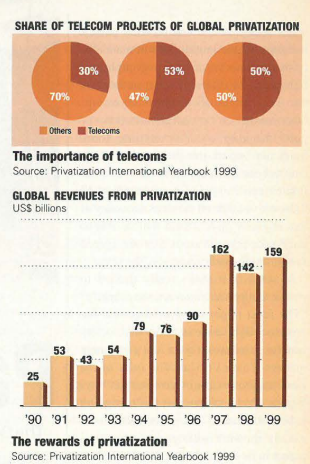
Among the utilities, the
telecommunications sector is set
to be the first up for sale and is
undoubtedly key. For Saidi, telecoms
will be integral to the
future of the Lebanese economy.
Analysts share that view
with the minister. “In the age of
the information revolution
where the wealth of nations is
determined by the ability and
willingness to embrace the
reform of telecommunications
and information technology, the
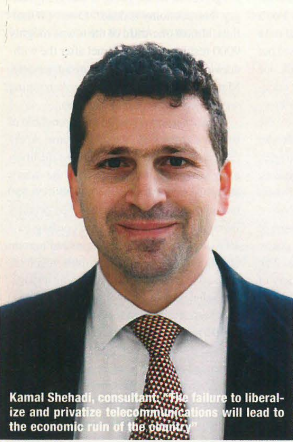
failure to liberalize and privatize
telecommunications will lead to
the economic ruin of the country,”
says Shehadi.
The draft law for the privatization
of telecoms is ready and
has been sitting at the council of
ministers, often a bottleneck of decision-making, for at least three months. “You have to be
encompassing in terms of your view and
careful about what types of legislation
you’re introducing,” says Saidi,
“particularly at a time when
technology is changing extremely
rapidly.” Indeed. But technology
isn’t going to stop evolving,
and the pace is only likely to
pick up. The law is expected to
prepare for the sale of a 25%
stake in the fixed network and is
slated to get underway next year.
Against this backdrop is the
government’s botched effort to
find a resolution to the dispute
with LibanCell and Cellis, the
two mobile phone operators. “The continuation of
the dispute over the $300 million
is very bad for Lebanon because
of what it says about the government’s
policy direction,
which is to keep telecom as a
government monopoly worthy
only of banana republics,” says
Shehadi. “If the government
does not succeed in resolving
the cellular dispute and converting
the BOTs into licenses, then you can kiss
the privatization of telecommunications
good-bye.” If so, that could also put a dent
in the government’s plans to auction
licenses for UMTS, the third generation of
mobile phones. According to Shehadi, no
respectable telecom operator will invest
such large amounts of money in a country
that doesn’t have an independent telecom
regulator, a modern telecom law and a government
committed to liberalization.
Albeit more complicated, preparations for
the privatization of EDL are also in progress.
Under the guidance of the World Bank, draft
plans foresee the corporatization and
unbundling of the utility into transmission,
generation and distribution units. Saidi predicts
that the privatization law for the power
sector should be ready in the fall. “Normally
the network remains in public hands, however
you can have competition in distribution and
generation,” says the minister. “And now
we’ve increased the potential extent of competition
through our linking up to five other
countries in the region.” Lebanon will join the
regional electricity grid being set up with
Egypt, Jordan, Syria, Iraq and Turkey.
Only the first step has been taken in the water sector: A law was recently passed
that foresees the introduction of mandatory
external audits and the regrouping of
Lebanon’s 21 different water authorities
into five such entities within three years. In
other words, don’t expect privatization or
good drinking water anytime soon.
Saidi also notes the preparations of an
antitrust and competition law as well as an
implementation plan for privatization. “I
think we’ve taken all the steps necessary so
that any new government will be able to
undertake privatizations that are agreed
fairly rapidly and efficiently,” he says.
So what is it that’s really needed to
ensure that privatization is done properly?
“The most important guarantee that the
process will be done in a way that society
benefits is to have it done in a transparent
manner. That’s critical. The rules of the
game need to be clear, evident and fair,” says
Wetter. “Privatizations that don’t follow this are going
to be problematic.” The government hasn’t
exactly shown a willingness to be transparent
in its demands that the two cellular
operators pay $300 million each in fines.
The government will also have to
ensure that the regulatory bodies it creates
to govern the newly privatized sectors
will not fall victim to politics. As impossible
as that may seem in Lebanon it’s not
a completely foreign concept. Take for
example the central bank and the banking
control commission, which have been
shielded from political influence and thus
able to perform their jobs properly. This is
a major factor that has led to the relatively
healthy and prosperous banking sector
that exists in Lebanon.
Superseding everything will be the government’s
political will to see privatization
through. Accepting the short-term job
losses associated with privatization is
never easy. And with cases like MEA,
where a large number of the staff of 4,500
are political appointees, it will be even
more difficult. The vested interests will
have to be defeated. “Throughout the
entire process you need political will,
political will,” says Shehadi. “If the government
wants to do it the proper way,
they can. You just bring in people who have
no interest in cozying up to anybody and
doing favors for anybody else.”

