
The new government
has been criticized for
spending too much
time pointing out the
deficiencies of the last
administration and not
enough on its own
economic targets.
Prime Minister Salim
Hoss talks to
EXECUTIVE about the
government’s track
record, movement on
privatization and the
gridlock at Solidere.
One of the hallmarks of the new
government was the commitment
to reduce the fiscal deficit and
deal with public debt. But 1999
budget targets will not be met.
How can we have faith in the ability
of the new government to meet
its fiscal targets in 2000?
HOSS We said in our budget that
the deficit will be 41% of our total
expenditures. While we don’t have all
the year’s figures yet, as of the end of
November, it is forty point something.
The fiscal deficit that includes
non-budgetary items is 43%, exactly
the same figure that the minister
of finance had predicted when the
budget was first drafted. Now I can’t
tell you what the situation will be by
the end of December. The second
point I’d like to raise is our program
for fiscal adjustment, which
includes privatization. There has
been a little delay in this; we were supposed
to have privatized something
during this year, which we have not
done. Legislation setting forth the
framework for privatization has been drafted, but not yet issued by Parliament. We can’t start on privatization
unless this framework legislation is out.
What about government spending on wages and salaries? At
around 11% of GDP, that’s higher than the regional average. Do
you agree that cutting this level of expenditure is an important
issue in the deficit?
HOSS Of course it is. We have inherited an administration which
is, to say the least, bloated. There are redundancies that you cannot
do away with easily for legal reasons. We do intend to redress the situation
with time. But we can’t just lay off employees of the government.
They have rights that are protected by law.
Are there any concrete steps that the government has made
to cut the level of wages or salaries?
HOSS I can mention one: wage-earners at the ministry of information
have been laid off by an act of the minister. They were not
employees per se, but rather contractual or temporary workers who
were there for years. We have prohibited any new recruitment
except by a decision from the cabinet in order to curtail this problem.
This affects full-time and contractual employees.
A recent survey by the Lebanese Center for Policy Studies confirmed
that government problems such as inefficiency, corruption
and red tape are major obstacles to private sector investment
in Lebanon. For example, 65% of private companies
admitted that they had paid bribes to government officials. What
has happened to administrative reform?
HOSS There is corruption in the public administration, no doubt
about that. We complain about it, but it’s not a new problem that
this government is responsible for; it’s a problem that has been rooted
in the administration for years and years. But we want to do
something about it.
As far as administrative reform is concerned, we are proceeding
with it. For the first time, we have an evaluation program for government
employees, decreed by the cabinet. We have supervisory
agencies, more particularly inspection agencies, that report on
violations within the workplace, and then the government would
have to take action against those responsible for such violations.
With regard to bribes, they are being referred to the judiciary or
to supervisory agencies. If any such crimes come our way, we would
refer them to the judiciary or to the relevant supervisory agency.
This process has not ended, and we are proceeding with it.
As for investments, we have converted the Investment
Development Agency for Lebanon (IDAL) into a one-stop shop for
foreign investors. We know that red tape is very cumbersome and
many investors complain about it. So we are converting IDAL into
an agency that will handle formalities on the investor’s behalf. This
will start very soon.
Given the public finance crisis the government is facing, how confident
are you that you’re going to be able to improve the performance
of the bureaucracy without significant input of money to upgrade salaries and technology?
HOSS We will do it within our means; it will take a lot of money.
We are getting some help from the World Bank, UN Development
Program and the European Union. And we have an administrative
reform portfolio in the government which handles this.
Recently you met with Nasser Chammaa, Solidere’s chairman.
Since the company is suffering from a delayed permit process,
was an agreement made to speed the process up?
HOSS There is no such agreement. But I am responsible here and
I intend to see to it that every project in Lebanon moves forward
soundly. Solidere is one of our major projects and we are interested
in promoting it. I was not aware of any snags in their operation, but
I am having a meeting with Solidere, IDAL and the governor of
Beirut to see what we can do for Solidere. The governor of Beirut
claims that he has some pending licenses in his file, but that’s
because there is a legal flaw in every one of them.
What about Middle East Airlines and Tele-Liban, two firms that
are draining the government of funds?
HOSS You cannot privatize a company without properly restructuring
it to make it financially viable. This is exactly what I’ll do.
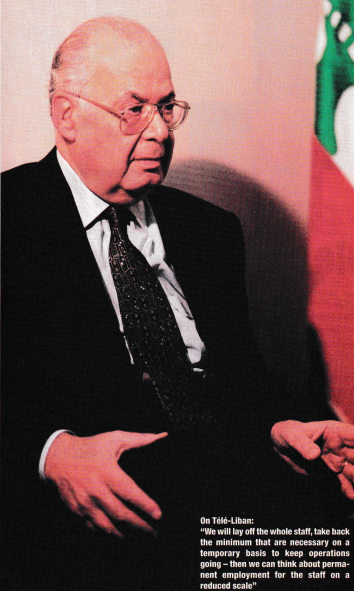
Before the end of this month (December 1999), the whole staff of
Tele-Liban will be laid off in a legal sense by way of severance
indemnity. The current contract is very cumbersome. It’s
unequaled in any other organization in the country. If you are a staff
member there, you get three times more indemnity than anywhere
else. We can’t make an institution viable with such a structure,
so we will lay off the whole staff, take back the minimum that
are necessary on a temporary basis to keep operations going, then
we can think about permanently employing staff on a reduced scale.
This is the first step. Then we can introduce a fundamental restructuring
operation.
As for MEA, I recently met a joint team from the International
Finance Corporation and World Bank, talking first about restructuring
the airline and then the possibility of privatizing it. We are
commissioning the IFC to handle the operation for Lebanon. So we
are embarking on this road. But in both cases, there was no serious
attempt to deal with either company until now.
How were you able to overcome the political pressures of keeping
those employees with their respective companies?
HOSS This has been worked out with the syndicate or employee
union. They will be paid properly according to their collective contract.
We are going to suffer, but this will have to happen sooner or later.
Since Lebanon’s foreign policy faces political restraints, why
not use the ministry and embassies to promote exports and
attract investment?
HOSS We use them whenever possible. Recently, I directed our
embassies in Arab countries which usually import Lebanese agricultural
produce, to make an effort with officials to increase their
imports of Lebanese produce. Diplomats are diplomats, but we do
make use of them in a limited way through such directives.
