
For the past year, EXECUTIVE has
been attempting, albeit in vain, to
interview Eternit, a Lebanese
industrial company that was until a couple
of years ago one of the region’s largest
pipe manufacturers. At different intervals,
we called several times a week for months
on end, knocked on a closed office door in
the downtown Starco building and called the
general manager’s mobile phone. Why did
we bother, other than to prove that a large
pipe maker can’t disappear into thin air?
Because EXECUTIVE felt it was important to
inform readers about what the management
of Eternit was trying to do to fulfill its
responsibilities to creditors, shareholders
(Eternit is a listed company on the Beirut
Stock Exchange) and its employees. And
boy are they some responsibilities. Eternit
is $26 million in debt – the company filed
for bankruptcy in January 1999. It has been
in the red since 1996 with estimated losses
of $8.4 million and $16 million in 1997 and
1998. It has been taken to court by
Lebanon Invest and its subsidiary Lebanon
Holdings (which has a 20% stake in the
company) for allegedly falsifying its financial
statements. After operating on and off
in 1998, it shut down completely for most
of the first half of last year.
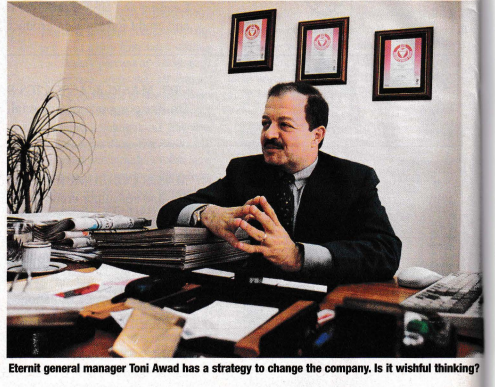
But in 1999, some things changed. In
June, the beleaguered board of directors
decided to remove the president and general
manager, Pierre Abboud (who has now left
the country), and moved Tony Awad, then
vice president and deputy general manager,
to the top, but not particularly sought-after,
spot. And it was Awad who finally decided
to give us an interview. Why did Abboud
finally move on? “It was obvious that
Pierre could not continue managing the
company,” says Awad. “It was impossible to
find a solution for the company to go on without changing the management. It was
hard to convince him to do this; he’s a big
shareholder. But finally he saw it was in the
interest of the company to leave.”
Awad, however, is not new blood; he was
with the company in the years preceding the
bankruptcy. Does the management change
really mean anything? Well, unbeknownst
to just about everyone in town, Awad has a
strategy to save the company, and he has
been implementing it since last summer.
Keeping a low profile, he has been working
on restructuring, salvaging some of the
company’s contracts and making an
attempt to increase sales.
So here’s what you don’t know. Awad
has reduced costs. He shrunk the number of
people in management positions from 20 to
six and then nearly halved Eternit’s workforce,
from 400 to 280. In early 2000 he
plans to cut personnel down to 240. But this
is no easy task. Political and social pressures
make it next to impossible in Lebanon for
local companies to make large-scale workforce
cuts. “I spent 70% of my time since
July working on reducing my workforce,”
says Awad. “I couldn’t offer anything. I
had to convince them that the company
would sink, and by keeping all employees,
we would all sink.” He says he was able
to let go of them without any incentives or
compensation.
Next, Awad has negotiated with foreign
suppliers in Canada, South Africa, Russia
and Greece to reduce the cost of raw materials
by 30%. He also saved some contracts
that had been postponed. Under execution
is a $2 million deal with the Syrian ministry
of defense, and in a few months, Eternit will
be working with Syria’s ministry of irrigation
and the ministry of housing; total contracts
worth $8.5 million. Awad says that there are other deals with Syria in the
pipeline that could bring in another $6 million
this year. He also restored a contract
with the United Nations (UN) for a project in
Cyprus, for approximately $500,000, and is
trying to work the company into the Iraqi
market – to be ready once the embargo is
lifted. Iraq used to be the source of
Eternit’s biggest contracts.
With the company totally stripped of
cash, filing for bankruptcy and waiting for
around $2 million in payments from previous
contracts, Eternit has been following a
very strict credit policy. “Nothing is manufactured
unless there are serious payment
terms with our clients,” says Awad. “A letter
of credit must be confirmed and we get
paid immediately as goods are delivered.”
He has also arranged with the suppliers to
get short-term credit facilities (approximately
60 days) and is able to pay quickly
since the clients pay right away.
Will the plan work? Even though the
company has scored some decent contracts in other markets, there is little hope in the
local market for the time being. In 1997,
63% of Eternit’s sales came from local
business. But with the Lebanese economy
struggling and government projects at a
standstill, it averages only $150,000 a
month in local sales.
Additionally, the company may face
problems with its current reliance on business
in the Syrian market, which is notoriously
unpredictable. In 1996, the Syrian
government froze its new infrastructure
development projects, which contributed to
Eternit’s disastrous financial performance in
recent years. Another unpredictable market
is Libya. Eternit has a stake in Eternit Libya
and has been trying to move into the market.
But recently a conflict between the
Lebanese and Libyan government has prevented
travel visas from being issued
between the two countries, and Eternit’s
focus on the market has been put on hold.
The best bet is Iraq. Once the embargo is
lifted, reconstruction projects will mean juicy contracts for pipe companies. But
although Eternit is trying to get its foot in the
door there, no one knows when the embargo
will be lifted. For other markets in the
region, countries like Saudi Arabia, Egypt
and Jordan prevent imports of pipes
through high custom duties. And other
markets that are open to imports may not be
easy to penetrate. The United Arab
Emirates is an open market, but its local
industries are well positioned with highly
competitive prices.
According to Rudy Sayegh, deputy general
manager at Fidus (which holds Eternit
shares), it was a good idea to dump the
previous general manager and start a new
beginning. “But I feel it is a difficult case.
The only hope is for Iraq’s market to open,
because there is no market in Lebanon and
many other markets are closed. It’s stuck. It
might be living off of artificial oxygen.”
There is also damage to Eternit’s credibility
that it has to deal with. Shareholders
are angry and the creditors are sweating it
out. Eternit could have at least taken its recent plan to those who
are victims of its failure.
Shareholders might feel a
little bit more at ease
knowing that at least the
company is doing something;
approaching creditors
and those filing lawsuits
may also bring the
items at court to a close
sooner (the bankruptcy
case has dragged on for a
year now). But according to
Awad, it would have been
useless. “People are fed up
with promises. They need
to see facts, figures and
results before approaching
them. Do the job first;
clean up and show proof to
address them.”
Maybe the reason Awad
hasn’t brought his plan to
others is that he’s not certain it will work. “When I started
I saw this as a very small percentage
of survival,” says Awad. “Now I think we
have a better chance.” Maybe. Eternit’s survival
could still be just a pipe dream.

