The one sure thing in life is death. And businesses that survive on such a tragic existence prosper best during wars and catastrophes. Ten years after the civil war, with peace on the horizon, the Lebanese business community is hoping for a resurrection. But there are those who just might mourn the passing away of better days.
Funeral businesses are grappling with the prospect of being the ones put six feet under in today’s market, beset by recession and calm. “Business during the war was good, very good, bombs were falling, people were dying and the relatives of the deceased had money, not so today,” says Antoine Bassil, the owner of Bassil’s funeral services.
While Bassil and others may not wish death on anyone, the nature of the business is such that without it they’d be receiving their own last rites. But here’s the chilling truth for Bassil. A trader and a manufacturer of coffins, he manually produced 30 to 40 coffins a month during the war. Today, a fully mechanized process manufactures just 50 to 60 a month. A locally made coffin once cost LL100, today the price is $100. In real terms today’s price is lower.
To be sure, peacetime business is slow, but firms are also getting cremated by increased competition. “I used to do 150 to 300 burials a year, but today I do no more than 100,” says George Abou Chabaki, owner of Abou Chabaki funeral services in Kesrouan. “There used to be five businesses in this area. Now there are no less than 18.”
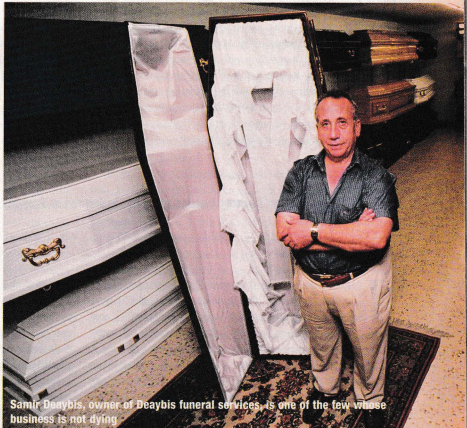
Recession may not affect mortality rates but on the other hand it does kill prices—and profits. Today, an average burial costs around $500. Those who can afford to spend more on their dearly departed are rarely willing to pay above $3,000. “Profits have gone down. We used to make $7,000 to $9,000 a month, now it’s down to $2,000,” says Samir Deaybis, owner of Deaybis funeral services.
Deaybis is one of the oldest and largest such businesses operating outside Beirut. It performs between 1,250 and 1,400 burials a year, each with an average bill of about $1,200.
The small market hardly provides enough good stiffs to bring any real business development. “In this business, people working out of the basement compete with you,” says Abou Chabaki. “This is not a showroom business like it is in the West.”
Abou Chabaki has total assets of around $100,000. No funeral service has more than one shop and rarely more than six cars.
So how are funeral businesses staving off their own demise? Expansion is nearly impossible, not only because opening a second location would cost at least $100,000, but also because certain areas have an oversupply of funeral services. But some companies are not yet ready to give up the ghost.
Diversifying products and manufacturing locally may breathe new life into their businesses. Many have begun selling flower arrangements for less macabre occasions as well. “I follow the person from his birth to his grave. I provide the flowers when he’s born, baptized, engaged and married, and finally I bury him,” says Bassil.
Despite the Lebanese taste for all things Western—even when it comes to coffins—many can’t afford such an extravagance today. Manufacturing locally saves on shipping costs and the 15% customs charge. Whereas a local coffin costs anywhere from $150 to $1,000, imported ones start at $900.
Bassil, Abou Chabaki and Deaybis each have their own factory. Hiring the services of death brokers—yes, that’s right—is also helping funeral businesses rise from the ashes. Death brokers have the ungodly task of scouring hospitals and homes to hunt down death or near-death situations. (In the words of Monty Python: ‘Bring out yer dead, bring out yer dead.’)
EXECUTIVE humor aside, death is no laughing matter and for the relatives of the deceased, a touch of humanity and special care goes far into securing the right funeral service. “I love this business, it has the most prestige in the world, but you need the right people to run it with depth and sensitivity,” says Deaybis, whose services cost up to 15% more than the competition.
In expansion mode, he plans to add three Cadillacs to his funeral fleet and open a funeral home.
In death as in birth, people can be extravagant and extreme. As much as $30,000 is sometimes spent on burials here, some women shop for the best death dress to wear into the afterlife, while there are even those so attached to their cars that they insist on being buried with their wheels.
And while some might see the funeral business as ghastly, those in the profession aren’t nearly so morbid. “Every day I wake up, I say God, don’t hurt anyone. But if you do take someone’s life, please send their business my way,” says Abou Chabaki.