
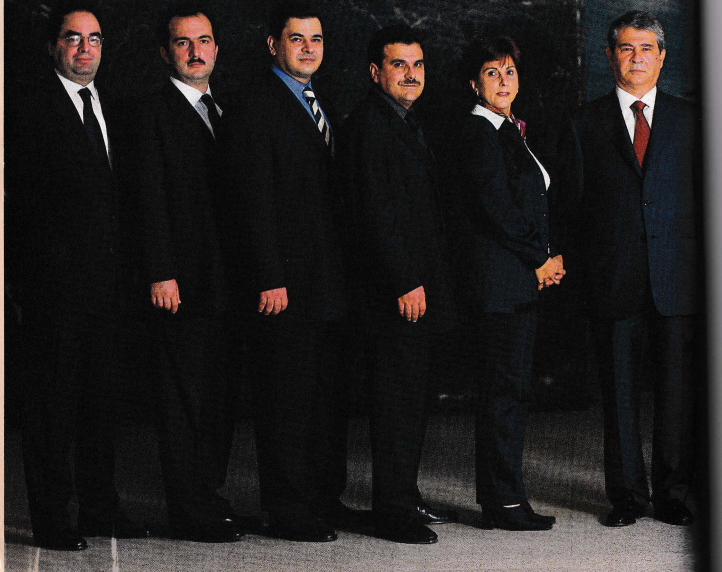
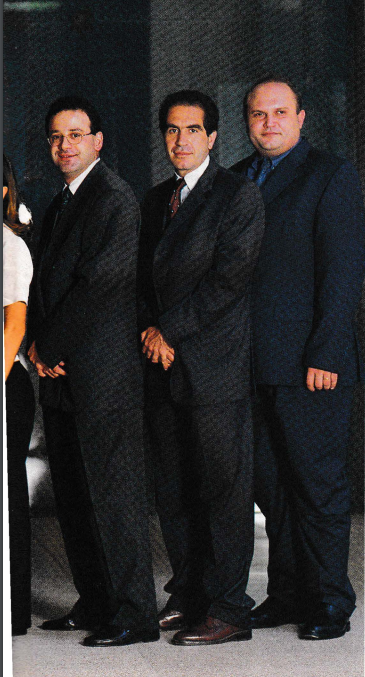
A wave of investment bankers swept into Lebanon a few years ago. Educated and experienced in the West, they envisioned big deals on the horizon. They dreamt that investment banks would play an important role in rebuilding the country. But the deluge of deals never materialized. Countless eager young men in suits have since fled the industry, and the country. The local investment banks themselves have had a difficult time eking out an existence. “Investment banking turned into a fiasco,” proclaims a former investment banker, who is now packing for Europe. “Dreams turned into nightmares.”
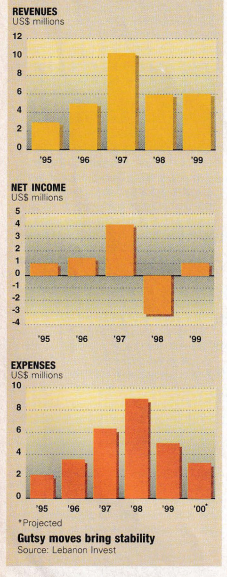
Lebanon Invest has so far been able to survive, though. After its bottom line cratered in 1998, hitting $3.1 million in losses, the firm was able to clear $1.3 million in earnings last year. Drumming up business was not the driving force that pulled it out of the red, however: Survival tactics were how it stayed afloat in such a desperate market. Cost cutting was the top priority. The work force was slashed by 38% between 1998 and 1999. Senior management took a 20% slice out of their salaries, while Marwan Ghandour, chairman and general manager, had the guts to drop his salary 75%. Then managing director, Sami Khoury, wiped out his own salary completely. At the same time, the cooperation agreement with Banque Audi helped reduce office and research expenses. Results: Costs fell from around $9 million in 1998 to $5 million last year. After recording one-off expenses in 1999—offering packages for compensation to let go of employees—Lebanon Invest’s target for expenses is expected to be reached this year, around $3.2 million, nearly a third of what they were two years ago.
Even though last year’s fee income from corporate finance hit an all-time low since 1995, crafty trading by the capital markets division, mostly on local stocks, pulled in positive returns. The division earned $1.3 million on its own equity portfolio and $700,000 on commissions, despite Lebanon’s stagnant markets.
When operations began in 1995, Lebanon Invest didn’t realize how difficult the business environment would be. “We came in with the idea that a country cannot be built strictly on a commercial banking structure,” says Ghandour. “In any economy, especially during a reconstruction period, there have to be funding vehicles, instruments, products that can be available, other than short-term lending from banks.”
Lebanon Invest was a pioneer. In 1995 it did the private placement for Byblos Bank, the first equity offering for a Lebanese bank. A year later, teaming up with SBC Warburg, it placed Byblos’ eurobonds, also a first for a private bank. The financial house merged Byblos with Banque Beyrouth pour le Commerce, then the largest merger in the banking sector at $700 million. Still the first and only fully-fledged project finance deal in Lebanon, the rebuilding of Vendome and Phoenicia hotels by Societe des Grands Hotels du Liban (SGHL) and its private equity placement worth $31.4 million in 1996 also carried the mark of Lebanon Invest. Lebanon’s first venture capital fund (LI Venture) was created by Lebanon Invest, which also put the only closed-end fund on the Beirut Stock Exchange (Lebanon Holdings, see box).
Ghandour’s dreams seemed attainable. From 1995 to 1997, total assets climbed from $33.2 million to $71.3 million, while profits jumped from $970,000 to $4.1 million. But 1998 brought a screeching halt to progress. A recession crept up and foreign capital headed for the exit following the meltdown in Asia, Russia and South America. Lebanon’s capital markets entered a catatonic state. Lebanon Invest’s income on equity plummeted from $4.8 million in 1997 to a loss of $860,000, and its deal flow nearly dried up.
“Suddenly, wham! The system was hit,” says Ghandour. “All the issues we had planned for 1998, including GDRs, eurobonds and so forth, were cancelled. Hundreds of millions of dollars’ worth of issues were stopped.”
The firm also got itself into a rotten deal. Lebanon Invest put up $2 million in loans to help pipe maker Etemit restructure and regain profitability. Including equity, total exposure came to $3.5 million. Etemit’s losses exploded in 1998 to $16 million, following $8.4 million in 1997, and the pipe maker filed for bankruptcy at the start of last year. Lebanon Invest has filed a lawsuit, which has been stuck in the archaic and slow judicial system. It has also completely written off its investment in Etemit. “It was a fraudulent situation, fraudulent accounting,” claims Ghandour. Analysts agree but argue that Lebanon Invest is also at fault, believing that due diligence should have been more thorough.
Survival tactics to stay afloat is one thing; generating growth is quite another. Despite some early successes, investment banking has never really caught on in Lebanon. Family-run businesses dominate the private sector. There’s a lack of understanding of what investment banking really is and how companies can benefit. “The mentality in Lebanon is not yet prepared for investment banking,” says Nicolas Photiades, vice president at Thomson Financial Bank Watch, who was once at the local Schroder branch. “The private sector is too disorganized, too backward and too uneducated to start to understand the benefits of investment banking.”
Those who do understand and turn to investment banks are difficult to work with. Investment bankers complain that companies lack transparency and organization, are not willing to give up control and are reluctant to cooperate. But there is also some criticism of the investment banks.
According to Alain Balian, mergers and acquisitions officer at ABN AMRO corporate finance, the environment in Lebanon for investment banking is not bad. “Every sector is fragmented and margins are low, they’re in need of consolidation and this is where investment banking is needed,” says Balian. “The companies are probably not ready to go public, but it’s time for restructuring, mergers and acquisitions and advisory services.”
Some analysts stress that firms need to be more aggressive in seeking deals. “After a couple of deals, investment banks wait for clients to come to them,” says one analyst. “They’re not really selling themselves, chasing down business.”
Arab Finance Corporation, which was reorganized after the war to run as a complete investment bank in 1997, has an active trading room but is still waiting for its first deal. On top of losing some people, its profits were a mere $111,000 in 1998, while management estimated that earnings shrunk further last year.
Middle East Capital Group (MECG) entered the market in 1996. Working in Lebanon and the region, it gained momentum putting together deals such as Banque Libanaise pour le Commerce’s initial public offering of $13.7 million on the BSE, as well as its GDRs worth $43.3 million at the end of 1996. It also worked as the co-lead manager on sovereign eurobonds in 1997 and 1998. But, just like Lebanon Invest, its deal flow also dried up that year. And it lost some key people, such as Ziad Makkawi, head of the capital markets, and Karim Soueid, head of corporate finance.
Now, opportunities are often picked up by foreign heavies. Last month Merrill Lynch and Credit Suisse First Boston were involved in issuing bonds for two leading local banks. The lead managers for the $500 million eurobonds issued recently by the government were Merrill Lynch and Morgan Stanley Dean Witter.
Financial houses that have excluded investment banking and concentrated on brokerage services trading on international markets are doing well (see “Focused,” June 2000). Credit Agricole, Banque d’Affaires du Liban et d’Outre-Mer (BALOM), a subsidiary of BLOM, and Financial Funds Advisors (FFA) have decided that investment banking activities are a waste of time. FFA’s trading volume and profits skyrocketed last year, up more than 300%. Brokerage house Fidus and Byblos’ capital markets division keep storming ahead. They average about $6 million and $5 million worth of transactions a day. So far Lebanon Invest has missed the boat, watching from the sidelines the massive wave of trading in the United States and Europe.
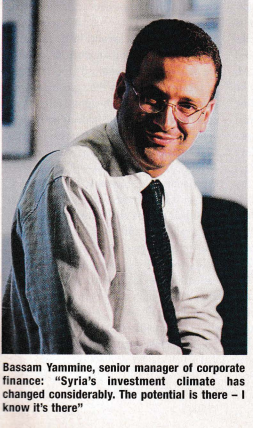
While downsizing, Lebanon Invest had to reevaluate its strategy to recreate growth. Last year it decided to move its services beyond the stifling local market and into the region. “One of the mistakes we’ve made was focusing on Lebanon for too long before going into the region,” says Bassam Yammine, senior manager in the corporate finance division. “In a way it was good for us that the Lebanon markets went down and forced us to go out.”
Several deals have already come through abroad. Lebanon Invest’s biggest deal in 1999 was a $3 million placement of Egyptian telecom company Orascom. Its 90% stake is now worth about $11 million as Orascom’s value has skyrocketed 400% in the last 15 months. Its shares recently began trading on the Cairo stock exchange and its GDRs in London. Lebanon Invest also made a deal with the Bin Laden Group, giving advisory services to its trading division. Deals in the making include businesses in the technology and financial sectors in Jordan, the poultry industry in Syria and more deals in Egypt.
Even Syria, a closed command economy, may provide greater opportunities. “Syria’s investment climate has changed considerably in the last few years,” says Yammine. “The potential is there—I know it’s there.” He might be right. If it’s true that Bashar Al-Assad plans to liberalize and open Syria’s economy, the country may, even at a slow pace, be a hunting ground for investment banks. And Lebanon Invest would already have a foot in the door.
There are challenges Lebanon Invest will have to face in the region, however. According to investment bankers, most business communities in the Middle East carry the same problems as in Lebanon, such as little knowledge of investment banking and clients being difficult to handle. In some markets, such as Egypt, local firms already have a foothold and are demanding little in the way of fees. “Investment banks will need patience to deal with businesses in the region. They will have to be more inventive, creative and aggressive to make it,” says Photiades.
Another problem is the western heavies that are present in the Middle East, such as Merrill Lynch, Morgan Stanley and Flemings. “The heavies have names and depth in experience. Plus, ‘Everything that’s western is better,'” confesses Yammine. “But they are working more on an in-and-out, hit-and-run kind of business. We are better at establishing relationships and are more familiar with the markets.”
In the Gulf, Lebanon Invest has solid relationships that can help generate business. Thirty-four percent of the firm’s shareholder base comes out of Saudi Arabia, while Kuwaitis take up 11%. Saudi Arabia has recently pushed forward economic reform. Its stock market and property ownership are now open to foreign investors.
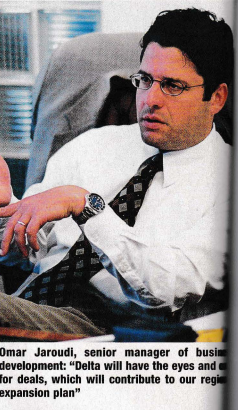
Lebanon Invest is establishing a new fund that should help the firm penetrate the region as well. Delta Capital has raised a capital base of $25 million, with a target of $35 million to $50 million. “Delta will have the eyes and ears for deals, which will contribute to our regional expansion plan,” says Omar Jaroudi, senior manager of business development. “They’ll be in the markets and have associations with major players, especially in Egypt. If they find a deal, we’ll have the right to co-invest with them. It’ll be a major source of deal flow to Lebanon Invest.”
Delta will be a major catalyst for another strategy that Lebanon Invest is implementing. Finding few deals, it has de-emphasized its project finance department. And although it will continue to carry out corporate finance deals—such as advisory services, IPOs, restructuring and mergers and acquisitions—Lebanon Invest will zero in on private equity.
Its objective: search out companies that are in trouble, buy a majority stake (unlike a minority stake in Etemit) and do a complete overhaul of the company. “We need to go into those situations, companies that have been screwed for whatever reason, but have potential for life,” says Ghandour. “If you can take control, turn it around, the potential for us is very significant.”
While the corporate finance division will raise capital, Delta has put together a team to perform surgery on businesses. Sami Khoury has joined Delta, and two veterans from leading consultancy firms are on the team: Fadi Abouchalache, from Bain & Co., and Fadi Majdalani, from Booz, Allen & Hamilton.
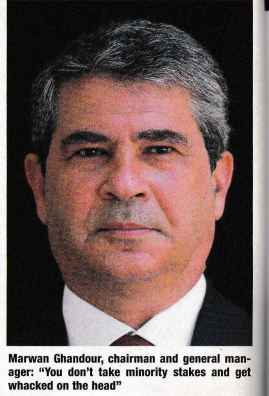
Delta and Lebanon Invest have already started their quest. Bonjus has been stumbling along in the tough fruit juice market. By raising capital, $6.2 million from Lebanon Invest and $6.2 million from Kuwaiti and Saudi investors, 79% of its shares were scooped up. “In this case we really took over,” says Ghandour. “We learned our lesson that you don’t take minority stakes and get whacked on the head. The team is in tune to the idea of picking up a sick animal and healing it, adding significant value to the shareholders.”
Lebanon Invest has other plans to build value for its shareholders. Being confined to trading stocks mostly on the local markets, Nicolas Sawan, head of trading, and some of his colleagues have been urging the firm’s board to include trading on international markets. What’s also missing is asset management: Most investment banks and brokerage houses offer that service. And Fadi Osseiran, general manager at BALOM, believes that portfolio management will be more important in the future. With online trading destined to become more popular, “A healthy income from brokerage transactions will eventually be extinct,” says Osseiran. “Our strategy is to move from brokerage activity to asset management. It’s important to be able to advise customers—asset allocation, risk management and so forth.”
The board has agreed to bring in international brokerage and asset management, which may be in place by the end of the year. To build an asset management department, Ghandour has been negotiating for an acquisition or alliance in order to bring in talent and work on a larger scale.
Ghandour is also shooting for a merger. He has been attempting to pull two large banks and Lebanon Invest together. “Investment banking services would be more likely to survive following the European model, like Deutsche Bank,” says Ghandour. “This would provide supermarket financial services, ranging from debt to insurance to investment banking to brokerage. But I realized that it’s not a reality in this primitive environment. Putting together large banks has been unsuccessful mostly for ego-related reasons.”
For now, the agreement with Audi has shown few benefits, missing an opportunity of passing on deals and developing private banking, and there has been little progress moving towards a merger. But Lebanon Invest and MECG are under negotiations to tie the knot. (MECG’s president and CEO Nabil Sawabini is not open to discussing the potential merger.) “The idea is to operate more efficiently,” says Ghandour. “And size matters; we can create power.” Economies of scale could help weather the harsh conditions in Lebanon, and both have the same objective to reach out into the region. According to Ghandour, a decision should be made by the end of the summer or early fall.
Lebanon Invest fought its way out of a hole and is equipped to survive some of the toughest times in Lebanon. With new strategies to go on the offensive, there’s a better chance that it won’t have to order another retreat.
Furnishing funds
The birth of a fund in Lebanon is a rarity. But Lebanon Invest has taken chances. At the end of 1996, LI Venture was launched with the aim to buy stakes in small to medium-size companies. Its investment in Clean Well Services was a flop: the fund went in with $650,000 and came out with just $250,000. Reasonable returns came from the $1 million investment in Petco, when the investment bank sold its shares at a 25% gain. But the shining star was Cyberia, in which LI Venture took a 15% stake in 1997.
Lebanon Invest made a gain of 320% when it sold two-thirds of its holding in Cyberia the following year. The fund also holds shares in Geovision, Bonjus and Ipso Facto. The first factoring firm in Lebanon, Ipso Facto is set to get a capital increase from $2 million to almost $9 million through Lebanon Invest. That will broaden its shareholder base and create a launching pad to move into the region. After three and a half years, LI Venture’s net asset value (NAV) has climbed at a healthy clip: up 128%.
But a much less brilliant performance has come from Lebanon Holdings. After being launched in 1997, it moved onto the Beirut Stock Exchange (BSE) in September 1998. The original plan was to invest in privately-held Lebanese businesses but gears were quickly shifted to zeroing in on listed companies, especially banks. Lebanese capital markets have been a virus in the last two years: Since it reached its high at 1244 in October 1997, the BLOM Index has fallen over 50% to 593. At the beginning of July, the fund had lost 46% on its BLOM GDRs and 40% on Byblos Bank’s BSE shares.
Worse yet, the fund invested $4.4 million in Etemit when Lebanon Invest was making plans to turn the pipe maker around. After severe losses in 1998, Etemit filed for bankruptcy and trading in its shares was frozen a year and a half ago. Lebanon Holdings filed a lawsuit against the failing company to recoup its investment but has written off 9% of its original capital of $50 million.
So far eight of the fund’s ten investments have been clobbered. Since it was listed on the BSE, its share price has fallen 16% and its NAV has dropped from 9.6 to 7.70. Being dependent on Lebanese stocks, it will probably take a long time before the fund gets out of purgatory.

