
Trade is as old as it is beneficial for economic development. In the foundational economic treatise on the Wealth of Nations, Adam Smith, the 18th century Scottish enlightenment philosopher, extolled the virtues and values of free trade. In his essay on the Spirit of the Laws from earlier in the same period, his French peer Montesquieu proposed that peace is the natural outcome of trade.
Both correlations, the one of free trade and national prosperity, as the one of trade and peace, are fueling learned debates – and populist rants – well into our time. But more importantly, issues of trade and cross-border collaboration are practical concerns for all countries that are today striving for survival in armed conflicts and at the same time seeking to succeed against the most averse headwinds – vicious geoeconomic squalls actually – seen in a generation. Countries such as Lebanon that are severely challenged in their prosperity today even as they represent a millennia-spanning history of trade.
In economic annals, evidence of indirect trade and anecdotes of mercantile voyages and maritime excursions from Eastern Mediterranean shores to the British Isles have long been associated with pivotal developments in Eu-Med trade history. On part of the British Isles, trade with the Eastern Mediterranean was commercially and institutionally solidified, via the Levant Company under charter of the English crown, first in the late 16th century.
As variable relations of formal trade between modern Lebanon and the United Kingdom thus have stretched over more than four centuries, recent years of European-Mediterranean trade and diplomacy saw private and public sectors of the United Kingdom engaged in economic interaction with Lebanon in context of the EU as well as after the parting of the UK from the EU.
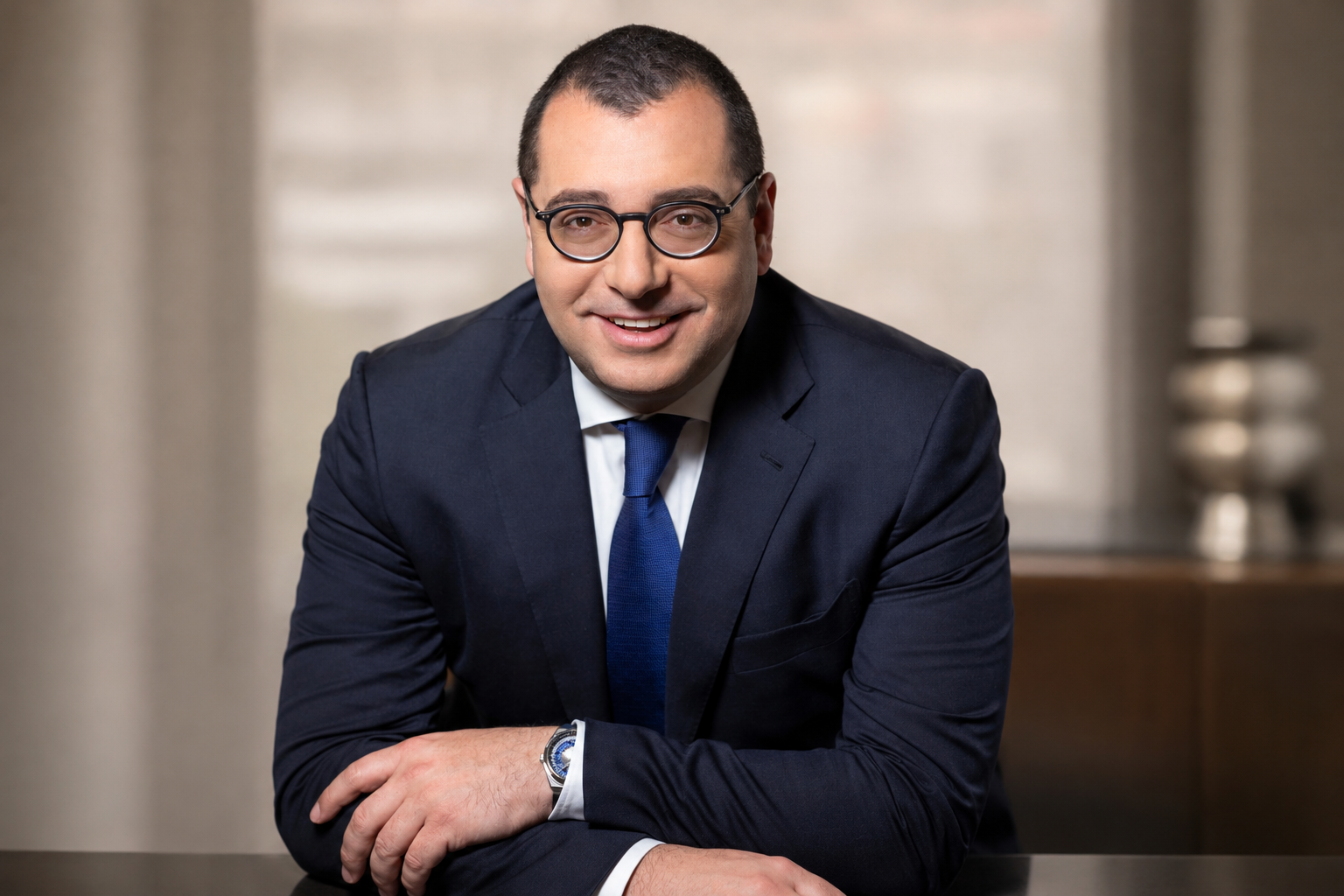
But could one building block of shared trade and prosperity still have been missing until the beginning of 2026? What could still be improved institutionally for a UK-Lebanon match in trade heaven? Executive sat down with Farid Chedid, the chairman of the British-Lebanese Chamber of Commerce (BLCC).
Executive: Mr. Chedid, as chairman of a reinsurance brokerage and capital group, you have provided Executive Magazine over past years with a number of interviews and valuable insights on the business of insurance and reinsurance in Lebanon and the Arab region. But as you tell us, your latest priority topic, the recently established British-Lebanese Chamber of Commerce (BLCC), is not an insurance topic but rooted in entirely different concerns and objectives. What is the identity and purpose of BLCC?
FC: The British Lebanese chamber of Commerce was established as non-profit organization with personal and corporate membership options. Our purpose is to increase trade relations and cross-border investments between Lebanon and the UK. We want to encourage UK-based companies to come and invest in Lebanon and export to us and we want to encourage Lebanese companies to go to the UK, invest there, and export to there.
Today, [annual] trade between Lebanon and UK has reached one billion USD, of which $700 to 800 million are imports to Lebanon and 200 to 300 are exports to the UK. Upon the initiative of the British ambassador, Hamish Cowell, we agreed to establish the British Lebanese chamber of commerce at the start of this year. I am one of nine founders and after we created BLCC, a board was elected and I was elected as chairman of BLCC for the next four years.
I consider it important to mention all founding members of BLCC: Nadim Tawtel, [the CDG of Tawtel Group of automotive companies] that represents UK-owned Land Rover in Lebanon, Emile Chaoui, [the chairman of Omnilab and Omnipharma companies], which represent Astra Zeneca in Lebanon, Rajab Joubaili [chairman of Jubaili Agrotech] who has an operation in the UK and in Africa in agriculture business. There is Amin Makarem, who works in education and schooling. His company [International School of London Group] is active in the UK and also in the Gulf and Africa. Among us are Hani Sheet who is owner of VOCO hotel in Beirut, which is operated by UK headquartered hospitality multinational, IHG Group, and Joumana Saddi, [managing partner of Lebanon-based lighting design company PSLAB]. We further have Ziad Kanaan, the owner of Portia Management Services, a UK company that manages ports and was a partner in the Beirut Container Terminal Consortium, and Mustapha Madi, a senior executive at [engineering consultants] Dar al Handasah which has a sizeable operation in the UK.
E: What is the vision that unites this collective of Lebanese business leaders with links to the UK?
FC: We have nine founders with the same objective of increasing trade and cross-border investments between Lebanon and the UK. Of course, this is something that is very beneficial for the Lebanese economy and also for Lebanese companies that want to export and invest in the UK. Recently, BLCC was also admitted to the British chambers, which is the aggregation of all [51] chambers of commerce in the UK and which has an international network of 75 chambers. This membership gives us access to British chambers in 75 countries and will enable Lebanese companies to increase their trade and investments with these countries and with businesses in these countries. Of course, when you talk UK, you also talk about Commonwealth and that this will give us access to the Commonwealth which helps Lebanese companies to [access these markets].
But all this should not be seen purely as a one-way relationship of facilitating Lebanese corporate access to the UK. It is also important to us to attract UK companies to Lebanon. BLCC should also help us make Lebanon become an attractive destination for UK companies. We also have an ambition for Lebanon to be attractive to service the region – at least the Near East out of Lebanon. These are our objectives.
Which practical steps are you planning towards implementing those objectives?
FC: We have several areas that we want to focus on. One of them is the UK Lebanon trade agreement that was signed after the Brexit and that needs to be renewed and revised. We have double taxation treaties, [and] we have focus areas such as infrastructure, transport, technology, education, healthcare, agricultural business, financial and professional services, infrastructure and public procurement.
Another focus of BLCC will be trade delegations in both directions. We will help companies from both countries to trade with each other and have access to the markets. When you look for instance at Lebanese wine producers, we want to help them to export to the UK. Jewelry is a big export for Lebanon and this is also something that we want to look at and help.
Another focal point are UK companies that are outsourcing and off-shoring in order to get access to more competitive professional services and solutions. There we want to mention that they can get access to Lebanese companies and services and Lebanon-based human resources and human capital, which is very well educated and speaks perfect English and is much more affordable than many other countries around the world. This is a competitive benefit that we need to use and if we can attract UK companies to create call centers or outsource their admin work to providers in Lebanon, why not?
You mentioned financial and professional services. Which priorities have you identified in this area?
FC: As far as financial and professional services, many of the big four [professional services companies] with offices that are based out of Lebanon, have their reporting lines to the UK. The UK offices of some of the big four accounting groups have responsibilities for offices that are here in Lebanon.
If you look at insurance and reinsurance, Lloyds of London is one of the most important reinsurance providers to the Lebanese market. I can say that some of the most important reinsurance support for Lebanon is the reinsurance support that Lloyds are providing, which is coverage of war and political violence. While everyone else has withdrawn support for war covers from Lebanon, Lloyds of London is one of the most important reinsurance providers to the Lebanese market.
All this sounds like the dimension of economic links between the UK and Lebanon is of greater importance to you than what can be measured in terms of imports, exports, and trade balance between the two countries. Is this correct?
FC: The relationship of trade is very important for Lebanon and the economic development of the country in trade, industry and economics. At the same time, we want to help UK companies to sell to Lebanon. There are so many large exporters in UK that have fantastic business in Lebanon, whether on engines, yachts and superyachts, pharmaceuticals, alcohol and spirits, and technology. In the sector of artificial intelligence, the UK is the third largest investor [globally] in AI after US and China, so definitely Lebanon has a lot to benefit from the UK and the UK can benefit from the access that we can give to the Near East out of Lebanon.
Your mention of the tech sector brings to mind that already over a decade ago, the relations between Lebanon and the UK were pivotal for the tech entrepreneurship sector here. Owing to efforts spearheaded by then-ambassador Tom Fletcher, there was the creation of the UK Lebanon Tech Hub, UKLTH. In light of the long records of trade relations between Lebanon and the UK, why did you decide on the establishment of BLCC just at the start of this year?
FC: There never before was a British-Lebanese Chamber of Commerce. Things used to be handled by the team of the UK embassy. I think it was about time to create and launch it and there is a need for it. If we look at Lebanese investments in Africa, we can help by giving them support in accessing UK markets in terms of trade and investments, imports and exports.
In the past, for example in the early 2010s from the Lebanese side, one could observe imbalances in areas such as tech entrepreneurship. According to global debates, even larger imbalances exist today in both ownership of AI and investments in AI infrastructure, where Lebanon is underpowered when it comes to national data of AI centers. How in the current economy can one create a more mutually beneficial relationship with important foreign partners such as the UK, with Lebanese investments flowing into it? Do you see this time as an inflection point in the mutual economic relationship?
FC: We are aligned on this, Thomas. With regard to technology and AI, it is time for us to catch up and create a balance in this relationship. We need more data and resources and have to encourage Lebanese companies to invest in UK technology and also help UK companies to invest in Lebanese human capital. We are looking for synergies and complementarities. Lebanon will benefit a lot, the more we can create synergies and complementarities.
Does your own group, Chedid Capital Group, have plans to expand in the UK?
FC: We are present with three operational companies in the UK and we are expanding.
Will that expansion involve a synergy with BLCC activities?
FC: No, these are totally separate issues. My private business is my private business. Our companies and investments are doing very well in both ways and do not need the BLCC. What we are doing with the British Lebanese Chamber of Commerce is to help trade and investments.
I am looking to help the ecosystem rather than to help my company, and the BLCC is our way to give back to the UK and the Lebanese. I want to help the relationship because I know what the comparative advantages of each are what the added value of each brings to the other. I know how Lebanon can significantly can add value to UK companies, and how UK companies can significantly add value to Lebanese companies and the Lebanese economy in addition to enhanced trade relations.
Sectors that come to mind when talking about British Lebanese links include education as a major one. In this sector, mostly people from Lebanon have been seeking certification from British institutions. Do you have partnerships with universities and educational institutions in the UK?
FC: First of all, the British chambers has an academy on artificial intelligence. We already have access to it and we have sent a communication to our members so that they can benefit from this certification. We have the representation of Pearson Education as a corporate member.
We are also continuously looking to enhance whatever solutions and services we are providing. You have to remember that the BLCC was launched in January [of this year] and we have already done a lot in the space of nine months. BLCC were able to attract members, do some events, and become visible. We are talking to people to show the added value and synergies, and we are now working on the focus areas that I mentioned.
Do you have specific targets regarding the trade balance? In note that in comparison to Lebanese trade deficits vis-à-vis some other countries, an export to import ratio of 70-30 or 80-20, which you mentioned, is actually quite good.
FC: We did not establish a target yet. We have to take into consideration the current political, economic, and security situation. Anything that is growing – in both trade directions – will definitely be beneficial.
Did you set membership targets?
FC: We are targeting to reach 150 BLCC members by end of 2027. Currently, we are close to 50.
You mentioned the political and security situation of Lebanon. The entire world seems to be in a frenzy of trade conflicts. Not to talk about the quagmires of relations with the United States at the present time, the relationship between Lebanon and the UK today is different from the pre-Brexit time when Europe and the Arab region were entertaining commitments that in today’s hindsight look almost idyllic and easy when compared to the tensions that we see in the 2020s. How do you see the geoeconomic trade war environment from the perspective of BLCC? Do you see it as a risk or as an opportunity?
FC: First of all, the BLCC has no [desire] to be involved in any trade war. This is not our objective. We are not in the mindset of war games, economic wars, or trade wars. We are on the contrary here to expand and reposition Lebanon and this means there will be initiatives that we will organize with other foreign chambers, such as the French and the American [-Lebanese] chambers and business councils in Lebanon because we are in a collaborative state of mind.
When we are talking about enhancing the British-Lebanese economic relationship, this enhancement is not going to be to the detriment of other trade and business relationships.
We are not here to compete with the US, with France, or China. What we want is for UK-Lebanon trade relations to increase, and we want more cross-border investments, both ways, more trade, both ways. We believe that Lebanon has added value, that the UK has added value, and that we can benefit from these synergies.
Of course, the region is going through upheaval and we have to remember that the UK has stood by Lebanon for many, many years. There is a lot of added value in this cooperation. What we want is to enhance this cooperation so that there is more added value.
But isn’t the political atmosphere in Europe today more loaded and difficult to navigate under any Arab ambition, more so than 10 or 15 years ago?
FC: Yes, but Lebanon puts us in a super-loaded political environment and we still manage to do business and trade. We as BLCC have no political positioning. We want to see trade and foreign direct investment grow and we can help other countries learn. Lebanese companies have been so resilient despite all the security issues and they are doing business despite all geopolitical concerns. This is something that we can help other companies and economies in the world to learn. That is definitely a plus that the Lebanese have.
