
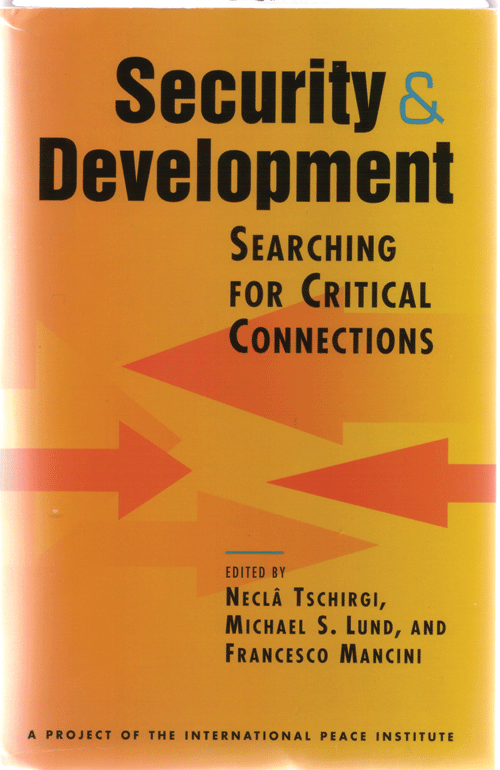
The New York-based International Peace Institute’s recently published “Security and Development: Searching for Critical Connections” is a scholarly work of valuable insight for the Middle East.
Edited by Neclâ Tschirgi, professor at the University of San Diego and former vice-president of the Institute, along with two other experts in the field, ‘Security and Development’ goes beyond rhetoric to examine the shortcomings of conflict prevention. The book begins with the point that often, underdevelopment and insecurity correlate — with higher levels of development meaning a lower likelihood of internal violent conflict.
After World War II, developed countries were overwhelmingly spared the ravages of military violence, while in the last several decades, most poor countries have suffered warfare — especially those that are home to the poorest billion of the world’s population, living in some 58 nations whose combined gross domestic product is less than that of metropolitan Chicago. After four lucid introductory chapters, the book illustrates such points in seven country case studies on the interplay between security and development in poorer states.
Awash with both insecurity and underdevelopment, the Middle East is seen by many in the West as the origin of much international terrorism, and close to 10 years since the September 11, 2001 attacks, the region is generally less secure; concurrently much of it still does not enjoy sustainable growth. This makes Arab countries the target of both security measures and development efforts, but the results have been far from satisfactory, as illustrated in the case study: “The Security Paradox in Unified Yemen.”
Defining the “security paradox” as the process whereby a country’s “internal insecurity is exacerbated by attempts to obtain international security,” the chapter’s authors Laurent Bonnefoy and Renaud Detalle paint a bleak but convincing picture of a state that is becoming more insecure as the West wages its war on terror inside Yemen.
Yemeni society is fraught with disaffection. Currently, Yemen suffers further as local and international security forces fight alleged terrorists on its soil; some of these people are “villains” that need to be dealt with (with or without Western involvement) but the net result of such antiterrorism efforts is destabilizing.
Internal stability suffers each time innocent bystanders are hit in attacks on terrorists, or targeted due to poor intelligence. Yet another mode of destabilization is the mass flight of people from an area reckoned to be a Western target, with lives and livelihoods disrupted. At the same time, despite much aid, Yemen is not developing. Unless strictly monitored and controlled, aid money can often compound local problems by abetting corruption and fueling nepotistic power structures.
As emphasized in the pithy final chapter, whatever the solution to this paradox, rigorous skeptical analysis of the sort found in ‘Security and Development’ offers a healthy antidote to ill-considered gung-ho antiterrorism operations coupled with lavish aid, which may actually end up making both the US and the global south, including the Middle East, less secure in the long run.
Though not necessarily for the lay reader, this carefully researched book should nevertheless interest regional security experts and practitioners whose Western colleagues are throwing vast amounts of money and force at problems such as those of Yemen, and other parts of the Middle East, with dubious results.
