T here was little hope for TMA’s survival
just a few years ago. Once one
of the world’s premier air freight
carriers, reaching the fourth position in
cargo capacity per mile hefore the war and
covering five continents, TMA was struggling.
It had lost most of its lucrative destinations
in the US and Far East and was left
with five aging B707s, down from 20
spanking new planes at its peak. The company
landed deep in the red. Headed by
Farid Raphael, chairman of Banque
Libano-Francaise, the Lebanese Air
Investment Holding (LAIH) bought 74% of
the airline from bankruptcy court in 1993.
In I 996, Raphael asked a little-known con-
L sultan!, Fadi Saab, to perform a complete
audit and create a plan to salvage the company.
Saab accepted and when he brought
in his results, Raphael said, “thanks, now
please implement it.” Hence the appointment
of Saab as chairman and president of
TMA in November of the same year.
Did Raphael pick the right man for the
job? Although TMA has not released 1999
figures, results indicate a clear improvement
since Saab took over. He claims to have
moved the company into the black in the last
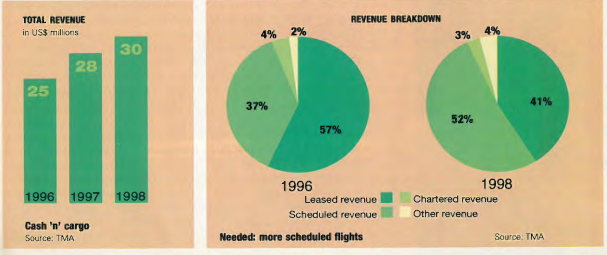
two years. Revenues grew from $25 million
in 1996 to $30 million in 1998. Leased
hours decreased by 12% to 67% of total
hours, while scheduled hours increased by
11 % to 31 %, representing 52% of revenues,
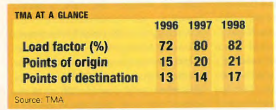
or $15 million. And as the number of
points of origin increased from 15 to 21 and
destinations went up from 13 to 17, the
load factor (cargo to capacity) increased
from 72% to 82%. That put TMA in the
uumber five spot in cargo load factor
among airlines under International Air
Transport Association, the world governing
body for air transport.
So how did he do it? In parallel with
Saab’s appointment and in accordance
with his restructuring plan, there was a
decision in 1996 to increase the airline’s
capital by $40 million. The injection is to be
subscribed by LAIH, with the first half
paid at the start of 1997. ”The increase in
capital stopped the heavy financial burden
of accumulated debt, as this money went to
covc:r loans that were costing us interest,”
says Saab. Ogden, a US-based conglomerate
with specialization in aviation, will participate
with a minority interest on the
remaining $20 million. Ogden has agreed to
invest in upgrading airport-handling facilities
and to enter joint-venture deals with
TMA on projects like the Beirut airport
free zone and Klayaat airport.
Next came a reduction in the airline’s
operating costs to increase efficiency. First
the workforce was reduced from about 650
to 400, followed by a cut in administrative
and general fixed costs. The result was a cost
saving of $2.5 mi.Ilion between 1996 and
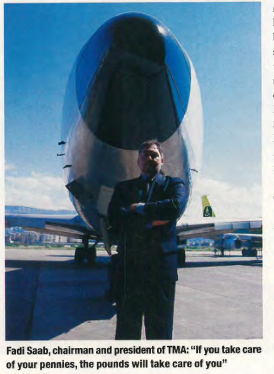
1997. “If you take care of your pennies, the
pounds will take care of you,” says Saab,
adopting the English proverh. Another
important cost-cutting measure came by
turning fixed costs tnto variable ones, with
the appointment of general sales agents,
or GS As. TMA had direct offices in places
like Germany, Japan, Hong Kong, Saudi
Arabia and Spain, which proved valuable
during TMA’s heyday. But when business
didn’t justify the expense, maintaining
those offices was an expensive proposition.
Jnstead GSAs are remunerated only
based on performance. With 14 offices
worldwide and 27 GS As operating another
35, TMA has managed to cut promotion and
sales expenses by 14% and general administrative
costs 17% from 1997 to 1998.
Finally, Saab took an overall look at
reducing fuel burn, maintenance, crew positioning
as well as landing and handling
charges. For example, double landing –
making a short stop on route to a destination
is now avoided. Instead of going from Paris
to Amsterdam and from Amsterdam to
London, TMA established hubs in Paris and
Amsterdam. Cargo from various European
markets is trucked to those locations.
Saab’s performance so far indicates that
he was the right choice for the job. And his
background explains part of the success.
This AUB graduate in economics and statistics,
received his MBA in finance from
France’s INSEAD, became vice president at
Bankers Trust in New York in charge of
international investment management
group for Middle East and Africa. He later
set up his own bnsiness, handling corporate
restructuring and venture capital for international
companies before returning to
work as a consultant in Lebanon.
But the situation at TMA isn’t exactly picture perfect. There is a.,problem with
IATA hooking agents, who are responsible
for booking cargo on outgoing flights.
About two-thirds of the 90 agents don’t
even work with the local cargo carrier.
Although Beirut is a transit stop for TMA on
its way from Europe to the Gulf and vice
versa, where the ratio of incomhig to outgoing
goods is nine to one, it is still an
important market to secure as TMA’s base
of operations. TMA claims to handle 30%
to 40% of the annual 50,000 tons of air
cargo moved in and out of Lebanon. That
would translate into about half the load it
handled during its boom years.
But some agents openly wonder who is
giving TMA cargo. “They need a fleet and
a schedule, which they don’t have,” says
Robert Douna, air freight manager at
Gezairi Transport and former shift manager
at TMA. Douna is one of the IATA
agents that books cargo on passenger airlines
like Air France (AF), MEA or KLM;
these have planes that can carry cargo in
their belly or larger ones that are used as
com bi es (half passenger-half cargo).
Bellies can take up to 4 tons of cargo on
average, while combies take up to 34 tO,!_lS
for Boeings and 16 tons for Airbus planes.
“The competition is offering exact deliveries,
frequent flights, more destinations and
money back guarantees if the cargo is not
delivered on time,” says Ousama Jureidini,
deputy general manager for Travel and
Cargo Divisions at Saad Transport, who is
a booking agent and a former TMA employee. Saab admits that exports from
Beirut to Europe are a problem for TMA:
“It’s a technical stop to unload some cargo
or to change crews.” TMA’s flights into
Beirut are scheduled from Europe on their
way to the UAE and Africa. Because
planes arriving from the UAE are usually
full and exports are minimal, there are no
scheduled flights to Europe. And with just
four operational planes, some of which are
chartered or leased, the frequency of
flights is inconsistent.
But the cargo TMA does pick up from the
30 agents it deals with in Beirut tends to
come from dedicated long-time clients.
Fouad Naja, CEO of Lebanese Trading and
Contracting, regularly gives TMA anywhere
from 5 to 20 tons of cargo containing
fish and textiles, and charters flights to
Europe. “TMA is so dynamic. They can do
miracles and Saab follows up on every kilo
of cargo we give him,” says Naja, who has
been a client ofTMA for at least nine years.
Meanwhile, Saab wants to offer alternative
solutions to increase local agent participation.
He’s looking at grouping them to
cooperate on TMA business so the cargo
carrier could appropriate scheduled flights
from Lebanon at good rates. Though this
won’t be easy, considering the competitive
nature of the business, some agents
already see the benefits of teaming up with
TMA. Mouhamad Jamil, owner of
Oumaya Transport and Trading Co., ships
about 3 to 6 tons of cargo of shoes and textiles
to UAE each week. ” It’s true that
TMA had more connections and more
flights, but they are intent on making this
company a true partner with its local
clients,” he says. In another move to
increase exports from Lebanon, Saab has
signed agreements with ministries, the
chamber of commerce and industrialists.
On top of the infrequent flights, agents
have other complaints about TMA’s services.
“There is a lack of information
between the sales representatives, and I
don’t trust the fragile labor situation they
have, where strikes can occur like in the
past, causing us many headaches,” says
Larene Haddad, manager at All Transport
Agency. Surveys done in 1997 and 1998 by
Information International indicated a list of
complaints, ranging from irregular service,
to lack of information, and more emphasis
on international flights to the detriment of
local clients. Recognizing this, Saab has
worked on intensifying the company’s
public image. He created a customer service
division in late 1998 and personally trained
his sales representatives to develop a team
spirit for better cooperation. He also developed
an IT system called ‘Super Cargo’
through an agreement with SETA. “It will
enable the clients to ge.t their own airway
bill, do transactions with us electronically,
trace and track shipments; it will solve a lot
of service problems,” says Saab, who has
invested more than $200,000 so far in setting
up the system. He also indicated that the
last strike was in 1996, and that labor relations
have since improved.
Saab will have to keep a close eye on other
airlines that arc competihg against TMA’s
route – mainly from Europe to the Gulf
and back with some reaching the Far East as
their ultimate destination, while TMA only
operates in the Far East on a charter basis.
Lufthansa, AF and Cargo Lux all have
scheduled flights in Beirut aJld price competition
is fierce. It is so fierce that
Lufthansa’s weekly freighter to Beirut will
most probably be discontinued, according
to Youssef Khatib, cargo sales
manager. He blames price dumping
from Cargo Lux, a
Luxembourg-based company.
(‘,in-,o I .m, initi,ill.v m,irlt>. ao-TP.Pments
to use TMA flight numbers,
later establishing its own
flight rights in 1995 and bringing
in two freighters a week.
Cargo Lux is a worldwide
cargo operator with over 14
hours of flight hours a day, one of
the highest rates in the world.
Operating out of an extensive
hub system, its unit cost is at least
30% to 40% less than any other
freighter operating in Lebanon.
“They are relatively new in
Lebanon and are usiug their
economies of scale to bring in
and take out cargo at low prices
and gain · market share,” says
Saab. TMA’s ability to stay competitive
in Lebanon is its
21,000m2 airport facilities.
Customs check points are located
within their facilities and there are areas for storage and han- dling, including cold storage for medicine
and perishables, a strong room for valuables
as well as equipment for hazardous materials
and for livestock. TMA is the only
cargo airline besides MEA, which handles
AF planes, with facilities to handle 707s and 747s. Those fees can run up to $1350 per
landing, according to Lufthansa, who uses
the facilities.
But can TMA deal with Cargo Lux price
slashing? According to Saab, the human factor
is the determining element in staying
competitive. “Cargo Lux is a mega-carrier
with no direct relationships with agents; we
on the other hand show flexibility and a
working relationship which caters to our
client’s changing needs,” says Saab.
Looking at the global picture, TMA
looks miniscule compared to other world
airlines. Commercial and freighter lines
such as Lufthansa, Cargo Lux, AF, KLM,
American Airlines compete on hub systems
that extend worldwide. Having refocused
operations on Paris
and Amsterdam as its main
hubs, TMA compensates
with 16 cooperation agreements
on certain destinations.
MEA, for example,
gives cargo to TMA for
flights to Amsterdam, while MEA takes TMA cargo from Europe to Kuwait.
TMA will soon beef up its fleet. There are
plans to lease medium-haul aircraft with a
capacity of 40 to 60 tons to replace the current
B707s and small feeder planes to take
care of the retail need of the market. These
new planes (one medium and one small in
2000, one medium and two small aircraft in
2001) will allow them to reach Far Eastern
destinations, while TMA waits for the US
ban to be lifted. Saab plans to strike more
alliances in order to extend TMA’s
reach in Africa and Asia. Following
last year’s transportation agreement
between Lebanon and Syria, TMA
signed a deal with Syrian Airways,
which doesn’t have a cargo department.
TMA will lease them planes,
operate joint flights and fly directly to
Damascus, starting next fall. “The
Syrian market is healthier than the
Lebanese market, with more balanced
trade and ex ports that justify
round trips,” says Saab. To better
serve the Syrian market, Saab hopes to
create a multi-model transportation
system via agreements with sea and
road transport companies.
However, freighter business is not
like it was during TMA’s boom years,
when passenger airplane capacities
were small, rendering cargo carriers an
important tool. “Today a freighter can
carry up to 50 tons, but a 727 passenger
plane can carry 18 tons, plus it
has several scheduled flights,” says
Sarni Abi Saab, cargo manager at
MEA. MEA net cargo income is around $17 million compared to TMA’s $24 million. Some $6 million –
20% ofTMA’s revenue -is generated from
pure lease contracts and don’t count as
actual cargo. “There’s not the advantage to
freighters like there was in the past,” says
Abi Saab.
Though growth is limited, the first steps
have been taken to get the company off
the ground again, but will it ever be tbe
TMA of old? “We’re a small fish in a big
pond, and our aim is to become a big fish in
a big pond,” says Saab.