For years they’ve been looking with bated breath at their eastern neighbor. It’s a market of over 16 million consumers, four times the size of Lebanon’s. Its cheap labor and energy make it a potential haven for frustrated Lebanese industrialists.
Without much of a banking system, Syria is an untapped gold mine for Lebanon’s financial institutions. But Lebanon’s closest neighbor has been, by and large, closed under the vice of a command economy.
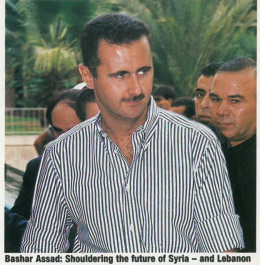
But now that might change. A new young leader has taken over the helm in Syria. It is believed that western-educated Bashar Assad has interests in liberalizing and opening up his country’s economy. But will it happen? “His first priority is to consolidate his power,” says political analyst Michael Young. “It’s difficult for him to control the system and be liberal at the same time.” Young feels that a peace agreement must precede
any reforms that could happen.
“Consolidating power, a peace agreement then reform; it must be in that order,” he says.
Others are more assured of Bashar’s position and his ability to carry out reform immediately. “His power
is already in place,” says Patrick Seale, a leading expert on the Assad regime. “It was prepared years in advance. The new government team is aware of radical reform and it’s Bashar’s first priority.” A doctor of ophthalmology, Bashar is already thought to have been behind a recent anti-corruption drive and pushed for limited access to the Internet and mobile phones.
Talk of reform is not new in Syria. For over a decade the country has taken baby steps towards liberalization.
In 1991 the government passed law No. 10, which granted investors tax holidays, exemptions from import restrictions and allowed the importation of capital duty free. Two years ago Syria signed a free-trade agreement with Lebanon, which was to eliminate barriers within four years. But the steps have fallen short of expectations. And for years, the strengthening of the relationship between Syria and the European Union has made little headway.
Some question whether Syria even has the know-how to modernize its economy.
Capital markets, monetary policy and free trade, essential building blocks of a free market, are alien to most Syrians. Most senior civil servants have been educated on socialist principles. “You can’t take a graduate of the old school, of Ceaușescu university for example, and ask him to liberalize the economy,” says Fadi Abboud, president of the North Metn Industrialists’ Association. But economic stagnation could push liberalization to the front of Assad’s agenda.
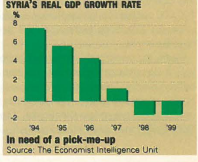
Syria has been in a recession for two years. According to the Economist Intelligence Unit, the GDP growth rate dropped from 7.7% in 1994 to -1.5% in 1998 and 1999 (see graph). Its oil sector, providing around 60% of exports, was harmed by the drop in oil prices last year. The rebound in prices should bring in some economic
growth this year, but its oil reserves are
running out. It’s estimated that Syria will
have to import oil in five to ten years. In
1999, the country suffered its worst drought in
years, which took a toll on the agricultural sector.
It’s estimated that barley production
dropped 60%, wheat 30%, and cotton 10%.
Over half the population is under 30 years old
and each year around 200,000 enter the
workforce only to find that jobs are scarce.
Yet things may be moving forward soon.
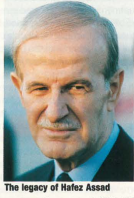
Immediately after Hafez Assad’s death,
Syria announced its willingness to go back
to the negotiating table with Israel. If a
comprehensive peace agreement is signed,
both Syria’s and Lebanon’s economies can
expect far brighter days. “I think Dr.
Bashar is not only willing, but also a strong
advocate of liberalization of the Syrian
economy, and he has interests in the New
Economy,” says Nassar Saidi, minister of
economy and trade. “I believe the
prospects are very positive.”