The Obegi family once owned one of the largest
and most respected banks in Lebanon. But
during the war, the family became fed up running
Credit Libanais under harsh conditions. “It was difficult
to reach many of your branches or even
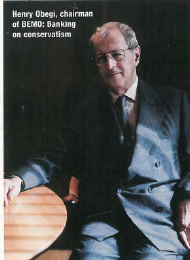
reach them by phone,” says Henry Obegi, now
chairman of BEMO. The Obegis packed up and
sold Credit Libanais in 1985.
In 1994 they returned to the financial market with
the purchase of Future Bank, and changed the
name to BEMO. Were the Obegis back on the
warpath to take their bank to the top of the industry?
Not particularly. “We are very conservative,”
says Obegi. There is some proof of that. When
BEMO came onto the scene, it had four branches.
It now has five. Foreign currency accounts for
90% of its balance sheet. The average assets that
are funneled into treasury bills (T-bills) for the sector
is around 40%, while just 5% of BEMO’s
assets are in T-bills. “We don’t do mismatching. We
don’t use the word ‘mismatch’ here at BEMO,”
says Obegi.
On attracting customers, he says: “We do not
run after depositors. We have private customers.
We wanted to find a niche and we have a niche.”
BEMO does not do retail lending, like consumer,
car or housing loans. It is strictly into commercial
lending.
But being this conservative does not mean that the
bank doesn’t generate profits. Between 1995 and
1998, its average earnings growth was 55%. In the
middle of a recession, BEMO’s conservative policy
has paid off so far. Last year its earnings grew by
6.3%, while the sector’s average profits are estimated
to have dropped by 15%. Better yet, its
assets grew 29.1% and deposits jumped 35.9%,
much larger gains than three of the leading banks,
BLOM, Banque Audi and Byblos Bank (see chart).
Its “niche” is a profitable tool. BEMO has impeccable
quality in its loan portfolio (the loan-to-deposit
ratio stood at 35.6% last year). BLOM is known for
its high-quality loan portfolio: its non-performing
loans (NPLs) to gross loans came out at 6.4% in
1999. BLOM aims at blue-chip corporate clients to
keep its portfolio squeaky-clean. BEMO uses the
same strategy, but its NPLs to gross loans last year
were 0.01%.
Another unique element in BEMO’s niche market is
its large customer base in Syria. If and when Syria
opens up to foreign banks to enter its market,
BEMO will have a foot in the door. Who will be its
local rival there? BLOM. Its chairman, Naaman
Azhari, is from Syria, was once the minister of
finance and a general manager at a leading Syrian
bank. He has strong ties with the Syrian business
community, which has lured Syrian companies to
bank with BLOM. But the Obegi family is originally
from Aleppo, so they have also brought with them
strong business connections next door.
BEMO may have some obstacles to face in the
future, however. Most of the leading financial
institutions are working towards becoming retail
banks. Banque Audi and Byblos Bank are running
neck and neck out in front, with Credit Libanais
coming up as a threat. “We’re not much into retail
banking,” says Obegi. “We’re mostly into commercial
banking.”
Will BEMO be changing its strategy soon? The
Obegis have now decided to add private banking
to BEMO’s activities.