
Could you imagine the deficit drops over 20% by the end of
the year? Debt servicing, now exceeding revenues,
becomes less of a burden? A healthier climate renews
investor confidence? Believe it or not, this is not so far-fetched. All
that would be needed is a more rational government. One that would
have resolved t~e ongoing dispute with LibanCell and Cellis and
accepted the two companies’ offers for licenses with an upfront payment
of $1.8 billion. “If the government allocated $1.5 billion of that
to the budget, we would have seen a deficit of around 32% at the
end of2000,” says Marwan Iskandar, economist.
But this wouldn’t have been restricted to a quick fix of this
year’s fiscal shortcomings. More could have followed. A third
license would have been sold, possibly with a similar price tag. Then
comes privatization, the initial 25% stake in the telecom. And don’t
forget the third generation – auctioning off UMTS licenses. This
would mean a continuous flow of revenue to the treasury. Oh, how
different things would look if the ball got rolling. Markets would
view this favorably, believes Marwan Barakat, head of research at
Banque Audi, instilling confidence in the Lebanese pound to allow
interest rates to drop.

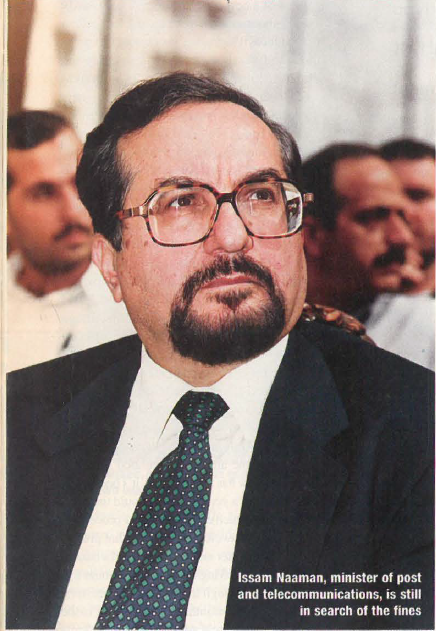
No go. Spearheaded by lssam Naaman, the minister of post and
telecommunications, the government blew it. Despite repeated
calls to the ministry, EXECUTIVE received no comments from
Naaman. The offers, worth a combined $2.7 billion for 20-year licenses,
were shot down. On par with its usual behavior, the government
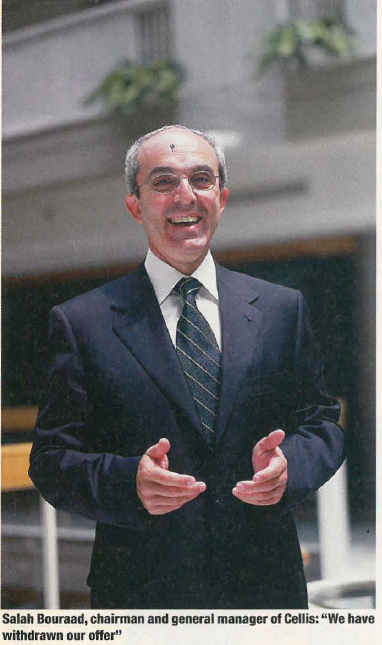
didn’t even send official rejection notices to the two companies. “We
have withdrawn our offer,” says Salah Bouraad, chairman and genera! manager of Cell is, “after the council of ministers made a decision
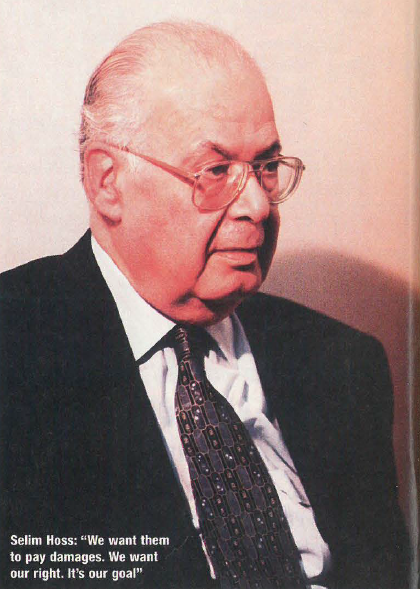
to reject it.” According to prime minister Selim Hoss, they’re
holding out for something better. “We want the contracts to run their
course,” says Hoss. “A 20-year license would be unfair. When the
current contracts expire, we can get better terms.” And while
Naaman talked up possible betteroffers from other international companies,
most believe that the offer was as good as it gets. Financial
consultants recommended to LibanCell an initial payment of $700
million, $200 million less than the actual offer. Plus, with UMTS on
the horizon, in a year’s time GSM may lose some of its luster.
With political wrangling at play behind the scenes, the council
of ministers couldn’t come to a unanimous decision and passed
the sordid affair onto the auditing department’s lap. Its findings?
Over $1 bill ion in penalties and fines should be paid by the two
companies to the government as compensation for violating the
contract. That’s about 6% of Lebanon’s entire GDP. It would also
suck the lifeblood out of LibanCell and Cellis as the amount is
equivalent to an outrageous 66% of their combined gross revenues
for the five-year period to the end of 1999. Could the government
get any greedier? The contracts already entitle the stale to 20% of revenues, plus municipal taxes, plus the 6 cent tax on talk time.
“It doesn’t make any sense,” says Kamal Shehadi, a telecom consultant.
Indeed not.
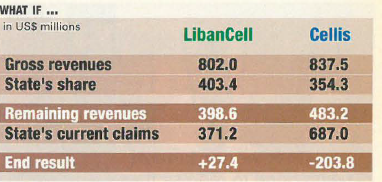
CeUis got the worst of the auditing department’s sting. Of the total
amount, the France Telecom-Mikati Group venture is expected to pay
$687 million. LibanCell, which is 14% owned by Finland’s Sonera,
was slapped with $371.2 million. “Our gross is $800 million. We paid
$400 million so if we were to pay $400 million more it would be a
total disaster, because our profits are only $ 140 million,” says
Hussein Rifai, chairman and general managerofLibanCell. “So where
do we get the remaining amount?” The most talked about alleged violation
is surpassing the 125,000 limit each for a total of $353.5 million.
But the biggest hit was in charges for microwave links-a mindboggling
$658.3 million. “It is quite clear that the government
couldn’t stop the cellular companies from continuing their operations;
they couldn’t get somebody to substitute the two operators so they
had to pull their strength away,” says lskandar. “ln order to compensate
for this setback, they have been trying to prove that the companies
owe more money than the government asked for.” Iskandar does, however,
agree that LibanCell and Cellis owe something for infringements.
But he estimates the amount to be a more reasonable $80-100 million
for each company.
From loud accusations, threats and ultimatums, the government
has since slipped into a quiet mode. It now intends to use the
auditing department’s report to get its money through legal
means. The government has already filed its case in local court. “We
needed the opinion given by the auditing department to support our
claim going to court,” says Hoss. “We want them to pay damages
based on their previous actions. We want our right. It’s our goal.”
According to Rifai, LibanCell has not received any injunction or
formal notification with respect to the auditing department’s
report. Meantime, the government has done a flip-flop. It has finally
agreed to appoint an arbitrator in accordance with the two companies’
request for arbitration, having previously said they would
rather break the contract than accept arbitration.
But that’s exactly how LibanCell and Cellis would prefer to
resolve the dispute. The two companies maintain that they are not
guilty of any breaches of contract. “I confirm that all the audits performed
by our auditors and other audits done by our mother company,
France Telecom, never never found any one of these accusations
that have been directed toward us,” says Bouraad.
EXECUTIVE obtained a copy of the Simmons & Simmons (S&S)
report that was lo advise Booz-Allen & Hamilton on the two contracts.
Concerning the cap on the number of subscribers, S&S found
such a limit unlikely and that the number of subscribers should be based on demand (see box). ltjs also odd that
the government would want to restrict the
expansion of a network under a build-operate-
transfer agreement, when at the end of the
contract ownership would revert back to the
state. Cellular penetration in Lebanon is at
19% but has the potential to reach 35% to
40%, according to Rifai. ~
As the row continues, LibanCell and
Cellis have both put a virtual halt to investments,
putting money only into maintaining
the network and service. ” It’s a sad feeling of
lost opportunities when we see how all the
Arab world is developing, growing, how
they’re really forging forward,” says Rifai.
“Because we were pioneers in the cellular field, to just stagnate right
now is something that’s extremely frustrating.”
So
is there a chance for the gauge on the stress meter to come down?
Some believe that a change of government will
go a long way in improving the state’s relations
with the two cellular operators. “Whichever
government comes into power in October,
the first thing that they would do is settle the
total amount of infringements and get the
$1.8 billion,” says Iskandar. Others are not so
sure that a new government will necessarily
bring about an improved climate. Regardless
of the faces it’s virtually guaranteed that political
and vested interests will override the
interests of the nation. Even if a different
administration comes into power with a new
attitude, mending relations and finalizing a deal
may not be so easy. “The offers the companies made are not on the table anymore. You need negotiations to start
again,” says Shehadi. “But frankly I don’t see any hope for this with out first getting some kind of telecom reform.”
The government could just go straight ahead with selling licenses
but there would be no guarantee of improved operating conditions
without a modern telecom law. “You’ ll have problems with
the administration every day of the week because the rules of the
game are antiquated. Just like the rules of game don’t allow the
couriers to operate, they don’t allow telecom to operate,” says
Shehadi. “This cannot be resolved unless you go back and design
new regulations.” The creation of an independent regulatory body
is one of the most important aspects of reform, according to
Charbel Nahas, an economist. “It is a poor choice to link privatization
negotiations to the council of ministers: They are politicians
subject to their constituencies, following their political careers,” says
Nahas. He proposes an institution similar to the central bank,
which is largely free of political influence. The banking industry
happens to be the most profitable and well-regulated sector in
Lebanon. While a new telecom law has been drafted, it’s been stuck
at the council of ministers for half a year. The law would then still
have to be passed by parliament, which can be a lengthy procedure.
Algeria is a good example of a developing country that proved
able to get its act together much better and quicker than Lebanon.
Starting from scratch last spring, the Maghreb country managed to
create a telecom law and pass it through the council of ministers,
parliament and senate all in just four months. Algeria is now in the
midst of international tenders to find legal and financial consultants
to advise on auctioning a GSM license, realizing the benefit of getting
expert advice. It is thus less likely to find itself with the contractual
mess the Lebanese government is in now. Despite
Algeria’s own political problems, the government managed to push
through telecom reform, citing the importance of using telecom as
a tool to stimulate economic growth. “Regulatory uncertainty is
something that frightens investors. This is reality, it’s the enemy of
foreign investment,” says Rifai. “Whenever there is regulatory
uncertainty, they would associate it with a higher risk profile; they’d
be less interested in coming to the country or they would require a much higher return on their investment.”
Along with reforming the telecom, the government needs to reconsider its policy on tariffs. Not only are phones calls overpriced
compared to much of the world, but so too are leased lines, satellite
and microwave 1 inks. Instead of looking at telecom pure I y as a source
of cash flow for the treasury, the administration should view it as an
important sector to spur economic growth, create employment and
encourage investment. As the rest of the world moves into the New
Economy, Lebanon risks being stuck in the Old World. The bulk of
the money that LibanCell and Cellis are expected to pay, according
to the auditing report, is for unpaid charges on microwave links. “I
think that the government could get more revenues for the use of the
900 MHz band and for the microwave but not at the tariffs these guys
are applying. There’s no reasonable tariff for microwave just like
there’s no reasonable rate for leased lines.” says Shehadi. “This to
me is the bigger problem because these are the bottlenecks to the
development of telecom and any form of IT in Lebanon. And that is
what the government should be looking at.”
But that would take vision – something the government has
shown it lacks. Without a resolution on the telecom front, don’t
expect the economy to move out of its sickly state any time soom
– This advice is addressed to Booz-Allen & Hamilton for the
purpose of its advice to the government of Lebanon in relation
to the possibility of increasing the revenues that it can
obtain from mobile telecommunications services.
– In certain respects the terms of the contracts are not totally
transparent and the impact of supervening law, documentation
and discussions is not clear. We have, therefore, in some
cases set out the likely alternative constructions and given an
indication of what is, in our view, the most likely meaning.
– The MPT also has the right to implement itself, or consider
. licenses, for other telecommunication services … no earlier than
six years after the notification date. The operators are given
the right to participate in such licenses before a third party is
invited. It might be suggested that this paragraph is not limited,
by the words of the contract, to mobile services but that
it gives the operators the right of first refusal over any licenses
for telecommunications services.
– It seems to us that the contracts purported to impose on the
operators only minimum standards in requirements for network
roll-out, rather than an upper limit on the number of subscribers
… A restriction on subscriber numbers is certainly
unusual when we consider international practice … It appears
to us that the contract, in general, intended that the operators
were entitled to meet market demand for mobile services.
– There may also be arguments that a failure to provide services
to customers over and above these limits if there is sufficient
demand is contrary to the principles of public service.
– Given that the position is not entirely free from doubt and
there is no certainty that a subscriber cap would be upheld
by a court or arbitral tribunal, we consider that it may be prudent
for the government of Lebanon to negotiate with the
operators on the basis that it is not certain that there is a subscriber
cap whether of 125,000 or 250,000 each .. .
– We consider that any exclusive use of frequencies only
apply to frequencies in the GSM 900 band … We believe the
correct interpretation must be that no exclusivity can apply
to the 1800 band ..

