
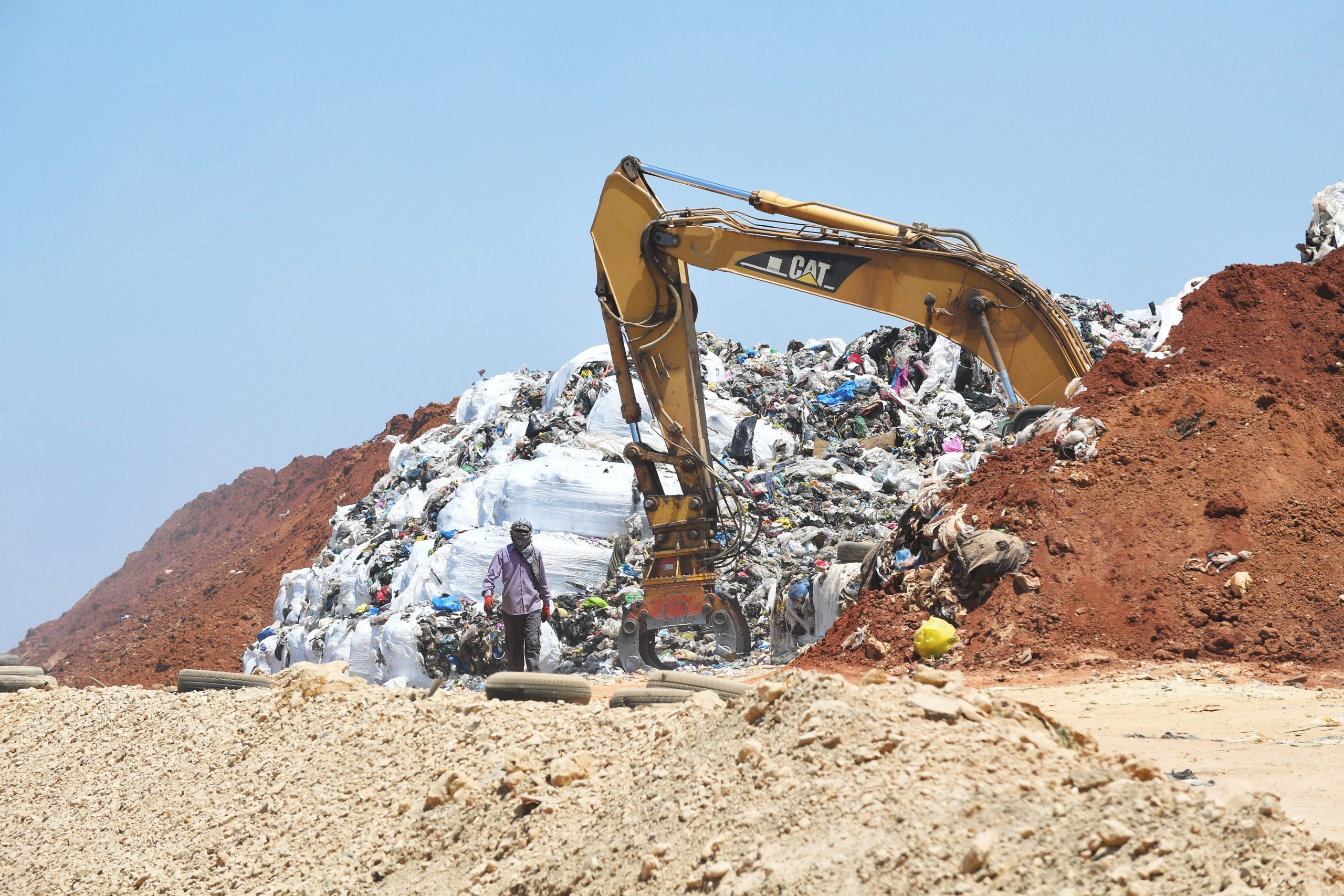
Talking trash, sorry: discussing political solutions for solid waste management, is a parliamentary tradition in the Lebanese Republic. Ten years ago this past summer, the long overdue closure of the overfull Naameh landfill south of Beirut sent Sukleen’s trucks home empty, and within weeks the capital’s streets were lined with rotting garbage. The “You Stink” movement that followed pulled tens of thousands of people onto the streets — at its peak, an estimated 250,000 on a single day in August 2015 — and turned trash into perhaps the most visceral symbol of state failure Lebanon had produced since the civil war.
A decade on, Lebanon is still mired in largely unrecycled trash and also in unresolved waste management debates at both the public square of opinionating and the parliament halls. In the latter, the bone of political contention is the text of a January 2026 law amendment – known as Law 38 of 2026 – and the role of a newly appointed government entity, The National Solid Waste Management Authority (SWMA) headed by Marwan Rizkallah.
Questions pertaining to the waste management debates include who gets to run Lebanon’s waste sector as well as the less overt matter of who profits both financially and politically from keeping it broken. As is true of many dysfunctional sectors in Lebanon, the solutions to the entrenched solid waste problem require as much political will as they do resources, capacity building, and awareness of what best practices might look like for Lebanon.
After zooming in on the trash problem over the past few weeks, Executive editors have concluded that, broadly speaking, the solution seems to hinge on decentralization, depoliticization, transparency and regulation, and a fundamental shift in the Lebanese mindset that moves from viewing garbage as waste and liability to garbage as an economic resource.
Lost in centralization
For most of the post-civil-war period, Lebanon ran waste collection as a tightly centralized affair, split across three separate functions that, from an outsider’s perspective, seemed to lack coordination or communication amongst eachother. The Ministry of Environment set policy and strategy, the Council for Development and Reconstruction (CDR) contracted out collection to a handful of private operators (Sukleen until 2018, then RAMCO and City Blu) and the whole system was bankrolled through the Independent Municipal Fund (IMF) under the Ministry of Finance (MoF).
The MoF-IMF collected funds for solid waste collection, processing, and disposal on behalf of municipalities and redistributed the money without their input, per the government’s own National Integrated Solid Waste Management Strategy documentation as per an Executive Summary of a study conducted in coordination with the World Bank in February 2024. Municipalities themselves, of which Lebanon has 1,065, one of the highest per-capita counts of any country its size, according to Ministry of Interior and Municipalities figures from last year, had essentially no legal say in who collected their waste, what it cost, or where the money went.
Lebanon generates somewhere around 6,500 tons of municipal solid waste a day nationally, per UNDP estimates, though the economic collapse pushed daily volumes down by roughly a quarter between 2018 and 2022, from about 7,300 tons a day to around 5,600, according to a 2024 CDR report. Of that, only a small fraction is recovered. Estimates range from about 8 percent recycled nationally to 15-20 percent once composting and material recovery are folded in. Most of the rest is landfilled or, worse, dumped illegally in Lebanon’s valleys or burned. A 2023 World Bank technical note found that most municipalities were spending more than 75 percent of their entire budgets on waste collection and disposal, pushing some into deficits and dwarfing capacity to provide other services.
Meanwhile, the country’s existing waste infrastructure has consistently underperformed its design capacity. The Karantina sorting facility in Beirut, for instance, was built with a rated capacity of 1,800 tons a day, which is nearly a third of the country’s entire daily waste output concentrated in a single site, and yet it sat effectively non-functional for years after the 2020 port explosion, and is only now approaching a partial reopening, at a reduced 1,250 tons a day, following a Germany- and EU-funded rehabilitation that UNDP expected to wrap up around October 2025. A single facility carrying that much of the national load is a fragility problem subject to Lebanon’s political and financial winds.
This is one core argument for decentralization, and it found legislative traction on January 5, 2026, when Parliament passed Law No. 38, amending Article 28 of the original 2018 waste law to let municipalities collect service fees directly from households and businesses and contract collection companies on their own terms. Municipalities can now also outsource fee collection itself, not just physical collection, meaning even under-resourced councils have a practical path to implementation without building expertise from scratch.
Skeptics note that many of Lebanon’s municipalities are barely functioning institutions at all. As per information from election monitors at the most recent municipal polls, at least 134 of the country’s 1,065 were formally dissolved ahead of its first municipal elections in nearly a decade, finally held in May 2025, and many more were described as de-facto inactive due to political disputes or lack of funds. In order for the new waste law’s municipal responsibilities to work, skeptics, including this magazine, contend that the central government would urgently need to provide support in the form of capacity building to convert refuse to resource, regulation to prevent increased use of illegal dumps and promote transparency as a starting point.
Depoliticization: a sector built for capture
If decentralization addresses who runs the system, depoliticization appears as the key for addressing the thorny question of why it keeps failing regardless of who’s nominally in charge. The story of the Naameh landfill, opened in 1997 as a “temporary” solution meant to hold roughly 2 million tons, and closed in 2015 after having taken in some 15 million tons, is an illustrative example. Political actors spent nearly two decades unable to agree on an alternative site in large part because every landfill decision in Lebanon carries sectarian and territorial weight.
The financing structure has compounded that problem. Routing sector funding through the Independent Municipal Fund and the general treasury rather than through fees tied transparently to actual service cost meant the money moving through the sector was difficult to trace to a specific outcome and remained opaque to the municipalities. That kind of centrally gate-kept resource is easily politicized, which is a large part of why reform efforts stalled for years even after Law 80 was first passed in 2018 establishing the legal framework for integrated solid waste management.
Depoliticizing the sector is a means of means confining the central government to the roles it can, hopefully, legitimately play, such as setting and regulating binding technical standards, monitoring compliance, enforcing penalties, and then moving implementation and financing to the municipal level, where the incentive to deliver a functioning service is strongest, because voters and business owners can see the results directly and locally.
Separating the roles
The sector’s institutional structure has, at least nominally, kept the functions of the Ministry of Environment, the CDR, and the IMF under the MoF separated. In practice, none of the three answered meaningfully to municipalities or to the public, and Lebanon’s National Integrated Solid Waste Management Strategy itself acknowledges that the sector has lacked a dedicated regulatory body, which is one reason the strategy calls for establishing a National Solid Waste Management Authority (SWMA) as a central oversight function.
That authority’s board and director were appointed alongside the government’s approval of its updated national strategy at the turn of 2025 into 2026, and government documentation describes the SWMA’s intended role in explicitly regulatory terms. What isn’t yet publicly documented is how the authority’s financing, contracting and regulatory functions will actually be divided and implemented in practice, or what its operating budget will be. Whether the SWMA’s mandate will match that stated design when and if it becomes fully operational remains to be seen.
Migrating trash from refuse to resource
The capstone of any sustainable solid waste management solution, and arguably the piece of trash reasoning with the most potential to change public sentiment, is the one that seems to be the least discussed. Recent debates have focused mainly on how to fund the treatment of recoverable waste; specifically, who should pay, and how much. This particular debate – which Executive editors perceive as convoluted, politicized, and overall not productive – misses the point that Lebanon’s waste is an untapped resource.
A September 2022 Q&A conducted by entreneurial ecosystem Berytech with longtime waste-management expert Samar Khalil put the country’s potential recycling-sector turnover at somewhere between $65 million and $272 million a year while estimating that Lebanon currently loses roughly $64 million a year in unrecovered e-waste material alone, plus further losses in unrecovered paper and organic-waste value, largely because so little of the waste stream is sorted at the source. The same analysis put the job-creation potential of a properly functioning recycling sector at somewhere between 1,900 and 2,500 new positions over roughly nine years.
One timely example where utilizing this potential is a matter of urgency—though one still complicated by Israel’s ongoing bombardment—is in the area of rubble. Lebanon generates roughly 1.65 million tons of construction and demolition waste a year, with 40-45 percent of it concentrated in Beirut and Mount Lebanon alone while only ten percent is recycled, according to a policy brief published by the American University of Beirut (AUB)’s Nature Conservation Center in August 2025. The brief models a phased national recycling program reaching an 80 percent recovery rate by 2036, and projects that a properly regulated rubble-recycling industry that turns debris back into aggregate, reclaimed asphalt and recovered metals could amount to a $20-25 million annual market. Most importantly, it directly reduces the need to quarry raw material from Lebanon’s mountains.
A second example is Lebanon’s iron and steel exports, which alone were worth $120.3 million in 2024, according to UN Comtrade trade data, out of total national exports of $4.29 billion that year. That revenue stream built substantially on scrap and recovered material could plausibly grow with better domestic sorting and collection, though comtrade classifications don’t allow a precise breakdown of how much of that $120.3 million specifically originated as recovered scrap versus other iron and steel products.
The last decade has seen many valiant attempts to instill a comprehensive local culture of recycling, with varying rates of success. Ventures like Recycle Lebanon, founded in 2015, and its EcoSouk retail arm, which describes itself as the first zero-waste shop in the Middle East, have spent a decade attempting to make circular, locally sourced alternatives to imported, disposable goods work commercially in the Lebanese environment. What these types of ventures need is greater market access in the form of public procurement rules that prioritize recycled or reused domestic material and predictable supply. Municipalities could provide that supply in a decentralized sorting and management scenario.
Trash talk need not be far from trash action
None of these proposed solutions necessarily require reinvention of the entire waste management sector. Lebanon already has more waste-treatment infrastructure than it currently uses, and as of January 2026, it has a legal pathway for municipalities to finance and contract collection directly. It has its own national strategy calling for a decentralized, transparently regulated, cost-recovery-based model. What’s urgently needed from this moment onwards is for the sector, and the National Solid Waste Management Authority in particular, to operate effectively and accountably as regulator, monitor, and enforcer.
Over ten years after the 2015 garbage crisis, the sector is still, for the most part, financing waste management centrally and treating it as a liability, but based on Law 38, it could slowly be moving towards looking at waste management as a local public service that can sell its byproduct back into the economy. Whether it does will depend on whether the SWMA publishes a transparent budget, cost breakdown and contracting rules and whether citizens and anyone outside government will wield their power to keep corruption and our reusable resources far apart.
