
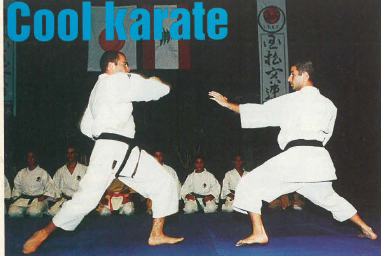
A t the outset karate was a martial art – that is,
-unarmed techniques of self-defense aimed at
killing in combat. It originated on the island of Okinawa,
where the techniques were kept secret until 1922, when
Master Gichin Funakoshi, the founder of modern-day
karate, was invited to give a demonstration in mainland Japan.
Thereafter he developed it into a sport that has amassed a huge
international following. Lebanon is no exception.
Why the enthusiasm? Karate is an exciting sport and its
techniques improve physical skills like coordination, balance
and timing. Additionally, karate embraces philosophies
that govern practitioners’ personal conduct. “Karate is a discipline
– it’s a way of life,” says Fadi Aoun, a third degree
black belt instructor.
Karate practitioners adhere to five basic principles:
seek perfection of character, be faithful,
endeavor, respect others and refrain from violent
behavior. If the last sounds contradictory, Aoun,
a lawyer by profession, explains that the ultimate
aim of karate is to be self-confident. “And whenever
you’ re in control of your mind and body,
you’ re not afraid, so you don’t need to be violent,”
he says. “Violence stems from fear.” If one must
resort to fighting, he should do so with composure.
Karate literally means emptying the hand and soul
of violence and preconceived ideas. Fighting
with a calm mind allows one to discern an opponent’s
psychological and physical moves,
enabling shrewd reactions.
Building a strong character is achieved through
discipline, concentration, self-respect and respect
for others. It is for these reasons that three years ago
Hala Zoghby wanted her
daughter to learn karate. “I
was told that it would help
her concentration span,”
says Zoghby, who started
taking lessons herself.
Today Zoghby is a first
degree black belt and a committee member of I.S.K.F. Lebanon, the local arm of the
International Shotokan Karate Federation. I.S.K.F. Lebanon
offers classes for kids,juniors and seniors. Most clubs let kids
start from as early as four, and no age limit is imposed.
The Korean kick
There are a few legends about the origins of tae kwon do, an ancient Korean martial
art. According to one, when Japan invaded Korea the conquerors severed the arms
of all Korean male newborns, so that in adulthood they couldn’t use swords against the
Japanese. As a result, the Koreans developed a martial art based entirely on kicks. Another
legend has it that the impoverished Koreans, to knock Japanese soldiers off their horses,
would leap high and strike them with powerful kicks.
Like karate, today tae kwon do is a sport, and while it now includes some hand action,
“it’s still mainly leg technique,” says Gaby Abousleiman, a fourth-degree black belt.
Abousleiman is a lawyer by profession and teaches tae kwon do on evenings at The Racquet
Club. He explains that while the differences between the various martial arts are
technique-related, their philosophies are fundamentally the same. “Discipline, concentration,
self-respect, humility, generosity … these principles are taught in all martial
arts. Tae kwon do is a way of life,” says Abousleiman.
Participants learn “forms” – or hand and leg techniques representing imaginary fights.
Sessions also include free fighting, self-defense motions as well as kicking pads and
wooden planks. The latter should break on impact.
Worldwide only 10% of practitioners get into competing at tournaments, according to
Nabil Abou Zaraa, a seventh-degree black belt and international referee. Yet he
becomes animated talking about the competition aspect and the entrance of
tae
kwon do at the Olympic Games this year.
